Category: Outfit Aesthetic

Outfit Aesthetic is all about creating a cohesive, recognizable style that reflects your personality and lifestyle. Instead of focusing on individual pieces, an outfit aesthetic looks at how colors, silhouettes, fabrics, and details work together to form a distinct visual identity. From timeless minimalism and quiet luxury to Parisian chic, Scandinavian simplicity, and modern street style, exploring different aesthetics can help you refine your wardrobe and develop a more intentional approach to fashion.

In this category, you’ll find curated inspiration, styling guides, and outfit ideas that highlight popular fashion aesthetics while remaining practical for everyday wear. Each post focuses on wearable combinations, balanced proportions, and versatile pieces that can easily integrate into a modern wardrobe. Whether you prefer clean neutral outfits, elevated casual looks, or romantic feminine styling, understanding outfit aesthetics makes it easier to build outfits that feel polished and consistent.

Our editorial approach is grounded in real fashion experience, combining insights from fashion retail, styling principles, and long-term wardrobe building. Rather than chasing short-lived trends, we focus on aesthetics that translate into timeless outfits you can adapt across seasons and occasions.

If you’re looking for fresh outfit inspiration, clear styling ideas, and guidance on defining your personal fashion identity, this Outfit Aesthetic category will help you discover styles that feel both authentic and effortlessly stylish.

  • Rain-Ready Hunter Boots Outfit: Country Cozy to City Chic

    Rain-Ready Hunter Boots Outfit: Country Cozy to City Chic

    Hunter boots outfit: country heritage vs city polish (and why both feel “right” in the rain)

    There’s a particular moment familiar to anyone who dresses for real weather: you’re standing by the door, the forecast looks unkind, and your outfit suddenly becomes a negotiation between practicality and identity. That’s where a hunter boots outfit earns its cultural staying power. It’s not just a functional choice—it signals a styling philosophy, and there are two distinct aesthetics that tend to orbit around it.

    The first is classic country heritage: grounded, outdoorsy, and slightly utilitarian, as if you could step from a muddy path into a warm kitchen without changing a thing. The second is city polish: pared-back, intentional, and composed—rainwear reframed as a sleek, modern uniform. These two approaches are often discussed together because they share the same hero piece—hunter boots—but they read very differently once you pay attention to proportion, texture, and finish.

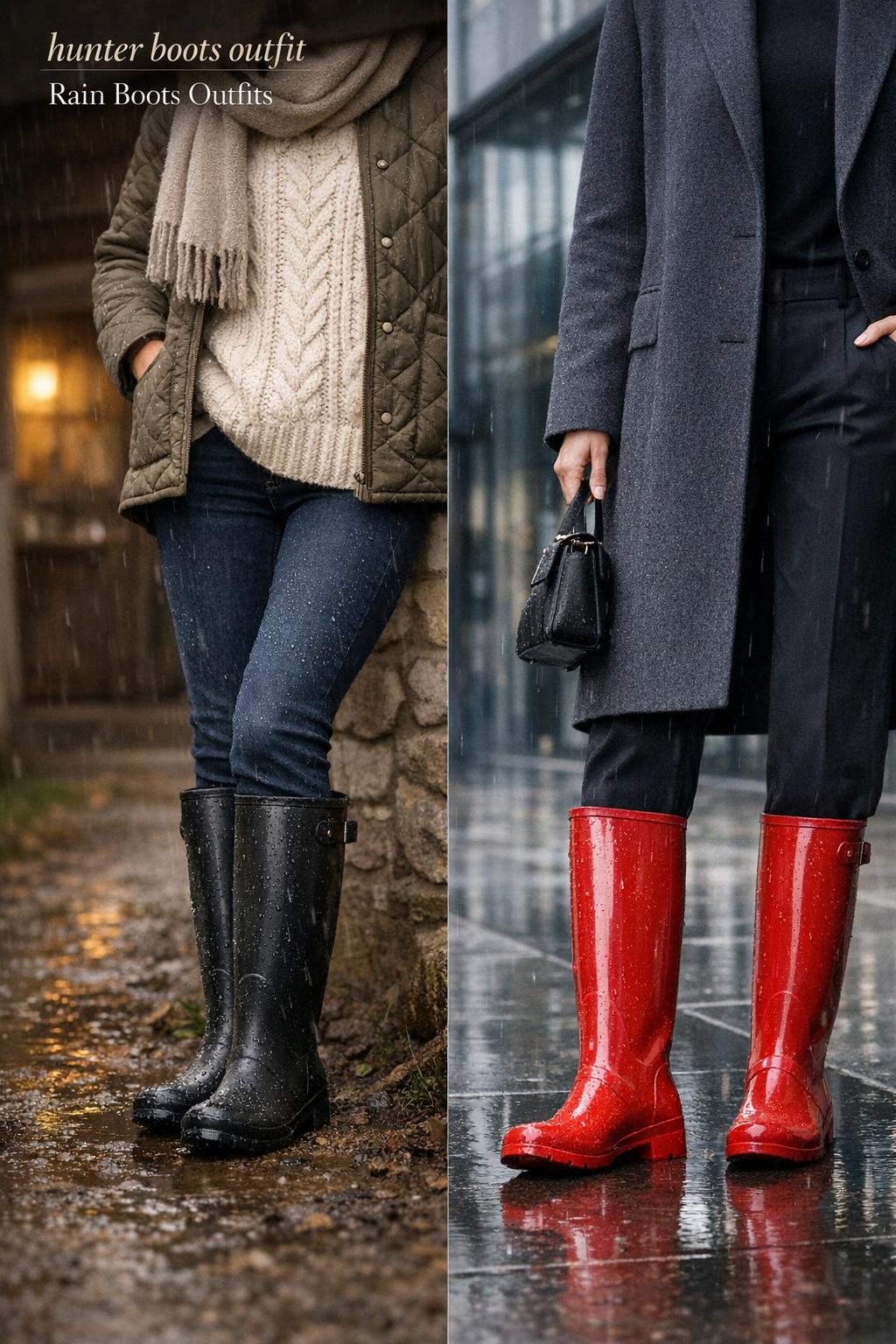
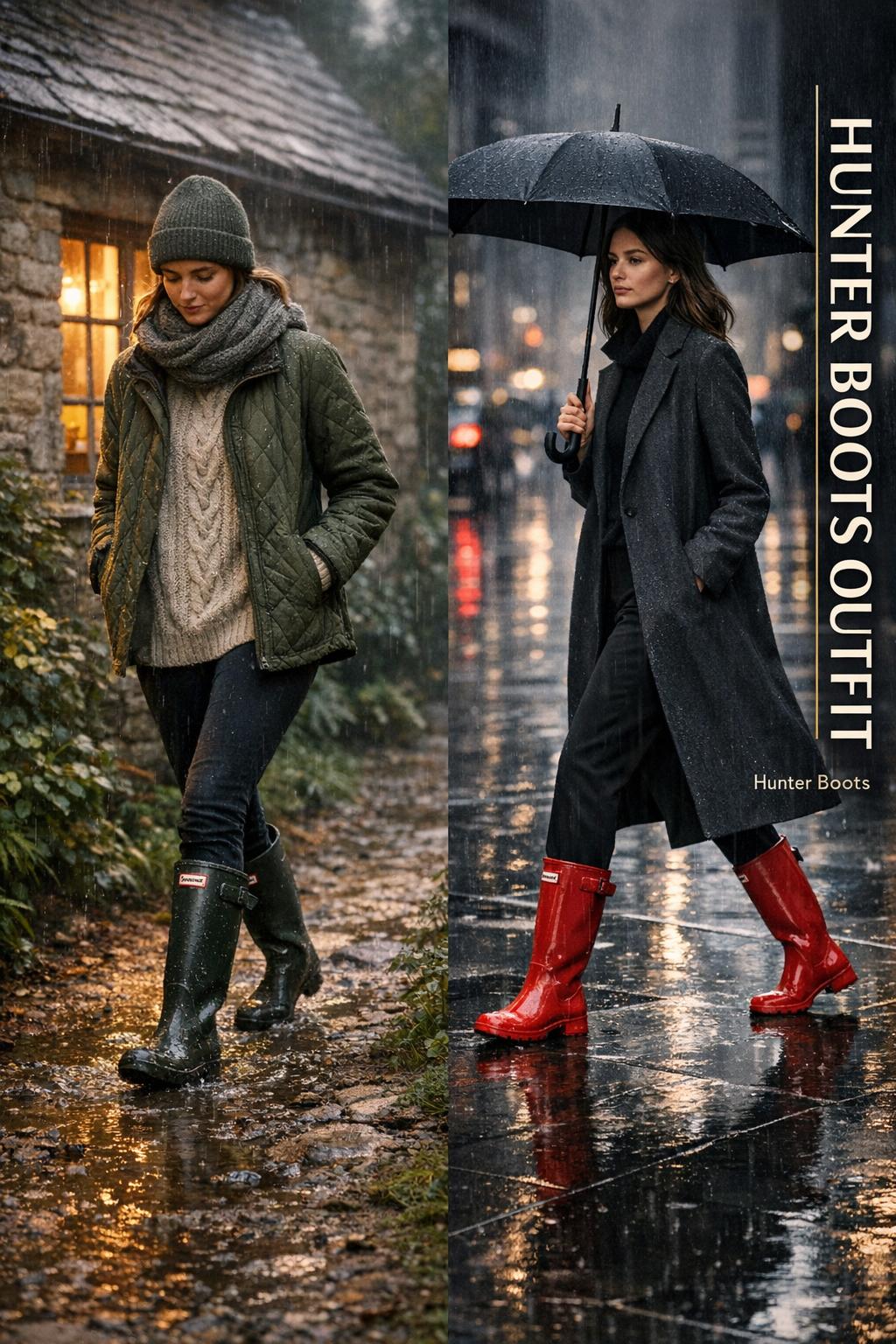
    Hunter boots outfit rainy day style guide with country and city looks in one editorial photo, wet textures and reflections.
    A minimalist rainy-day editorial split scene highlights Hunter rain boots styled for cozy country heritage and sleek city polish.

    Below, you’ll learn how to distinguish the heritage look from the polished urban take, how to build rain boots outfits that feel coherent (not costume-like), and how details like outerwear structure, color temperature, and accessory restraint determine whether your outfit with hunter boots looks “weekend practical” or “weekday editorial.”

    Style overview: country heritage rain dressing

    Country heritage styling is the most instinctive place hunter boots land: it prioritizes durability and ease, and it embraces the idea that clothes should tolerate weather without becoming precious. The defining characteristic is a relaxed, functional silhouette—pieces that layer comfortably, move easily, and look natural against the matte, rubber finish of hunter boots.

    Silhouettes skew practical: straight or slim jeans tucked into boots, leggings with longer tops, quilted or utility outerwear, and knit layers that feel substantial rather than delicate. Color palettes tend to be earthy and grounded—think muted neutrals and deeper shades that don’t look out of place against wet sidewalks or muddy paths. Textures are tactile and honest: knits, waxed-looking finishes, and fabrics that appear hard-wearing. The mood is warm, approachable, and quietly prepared.

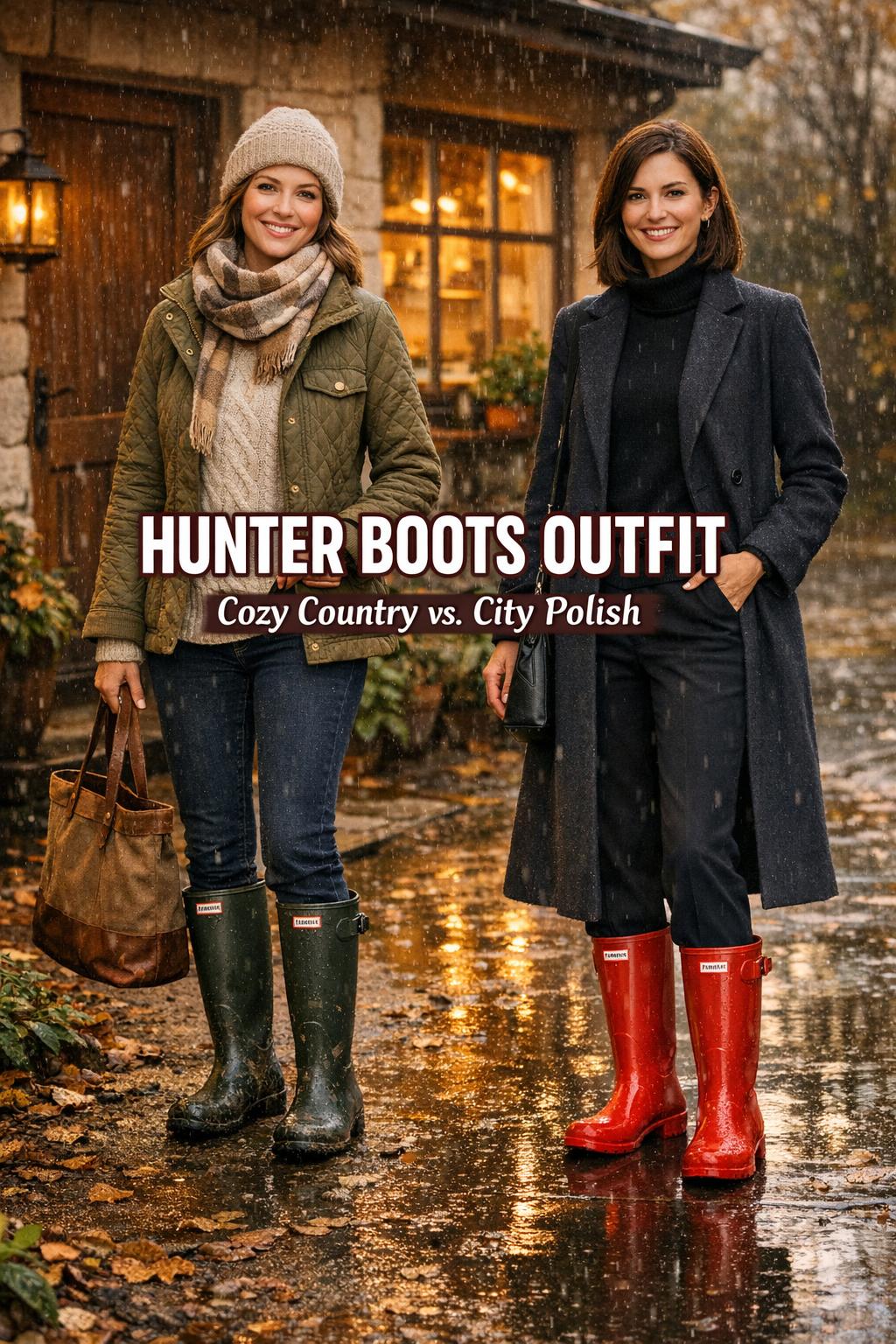
    Hunter boots outfit comparison in rainy autumn, cozy country look beside city polish with warm café glow
    Two women model a hunter boots outfit in warm rainy autumn light, contrasting cozy country heritage with sleek city polish.

    Style overview: city polish rain uniform

    City polish takes the same boots and reframes them as a deliberate contrast—rubber footwear offset by clean lines, controlled volume, and a more minimal palette. Here, the point isn’t to look “outdoorsy.” The point is to look composed despite the weather, as if rain is simply another lighting condition.

    Silhouettes are more structured: straight-leg trousers cropped to show a clean break above the boot, longline coats that create a column, and streamlined layers that avoid bulk at the knee. Color tends to read cooler or more monochrome, with tonal dressing doing the heavy lifting. Textures are smoother and more intentional—outerwear with shape, knits with a refined hand, and accessories that feel edited rather than abundant. The mood is modern, crisp, and quietly directional.

    Hunter boots outfit styled with a classic trench coat and skinny jeans on a rainy city street
    A timeless hunter boots outfit pairs glossy rain boots with a tailored trench and slim denim for wet-weather polish.

    Key differences that change the entire read

    Silhouette: relaxed layering vs controlled proportion

    In the heritage approach, the outfit builds from comfort: a forgiving layer on top, a streamlined base (often tucked into the boot), and an overall shape that feels easy. The city approach is more architectural: it manages volume carefully so the boot feels like part of a clean, intentional line rather than a purely practical add-on. This is why the same boots outfit can look charmingly casual in one context and sharply polished in another—proportion is doing the storytelling.

    Color palette: earthy depth vs tonal restraint

    Heritage dressing tolerates visual warmth and contrast—darker denim against lighter knits, a practical jacket over layered textures. City polish often prefers tonal continuity: blacks, grays, navies, or other closely related shades that make the rubber boot feel like a sleek punctuation mark. Even when you introduce hunter red boots, the styling logic shifts: heritage treats red as cheerful and sporty; city polish treats it as a single statement, then quiets everything else down.

    Formality: pragmatic casual vs refined everyday

    Neither aesthetic is “formal” in the traditional sense—rain boots are inherently casual. But heritage reads as weekend-ready and practical, while city polish can pass for a thoughtful weekday look with the right coat shape and a more edited base. The difference isn’t about adding dressy pieces; it’s about removing visual noise and choosing sharper lines.

    Styling philosophy: function-first vs function, then composition

    Country heritage starts with: “Will I be warm and dry?” City polish starts with: “Will I look intentional?” Both value function, but the order matters. In practice, that changes everything from sock choice (invisible vs deliberately cozy) to whether you tuck or crop your trousers, to how much you allow your outfit to look layered.

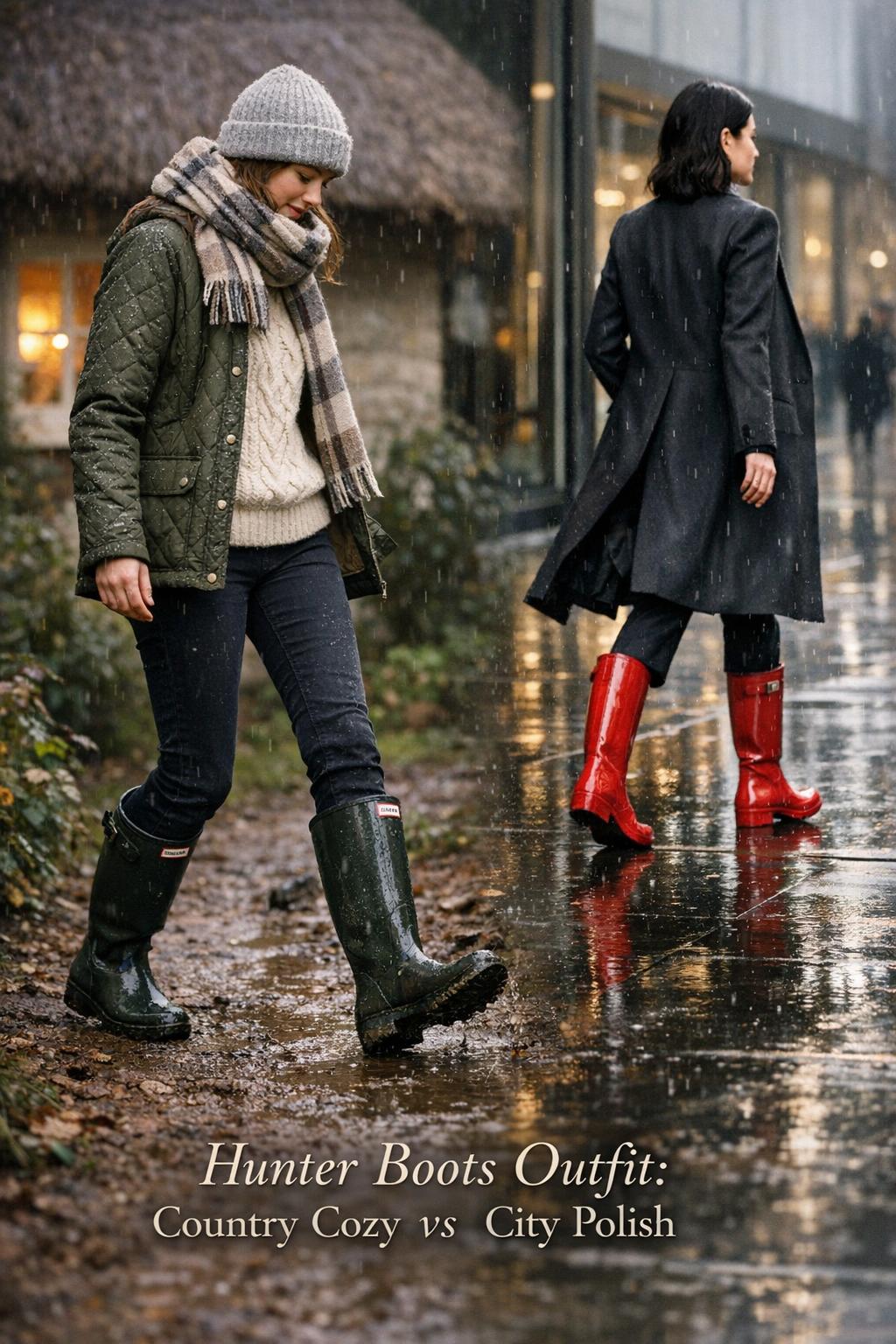
    Hunter boots outfit in rainy setting showing country cozy and city polish looks with tall boots on muddy path and wet sidewalk
    Two rainy-day hunter boots outfit looks—country cozy by the cottage and city polish on a gleaming sidewalk—share one cinematic frame.

    Visual style breakdown: how each approach looks in real rain boots outfits

    Layering: cozy stacks vs sleek columns

    Heritage layering is openly practical: a knit, a vest-like warmth layer, then a weather-ready outer layer. You’ll see multiple textures at once, and that’s part of the charm. City polish is more about creating a single, long line—one excellent coat over a simpler base, with fewer competing textures. The result is a cleaner silhouette that photographs well and feels less “busy” in motion.

    Proportions: the knee is the battleground

    With tall rain boots, the knee area becomes a focal point—especially with hunter boots. Heritage styling typically commits to a tuck: slim denim or leggings disappear into the boot, leaving the top half to do the visual work. City polish often avoids the full tuck unless the rest of the outfit is extremely clean; instead it uses cropped hems, straight legs, or a deliberate break that keeps the outfit looking tailored rather than sporty.

    Accessories: practical abundance vs editorial restraint

    Heritage outfits welcome the extras: a warm scarf, a cozy hat, a carryall that looks ready for a long day. City polish edits accessories down to a few purposeful pieces—often choosing one hero element (a sharp coat shape, a clean bag line, or a single color story) and letting the boots function quietly. The effect is not “less effort,” but rather effort concentrated in fewer decisions.

    Footwear emphasis: blending in vs making a statement

    In heritage dressing, hunter boots tend to blend into the utility narrative: they are part of the uniform. In city polish, they can become a deliberate contrast—especially in a monochrome outfit where the boot’s sheen and structure stand out. This is where hunter red boots become particularly interesting: the same red that reads playful outdoors can read graphic and modern when the rest of the look is restrained.

    Comparison in practice: the same scenarios, two different outfit logics

    Scenario: an everyday errand run in steady rain

    The heritage interpretation begins with comfort: a soft knit, a longer outer layer that can handle drizzle, and slim bottoms tucked into hunter boots so you never think about puddles. The city interpretation starts with a clean base—straight-leg pants or a streamlined leg—and a structured coat that holds its shape even when the weather doesn’t cooperate. Both are practical; one looks cozy and lived-in, the other looks deliberately composed.

    Scenario: commuting and arriving somewhere heated

    Heritage styling often assumes you’ll stay layered: the outfit remains warm once you’re inside, sometimes at the expense of feeling a touch heavy. City polish thinks about the “arrival moment.” It uses fewer, better layers—so you can remove a coat and still look finished. This is one of the clearest places you’ll feel the difference between rain boots outfits that are built for being outdoors all day and those designed for moving between weather and interiors.

    Scenario: weekend trip with unpredictable sidewalks and park paths

    Heritage is naturally at home here: it welcomes texture, casual layering, and a little ruggedness. A city-polished approach can work, but it needs careful fabric choices—pieces that won’t look overly precious once you’re navigating wet benches, damp grass edges, and the kind of terrain that makes you grateful you chose hunter boots in the first place. The styling distinction becomes less about “dressy vs casual” and more about whether the outfit is willing to show its practicality.

    Where hunter red boots fit: sporty heritage or graphic city accent

    Hunter red boots are often treated as a novelty, but they’re actually a useful style tool because they force clarity. Red demands a decision: do you want the boots to harmonize with the outfit’s warmth, or do you want them to act as a crisp, graphic interruption?

    In the heritage lane, red feels classic and cheerful—an outdoorsy pop against practical layers. In the city lane, red is most convincing when everything else calms down: clean lines, minimal competing colors, and an outfit that looks intentional even when the weather is not. The trade-off is simple: a louder boot can make your look memorable, but it can also reduce versatility if the rest of your wardrobe is already high-contrast. If you’re building a repeatable outfit with hunter boots, consider whether you want your statement to come from color or from silhouette.

    Tips: how to make a hunter boots outfit look intentional (not accidental)

    The quickest way to lose the plot with rain boots is to treat them as an afterthought—pulled on at the last second with an outfit designed for different shoes. Hunter boots have visual weight and a distinct finish; they ask the rest of your outfit to meet them with either cohesion or conscious contrast.

    • Decide your silhouette first. If you’re tucking into tall boots, keep the top half relaxed but not shapeless; if you’re going for a city line, keep the leg clean and manage volume with a structured coat.
    • Keep the knee area clean. Bunched fabric at the shaft looks fussy. Choose hems and fits that either tuck smoothly or break intentionally above the boot.
    • Use texture strategically. Rubber reads sleek; pairing it with overly delicate fabrics can feel mismatched. Balance it with knits, sturdy cottons, or outerwear that has body.
    • Let one element lead. If the boots are the bold piece (especially hunter red boots), quiet the rest. If the coat is the hero, keep the boots classic and understated.

    A small but meaningful real-life consideration: rain often means walking faster, stepping wider, and navigating slick surfaces. An outfit that looks beautiful standing still can become irritating in motion if the hem catches or the layers shift. Before you commit to a boots outfit for a long day, take a minute to move around—sit, climb stairs, and check that your trousers don’t ride up in a way that leaves you constantly adjusting.

    Common styling mistakes that make rain boots outfits feel heavy

    Too much bulk at once

    Hunter boots already add structure and volume from the calf down. If you add an oversized coat, a thick scarf, and a bulky knit all at once, the outfit can skew visually dense. Heritage style can handle warmth, but it still benefits from one streamlined area—usually the leg. City polish is even less forgiving: it wants one strong shape, not competing puffiness.

    Unclear hem strategy

    Half-tucked hems and fabric bunching around the shaft are what make an outfit with hunter boots feel accidental. Commit to a clean tuck with slim pieces, or commit to a cropped/straight line that sits above the boot. The “in-between” is what reads messy.

    Competing statements

    If you’re wearing hunter red boots, keep your palette focused. If your coat is bold in shape, keep the rest calm. The most elegant rain boots outfits usually have one statement—color, silhouette, or texture—and everything else supports it.

    When to choose heritage vs city polish (and how to blend them)

    Choose country heritage when the day is outdoors-forward

    If you’ll be outside for long stretches—walking, standing, moving between damp environments—heritage styling shines because it’s built around comfort and tolerance. It also suits weekends and casual plans where a relaxed mood feels appropriate. The limitation is that it can feel too casual for certain workplaces or meetings, especially if the layers become overly cozy.

    Choose city polish when you need a composed “arrival”

    If your day involves commuting, meetings, or simply wanting to look sharp despite the rain, the polished approach is more reliable. It photographs well, reads intentional, and transitions better once you’re indoors. The limitation is that it can feel slightly rigid if your day turns more active than expected—sleek lines are wonderful, but they don’t always love muddy spontaneity.

    Blend the two for the most wearable boots outfit

    The most modern hunter boots outfit often lives between the extremes: a heritage-leaning base (comfortable layers, weather readiness) with a city-minded edit (cleaner palette, fewer competing textures). A useful guideline is to borrow one element from each: take heritage practicality in fabric and layering, then apply city restraint in color and proportion. The result feels lived-in but not sloppy—prepared but still refined.

    Context matters: styling hunter boots for U.S. weather realities

    Rain dressing in the U.S. is rarely consistent—one day calls for puddle-proof footwear, the next feels like a damp chill, and another brings sudden warmth that makes heavy layers impractical. That variability is exactly why hunter boots remain a staple: they offer a stable foundation when the rest of the outfit must adapt.

    In cooler rain, the heritage approach feels natural because layering adds comfort. In warmer rain, city polish becomes especially useful: fewer layers, cleaner lines, and a base that doesn’t feel too insulated. If you’re building repeatable rain boots outfits, consider your local pattern—do you need warmth, or do you need breathability paired with protection? Let that answer determine whether you lean into cozy texture or streamlined structure.

    The subtle art of repetition: building a small rotation of outfits with hunter boots

    There’s a reason certain boots outfit formulas endure: they are easy to repeat without feeling repetitive. Hunter boots become most valuable when they anchor a small wardrobe logic you can return to whenever weather disrupts your plans.

    • The heritage formula: slim base + tactile knit + practical outer layer + hunter boots, with optional cozy accessories depending on temperature.
    • The city formula: streamlined base + structured outer layer + minimal accessories + hunter boots, with a tighter palette for a cleaner read.
    • The statement formula (with hunter red boots): quiet, tonal outfit + one intentional accent (the boots) + simple lines to keep the color looking modern.

    The editorial point is not to own more; it’s to decide more clearly. When you know which style lane you’re dressing in, the choices become quicker—and your outfit with hunter boots stops feeling like a compromise and starts feeling like a signature.

    Conclusion: the difference is not the boot—it’s the styling intention

    Country heritage and city polish both make sense with hunter boots because both respect function. The distinction comes down to what you want your outfit to communicate: heritage leans into warmth, texture, and relaxed practicality; city polish leans into line, restraint, and a composed silhouette.

    Once you train your eye on proportion at the knee, palette discipline, and the role of outerwear structure, you can identify each style instantly—and blend them when real life demands both comfort and refinement. The best rain boots outfits are not complicated; they’re simply decisive.

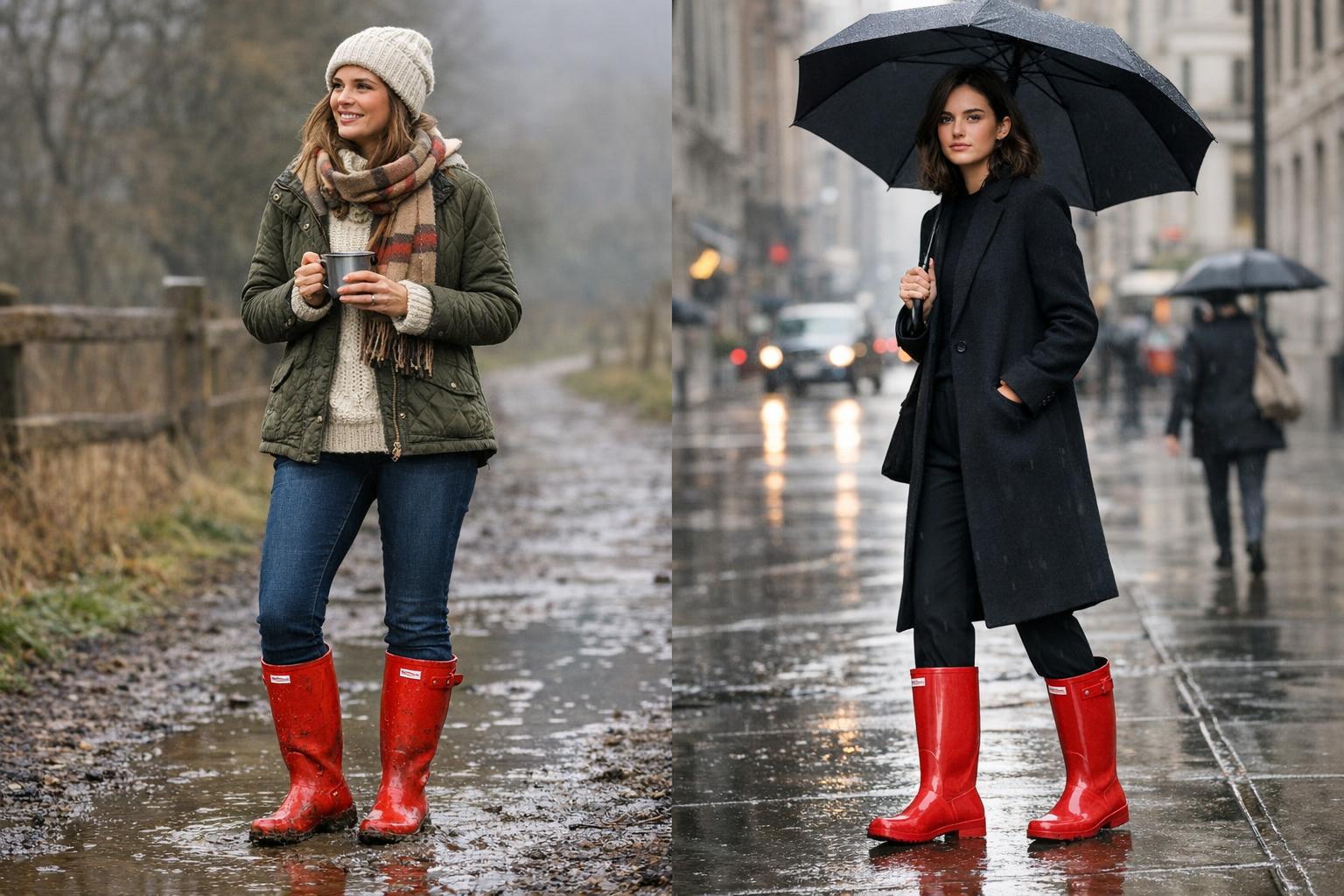
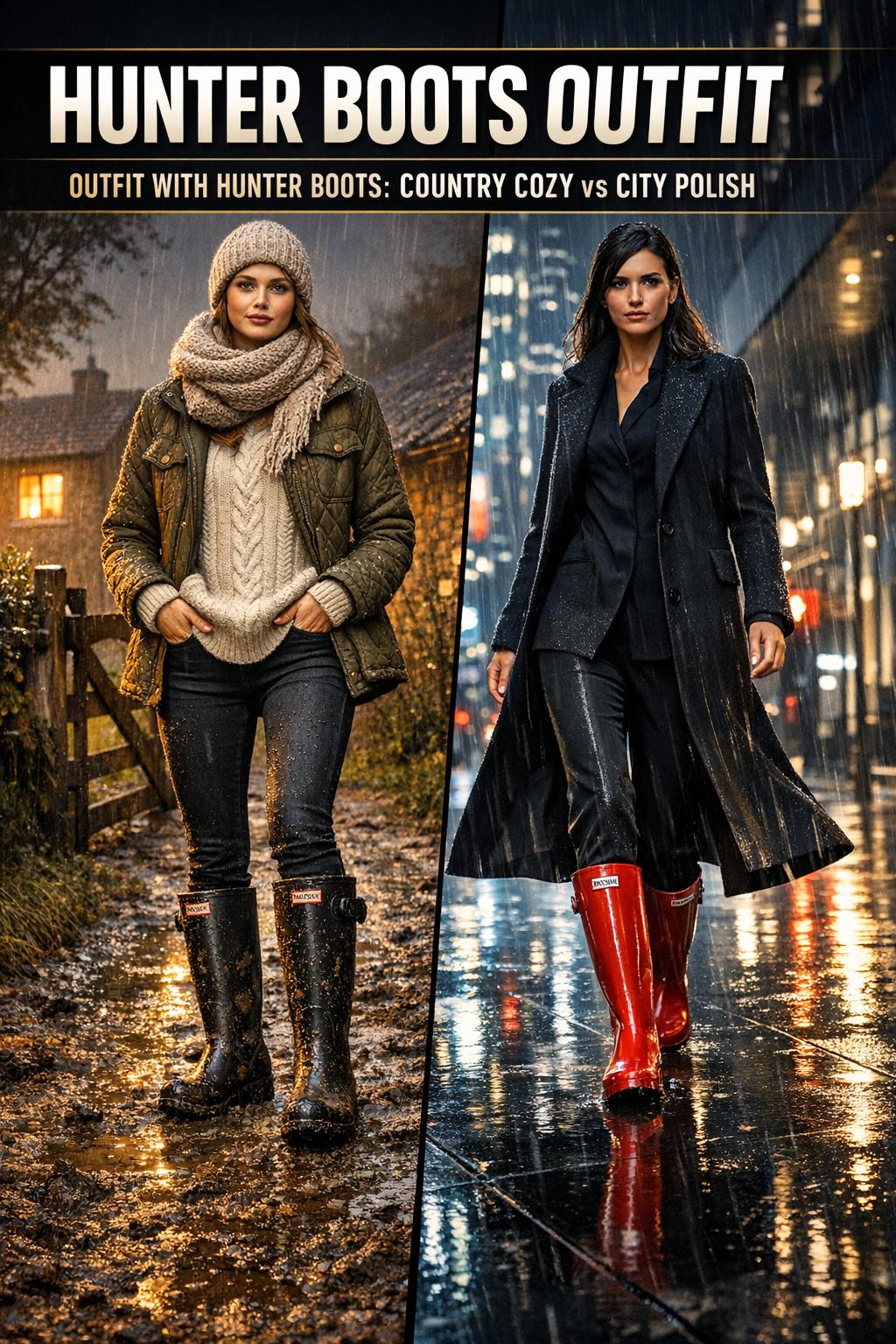
    Hunter boots outfit diptych: cozy cottage look and sleek city style in rain, with red boots accent and umbrella
    A moody rainy-day editorial frames a hunter boots outfit in two looks—cozy country heritage and sleek city polish—with red boots as the bold accent.

    FAQ

    What should I wear with hunter boots for a casual everyday look?

    For a casual hunter boots outfit, keep the base streamlined (so the boot shaft looks clean) and let the top half carry the comfort—think a cozy layer and a practical outer layer that matches the weather, with a palette that feels relaxed rather than overly styled.

    How do I make an outfit with hunter boots look more polished?

    Shift toward city polish by simplifying the color palette, choosing cleaner lines through the leg, and relying on a structured outer layer to create a composed silhouette; the boots should look integrated, not like a last-minute swap for rain.

    Are hunter red boots hard to style?

    They’re easiest to style when you treat them as the single statement in the look—keep the rest of the outfit calm and intentional, with minimal competing colors, so the red reads graphic and modern rather than busy.

    Should jeans go over or inside hunter boots?

    Inside tends to look cleaner with tall rain boots because it avoids bunching at the shaft; if you prefer not to tuck, a more polished approach is to use a straight or cropped hem that breaks intentionally above the boot rather than sitting awkwardly on it.

    How do I avoid looking bulky in rain boots outfits?

    Balance the visual weight of the boots by keeping one area streamlined—often the leg—and limiting competing volume in outerwear and accessories; aim for one strong shape at a time instead of multiple bulky layers.

    Can I wear hunter boots for commuting and workdays?

    Yes, especially if you choose a city-polished styling approach that prioritizes clean proportions and a refined outer layer, so you still look finished when you remove your coat and step into an indoor setting.

    What’s the easiest way to build a repeatable boots outfit for rainy weather?

    Create a simple formula you can repeat—either a heritage formula (streamlined base plus cozy layers) or a city formula (tonal base plus structured outerwear)—and stick to a consistent proportion strategy around the boot shaft.

    How can I tell if my hunter boots outfit looks “heritage” or “city”?

    Heritage looks more textured and layered with an outdoorsy ease, while city looks more tonal and controlled with cleaner lines; the difference usually shows up at the knee (tucked and cozy versus cropped/straight and streamlined) and in how edited the accessories feel.

  • Chic Thigh High Boots Outfit for City Nights and Commutes

    Chic Thigh High Boots Outfit for City Nights and Commutes

    Thigh-high boots outfit dilemmas: how to look intentional, not overwhelmed

    The hardest part of building a thigh high boots outfit isn’t boldness—it’s control. The shaft is dramatic by design, which means a single misstep in proportion, hemline, or outerwear can make the look feel unbalanced, overly “costume,” or simply impractical for real life. Most people aren’t dressing for a flashbulb-lit moment; they’re trying to get through a chilly commute, a long dinner, or a day that turns from errands into evening plans.

    Yet thigh-highs keep returning because they solve a real wardrobe problem: they add warmth, lengthen the leg line when styled with intention, and instantly polish even simple pieces. You see the proof in how consistently they show up across settings—from Paris Fashion Week runways with houses like Hermès, Chloé, and Balenciaga, to New York City appearances and red-carpet moments worn by Emma Watson, Rihanna, Jennifer Lopez, Amal Clooney, Kylie Jenner, Tracee Ellis Ross, and Hannah Waddingham.
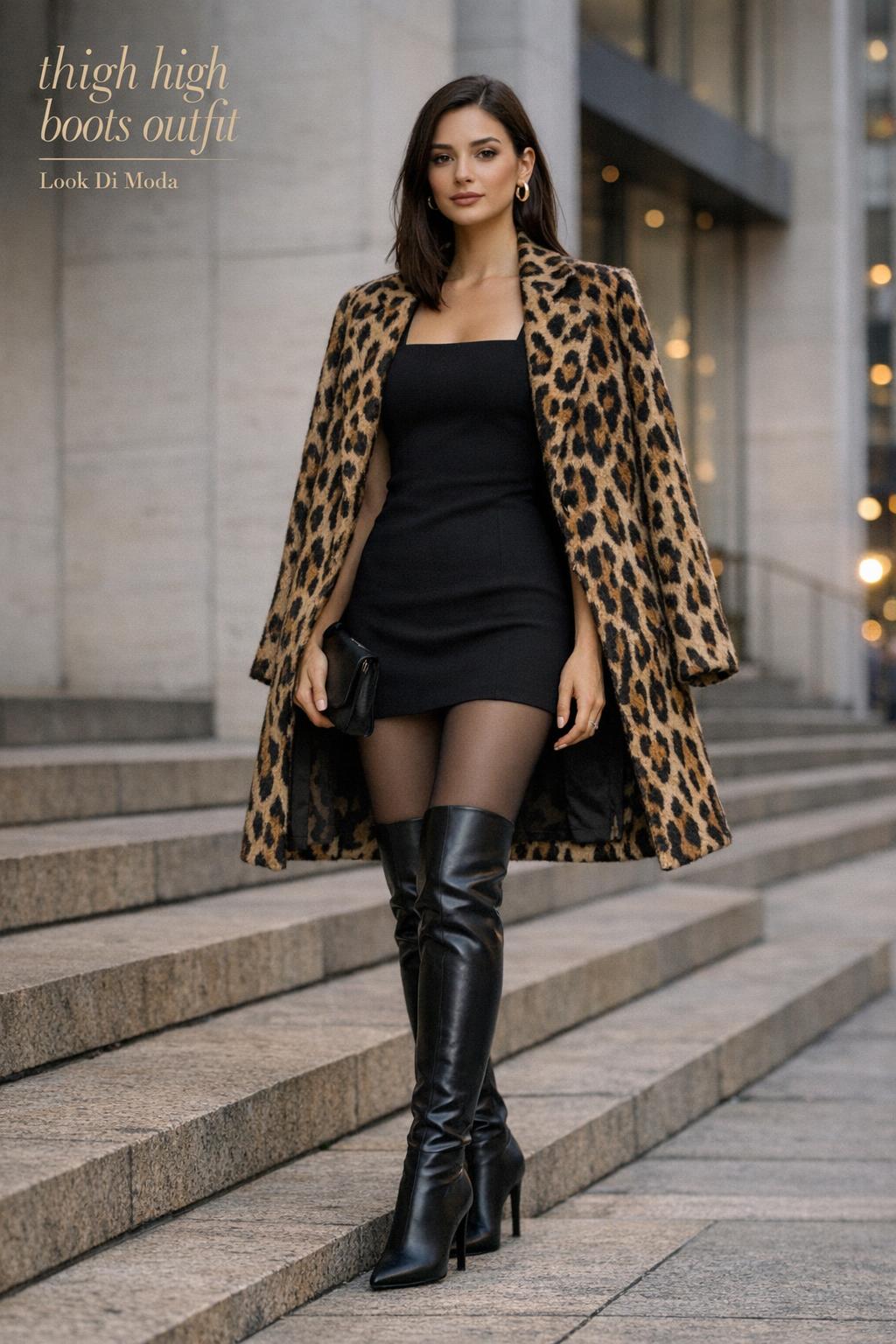
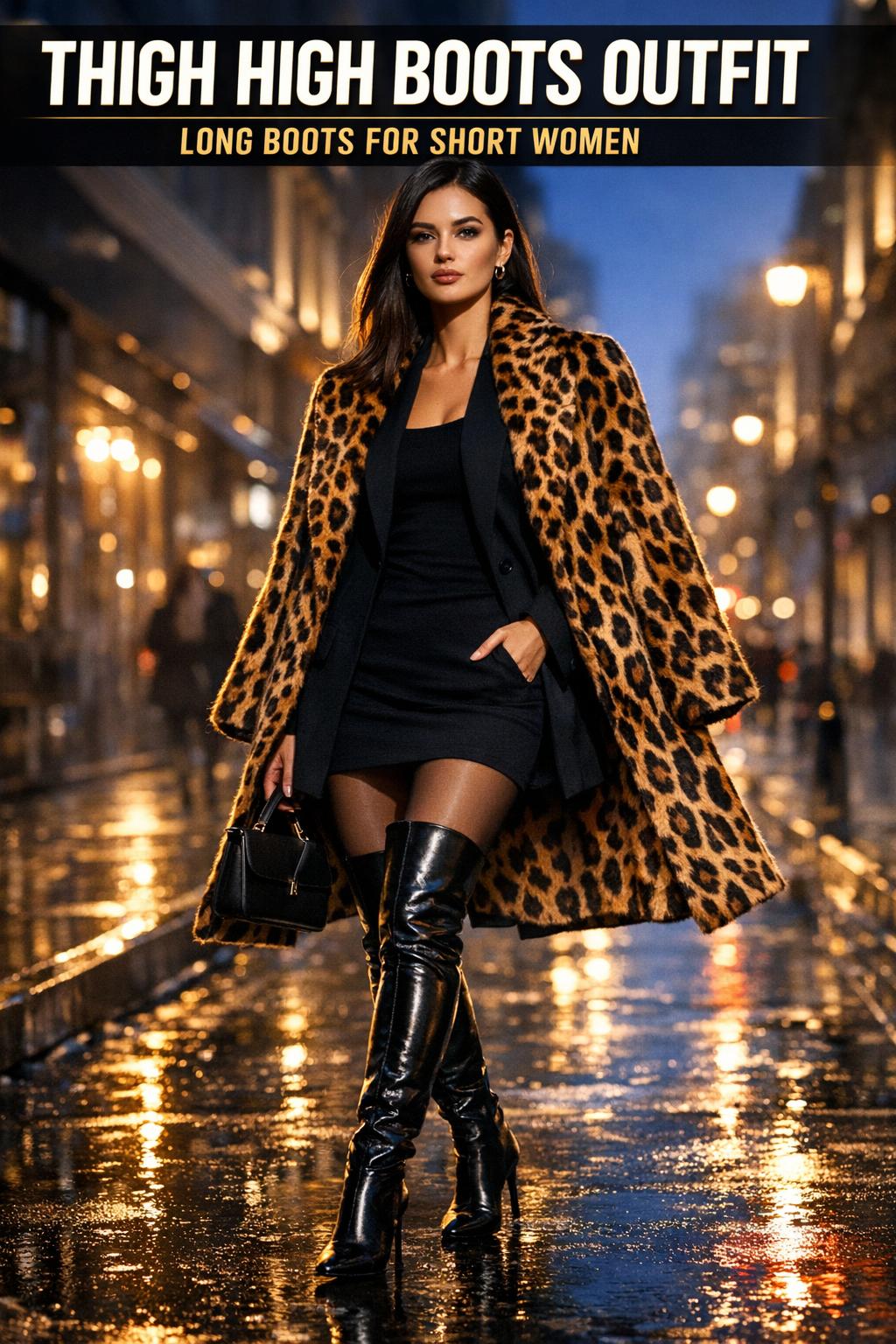
    Thigh high boots outfit in chic city evening style on stone steps, black mini dress and structured coat with elegant text.
    A poised city-evening look pairs sleek thigh-high boots with a black mini dress and structured coat on modern stone steps.

    This guide approaches women thigh high boots the way an editor would: as a silhouette tool. You’ll learn how to balance coverage with ease, how to translate runway and celebrity cues into wearable combinations, and how to adapt the look for climate, comfort, and different body proportions—including the specific challenge many readers search for: long boots for short women.

    Understanding the styling challenge: why thigh-highs feel tricky in real life

    Thigh-high boots (often called over-the-knee boots) visually “take up space” on the body. That’s their allure and their complication. When the boot rises above the knee, it changes how your outfit reads in three immediate ways: the leg line becomes a single, dominant column; hemlines suddenly feel shorter; and outerwear needs to negotiate with the boot instead of simply layering over it.

    Weather and movement add another layer. In fall and winter, thigh-highs can be wonderfully practical—especially in a city like New York, where wind and long walks reward coverage. But if you’re sitting for hours (a Broadway opening night like Amal Clooney’s context, or any long dinner), you need an outfit that doesn’t pinch at the knee, fight the boot shaft, or constantly require readjusting. Comfort isn’t separate from style here; it’s what allows the look to stay polished past the first ten minutes.

    Finally, there’s the “tone” issue. Thigh-highs can lean romantic, sharply modern, or unapologetically bold depending on what they’re paired with: a micro miniskirt (Jennifer Lopez), ripped skinny jeans (Tracee Ellis Ross), a leather date-night ensemble (Rihanna), or even a velvet, goth-leaning red-carpet moment with a Balenciaga gown (Emma Watson). The same boot category, completely different messages.

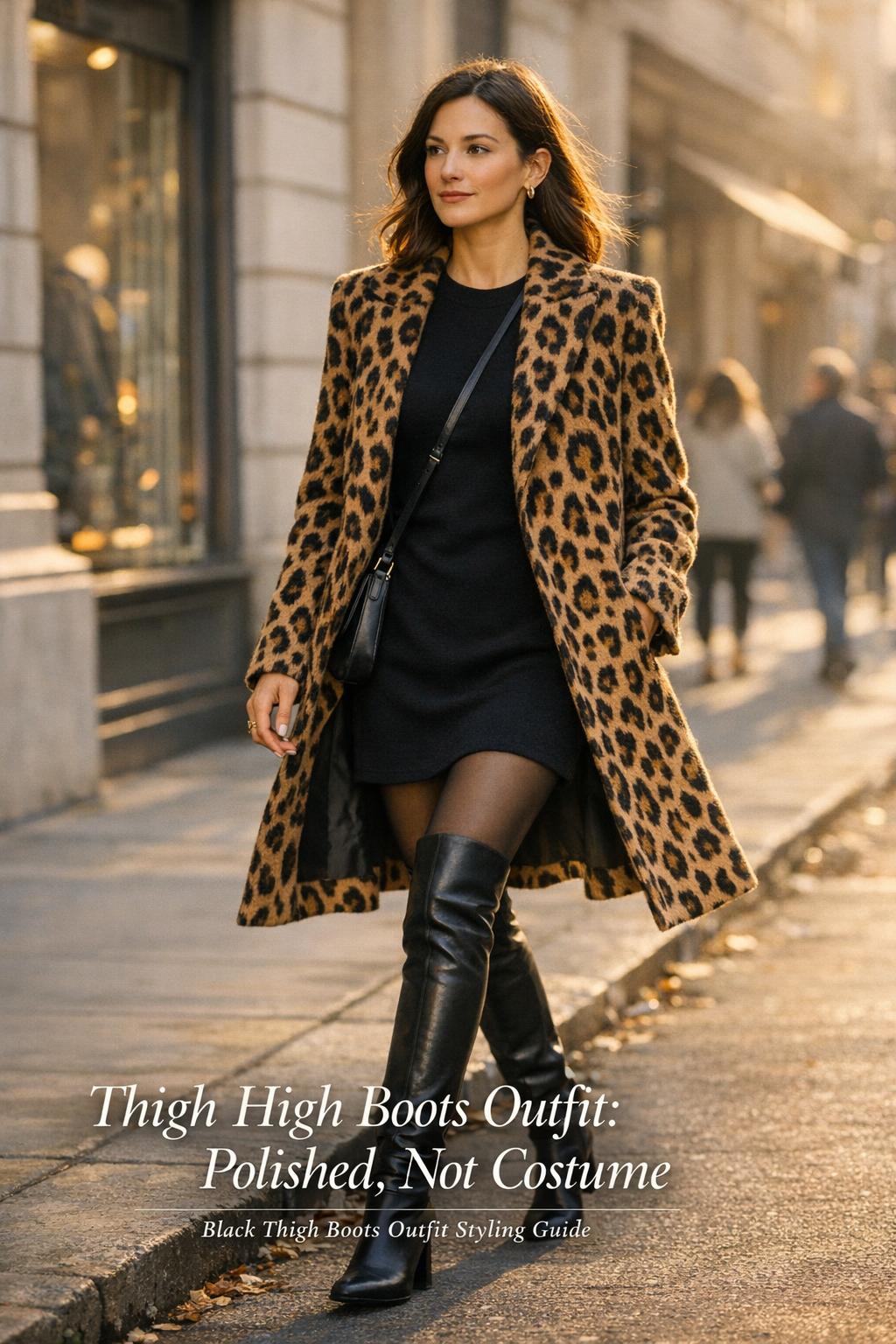
    Thigh high boots outfit with a stylish woman in black dress and coat walking a warm golden-hour city street at dusk
    A polished black-on-black thigh high boots outfit shines in warm golden-hour light on an upscale city street.

    Key dressing principles: a ModePrima method for balancing drama and wearability

    Principle 1: choose your focal point—boot, hemline, or outerwear

    A thigh-high boot is already a headline. If the boot is the focal point, keep the rest of the outfit clean: a refined coat, a simple dress shape, minimal jewelry. If the hemline is the focal point (micro skirt, mini dress), then your outerwear should bring structure and maturity. If the outerwear is the focal point (a leopard-print coat like Amal Clooney’s), the boot can act as a sleek anchor in a quiet color story.

    Principle 2: build a continuous line (especially for a black thigh boots outfit)

    The easiest way to make thigh-highs look expensive and intentional is to create an uninterrupted column. This is why a black thigh boots outfit reads so confident: black boot + black tights (or a dark dress) creates a single line, reducing visual breaks. It’s also why velvet thigh-highs on a red carpet can feel so architectural—texture becomes the interest, not contrast.

    Principle 3: use texture to soften the “too much” feeling

    When the silhouette is high-impact, texture becomes your best editor. Leather long boots feel sharp and city-ready; velvet feels evening-coded; a sleek finish reads modern on the street and formal under lights. If you’re borrowing the boldness of Kylie Jenner’s fishnet catsuit pairing, texture must be controlled elsewhere so the look doesn’t become visually noisy. Conversely, if you’re working with ripped denim like Tracee Ellis Ross, a smooth boot brings back polish.

    Principle 4: decide how much thigh to show—then commit

    The awkward zone is indecision: a hem that hovers too close to the boot top can look accidental. Either let the boot meet the hem cleanly (a mini skirt with a confident gap), or cover more with a longer knit dress, coat, or skirt. On runways at Paris Fashion Week, the message is clear: the boot is meant to be seen. In everyday life, the most flattering approach is simply being deliberate about exposure.

    Runway to real life: what Paris Fashion Week gets right about thigh-highs

    Paris Fashion Week Fall 2026 reinforced a familiar truth: thigh-high boots are not a niche item; they’re a seasonal styling device. When labels like Hermès, Chloé, and Balenciaga put tall boots into their show narratives, the takeaway isn’t “copy this exact look.” It’s that the boot can function as a foundation piece—almost like a second skin—supporting coats, sharp tailoring, and statement proportions.

    In practice, you can translate runway logic into three wearable moves: keep the palette disciplined, let the boot streamline the lower half, and use outerwear to set the tone. This is where Look Di Moda becomes a useful mindset: not a single aesthetic, but the habit of composing an outfit with restraint, so the most dramatic element reads refined rather than loud.

    • Palette discipline: black, neutrals, or a tight set of tones so the boot doesn’t fight the rest of the outfit.
    • Streamlined lower half: clean hemlines, controlled denim distressing, or a dress that doesn’t bunch at the knee.
    • Outerwear as narrative: a structured coat makes the boots feel “day,” while a sleek dress pushes them “night.”
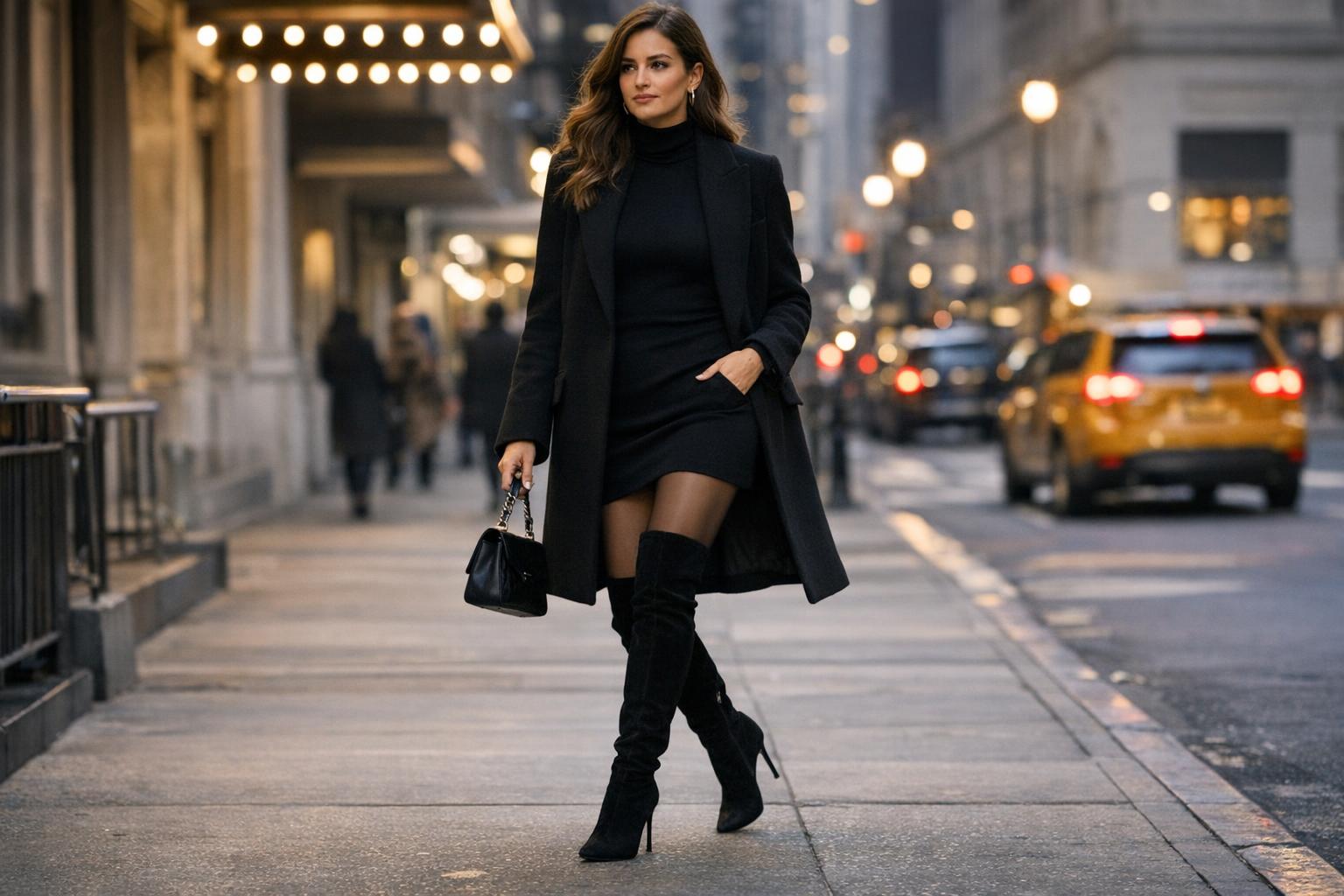
    Street-style thigh high boots outfit with sleek black boots, mini skirt, and long coat in an urban setting
    A polished street-style look pairs sleek thigh high boots with a mini skirt and tailored coat for effortless edge.

    Celebrity case studies you can actually use

    Emma Watson in New York City: velvet thigh-high boots as evening architecture

    Emma Watson’s Little Women NYC premiere look—velvet thigh-high boots with a Balenciaga gown—shows how one material choice can carry an entire outfit. Velvet absorbs light; it reads deep, intentional, almost gothic in mood. The lesson for everyday wear isn’t to replicate a red-carpet gown, but to understand that when boots are richly textured, the rest of the silhouette can be clean and sculptural. Think of velvet or similarly dramatic finishes as your “event-ready” option: minimal fuss elsewhere, maximal impact at the leg.

    Tracee Ellis Ross: ripped skinny jeans with thigh-high boots, made polished

    Tracee Ellis Ross pairing thigh-high boots with ripped skinny jeans is a masterclass in tension: the denim is casual and disrupted, while the boots reintroduce sleekness. This combination works best when the boots are clean-lined and the rest of the outfit stays edited—an easy route for a comfortable city outfit when you want practicality without giving up presence. If you’ve ever worried thigh-highs feel “too dressed up,” denim is the bridge.

    Amal Clooney: leopard-print coat + thigh-high boots for confident glamour

    Amal Clooney’s look—thigh-high boots paired with a leopard-print coat by Giambattista Valli in New York City around a Broadway opening night—captures a very specific styling solution: let a statement coat do the talking, and use the boots to sharpen the outline. Animal print can overwhelm when it’s paired with too many competing details; tall boots in a controlled tone give the print a clean edge and keep the look firmly in “1960s glamour” territory rather than costume.

    Rihanna: leather date-night energy grounded by thigh-high boots

    Rihanna’s thigh-high boots within a leather date-night ensemble (in an awards context alongside ASAP Rocky) is a reminder that leather-on-leather doesn’t have to feel heavy if the silhouette is clean. The solution here is cohesion: leather pieces share a visual language, so the outfit reads like one composed idea. If you’re drawn to leather long boots, take this approach for evening—keep the lines sleek, the accessories minimal, and let the boots elongate the look.

    Jennifer Lopez: thigh-highs with a pleated micro miniskirt

    Jennifer Lopez wearing thigh-high boots with a pleated micro miniskirt sits firmly in night-out territory. The practical takeaway is proportion management: when the skirt is short, the boots do double duty—style and coverage. To keep this wearable beyond a red-carpet moment, the rest of the outfit should carry structure: a tailored jacket, a refined top, or a coat that gives the look authority.

    Kylie Jenner: bold styling that teaches restraint

    Kylie Jenner’s fishnet catsuit with thigh-high boots is bold by design. For most wardrobes, the useful lesson is not the catsuit—it’s the idea of committing to one dramatic element at a time. If you use a high-impact base (fishnet, strong pattern, skin-baring cut), then your boots should be streamlined and your styling should avoid extra competing textures. Boldness works when it’s composed.

    Thigh high boots outfit street style look with black mini dress and tailored coat in a golden hour city scene
    A polished woman strides through a chic golden-hour city street in a sleek black look styled with thigh-high boots and a tailored coat.

    Outfit solutions: wearable formulas that solve common thigh-high boot problems

    Below are editorial outfit solutions designed for real conditions: temperature shifts, walking, sitting, and the constant need to look appropriate from day to evening. Each formula can be adapted to women thigh high boots in different finishes—especially black, which is the most forgiving for first-time styling.

    Outfit solution: the black thigh boots outfit that survives a full day in the city

    Start with black thigh-high boots and keep the lower half continuous: a black dress or a dark, clean base that won’t interrupt the line. Add a structured coat to signal “day,” and keep accessories sharp and compact (a small clutch or a mini bag silhouette works especially well with the streamlined leg). This is the outfit you reach for when the weather is cold and your schedule is long—warmth without bulk, polish without fragility.

    Why it works: the monochrome column makes the boot feel integrated rather than added on. It’s the same logic that makes red-carpet boots read intentional—only translated into everyday restraint.

    Outfit solution: coat-as-hero glamour (the Amal Clooney method)

    Choose one statement coat—animal print if you love the Giambattista Valli-style impact, or simply a coat with presence—and keep everything else quiet: thigh-high boots in a controlled tone, a simple dress or streamlined separates underneath. This formula is ideal for evenings that begin outside (waiting for a car, walking to dinner, entering a theater) where outerwear is part of the outfit, not an afterthought.

    Why it works: the coat creates a frame; the boots create a line. Together, they look intentional even if the layers underneath are minimal.

    Outfit solution: denim tension done right (inspired by Tracee Ellis Ross)

    Pair thigh-high boots with skinny jeans—ripped if that’s your personal style, but keep the rest composed. Add a clean top and a refined outer layer. The boots should read sleek against the denim’s casualness, which is exactly why this works for weekend errands that need a little elevation.

    Why it works: the jeans keep the outfit grounded, while the boots bring sophistication. It’s a smart casual balance that doesn’t feel try-hard.

    Outfit solution: date-night leather continuity (a nod to Rihanna)

    For evening, lean into leather long boots and keep the outfit’s language consistent: a sleek leather element elsewhere, or a clean silhouette that complements the boots’ edge. Keep the lines uninterrupted—no fussy hems that catch on the boot top—and let the boots do the elongating work. This formula is especially strong when you want the confidence of a “going out” look but still need warmth and coverage.

    Why it works: cohesion reads luxurious. The boots don’t shout; they anchor.

    Outfit solution: mini skirt, maximum control (the Jennifer Lopez proportion play)

    When the skirt is micro—pleated or otherwise—treat the top half like architecture. Add a structured layer (a tailored jacket or a coat) to balance the exposed leg line above the boot. Keep the palette tight so the look stays refined rather than chaotic. This is the formula for a party, an event, or any night where you want your boots to read unapologetically fashion-forward.

    Why it works: the structure above counterbalances the short hem, so the boots look elegant rather than extreme.

    Outfit solution: wearable polish with coats and skirts (a Hannah Waddingham approach)

    Hannah Waddingham’s over-the-knee boot styling leans into what most wardrobes actually need: a chic solution that works with coats and skirts. Choose a skirt length that feels stable when you sit and move, then let your coat finish the look. This is especially useful if you’re new to thigh-highs and want a “grown-up” version that still feels modern.

    Why it works: it centers wearability. The boots become a warm, sleek underlayer rather than a statement you have to justify.

    A short, honest section on proportions: long boots for short women

    Long boots for short women can be transformative, but only if the line stays clean. The risk isn’t the boot height—it’s where visual breaks occur. A chopped line at the ankle or a mid-thigh interruption can visually shorten the leg, while a continuous column can do the opposite.

    Use simple strategies that keep the silhouette elongated: choose a boot color that blends with your tights or base layer, avoid hems that collide with the boot top, and keep outerwear proportionate so it doesn’t overwhelm. If you love a black thigh boots outfit, you’re already working with the most forgiving palette for elongation.

    • Keep the leg line continuous with a dark base and minimal contrast.
    • Avoid hemlines that land exactly at the boot top unless the look is clearly intentional.
    • Let your coat create a clean vertical frame instead of a bulky, wide shape.

    Tips that make thigh-highs feel comfortable, not precious

    Comfort issues usually come from friction between the boot and the rest of the outfit: bunching fabric at the knee, a skirt that rides up when you sit, or an outer layer that catches on the boot shaft. The most polished looks—whether on a runway in Paris or on a sidewalk in New York City—have one thing in common: the clothing moves cleanly around the boot.

    Tip: before you leave the house, sit down in your full outfit for a minute. If the hem creeps, the coat pulls, or the boot top digs uncomfortably, adjust the pairing. This small test saves you from spending the entire evening fixing your silhouette instead of enjoying it.

    Tip: choose your “busy” element wisely. If you’re borrowing from Kylie Jenner’s bold styling, keep the rest sleek. If you’re borrowing from Amal Clooney’s statement coat approach, let the boots stay quiet and streamlined. If you’re borrowing from Tracee Ellis Ross and wearing distressed denim, keep the boot finish polished.

    Common mistakes that sabotage a thigh-high boots outfit (and what to do instead)

    Mistake: the accidental gap

    If the hem hits right at the top of the boot and shifts while walking, it can look like a sizing mishap rather than a styling choice. Instead, either create a deliberate gap with a mini hemline or choose more coverage with a longer dress or coat that clearly overlaps the boot.

    Mistake: competing statements

    Thigh-highs plus a loud coat plus a complicated base (rips, fishnet, heavy texture) can overwhelm the eye. Instead, keep one hero piece and let the rest support it—an approach seen across celebrity looks, from Rihanna’s cohesive leather mood to Emma Watson’s texture-led velvet moment.

    Mistake: treating boots as an afterthought

    These boots aren’t a last-minute swap for ankle boots. They change the proportions of your outfit. Instead, build from the boot upward: decide the leg line first (continuous black, denim tension, or mini hem), then choose outerwear and accessories that reinforce the same story.

    Where “look di moda” fits in: making trend energy feel timeless

    Thigh-high boots are often framed as a trend, but they behave more like a styling instrument. The runway confirms their staying power; celebrity wardrobes confirm their versatility. A Look Di Moda approach isn’t about chasing every new iteration—it’s about composing a modern silhouette with restraint: a controlled palette, intentional proportions, and an outfit that reads elegant in motion.

    If you want the confidence of Paris Fashion Week energy without the costume risk, take one cue at a time. Choose the boot as the anchor, then decide whether your mood is coat-led (Amal Clooney), denim-grounded (Tracee Ellis Ross), evening-architectural (Emma Watson), leather-sleek (Rihanna), or mini-skirt bold (Jennifer Lopez). The smartest outfits are the ones that know what they’re trying to say.

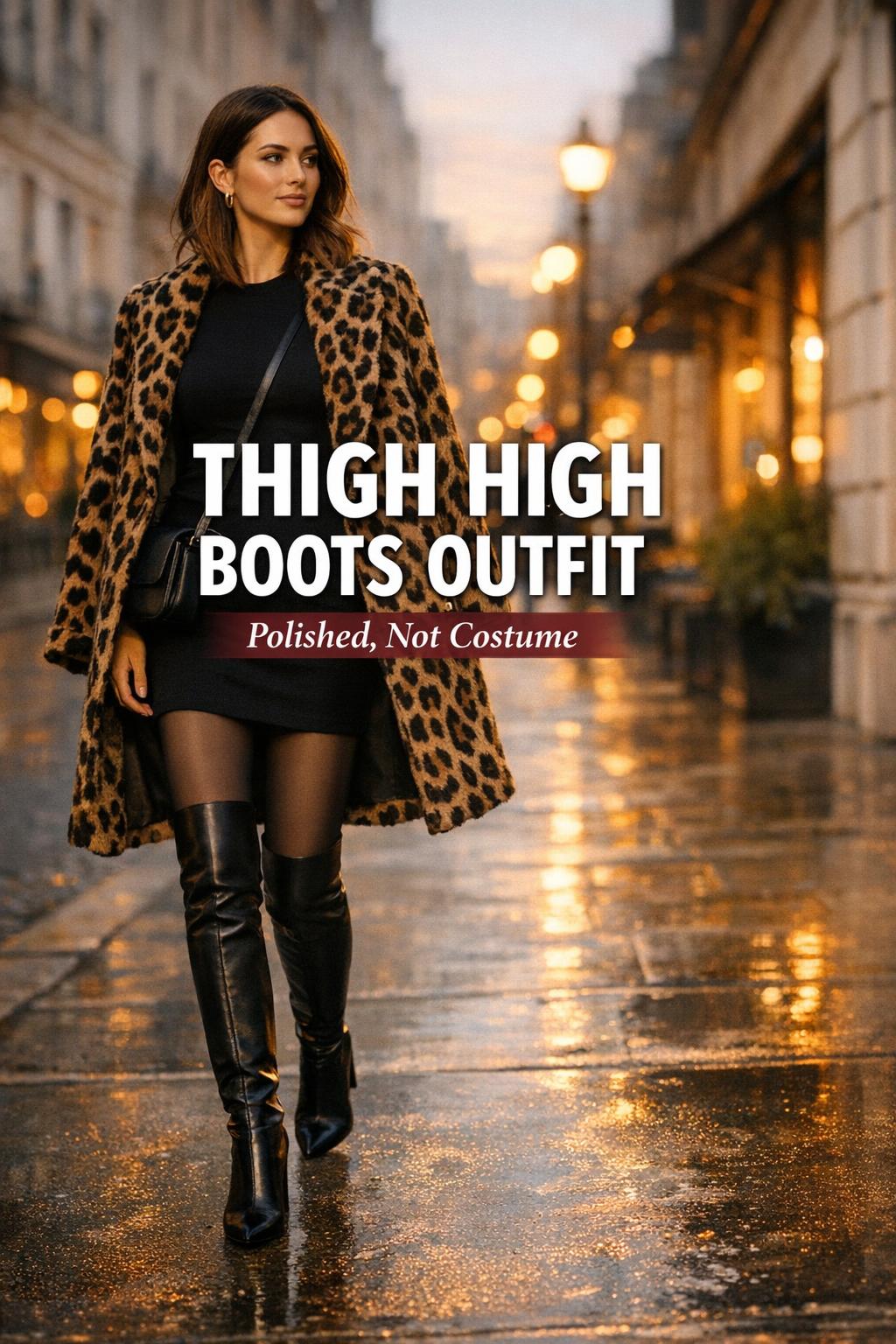
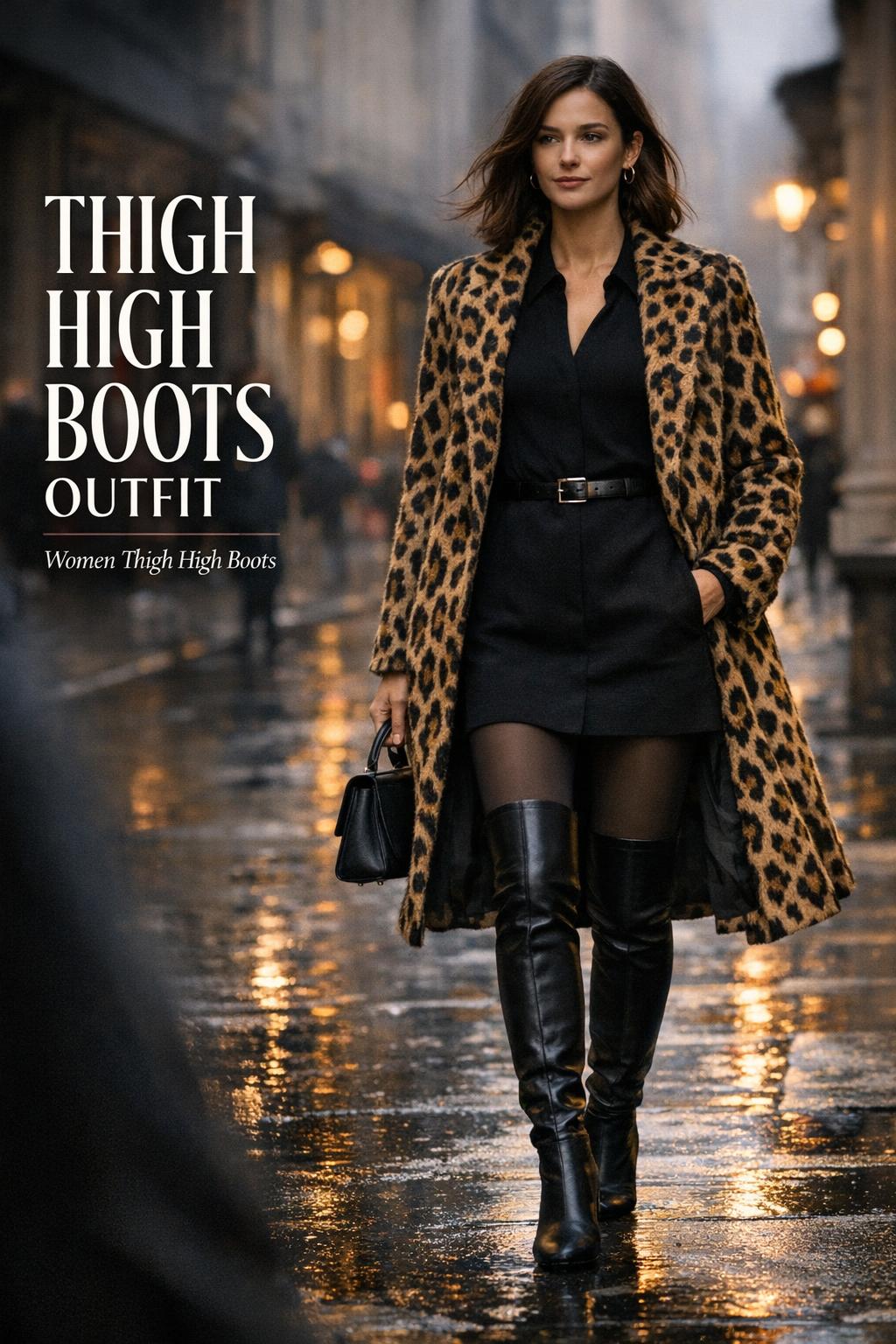
    Thigh high boots outfit on a stylish woman walking a wet winter city street with cinematic editorial lighting and bokeh
    A polished woman strides through a moody winter city scene in a sleek thigh high boots outfit, lit by warm streetlight glow.

    FAQ

    How do I make a thigh high boots outfit look polished instead of overdone?

    Pick one focal point—boots, hemline, or outerwear—and keep the rest restrained with clean lines and a disciplined color palette. Polished looks often rely on a continuous leg line (especially with black thigh-highs) and minimal competing statements, the same way runway styling and red-carpet outfits keep the silhouette intentional.

    What’s the easiest “starter” black thigh boots outfit for everyday wear?

    Build a monochrome column: black thigh-high boots with a dark dress or dark base layer, finished with a structured coat. This keeps contrast low, makes proportions easier to manage, and feels city-appropriate for long days when you need warmth and a refined silhouette.

    Can I wear thigh-high boots with jeans without looking dated?

    Yes—keep the look intentional by pairing sleek thigh-high boots with skinny jeans and balancing any casual distressing (like ripped denim) with refined layers above. Tracee Ellis Ross’s styling shows how the boots can reintroduce polish, making the outfit feel current rather than overly casual.

    How should I style thigh-high boots for date night?

    Lean into cohesion: a sleek silhouette and a consistent mood works best, such as a leather-led ensemble with thigh-high boots anchoring the line. Rihanna’s approach demonstrates how tall boots can elevate an evening look while still offering warmth and coverage for nights that include walking or waiting outside.

    Do thigh-high boots work for short women?

    Long boots for short women can be very flattering when you avoid visual breaks. Keep the leg line continuous with tights or a dark base close to the boot color, and steer away from hems that land exactly at the boot top unless the gap is clearly intentional.

    How do I wear thigh-high boots with a statement coat like leopard print?

    Let the coat lead and keep everything else streamlined: simple layers underneath and controlled, sleek boots to anchor the silhouette. Amal Clooney’s leopard-print coat styling shows how thigh-high boots can sharpen the outline so the print reads glamorous and deliberate rather than overwhelming.

    Are velvet thigh-high boots only for formal events?

    Velvet naturally reads evening because it absorbs light and looks rich, which is why Emma Watson’s velvet thigh-high boots worked so well for a New York City premiere with a Balenciaga gown. You can still wear velvet outside formal settings, but it looks best when the rest of the outfit is simplified so the texture feels intentional, not fussy.

    What’s the biggest styling mistake people make with women thigh high boots?

    The most common mistake is an “accidental” proportion—hemlines that collide with the boot top or too many competing statements at once. A better approach is committing to a deliberate gap with a mini skirt (as seen in bolder celebrity looks) or choosing more coverage with coats and skirts for a chic, wearable effect.

  • What to Wear: Konzert Outfit for Stadiums to Small Clubs

    What to Wear: Konzert Outfit for Stadiums to Small Clubs

    The konzert outfit dilemma: looking effortless while planning for reality

    A concert is rarely just “a night out.” It’s a walk from parking to gate, a queue that stretches longer than expected, a temperature shift between daylight and the first encore, and—if you’re lucky—hours of movement. The best konzert outfit acknowledges this reality without surrendering the pleasure of dressing. It’s a look built for the body in motion: standing, dancing, weaving through crowds, stepping onto sticky club floors or gravel festival paths. And it still needs that editorial charge—the feeling that your silhouette and styling choices are intentional.

    Across concert fashion, a few priorities keep reappearing: comfort, weather readiness, and a vibe that aligns with the music. Yet “comfort” doesn’t have to mean forgettable. Oversized tees can be styled to look deliberate; a light blazer can read polished while solving the “cold indoor” problem; sneakers can anchor an outfit with streetstyle credibility. Think of this as Look Di Moda with a practical spine: refined composition, clean lines, and pieces chosen for how they behave over a full night—not just how they photograph.

    konzert outfit flat lay with blazer, ivory tee, dark denim, ankle boots, and minimal accessories on warm gray stone
    A minimalist konzert outfit flat lay pairs an ivory tee, structured blazer, dark denim, and sleek accessories for a refined concert-ready look.

    Below, you’ll find a fashion-editor approach to outfit for concerts: how to build the foundation, how to adjust for venue and weather, how to translate genre into proportion and texture, and how accessories (from hats and bags to a watch) can quietly do the heavy lifting. Consider it Outfit Inspo Casual elevated into looks chic—and still ready for the real world.

    The anatomy of a concert look: why some outfits work all night

    A strong concert outfit is a system, not a single item. The most reliable approach is to start with three anchors—mobility, climate logic, and aesthetic intent—and then add detail. Mobility means you can raise your arms, step quickly, and stand for long stretches without constant adjustment. Climate logic means you won’t be forced to carry a coat all night or shiver through the opener. Aesthetic intent is the invisible difference between “I threw something on” and “this is my lookbook outfits moment.”

    Stylists and fashion editors often return to the same balancing act: relaxed pieces that allow movement, sharpened by one structured element. An oversized tee paired with a clean jacket; denim with a sleeker shoe; a casual base with a glam accent. The goal isn’t to dress like the performer. It’s to choose a silhouette that feels aligned with the event—concert, open-air concert, festival, club night—while still feeling like you.

    • Base layer: the item that touches the skin and determines comfort (often a tee, lightweight top, or breathable fabric choice).
    • Structure layer: the piece that gives the look shape (a blazer, a jacket, or a well-chosen outerwear silhouette).
    • Grounding layer: footwear that can handle standing and dancing (sneakers and boots are the recurring heroes).
    • Functional accents: accessories that solve real needs (bag, belt, hat, sunglasses, watch).

    Once you start thinking in layers and roles, concert fashion becomes less about chasing trends and more about building a look that performs.

    Konzert Outfit bei Sonnenuntergang vor dem Venue-Eingang mit Blazer, Denim und Crossbody-Bag in der Schlange
    Ein lässiges Konzert Outfit im goldenen Abendlicht verbindet cleanes Layering mit komfortablen Schuhen für lange Nächte.

    Venue intelligence: dressing for stadiums, open-air festivals, and small clubs

    Venue type quietly dictates everything: fabric choice, layering strategy, and even how much accessory “weight” you can tolerate. A stadium seat changes your posture and temperature; an outdoor festival demands weather readiness; a small venue compresses the room and intensifies heat and movement. If you’ve ever watched your carefully chosen outfit unravel by hour two, venue logic was probably missing.

    Indoor stadiums and theatres: the art of light layering

    Indoor venues can feel climate-controlled—until they don’t. The common experience is a warm crowd with pockets of cold air, especially once you’re seated. The most dependable indoor concert outfit is built on breathable fabrics with a removable top layer: a light jacket, a soft cardigan, or a structured blazer that won’t crush under your arm.

    A refined formula: an oversized tee softened by tailored structure. The tee keeps movement easy; the blazer adds polish and a clean vertical line that reads intentional. If your style leans streetstyle, keep the blazer relaxed and the tee slightly longer. If you want looks chic, choose a cleaner blazer shape and let your accessories do the playfulness.

    Open-air concerts and festivals: sun, dust, and sudden weather

    Outdoor events demand a different kind of elegance: preparation that doesn’t look like preparation. Sun is a styling factor, not merely a comfort issue—hats and sunglasses become part of the silhouette, and breathable fabrics shift from “nice to have” to non-negotiable. Weather can turn quickly, so your outerwear should be easy to carry or wear without overheating.

    Footwear becomes the make-or-break decision. Sneakers are a baseline for a reason: stable, comfortable, and reliable on uneven ground. Boots can work beautifully, especially if the look is genre-driven (rock textures, darker palettes), but the boot has to be walkable for long stretches. Your festival outfit is not the place for shoes you must “break in.”

    For fest outfits that still feel editorial, focus on proportion: a relaxed top balanced with a more defined bottom, or a streamlined base with a more dramatic layer—like a cape-inspired outer piece that moves with you and adds visual narrative without restricting motion.

    Small venues and club nights: compact silhouettes, high impact

    In smaller venues, you feel the music in close quarters. The styling challenge is heat and density—your outfit needs to breathe, and your accessories should be minimal enough to avoid constant readjustment. This is where texture and color do their best work: velvet or satin accents (even subtle) can create a sense of glamour without piling on layers.

    Keep the look streamlined: a clean top, a confident jacket choice, and shoes designed for movement. If you want a stage-ready look without looking costume-like, select one statement element—an accessory, a bold color note, or a sharp outerwear piece—and let the rest stay refined.

    Photographic konzert outfit with stylish concert-ready look in a modern venue
    A stylish konzert outfit captures effortless confidence for an unforgettable night of live music.

    Genre dressing without clichés: translating music into silhouette and texture

    Genre-inspired dressing works best when it’s interpreted, not copied. The most convincing “music-vibe” outfits use a few genre cues—texture, color, proportion—then filter them through your own wardrobe. This is where the lookbook outfits mindset becomes useful: you’re composing a visual story using pieces that already make sense on your body.

    Rock and indie: denim, leather accents, and purposeful layering

    Rock and indie styling thrives on contrast: a relaxed base with a tougher edge, matte textures with a hint of shine. Denim is the easy backbone—especially layered with a jacket—and it reads authentic because it’s durable and lived-in. A denim jacket over a tee is classic, but the editorial trick is proportion: keep the jacket slightly cropped or structured so the line of the body stays clear, even when you’re moving.

    Boots naturally belong here, but sneakers can feel just as right if the rest of the look carries the mood. The goal is a look that can handle crowds, doors, and late-night chill—without sacrificing that nonchalant cool that indie streetstyle suggests.

    Tip: If you’re wearing an oversized tee, make the rest of the silhouette intentional. Pair it with a jacket that adds shape, or balance it with a cleaner, more streamlined lower half. That’s the difference between “oversized” and “sloppy.”

    Pop and mainstream: bold color with wearable comfort

    Pop concerts invite shine, color, and a more playful relationship with accessories. Yet the most modern pop concert outfit still respects comfort—because you’ll be dancing. Think bold colors placed thoughtfully rather than everywhere at once: a bright top against a calmer base, or a neutral outfit punctuated by statement jewelry.

    To keep it refined, choose one focal point. If the jewelry is the statement, keep the neckline clean. If the color is the statement, keep accessories minimal and deliberate. This is how you get looks chic without slipping into “trying too hard.”

    Tip: For a polished effect under venue lighting, mix textures rather than stacking loud pieces. A smooth fabric paired with a more tactile layer can read glamorous and controlled.
    EDM and dance: movement-first styling with glow accents

    EDM styling is driven by motion. You’ll feel the difference between an outfit that fights your body and one that moves with it. Flexible fabrics, clean lines, and shoes that can handle hours of dancing are the foundation. Glow-in-the-dark accessories and reflective details can be fun here, but they work best when the base outfit is simple and stable.

    Approach glow as an accent, not a full theme: a small accessory, a subtle detail, a single element that catches light. It keeps the look elevated—more Look Di Moda than novelty—while still honoring the rave and festival context where this style language makes sense.

    Konzert outfit at golden hour: stylish woman in blazer and black jeans walking toward a stadium entrance.
    A stylish woman steps toward the stadium at golden hour, wearing a chic konzert outfit with effortless polish.

    Weather and climate: a layering strategy that looks intentional

    Weather-appropriate layering is the quiet hallmark of experienced concertgoers. The most common failure is dressing only for the moment you leave the house—then spending the rest of the night either sweating or freezing. A smart concert look anticipates transitions: afternoon sun to evening chill, indoor warmth to outdoor air, crowd heat to the walk back.

    Heat and summer nights: breathable fabrics that still look polished

    In warm weather, the best summer concert outfit starts with breathable fabric choices and a silhouette that allows airflow. Lightweight materials and looser cuts can still look refined if the lines are clean. Sun protection becomes part of styling: a hat can frame the face and complete the outfit; sunglasses add attitude and practical comfort.

    In the heat, glam is best expressed through detail: a crisp accessory choice, a controlled color palette, or a well-balanced outfit rather than heavy layers. This is the season where Outfit Inspo Casual can be the most sophisticated, because simplicity looks deliberate when the fit is right.

    Rain and cold nights: outerwear that doesn’t ruin the look

    Cold and rain don’t need to mean bulky compromise. The trick is selecting outerwear that integrates into the outfit story. A blazer can add warmth indoors and still look sharp; a jacket with a clean shape can protect you outside. If rain is possible, avoid fabrics that show water spots easily and focus on layers you can rearrange.

    When the temperature drops, a cape-like layer can be unexpectedly effective: it reads dramatic and editorial, and it allows movement without the rigidity of a tight sleeve. It’s a styling choice that feels fashion-forward while still being functional for an open-air concert.

    The layering toolkit: modular pieces you’ll actually use

    Layering works when it’s modular. If the pieces can’t be removed, carried, or re-styled quickly, they become a burden. Think in “on/off” items that still look good when you’re holding them.

    • A light blazer that folds over the arm without losing its shape
    • A jacket that can be tied at the waist without looking bulky
    • A cardigan that adds warmth but doesn’t trap heat in crowds
    • A top layer that complements your base colors, so it never feels like an afterthought

    Tip: Choose a consistent color story across layers. When the palette is cohesive, the outfit still reads “finished” even after you remove a piece.

    Shoes that dance: the elegant case for sneakers and the right boots

    Footwear is the most underestimated part of concert attire, and the part you’ll feel most intensely. A concert is not a short walk; it’s hours of standing, shifting weight, and navigating other people’s pace. Comfortable footwear is not just comfort—it’s posture. The wrong shoe changes how you stand and how you move, which changes how your clothes sit on the body. Even a beautiful outfit can look off if your shoes force an awkward stance.

    Sneakers are the modern default for good reason, and they can be styled to look intentional. A streamlined sneaker keeps the outfit clean and contemporary; it supports movement and pairs well with everything from denim to a blazer-based look. Boots bring attitude and can suit rock and indie styling beautifully, but only when the boot is stable enough for a long night.

    • Choose sneakers when the venue involves long walking, outdoor terrain, or hours of dancing.
    • Choose boots when the weather is cooler, the look is texture-driven, or you want a tougher finish—provided they’re broken-in and supportive.
    • Avoid “new shoes” for festivals and open-air concerts; discomfort becomes the main memory.

    In editorial terms, shoes also anchor proportion. Chunkier footwear can balance an oversized tee; sleeker shoes can sharpen a relaxed outfit. Either can be correct—if the rest of the silhouette agrees.

    Accessories as architecture: hats, bags, sunglasses, and the quiet power of a watch

    Accessories at concerts should feel stylish, not fussy. The best ones function like architecture: they organize the look and solve problems. A bag shapes how your body moves through a crowd. A belt can add definition when you’re wearing a looser top. Sunglasses and hats do more than protect from sun—they set the mood and frame the face in a way that reads instantly on arrival.

    Bags, belts, and tech-friendly add-ons for real movement

    A small crossbody bag is often the most practical concert companion because it keeps hands free and stays close in crowds. The silhouette matters: a neat shape looks polished; an overly bulky bag can distort proportions. Belts are useful when you want to give an oversized tee or relaxed outfit a clearer waistline—especially if you’re aiming for looks chic rather than purely casual.

    If you like the idea of subtle “tech-friendly” styling, keep it discreet: choose accessories that support your needs without turning the outfit into gear. Functional accessories should disappear into the overall composition, not shout over it.

    Jewelry, hats, and sunglasses: glam without discomfort

    Statement jewelry can elevate the simplest base, but at concerts it has to be wearable for hours. If you’ll be dancing, choose pieces that won’t snag or require constant adjustment. Hats can read especially modern when balanced with clean lines—think of them as part of a festival outfit silhouette rather than a last-minute add-on. Sunglasses bring instant attitude and remain one of the simplest ways to turn Outfit Inspo Casual into a more intentional concert look.

    A watch as a finishing detail: subtle, composed, and intentional

    A watch can be the most understated “finishing touch,” especially if the rest of the look is minimal. It adds a sense of polish and deliberateness—quietly suggesting you thought about details. Brand-led styling content often frames watches as coordination pieces, and in practice that’s exactly right: the watch should harmonize with your outfit’s texture and color story rather than competing with statement jewelry.

    Look di moda, not last-minute: styling rules that make any concert outfit feel elevated

    Concert outfits are full of temptations: too many trends, too much discomfort, too little planning. The styling rules below aren’t rigid; they’re the kind of editor’s mental checklist that keeps a look from tipping into chaos. When applied lightly, they make even basic pieces feel like a considered lookbook outfit.

    • Balance volume: if one piece is oversized, keep another more streamlined so the silhouette stays intentional.
    • Choose one “glam twist”: texture (velvet, satin), statement jewelry, or a bold color—just one is usually enough.
    • Respect movement: anything that restricts your arms, hips, or stride will become annoying by the second song.
    • Plan for holding your layer: if you can’t carry your outerwear comfortably, it will end up tied awkwardly or left behind.
    • Use accessories to finish, not clutter: a hat, a crossbody bag, sunglasses, or a watch can complete a look; too many pieces dilute it.

    Tip: Before you leave, do a two-minute “movement test”: raise your arms, sit, stand, and walk quickly. If anything rides up, pinches, or demands constant adjustment, revise now—not later in line.

    A curated concert wardrobe: pieces that re-style across seasons and vibes

    The smartest approach to concert fashion is building a small set of pieces that can shift from indoor stadium to open-air festival without changing your entire identity. Think of it as a capsule with range: streetstyle-friendly, but adaptable to glam accents and weather shifts. Retailers and fashion magazines often show dramatic outfit ideas, but the most useful inspiration is the kind you can re-style with what you already own.

    Start with the foundation pieces that appear again and again: tees (including oversized tees), denim, a jacket you can live in, and shoes designed for movement. Then add one or two “editorial” elements—perhaps a blazer that sharpens any base, or accessories that can tilt the mood from casual to polished. This is how fest outfits can still feel mature and refined: the palette is controlled, the silhouette is considered, and the materials feel chosen.

    If you like browsing retailer inspiration, you’ll notice the same patterns across different sources: sneakers as a baseline, jackets and outerwear as problem-solvers, and accessories like hats and bags as the finishing layer. The point isn’t to copy a catalog. It’s to recognize the structure behind the styling and recreate the effect in your own way.

    Genre-meets-weather outfit stories: realistic scenarios you can actually use

    Concert dressing becomes easier when you imagine the night as a story: where you’ll walk, where you’ll wait, when the temperature changes, and how much you’ll move. Below are a few scenario-based compositions—less “Outfit 1, Outfit 2,” more editorial styling logic you can borrow and adapt.

    Indoor pop show with intense air conditioning: polished layers that won’t overwhelm

    Begin with a clean base—an easy top that breathes—then add a blazer that brings structure. Keep the palette simple, and place your “pop” energy in accessories: statement jewelry or a strong color note. Finish with sneakers so you can dance without thinking. The blazer is the practical hero: it reads elevated while solving the cold-venue problem.

    Outdoor festival afternoon into chilly night: a modular look that stays chic

    Think breathable fabric at the base, plus a jacket that can be worn or carried without ruining the silhouette. Add a hat and sunglasses early—both functional and mood-setting. As the temperature drops, your outerwear becomes part of the look rather than an emergency. Sneakers keep the outfit grounded across grass, pavement, and packed crowds.

    Small indie venue with a packed floor: texture-driven minimalism

    Choose a streamlined outfit with one tactile element—denim, a subtle satin accent, or a sharper jacket. Keep accessories compact: a crossbody bag that stays close, minimal jewelry that won’t snag. The effect is modern, slightly moody, and comfortable enough to move for hours without distraction.

    EDM night where you’ll dance for hours: glow details on a disciplined base

    Prioritize flexible, movement-friendly pieces and supportive shoes. Keep the base clean and minimal so reflective or glow-in-the-dark accessories feel intentional rather than overwhelming. This is where a single accent becomes your signature—an editorial “glam twist” that catches the light while the rest of the outfit does its job quietly.

    Common mistakes that sabotage a konzert outfit (and how to fix them)

    The most common concert styling mistakes are easy to make because they look fine in a mirror—until you’re outside, in a crowd, under changing temperatures. Fixes are usually small: a different shoe, a smarter layer, or a more deliberate proportion choice.

    • Over-layering without a plan: If you can’t remove a layer without losing the outfit’s shape, the layers are working against you.
    • Choosing shoes for aesthetics only: Uncomfortable footwear changes your posture and your mood, and can make even stylish clothes look awkward.
    • Too many accessories: In crowded spaces, excess jewelry and bulky bags become a constant inconvenience.
    • Ignoring weather transitions: Dressing only for the start of the night often ends with discomfort later.
    • Oversized without intention: Oversized tees look modern when balanced; without structure, the silhouette can collapse.

    Tip: If you feel uncertain, simplify the base and add one clear focal point. A controlled foundation always photographs—and feels—more refined than a chaotic mix.

    Quick tips: a pre-concert checklist for comfort, style, and confidence

    Before you step out, a concise checklist keeps your concert attire grounded in reality. It’s not about overthinking; it’s about making sure your look holds up through the full arc of the night.

    • Confirm whether the venue is indoor, open-air, or a small club, then choose your outerwear accordingly.
    • Plan one removable layer for temperature shifts.
    • Choose comfortable footwear you trust for long standing and dancing.
    • Keep valuables in a small bag that stays close, ideally crossbody.
    • Select accessories with intention: hat and sunglasses for sun, minimal jewelry for movement, a watch for subtle polish.
    • Do a quick movement test at home to catch fit issues early.

    This is the quiet difference between a look that feels like a last-minute decision and one that reads like curated Look Di Moda—composed, effortless, and ready.

    Lookbook outfits, not costumes: building a personal concert style vocabulary

    The most stylish concertgoers aren’t necessarily wearing the most dramatic pieces. They’re wearing outfits that are coherent. Their color palette makes sense. Their proportions feel intentional. Their layers feel like part of the story. Whether your default is streetstyle, glam-leaning, or Outfit Inspo Casual, the goal is to develop a small vocabulary of shapes and textures you can repeat and refine.
    Start by identifying your “concert uniform” and then adjusting it by genre and weather. Maybe it’s denim plus a tee plus a jacket, reworked with a blazer for a pop show or with tougher outerwear for rock. Maybe it’s a minimalist base with a single accessory statement. This repeatable approach is what turns one-off fest outfits into a wardrobe strategy.

    And if you do browse inspiration—magazine edits, retailer guides, or curated collections from brands such as IVY Berlin, Peek & Cloppenburg, or Stylight—use them as composition lessons. Notice the structure. Notice the role of sneakers. Notice how a bag and sunglasses can finish a look. Then translate it into your own life, climate, and movement needs.

    Konzert outfit with white tee, charcoal blazer and black trousers outside stadium entrance at golden-hour dusk
    A confident concert-ready look pairs a crisp white tee with a charcoal blazer and dark trousers outside the stadium at dusk.

    FAQ

    What is a konzert outfit, and how is it different from everyday outfits?

    A konzert outfit is designed for movement, long wear, and changing conditions—standing, dancing, and shifting temperatures—while still expressing a clear style intention through silhouette, layering, and accessories.

    What should I wear to an indoor concert if I’m worried about getting cold?

    Start with a breathable base layer and add a light, removable top layer like a blazer or light jacket; it keeps you warm in colder pockets of the venue without forcing you into heavy outerwear you’ll have to carry later.

    What are the best shoes for concerts if I plan to dance?

    Sneakers are usually the most reliable choice because they support long standing and dancing, especially in crowded venues; boots can work as well if they’re stable, comfortable, and already broken in.

    How do I dress for an open-air concert or festival without sacrificing style?

    Build your outfit around breathable fabrics, add sun-smart accessories like a hat and sunglasses, and choose a modular outerwear layer you can wear or carry as the temperature changes, keeping the color palette cohesive so the look stays intentional.

    How can I make an oversized tee look polished for a concert?

    Balance the relaxed volume with a structured layer such as a blazer or a clean jacket shape, and keep the rest of the silhouette more streamlined so the oversized proportion looks deliberate rather than accidental.

    What accessories are actually useful at concerts?

    A small crossbody bag helps you move hands-free in crowds, sunglasses and a hat are practical for open-air events, and a watch can add subtle polish; the best concert accessories solve real needs without creating extra bulk or discomfort.

    How do I choose a concert outfit based on genre like rock, pop, or EDM?

    Use genre as a guide for texture and proportion—denim and layered toughness for rock/indie, a controlled bold color or statement jewelry for pop, and movement-first styling with optional glow accents for EDM—while keeping comfort and layering appropriate to the venue.

    What are the biggest concert outfit mistakes to avoid?

    The most common issues are ignoring weather transitions, choosing uncomfortable footwear, over-layering without a plan for carrying pieces, and over-accessorizing in crowded spaces, all of which can undermine both comfort and the overall look.

  • Modern Blundstone Outfit Ideas for City Days and Weekends

    Modern Blundstone Outfit Ideas for City Days and Weekends

    Introduction

    A blundstone outfit has a particular kind of visual confidence: grounded, unforced, and quietly capable. The silhouette is clean but never precious—built around the ease of a Chelsea boot, the sturdiness of leather, and the kind of proportions that look better the longer you live in them. Think urban utilitarian with a soft edge, or Western wear softened into modern minimalism. It’s a style that reads practical in the morning and intentional by late afternoon.

    This aesthetic shows up where real life happens: commute-to-coffee days, long travel hours, weather that changes its mind, and weekends that drift between errands and dinner. Blundstone boots—especially the brand’s Chelsea boots and lug boots—sit at the center because they can hold a look together without demanding attention. In the U.S., that versatility matters: you can build a wardrobe that flexes across seasons and still feels cohesive.

    Blundstone outfit street style with brown Chelsea boots on a rainy café sidewalk, cropped denim and tailored coat
    A minimalist city coffee-run look featuring rich brown Blundstone boots, cropped denim, and a tailored coat on a rain-kissed sidewalk.

    The appeal isn’t about chasing a trend. It’s about composition—denim weight against smooth leather, tailored structure against knit softness, earthy palettes that make getting dressed feel intuitive. Add in the brand’s cultural visibility—from its Tasmania and Hobart origins to the modern spotlight of high-profile wearers like Kate Middleton and Jake Gyllenhaal—and you get a boot that comfortably crosses the line between function and fashion.

    The Blundstone aesthetic, defined: Chelsea ease, utilitarian poise, Western undertones

    Before styling specifics, it helps to name the visual language. The Blundstone look is anchored by a pull-on Chelsea boot shape—sleek at the ankle, practical through the sole—making it naturally compatible with denim, straight-leg trousers, skirts, and dresses. It’s also a style that thrives on “everyday contrast”: rugged footwear under refined layers, or polished leather paired with worn-in textures.

    Two style archetypes recur again and again: Western wear and urban utilitarian. Western wear brings a sense of heritage—denim, sturdy layers, confident simplicity—while urban utilitarian leans into function as aesthetic: practical outerwear, clean lines, pieces that look designed for movement and weather. Whether you prefer black boots for sharper minimalism or brown leather for a warmer, more rustic mood, the same principle holds: the boots act as the visual anchor, and everything else harmonizes around proportion and palette.

    Blundstone outfit with brown Chelsea boots, dark jeans, cream sweater and camel coat on a wet city sidewalk at golden hour
    A relaxed golden-hour city coffee run look featuring brown Blundstone boots, dark denim, and a camel coat with modern minimal layering.

    Look: Relaxed minimal layers with Chelsea boots (the “weekday uniform”)

    This look is about calm structure: a streamlined column of color broken up by texture. The silhouette stays close to the body without clinging—an approach that makes Chelsea boots feel especially natural, because the ankle line remains clean and uninterrupted. It’s the kind of outfit that reads effortless in motion, from sidewalk to office lobby to an unplanned dinner.

    Start with denim in a classic wash—mid or dark tends to feel more polished—and balance it with knitwear that has a refined handfeel (think smooth knits rather than overly chunky). A simple outer layer—coat-like in shape, even if it’s casual in spirit—keeps the proportions tidy. For footwear, Blundstone Chelsea boots do the quiet heavy lifting: they ground the look and keep it weather-ready without changing the mood.

    • Key garments: straight or slim denim, refined knit, clean-lined outer layer
    • Footwear: Blundstone Chelsea boots
    • Accessories: minimal belt, compact bag, scarf for texture

    Why it works: minimal layering emphasizes the boot’s iconic shape. When the outfit is composed of simple lines, the leather and silhouette of the Chelsea boot become the “design detail,” adding depth without clutter.

    Style tip: keep the hem intentional

    A Chelsea boot looks strongest when the hem either meets the boot neatly or hovers just above it. Too much bunching at the ankle can dilute the sharpness that makes this silhouette feel modern. If you’re building a blundstone outfit around denim, aim for a hem that shows the boot’s shape rather than hiding it.

    Look: Brown blundstone outfit in earthy tones (warm leather, soft confidence)

    Blundstone outfit styled with rugged boots and casual layers in a natural outdoor setting
    A timeless Blundstone outfit pairs rugged boots with effortless layers for everyday comfort and style.

    Brown leather creates a different mood than black: warmer, more textured, and subtly nostalgic. The overall vibe is grounded and approachable—less “city sleek,” more “weekend escape,” even if you’re not leaving town. This is where a brown blundstone outfit becomes a palette story: earth tones, denim washes, and natural neutrals working in quiet agreement.

    Brown leather Blundstone boots pair easily with denim—especially medium washes—and with neutrals that echo the boot’s warmth. Think sand, cream, olive, and soft charcoal rather than stark black-and-white contrast. The goal is not to match perfectly, but to keep the palette cohesive. Textures matter here: leather against denim, knit against outerwear, creating visual depth without loud pattern.

    • Key garments: medium-wash denim, neutral knit, earthy outer layer
    • Footwear: brown leather Blundstone boots
    • Accessories: tonal scarf, simple belt, practical bag

    Why it works: brown leather makes the outfit feel lived-in in the best way—softened, layered, and season-flexible. This is also one of the easiest ways to style blundstone boots through seasonal transitions, when the weather demands practicality but the wardrobe still wants lightness.

    Look: Blundstone style woman—soft weekend aesthetic with dresses and boots

    Blundstone outfit street-style photo of a woman walking by a coffee shop in rustic brown Chelsea lug boots at golden hour
    A stylish city stroll captures a relaxed blundstone outfit with rustic brown Chelsea lug boots in warm golden-hour light.

    There’s a particular kind of charm in pairing sturdy boots with a softer silhouette. The mood here is relaxed romantic, but not fragile: the dress moves, the boots anchor. It’s an aesthetic that feels especially relevant for weekends—farmers’ market mornings, gallery afternoons, long walks—when you want ease without losing shape.

    A dress or skirt becomes the focal line, and the boots offer contrast. Keep the palette coherent: neutral dresses, earthy tones, or denim-adjacent blues tend to pair naturally with brown leather, while darker or more structured dresses can feel sharper with black. The Chelsea profile keeps the ankle clean, preventing the look from feeling heavy even when the boots are built for weather and wear.

    • Key garments: dress or skirt with fluid movement, light layering piece for balance
    • Footwear: Blundstone Chelsea boots (brown or black depending on palette)
    • Accessories: scarf for softness, minimal bag, belt if you want waist definition

    Why it works: this blundstone women outfit hinges on contrast—soft fabric against durable leather—creating a composed “off-duty” elegance that still makes sense in real weather.

    How to recreate the look without feeling “too sweet”

    If dresses with boots feel overly romantic for your taste, keep the dress silhouette cleaner and the color palette more restrained. The boots will naturally add utilitarian edge; your job is simply to avoid introducing too many competing details.

    Look: Smart-casual polish—office-ready without losing the boot’s character

    Smart-casual with Blundstones is not about pretending they are formal dress shoes. It’s about refining the surrounding pieces so the boots read intentional. The silhouette shifts slightly here: more tailoring, cleaner lines, fewer relaxed proportions. The overall mood is modern and competent—an outfit that can handle a meeting and still look right at an easy dinner afterward.

    For men, Blundstone Chelsea boots can sit comfortably under trousers when the leg line is clean and the break is controlled; a blazer or structured layer adds the “office signal” while the boots keep it grounded. For women, the smart-casual direction can come from trousers or a dress with a more structured outer layer. In both cases, let the boots be the practical foundation—especially when weather makes delicate shoes unrealistic.

    • Key garments: trousers with a clean leg line, structured layer (blazer-like shape)
    • Footwear: Blundstone Chelsea boots
    • Accessories: belt to echo structure, understated bag

    Why it works: the boot doesn’t need to become “dressy”; the outfit becomes more tailored around it. That balance—practical footwear with polished clothing—feels particularly current in U.S. workwear, where office norms often blend comfort with presentability.

    Practical note: when this look may not be the right choice

    If the setting requires truly formal footwear, a rugged boot silhouette can look out of place. In those cases, it’s better to treat Blundstones as your commute shoe and switch later, rather than forcing the boot into a context where it can’t look intentional.

    Look: Urban utilitarian—clean lines, weather-ready ease, lug-sole attitude

    Urban utilitarian is where Blundstones feel almost inevitable. The mood is functional but designed: pieces that look like they can handle rain, uneven sidewalks, and full days on your feet—yet still feel considered. Here, the boot doesn’t just complement the outfit; it defines it.

    This is the natural home of lug boots, where the sole becomes part of the silhouette. Pair them with practical shapes—straight-leg pants, cargo silhouettes, and outerwear with presence. The palette tends to stay within neutrals and earth tones, allowing texture to do the work: rugged soles, durable fabrics, and layered outerwear creating depth without decoration.

    • Key garments: cargo or straight-leg silhouettes, substantial outerwear
    • Footwear: Blundstone lug boots
    • Accessories: scarf for warmth, bag with structure, minimal hardware

    Why it works: lug boots bring visual weight. When the clothing echoes that practicality—rather than fighting it with overly delicate pieces—the look becomes cohesive, modern, and undeniably wearable.

    Seasonal outerwear pairing: the silent hero of the utilitarian look

    Outerwear is the top-half counterbalance to a rugged boot. A stronger shoulder line or a longer outer layer can keep the proportions elegant, especially in colder months when layering is non-negotiable. Think of the outfit as architecture: the boots provide the foundation, and outerwear provides the frame.

    Look: Western wear, modernized—denim, leather, and a confident simplicity

    Western wear doesn’t have to be costume to be compelling. In its most wearable form, it’s about clean denim, straightforward layers, and a sense of heritage that reads as confidence. Blundstone boots fit this world naturally: durable leather, ready-for-anything energy, and a silhouette that doesn’t need embellishment to feel authentic.

    Lean into denim as the central material story. A strong denim silhouette paired with simple layers lets the boots read as purposeful rather than decorative. Brown leather often feels especially at home here, echoing the warmth of classic Western palettes, but black can modernize the mood—less ranch, more city interpretation of a heritage idea.

    Why it works: Western wear’s strength is restraint. When you keep the look pared back, the boot’s durability and the denim’s texture do enough on their own, creating that quietly iconic “boots-and-denim” impression that keeps returning across fashion cycles.

    Color play: how to match Blundstone boots with denim washes and neutrals

    Color coordination is often what separates a decent boot outfit from a truly cohesive one. With Blundstones, the most successful palettes tend to live in neutrals, earth tones, and denim blues—because they complement leather naturally. The goal isn’t to be monochrome; it’s to keep contrast controlled so the boots feel integrated rather than pasted on at the end.

    Brown leather boots often sit best with medium to dark denim, plus warm neutrals like cream and sand. Black boots can handle sharper contrast and look especially clean with darker palettes. If your outfit is already texture-heavy—chunky knit, rugged outerwear—keep the color story quieter. If your outfit is minimal, you can let the boot color act as the subtle focal point.

    • Brown leather boots: strongest with earth tones, warm neutrals, and classic denim
    • Black boots: strongest with darker palettes and cleaner, sharper contrast
    • When in doubt: keep the boot color echoed somewhere small (a belt or outer layer) for cohesion

    Small but powerful: texture as your styling tool

    When outfits start to feel flat, it’s rarely a “more color” problem—it’s often a texture problem. Leather boots already bring a tactile element; pair them with denim, knitwear, and outerwear that has a distinct handfeel to create depth that reads luxurious, even in a casual blundstone outfit.

    Accessories that amplify the aesthetic (without turning it into a costume)

    Accessories should support the narrative the boots already suggest: practical, composed, quietly stylish. In other words, avoid anything that looks too delicate for the boot’s character, or too ornate for the outfit’s clean lines. The best accessories here add structure or softness—never noise.

    Belts are especially useful when you want to elevate a boot-based outfit into smart-casual territory; scarves can soften utilitarian shapes; bags can either sharpen the look (more structure) or relax it (more slouch). The key is consistency: if you’re styling lug boots with rugged outerwear, choose accessories that feel equally capable. If you’re wearing Chelsea boots with a dress, choose accessories that keep the silhouette streamlined.

    • Belts: refine the line of denim or trousers and echo the boot’s leather
    • Scarves: add warmth and texture, especially in seasonal transitions
    • Bags: structured for polish, softer for weekend ease
    • Hats: work best when minimal and aligned with the outfit’s utilitarian or Western mood

    Common styling mistakes with Blundstones (and how editors avoid them)

    Blundstones are famously versatile, but that doesn’t mean every pairing lands. The most common issue is competing aesthetics: delicate pieces styled as if the boots aren’t present, or overly rugged layers stacked on top of lug soles until the outfit feels heavy. The fix is rarely dramatic—it’s usually one proportional adjustment or a palette edit.

    • Too much bulk at the ankle: choose hems that show the boot shape or fall cleanly over it
    • Unclear silhouette: balance rugged boots with either streamlined bottoms or a structured outer layer
    • Overly “matchy” browns: aim for tonal harmony, not identical shades from head to toe
    • Mixing dressy and rugged without intention: add one refined piece (tailoring) or one practical piece (outerwear) to make the story coherent

    In practice, stylists think in frameworks: the boots are the anchor, and the outfit needs either an equally grounded partner (denim, outerwear) or a deliberate contrast (dress, tailoring). What rarely works is treating the boots as an afterthought.

    Care, longevity, and the quiet luxury of keeping your boots looking intentional

    A blundstone outfit looks best when the boots look genuinely cared for—not necessarily pristine, but maintained. Leather develops character, yet it still benefits from routine attention, especially if you wear your boots through changing seasons. The goal is longevity and consistency: boots that hold their shape and finish so every outfit feels deliberate.

    Build a simple care rhythm around your real life. If your boots see frequent weather, regular cleaning and conditioning keeps the leather from looking tired. If you lean into brown leather, you’ll notice how conditioning can help preserve the richness of the color. And if you wear lug boots hard, check them periodically so the sole remains part of the outfit’s strong line, not an afterthought.

    Longevity also influences styling decisions: when you commit to maintaining a pair, you naturally build outfits that suit them—denim that hits the right point at the ankle, outerwear that complements the boot’s weight, palettes that work across seasons. This is where “durable design” becomes a style advantage, not just a functional one.

    Capsule thinking: building a small wardrobe that makes styling Blundstone boots effortless

    The easiest way to style blundstone boots consistently is to think in a capsule: a short list of pieces that all share the same visual language. Blundstones already suggest that language—clean, practical, slightly rugged—so your capsule should echo it. This approach is especially useful for travel, office-to-weekend dressing, and seasonal transitions when you want maximum outfits from minimal choices.

    • Denim in one or two washes you actually wear
    • A knit layer that holds its shape (your “everyday polish” piece)
    • One structured layer for smart-casual moments
    • Outerwear that matches your climate and your boot’s visual weight
    • A dress or skirt option if you want a softer blundstone women outfit in rotation

    When this works best: on mornings when you have five minutes and need the outfit to look intentional anyway. A capsule aligned with your boots means fewer styling decisions—and better results—because every piece already belongs in the same aesthetic family.

    Real-world style context: why Blundstones read “modern” right now

    Blundstone’s popularity isn’t only about the boot’s practicality—it’s also about cultural visibility. A brand with roots in Tasmania and Hobart feels distinctly grounded, yet its global adoption has made the silhouette familiar across demographics and settings. When widely recognized figures like Kate Middleton and Jake Gyllenhaal wear Blundstone boots, it signals that the look can live in both everyday life and the public eye without losing credibility.

    In style terms, this matters because it reframes the boot. It’s no longer only “outdoor” or only “casual.” It becomes a wardrobe anchor—one that can move between Western wear cues, urban utilitarian structure, and smart-casual restraint. That flexibility is exactly what many U.S. wardrobes demand: fewer pieces, more mileage, and outfits that handle weather, movement, and varied occasions.

    blundstone outfit on a stylish woman walking a rainy city sidewalk with coffee, boots visible in cinematic light
    A stylish woman strolls a rain-slick city sidewalk with coffee in hand, showcasing a refined blundstone outfit in moody morning light.

    FAQ

    What is the easiest way to create a blundstone outfit that looks intentional?

    Start with one clear aesthetic direction—urban utilitarian, Western wear, or minimal smart-casual—then keep the palette cohesive with neutrals and denim. Let the boots be the anchor and avoid adding pieces that fight their rugged, practical character.

    How do I style Blundstone Chelsea boots with denim?

    Choose denim with a hem that either meets the boot neatly or sits just above it so the Chelsea shape stays visible. Pair it with knitwear and a clean-lined outer layer for a balanced silhouette that feels effortless but polished.

    What makes a brown blundstone outfit look cohesive rather than “matchy”?

    Use tonal harmony instead of exact color matching: brown leather works beautifully with earth tones, warm neutrals, and classic denim washes. Echo the warmth of the boots in a small way—like a belt or outer layer—without trying to match every brown perfectly.

    Can a blundstone women outfit include dresses without looking too rugged?

    Yes—keep the dress silhouette clean and let the boots provide the contrast. A cohesive palette and a streamlined ankle line from Chelsea boots help the outfit feel modern and composed rather than heavy.

    How do I style blundstone boots for smart-casual or office settings?

    Refine the surrounding pieces: trousers with a clean leg line, a structured layer for shape, and minimal accessories. The boots don’t need to look formal; the outfit becomes more tailored around them so the overall impression reads intentional.

    When should I choose Blundstone lug boots instead of Chelsea boots?

    Reach for lug boots when you want a more rugged, weather-ready look or when your outfit leans strongly urban utilitarian with substantial outerwear and practical silhouettes. Chelsea boots are the more streamlined choice for minimal layering, denim-focused looks, and smart-casual styling.

    What colors pair best with black Blundstone boots versus brown leather Blundstones?

    Black boots pair naturally with darker palettes and sharper contrast, creating a cleaner, more modern edge. Brown leather Blundstones feel strongest with earth tones, warm neutrals, and classic denim blues for a softer, more rustic mood.

    How can I make my boots look better over time rather than worn out?

    Maintain the leather with a simple routine that fits your wear pattern—cleaning and conditioning as needed, especially through seasonal transitions. The goal is boots that develop character while still looking cared for, so every outfit reads deliberate.

    Are Blundstones associated with any wider style or cultural trend?

    They’ve become a cross-demographic staple, helped by durable design, a recognizable Chelsea boot silhouette, and broad visibility—from their Tasmania and Hobart heritage to modern cultural moments and high-profile wearers like Kate Middleton and Jake Gyllenhaal—making them feel equally at home in casual, utilitarian, and smart-casual wardrobes.

  • Two-Way Spring Leopard Skirt Outfit: Tailored or Casual

    Two-Way Spring Leopard Skirt Outfit: Tailored or Casual

    A leopard skirt outfit is one of those styling problems that returns every spring: the print feels bold, the silhouette feels familiar, and yet the final look can land anywhere between Parisian polish and weekend-casual ease. That range is exactly why leopard print skirt outfits are endlessly discussed—and often confused. The same skirt can read refined or loud, intentional or accidental, depending on structure, proportion, and what you choose to keep quiet.

    This style breakdown compares two dominant approaches to leopard skirt outfits: a classic, polished interpretation built on clean lines and tailored layers, and a casual, spring-ready interpretation that treats leopard as an everyday neutral. They overlap in pieces—tees, knits, sneakers, simple accessories—but differ in styling philosophy. One is about control and restraint; the other is about comfort and relaxed contrast.

    Leopard skirt outfit editorial photo with polished blazer and casual denim looks in a bright neutral studio with text overlay
    A minimalist editorial scene contrasts a tailored blazer look and a casual denim layer, both styled around a leopard-print midi skirt.

    By the end, you’ll know how to identify each approach at a glance, how to build a leopard skirt outfit spring wardrobe that feels wearable in real life, and how to borrow the best of both styles without looking like you tried too hard.

    Style overview: the polished, tailored leopard skirt outfit

    The polished approach treats leopard as a sophisticated pattern—almost a texture—set within a structured outfit. The defining characteristic is a composed silhouette: clean waist definition, intentional proportions, and layers that hold their shape. The mood is “editorial but real,” the kind of look that works for a meeting, dinner, or a city day where you want to feel pulled together.

    Silhouettes tend to be streamlined: a midi skirt that skims rather than clings, a tucked knit or crisp shirt, and a blazer or structured jacket that sharpens the outline. The color palette stays restrained—think neutrals that let the print remain the focal point without adding visual noise. Fabrics matter: a skirt with a fluid drape reads more luxe, while a jacket with a firmer hand adds authority and shape.

    Leopard skirt outfit in a golden-hour city apartment, showing polished blazer look and casual tee look with central text overlay
    A warm golden-hour diptych shows two chic spring ways to style a leopard-print midi skirt, from tailored to effortlessly casual.

    Style overview: the casual leopard print skirt for spring

    The casual approach—especially for a casual leopard print skirt for spring—treats leopard like a wardrobe basic. Instead of “dressing up” the print, you bring it down to earth with relaxed layers and easy footwear. The mood is effortless and modern: a look that can handle errands, coffee, travel days, and long afternoons that shift from sun to breeze.

    Silhouettes here are looser and more forgiving. The skirt can still be midi, but the overall outfit relies on soft structure: a simple tee, a light knit, a denim layer, or an easy shirt worn slightly undone. The palette can still be neutral, but it’s less strict—spring-appropriate lightness and comfort lead. Fabrics lean toward breathable and movement-friendly choices, because the point is wearability, not perfection.

    Leopard skirt outfit styled with a fitted top and ankle boots in a modern street fashion look.
    A chic leopard skirt outfit pairs effortless elegance with modern street-style edge.

    Why these two leopard skirt outfits get mixed up

    Both styles often start with the same foundation: a leopard skirt and a neutral top. From there, the difference comes down to the “frame” you build around the print. In a polished leopard skirt outfit, the print is contained by tailoring and deliberate balance. In a casual spring version, the print is softened by relaxed texture and low-key styling.

    The confusion is understandable because leopard functions like a neutral in both worlds. But the logic is different: one uses leopard as a refined statement within a controlled silhouette, and the other uses leopard as an everyday pattern within an easy uniform.

    Key differences that change the entire mood

    Silhouette: structured frame vs relaxed outline

    In the tailored approach, the outfit has a clear architecture: shoulders are defined (through a blazer or structured jacket), the waist is intentional (tucked or neatly belted), and the skirt length is chosen to elongate. In the casual approach, the silhouette breathes: a slightly slouchy top, a looser layer, and an outfit that moves easily—designed for comfort and momentum.

    Formality: “city-ready” vs “day-off”

    A polished leopard print skirt outfit leans toward smart casual at minimum. Even when it’s simple, it looks finished: clean footwear, a refined bag shape, and minimal but deliberate accessories. The casual version is intentionally everyday—often anchored by sneakers or flat shoes and a top that prioritizes ease. Both can look chic, but their default settings differ.

    Styling philosophy: editing vs layering

    Tailored styling is about editing: fewer elements, sharper lines, and a clear focal point. Casual styling is about layering and texture: light knits, soft cotton, and pieces that feel lived-in. With leopard, this philosophical difference matters because the print already carries visual energy; the question is whether you refine it or relax it.

    Typical wardrobe pieces: blazer and sleek shoe vs tee and sneaker

    The polished wardrobe reaches for structured outerwear, refined knits, and sleek shoes that lengthen the leg line. The casual wardrobe reaches for tees, light jackets, and comfortable footwear built for walking. Neither is “more correct.” The more useful question is which approach matches your day, your environment, and your tolerance for fuss.

    Visual style breakdown: what changes in the mirror

    Leopard skirt outfit on a stylish woman in a camel blazer walking past a modern cafe in golden-hour spring light.
    A stylish woman steps past a modern café in golden spring light, showcasing a polished leopard skirt outfit with tailored layers.

    Layering approach

    With a polished leopard skirt outfit, layers are clean and intentional: a blazer that ends at a flattering point on the hip, a knit that tucks smoothly, a coat that creates a long vertical line. In a leopard skirt outfit spring casual version, layers are lighter and more flexible: a denim layer you can take off, a cardigan that softens the print, or a shirt worn open for ease.

    Proportions: where the volume sits

    Polished looks usually concentrate volume in one place only. If the skirt has movement, the top stays neat. If the top is slightly oversized, the skirt is slimmer and the waist remains defined. Casual looks allow a touch more volume on top—especially in spring when you want comfort—yet still benefit from one grounding detail, like a partial tuck or a cropped layer that keeps the outfit from feeling shapeless.

    Accessories and footwear

    The tailored route typically chooses refined accessories that don’t compete: simple jewelry, a structured bag, and shoes that read sleek rather than sporty. The casual route chooses practicality—sneakers, flats, or low-profile sandals—plus an everyday bag that fits a real schedule. The key is consistency: mixing a highly polished bag with very casual footwear can look accidental unless the rest of the outfit is carefully controlled.

    A spring-specific reality check: leopard in shifting weather

    Spring styling is rarely about one perfect outfit; it’s about adaptation. A leopard skirt outfit spring plan should account for temperature swings, wind, and the fact that you may be walking more—weekends, travel, and longer days outside. This is where the casual approach gains an advantage: it welcomes layers that can be added and removed without breaking the look.

    That said, polished leopard skirt outfits can be spring-friendly too, as long as the structure doesn’t become heavy. Think lighter layers and breathable fabrics, with a silhouette that still feels crisp. The goal is not to overdress the print, but to give it a frame that works in daylight.

    Example comparisons: the same skirt, two styling philosophies

    Example comparison: casual daytime errands vs polished city lunch

    For a casual leopard print skirt for spring, the outfit works best when the print is treated like a neutral: a simple tee or light knit, easy footwear, and a layer you can carry. The skirt becomes the interesting element, while everything else stays calm and comfortable. For a polished city lunch, the same skirt becomes more intentional with a tucked top, a structured outer layer, and cleaner lines through the waist and shoulder—less “weekend,” more “considered.”

    Example comparison: work-friendly polish vs relaxed office day

    In the polished interpretation, the leopard skirt outfit relies on restraint: a refined top, minimal accessories, and a silhouette that reads professional without feeling severe. In the relaxed office version, you keep the skirt but shift the energy with softer layers and comfort-first choices. The difference is subtle but visible: structured pieces signal formality, while soft textures signal approachability.

    Example comparison: travel day practicality vs dinner-ready elegance

    For travel, leopard print skirt outfits succeed when they’re built for movement: low-fuss layers, comfortable shoes, and a top that won’t require constant adjusting. For dinner, the same skirt can feel elevated simply by sharpening the outline—cleaner top lines, more deliberate accessories, and footwear that visually lengthens. The print does the work; your job is to decide whether the mood is ease or elegance.

    Tips: how to keep leopard chic (and not costume-like)

    Leopard can be surprisingly unforgiving when the outfit lacks a clear point of view. If you’ve ever put on a leopard skirt and felt “too much,” it’s usually not the print—it’s the competing elements around it. The fix is editing and intention.

    • Choose one lead element. If the skirt is the statement, keep the rest of the outfit quiet and cohesive.
    • Anchor with neutrals. Neutral tones help leopard read like a classic rather than a novelty.
    • Watch the fit at the waist. A waistband that sits cleanly changes the entire impression, especially in spring layers.
    • Be consistent with mood. If you go sporty with footwear, commit to casual elsewhere; if you go polished, keep lines clean.

    A practical trick: take a quick mirror check from a few steps back. If your eye doesn’t know where to land, simplify—remove one accessory, refine one layer, or bring the top closer to the body. Leopard likes clarity.

    Common styling mistakes (and the easy fixes)

    Mistake: adding too many “statement” pieces

    The most common misstep with leopard skirt outfits is stacking bold elements—busy accessories, loud color, or multiple prints—until the look feels chaotic. The fix is not to eliminate personality, but to pick one expressive lane. If leopard is the feature, let texture or silhouette be the supporting interest rather than another competing print.

    Mistake: ignoring proportion in spring layers

    Spring layers can easily distort proportion: a longer cardigan can fight a midi skirt, or a bulky layer can swallow the waist. The fix is to choose one intentional line—either define the waist with a tuck, or create a long vertical with a cleaner outer layer. In a leopard skirt outfit spring context, small proportion choices are what keep the look modern.

    Mistake: treating leopard as “formal-only”

    Leopard can look overly done when it’s styled as if it only belongs at night. One of the most wearable approaches is daytime casual: the skirt with an unfussy top and comfortable shoes. If you want to get more wear from the piece, build at least one truly casual formula so the skirt doesn’t live only in “special occasion” territory.

    When to choose each style (and how to decide quickly)

    The best leopard skirt outfit is the one that matches your setting and your schedule. A useful way to decide is to think about two factors: how much walking you’ll do, and how “finished” you need to look when you arrive.

    • Choose polished tailoring for meetings, dinners, date nights, and any occasion where you want the print to feel refined and intentional.
    • Choose casual spring styling for weekends, travel days, outdoor plans, and everyday wear where comfort and flexibility matter.
    • Choose a hybrid when your day spans settings—errands to lunch to evening—by keeping the base casual and adding one structured layer to elevate.

    In real wardrobes, the hybrid option is often the most useful: a casual foundation that can be sharpened with one deliberate piece. This is how leopard becomes a repeatable uniform rather than a one-off statement.

    How to blend both aesthetics without losing the plot

    The most modern leopard print skirt outfits rarely sit at extremes. They borrow the comfort of casual styling and the clarity of tailored dressing. The goal is balance: relaxed textures paired with a clean silhouette, or structured layers paired with easy footwear—so the outfit feels current, not precious.

    The “one structured piece” rule

    If you start with a casual leopard skirt outfit spring base, add exactly one structured element—think a sharper jacket shape or a cleaner, more refined top line. The structure provides definition, while the rest stays comfortable. The outfit reads intentional without looking like it’s trying to be formal.

    The “one casual piece” rule

    If you begin with a polished leopard skirt outfit, soften it with one casual element that makes sense for the day: a more relaxed knit, a simple daytime layer, or an easier shoe choice. This prevents the print from feeling like it belongs only to evening and makes the look feel more American-daytime wearable while maintaining editorial elegance.

    Leopard as a neutral: a stylist’s mindset for repeat wear

    The most useful way to think about leopard—especially when you want to wear it often—is as a neutral with movement. It carries contrast (light and dark) and natural warmth, which means it can harmonize with many understated tones without needing additional “styling tricks.” This is why leopard skirt outfits can be built like a uniform: one skirt, multiple moods.

    When you treat leopard as a neutral, your focus shifts to composition: how the skirt’s pattern interacts with the rest of the outfit’s textures, how the hemline relates to footwear, and how spring layers change the proportions. This is where personal style shows up—not in buying more, but in refining how pieces sit together.

    Spring capsule thinking: making one skirt do more

    A leopard skirt is at its best when it earns its space in your spring rotation. Instead of chasing new combinations, build two reliable formulas—one casual, one polished—and then adjust only one variable at a time. That approach keeps leopard feeling effortless, not complicated.

    A simple two-formula framework

    • Casual formula: leopard skirt + simple top + comfortable footwear + light layer for temperature shifts.
    • Polished formula: leopard skirt + refined top line (tucked/neat) + structured layer + sleek finishing details.

    Once those two are working, you can refine for your life: more walking, more meetings, more travel, more evenings out. The skirt stays constant; the frame changes.

    Conclusion: the real difference is the frame, not the print

    The core distinction between these leopard skirt outfits is how the rest of the look “frames” the print. The polished style relies on structure, clean proportions, and edited accessories to make leopard feel refined. The casual spring style relies on softness, comfort, and easy layers to make leopard feel like an everyday neutral.

    Once you can see that frame—tailored versus relaxed—you can choose your approach quickly and dress for the reality of your day. And when you blend the two with intention, leopard becomes less of a statement and more of a signature: wearable, modern, and quietly confident.

    Leopard skirt outfit on a stylish woman walking past a café, with a second casual look reflected in a storefront window.
    A chic spring city moment captures a leopard skirt outfit styled two ways, polished in the foreground and casual in the reflection.

    FAQ

    How do I make a leopard skirt outfit look casual for spring?

    Keep the styling relaxed and breathable: pair the skirt with an unfussy top and comfortable footwear, then add a light layer you can remove as temperatures change; the goal is to let leopard act like a neutral while the rest of the outfit feels easy and daytime-appropriate.

    What makes a leopard print skirt outfit look polished instead of loud?

    Polish comes from structure and editing: a clean, intentional silhouette (especially at the waist and shoulders), restrained supporting pieces, and accessories that don’t compete with the print, so the leopard reads as refined texture rather than visual chaos.

    Can leopard print be worn like a neutral?

    Yes—when you treat it as a neutral with contrast and keep surrounding pieces calm, leopard becomes a flexible base that can swing casual or tailored depending on your layers, proportions, and finishing details.

    How do I choose between casual and polished leopard skirt outfits for the same day?

    Decide based on walking time and how finished you need to look on arrival: start casual if your day is mobile and outdoors, start polished if you’re heading into meetings or dinner, and use a single structured (or single casual) piece to shift the mood without changing the skirt.

    What’s the biggest mistake people make with a leopard skirt outfit?

    The most common mistake is adding too many statement elements at once—busy accessories, competing prints, or overly dramatic pieces—when leopard already carries energy; simplifying the supporting items usually makes the outfit look immediately more intentional.

    How can I keep a leopard skirt outfit spring-ready when the weather changes?

    Build the outfit around light, flexible layers that can be added or removed without disrupting proportion; in spring, the most successful leopard looks are the ones that stay cohesive whether your outer layer is on or off.

    How do I blend casual and polished elements without looking mismatched?

    Use a clear “one shift” strategy: either start casual and add one structured element for definition, or start polished and add one relaxed element for ease; keeping the rest of the outfit consistent prevents the mix from feeling accidental.

  • Victoria Beckham–Style White Shirt and Jeans Outfit, Refined

    Victoria Beckham–Style White Shirt and Jeans Outfit, Refined

    You know the moment: you’re standing in front of your closet with a crisp white shirt in one hand and your best jeans in the other, convinced the combination should look effortless—yet somehow it reads unfinished, too casual, or oddly “not you.” The white shirt and jeans outfit is a modern uniform, but it’s also deceptively exacting. Small shifts in fit, fabric, and proportion can tip it from polished to plain in seconds.

    The challenge is rarely about owning the right pieces. It’s about composing them for your real life—commutes, meetings, dinners, travel days—while staying comfortable and looking intentional. Jeans and a white shirt can be sharp, relaxed, or quietly luxe, but only when the silhouette and styling logic are doing the work.
    White shirt and jeans outfit on a stylish woman in a modern city sidewalk, minimalist editorial look
    A quietly luxe city look pairs a crisp white shirt with straight-leg indigo jeans, polished accessories, and refined tailoring.

    This guide approaches the look as a problem-solving fashion blueprint: how to make blue jeans and a white shirt feel elevated, how to adjust for weather and settings, and how to borrow the clean confidence often associated with “Victoria Beckham jeans outfits”—without turning your wardrobe into a costume.

    Understanding the styling challenge behind jeans and a white shirt

    A white shirt amplifies everything around it. Because it’s visually simple, it highlights the fit of your denim, the rise and length of your jeans, the line of your shoulders, and even the practicality of your footwear. If something is slightly off—too tight at the waist, too long at the hem, too sheer in the shirt—it becomes obvious.

    Then there’s the reality of U.S. day-to-day dressing: indoor air conditioning, unpredictable weather swings, and the need to move comfortably. A white shirt can crease, denim can feel rigid, and the wrong layering choice can leave you too warm outside or too cold inside. This is why the white shirt and denim jeans pairing often feels “almost right” but not quite resolved.

    The good news: the solution isn’t more trend pieces. It’s a tighter set of decisions—fabric weight, shirt structure, and a deliberate silhouette that makes the outfit look complete even when it’s built from classics.
    Woman walking on city sidewalk in warm light wearing a white shirt and jeans outfit with coffee and tote
    In warm golden-hour light, a stylish commuter elevates a crisp white shirt and straight-leg jeans with polished minimalist ease.

    Key dressing principles that make a white shirt and jeans outfit look intentional

    Start with silhouette: crisp meets relaxed, but never sloppy

    The easiest way to refine jeans and white shirt is to contrast structure with ease. If your jeans are relaxed through the leg, let the white shirt bring clean lines—think a sharper collar, a more defined shoulder, or a firmer cotton that holds shape. If your denim is slimmer or more tailored, a slightly looser shirt creates an elegant, modern balance rather than a tight-on-tight look.

    Use proportion as your styling “shortcut”

    Most styling problems in a blue jeans white shirt look come down to proportion: where the shirt ends, where the waistband sits, and where the hem breaks at the shoe. The simplest fix is also the most effective—define your waist on purpose (a full tuck, a half tuck, or a clean front tuck), then ensure the rest of the silhouette follows a clear line.

    Let fabric do the heavy lifting

    Not all white shirts behave the same. A crisp, opaque cotton reads polished; a softer, drapier fabric reads more relaxed and can skew casual quickly. Denim, too, varies—stiffer jeans hold a sharper shape, while softer denim can look lived-in. Pair like with like: if you’re styling for a more elevated context, choose a white shirt that holds its form and denim that looks clean and intentional.

    Finish matters: your “third piece” and your shoes

    A white shirt and denim jeans combination often needs one additional element to feel complete: a layer with shape (like a blazer), a practical outerwear piece (depending on temperature), or a refined accessory choice. Footwear does similar work; it can shift the entire mood from casual to smart with no change to the core pieces.
    White shirt and jeans outfit styled for a casual, timeless street look
    A crisp white shirt paired with classic blue jeans creates an effortlessly polished everyday look.

    Before you style: choose the right white shirt

    Think of the white shirt as the “light source” of the outfit: it draws the eye first. That means details that might be minor elsewhere—opacity, collar shape, and fit through the shoulders—become the difference between crisp and careless.
    • Opacity: a white shirt should feel confident in daylight. If it’s even slightly sheer, it can make the whole look feel improvised rather than polished.
    • Collar and cuffs: these anchor the outfit. A clean collar reads more tailored; more relaxed collars lean casual.
    • Length: longer shirts excel for tucks and sleek lines; shorter lengths work for untucked styling but must look intentional at the hem.
    • Structure: a crisper shirt elevates blue jeans; a softer shirt softens the entire look and suits more relaxed days.

    If you’re trying to capture the controlled simplicity often associated with Victoria Beckham jeans outfits, prioritize structure: a shirt that holds shape through the torso and sleeves creates that editorial clean line even with everyday denim.

    Denim decisions: why “blue jeans + white shirt” can look different on everyone

    Jeans are not neutral; their wash, rise, and leg shape are the mood-setters. A classic blue jeans white shirt pairing can read casual weekend or smart city—depending on whether your denim looks crisp and purposeful or overly distressed and soft.

    Wash and finish: keep it clean when you want polish

    A darker or cleaner blue denim finish tends to look sharper with a white shirt because the contrast is crisp and graphic. Lighter washes feel more relaxed and sun-washed; they can still work beautifully, but you’ll want to pay closer attention to the rest of the styling—especially footwear and layering—so the outfit doesn’t drift into “too casual for the room.”

    Rise and waist placement: the simplest way to modernize

    Where your jeans sit changes the entire line of the outfit. A higher rise makes tucking easier and elongates the leg line. A lower rise can still look chic, but the shirt styling must be more controlled—often a cleaner, less bulky tuck—to avoid visual clutter at the midsection.

    Hem length: the quiet detail that makes the outfit look “styled”

    When the hem stacks too much at the shoe or cuts off at an awkward point, the outfit can look accidental. Aim for a hem that breaks cleanly, especially if your goal is a refined jeans and white shirt silhouette. This is one of the most practical, real-world adjustments you can make.

    White shirt and jeans outfit on stylish woman walking by glass office buildings at golden hour in a modern city street-style photo
    A stylish woman strides through a golden-hour city sidewalk in a crisp white shirt and blue jeans for a quietly luxe street-style look.

    Outfit solutions for real life: refined ways to wear a white shirt and denim jeans

    Below are outfit solutions built around common constraints—temperature shifts, comfort, and the need to look appropriate across multiple settings. Each one keeps the core concept intact: white shirt, jeans, and a finish that makes the look feel complete.

    Outfit solution: the crisp city uniform (polished, not overdressed)

    This is the version that works when you need to look sharp—think a workday with meetings, an urban dinner reservation, or any moment when “casual” must still read competent. Choose a structured white shirt with a clean collar, tuck it neatly into clean blue jeans, and emphasize a long, uninterrupted line from shoulder to hem. The result is the simplest form of sophistication: crisp, graphic contrast that looks considered.

    Why it works: the structure of the white shirt counterbalances denim’s informality. The tuck defines the waist, and a clean denim finish keeps the look from feeling weekend-only. This is the styling logic at the heart of many Victoria Beckham jeans outfits: minimal elements, maximized precision.

    Outfit solution: air-conditioned office to warm sidewalk (layering without bulk)

    When your day includes cold interiors and warmer outdoor stretches, the jeans and white shirt base becomes a temperature-friendly foundation. The key is choosing layers that add warmth without swallowing the outfit’s clean geometry. Keep the white shirt close to the body without strain—enough ease to move, enough structure to stay crisp—then add a third piece that can come off easily without wrinkling the silhouette underneath.

    Why it works: a white shirt holds a visual “center,” so when you remove the layer, the outfit still looks complete. Blue jeans and a white shirt also photograph well in natural light, which matters on travel days or commutes when you want to look pulled together at a glance.

    Outfit solution: comfortable city walking day (movement-first, still refined)

    For days spent on your feet—errands, museums, long lunches—comfort can’t be an afterthought. Here, prioritize denim that moves well and a white shirt that breathes. Styling detail becomes your polish: a controlled half tuck that keeps the front line clean, sleeves rolled with intention rather than fussiness, and a neckline that frames the face neatly.

    Why it works: you’re not fighting your clothes. The outfit looks effortless because it is practical—yet it avoids looking careless because the shirt styling (tuck and sleeves) creates structure. This is the sweet spot for a white shirt and jeans outfit: ease with a deliberate finish.

    Outfit solution: dinner-ready denim (the subtle shift from day to night)

    Turning white shirt and denim jeans into an evening look is less about adding “more” and more about refining the lines. Keep the shirt crisp, opt for a clean jean wash, and focus on a sleek silhouette—less volume, more clarity. A precise tuck instantly changes the tone, making the outfit feel intentional for a restaurant, a date, or a low-key event where you want to look modern but not try-hard.

    Why it works: the high-contrast simplicity reads confident at night. It’s also adaptable—if the room feels dressier, you can elevate the finish with a sharper layer or more refined accessories while keeping the foundation intact.

    Outfit solution: relaxed weekend minimalism (the “easy but styled” formula)

    This is for Saturdays that involve coffee, casual meetups, and a slower pace. The danger is slipping into “just clothes.” Keep the white shirt slightly looser, but make sure it still has shape at the shoulder and collar. Pair it with blue jeans that feel comfortable but look clean. The goal is a soft silhouette with one controlled element—either a sharper tuck or a more deliberate sleeve roll—so the outfit reads relaxed, not rumpled.

    Why it works: the white shirt keeps the look fresh, while denim gives it ease. This is the version of jeans and white shirt you’ll repeat, because it’s comfortable and quietly elevated.

    Context matters: adjusting the white shirt and jeans outfit for weather and settings

    A great outfit isn’t just attractive; it’s appropriate. The same white shirt and denim jeans can feel perfect in a coastal breeze and frustrating in humid heat if you don’t adapt the build.

    Warm weather: keep the look crisp without feeling heavy

    Heat exposes uncomfortable fabrics and overly tight fits. In warm conditions, a breathable white shirt with enough ease to lift your arms comfortably matters more than extreme tailoring. Choose denim that doesn’t feel restrictive, and rely on clean lines rather than extra layers. The white shirt becomes your cooling, brightening element—fresh against the skin and visually light with blue denim.

    Cooler days: add structure, not clutter

    When temperatures drop, it’s tempting to pile on pieces and lose the simplicity that makes jeans and a white shirt so strong. Instead, keep the base streamlined and add one considered layer. The white shirt should remain visible enough to create contrast; that contrast is what keeps the outfit looking sharp even when you’re bundled.

    Casual vs. smart casual: define your finish point

    “Smart casual” is where this outfit shines, but only when you decide what “smart” means for your day. If you need to look more composed, choose cleaner denim, a more structured white shirt, and a neater tuck. For a casual setting, loosen one element—an untucked hem or a softer shirt—but keep the overall look intentional by maintaining clean proportions.

    Styling details that elevate blue jeans and a white shirt

    The magic of this pairing lives in small decisions. When stylists talk about “finishing” a look, they mean the points where fabric meets body and movement: cuffs, collars, waistlines, hems.

    • Master the tuck: a full tuck reads most polished; a half tuck looks relaxed but styled; an untucked shirt works best when the hemline looks intentionally designed, not simply long.
    • Refine the sleeves: rolling sleeves can look chic, but keep it tidy and symmetrical so it reads deliberate.
    • Control volume: if the shirt is oversized, keep jeans cleaner and more streamlined; if jeans are wider, keep the shirt more structured and defined at the waist.
    • Mind contrast: the clearer the contrast between white shirt and blue denim, the more graphic and modern the outfit feels.

    If you’re drawn to Victoria Beckham jeans outfits as a reference point, notice the discipline: the line is always clean, the proportions are resolved, and nothing looks like an afterthought. You can borrow that approach in any wardrobe by focusing on tuck, hem, and structure—not by chasing novelty.

    Tips: practical fixes when the outfit feels “off”

    Sometimes the issue is not your taste—it’s the physics of fabric and fit. If your white shirt balloons at the waist, choose a more controlled tuck and smooth the fabric at the sides so the line is clean. If the shirt pulls at the bust or buttons gape, size up for ease and rely on tailoring or styling to keep it sharp rather than strained.

    If your jeans feel too casual, it’s often the wash and finish rather than the concept of denim itself. A cleaner pair of blue jeans instantly makes a white shirt look more elevated. And if the whole look seems flat, introduce a deliberate third element—something with shape—so the outfit reads as a composition, not simply two basics worn together.

    On real days, comfort is the hidden key to confidence. If you’re constantly adjusting the waistband, tugging the shirt hem, or feeling restricted in your shoulders, the outfit will never look effortless. Solve the comfort issue first; the polish will follow.

    Common mistakes with a white shirt and denim jeans—and what to do instead

    Mistake: treating the look as “too basic” and overcomplicating it

    When people feel underdressed in jeans and a white shirt, they often add too many competing elements. The outfit loses its power when it becomes cluttered. Instead, keep the foundation clean and elevate it through fit, structure, and a single intentional layer.

    Mistake: wearing a white shirt that doesn’t hold its shape

    A limp collar or overly thin fabric can make even excellent jeans look casual. If you want polish, choose a white shirt with enough substance to stay crisp through the day. If you prefer a softer shirt, balance it with cleaner denim and more controlled styling at the waist and sleeves.

    Mistake: ignoring hem and length

    An awkward jean hem or an untucked shirt that hits at an unflattering point can make the outfit feel unfinished. The fix is usually simple: adjust the hem length, choose a different tuck, or opt for a shirt length that better suits how you actually like to wear it.

    A note on inspiration: interpreting “Victoria Beckham jeans outfits” in everyday terms

    People reference Victoria Beckham jeans outfits because they communicate a particular kind of modern confidence: clean lines, restrained styling, and a sense that every piece has a purpose. The takeaway is not a strict formula—it’s an approach. Start with a white shirt that reads crisp, add denim that looks intentional, then edit ruthlessly until the silhouette is clear.

    In practice, this means resisting fussy additions and focusing on proportion: a defined waist, a clean hem, and a balanced relationship between relaxed and tailored. That’s what transforms white shirt and denim jeans from a default to a signature.

    Conclusion: make the white shirt and jeans outfit work harder for you

    The most reliable way to master a white shirt and jeans outfit is to treat it like a composed look, not a fallback. Prioritize structure where you need polish, choose denim that supports the mood you’re aiming for, and use proportion—tuck, hem, and sleeve—to create a deliberate silhouette.

    Once you understand the logic, jeans and white shirt becomes a flexible foundation you can adapt to weather, settings, and personal style. The goal isn’t perfection; it’s clarity. When the lines are clean and the finish is intentional, even the simplest combination looks unmistakably refined.

    White shirt and jeans outfit on a minimalist city street at dusk, woman in blazer with tote walking past glass buildings
    A poised woman strolls through a modern city at dusk in a crisp white shirt and indigo jeans, finished with a tailored blazer and leather tote.

    FAQ

    How do I make a white shirt and jeans outfit look more polished?

    Choose a more structured, opaque white shirt, pair it with clean-finish blue jeans, and define the waist with a deliberate tuck; then keep the silhouette clear by avoiding bulky layering and paying attention to hem length so the outfit looks finished rather than thrown on.

    Should I tuck in my white shirt with jeans?

    Tucking is the quickest way to make jeans and a white shirt look intentional: a full tuck reads most refined, a half tuck feels relaxed but styled, and an untucked shirt works best only when the hem and proportions look deliberately designed.

    What type of jeans work best with a white shirt?

    The most versatile option is a clean pair of blue jeans with a flattering rise and a hem length that breaks neatly at the shoe, because the crisp contrast with a white shirt looks modern and easy to elevate across casual and smart casual settings.

    How do I wear blue jeans and a white shirt in hot weather?

    Use a breathable white shirt with enough ease to move comfortably, keep the styling light with a controlled tuck and tidy sleeves, and avoid heavy layers so the white shirt and denim jeans combination stays crisp without feeling restrictive.

    How can I make jeans and white shirt work for smart casual?

    For smart casual, prioritize a sharper white shirt, cleaner denim, and a neat tuck, then finish with one structured layer or refined accessories so the outfit reads composed while still feeling like effortless denim dressing.

    Why does my white shirt and denim jeans outfit look sloppy?

    It typically comes down to fit and finishing details: a shirt that’s too thin or too loose at the collar, jeans with an awkward hem break, or an undefined waist can make the outfit feel unfinished, so refining structure, tuck, and hem usually resolves it quickly.

    How do I get a “Victoria Beckham jeans outfits” vibe without copying a look exactly?

    Focus on the underlying styling logic—clean lines, crisp structure in the white shirt, intentional blue denim, and disciplined proportions—so the result feels minimal and confident rather than over-styled or trend-dependent.

    Can I wear a white shirt and jeans outfit for dinner?

    Yes—choose a crisp white shirt, keep denim clean and well-fitted, and refine the silhouette with a precise tuck and a sleek finish so the contrast feels sharp and evening-appropriate without needing a completely different outfit.

  • Causal Outfit Ideas for Women with Polish

    Causal Outfit Ideas for Women with Polish

    The modern casual equation: comfort, polish, and a little structure

    Most mornings, style isn’t a grand creative project—it’s a negotiation between your calendar, the weather, and what feels good on your body for the next ten hours. That’s exactly why “causal outfit ideas for women” has become such a persistent search: casual no longer means careless. In a culture of daily movement—commutes, coffee runs, work meetings, school pickups, flights, and last-minute dinners—casual dressing is expected to be comfortable, functional, and still visually intentional.

    In today’s women dressing style landscape, the most reliable outfits share a quiet architecture: a relaxed base (denim, a t-shirt, a hoodie, a knit) anchored by at least one structured element (a blazer, a crisp button-down shirt, a coat) and finished with footwear that sets the formality dial (sneakers for ease, loafers for polish, boots for confidence). Think of it as modern casual chic—simple pieces arranged with proportion, texture, and clean lines, not a pile of trends.

    Causal outfit ideas for women in a minimalist European street style photo, woman mid-stride in jeans, tee and greige blazer
    A modern woman strides through a quiet European sidewalk in a refined casual-chic look with tonal neutrals and clean daylight.

    If you’re drawn to moda femenina with an editorial sensibility—Paris restraint, Milan sharpness, Copenhagen practicality—this guide will feel familiar. We’ll work with essentials that show up again and again for a reason: jeans, blazers, t-shirts, sneakers, and the layering pieces that make everyday outfits feel deliberate. You’ll see how smart casual and business casual can overlap, how a “shirt work outfit” can still feel relaxed, and how to adapt basic style outfits women rely on across seasons, climates, and real-life settings.

    What “casual” actually means now (and why it’s not the same as “basic”)

    Casual is a dress code, but it’s also a styling language. At its best, casual dressing balances approachability with refinement: pieces you can move in, fabrics that don’t demand constant adjustment, and silhouettes that look composed even when they’re comfortable. “Basic,” on the other hand, only describes the building blocks—jeans, tees, cardigans. The difference is how you assemble them.

    Classic casual outfits tend to use familiar items and repeatable outfit formulas: denim + blazer + tee; button-down shirt + jeans + loafers; hoodie + structured layer + sleek sneakers. The polish comes from restraint and continuity—tonal color stories, minimal accessories, and one intentional focal point (a blazer’s shoulder line, a crisp collar, a clean sneaker profile).

    Smart casual is the bridge concept: it’s still relaxed, but it suggests some tailoring. Business casual is the stricter sibling, often requiring structure and a more office-appropriate finish. The good news is that the same core pieces—especially jeans paired with blazers and button-down shirts—can travel between these categories when you adjust styling details like footwear and layering.

    Causal outfit ideas for women on a European sidewalk in golden-hour light, woman in jeans, white tee, and blazer
    A stylish woman strolls a warm European street at golden hour, showcasing an easy casual-chic layered look with space for text.

    Start with four outfit “templates” that never feel random

    Fashion editors lean on templates because they remove decision fatigue. A template isn’t a uniform—it’s a framework. You can swap proportions, fabrics, and seasonal layers while keeping the overall effect consistent: relaxed, modern, and quietly put-together.

    The denim + blazer + t-shirt formula (the classic casual backbone)

    This is the outfit you reach for when you want instant credibility without discomfort. Denim gives you ease; the t-shirt keeps it grounded; the blazer sharpens the silhouette. It also photographs well in the real world—think street-style energy you’d spot around a shopping district, where people dress for walking and meetings in the same afternoon.

    Proportion is the secret. A structured blazer layered over a simple tee creates clean lines through the torso, which makes even relaxed jeans look intentional. If the denim is straighter or looser, keep the blazer crisp. If your jeans are more fitted, you can play with a slightly more relaxed blazer shape while maintaining structure at the shoulders.

    • For the most “classic casual” read: medium-wash jeans + white t-shirt + dark blazer + sneakers
    • For a smart casual lean: dark denim + blazer + refined tee + loafers
    • For a business casual edge (where jeans are allowed): dark denim + button-down shirt under blazer + pumps or loafers

    This is also where shoes do heavy lifting. Sneakers communicate ease. Loafers add a polished, slightly European finish. Pumps can move the look toward office-ready—useful if you’re navigating a day that includes work environments and evening plans.

    The button-down shirt and jeans combination (the “shirt work outfit” that doesn’t feel stiff)

    A button-down shirt is the quiet hero of everyday outfits because it changes the tone of denim without changing the comfort level. The structure of the collar and placket suggests intention; the jeans keep it grounded. In offices with business casual norms, this pairing reads as capable and appropriate—especially when the denim is clean and the styling is restrained.

    To keep it modern, avoid overcomplicating. The visual goal is a crisp vertical line through the center of the body, balanced by denim’s relaxed texture. Add a blazer when you need more formality, or keep it shirt-forward for a lighter, more effortless mood.

    Footwear choices clarify the setting. Loafers are the most versatile—polished yet walkable. Pumps are the sharpest, but less forgiving on long days. Sneakers can work if the rest of the outfit is clean and office norms allow a more relaxed interpretation of smart casual.

    The hoodie + structured blazer contrast (relaxed chic with editorial balance)

    One of the most wearable modern formulas is also the most deceptively clever: a hoodie under a structured blazer. It’s the essence of elevated casual—comfortable at the core, with tailored framing. The hoodie introduces softness and a relaxed texture; the blazer creates shape and presence.

    This combination works because it plays with contrast: relaxed knit against structured tailoring, sport-adjacent ease against a polished outer layer. Keep the rest of the look streamlined—jeans or trousers that don’t fight for attention, and sleek sneakers that feel intentional rather than purely athletic.

    In real life, this is a strong option for city days when you might step from a casual coffee meeting into a more formal setting. The blazer ensures you won’t feel underdressed; the hoodie ensures you won’t feel constrained.

    The casual dress with sneakers (simplicity with a practical finish)

    Dresses are often overlooked in casual wardrobes because they can feel “too done.” But the right styling makes a casual dress one of the easiest daily outfits: one piece, one silhouette, and instant coherence. The key is footwear—sneakers keep the look grounded and walkable, and the overall feel becomes relaxed rather than precious.

    A belt bag can add an urban practicality, especially when you’re moving through a full day of errands, travel, or a long walk through a city. If you want a slightly more refined mood, shift from sneakers to loafers and add a light layer like a cardigan or coat depending on the season.

    How to style everyday basics like an editor (without buying anything new)

    Casual outfit ideas for women featuring a relaxed everyday look with stylish basics in natural light.
    Effortless casual styling pairs timeless basics with a polished, everyday finish.

    Most people already own the core items: jeans, t-shirts, sneakers, a cardigan, perhaps a blazer or coat. The difference between “I got dressed” and “I styled an outfit” is composition. Editorial dressing is less about novelty and more about control—of color, proportion, and texture.

    Use a “one-structured-piece” rule

    If your base is soft (tee + denim, hoodie + jeans), add one structured item: a blazer, a button-down shirt, or a coat. This creates a frame. It also keeps casual outfits from reading as purely lounge—even when they’re comfortable enough to feel like it.

    Build around texture, not just color

    Casual outfits thrive on texture because the pieces are simple. Denim brings grain and weight; knits bring softness; blazers bring a crisp surface. When you layer—cardigan over tee, coat over sweater, blazer over hoodie—you’re creating depth. That depth is often what people describe as “put-together,” even when the palette is neutral.

    Let footwear set the tone

    Sneakers communicate relaxed modernity. Loafers suggest classic polish. Boots add authority and seasonal practicality. Pumps elevate instantly but demand comfort considerations. If you’re unsure whether a look is too casual, change the shoes first; it’s the fastest way to adjust the message without rebuilding the outfit.

    Shoes and accessories that elevate casual looks (quietly, not loudly)

    causal outfit ideas for women: stylish woman in blazer, white tee and jeans walking past a European cafe with coffee cup
    A stylish woman strolls past a European café in a tailored blazer, white tee, and straight-leg jeans for effortless travel-ready polish.

    Accessories are often treated as decoration, but in casual dressing they function as punctuation. A handbag can make denim feel refined. A scarf can make a sweater look intentional. The goal is not to add more, but to add the right detail so the outfit looks finished.

    Sneakers, loafers, boots, pumps: choosing your “formality dial”

    Think of shoes as the final edit. The same jeans and blazer can read like weekend street style with sneakers, or office-ready with loafers, or business casual with pumps—assuming your workplace allows denim. Boots become essential in cold weather, especially when you’re layering sweaters, coats, and scarves and want the outfit to feel seasonally complete.

    Bags, belts, scarves, hats: the practical accessories that matter

    A handbag is more than a carry-all; it’s a signal of intention. A belt can define proportion, particularly with an oversized blazer or a casual dress. Scarves contribute warmth and visual softness in colder months, and they’re one of the most effortless ways to make a simple coat-and-denim combination feel styled rather than purely functional. Hats can be useful in transitional weather, but keep the overall look cohesive—casual chic works best when one accessory leads and the rest supports.

    Minimalist jewelry and clean accents

    In classic casual outfits, jewelry should read as part of the silhouette, not a separate statement. Minimalist accents reinforce “clean casual”: they don’t compete with the blazer line, the denim texture, or the layering. If your outfit already has contrast—hoodie under blazer, for example—keep jewelry especially restrained so the styling feels deliberate rather than busy.

    Seasonal casual essentials: adapting the same templates all year

    Seasonal dressing isn’t about reinventing your wardrobe; it’s about adjusting fabric weight, layering strategy, and footwear. The same base ideas—denim with a tee, blazer over casual pieces, smart casual layering—become more or less practical depending on climate.

    Spring and summer: lighter layers, breathable fabrics, and relaxed structure

    Warm weather casual outfits benefit from ease and breathability. Cotton and linen feel natural here, while denim becomes a key anchor for cooler mornings or air-conditioned interiors. A t-shirt and jeans can still look polished when the fit is clean and the styling is minimal; a casual dress with sneakers becomes an easy daily uniform for city walking.

    In summer, the blazer can remain relevant as a light finishing layer—particularly when you want a smart casual impression without resorting to heavier pieces. Keep the palette streamlined and let the texture—denim grain, cotton softness—do the work.

    Fall and winter: layering as a styling tool (not just warmth)

    Cold weather is where casual style becomes most interesting because layering adds dimension. Sweaters, coats, scarves, and boots create a composed silhouette that still feels wearable. A cozy-chic approach—made famous in public-figure inspiration moments like Katie Holmes’ city-ready formulas—shows how comfort and polish can coexist: a sweater that feels soft, a coat that frames the look, boots that ground it.

    In winter, the blazer can sit under a coat or be swapped for heavier outerwear. The key is maintaining a consistent story: if the layers are chunky, keep the base streamlined; if the coat is tailored, you can afford a relaxed knit underneath without losing shape.

    Tips: In cold climates, build your outfit from the outer layer inward. Choose the coat and boots first, then decide whether your mid-layer is a blazer or sweater, and finish with a tee or button-down shirt depending on how polished you need to look once indoors.

    Office-ready denim and smart casual boundaries (what works, what doesn’t)

    The most common modern dilemma is whether jeans can truly belong in a work wardrobe. The answer is contextual: office dress codes vary, and so does the interpretation of business casual. But the styling principles are consistent. If denim is allowed, it should be paired with structured pieces that signal professionalism—blazers, button-down shirts, refined shoes like loafers or pumps.

    A work outfit with jeans succeeds when it leans on tailoring and clean lines. Dark denim reads more formal than lighter washes. A crisp button-down shirt immediately elevates the look, and a blazer adds authority. Footwear finishes the message: loafers are a dependable choice, pumps are the most formal, and sneakers are best reserved for offices with a more relaxed culture.

    Common pitfalls that make denim look “too weekend”

    In practice, the problem is rarely “jeans” themselves—it’s the styling around them. When everything in the outfit is relaxed, the result reads like off-duty errands rather than office-appropriate smart casual.

    • Pairing jeans with an overly casual top without a structured layer (no blazer, no button-down shirt)
    • Choosing footwear that looks purely athletic rather than clean and streamlined
    • Layering pieces that feel too slouchy together (for example, hoodie + jeans + sneakers with no tailoring to balance)
    • Over-accessorizing, which can make a simple outfit look chaotic rather than elevated

    Tips: If you want a foolproof “shirt work outfit,” start with a button-down shirt and choose either a blazer or loafers—ideally both. That single decision usually keeps denim within professional boundaries.

    Outfit ideas for traveling: the airport-to-city formula that stays polished

    Travel is where casual dressing is tested: long periods of sitting, temperature shifts, and the desire to feel comfortable without looking undone. The best outfit ideas for traveling mirror street-style logic—pieces that layer, fabrics that move, and silhouettes that look intentional even when you’re tired.

    Start with a comfortable base you can sit in: jeans with a bit of ease, or trousers if that’s your preference. Add a t-shirt as the breathable foundation, then layer with a cardigan, hoodie, or blazer depending on how polished you want to appear when you arrive. A coat can become the outer shell in colder seasons, while scarves are invaluable for warmth and softness without bulk.

    Sneakers are the obvious travel companion for comfort, but the editorial upgrade is to keep them clean and sleek so the outfit still reads modern. A handbag that fits essentials keeps your look city-ready the moment you step off the plane. If your itinerary includes a dinner shortly after arrival, swap the outer layer: blazer on, scarf adjusted, and suddenly your travel uniform becomes a smart casual look.

    Two travel-ready silhouettes that always look composed

    • Relaxed base, tailored frame: t-shirt + jeans + sneakers + structured blazer (add a coat for winter)
    • Cozy-chic layers: sweater or hoodie + jeans + sleek sneakers + scarf (add boots in cold weather)

    These aren’t costumes; they’re reliable compositions. They also suit the reality of moving through airports, taxis, and city sidewalks—exactly where casual chic proves its worth.

    Inclusive, comfortable casual styling: fit, movement, and confidence

    Casual style only works when it works on a real body in motion. Inclusive styling begins with acknowledging that comfort and fit aren’t luxuries—they’re the foundation. The most wearable casual outfits are the ones you don’t have to “manage” all day: waistbands that don’t pinch, layers that don’t restrict your arms, shoes that support your pace.

    Rather than chasing one ideal silhouette, focus on balance. If you prefer a more relaxed fit on the bottom (looser jeans, for example), add structure on top with a blazer or button-down shirt to create clean lines. If you feel best with a closer fit on the bottom, you can introduce softness through knits—sweaters, hoodies, cardigans—while keeping the overall outline refined with a tailored outer layer.

    Comfort-focused fabrics and fits (the practical checklist)

    Comfort doesn’t have to look casual in the unstyled sense. It can look intentional when you choose pieces that drape well and maintain shape. Stretch fabrics and thoughtful cuts can help you stay comfortable without losing polish, especially in jeans and layered looks.

    • Choose denim that allows movement, especially for long days and travel
    • Use layering pieces (cardigans, coats, scarves) to adapt to temperature shifts without outfit disruption
    • Prioritize footwear you can actually walk in; even the most beautiful outfit collapses if you’re uncomfortable

    Tips: When trying to make an outfit feel more “elevated casual,” don’t tighten everything. Often, the more flattering approach is to keep one area relaxed (a tee, a hoodie, a sweater) and sharpen another (a blazer, a button-down shirt, a polished shoe).

    Basic style outfits women rely on—refined through color and tone

    Many of the best casual outfits are built in neutrals because neutrals make mixing easier and layering more coherent. Layered neutrals—tonal, monochrome, or softly contrasting—create a streamlined effect that feels “expensive” in the sense that it looks considered. You don’t need loud statements; you need harmony.

    A tonal base also lets texture shine: denim against a knit sweater, a blazer over a t-shirt, a scarf adding softness near the face. This is where casual becomes quietly sophisticated—less about novelty, more about the discipline of editing.

    That said, a neutral wardrobe shouldn’t feel flat. The trick is to vary depth (dark denim with a lighter top), or to add one small contrast through footwear or a handbag. The result remains classic casual, but with dimension.

    Street-style reality: outfits that look good in motion, not just in mirrors

    Street style—especially around fashion week moments—teaches a practical truth: an outfit has to function while walking, standing, and moving between locations. That’s why sneakers, denim, and layering recur so consistently. The most compelling everyday looks are the ones that hold their shape and mood under real conditions: wind, cold, heat, crowds, long days.

    Imagine a day that starts in an office environment, shifts to errands across a busy city, and ends with dinner. A jeans-and-blazer base can carry all of that. Swap sneakers for loafers to move more polished. Add a scarf and coat in winter, or keep the outfit lighter with a button-down shirt in warmer seasons. These are small adjustments, but they change the story of the look without changing its comfort.

    This is the editorial secret behind moda femenina that feels wearable: repeat the same core items, then refine the finishing choices. Great style comes from thoughtful composition, not constant reinvention.

    A quick-start capsule mindset for everyday casual outfits

    You don’t need a rigid capsule wardrobe to benefit from capsule thinking. The idea is simple: reduce your styling to a small set of pieces that combine effortlessly—jeans, t-shirts, blazers, button-down shirts, sneakers, loafers, a coat, a cardigan, a hoodie, a sweater, and a scarf. These items appear repeatedly in the most useful casual outfit ideas because they share a common strength: they layer well, and they can be dressed up or down.

    A closet inventory approach can be surprisingly elegant. Look at what you already reach for—denim, tees, sneakers—and add one or two “bridges” that elevate everything: a blazer for structure, a button-down shirt for polish, a coat for seasonal authority. Suddenly, your basic style outfits women default to become a curated wardrobe with range.

    Tips: When you feel like you have “nothing to wear,” choose a template first (denim + blazer + tee; shirt + jeans; hoodie + blazer; dress + sneakers). Then decide the season layer (cardigan, coat, scarf) and the shoe mood (sneakers, loafers, boots, pumps). This sequence reduces overwhelm and produces more consistent outfits.

    How to make casual feel elevated without losing ease

    Elevated casual is not about looking formal; it’s about looking finished. The most effective upgrades are subtle: sharper outerwear, cleaner footwear, more coherent layering, and fewer competing details. A blazer is the clearest shortcut, but it’s not the only one—button-down shirts, coats, and even a well-chosen scarf can do the same work.

    It’s also worth acknowledging what doesn’t always work. A hoodie can be smart casual in the right context, but in more conservative office environments it may read too relaxed unless it’s balanced with a structured blazer and streamlined shoes. Similarly, sneakers can be polished, but an overly athletic pair may fight the refined lines of a blazer-and-denim look.

    When in doubt, return to silhouette. Casual chic is a shape story: relaxed pieces need a frame; structured pieces need softness nearby so the outfit doesn’t feel rigid. That tension—comfort against tailoring—is what makes modern everyday style feel current.

    Causal outfit ideas for women on a European sidewalk, stylish woman in blazer, jeans and sneakers with coffee cup
    A stylish woman strides past a minimalist café on a moody European morning, blending tailored ease with everyday denim and coffee-in-hand.

    FAQ

    What are the easiest causal outfit ideas for women to recreate with basics?

    The most reliable options are template-based: jeans with a t-shirt and a blazer, a button-down shirt with jeans and loafers, a hoodie under a structured blazer with sleek sneakers, or a casual dress styled with sneakers. These formulas work because they balance relaxed comfort with at least one polished element.

    How do I style jeans for the office without looking too casual?

    Keep denim clean and pair it with structured pieces like a blazer and a button-down shirt, then finish with loafers or pumps to reinforce a business casual mood. The more tailored the top half looks, the more office-appropriate jeans tend to feel in workplaces where denim is permitted.

    Are sneakers acceptable for smart casual outfits?

    Sneakers can work for smart casual when the rest of the outfit is refined—think jeans with a blazer and a simple t-shirt or a button-down shirt. Choose a clean, streamlined sneaker shape so the overall look reads intentional rather than purely athletic.

    Can a hoodie be part of a polished everyday look?

    Yes, especially when you use contrast: a hoodie layered under a structured blazer creates an elevated casual balance of soft and tailored. Keep the rest of the outfit simple—jeans or trousers and sleek sneakers—so the hoodie reads as a styling choice, not an afterthought.

    What shoes make casual outfits look more “put-together”?

    Loafers and boots tend to elevate casual outfits quickly because they add polish and structure, while pumps push the look closer to business casual. Sneakers remain ideal for comfort and travel, but they look most refined when paired with classic pieces like a blazer and clean denim.

    How do I make basic style outfits women wear feel more elevated?

    Add one structured layer—typically a blazer, button-down shirt, or coat—and keep your palette coherent, especially with layered neutrals. Small finishing choices like loafers instead of overly sporty sneakers or a scarf in cold weather can make a simple jeans-and-tee base look styled.

    What are the best outfit ideas for traveling that still look stylish?

    Build from a comfortable base like jeans and a t-shirt, then add a layer you can adjust—cardigan, hoodie, blazer, or coat depending on the climate. Finish with sneakers for walking comfort and use a handbag to keep the look city-ready; a blazer swap can take you from airport casual to smart casual quickly.

    How should I adapt casual outfits for cold weather?

    Use layering as both warmth and styling: add sweaters, coats, scarves, and boots to build a cohesive silhouette over your base pieces like jeans and tees. A cozy-chic approach keeps the look comfortable, while a structured outer layer maintains polish.

  • Modern Cottage Core Outfit Ideas for Sunlit City Days

    Modern Cottage Core Outfit Ideas for Sunlit City Days

    Introduction

    There’s a particular kind of softness that reads instantly as cottagecore: a silhouette that moves when you walk, a print that feels borrowed from a wildflower field, and textures that look better in daylight than they do under nightclub lights. The cottage core outfit isn’t costume—at its best, it’s an aesthetic discipline built around romance, rustic charm, and a calm, nature-leaning palette that makes the wearer feel slightly removed from the frantic pace of modern dressing.

    In practice, this cottage core outfits aesthetic shows up everywhere: weekend farmer’s market mornings, casual coffee dates, long park walks, and even “city cottagecore” commutes where a woven bag and a floral dress soften the edges of an urban backdrop. It’s also a look that thrives across seasons. In warm months, light cottage core outfits lean into breathable fabrics and sun-washed color. In colder months, prairie-inspired layers and textured knits create warmth without losing the mood.

    Cottage core outfit flat lay with cream milkmaid dress, gingham scarf, straw bag, wildflowers and tan mules in sunlit park
    A sunlit cottage core outfit featuring a cream milkmaid dress, gingham scarf, straw market bag, and tan leather mules beside a leafy park path.

    Part of the appeal is cultural: cottagecore has been framed as both a fashion trend and a broader aesthetic with related offshoots—fairycore, farmcore, goblincore, even grandmacore—each nudging the same pastoral dream in a slightly different direction. The style’s popularity has also been tied to social media moments and a renewed appetite for handmade and vintage pieces, the kind you’d browse through a marketplace like Etsy or a brand-led curation such as Shoppe Flora. The result is a wardrobe language that feels personal, feminine, and quietly intentional.

    What “cottagecore” really means in clothing

    Cottagecore, as a concept, is an aesthetic that romanticizes rural life—especially the visual cues of countryside calm—then translates that into modern styling. In fashion terms, it typically resolves into prairie silhouettes, milkmaid dress shapes, floral prints, and accessories that suggest craft and utility: straw bags, woven details, crochet textures, silk scarves, and the occasional lace collar that frames the face like a portrait.

    It also sits in a family of related aesthetics. Fairycore pushes the look more ethereal and storybook, farmcore leans practical and workwear-adjacent, goblincore tilts toward earthy quirk, and grandmacore embraces vintage coziness. You don’t need to label yourself to dress the part, but understanding these relationships helps you steer your outfit toward “romantic meadow” versus “rustic garden” versus “forest girl era.”

    Cottage core outfit at golden-hour farmers market with floral milkmaid dress, straw tote flowers, and cozy cardigan.
    A warm, golden-hour moment captures a modern cottage core outfit with a floral milkmaid dress, straw tote, and cozy layers.

    Key pieces that quietly do the heavy lifting

    Every strong cottagecore wardrobe has a few anchor items—pieces that instantly set the scene. They’re less about novelty and more about shape, texture, and repetition. When these foundations are right, you can keep everything else simple and still read unmistakably cottagecore.

    Milkmaid dresses and prairie silhouettes

    The milkmaid dress and the prairie dress are the silhouettes most closely associated with cottagecore fashion. They’re defined by gentle structure—often a fitted bodice with a fuller skirt—and details that add romance without fuss, like puff sleeves. The key is proportion: a defined top half balanced by movement through the hem creates that “storybook” line without feeling overly formal.

    Florals, gingham, and nature-inspired prints

    Florals and gingham appear repeatedly because they function like visual shorthand. A ditsy floral suggests a meadow; gingham nods to picnic tradition; nature motifs keep the look grounded. If you’re building cottagecore outfits for women who want versatility, choose prints that feel wearable at a distance—small-scale florals, soft checks—so the outfit reads romantic rather than theatrical.

    Natural fabrics and tactile texture

    Even when an outfit is simple, fabric choice changes the entire mood. Linen and cotton are repeatedly associated with cottagecore because they look authentic in daylight and feel comfortable over long hours. Wool blends support the colder side of the aesthetic, especially when you want warmth but still crave texture. Lace and crochet add that hand-touched feeling that pairs naturally with the cottagecore idea of craft and calm.

    Accessories that signal the aesthetic

    Accessories are where cottagecore becomes instantly legible. Straw bags and woven bags are iconic because they suggest countryside practicality. Crochet accessories and woven bracelets bring softness at the wrist and neckline. A silk scarf—whether tied in the hair or looped at the neck—adds polish that feels European in spirit while still aligning with the rustic charm at the heart of cottagecore.

    Footwear that keeps it grounded

    Cottagecore footwear works best when it looks walkable. Ankle boots add structure to floaty dresses, mules feel effortless with skirts, and simple leather sandals keep summer outfits realistic. The aesthetic is romantic, yes—but it’s also meant to move through real life, whether that’s a city sidewalk or a countryside path.

    • Core dress shapes: milkmaid dress, prairie dress
    • Prints: florals, gingham, nature motifs
    • Fabrics and texture: linen, cotton, wool blends, lace, crochet
    • Accessories: straw bag, woven bag, silk scarf, woven bracelets, lace collar
    • Footwear: ankle boots, mules, simple leather sandals
    Cottage core outfit styled in a sunlit garden with a floral dress, lace details, and a straw hat
    A cottage core outfit comes to life in soft sunlight with floral prints, lace accents, and a timeless straw hat.

    Look: light cottage core outfits in sun-washed florals

    This is the cottagecore version of minimal summer dressing: airy, romantic, and unforced. The silhouette should feel buoyant—something that catches the breeze rather than clinging—while still keeping a gentle sense of shape through the bodice or waist.

    Start with a floral dress in a soft color story, then let fabric do the work: linen or cotton will look naturally textured, especially in daylight. A straw bag or woven bag keeps the look grounded in rustic charm, while simple leather sandals keep the outfit practical for long walks, outdoor markets, or travel days when comfort matters as much as mood.

    Why this fits the cottage core outfits aesthetic: it doesn’t chase complexity. The romance comes from proportion and print—prairie influence through shape, nature influence through pattern—then a single accessory telegraph (woven texture) seals the identity.

    • Key garments: floral dress in linen or cotton
    • Footwear: simple leather sandals
    • Accessories: straw bag or woven bag

    Look: the “cottage core girl outfits” formula—puff sleeves and a woven accent

    When people picture cottagecore in its most recognizable form, they’re often imagining a puff-sleeve moment. The look is youthful but not childish, romantic without being overly precious, and visually clear even in a crowded room.

    Choose a milkmaid dress with puff sleeves to establish the silhouette. Keep the palette gentle—nature-inspired tones and soft contrasts—then add one accessory with obvious texture: a woven bag or straw bag works perfectly. If you want a slightly more styled finish, a silk scarf can be tied as a hair detail, or worn at the neck for that polished, magazine-like touch.

    Why it works: puff sleeves bring volume near the face, which makes accessories like scarves and lace collars feel harmonious rather than fussy. The woven element keeps everything from drifting too “fairytale costume,” anchoring the romance in something rustic and usable.

    Look: rustic chic with a striped shirt dress and countryside ease

    Not every cottagecore outfit needs florals. This interpretation leans rustic chic—cleaner, slightly more tailored, and ideal for someone who wants the aesthetic without a full-on prairie dress moment. The mood is “quiet countryside,” with a modern line.

    A striped shirt dress provides structure and simplicity while still feeling pastoral when paired with natural textures. Add a straw bag for that unmistakable cottagecore signal, then choose footwear based on your day: mules for an effortless city-café mood, or leather sandals for warm-weather practicality.

    Why it fits: cottagecore is an aesthetic, not a uniform. A shirt dress can still feel cottagecore when the styling references nature and craft—woven accessories, soft color choices, and a silhouette that reads relaxed rather than corporate.

    Stylish woman in a cottage core outfit walking at a golden-hour farmer’s market, wearing a floral midi dress and cardigan.
    A stylish woman strolls through a sunlit farmer’s market in a soft, modern cottage core outfit with a floral midi dress and woven bag.

    Look: crochet-knit romance with a woven bag—soft texture, strong identity

    This look is built on texture rather than print. It’s ideal when you want cottagecore to feel elevated and modern—less “flower field,” more “quiet artistry.” The silhouette should skim the body without clinging, letting knit texture and movement speak.

    A crochet-knit dress creates immediate visual interest, especially when balanced with something simple and natural, like a woven bag. Keep the color palette calm and nature-leaning, so the texture reads as intentional. For footwear, ankle boots can add contrast and structure, while mules keep the look soft and contemporary.

    Why it works: crochet and woven accessories share a hand-touched sensibility. Together they reinforce cottagecore’s craft-forward impression without leaning heavily on overt prairie tropes.

    Look: cottage core office outfits—romantic, but composed

    Cottagecore can be surprisingly wearable for the office when you treat it like a refinement exercise. The goal isn’t to bring a picnic blanket to your desk; it’s to translate romantic dressing into a silhouette that feels intentional and work-appropriate.

    Start with a blouse that nods to the aesthetic—think a peasant blouse feel, gentle volume, perhaps a lace collar detail—then pair it with a skirt that holds a clean line. If you want print, keep it subtle: a soft floral that reads calm rather than loud. Accessories should be restrained: a silk scarf for polish or a small woven accent that hints at rustic charm without becoming distracting.

    Why it works: office dressing thrives on coherence. Cottagecore, at its best, is coherent by design—soft shapes, nature-inspired palettes, tactile materials—so the look can feel professional when the proportions are controlled and the accessories are edited.

    • Key garments: blouse with gentle volume (peasant-blouse mood), clean-line skirt
    • Accessories: silk scarf or subtle woven detail
    • Footwear: mules or ankle boots depending on formality and weather

    Look: cozy forest-girl layering for fall and winter

    Fall and winter cottagecore is where texture becomes the lead character. The silhouette shifts from breezy to layered—still romantic, but grounded by warmth and weight. Think prairie influence with a practical edge: you want to look like you stepped out of a period drama, but you also want to survive a cold commute.

    Build the base around a dress or skirt with movement, then add warmth through wool blends and layered pieces. Ankle boots make the look feel intentional and weather-ready, and accessories can do quiet work: a woven bag adds texture, while crochet elements or a lace collar keep the softness near the face.

    Why it fits: cottagecore isn’t limited to summer. The same principles—nature tones, tactile fabrics, romantic proportion—become even more compelling when the season demands layering and texture.

    A city-to-countryside rubric: where the look is worn, and how to adapt it

    Cottagecore is often associated with the countryside, with cultural references that point back to the United Kingdom and rural England as part of the aesthetic’s broader mythology. But most people wear it in modern environments—U.S. cities, suburbs, college campuses—where practicality matters. The trick is learning what to amplify and what to soften depending on your setting.

    In a countryside setting—outdoor gatherings, day trips, garden strolls—you can lean fully into prairie silhouettes, florals, straw bags, and sandals without feeling overdressed. In the city, the same outfit benefits from one stabilizing element: a cleaner silhouette like a shirt dress, more restrained prints, or accessories that are tactile but not oversized. This is the difference between “romantic fashion” and “themed dressing.”

    If you’re someone who loves the idea but worries it won’t translate to your real life, start with accessories first. A woven bag or silk scarf can shift even a simple outfit toward cottagecore, then you can layer in florals or milkmaid shaping as your comfort grows.

    Style tip: how to keep cottagecore romantic, not theatrical

    The most common misstep with cottagecore is treating every detail as equally loud: puff sleeves, heavy florals, lace, crochet, straw accessories—all at once. In editorial styling, restraint is what makes romance feel modern.

    Choose one focal point per outfit. If the dress is a bold prairie silhouette, keep accessories quieter: a simple woven bag and understated sandals. If the outfit is minimal in shape (like a shirt dress), let one romantic element come forward—a silk scarf, a lace collar, or a delicate floral print. This balancing act is what makes cottagecore outfits for women look intentional rather than like a costume rack.

    • One statement silhouette at a time (puff sleeves or full skirt, not every volume detail together)
    • One high-texture element at a time (crochet or lace or heavy weaving)
    • Keep the color story nature-inspired and calm for a refined finish

    How to start: a practical wardrobe plan for cottagecore outfits for women

    Building a cottage core outfit wardrobe is easier when you separate “core pieces” from “accent pieces.” Core pieces create the silhouette and can be reworn across seasons; accent pieces deliver the aesthetic cue—woven texture, crochet, a scarf detail—that makes the outfit unmistakably cottagecore.

    Budget-friendly starters that still look authentic

    If you’re starting on a budget, prioritize items that work hard across different looks: a floral dress that can be worn alone in summer and layered later; a blouse with romantic volume that can move between weekend and cottage core office outfits; and one excellent accessory like a woven bag. Shopping routes vary—some prefer brand curation such as Shoppe Flora, others enjoy the wide handmade and vintage mix found on Etsy—but the decision should be guided by how often you’ll truly wear the piece.

    Capsule logic: repeat silhouettes, rotate details

    A capsule approach keeps cottagecore from becoming clutter. Repeat the same few silhouettes—milkmaid dress, clean-line skirt, soft blouse, shirt dress—then rotate details like florals versus gingham, or crochet versus silk scarf. This is also where seasonality becomes easy: linen and cotton for warmth, wool blends when temperatures drop, ankle boots when you need traction and structure.

    • Core silhouettes: milkmaid dress, prairie dress, shirt dress, skirt-and-blouse
    • Accent cues: straw bag, woven bag, crochet accessories, lace collar, silk scarf
    • Seasonal switches: linen/cotton in spring-summer, wool blends and ankle boots in fall-winter

    Where related aesthetics fit: fairycore, farmcore, goblincore, grandmacore

    One reason cottagecore stays interesting is its flexibility. If your taste leans whimsical, fairycore makes sense—romantic, storybook, and airy, often emphasizing the “fairy-tale fashion” side of the spectrum. If you prefer practicality, farmcore grounds the look with a more utilitarian sensibility. Goblincore keeps it earthy and quirky, while grandmacore leans into cozy vintage charm.

    Use these sub-aesthetics as styling nudges rather than strict categories. A crochet-knit dress with a woven bag reads more fairycore-adjacent; a structured shirt dress with straw accessories can feel farmcore-leaning; lace collars and vintage-inspired touches can drift toward grandmacore. The underlying cottagecore principles remain the same: nature cues, tactile fabrics, and romantic proportion.

    A note on the fashion trend: inspiration versus real life

    Cottagecore has been framed repeatedly as a fashion trend, and trends often come with extremes—hyper-styled images, heavily curated outfits, and occasional pressure to “look the part.” In real wardrobes, cottagecore works best when it’s treated as a vocabulary rather than a strict dress code.

    A useful approach is to build one outfit that feels unmistakably cottagecore for days you want full mood—floral dress, woven bag, sandals—then keep a second, quieter version for daily wear, like rustic chic with a shirt dress and subtle woven accessories. This protects the aesthetic from becoming repetitive and keeps it wearable across different spaces, including work.

    Shopping pathways, without losing your point of view

    Cottagecore is often discovered through editorial inspiration—guides that highlight woven bags, floral dresses, and crochet textures—then built through a mix of sources. A brand like Shoppe Flora emphasizes romantic and feminine cottage core clothing style with vintage-inspired energy. A marketplace like Etsy offers variety through handmade and vintage goods, shaped by individual makers and shops. Even trend-focused retailer blogs, such as Urban Expressions, frame the aesthetic through accessory pairings like woven bracelets and silk scarves.

    The practical takeaway isn’t where you shop—it’s how you choose. Prioritize fabric feel and silhouette first. A beautiful accessory can elevate a simple dress, but an unconvincing base piece is hard to rescue. When in doubt, choose fewer items with stronger identity: one dress you love, one woven bag you carry constantly, and one seasonal shoe that makes sense for your daily life.

    Mini visual guide: composing a cottage core outfit like an editor

    Think in components, like a flat-lay you could imagine on a clean table: a main silhouette, one secondary layer or detail, and one accessory texture. This keeps the outfit readable and ensures the aesthetic comes through even when the day becomes hectic—sudden weather changes, long commutes, or a packed schedule.

    For on-model variation, adjust only one variable at a time. Swap sandals for ankle boots, woven bag for straw bag, floral for gingham, linen for wool blend. This is how you create multiple looks that still feel like the same style identity, rather than a random rotation of “cute outfits.”

    • Main silhouette: milkmaid dress, prairie dress, shirt dress, or skirt-and-blouse
    • Texture cue: crochet, lace collar, or woven detail
    • Accessory anchor: straw bag or woven bag, optionally a silk scarf
    • Practical finish: sandals, mules, or ankle boots depending on the setting
    Young woman in a cottage core outfit walks past a farmers market at golden hour, carrying a straw tote in soft bokeh.
    A young woman in a cottagecore dress strolls past a golden-hour farmers market, straw tote in hand and romance in the air.

    FAQ

    What defines a cottage core outfit?

    A cottage core outfit is defined by romantic, prairie-inspired silhouettes (like milkmaid dresses and prairie dresses), nature-inspired prints (especially florals and gingham), tactile materials (linen, cotton, wool blends, lace, crochet), and rustic-leaning accessories such as straw bags or woven bags.

    Can I wear cottagecore in an urban setting without looking like I’m in costume?

    Yes—keep the styling edited. Use one strong cottagecore cue at a time (a floral dress or a woven bag), and balance it with cleaner lines such as a shirt dress or a simple skirt-and-blouse silhouette; this keeps the look romantic and modern rather than theatrical.

    What are the best accessories for the cottagecore outfits aesthetic?

    Straw bags and woven bags are the most immediate signals, while crochet accessories, lace collars, woven bracelets, and a silk scarf add softness and a crafted finish; choosing one or two accessories with texture is usually more effective than wearing all of them at once.

    How do I make light cottage core outfits work for hot weather?

    Rely on breathable natural fabrics like linen and cotton, and choose airy silhouettes with movement—such as a floral dress—then keep footwear and accessories practical, like simple leather sandals and a straw bag that feels comfortable to carry all day.

    How can cottagecore translate into cottage core office outfits?

    Focus on controlled proportions and subtle cues: a softly romantic blouse (peasant-blouse mood or a lace collar detail) paired with a clean-line skirt, plus restrained accessories like a silk scarf or a small woven element, creates a composed look that still reads cottagecore.

    What shoes work best with cottagecore outfits for women?

    Ankle boots add structure and make prairie silhouettes feel weather-ready, mules give a modern and effortless finish, and simple leather sandals keep warm-weather looks grounded; the best choice depends on season, comfort, and how much walking your day requires.

    How do fairycore, farmcore, goblincore, and grandmacore relate to cottagecore?

    They’re related aesthetics that share cottagecore’s nature-leaning spirit but shift the emphasis: fairycore is more ethereal and storybook, farmcore is more practical and rustic, goblincore is earthy and quirky, and grandmacore is cozy and vintage-tinged; you can use these as styling directions without changing the core cottagecore foundation.

    Where do people typically shop for cottagecore pieces?

    People often mix sources: brand-led cottagecore clothing curation like Shoppe Flora, accessory-focused fashion retailer edits such as Urban Expressions, and handmade or vintage options via Etsy; whichever route you take, prioritize silhouette and fabric feel so the look remains authentic and wearable.

  • Athleisure or Casual-Chic? A College Outfit for Real Days

    Athleisure or Casual-Chic? A College Outfit for Real Days

    College outfit logic: why “cute” and “put-together” often mean two different things on campus

    The most common college outfit dilemma rarely has anything to do with trend cycles. It’s about tempo. Campus life moves quickly—early classes, long walks, unpredictable lecture-hall temperatures, and the sudden pivot from study session to coffee run. In that pace, two aesthetics rise again and again: the relaxed, sporty ease of athleisure and the polished, intentional clarity of casual-chic (the “effortlessly put-together” look). They’re often discussed together because both can be simple outfits for school, both photograph well, and both rely on the same core wardrobe staples—denim, sneakers, basic tees, and outerwear like a denim jacket or cardigan.

    Yet they behave differently once you start building outfits in real life. Athleisure is designed around movement and comfort first; casual-chic is designed around proportion and refinement first. The confusion happens because they borrow from the same closet: the same sneakers can read sporty or polished depending on what’s paired with them; the same sweatshirt can feel intentional when balanced with tailored trousers, or purely lounge when combined with sweats.

    This style breakdown compares these two approaches—athleisure campus wear vs. casual-chic campus wear—so you can choose with clarity. You’ll see what defines each style, how they differ in silhouette, color, and formality, and how to translate them into cute outfits for school that still feel practical for class. Along the way, we’ll also touch the “vanilla fall outfits” conversation—those soft, neutral, minimalist campus looks that sit between sporty and polished—and show how to make them work without losing the point of getting dressed for college: function, confidence, and ease.

    Style overview: athleisure campus wear (the movement-first college outfit)

    Athleisure on campus is the wardrobe equivalent of a smooth commute: minimal friction, maximum comfort. It’s built from pieces that already signal motion—leggings or sweats/loungewear, sporty tops, logo sweatshirts, and sneakers/trainers. The mood is clean, energetic, and slightly street style–adjacent, often anchored by practical accessories like a backpack.

    Silhouette tends to be relaxed or streamlined: a fitted leg with a looser top, or a full relaxed set when you want the softness of head-to-toe loungewear. Color palettes are typically neutral or sporty—black, gray, white, and muted tones—though the real signature is texture: fleece, knit, technical fabrics, and the matte finish of athletic basics.

    Athleisure’s strongest campus advantage is realism. It acknowledges long days and the need for clothing that feels good while sitting through lectures, climbing stairs, or carrying a laptop. It also integrates naturally with brand-coded cues that are familiar in U.S. campus culture—Nike and Adidas sneakers, a North Face layer or backpack—without requiring constant outfit “work.”

    College outfit inspiration: two students walking on a golden-hour campus path in cozy vanilla fall athleisure and casual-chic
    Two students stroll through a golden-hour college campus in cozy vanilla-fall layers, showcasing cute outfits for school.

    Style overview: casual-chic campus wear (the proportion-first college outfit)

    Casual-chic is not “dressed up” in the traditional sense; it’s composed. The same staples—denim, tees, sneakers—are arranged with a slightly sharper eye: cleaner lines, more deliberate layering, and a silhouette that looks finished even when it’s built from basics. Think jeans and a top, but with intentional balance; a denim jacket, but used as structure; a dress or skirt, but paired with pragmatic shoes so it remains campus-ready.

    Typical silhouettes are anchored by denim (jeans) or tailored/trouser pants, often contrasted with simpler tops—tees, refined knitwear, or a cardigan. The color palette can be classic and restrained, which is why it’s frequently linked to “vanilla girl fall outfits” and “vanilla fall outfits”: soft neutrals, calm layers, and an understated mood that reads modern and polished.

    Casual-chic is also the style that transitions most smoothly into “dressy college looks”—presentation days, campus interviews, or moments where you want to look more elevated without abandoning comfort. It’s less about adding “more” and more about choosing the right structure: trousers instead of sweats, a dress instead of a tee, or a mini skirt balanced with a grounded sneaker.

    College outfit with casual layered look on campus, featuring a hoodie, jeans, and sneakers
    A relaxed college outfit blends cozy layers with everyday denim for an effortlessly polished campus look.

    The shared foundation: wardrobe staples that sit under both aesthetics

    Before comparing differences, it helps to acknowledge what the two styles share. The campus wardrobe—especially in the United States—gravitates to a dependable set of pieces that appear in nearly every outfit inspo casual edit: denim, sneakers, tees/tops, and easy layering. The distinction is rarely about what you own; it’s about how you compose it.

    • Denim: jeans for everyday wear; a denim jacket for structure and layering
    • Sneakers/trainers: the default campus shoe, usable in both sporty and polished looks
    • T-shirts and tops: basic tees, graphic tees, and simple knit tops
    • Dresses and skirts: a fast route to “put-together,” especially when paired with sneakers
    • Outerwear: denim jacket, cardigan, or a more practical layer for colder days
    • Bags: backpacks as the functional anchor; accessories like jewelry to shift the mood
    • Seasonal framing: back-to-school timing shapes shopping and styling decisions

    That’s why so many cute college outfits look similar at first glance on a Pinterest board: you’re seeing the same components remixed. The real difference is styling philosophy—movement-first versus proportion-first.

    Key differences: how athleisure and casual-chic diverge in real campus styling

    College outfit ideas: two women in vanilla fall athleisure and casual-chic walking on a campus walkway at golden hour
    Two friends stroll a sunlit campus walkway in vanilla fall layers, blending cozy athleisure with polished casual-chic style.

    Silhouette and structure

    Athleisure prioritizes ease: relaxed sweats, soft sets, streamlined leggings, roomy hoodies. The silhouette is designed to move. Casual-chic, by contrast, uses structure to look intentional: jeans that hold their shape, tailored trousers that create a clean line, a denim jacket that frames the shoulders. Even when both styles use sneakers and a tee, casual-chic tends to define the waist or leg line more deliberately.

    Color palette and “vanilla” minimalism

    Both styles can live comfortably in neutrals, but they use them differently. Athleisure neutrals feel sporty—black, heather gray, crisp white—often in matte knits. Casual-chic neutrals feel curated and layered, which is why “vanilla fall outfits” often lean into denim, soft tops, and an outer layer like a cardigan or denim jacket. The “vanilla girl fall outfits” mood is less about athletic energy and more about calm, refined balance.

    Level of formality (and what “dressy” means in college life)

    On campus, “dressy” rarely means formalwear—it means polished enough for a presentation, a campus interview, or a day when you want to look sharp. Athleisure can be made neat, but it doesn’t easily become dressy without feeling like a compromise. Casual-chic can pivot into dressy college looks simply by switching denim for tailored trousers, or choosing a dress and adding a more refined layer.

    Styling philosophy: comfort cues vs. composition cues

    Athleisure sends comfort cues on purpose—softness, ease, sport references, and sometimes school spirit through logo sweatshirts and graphic tees. Casual-chic sends composition cues—line, proportion, layering, and a sense that the outfit was assembled, not just worn. Neither is “better”; the point is choosing the message that matches your day.

    Visual style breakdown: how these looks read at a glance

    Layering approach

    Athleisure layering is practical: a hoodie under a jacket, a sweatshirt over a tee, a warm layer you can pull on for cold classrooms. Casual-chic layering is architectural: a denim jacket or cardigan placed to frame the outfit, create a vertical line, or add contrast between relaxed and tailored textures. In other words, athleisure layers for temperature; casual-chic layers for shape as well as warmth.

    Garment proportions

    Athleisure tends to favor either streamlined (tight bottom, oversized top) or fully relaxed (sweats with sweatshirt). Casual-chic uses proportion to look effortless: straight-leg jeans with a simple top, tailored pants with a softer knit, a mini skirt balanced by a more covered top. The difference is subtle but visible—the casual-chic outfit usually has one “clean line” that anchors the look.

    Accessories: backpacks, jewelry, and the finishing signal

    Both styles rely on a backpack because campus life demands it. In athleisure, the backpack reinforces the sporty practicality, often paired with sneakers that echo that same utility. In casual-chic, accessories are the quiet upgrade: a touch of jewelry, a more intentional pairing of bag and shoe, and a layered outer piece that reads refined. Small details matter because the clothing itself may be minimal.

    Footwear choices: sneakers as the bridge

    Sneakers are the great campus equalizer. In athleisure, they are the centerpiece—trainers that match the athletic mood. In casual-chic, sneakers are used as a modern contrast: paired with a dress, skirt, or tailored trousers to keep the look grounded and wearable for class. Either way, the sneaker is rarely optional in a college outfit built for real walking.

    Outfit comparisons: the same campus scenario, two different styling minds

    Rather than treating outfits as isolated “looks,” it’s more useful to see how each style answers the same day. The following comparisons show styling logic—how the pieces interact, how comfort and polish are negotiated, and why the outfit reads the way it does.

    Example comparison: early morning class (simple outfits for school)

    Athleisure interpretation: Start with sweats/loungewear and a sweatshirt that feels soft enough for an early lecture. Add sneakers/trainers for walking across campus, and a backpack that carries the day’s essentials. If you want a subtle campus identity, this is where a logo sweatshirt or graphic tee makes sense—it’s effortless and familiar in back-to-school season.

    Casual-chic interpretation: Choose jeans as the anchor, then a simple top (a tee or knit) and a denim jacket for a clean outer layer. Sneakers keep it practical, but the denim-on-denim structure reads more finished than sweats. The backpack stays, but the overall effect is “awake” even when you are not.

    Example comparison: long library day (outfit inspo casual, but functional)

    Athleisure interpretation: Athleisure excels here because comfort isn’t a luxury—it’s strategy. A coordinated top-and-bottom set (think sweatshirt and matching relaxed bottoms) creates a cohesive silhouette without effort. Layering matters because library air conditioning can be sharp; a second layer you can pull on quickly is part of the uniform.

    Casual-chic interpretation: Build softness into the polished framework: tailored/trouser pants with a comfortable top and a cardigan for warmth. You still get ease for sitting and studying, but the trouser line keeps the outfit composed. Sneakers maintain practicality, and jewelry can be minimal—just enough to keep the look intentional.

    Example comparison: warm-weather campus day (cute outfits for school without overthinking)

    Athleisure interpretation: A sporty short paired with a simple top keeps the outfit breathable and easy. Sneakers remain the default for walking, and a backpack keeps hands free. The mood is energetic and unfussy—ideal for days that include both class and errands.

    Casual-chic interpretation: Choose denim shorts with a clean tee, then add a denim jacket for indoor chill or late-afternoon cooling. The double-denim can work because the proportions are different—shorts below, jacket above—and sneakers keep it grounded. This is the warm-weather version of a “put-together” college outfit: simple pieces, deliberate balance.

    Example comparison: cold-weather lecture halls (layering that survives the day)

    Athleisure interpretation: This is where brand-coded practicality shows up. A North Face outer layer over a hoodie creates warmth with minimal styling decisions. Pair with sweats or leggings, sneakers, and a backpack. The outfit’s success is measured in comfort and temperature control, not refinement.

    Casual-chic interpretation: Start with jeans or tailored pants, then add a top that layers cleanly and a structured outer piece (a denim jacket for milder days, a heavier layer when needed). The goal is to keep the silhouette clear even with multiple layers. You still get warmth, but the outfit reads intentional—especially important if you’re heading from class to a meeting or presentation.

    Example comparison: “career day” on campus (dressy college looks that still feel like you)

    Athleisure interpretation: Athleisure can be cleaned up, but it is inherently casual. If you lean sporty, your best strategy is refinement through simplicity: darker, minimal pieces; clean sneakers; and a more structured layer on top. It can work for a normal class day, but may feel underpowered for presentations or campus interviews.

    Casual-chic interpretation: This is the natural territory of casual-chic. Tailored/trouser pants with a simple top creates a direct line to polish without feeling costume-like. A cardigan can soften the look while keeping it professional-leaning; a denim jacket can work if the rest of the outfit is clean and structured. The backpack is still allowed—college is practical—but the outfit reads ready.

    Example comparison: weekend social plans after class (from campus to coffee)

    Athleisure interpretation: Swap the most lounge-coded piece (very baggy sweats, overly worn tee) for something slightly sharper—cargo pants, for instance, can retain comfort while adding a street style edge. Keep sneakers and a graphic tee for personality; the result feels current and easy.

    Casual-chic interpretation: A dress with sneakers is a classic campus shortcut to “effortlessly put-together.” Alternatively, a mini skirt paired with a more covered top balances proportion in a way that feels intentional rather than “trying.” Add a denim jacket for texture and practicality, and the outfit shifts smoothly from classroom to evening plans.

    Where “vanilla fall outfits” fit: the quiet middle between sporty and polished

    “Vanilla fall outfits” and “vanilla girl fall outfits” are often described as soft, neutral, and minimalist. On campus, that aesthetic tends to borrow from both athleisure and casual-chic—comfort from the first, composition from the second. The trick is to keep the neutrals from looking accidental. Without some structure—denim, tailored trousers, or a defined outer layer—the palette can drift into “I grabbed what was clean” territory.

    The most convincing vanilla-leaning college outfit is built on contrast: a clean base (jeans or trousers) paired with a softer layer (cardigan or sweatshirt) and anchored by sneakers. Accessories—especially a backpack and minimal jewelry—should look deliberate. This aesthetic is quietly powerful for back-to-school season because it’s repeatable, camera-friendly, and grounded in staples rather than constant newness.

    Campus culture cues: logos, graphic tees, and why “school spirit” reads differently in each style

    Campus style has its own visual language. Logo sweatshirts and graphic tees are a common shorthand for belonging—whether it’s school spirit or simply the familiar uniform of American college life. Athleisure welcomes these cues naturally; a logo sweatshirt over comfy bottoms looks cohesive because the outfit already leans casual and sporty.

    In casual-chic, those same cues require editing. A graphic tee can still work, but it often needs a stronger frame—jeans with a clean fit, or tailored trousers to offset the casual print. The goal isn’t to erase personality; it’s to keep the overall look balanced so the graphic reads intentional rather than loud. This is one of the easiest ways to translate cute college outfits into a more polished register without abandoning campus identity.

    Regional and seasonal reality: why one “college outfit” doesn’t fit every campus day

    Even within the United States, campus weather and daily rhythms can change the outfit equation. Warm-weather days invite denim shorts, dresses, and lighter tops; cold-weather days demand layering and outerwear that can handle long walks and indoor temperature swings. That’s why the same college outfit idea can feel perfect in one setting and frustrating in another.

    Instead of treating seasonal dressing as a separate wardrobe, it’s more practical to treat it as a layering system. A denim jacket becomes the hinge piece for mild transitions; a cardigan is the indoor layer that makes classrooms bearable; a more robust outer layer (the kind you might associate with North Face in campus contexts) becomes necessary when the day is genuinely cold. Sneakers remain constant because walking remains constant.

    Tips from real campus dressing: how to make either style work for long days

    Tip: dress for the “middle temperature,” then layer

    College days often include two climates: outside weather and aggressively cool lecture halls. Aim for a base you can tolerate indoors (tee, top, or lightweight knit), then add a layer you can remove (denim jacket or cardigan). Athleisure does this with hoodies and sweatshirts; casual-chic does it with structured layers. The principle is the same: controllable warmth without bulk.

    Tip: keep one anchor piece consistent

    If you’re building simple outfits for school quickly, choose one anchor and vary around it. For athleisure, the anchor is often sneakers or a dependable sweatshirt. For casual-chic, it’s frequently denim (jeans) or tailored trousers. When one piece is consistent, the rest of the outfit becomes easier to compose, and repetition starts to look like a signature rather than a rut.

    Tip: use accessories to “tilt” the outfit

    When you don’t have time for a full change between class and plans, accessories do the work. A backpack is non-negotiable for many students, but jewelry can shift the mood quickly, and even the choice between a graphic tee versus a clean top changes the outfit’s message. This is where outfit inspo casual becomes genuinely useful: the same pieces can read sporty or refined depending on the finishing decisions.

    Common styling mistakes that make a college outfit feel “off” (and how to correct them)

    Most campus outfits fail not because the pieces are wrong, but because the outfit lacks a clear center of gravity. When everything is relaxed, the look can feel unfinished; when everything is structured, it can feel rigid for college life. The correction is usually a single adjustment: balance.

    • All-lounge, no shape: if you’re in sweats and a loose top, add a more defined outer layer or keep the sneaker clean and intentional to avoid looking sleepy.
    • Too many statements at once: graphic tee plus loud accessories plus a busy bottom can compete. Choose one statement, then keep the rest quiet.
    • Ignoring proportion with skirts: mini skirts and skirts in general look more modern when balanced—either a cleaner top line or a grounded sneaker.
    • Cold-weather bulk without a plan: pile-on layering can swallow the silhouette. Keep one layer structured (a denim jacket in milder cold, a more defined outer layer when needed) so the outfit still has lines.
    • Comfort sacrificed on walking-heavy days: a college outfit that looks great but punishes your feet will not be repeated. Sneakers exist for a reason; use them strategically.

    These corrections don’t require a new wardrobe. They require a clearer decision about what you’re aiming for: sporty ease or polished ease.

    Brand signals, used sparingly: how Nike, Adidas, and North Face function in campus style

    On U.S. campuses, certain brands function less as “fashion labels” and more as visual shorthand for utility. Nike and Adidas are commonly associated with sneakers/trainers that support long walking days, while North Face often appears in the context of practical outerwear or campus-ready gear. These brand cues show up most naturally in athleisure, where performance and comfort are part of the aesthetic.

    In casual-chic, brand signals tend to fade into the background. The focus is on silhouette—jeans, tailored trousers, a denim jacket, a clean dress—so the outfit reads refined even when you’re wearing the same sneakers. The best approach is moderation: let recognizable pieces do their job (comfort, warmth, function) without forcing them to be the entire outfit’s identity.

    How to blend the two styles without looking undecided

    Many of the most wearable cute college outfits live in the space between athleisure and casual-chic. The blend works when you follow one clear rule: choose one style to lead, the other to support. If athleisure leads, keep the base sporty and use a structured element—denim jacket or tailored pants—to sharpen it. If casual-chic leads, keep the base refined and use athleisure as comfort—sneakers, a soft top, or a sweatshirt styled with intention.

    This is also where cargo pants earn their place. They can lean street style and comfortable (supporting athleisure) while still feeling deliberate when paired with a clean top and a structured layer (supporting casual-chic). The result feels modern, not conflicted—a college outfit that understands the day ahead.

    When to choose each style: a practical campus decision guide

    Athleisure works best when the day is physically demanding

    Choose athleisure for days with long walks, packed schedules, or back-to-back classes where comfort is the priority and you want the outfit to disappear into the background. It’s also ideal during back-to-school season when you’re building a repeatable uniform and need reliability more than novelty.

    Casual-chic works best when you need polish without sacrificing ease

    Choose casual-chic for presentation days, group meetings, or moments where you want to feel sharper—without wearing anything that feels out of place on campus. Jeans with a clean top, tailored trousers with a cardigan, or a dress with sneakers are dependable formulas that still qualify as outfit inspo casual because they’re built from staples.

    The vanilla fall outfits sweet spot: when you want calm, neutral confidence

    Lean into vanilla girl fall outfits when you want a quieter kind of style that still reads intentional: neutrals, denim, soft layering, and a clean sneaker. This approach photographs beautifully, but more importantly, it repeats well—making it a smart choice for anyone building simple outfits for school with limited time and a realistic student wardrobe.

    A small, versatile outfit framework you can repeat (without feeling repetitive)

    If you want the ease of a Pinterest board with the practicality of real life, think in modules rather than “new outfits.” Keep your core pieces consistent—denim, sneakers, tees, outerwear, backpacks—then rotate one element to change the style message. This is how students end up with cute outfits for school that feel fresh without constant shopping.

    • Module A (sporty base): sweats/loungewear + sweatshirt + sneakers + backpack
    • Module B (denim base): jeans + tee/top + denim jacket + sneakers + backpack
    • Module C (dress base): dress + sneakers + denim jacket or cardigan + backpack
    • Module D (tailored base): tailored/trouser pants + simple top + cardigan + sneakers + backpack
    • Module E (warm-weather base): denim shorts or shorts + tee/top + sneakers + backpack
    • Module F (skirt base): mini skirt or skirt + balanced top + sneakers + denim jacket

    The framework is intentionally familiar because campus wardrobes are built from repetition. The sophistication comes from your edits: proportion, layering, and the decision to lead with sporty ease or polished ease.

    Conclusion: two campus aesthetics, one intelligent wardrobe

    The core distinction is simple: athleisure is movement-first, casual-chic is proportion-first. They share the same building blocks—denim, sneakers, tees, backpacks, outerwear—but they communicate different priorities. Athleisure delivers comfort and speed; casual-chic delivers polish and composure. Vanilla fall outfits sit between them, using neutrals and soft layering to create a calm, modern campus mood.

    Once you can identify the leading logic of an outfit—sporty ease or refined balance—you can recreate it with what you already own, adapt it for warm or cold days, and build cute college outfits that feel authentic to your schedule. And if you like elements from both styles, blend them with intention: let one lead, let the other support, and keep the silhouette clear.

    College outfit inspiration: two women walking with coffee on a campus walkway near a brick library at golden hour
    Two college friends stroll past a brick library at golden hour, showcasing vanilla fall neutrals with coffee in hand.

    FAQ

    What are the most essential pieces for a college outfit?

    The most repeatable college outfit wardrobe relies on denim (especially jeans), sneakers/trainers, simple tops like tees, a layering piece such as a denim jacket or cardigan, and a practical bag like a backpack; dresses and skirts add quick “put-together” options without requiring complex styling.

    What are cute outfits for school that still feel comfortable for class?

    Comfortable cute outfits for school usually combine a dependable base (jeans or sweats/loungewear) with sneakers and a layer you can adjust for temperature, like a denim jacket, cardigan, or sweatshirt, plus a backpack to keep the look realistic for campus movement.

    How do I make athleisure look more put-together on campus?

    Keep the palette simple, ensure the sneakers look clean, and add one structured element—such as a denim jacket or more intentional pants like cargo pants—so the outfit reads styled rather than purely lounge, while still staying true to athleisure comfort.

    What makes casual-chic different from basic casual campus wear?

    Casual-chic uses the same staples—denim, tees, sneakers—but focuses on proportion and structure, often through jeans with a clean fit, tailored/trouser pants, or a composed layer like a denim jacket or cardigan, creating an “effortlessly put-together” effect.

    What should I wear to college on a warm-weather day?

    Warm-weather campus outfits often center on denim shorts or shorts with a simple top and sneakers for walking, and many students add a denim jacket for indoor air conditioning or later temperature drops while keeping the look easy and class-appropriate.

    What should I wear to class in colder weather?

    Cold-weather class dressing works best with a layered system: a comfortable base top, jeans or tailored pants, sneakers for walking, and an outer layer you can adjust; many students choose practical outerwear associated with campus utility, such as a North Face-style layer, paired with a backpack for daily function.

    How can I do “vanilla fall outfits” as a college student without looking boring?

    Vanilla fall outfits feel intentional when neutrals are paired with a clear silhouette—jeans or tailored trousers—then finished with a layered piece like a cardigan or denim jacket and grounded by sneakers; small accessories like jewelry can add polish without disrupting the minimalist mood.

    Are dresses and skirts practical for college outfits?

    Yes—dresses and skirts can be very practical when styled with sneakers and a functional bag like a backpack, and they’re one of the fastest ways to look put-together for class while still keeping the outfit comfortable and easy to move in.

    What brands are commonly associated with campus athleisure?

    In U.S. campus contexts, Nike and Adidas commonly appear as sneaker examples, and North Face is often referenced for practical outerwear or campus-ready gear, functioning as familiar signals of comfort and utility within athleisure-oriented looks.

  • Head Scarf Outfit Styling: Polished Looks for Real Life

    Head Scarf Outfit Styling: Polished Looks for Real Life

    The head scarf outfit dilemma: looking intentional, not improvised

    There’s a particular kind of outfit problem that shows up five minutes before you leave the house: you want a head scarf outfit that looks polished, but your mirror says “last-minute fix.” Maybe it’s a humid day and your hair won’t cooperate. Maybe you’re traveling, stretching a wash day, or simply craving that effortless, European sense of ease—where a scarf on head outfit feels like a styling decision, not a compromise.

    The challenge is that headscarves sit at the most visible point of your look. If the fabric is bulky, the knot is oversized, or the colors fight your outfit, the scarf can dominate rather than harmonize. And because it frames your face, even a small imbalance in proportion can read louder than the rest of your clothes combined.

    Head scarf outfit on an androgynous model in a minimalist European street-style city scene
    A polished head scarf outfit in tonal neutrals brings calm, modern elegance to a humid city commute.

    This guide is built to solve that exact tension. You’ll learn the logic behind head scarf styles outfits—how to choose a shape, tie, and outfit silhouette that feels deliberate, comfortable, and modern. You’ll also find outfit solutions for real situations (from city errands to smart-casual plans), plus clear ways to adapt the look for headscarf outfits across seasons and for a men’s head scarf or a bandana with outfit styling approach.

    Understanding the styling challenge: why headscarves can look “off” so quickly

    A headscarf is a compact accessory, but it behaves like a structural piece. It adds volume, introduces color close to the complexion, and changes the visual “top line” of your outfit. That’s why a scarf on head outfit can feel inexplicably wrong even when the rest of the look is strong.

    Most headscarf frustration comes down to a few practical factors: comfort, stability, and proportion. Too tight and you spend the day adjusting. Too loose and it slips—especially when you’re walking fast, commuting, or dealing with wind. Then there’s the style equation: if the scarf is bold and the outfit is busy, the look can tip into clutter; if both are minimal, you risk looking unfinished rather than refined.

    Weather plays its part, too. Heat can make thick ties feel suffocating, while cold conditions can demand coverage that challenges your usual styling rhythm. The good news is that the solution is rarely “buy something new.” It’s almost always about tie choice, fabric behavior, and the way you balance the scarf with the neckline, outerwear, and overall silhouette.

    Head scarf outfit on a stylish woman running errands with iced coffee on a warm European street at golden hour
    A stylish woman in a polished head scarf outfit strolls a sunlit café-lined street with an iced coffee and tote.

    Key dressing principles that make a headscarf look editorial (and feel wearable)

    Start with proportion: the scarf is your topmost silhouette

    Think of the headscarf as the crown of the outfit. If you create volume at the top, you generally want cleaner lines through the body—sleeker knitwear, a tidy collar, a tailored coat, or a more streamlined pant shape. If the scarf is small and close to the head (a bandana-style fold), you can support it with slightly more texture and layering elsewhere without losing control of the look.

    Control the “face frame”: keep color and print intentional

    Because the scarf sits right by your face, it’s not the place for accidental color. The most reliable approach is to echo a tone already present in your outfit—one shade pulled from your top, outerwear, or shoes. If you love prints, anchor them with quiet clothing lines. A patterned headscarf paired with a calm, modern silhouette reads sophisticated rather than busy.

    Let function lead: comfort and stability are non-negotiable

    If your scarf feels fussy, it will look fussy. Choose tying methods that match your day: a secure wrap for walking and errands, a softer knot for seated occasions, and a low-bulk fold if you’ll be layering outerwear. The most convincing head scarf styles outfits are the ones that stay put—so you can move naturally and stop thinking about it.

    Balance neckline and scarf shape

    A headscarf changes how your neckline reads. High necklines plus bulky ties can feel crowded; open necklines can benefit from a scarf that’s tidy and close to the head. When in doubt, simplify the upper chest area: a clean crewneck, a crisp collar, or a neat V creates a calm backdrop for the scarf to do its work.

    Stylish head scarf outfit with a silky scarf and neutral-toned clothing in natural light
    A chic head scarf outfit pairs a silky wrap with soft neutral layers for an effortlessly polished look.

    Choosing a headscarf format: head scarf vs bandana with outfit styling

    Before you build the outfit, decide what the scarf is doing. Is it primarily practical—hair control, protection, coverage? Or is it a style accent? This decision determines whether you’ll lean into a fuller headscarf wrap or a bandana with outfit approach that feels more minimal and graphic.

    • Bandana-style fold: smaller, closer to the head, visually “sportier,” and easier to pair with casual silhouettes.
    • Classic headscarf wrap: more coverage and structure, reads refined when paired with tailored or clean-lined clothing.
    • Soft turban-inspired wrap: creates volume and a sculptural top line; best when the outfit beneath is streamlined.

    For a men’s head scarf, the same logic applies: the more graphic and compact the fold, the easier it is to integrate with everyday basics. When the wrap becomes larger or more sculptural, it asks for quieter clothes and stronger silhouette control.

    Head scarf outfit on a stylish woman walking in a humid European city at golden hour, modern street style in motion.
    A polished head scarf outfit captures effortless European street style in a soft golden-hour glow.

    Outfit solutions that solve real-life headscarf problems

    The most useful headscarf outfits are the ones that work under pressure: heat, movement, long days, and mixed dress codes. Below are outfit solutions organized by the problem they solve, with styling logic so you can adapt them to your wardrobe rather than copy a costume.

    Outfit solution: the humid-day city look (stays polished when hair won’t)

    On sticky days, the goal is to keep fabric light, the silhouette clean, and the scarf secure. Choose a bandana-style fold or a close wrap so you’re not adding unnecessary warmth around the head and neck. Pair it with breathable, simple lines—think a crisp shirt or a clean tee and relaxed trousers that skim rather than cling.

    Why it works: the headscarf becomes a controlled focal point while the rest of the outfit stays calm. A minimal scarf on head outfit looks intentional when the body silhouette is uncluttered and the palette is restrained.

    Practical tweak: if you’re walking a lot, keep the knot flat and positioned so it won’t press uncomfortably when you lean back against a seat or chair.

    Outfit solution: smart-casual balance (headscarf without feeling “too casual”)

    The smart-casual challenge is that headscarves can read relaxed by default—especially in a bandana with outfit styling direction. The fix is structure. Add one tailored element: a blazer, a crisp button-front, or a coat with clean lines. Keep the scarf print controlled and the wrap tidy, letting the outfit’s architecture do the heavy lifting.

    Why it works: structure below balances softness above. When your head scarf outfit includes a tailored piece, the scarf reads like a styling choice—modern, composed, and considered—rather than a purely functional cover.

    Variation: if you prefer a fuller wrap, simplify the rest even more. A sculptural scarf shape pairs best with a streamlined column underneath.

    Outfit solution: the comfortable travel day (movement, temperature swings, and long wear)

    Travel exposes every weakness in styling: fabrics wrinkle, shoes pinch, and accessories become annoying. For a travel-proof head scarf outfit, prioritize stability and comfort. Choose a secure wrap that won’t slip when you’re carrying bags, and build your clothes around soft structure—layers that are easy to add or remove without disrupting the scarf.

    Why it works: a headscarf can quietly “finish” a travel look, especially when the outfit is built from elevated basics. It also helps you feel put-together after hours in transit, when hair and collar lines can look tired.

    Practical tweak: avoid bulky knots if you’ll be resting your head against a seat. A flatter tie keeps the experience comfortable without sacrificing the look.

    Outfit solution: the minimalist monochrome (when you want the scarf to look expensive and modern)

    Monochrome is a quiet power move for head scarf styles outfits. Keep your clothing in one tonal family—light to dark variations—then choose a scarf that either matches closely or introduces one controlled accent. The outfit becomes a clean canvas, and the scarf looks like part of the composition rather than an add-on.

    Why it works: tonal dressing reduces visual noise, which is exactly what headscarves need to look refined. It also makes a scarf on head outfit easier to repeat across occasions without feeling like you’re wearing the same “look” every time.

    Variation: if you’re wearing a bolder scarf, keep the monochrome base extra sleek—minimal seams, simple shapes, and fewer competing accessories.

    Outfit solution: the textural contrast (for headscarf outfits that feel styled, not flat)

    When the scarf is simple—solid color, compact fold—you can build interest through texture. Pair smooth scarf fabric with a tactile knit, a crisp shirt, or a softly structured outer layer. This creates depth without relying on more color or print near the face.

    Why it works: texture does what pattern would do, but in a subtler way. It keeps the outfit editorial while allowing the headscarf to remain the quiet anchor.

    Practical tweak: if you’re sensitive to heat, keep textures lighter and avoid heavy layering around the neckline. The scarf should feel like a light finish, not a thermal trap.

    Outfit solution: the men’s head scarf, modernized (not costume, not cliché)

    A men’s head scarf works best when it’s treated like a clean accessory rather than a statement trying too hard. The easiest entry point is a bandana with outfit styling approach: compact fold, tidy lines, and an overall silhouette that’s modern and uncluttered. Keep the outfit grounded in well-fitting basics and let the scarf be a sharp, minimal accent.

    Why it works: the smaller scale of the bandana fold integrates naturally into everyday menswear proportions. It reads intentional when the rest of the look is consistent—clean lines, controlled palette, and no competing headwear or overly loud accessories.

    Variation: if you want a fuller scarf on head outfit, keep the rest of the styling even more streamlined so the wrap remains the single focal point.

    Head scarf styles outfits: tying choices that change the mood of the same clothes

    One of the most practical ways to make headscarf outfits feel versatile is to treat the tie as your “styling dial.” The same shirt and trousers can read relaxed or refined depending on how the scarf is folded and where the knot sits.

    • Flat side knot: clean and understated, good for days when you want the scarf to blend seamlessly with tailored pieces.
    • Low wrap with minimal volume: polished and comfortable under outerwear, especially when collars and lapels are involved.
    • Bandana triangle with a neat back tie: slightly sportier and fresh, ideal for casual errands and warm weather.

    Tips: when you’re experimenting, do it with the outfit already on. A scarf that looks perfect with a bare neckline can feel crowded once you add a collar or jacket. The final look should feel composed from every angle—front, profile, and back—because headscarves are visible in motion, not just in selfies.

    A location-minded note: translating the scarf on head outfit for real American life

    In the U.S., headscarves often sit at the intersection of practicality and personal style—especially on days when weather and schedules are unpredictable. The most wearable approach is to build an outfit that works indoors and outdoors, then choose a scarf tie that won’t become a nuisance when you’re in a car, at a desk, or moving between errands.

    European-inspired styling—clean silhouettes, thoughtful proportion, restrained palette—translates beautifully here because it makes headscarf outfits feel like an extension of your wardrobe rather than an “extra.” The goal is not to dress for a runway; it’s to look composed while living your actual day.

    Additional styling tips that make headscarf outfits feel effortless

    Tips: keep the knot flatter than you think you need

    Most headscarf discomfort comes from bulk. A flatter knot looks more refined and is more comfortable against chairs, headrests, and coat collars. If you want drama, create it through shape at the crown rather than a heavy tie at the back.

    Tips: echo one color, then stop

    For a cohesive head scarf outfit, repeat one scarf color elsewhere—shoes, a bag, a top—then let the rest remain neutral or tonal. This creates the editorial impression of intention. Too many repeated accents can feel “matched” in a dated way; one is modern.

    Tips: consider your earrings and sunglasses as part of the architecture

    Headscarves change the space around the face. If you wear earrings, choose shapes that don’t compete with the scarf’s line. Sunglasses can also help “finish” the look, especially with a bandana with outfit styling approach that reads crisp and graphic.

    Tips: adjust your neckline for breathing room

    If the scarf covers more of the head and sits close to the neck, keep your top layer’s neckline cleaner—open collar, simple crew, or a neat V. This prevents the upper body from feeling visually congested and makes the scarf look like a deliberate frame rather than a crowded layer.

    Common mistakes that make a head scarf outfit look unbalanced (and how to fix them)

    Mistake: pairing a voluminous wrap with a busy outfit

    This usually happens when you love a bold scarf and also love layered clothing. The result can feel visually noisy. Fix it by simplifying one side of the equation: keep the wrap sculptural and streamline the outfit, or keep the outfit layered and choose a compact scarf fold.

    Mistake: ignoring the back view

    A headscarf is seen from behind all day—especially in mirrors and photos. Oversized tails or uneven ties can make an otherwise refined look feel improvised. Fix it by tucking ends neatly or choosing a flatter knot that sits cleanly against the head.

    Mistake: treating the scarf as an afterthought

    The fastest way to make headscarf outfits look accidental is to add the scarf after the outfit is “done.” Instead, choose the scarf first, then dress to support it—pull one color from it, keep the neckline calm, and match the outfit’s formality to the tie style.

    Mistake: choosing a tie style that doesn’t match your day

    A delicate, looser tie may look beautiful at home, but it can slip during errands, commuting, or long walks. The fix is simple: reserve softer ties for low-movement occasions and use a more secure wrap when your schedule is active. Comfort is what makes a scarf look confident.

    How to build a repeatable formula for headscarf outfits

    If you want the head scarf outfit to become a reliable part of your wardrobe—not a once-in-a-while experiment—create a simple formula you can repeat. The point is consistency: when your scarf, silhouette, and palette follow a familiar rhythm, the look stops feeling risky.

    • Pick the scarf role: practical coverage (more secure wrap) or style accent (bandana fold).
    • Choose one anchor piece: tailored layer for polish, or minimal basics for ease.
    • Keep the palette disciplined: tonal base plus one echoed scarf color.
    • Finish with one “clean” accessory: sunglasses, a watch, or understated jewelry to reinforce intention.

    Over time, you’ll notice something subtle: the scarf becomes less about hiding hair or solving a bad day and more about refining your silhouette. That shift—toward composition—turns head scarf styles outfits into a genuine signature.

    Conclusion: a headscarf is easiest when you style it like structure, not decoration

    A successful head scarf outfit is built from a few calm decisions: proportion you can trust, a tie style that matches your day, and an outfit silhouette that supports the scarf rather than competing with it. When you treat the headscarf as part of your outfit’s architecture—framing the face, setting the top line, and guiding the palette—the look reads polished in a deeply wearable way.

    The most valuable takeaway is a mindset: start with function, refine with structure, and keep your color story intentional. With that approach, scarf on head outfit styling becomes repeatable—whether you’re leaning into headscarf outfits for daily practicality or exploring a men’s head scarf and bandana with outfit direction that feels modern and composed.

    Head scarf outfit styling at a European tram stop, woman in tonal monochrome look adjusting sunglasses with coffee
    A poised commuter refines a head scarf outfit into polished, practical city style under moody golden-hour light.

    FAQ

    How do I make a head scarf outfit look intentional instead of last-minute?

    Choose the scarf first, then build the outfit around it: echo one scarf color elsewhere, keep the neckline clean, and match the tie style to the outfit’s formality so the scarf reads like a styling decision rather than a quick fix.

    What’s the easiest way to wear a bandana with outfit styling without looking too casual?

    Keep the bandana fold compact and neat, then add one structured element—like a crisp shirt or tailored outer layer—so the overall silhouette feels polished while the bandana stays graphic and controlled.

    How can I keep my scarf on head outfit comfortable for long days?

    Use a flatter knot to reduce bulk, avoid overly tight ties that create pressure, and choose a wrap style that suits your movement level; a secure tie is best for walking and errands, while softer ties work for low-activity plans.

    How do I stop a headscarf from overpowering the rest of my look?

    Balance volume with simplicity: if the scarf wrap is fuller, keep the clothing lines cleaner and the palette restrained; if your outfit is layered or textured, choose a smaller, closer-to-the-head fold so the overall composition stays calm.

    What are the most wearable head scarf styles outfits for everyday errands?

    A compact bandana-style fold or a low-volume wrap paired with clean, breathable basics works best for errands because it stays stable, feels comfortable, and looks intentional even in motion.

    How can a men’s head scarf look modern rather than costume-like?

    Keep the fold compact and the outfit streamlined, with well-fitting basics and a controlled palette; a minimal, tidy tie integrates naturally and looks like a deliberate accessory instead of a forced statement.

    Why does my head scarf outfit look “crowded” around the neck and shoulders?

    This usually happens when a bulky tie meets a high neckline or layered collars; create breathing room by choosing a flatter knot, simplifying your upper layers, and selecting a cleaner neckline so the scarf frames the face without competing with the collar area.

    How do I create variety with the same headscarf?

    Change the tie “mood” rather than the scarf itself—switch between a flatter side knot, a low-volume wrap, and a compact bandana fold, then adjust your outfit structure (more tailored or more relaxed) to match the new silhouette.