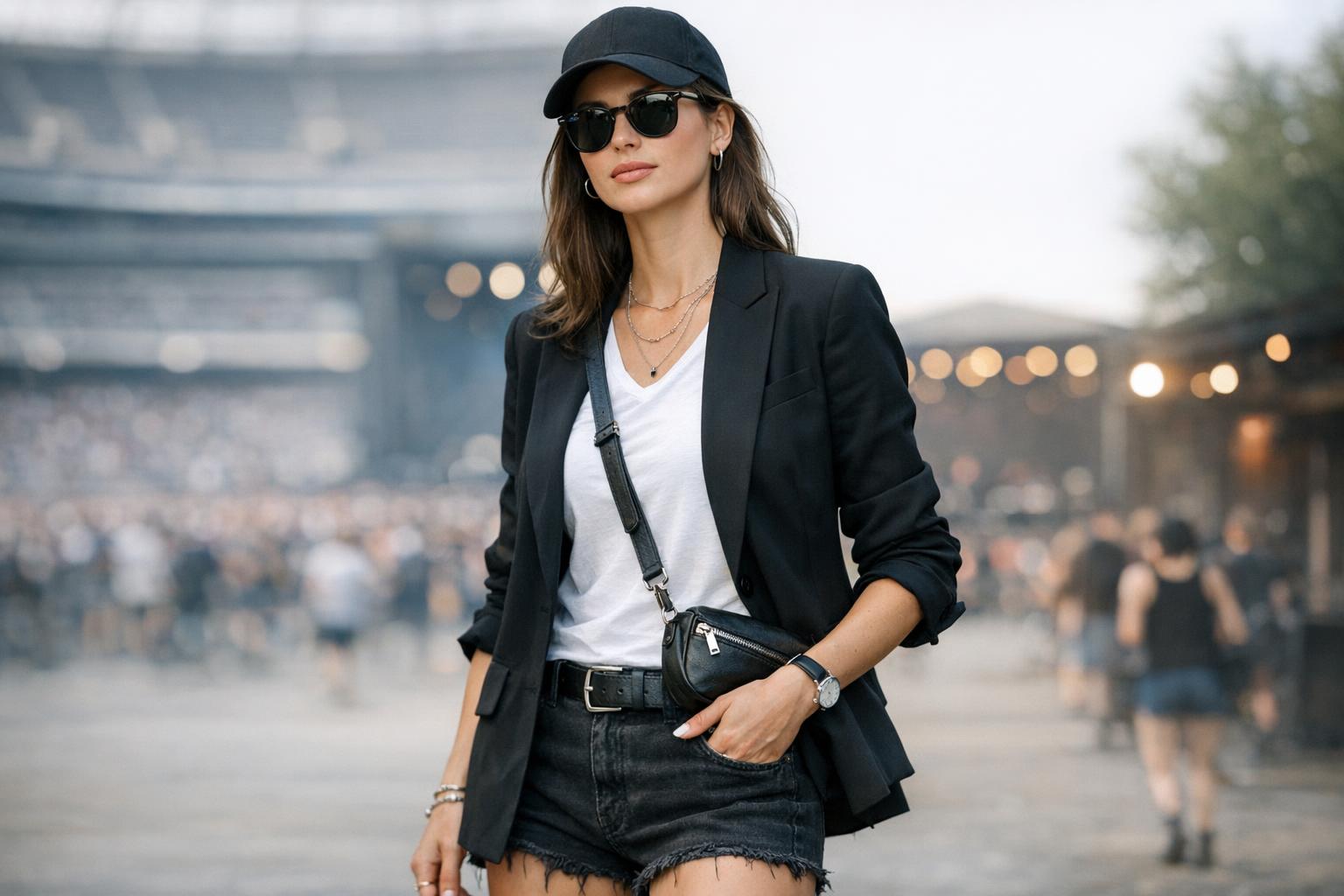
Category: Outfit Aesthetic

Outfit Aesthetic is all about creating a cohesive, recognizable style that reflects your personality and lifestyle. Instead of focusing on individual pieces, an outfit aesthetic looks at how colors, silhouettes, fabrics, and details work together to form a distinct visual identity. From timeless minimalism and quiet luxury to Parisian chic, Scandinavian simplicity, and modern street style, exploring different aesthetics can help you refine your wardrobe and develop a more intentional approach to fashion.

In this category, you’ll find curated inspiration, styling guides, and outfit ideas that highlight popular fashion aesthetics while remaining practical for everyday wear. Each post focuses on wearable combinations, balanced proportions, and versatile pieces that can easily integrate into a modern wardrobe. Whether you prefer clean neutral outfits, elevated casual looks, or romantic feminine styling, understanding outfit aesthetics makes it easier to build outfits that feel polished and consistent.

Our editorial approach is grounded in real fashion experience, combining insights from fashion retail, styling principles, and long-term wardrobe building. Rather than chasing short-lived trends, we focus on aesthetics that translate into timeless outfits you can adapt across seasons and occasions.

If you’re looking for fresh outfit inspiration, clear styling ideas, and guidance on defining your personal fashion identity, this Outfit Aesthetic category will help you discover styles that feel both authentic and effortlessly stylish.

  • A Calm, Modern Airplane Outfit for Long Haul Days

    A Calm, Modern Airplane Outfit for Long Haul Days

    The airplane outfit as a small act of composure

    There’s a particular moment at the airport—somewhere between the security line and the gate—when style becomes less about being “seen” and more about staying steady. A good airplane outfit does that quietly. It holds its shape when you’ve been sitting too long, it adapts to the cold gust of cabin air, and it still looks intentional when you arrive and head straight into the day. In other words: it’s not a costume, it’s a system.

    Airport dressing asks for a rare mix of polish and practicality. You need pieces that move, layer, and breathe. You need pockets that work, shoes you can walk in, and fabrics that don’t punish you for existing. And because most travel days have an element of unpredictability—temperature swings, delays, spilled coffee, sudden sprints to a new gate—your best flight outfit is one that can take a little chaos without looking like it did.

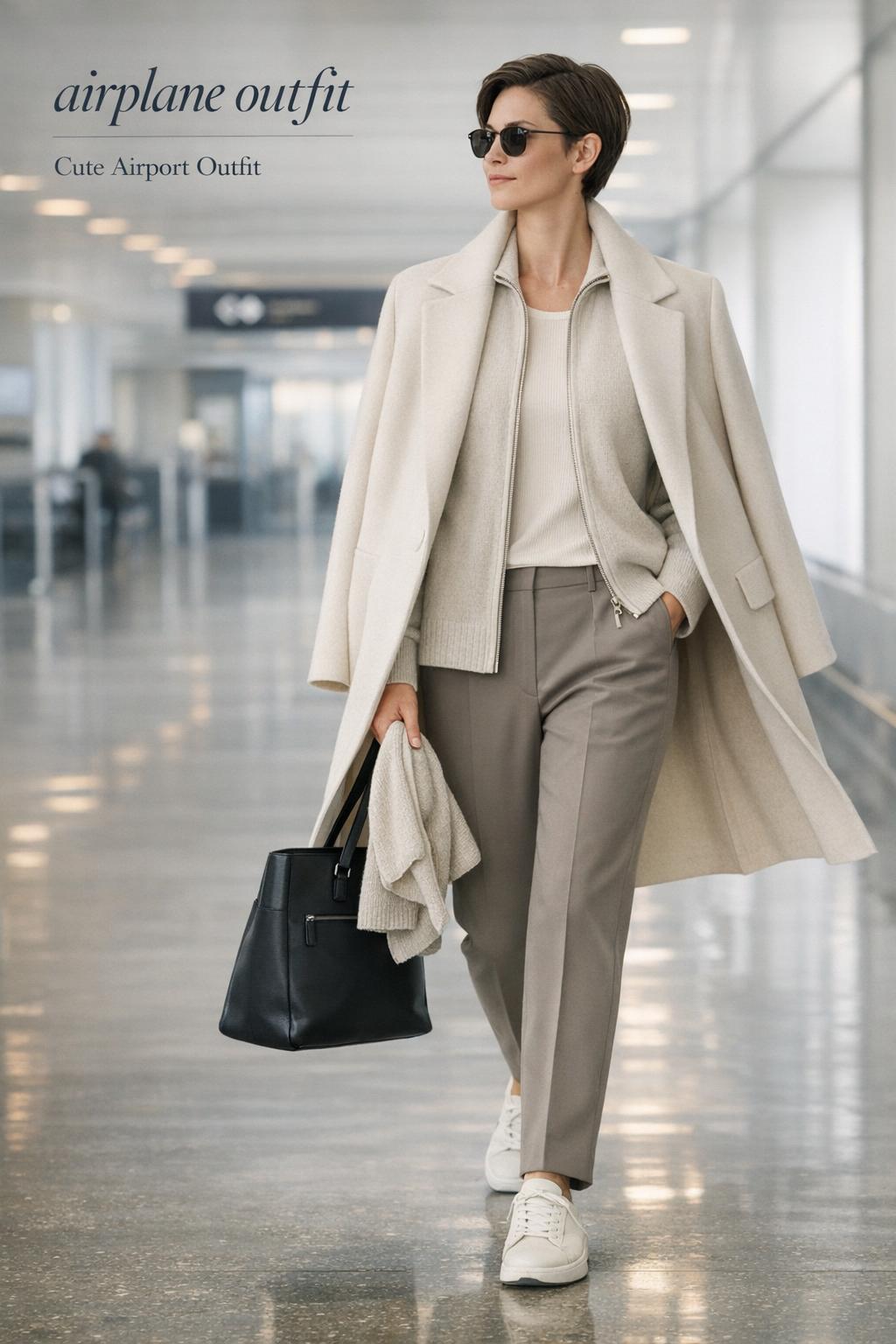
    Airplane outfit in a modern airport corridor with a stylish traveler in neutral layers walking toward the gate
    A stylish traveler strides through a bright, minimalist terminal in a polished neutral airplane outfit built for comfort and polish.

    This is where the “cute airport outfit” becomes more than a trend phrase. It’s a styling challenge: how to look refined without feeling restricted, and how to be comfortable without tipping into pajama territory. The answer is composition—clean lines, intelligent layering, and a silhouette that reads modern even when it’s built from simple basics.

    What makes airplane outfits work: silhouette, fabric, and temperature strategy

    Successful airplane outfits share a few structural principles. Not rules—principles. They’re the behind-the-scenes decisions that keep a look looking good after five hours in a seat and a trek through the terminal.

    Silhouette: relaxed, but not careless

    The most flattering travel silhouettes are gently defined. Think of a relaxed base with one point of structure: a straight-leg pant with a fitted tee, a soft knit set with a sharp coat, or leggings balanced by an oversized button-down. The goal is to avoid the all-tight or all-baggy extremes; both can feel uncomfortable in motion and visually unbalanced in photos. Instead, aim for proportion: volume on top with a sleeker bottom, or a fuller pant with a cleaner, closer-fitting layer above.

    Fabric: choose materials that behave

    Air travel exposes clothing to stress—friction from armrests, creasing from sitting, fluctuating cabin humidity, and the reality of carrying bags. The best flight outfit fabrics are those that recover: knits with a bit of structure, midweight cotton blends, soft but substantial jerseys, and woven fabrics that don’t wrinkle dramatically. Anything overly stiff can feel constricting; anything too thin can look tired quickly. A good litmus test is whether the fabric keeps its line when you pinch it lightly and release.

    Temperature: build a look that can expand and contract

    Airports run warm, planes run cold, and your destination might be anything. The best airplane outfit is one you can adjust without undoing it. That’s why layering is not optional—it’s your styling insurance. A base layer that feels comfortable on skin, a mid layer that adds warmth, and an outer layer that looks deliberate is the simplest framework. You’re not packing for a runway; you’re dressing for microclimates.

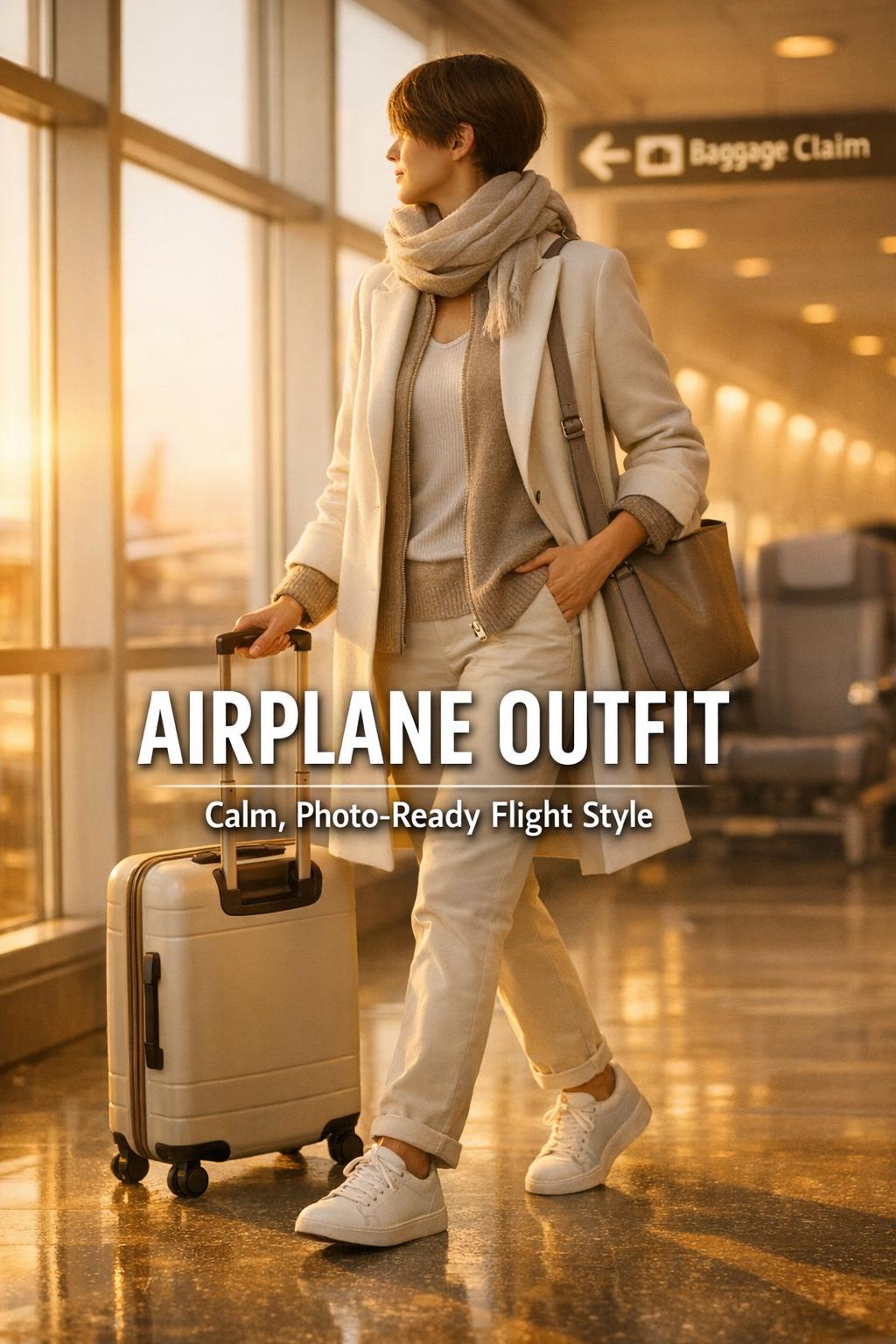
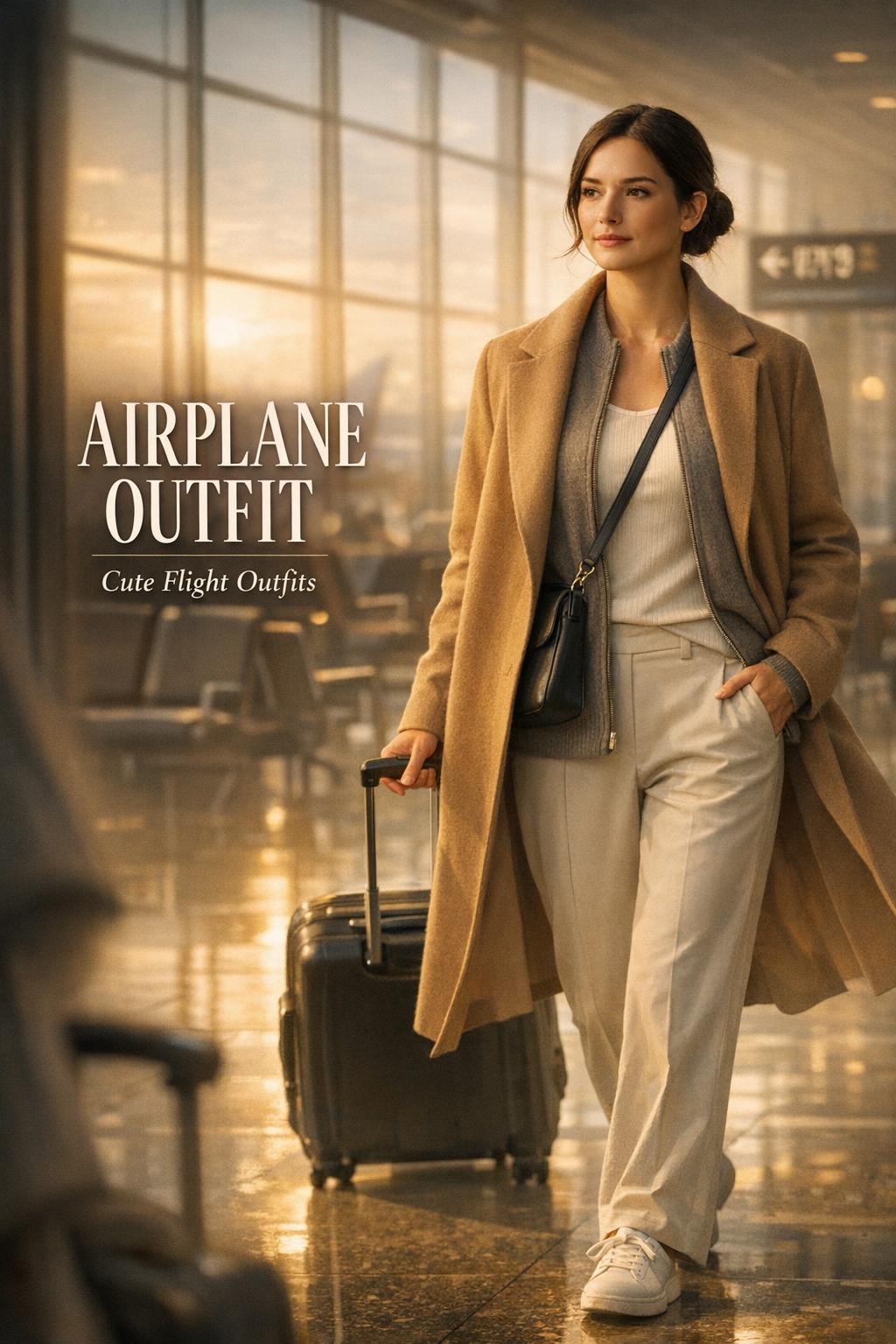
    Airplane outfit in a warm golden-hour airport terminal with a stylish traveler and carry-on, calm photo-ready flight style
    A calm golden-hour airport moment featuring a minimalist airplane outfit styled for polished, photo-ready comfort in transit.

    The modern cute airport outfit: elevate the basics

    “Cute” in an airport context isn’t about novelty. It’s about ease with intention: the kind of outfit that looks like you made choices, not compromises. The most reliable way to achieve that is to start with elevated basics—pieces you already own, styled with attention to line and texture.

    A simple base can look editorial when the proportions are right. A ribbed tank with a cardigan becomes sleeker when paired with a straighter pant and a belt bag worn close to the body. A sweatshirt stops feeling juvenile when the hemline is clean and the trousers are tailored. Even leggings can feel refined when the top layer is longer, crisp, and slightly architectural.

    • One clean focal point: a structured jacket, a sharp collar, or a well-cut trouser.
    • One soft element: knitwear, jersey, or a brushed fabric that reads comfortable.
    • One practical detail that looks designed: a sleek tote, a tidy crossbody, or a cap with a minimal silhouette.

    This is the quiet secret behind “cute flight outfits” that look expensive without trying: they’re balanced. They don’t shout. They hold a line.

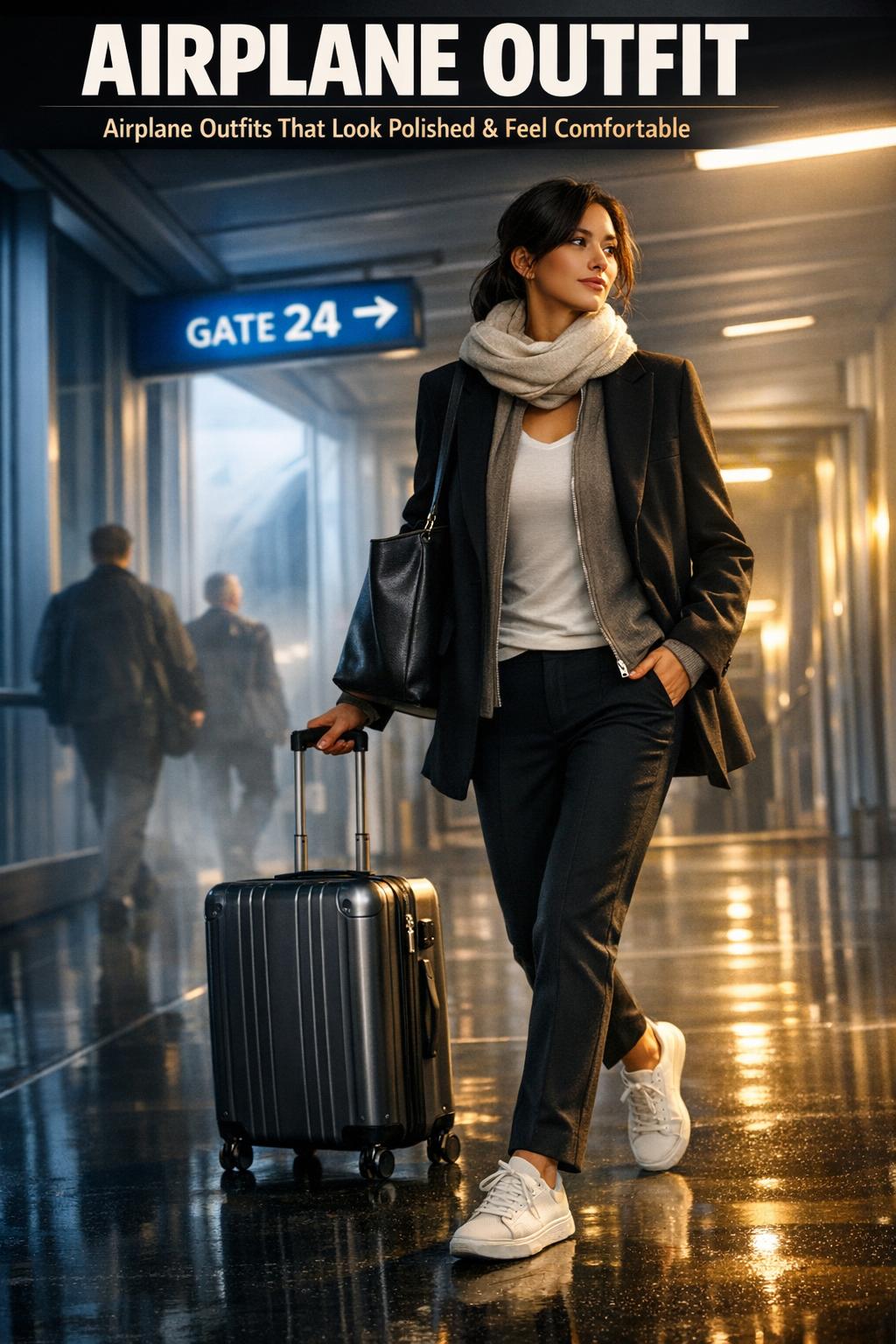
    Stylish airplane outfit with cozy travel layers and carry-on bag in an airport terminal
    A stylish airplane outfit pairs cozy layers with polished accessories for effortless comfort on travel day.

    Styling intelligence for your flight outfit: the layered core

    If there is one airport styling formula that consistently works, it’s the layered core—an outfit built around a base that can stand on its own, then upgraded with layers that can be removed or added without breaking the look.

    The base layer: soft and close, never fussy

    Your base should feel natural against skin because it’s the piece you’re least likely to remove. A fitted tee, a long-sleeve top, or a tank that sits flat under knits keeps you comfortable and avoids bunching. If you lean toward a minimalist look, choose a base in a neutral tone and let texture carry the interest: ribbing, a smooth jersey finish, or a slightly heavier cotton hand-feel.

    The mid layer: warmth that also creates shape

    Mid layers are where airport outfits become stylish rather than merely functional. A cardigan, a zip knit, or a light sweater adds warmth but—more importantly—creates a vertical line down the body. Leave it open for length, or half-zip for a sporty, modern neckline. Choose a mid layer with enough structure to avoid looking limp after sitting; the goal is a piece that drapes, not collapses.

    The outer layer: the “arrive like you mean it” piece

    The outer layer is what makes the entire airplane outfit feel intentional when you stand up at baggage claim. A structured coat, a blazer with a relaxed shoulder, or a clean-lined jacket can transform otherwise casual pieces. It also works as a practical barrier—against chilly cabins, sticky airport seats, and the general wear of travel. The best outer layers for airports are those that look good worn open; you rarely want to feel sealed in on a flight.

    Airplane outfits by mood: polished minimalism, sporty refinement, and modern comfort

    Not every travel day has the same rhythm. Sometimes you’re going straight into meetings. Sometimes you’re landing late and heading to a hotel. Sometimes you’re traveling as a group, taking pictures, and treating the airport like the first chapter of the trip. Your airplane outfit should match that energy.

    Polished minimalism: clean lines, quiet confidence

    This approach is perfect when you want to look sharp without looking dressed up. Think straight-leg trousers or dark, well-fitted leggings, a fine knit top, and an outer layer with structure. Keep the color story tight—two tones maximum—and let the silhouette do the work. Minimalism reads especially chic in airport lighting because it looks composed even under fluorescent glare.

    Tips: Keep hardware subtle. If you’re wearing jewelry, make it small and intentional. If you’re wearing a belt bag or crossbody, wear it close to the torso rather than hanging low, which can disrupt the line of the outfit.

    Sporty refinement: the elevated “off-duty” look

    Sporty doesn’t have to mean sloppy. The refined version is about selecting athletic-inspired pieces with a tailored sensibility: a clean sweatshirt with a crisp hem, joggers with a tapered leg, a sleek zip layer, and shoes that look streamlined rather than bulky. This is where a “cute airport outfit” often lives—effortless, practical, and still photo-ready.

    Tips: Watch the ankle. A jogger that hits cleanly at the ankle (not pooling) immediately looks more intentional. If your joggers run long, consider a cuffed style or a slight crop to keep the silhouette tidy.

    Modern comfort: soft sets, thoughtful contrast

    Co-ords and knit sets can be the most comfortable flight outfit option—if you style them with contrast. Without contrast, sets can read like loungewear. Add a sharper layer (a structured jacket, a crisp shirt, or a coat) and keep the shoes sleek. This creates a look that feels comfortable for a long-haul flight but still looks like clothing, not sleepwear.

    Tips: If you’re wearing a monochrome set, break it gently with a different texture—smooth leather-like accessories, a matte cap, or a woven tote. Texture variation is what makes monochrome look expensive.

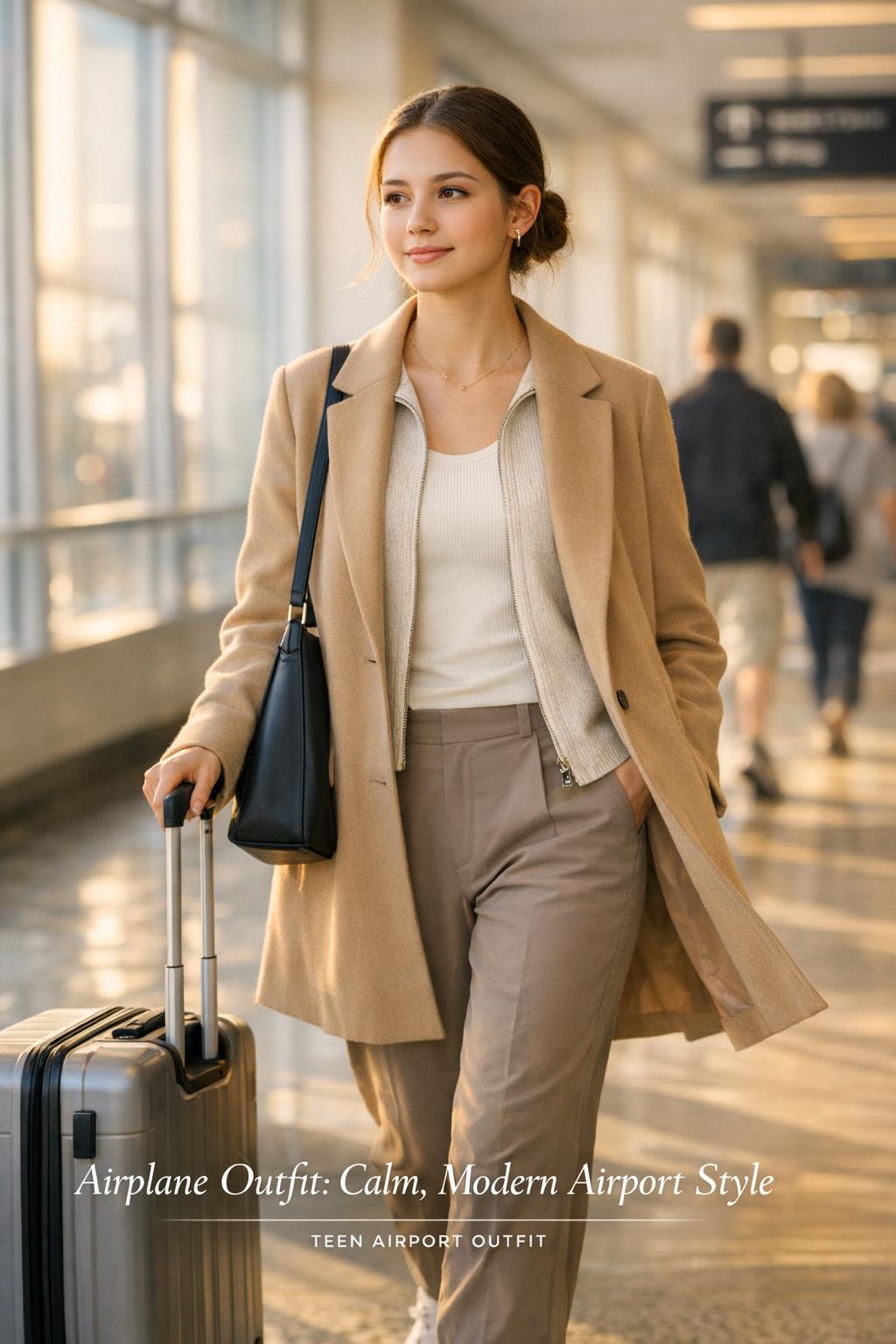
    Teen in calm airplane outfit walking through a modern airport terminal with carry-on in warm golden-hour light
    A teen traveler strolls confidently through a sunlit terminal in a calm, modern airplane outfit with minimalist layers and a carry-on.

    Teen airport outfit: balancing comfort, school-day ease, and grown-up polish

    A teen airport outfit often has different requirements than an adult one: you want comfort for sitting and walking, a look that feels current, and pieces that still feel like “you” rather than borrowed from someone else’s wardrobe. The style win is learning proportion early—how to mix oversized and fitted pieces so the outfit reads intentional.

    For teens, the easiest route to cute flight outfits is to start with a simple base—leggings or straight-leg pants—then add one oversized layer with shape, like a roomy sweatshirt or a relaxed jacket. Keep the color palette cohesive (neutrals, tonal grays, soft blues, or classic black-and-white) so the outfit photographs well and feels pulled together.

    • Choose one statement volume: oversized hoodie or roomy jacket—then keep the rest streamlined.
    • Prioritize movement: fabrics that stretch, waistbands that don’t dig, and layers you can remove easily.
    • Keep accessories functional: a compact crossbody for phone and boarding pass, plus a tote or backpack that sits comfortably.

    What often doesn’t work: ultra-short tops paired with low-rise pants for a cold cabin, or heavy layers without breathable bases. Airports are long days. The best looks are the ones you don’t have to adjust every five minutes.

    Airport-specific reality checks: security, seating, and the long walk

    Even the most beautiful airplane outfit fails if it ignores how airports function. The environment is physical: you’ll lift bags overhead, sit in narrow seats, and walk farther than you think—often in a hurry.

    Security styling: reduce friction without losing style

    Security lines reward simplicity. Shoes that come on and off without drama, layers you can remove quickly, and minimal metal details make the process smoother. This is not about dressing down; it’s about designing an outfit with an efficient rhythm. If your look includes a belt, heavy jewelry, or elaborate lace-up footwear, be prepared for a slower routine.

    Seating reality: what feels good after three hours

    Airplane seats compress fabric, and the wrong choices will make themselves known fast. Waistbands that pinch, stiff denim that fights your hips, and scratchy knits can turn a short flight into a long one. If you love denim, consider softer, stretchier pairs and a slightly higher rise for comfort. If you’re wearing a dress, layer it with leggings or choose a knit that doesn’t ride up. The point isn’t to avoid fashion; it’s to choose fashion that doesn’t punish you.

    The terminal walk: your shoes are the foundation

    Airports are built for walking. Your shoes need to handle hard floors, long corridors, and sudden pace changes. A sleek, supportive sneaker is often the smartest choice because it balances comfort with a modern silhouette. If you prefer flats, ensure they won’t slip off when you’re rushing. If you insist on a heel, choose a stable shape and accept that it may not be the most efficient travel decision.

    Season and destination: how to dress for the climate gap

    Travel style is never just about the flight; it’s about the transition. The airport is an in-between space, and your airplane outfit needs to bridge climates without making you carry your closet.

    Cold origin, warm destination

    When you’re leaving a cold city and landing somewhere warm, the smartest strategy is lightweight layering. Wear your warmest piece as an outer layer you can carry easily—something that looks good folded over an arm or looped onto a bag. Underneath, keep your base breathable so you can step into heat without feeling overwhelmed. The best travel outfits here rely on pieces that look complete even when you remove the coat: a clean top, a well-proportioned pant, and shoes that work in both climates.

    Warm origin, cold cabin, chilly destination

    This is where many cute airport outfit attempts go wrong: dressing for summer heat and forgetting the airplane is often cold. You’ll want a base that works in warmth—short sleeves or breathable knits—plus a mid layer that provides real comfort in the cabin. A scarf or wrap-like layer is useful here because it can double as a blanket without looking like you raided the bedding aisle.

    Unpredictable weather and delays

    When you’re not sure what you’re walking into, lean into versatility: neutral tones, layers with clean lines, and shoes that can handle a sudden downpour or a long wait. Avoid fabrics that show every wrinkle and every spill. This is also when darker palettes can feel reassuring—less maintenance, more composure.

    The art of looking polished in photos—without dressing for photos

    Airport photos are their own genre: harsh lighting, reflective floors, and angles that don’t flatter. The answer isn’t to overstyle; it’s to simplify and choose shapes that hold their integrity.

    • Choose a strong neckline: a crewneck, a collar, or a clean V creates structure near the face.
    • Keep the palette cohesive: tonal neutrals photograph more elegantly than high-contrast chaos.
    • Prioritize vertical lines: open layers elongate and keep the outfit looking intentional.
    • Mind the bag scale: an oversized bag can swallow a petite frame; a tiny bag can look impractical. Aim for proportionate.

    A refined flight outfit reads as calm. It doesn’t fight the environment. It looks like it belongs in motion—walking, waiting, arriving.

    Common airplane outfit mistakes (and how to correct them elegantly)

    Airport dressing is full of small traps. They’re easy to fall into because we tend to prioritize either comfort or aesthetics, when the best airplane outfits are a collaboration between the two.

    Mistake: overly tight, overly thin, overly exposed

    What looks fine for a quick errand can feel uncomfortable and overly revealing in a cold cabin and crowded terminal. The fix is not necessarily to cover up, but to balance: if the bottom is fitted, soften and lengthen the top; if the top is cropped, add a layer that gives coverage when you sit and stand.

    Mistake: too many fussy details

    Complicated closures, delicate fabrics, and accessories that require constant adjustment rarely survive a travel day. Streamline. Keep one or two details that feel special—an elegant coat line, a clean shoe, a refined knit—and let the rest be quietly functional.

    Mistake: the “sleepwear disguise”

    There’s a difference between comfortable and careless. If your look resembles sleepwear, it often lacks contrast, structure, or a finishing piece. Add a crisp outer layer, choose a more defined pant shape, or swap in a cleaner shoe silhouette. Suddenly the same comfortable base reads like a considered cute airport outfit.

    Tips for making cute flight outfits feel personal—not copied

    The most stylish travelers aren’t the ones in the newest pieces. They’re the ones who understand their own uniform: what shapes flatter them, what fabrics feel good, and what details make an outfit feel like theirs.

    Tips: Start by identifying your “non-negotiables.” If you hate tight waistbands, build around a soft waistband and add structure with a jacket. If you always get cold, make the mid layer the hero and keep the base minimal. If you love a clean, European minimal aesthetic, choose a tonal palette and let silhouette carry the elegance. This is how airplane outfits become repeatable without becoming boring.

    • Use one signature element: a cap, a specific neutral palette, or a consistent outerwear shape.
    • Repeat shapes you trust: once you find a pant rise and leg shape that works for sitting, keep it as your travel foundation.
    • Finish with grooming, not glitter: neat hair and clean shoes do more than flashy accessories in an airport setting.

    Practical packing logic: keep your travel outfit doing double duty

    The smartest airplane outfit is one that works again after you land. If your travel day ends with dinner, a meeting, or simply the desire to feel put-together, you’ll appreciate pieces that can shift contexts.

    Build your flight outfit around items that can be restyled: a knit that pairs with jeans later, trousers that can be worn with a different top, an outer layer that elevates multiple looks. This is less about minimal packing as a principle and more about travel sanity—fewer pieces, more coherence.

    Tips: Keep one “reset” item accessible in your bag—a fresh top layer or a light knit—so you can change the feel of your look quickly after landing. It’s a small move that makes a long travel day feel less visible on you.

    How to choose the right cute airport outfit for your trip type

    A weekend city break, a long-haul flight, and a family trip each ask for different priorities. The best flight outfit isn’t universal; it’s contextual.

    Short domestic flights: light layers, sharper finish

    For quick flights, you can afford a slightly more structured look because you won’t be seated as long. A polished minimal base with a crisp outer layer is ideal—comfortable enough for the plane, sharp enough to arrive and move on immediately.

    Long-haul flights: softness, warmth, and friction-free comfort

    Long-haul demands kindness from your clothes. Prioritize soft fabrics, generous layering, and shoes that won’t make your feet miserable. This is where “cute flight outfits” should lean into knit sets, relaxed trousers, and a warm layer you can use like a blanket—without sacrificing shape.

    Travel days with plans immediately after landing

    If you’re landing and heading straight out, choose an outfit that looks complete without needing a full change. A cleaner pant, a structured outer layer, and a cohesive palette will take you farther than anything overtly “dressy.” Comfort remains essential, but polish becomes the leading note.

    Airplane outfit inspiration: stylish woman in neutral layers walking through a modern airport terminal at golden hour
    A calm, modern traveler wears a chic neutral airplane outfit as warm window light fills the airport terminal.

    FAQ

    What should I wear on a plane to be comfortable but still look polished?

    A polished airplane outfit starts with a comfortable base (soft top and flexible pants), then adds one structured layer—like a clean-lined jacket or tailored outerwear—to create shape; keeping the color palette cohesive and the fabrics substantial helps the look stay refined after hours of sitting.

    How do I make a cute airport outfit without looking overdressed?

    Focus on elevated basics and proportion rather than dressy pieces: pair a relaxed item (like a knit or sweatshirt) with a cleaner counterpart (like straight-leg pants or a crisp layer), and let a simple, practical bag and tidy shoes finish the outfit without adding fuss.

    Are leggings acceptable as an airplane outfit?

    Leggings work well for travel when balanced with a longer or more structured top layer—such as a crisp shirt, a polished knit, or a defined outer layer—so the overall silhouette reads intentional and comfortable rather than overly casual.

    What’s the best flight outfit for a cold airplane cabin?

    The most reliable approach is a layered system: a soft base layer against the skin, a mid layer that provides real warmth, and an outer layer that can be worn open; this keeps you comfortable without forcing you into a bulky outfit that feels restrictive in a seat.

    How can I style cute flight outfits for a long-haul flight?

    Choose soft, substantial fabrics that won’t itch or crease harshly, avoid tight waistbands, and build in adjustable warmth with layers; a cohesive tonal palette and a clean shoe silhouette will keep the look modern even when comfort is the priority.

    What should a teen airport outfit prioritize?

    A teen airport outfit should prioritize movement, temperature comfort, and proportion—often by pairing a streamlined base (leggings or straight-leg pants) with one oversized layer that has shape, keeping the color story cohesive so the look feels current and composed.

    How do I dress for a warm destination if my departure city is cold?

    Wear a warm outer layer you can carry easily and keep the layers underneath breathable and complete on their own; that way, your airplane outfit transitions smoothly when you remove the coat after landing without leaving you feeling underdressed or overheated.

    What are common airplane outfit mistakes to avoid?

    The most common mistakes are choosing overly tight or scratchy pieces, relying on thin fabrics that look tired quickly, and wearing outfits with too many fussy details; correcting them usually means adding structure through a clean layer, simplifying accessories, and choosing fabrics that hold their shape.

    How can I make my airport look photograph well without dressing just for photos?

    Prioritize clean lines and balance: keep the palette cohesive, use layers to create vertical length, choose a strong neckline near the face, and make sure your bag and shoes are proportionate to your frame so the outfit looks composed in harsh airport lighting.

  • The Modern Fitted Shirt Outfit: Polished Minimalism, Real Life

    The Modern Fitted Shirt Outfit: Polished Minimalism, Real Life

    Introduction

    A fitted shirt outfit is one of those rare style moves that reads as both intentional and effortless—especially in the in-between moments of real life: the morning commute, a last-minute dinner reservation, a gallery afternoon that turns into cocktails. The fitted shirt has structure, but it doesn’t demand ceremony. It simply sharpens your silhouette and makes everything around it look more considered.

    The visual identity here is polished minimalism with a quietly sensual edge: clean lines, a defined waist or torso, and styling that plays with proportion—sleek on top, relaxed elsewhere. Think of it as a modern uniform you can tune to different moods, from pared-back European ease to a slightly more downtown, American practicality.

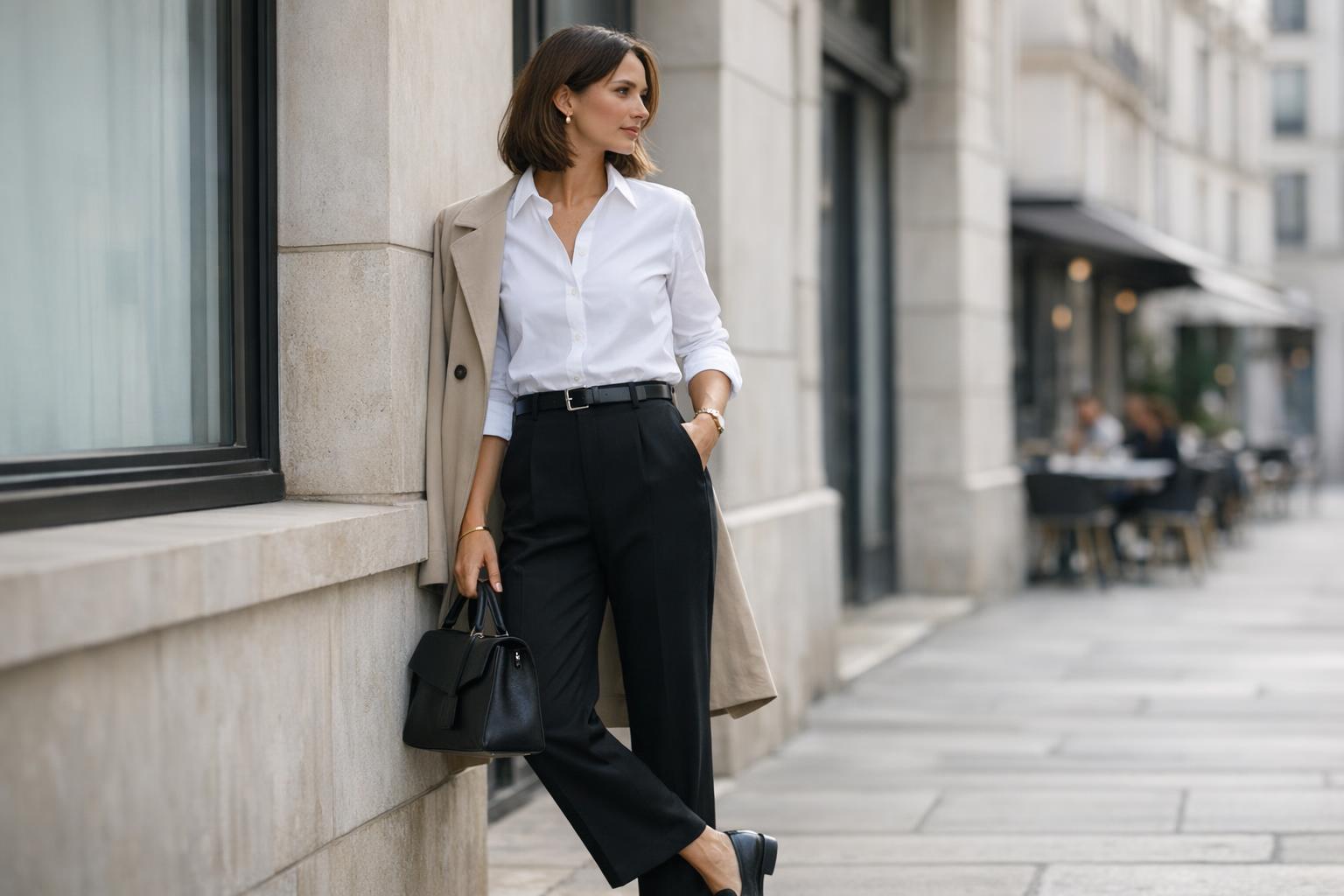
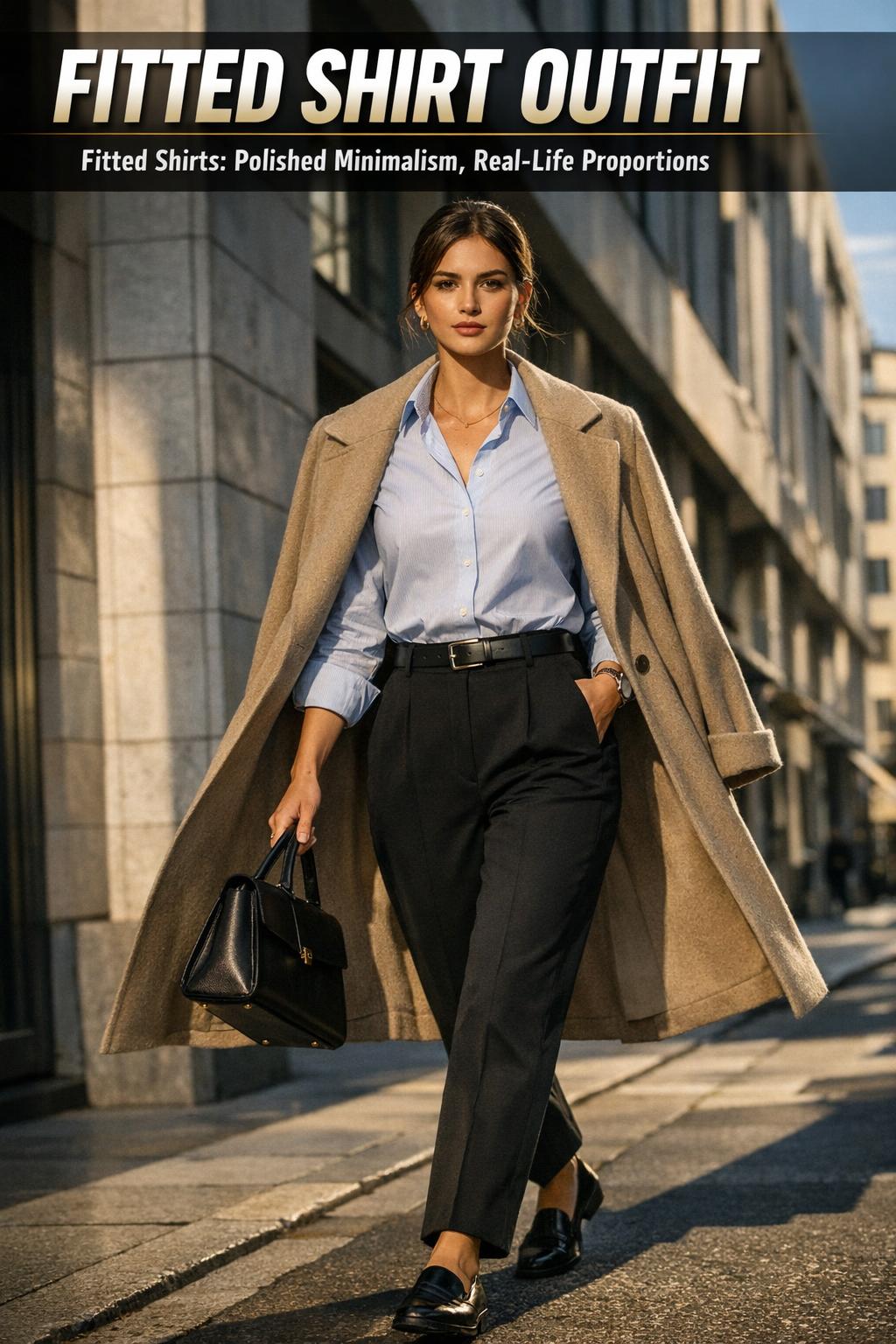
    Fitted shirt outfit editorial street style with woman in crisp button-up, tailored trousers and trench coat in modern lobby
    A confident woman strides through a minimalist stone-and-glass street corner in a crisp button-up and tailored trousers for a refined fitted shirt outfit.

    It’s popular because it solves a familiar styling puzzle: how to look “put together” without feeling overdressed. A fitted shirt—whether crisp cotton, a soft stretch poplin, or a subtle rib—creates a controlled foundation that works across offices, weekends, travel days, and evenings. The best part is its adaptability: one shirt can feel architectural under tailoring, casual with denim, or quietly provocative when styled with a long line and minimal accessories.

    The fitted shirt, defined: what makes it work

    “Fitted” isn’t synonymous with “tight.” In a modern wardrobe, fitted shirts are about clean contact with the body—skimming rather than clinging—so the outfit reads streamlined without restricting movement. The aim is a silhouette that holds its shape: a collar that frames the face, a shoulder seam that sits where it should, and a torso that’s shaped enough to feel deliberate under layers.

    When a fitted shirt outfit looks exceptional, it’s usually because the fit has been balanced against something looser: a wide-leg trouser, a slouchy jean, an oversized coat, or a relaxed skirt. This tension—tailored structure against ease—is the aesthetic engine. If everything is fitted, the result can feel dated or overly formal; if everything is loose, the outfit loses clarity.

    Key fit checkpoints that separate “sharp” from “stiff”

    In practice, a fitted shirt should let you breathe, sit, and reach without pulling at the buttons or twisting at the side seams. The collar should lie flat without gaping, and the shirt should be long enough to stay tucked (if you’re tucking) without constant adjustment. These details matter because the fitted shirt is often the focal point—any small fit issue becomes part of the visual story.

    • Shoulders: seams sit at the edge of the shoulder bone, not down the arm
    • Chest: no strain lines; buttons lie flat when you move
    • Waist: shaped enough to define, relaxed enough to sit comfortably
    • Hem length: long for a clean tuck, or intentionally cropped for proportion play
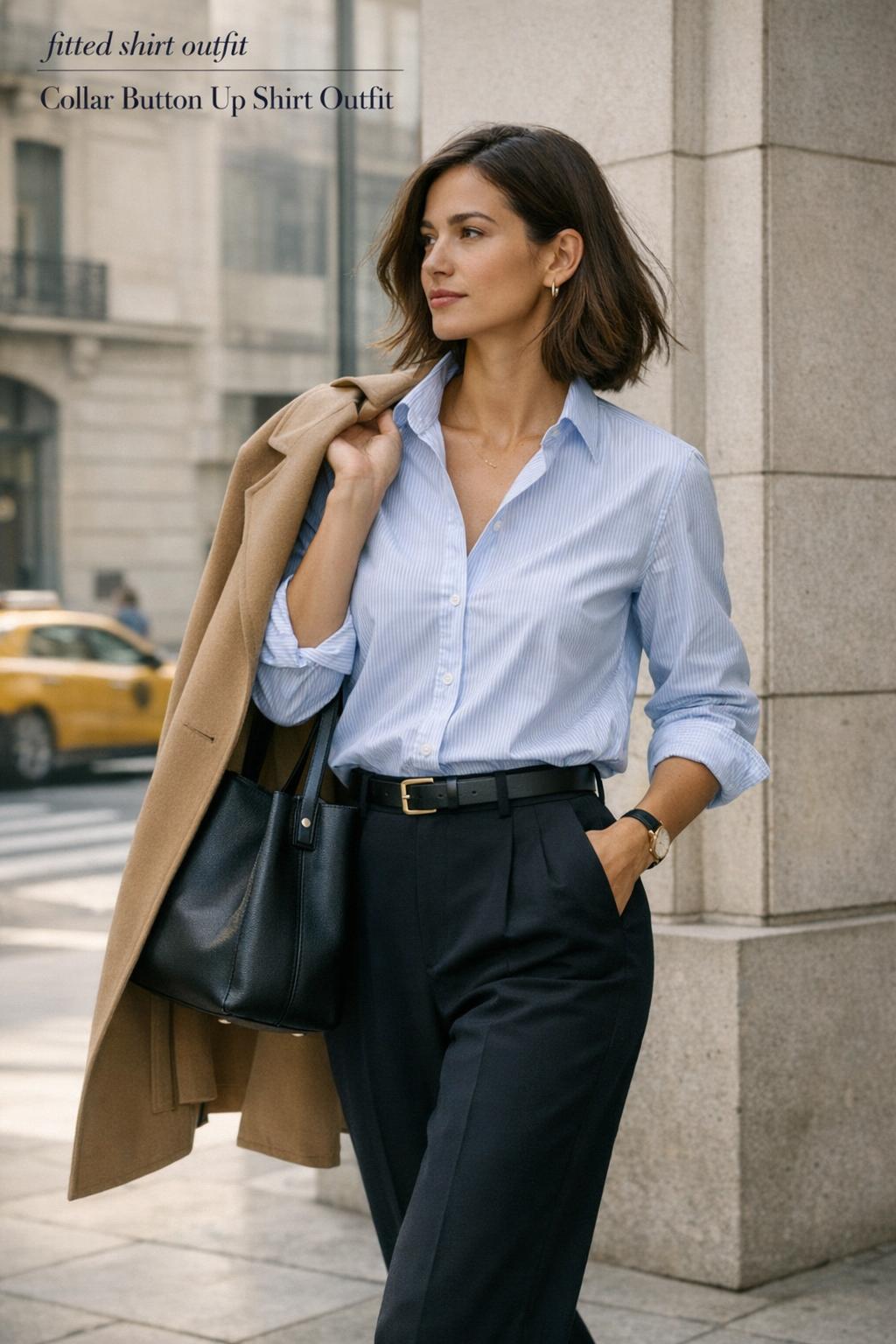
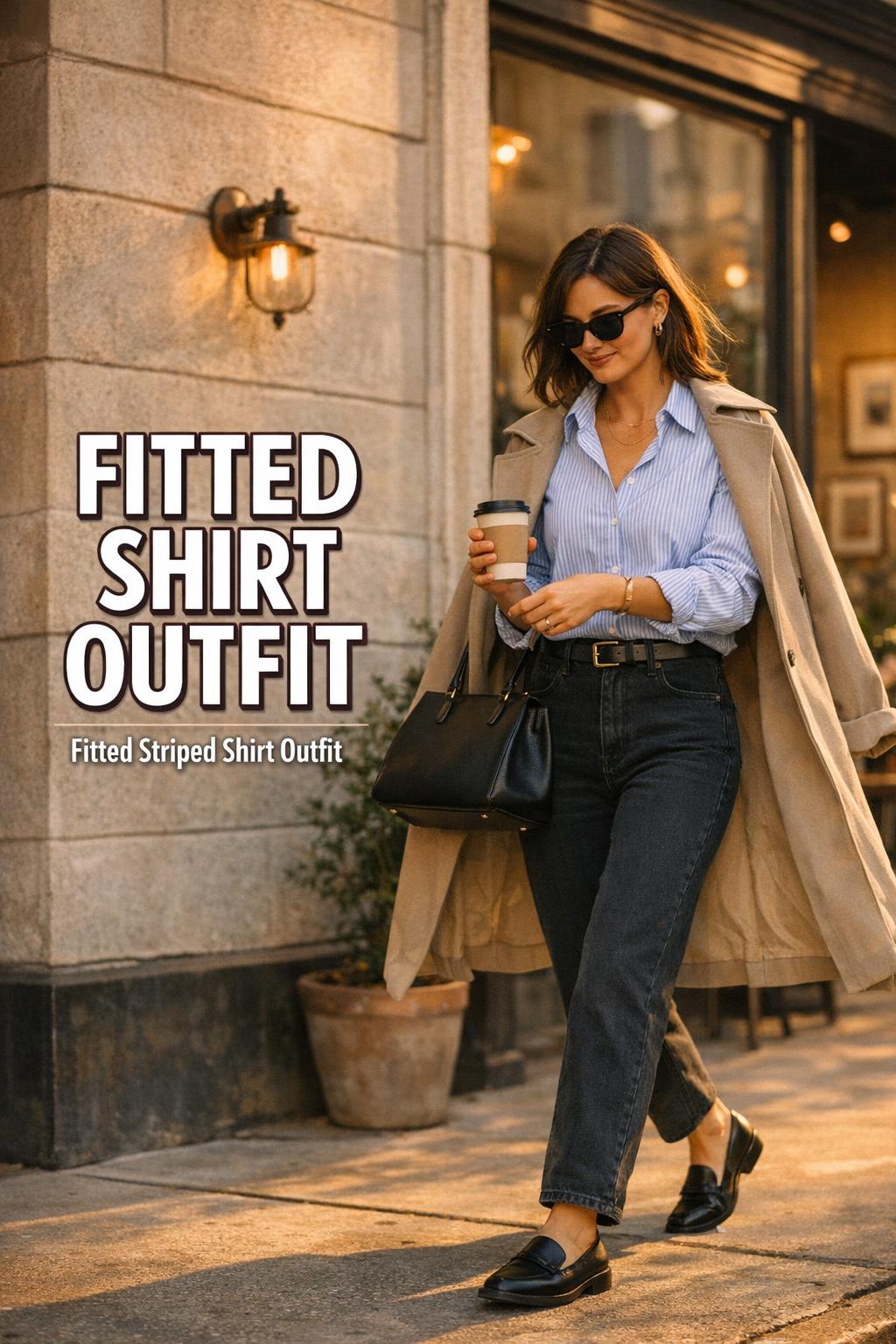
    Fitted shirt outfit in golden-hour street style, woman walking past a European-style café in tailored trousers and trench.
    A confident woman in a fitted striped shirt and tailored trousers strolls past a sunlit European-style street café.

    Look: collar button-up shirt outfit in crisp minimal tailoring

    This is the fitted-shirt look that feels most “editorial office,” the kind of polish you’d associate with a fast morning in Paris or Milan—sleek, quiet, and composed. The silhouette is narrow on top and elongated through the leg, creating a clean column that reads professional without feeling corporate.

    Anchor the look with a collar button-up shirt outfit in structured cotton or poplin, worn fully buttoned or with only the top button undone for a softer frame at the neckline. Pair it with high-rise tailored trousers—straight or gently wide—so the waistline becomes the transition point between fitted and fluid. Keep the palette restrained: white, pale blue, or soft cream against black, charcoal, or deep navy.

    • Key garments: fitted collared shirt, high-rise tailored trousers
    • Footwear: sleek loafers or refined low-heel boots
    • Accessories: slim belt, minimal watch, structured bag

    Why it fits the aesthetic: the shirt delivers structure and intention, while the trousers provide ease and movement. The overall effect is a modern uniform—controlled, minimal, and quietly powerful—built on proportion rather than decoration.

    Look: fitted striped shirt outfit with relaxed denim and precise accessories

    Fitted shirt outfit with tailored pants in a minimalist street style look
    A sleek fitted shirt outfit paired with tailored pants creates a polished, modern street style look.

    A fitted striped shirt outfit has an inherent graphic intelligence: the lines do some of the styling work for you, adding rhythm and direction to the torso. The mood here is clean and city-ready—an elevated casual look that feels just as appropriate for a coffee meeting as it does for an afternoon in a bookstore.

    Choose a fitted striped shirt with a crisp collar and a close-but-comfortable body. Keep the stripe classic and understated so it reads timeless rather than novelty. The contrast comes from denim: a relaxed straight leg or a slightly slouchy silhouette that sits lower on the hip for a quieter, more modern nonchalance. A tidy belt and a structured shoe bring the outfit back into focus.

    • Key garments: fitted striped button-up, straight or relaxed jeans
    • Footwear: clean sneakers for day, loafers for a sharper note
    • Accessories: leather belt, simple hoops, compact shoulder bag

    Why it fits the aesthetic: the fitted shirt provides the “line,” and the denim provides the “air.” Together, they create a look that feels composed but never precious—exactly what a modern fitted shirt outfit should do in everyday life.

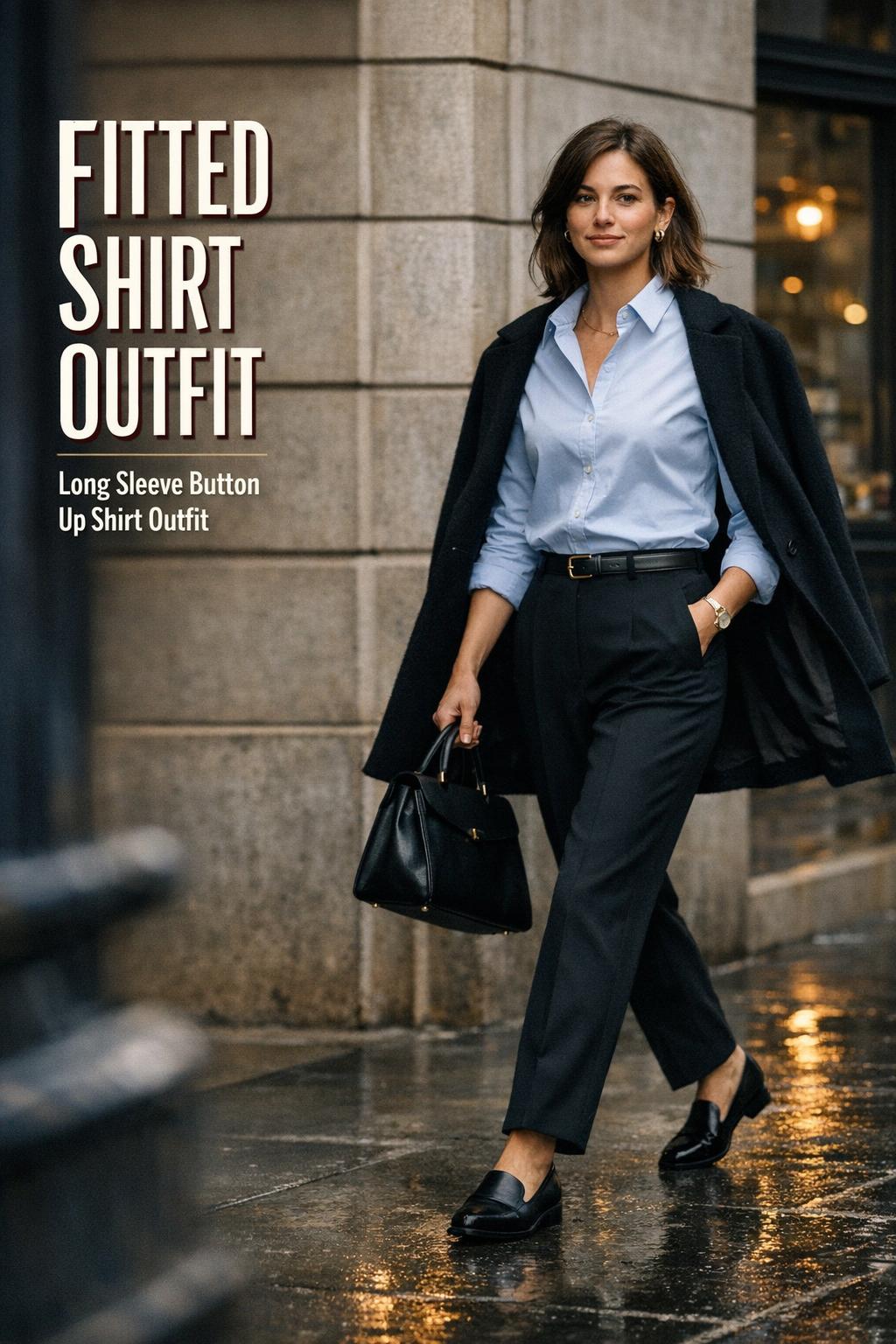
    Look: long sleeve button-up shirt outfit with tonal layering for transitional weather

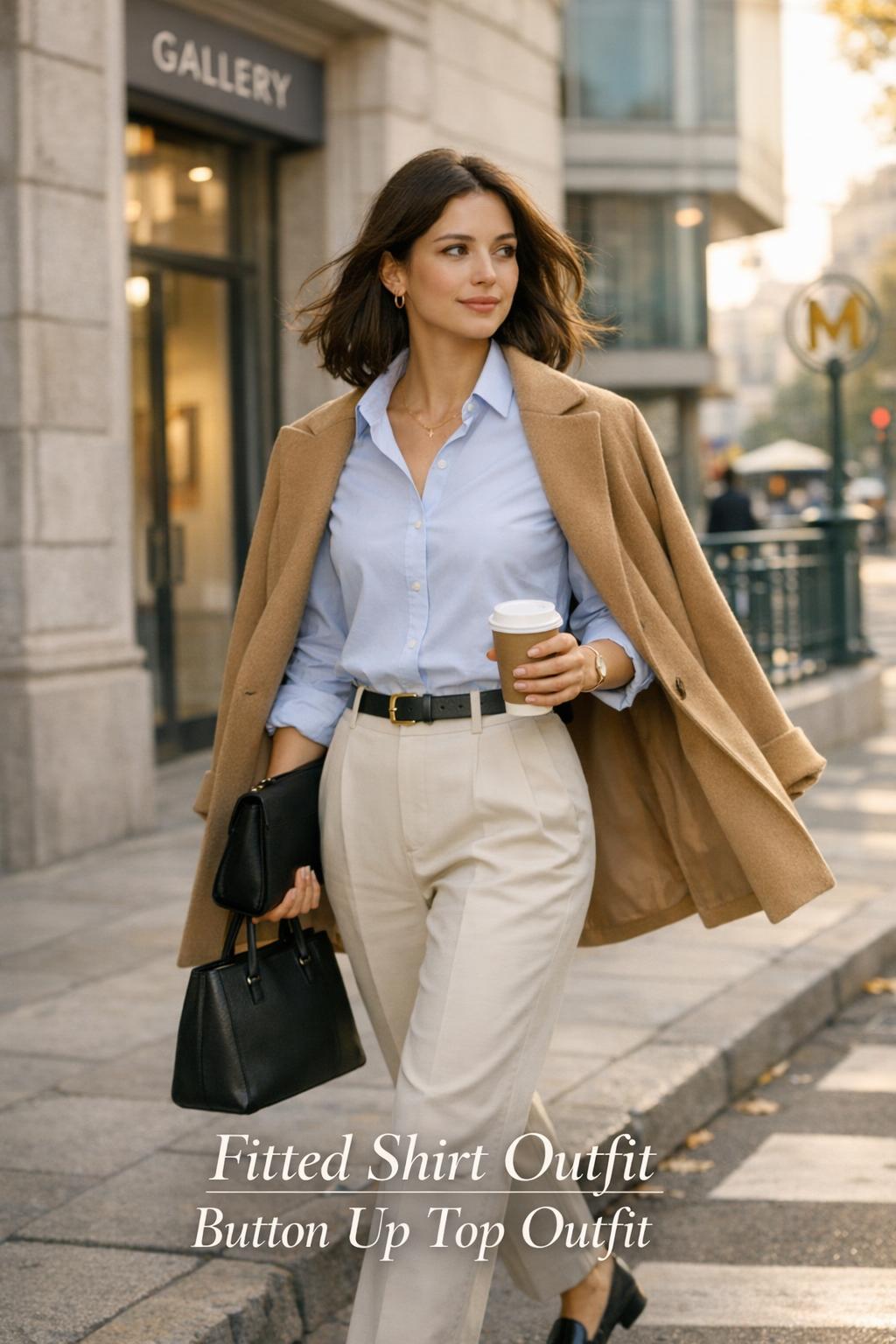
    Fitted shirt outfit inspiration: stylish woman walking by a European gallery in golden-hour light with tailored trousers
    A stylish woman strides past a modern European gallery in golden-hour light, showcasing a polished fitted shirt outfit with tailored trousers.

    There’s a particular sophistication to tonal dressing in transitional weather: it looks intentional, photographs beautifully, and feels calm. This long sleeve button-up shirt outfit leans into texture and subtle color shifts—think soft neutrals or a deep monochrome—so the eye reads the silhouette before it notices the pieces.

    Start with a fitted long sleeve button-up shirt in a smooth, structured fabric that holds a clean line under layers. Add a fine-gauge knit draped over the shoulders or a tailored outer layer that skims the body without compressing it. On the bottom, a fluid trouser or a straight midi skirt keeps the look elegant while remaining comfortable for a full day of movement—walking between meetings, sitting for long lunches, stepping into cooler evening air.

    Why it fits the aesthetic: the fitted shirt acts like an architectural base layer, and the tonal approach keeps the styling refined. It’s minimalism with depth—less about “statement pieces,” more about controlled composition.

    Style tip: make tonal outfits look rich, not flat

    When you stay in one color family, rely on texture and finish to create dimension. Pair a crisp cotton shirt with a matte trouser, or contrast a smooth poplin with a softly brushed coat. Even small shifts—cream to oatmeal, navy to ink—create a layered, European-feeling sophistication without adding visual clutter.

    Look: button up top outfit with a soft waist and subtle evening polish

    Not every fitted shirt outfit needs to read “daytime.” The evening version is quieter than a full going-out top, but it has a certain confidence—more refined than flashy. The silhouette is controlled through the torso, then softened through the styling: a slightly open neckline, a defined waist, and a fluid movement below.

    Use a fitted button up top outfit as your base—something with a clean collar and a smooth finish. Style it with a skirt that moves (a midi length works particularly well) or a tailored trouser with a gentle drape. The color palette can stay classic—black, white, deep neutrals—or shift into softer tones for a more romantic edge. Accessories should feel deliberate: one strong element is enough, whether that’s sculptural earrings, a sleek bag, or a refined heel.

    Why it fits the aesthetic: it’s an exercise in restraint. The fitted shirt creates poise; the styling choices create mood. You look dressed without looking like you tried to be “dressy,” which is often the most modern kind of evening elegance.

    Look: fitted shirts under relaxed outerwear for an off-duty city uniform

    This interpretation is about contrast in scale: a fitted shirt against an outer layer that’s intentionally roomier. The vibe is Copenhagen-adjacent—practical, architectural, and unfussy—ideal for errands that turn into impromptu plans. The fitted shirt keeps the base clean; the outerwear brings the attitude.

    Choose fitted shirts in neutral shades—white, pale blue, or soft gray—then layer a relaxed coat or jacket over the top. Keep the bottom half comfortable and modern: a straight trouser, a relaxed jean, or even a tailored short with tights when the weather calls for it. The key is that the shirt remains visible at the collar and cuffs, acting as a crisp frame beneath the softer outer layer.

    • Key garments: fitted shirt, relaxed outerwear, straight-leg bottoms
    • Footwear: boots for structure, minimalist sneakers for ease
    • Accessories: scarf in a muted tone, sunglasses, understated tote

    Why it fits the aesthetic: the fitted shirt is the anchor that keeps relaxed pieces from feeling messy. It’s the styling equivalent of a clean line in architecture—quiet, but essential.

    Look: the modern tucked-and-unbuttoned formula (without the styling clichés)

    The half-tuck and the slightly unbuttoned neckline are everywhere for a reason: they create ease. But the difference between looking styled and looking accidental comes down to symmetry and intention. This look is a study in relaxed polish—a fitted shirt outfit that feels lived-in, not sloppy.

    Start with a fitted shirt that’s tailored through the torso but not skin-tight. Unbutton just enough to elongate the neck, then choose one deliberate styling move: a clean full tuck with a sharp belt, or a controlled partial tuck that emphasizes the waistline without adding bulk at the hips. Balance it with a bottom that has shape—straight trousers, a structured skirt, or a clean denim silhouette—so the loosened neckline doesn’t make the whole outfit drift.

    Why it fits the aesthetic: it reads effortless, but the silhouette is still “held.” The fitted shirt keeps your lines clean; the styling makes it feel modern and wearable rather than overly formal.

    How to recreate a fitted shirt outfit with pieces you already own

    Most wardrobes already contain the raw materials for this aesthetic: a collared shirt, a pair of trousers, a denim option, and a coat or jacket. The shift comes from how you edit. The goal is not to buy a whole new look, but to refine your proportions so the fitted element feels intentional.

    • Choose one fitted piece only: let the shirt be fitted, then keep the bottom relaxed or straight
    • Control the waistline: use a tuck, a belt, or a high-rise bottom to define proportion
    • Repeat a color: echo the shirt tone in your shoes or bag for a cohesive finish
    • Keep accessories minimal: one strong element reads more editorial than many small ones
    • Mind fabric behavior: crisp shirts look sharp; softer shirts look romantic—style accordingly

    Practical tip for real life: movement matters

    If you’re wearing a fitted button-up for a full day—driving, working, commuting—test the fit while sitting. A shirt that looks perfect standing can pull at the bust or waist once you’re seated. A subtle adjustment (slightly more room through the torso, a different bra shape, or a higher-rise bottom) keeps the look polished without constant fussing.

    Common styling mistakes that make fitted shirts feel dated

    Fitted shirts have history—they can quickly skew “old office” if the styling is too literal. The modern approach is about mixing structure with ease, keeping the outfit clean but not rigid. A few predictable pitfalls tend to flatten the look.

    • Pairing a very fitted shirt with very fitted pants, creating a compressed silhouette
    • Over-accessorizing with multiple statement items competing at the neckline
    • Choosing overly stiff fabric with no room for movement, leading to pulling and gaping
    • Ignoring proportion: long shirt tails over low-rise bottoms can shorten the leg line
    • Overly perfect styling (too many “rules”), which can drain the outfit of ease

    A modern fitted shirt outfit should feel like a decision, not a costume. If you’re unsure, simplify: clean shirt, thoughtful bottom, one strong shoe, and a coherent palette. That restraint is often what makes the look feel current.

    Key pieces that quietly elevate fitted shirts

    Because a fitted shirt is a foundational piece, the supporting cast matters. You don’t need many items, but you do need the right categories—pieces that respect the shirt’s clean lines rather than fighting them. Think of these as the wardrobe “architecture” that helps fitted shirts look intentional across settings.

    • A high-rise trouser with a straight or gentle wide leg to balance the fitted torso
    • A structured belt that defines the waistline without adding bulk
    • A refined flat (like a loafer) and a sleek boot option for season shifts
    • A relaxed outer layer that adds contrast in volume
    • A compact bag shape that feels polished, not heavy

    These pieces don’t compete with the shirt—they frame it. That’s the secret of the aesthetic: composition over clutter, proportion over trend.

    Where this aesthetic wears best: context styling for U.S. life

    In the U.S., the fitted shirt outfit has a particular advantage: it can flex between casual and polished depending on the city and the setting. A fitted striped shirt outfit with denim reads natural in a creative office, while a collar button-up shirt outfit with tailored trousers suits a more formal environment. The same fitted long sleeve button-up shirt outfit can take you from a cool morning to a heavily air-conditioned interior without losing its line.

    For travel, fitted shirts are quietly brilliant: they take up little space, layer easily, and instantly refine simpler pieces. For evenings, the button up top outfit approach—sleek, minimal, intentional—offers a sophisticated alternative to more revealing silhouettes, while still feeling modern and confident.

    Conclusion

    The fitted shirt outfit works because it’s built on design principles that rarely go out of style: clean lines, intentional proportion, and a controlled silhouette softened by ease elsewhere. Whether you lean into a collar-forward tailored mood, a fitted striped shirt outfit with relaxed denim, or a tonal long sleeve button-up shirt outfit for transitional days, the aesthetic adapts to real wardrobes—and real schedules. Start with one excellent fit, balance it with a looser counterpiece, and let restraint do the heavy lifting.

    Fitted shirt outfit style guide featuring a woman in a white button-up and tailored trousers walking on a wet European city street
    A stylish woman strides through a muted European city street in a fitted long-sleeve button-up, tailored trousers, and a draped trench for polished proportion.

    FAQ

    What bottoms work best with a fitted shirt outfit?

    The most modern pairings balance the fitted torso with a straighter or more relaxed bottom—high-rise straight trousers, gentle wide-leg tailoring, straight-leg denim, or a fluid midi skirt. This contrast keeps the silhouette current and prevents the outfit from feeling overly tight or overly formal.

    How do I keep a collar button-up shirt outfit from looking too corporate?

    Soften the structure with proportion and styling: choose a slightly relaxed trouser shape, keep accessories minimal, and consider a subtle neckline opening rather than fully buttoned-to-the-top. A relaxed outer layer or a more casual shoe can also shift the mood from corporate to polished everyday.

    Is a fitted striped shirt outfit flattering, or do stripes emphasize the wrong areas?

    Stripes can be very flattering when the shirt fits cleanly through the shoulders and chest and the stripe scale feels subtle rather than bold. If you’re concerned about emphasis, keep the rest of the outfit simple and choose a straight or relaxed bottom so the overall look stays balanced and elongating.

    How should a long sleeve button-up shirt outfit fit for all-day comfort?

    It should skim the body without pulling when you sit or reach; buttons should lie flat with no gaping across the chest. In real life, comfort often improves when there’s a touch more ease through the torso, paired with a high-rise bottom that holds the tuck and keeps the silhouette defined.

    What’s the easiest way to style fitted shirts for a casual weekend?

    Use the fitted shirt as the polished anchor and keep everything else relaxed: straight or slightly slouchy denim, minimal sneakers or loafers, and a low-effort outer layer. A simple belt and restrained accessories help the look feel intentional without becoming “dressed up.”

    Can a button up top outfit work for evening without looking too conservative?

    Yes—focus on silhouette and finish rather than exposure. A fitted button-up with a subtly open neckline, paired with a fluid skirt or draped trouser and one refined accessory element, reads modern and confident while staying understated.

    How do I avoid the “too tight” look with fitted shirts?

    Prioritize clean fit over compression: the shirt should contour without strain lines or button pull. Then style it with a looser counterpiece—relaxed trousers, straight denim, or an outer layer with volume—so the overall outfit feels balanced and wearable.

    What’s the most important styling trick to make a fitted shirt outfit feel modern?

    It’s proportion control: define the waistline with a tuck or high-rise bottom, then balance the fitted shirt with a straighter or roomier silhouette elsewhere. Modern styling is less about adding more and more about editing—clean lines, cohesive color, and one clear focal point.

  • Silk Dress Outfit, Decoded: Slip vs Structured Styling

    Silk Dress Outfit, Decoded: Slip vs Structured Styling

    Silk dress outfit, decoded: why “slip” and “silk dress” styles get blurred

    The modern silk dress outfit lives in a curious double life. In one setting, it reads as minimal and intimate—bare straps, fluid drape, a silhouette that seems to skim rather than “fit.” In another, it’s the same fabric and the same dress category, yet it appears composed and architectural, almost like tailoring translated into shine. This is where confusion begins: “slip dress” is often used as shorthand for any silk dress, while “silk dress” gets used as a catchall for multiple silhouettes that behave very differently once you actually wear them.

    This comparison breaks down two styling approaches that are routinely discussed together: the slip-led aesthetic (built around the silk slip dress and the idea of lingerie-as-daywear) versus the structured silk dress approach (where silk is the material, not the mood). You’ll learn how to identify each style by silhouette, proportion, layering logic, and accessories—then apply those differences to real-life scenarios like work, travel, and evenings out without falling into the common traps that make silk look accidentally underdressed or overly precious.

    Silk dress outfit editorial photo with ivory slip and navy structured silk dresses on a minimalist studio rack in soft daylight.
    A minimalist studio scene contrasts an ivory slip and a structured navy silk dress, styled with refined accessories and footwear for a modern editorial mood.

    Style overview: the slip-led aesthetic (silk slip dress and silk slip logic)

    The slip-led aesthetic begins with a specific garment idea: the silk slip—traditionally bias-cut, usually midi or mini, with fine straps and minimal hardware. The defining characteristic is restraint. Seams are reduced, structure is softened, and the dress relies on fabric behavior rather than tailoring to create shape. When people say “slip dress outfit,” this is typically what they mean: a dress that feels light on the body, visually uninterrupted, and quietly sensual without trying to be overt.

    Silhouette and structure: the slip dress tends to be column-like with gentle contouring, not sharp waist definition. The neckline is often a cowl or a simple scoop; the back may be low, but the overall effect stays clean. The hem moves when you walk, and the dress looks best when it’s allowed to hang naturally rather than being cinched into submission.

    Color palette and mood: slip-led styling often leans toward understated tones—neutrals, soft shades, and deep, quiet hues that let the sheen read as “texture” rather than “statement.” The mood is effortless, slightly intimate, and modern in its minimalism.

    Fabrics and textures: the hero is silk (or silk-like fluidity), where the surface catches light and emphasizes movement. In a slip-led wardrobe, contrast is typically introduced through layering pieces—matte knits, crisp shirting, or structured outerwear—so the silk remains the focal texture.

    Silk dress outfit comparison of two women, slip vs structured, in a warm golden-hour loft entryway with travel details.
    A warm golden-hour editorial moment compares a minimalist slip silk dress outfit with a structured silk dress look for day-to-night ease.

    Style overview: the structured silk dress approach (silk as a refined fabric, not lingerie)

    The structured silk dress approach starts from a different premise: silk is chosen for its refinement, not its intimacy. These dresses may still be fluid, but they are designed with clearer intent—defined shoulders, a deliberate waist, purposeful sleeves, or a neckline that frames the face in a more formal way. If the slip dress is about whisper-level design, the structured silk dress is about composition.

    Silhouette and structure: think of silhouettes that hold a line. A structured silk dress might be wrap-inspired, shirt-dress adjacent, or shaped with darts and panels. Even when it drapes, it drapes with direction. The garment communicates “dressed” before you add anything else, which is why this approach often feels naturally aligned with a silk dress outfit classy agenda—polish built in, not styled on later.

    Color palette and mood: structured silk styling can be just as neutral, but it’s more comfortable leaning into decisive color. Because the silhouette reads intentional, it can carry bolder shades or stronger contrasts without tipping into “nightwear” territory. The mood is refined, poised, and occasion-ready—even when the dress is simple.

    Fabrics and textures: silk remains central, but the styling often emphasizes finish—clean edges, considered closures, and accessories that echo the dress’s clarity. Where the slip aesthetic depends on softness, the structured approach uses silk to elevate the formality of a silhouette that already has shape.

    Silk dress outfit styled on a woman in natural light, elegant and minimalist look for a chic daytime occasion
    A refined silk dress outfit photographed in soft natural light for a timeless, polished look.

    The essential differences that change how the outfit reads

    Silhouette: skim versus shape

    The slip-led silk slip dress is built to skim. Its elegance comes from the uninterrupted line and the way the fabric glides over the body. In contrast, a structured silk dress is built to shape—through seam placement, a defined waist, or a shoulder line that frames the upper body. This single difference explains why a slip dress can look effortlessly cool with minimal styling, yet feel “too little” in environments that expect definition and structure.

    Formality: intimate minimalism versus composed polish

    A slip dress outfit often sits in a liminal space: it can look elevated, but it also carries an at-home intimacy that needs balancing for certain settings. Structured silk dresses begin at a higher baseline of formality; even simple designs look intentional. If you’re trying to achieve a silk dress outfit classy effect with minimal effort, structured silhouettes give you a head start.

    Styling philosophy: layering as a necessity versus layering as an option

    In slip-led dressing, layering isn’t just a flourish—it’s often the difference between a look that feels editorial and one that reads like lingerie. A blazer, a knit, or a crisp shirt can “translate” the silk slip into daywear. In the structured silk dress approach, layering is more optional; the dress can stand on its own, and outerwear becomes an enhancement rather than a rescue.

    Wardrobe ecosystem: basics-driven versus occasion-driven

    Slip-led wardrobes typically rely on elevated basics around the dress: a thoughtful coat, a refined knit, a clean bag, a shoe that anchors the delicacy. The structured silk dress approach can be more occasion-driven because the dress itself does more visual work; accessories are chosen to complement, not to stabilize.

    Visual style breakdown: how the two approaches look in real outfits

    Silk dress outfit with blazer in a sunlit apartment entryway, stylish woman holding coffee and phone in golden-hour light
    In warm window light, she pairs a glossy silk slip dress with a sharp blazer for a polished slip-versus-structured outfit moment.

    Layering approach: anchoring the silk versus highlighting the silhouette

    With a silk slip dress, the most successful outfits usually add one grounded element that introduces contrast—something matte, structured, or deliberately casual. The effect is a controlled tension: delicate fabric, confident styling. With a structured silk dress, the silhouette already communicates intention, so layering tends to be lighter-handed: a coat that follows the dress’s line, or a jacket that frames the waist without cutting the body awkwardly.

    Proportions: long and lean versus defined and balanced

    Slip-led looks often aim for an elongated column. The dress is the vertical line; shoes and outerwear are chosen to keep that line uninterrupted. Structured silk dresses create proportion through built-in shape—waist definition, sleeves, or a skirt that has measured volume—so your accessories can be subtler without losing impact.

    Accessories: minimal metal versus purposeful punctuation

    A slip dress outfit tends to look best with restrained accessories—pieces that echo the dress’s quietness. Too much hardware can fight the fabric’s softness. Structured silk dress outfits can handle more “punctuation”: a sharper bag shape, a bolder earring, or a belt that’s meant to be seen rather than hidden.

    Footwear choices: grounding delicacy versus matching refinement

    With a silk slip, shoes often do the grounding. A heavier sole, a cleaner line, or a deliberate contrast can keep the look modern. With structured silk dresses, shoes typically match the refinement—sleek shapes that keep the outfit cohesive rather than pulling focus away from the dress’s construction.

    Outfit comparisons that reveal the styling logic

    Instead of treating silk dresses outfit styling as a list of interchangeable combinations, it helps to test each aesthetic against the same scenario. Notice how the decisions shift—not just what you wear, but why.

    Example comparison: a casual daytime slip dress outfit versus a casual structured silk dress

    In a slip-led casual outfit, the dress stays simple and the support pieces do the work: a relaxed knit or a crisp shirt layered over the silk slip dress to remove any nightwear association, plus a practical shoe that keeps the look daytime. The goal is ease with intention—silk, but not precious. In a structured silk dress casual interpretation, the dress itself already signals “dressed,” so the casual note comes from restraint: fewer accessories, a simpler bag, and an outer layer that softens the formality without collapsing the silhouette.

    Example comparison: office-appropriate silk dress outfit classy versus “creative office” slip styling

    A structured silk dress is naturally office-aligned because it tends to offer coverage and definition—elements that read professional without requiring heavy styling. Keep the look composed with clean lines and minimal distraction, letting the silk function as quiet luxury. A slip dress can work in a creative office, but it typically needs a framing layer: a structured blazer over the silk slip, or a fine-gauge knit that creates a neckline and shoulder line. The intention should be unmistakable: the slip is a dress, styled as daywear, not a piece that wandered out of evening.

    Example comparison: evening polish—sleek slip versus sculpted silk

    For evening, the slip-led approach leans into the dress’s natural elegance: the silk catches low light beautifully, and the silhouette becomes the statement. The styling trick is precision—clean hair, refined shoes, and accessories that don’t clutter the neckline. In a structured silk dress evening approach, the dress provides a clearer “event” signal, so you can choose whether to amplify with bolder jewelry or keep it restrained and architectural. The difference is subtle but important: slip styling reads sensual-minimal; structured silk reads formal-modern.

    How to choose: matching the aesthetic to real life

    Everyday wear and errands (where silk can feel intimidating)

    Slip-led outfits can be surprisingly wearable day to day when the silk is treated as a texture rather than a special-occasion fabric. The key is to introduce an element that signals practicality—an outer layer with structure or a knit that makes the outfit feel lived-in. Structured silk dresses can also work for everyday, but they may feel “too much” if the silhouette is very event-coded. If you’re choosing one approach for regular wear, slip-led styling offers flexibility—provided you’re comfortable with layering and proportion control.

    Work environments (where perception matters)

    Structured silk dresses are the safest route for conventional workplaces because they communicate professionalism through shape and coverage. They deliver a silk dress outfit classy impression without requiring explanation. Slip dresses belong more naturally in creative or relaxed offices, and they ask for intentional styling: a strong shoulder line via a blazer, or a refined knit that turns the dress into a layered composition.

    Travel and packing (where wrinkles and versatility decide everything)

    For travel, the slip dress outfit approach can be a quiet powerhouse because it layers easily and transitions across settings. A silk slip can act as a day base with a shirt or knit, then become evening-ready with a simple switch in accessories. Structured silk dresses can be equally effective when you need a one-and-done look that feels polished for dinners or events, but the silhouette may be less flexible if it relies on specific underpinnings or a precise fit.

    Occasions that require polish (where intention must be obvious)

    When the invitation or venue demands clarity—formal dinners, ceremonies, or professional events—structured silk dresses tend to read more appropriate with less effort. Slip dresses can still be elegant, but they require sharper finishing: impeccable outerwear, refined accessories, and a silhouette that doesn’t look overly casual once you’re indoors.

    Tips: the small adjustments that make silk look expensive, not fussy

    Silk is unforgiving in the best way: it reflects light, it moves with you, and it reveals styling decisions immediately. The difference between “beautifully effortless” and “slightly unfinished” is usually a matter of finishing details rather than buying anything new.

    • Decide what is doing the work: in a slip dress outfit, let either the dress or the outer layer lead—if both are minimal, the look can feel too quiet; if both are dramatic, silk can look overwhelmed.
    • Control the neckline story: a silk slip dress neckline is visually delicate; keep competing details away from the chest area if you want the look to read refined.
    • Use contrast strategically: pair silk with one contrasting texture (matte knit, crisp cotton, structured tailoring) so the silk reads as intentional texture, not shine for shine’s sake.
    • Mind the hem and movement: silk looks best when it moves cleanly; if the length interrupts your stride, it will show in the way the fabric pulls and twists.

    Most importantly, treat silk as a fabric with behavior. When you sit, walk, or layer, it shifts. A composed look anticipates that shift: layers that won’t bunch, straps that sit flat, and proportions that allow the dress to skim rather than cling in motion.

    Common mistakes: why a silk slip dress can look “off” (and how to correct it)

    Mistake 1: relying on the dress alone in settings that require structure

    A silk slip dress can look impeccable at dinner, then feel oddly exposed in daylight or at work. The fix isn’t to abandon the dress; it’s to add one structural cue—an outer layer that creates shoulders, or a layering piece that clarifies the neckline and makes the styling look deliberate.

    Mistake 2: adding too many delicate details at once

    Fine straps, glossy fabric, delicate jewelry, and dainty shoes can collectively tip into fragility. If the silk is already doing “delicate,” choose one counterpoint: a cleaner shoe line, a slightly stronger bag shape, or an outer layer with tailored clarity.

    Mistake 3: confusing “minimal” with “unfinished”

    Minimalism is not the absence of decisions; it’s the presence of fewer, better decisions. In a silk dresses outfit, minimal styling still needs a finish—clean proportions, intentional layering, and accessories that look chosen rather than incidental. A structured silk dress can carry minimalism more easily because the garment supplies visual intent; a slip-led look often needs one additional point of definition.

    Silk dress outfit classy: how each style achieves refinement

    “Classy” is often used as a vague compliment, but in styling terms it usually means balance: the outfit feels composed, appropriate to the setting, and visually calm. Both slip-led and structured silk approaches can deliver that effect, but through different routes.

    The slip-led route to a silk dress outfit classy is about controlled simplicity. Keep the silhouette long and clean, choose accessories with restraint, and use a framing layer when needed. The dress should look like the centerpiece of a thoughtfully edited outfit, not an afterthought. The structured route is about clarity: the dress’s shape sets the tone, and you maintain refinement by avoiding competing elements. In both cases, the goal is the same—quiet sophistication—but the mechanics differ.

    Blending the two: a modern wardrobe doesn’t have to pick a side

    In practice, most people don’t dress in pure aesthetics. The most modern silk dress outfit often borrows from both: the clean sensuality of a silk slip, tempered by the composure of structure. This is where styling becomes personal—less about following a look, more about building a silhouette that feels like you.

    A simple way to blend approaches is to keep the slip silhouette but adopt structured finishing—clean outerwear, refined shoes, and a composed accessory story. Or reverse it: take a structured silk dress and soften it with minimal, slip-like styling—barely-there jewelry, a quieter bag, and an emphasis on the dress’s natural drape. The most convincing blends always respect the fabric: silk wants to move, catch light, and feel deliberate. Your job is to keep the outfit’s message clear.

    Silk dress outfit diptych photo showing slip dress vs structured look in a boutique hotel suite by a sunlit window
    A cinematic editorial diptych contrasts an effortless silk slip look with a polished structured silk dress ensemble in warm window light.

    FAQ

    What’s the difference between a silk slip dress and a regular silk dress?

    A silk slip dress is defined by slip-style design cues—minimal structure, fine straps, and a skimming silhouette that relies on drape—while a regular silk dress can include more tailoring, sleeves, defined waist shaping, or deliberate construction; in that case silk is the fabric, not the lingerie-inspired style.

    How do I make a slip dress outfit look daytime-appropriate?

    Add one grounding element that signals daywear—typically a structured outer layer or a matte knit—and keep accessories restrained so the silk reads as a textural choice rather than an evening statement.

    Can a silk slip dress be worn to the office?

    Yes, especially in creative or relaxed workplaces, but it usually needs intentional styling such as a blazer or refined layering piece that clarifies structure at the shoulders and neckline so the overall look reads professional rather than intimate.

    What makes a silk dress outfit classy rather than overly flashy?

    Classy silk styling comes from balance and clarity: a clean silhouette, controlled sheen through contrasting textures, and accessories that don’t compete with the fabric’s light-reflecting surface.

    Which is more versatile: a structured silk dress or a slip dress?

    A slip dress can be more versatile across casual-to-evening situations because it layers easily, while a structured silk dress is often more versatile for polish and events because it looks intentional on its own; the better choice depends on whether your wardrobe needs layering flexibility or built-in formality.

    Why does my silk slip dress sometimes look “unfinished”?

    Because slip silhouettes are intentionally minimal, the outfit can lack a clear anchor if everything else is also delicate; adding one element of structure, contrast, or sharper finishing usually restores intention without losing the dress’s ease.

    How should I think about accessories for silk dresses outfit styling?

    For slip-led looks, choose quieter accessories that respect the dress’s delicacy, and let one item provide definition; for structured silk dresses, you can use more purposeful accessories as long as they support the silhouette rather than competing with it.

    Can I combine the slip aesthetic with a more structured, polished look?

    Yes—keep the silk slip dress as the base but introduce structured finishing such as a crisp layer, refined shoes, and a cohesive accessory story, so the outfit reads composed while preserving the slip’s fluid, modern line.

  • What to Wear: A Lace Pants Outfit that Reads Polished, not Costume

    What to Wear: A Lace Pants Outfit that Reads Polished, not Costume

    Lace pants, real life: making a lace pants outfit feel wearable (not costume)

    You buy lace pants for the romance of the idea: lightness, texture, a little intrigue. Then you put them on and the mirror asks difficult questions. Is it too sheer? Too “occasion”? Too delicate for an ordinary day that includes commuting, sitting, and moving through the world without fussing over your hemline?

    That tension—between the elegance of lace and the practicality of real life—is exactly why styling lace pants can feel oddly hard. Lace reads as intentional, and intentional pieces demand equally thoughtful partners: proportions that make sense, layers that behave, and shoes that don’t tip the look into costume.

    Lace pants outfit on a modern city sidewalk with a woman in black wide-leg lace pants, ivory top, and charcoal coat.
    A refined lace pants outfit pairs black wide-leg lace trousers with an ivory mock-neck top and a charcoal tailored coat on a sunlit city sidewalk.

    This guide approaches the lace pants outfit as a solvable styling problem. You’ll get clear dressing principles, outfit solutions you can actually wear, and practical adjustments for comfort, coverage, and context—so lace pants become part of your wardrobe, not a one-time experiment.

    Understanding the styling challenge: why lace pants are deceptively tricky

    Lace pants bring built-in visual texture and, often, some transparency. That’s beautiful in theory, but it introduces three real-world constraints: coverage, structure, and durability. A lace trouser can look refined in still photos, yet feel exposed under daylight, harsh office lighting, or the wrong underlayer. The second issue is silhouette: lace is usually soft, sometimes stretchy, and it can cling in ways that aren’t as forgiving as a crisp wool trouser. Finally, lace can snag—so any look that requires constant readjustment will never feel effortless.

    Weather amplifies these challenges. In heat, the temptation is to wear the lightest layers possible—exactly when sheerness becomes most visible. In cooler temperatures, bulky knits can fight with lace’s delicacy, creating a look that feels visually confused. And in transitional seasons, you need a strategy for layering without crushing the lace texture you wanted in the first place.

    The solution is not to “tone down” lace until it disappears. The goal is to compose a look where lace is the texture—not the problem.

    Stylish woman walking in a modern city lobby wearing a lace pants outfit with camel blazer and ivory top in golden-hour light
    A poised city look pairs wide-leg lace pants with an ivory top and camel blazer in warm golden-hour light.

    Key dressing principles that make lace pants look polished

    1) Treat lace as a texture, then anchor it with clean structure

    Lace is already ornate; it doesn’t need more decoration competing for attention. The most reliable way to make lace pants feel modern is to pair them with pieces that have clean lines: a crisp shirt, a tailored blazer, a structured coat. Think of the top half as architecture and the bottom half as atmosphere.

    2) Control transparency with intentional underlayers

    Sheerness is only stressful when it’s accidental. Your base layer should look like a choice, not an afterthought. A smooth short, a slip, or a fitted liner in a tone that matches either your skin or the lace itself creates visual calm. When the underlayer is too contrasting, the eye gets pulled to the outline rather than the overall silhouette.

    3) Balance proportion: wide lace wants a refined top; slim lace wants a longer line

    If your lace pants are wide-leg, keep the top more fitted or neatly tucked to avoid a volume-on-volume effect. If they’re slim, you can go longer on top—an elegant shirt, a blazer with length, or a coat that creates a column. This isn’t about rules; it’s about keeping the outfit legible from a distance.

    4) Let one statement speak: lace + one focal point

    When lace is the hero, choose one additional focal point only: a sharp shoulder line, a strong shoe, or a single piece of jewelry. Multiple “special” items can make the look feel like an outfit for everyone else, not a wardrobe for you.

    5) Build outfits around movement and comfort, not just aesthetics

    A lace pants outfit should survive a full day: sitting, walking, stepping into a car, and navigating stairs. Prioritize waistbands that don’t pinch, shoes you can stand in, and layers that stay in place. The more comfortable you are, the more expensive lace looks—because you stop fussing.

    Lace pants outfit styled with a chic blouse and heels for an elegant street look
    A refined lace pants outfit pairs delicate texture with polished styling for a modern, elegant look.

    How to style lace pants without losing your personal style

    Most people don’t struggle with lace itself—they struggle with what lace “signals.” Lace can read romantic, vintage, or evening. If that’s not your everyday identity, you may feel like you’re playing a part. The trick is to translate lace into your existing wardrobe language: minimal, classic, edgy, or relaxed.

    Start by deciding what you want lace to do for you. Do you want it to feel like a subtle texture in an otherwise classic outfit? A contrast against something tailored and sharp? Or a light, feminine note inside a casual uniform? Once you know the role, pairing becomes simple: you’re not assembling a “lace look,” you’re styling your look with lace.

    • Classic: crisp shirts, structured blazers, sleek flats or understated heels
    • Minimal: tonal palette, clean knits, simple leather accessories
    • Modern romantic: soft tailoring, elegant drape, restrained shine
    • Edge: strong jacket lines, darker palette, confident footwear
    • Relaxed: easy layers, practical shoes, a composed but not fussy finish

    Outfit solutions: lace pants outfit ideas that solve real constraints

    Outfit solution: the “tailored calm” office formula

    For work settings, the challenge is making lace feel professional and appropriately covered. Anchor your lace pants with a structured blazer and a crisp, uncomplicated top—think smooth, matte fabrics that contrast with the lace texture. Keep the color story restrained (tonal or classic neutrals) so the lace reads as refined rather than theatrical.

    Why it works: the blazer provides authority and clean lines; the lace becomes a subtle texture beneath a clear, intentional frame. If you’re navigating an office with bright lighting, a deliberate underlayer prevents the “unexpected sheerness” moment and keeps you focused on your day, not your outfit.

    Outfit solution: lace pants outfit casual—weekend ease, but composed

    A lace pants outfit casual approach succeeds when you keep the silhouette simple and the styling practical. Pair lace pants with a relaxed top that still has shape—something that skims rather than swallows. The goal is to make lace feel like texture in a normal outfit, not the centerpiece of a themed look.

    Why it works: casual styling isn’t about making lace “less fancy” by adding more details. It’s about reducing friction—comfortable shoes, a top you can move in, and proportions that don’t require constant adjustment. When the outfit behaves, lace stops feeling precious.

    Outfit solution: the white lace pants outfit that doesn’t feel too bridal

    White lace pants are particularly polarizing because they can lean “bridal” or “vacation.” The antidote is contrast and restraint. Choose a top in a clean, solid tone—something that reads modern rather than ornate—and keep accessories minimal. A sharp, structured layer (even a light jacket) makes the look city-appropriate.

    Why it works: white lace is already high-impact. By pairing it with pieces that are smooth and simple, you prevent the outfit from drifting into costume. You also gain versatility: the same pants can move from daytime lunch to an evening reservation when the top and shoes shift slightly more polished.

    Outfit solution: black lace pants outfit—elegant edge, not predictable

    Black lace pants are the easiest entry point because the color naturally reduces the visibility of sheerness and reads evening-ready. The pitfall is making the outfit feel overly expected—too “going out,” too tight, too styled. Instead, use black lace as a textural alternative to a classic black trouser, and build the look with clean layers.

    Why it works: black-on-black can be deeply chic when the textures differ. Lace provides depth; a smooth top and structured outer layer create sophistication. It’s the difference between looking dressed up and looking well dressed.

    Outfit solution: transitional weather layering that protects the lace

    In transitional seasons, the temptation is to throw on heavy knits and hope for the best. With lace pants, that can crush the delicacy and create awkward bulk at the waist and hip. Instead, layer with intention: a longer, cleaner top layer that creates a vertical line, plus a midweight outer layer that doesn’t snag the lace.

    Why it works: the long line keeps the look elegant and practical, while the right outer layer prevents lace from catching or bunching. You get warmth without sacrificing silhouette—especially important if you’ll be indoors and outdoors throughout the day.

    Outfit solution: evening polish without “too much”—the modern dinner look

    Lace pants are naturally suited to evening, but the styling challenge is keeping the look sophisticated rather than overly ornate. Choose one elevated element—either a sleek top with a refined neckline or a sharply tailored jacket—and let the lace do the rest. Keep the palette cohesive, and avoid piling on multiple statement accessories.

    Why it works: evening style is often about editing. A lace trouser already reads intentional; your job is to ensure everything else looks equally considered. When the outfit feels streamlined, lace becomes elegant rather than loud.

    Stylish woman walking in white lace pants outfit with blazer on a sunny modern city sidewalk
    A stylish woman strolls past a modern office building in a polished white lace pants outfit with a taupe blazer and nude flats.

    A practical capsule approach: building around white lace pants and black lace pants

    If you own (or plan to own) one pair of lace pants, consider whether you want them to work hardest in daytime or nighttime. A white lace pants outfit leans daytime and warm-weather by nature; a black lace pants outfit is the quiet workhorse for evening and cooler months. Many wardrobes benefit from treating these as two different tools.

    To make either color more versatile, focus on a small set of supporting pieces that repeat across outfits: a structured jacket, a clean top in a solid fabric, and shoes that can move between casual and polished contexts. The repetition is not boring—it’s what makes lace feel like part of a wardrobe rather than a special-effects piece.

    • A structured layer that holds its shape (for authority and balance)
    • A smooth, matte top (to calm the lace texture)
    • An intentional underlayer (for coverage and confidence)
    • A shoe strategy: one comfortable pair, one polished pair

    Additional styling tips that quietly change everything

    Tips for coverage that still looks chic

    If you’re unsure about sheerness, test your lace pants in the light you’ll actually be in—daylight near a window, overhead lighting, and flash photography if the occasion calls for it. Choose underlayers that either blend (for a seamless look) or intentionally match the pants (for a deliberate, graphic effect). The only underlayer that looks accidental is the one that’s slightly off.

    Tips for footwear: keep the line long

    Lace pants often look best when the leg line is uninterrupted. Shoes that visually “cut” the ankle can make lace appear heavier or shorten the silhouette. Aim for footwear that either elongates—by blending with the pant color—or looks intentionally minimal. Comfort matters here: if you’re adjusting your step all day, the pants will never look effortless.

    Tips for accessories: polish, not noise

    Lace already reads detailed up close, so accessories should support the outfit rather than compete. A clean bag shape and understated jewelry keep the look modern. If you want a stronger fashion point, make it one element—perhaps a sculptural earring or a sharp belt—then keep everything else calm.

    Tips for fabric pairing: matte + texture is the editor’s shortcut

    The easiest way to make lace look expensive is to pair it with matte, substantial fabrics that don’t shine under light. Lace next to overly glossy or overly delicate materials can look busy. Lace next to a crisp, clean fabric looks intentional—like you planned the contrast rather than stumbled into it.

    Common mistakes that make lace pants harder than they need to be

    Accidental lingerie energy

    This happens when the underlayer is too visible, too contrasting, or too flimsy—so the eye reads “underwear” before it reads “trouser.” Fix it by choosing a smoother, more intentional base layer and a top that adds structure near the face and shoulders.

    Too many romantic elements at once

    Lace with ruffles, bows, and multiple delicate textures can tip into costume quickly. If you love romance, edit it: keep lace as the romantic note and let the rest of the outfit be clean, tailored, or quietly minimal.

    Ignoring movement and snag risk

    Lace catches on rough hardware, abrasive bags, and certain outer layers. If you plan to be in crowds, on public transit, or moving through tight spaces, choose a smoother top layer and avoid accessories that rub against the lace as you walk. Practicality isn’t unglamorous—it’s how you keep the look pristine.

    Misjudging proportion with wide lace legs

    Wide-leg lace pants need a clear waist and a top that doesn’t add unnecessary bulk. When both halves are loose, the outfit can lose shape and look heavy, which is the opposite of what lace promises. A neater top line brings the look back to elegance.

    Occasion cues: where lace pants make sense (and how to adjust)

    Part of learning how to style lace pants is knowing when the fabric naturally fits—and when you need more restraint. For daytime, lace thrives when styled as texture within a clean outfit: simple top, practical shoes, controlled transparency. For evenings, you can lean into polish, but editing remains essential; a lace trouser doesn’t require a full “statement” ecosystem around it.

    If you’re dressing for a setting where you expect varied lighting and photography—dinners, events, celebrations—do a quick reality check at home: walk, sit, and look at the pants from a few angles. Lace can shift with movement. That small rehearsal prevents the most common lace-pants anxiety: feeling perfect when standing, and unsure the moment you sit down.

    Pulling it together: a smarter way to think about a lace pants outfit

    Lace pants are not difficult because they’re dramatic; they’re difficult because they’re specific. They ask for clarity—about coverage, proportion, and context. Once you treat lace as a texture to be framed with structure, and you choose underlayers and silhouettes with intention, the styling becomes remarkably straightforward.

    Use the principles as your compass: anchor with clean lines, control transparency, balance volume, and edit your focal points. Whether you’re building a white lace pants outfit for daytime or a black lace pants outfit for evening, the goal is the same: lace that feels elegant, wearable, and unmistakably yours.

    Lace pants outfit on a stylish woman in black wide-leg lace pants, blazer, and ivory top walking on a modern city sidewalk.
    A confident city stroll in a polished lace pants outfit, pairing wide-leg black lace trousers with an ivory top and tailored blazer.

    FAQ

    How do I style lace pants so they don’t look like lingerie?

    Make the transparency look intentional by choosing a smooth underlayer that blends with your skin tone or matches the lace color, then add structure on top—such as a crisp shirt or tailored blazer—so the overall outfit reads “styled” before it reads “sheer.”

    Can I wear a lace pants outfit to the office?

    Yes, if you keep the look polished and covered: opt for a more restrained color, use an intentional liner, and pair the pants with clean, structured pieces so the lace reads as texture within a professional silhouette rather than a statement on its own.

    What’s the easiest way to do a lace pants outfit casual?

    Keep everything else simple and comfortable: a relaxed but tidy top, practical shoes, and minimal accessories, focusing on a clean silhouette so the lace feels like a subtle wardrobe detail instead of a special-occasion centerpiece.

    How do I wear a white lace pants outfit without looking bridal?

    Introduce modern contrast through a solid, clean-lined top and restrained accessories, and avoid stacking multiple delicate or “occasion” elements; a structured layer can also help shift the mood from ceremonial to city-chic.

    How do I make a black lace pants outfit look modern instead of predictable?

    Use black lace as a textured alternative to a classic trouser and build the outfit with streamlined layers and calm proportions, letting the lace provide depth while the rest of the look stays clean and intentional.

    What underlayer should I wear with lace pants?

    Choose an underlayer that looks deliberate in the lighting you’ll be in—typically something smooth and close to the body in a tone that either blends for a seamless effect or matches the pants for a cohesive, intentional finish.

    How do I style wide-leg lace pants without looking bulky?

    Create definition at the waist and keep the top half neat—either fitted, tucked, or cleanly layered—so the volume reads as elegant drape rather than extra fabric competing across the whole silhouette.

    What should I avoid when learning how to style lace pants?

    Avoid accidental sheerness, too many romantic details at once, and rough accessories or layers that snag; instead, anchor lace with structure, edit to one focal point, and prioritize comfort so the outfit looks composed all day.

  • Modern Red Heels Outfit Ideas for Day-to-Night Polish

    Modern Red Heels Outfit Ideas for Day-to-Night Polish

    A red heels outfit is one of those style decisions that can feel decisive before you’ve even left the house. The shoes do the talking—confident, graphic, unapologetically polished—yet they can also be surprisingly versatile when you treat them as a color accent rather than a costume. The challenge is rarely the heels themselves; it’s everything around them: proportion, texture, and the fine line between “intentional” and “trying too hard.”

    Fashion media and outfit-focused style coverage—think the kind of editorial inspiration you’d expect from WhoWhatWear, Marie Claire, Glamour, and the broader ecosystem of outfit blogs—returns to red heels again and again because they solve a real wardrobe problem. They elevate basics instantly, they sharpen a silhouette, and they can shift the mood of denim, tailoring, or a dress without changing the underlying outfit. This guide approaches red heels with that same editor’s eye: composition first, trend second, and always with real-life wearability in mind.

    Red heels outfit with black blazer, ivory top and straight-leg denim on a European street in soft evening light
    A minimalist street-style look pairs a tailored black blazer, ivory top, and denim with glossy red heels for polished ease.

    Red heels, but make them modern: the styling logic that keeps it chic

    There’s a reason “styling red heels” is often framed as a question of balance. Red is visually forward; heels add height and formality. Together, they can either read as sleek punctuation—or as a full stop. The most wearable red heels outfits treat the shoes as one strong element inside a controlled outfit architecture: clean lines, considered color families, and a silhouette that doesn’t compete.

    In editorial terms, red heels work best when you decide what role they play: are they the only bright note in a neutral look, or one part of a deliberate color story? When the rest of the outfit is calm—tailoring, minimal jewelry, matte textures—the red looks elevated. When the outfit is already loud—busy prints, multiple bold colors, fussy details—the shoes can look disconnected.

    Define your “red”: pump, heel height, and finish change everything

    “Red pump outfits” often feel more classic because a pump has a cleaner, more structured line than many other heel shapes. But even within pumps, the finish matters: glossy looks sharper and more evening-coded; a softer finish reads more daytime. Heel height is not just about comfort—it shifts proportions. A mid heel can look crisp with relaxed denim; a higher heel can turn the same denim into something more overtly dressed.

    Practical experience note: if you’re building a red heels outfit for a long day, the most polished choice is the one you can actually walk in. A slightly lower heel often looks more expensive because your posture stays relaxed and your stride remains steady—details that register immediately, even if no one can name why the outfit works.

    Building a red heels outfit casual enough for daylight

    Red heels outfit street style in warm golden-hour light, woman in blazer and jeans walking by a modern European cafe
    A polished street-style look pairs crisp denim and a tailored blazer with vivid red heels in warm golden-hour city light.

    “Red heels outfit casual” can sound contradictory until you focus on texture and ease. Casual isn’t about being underdressed; it’s about relaxed components that soften the formality of the shoe. The most convincing casual red heel outfits use pieces you’d wear anyway—denim, simple knits, easy shirting—then allow the heels to lift the look into something polished.

    Denim plus red heels: a controlled contrast that always reads intentional

    Denim is the perfect counterweight to a red heel because it’s familiar and visually matte. A clean, straight jean with a simple top lets the shoes become the accent without pushing the outfit into “night out” territory. The key is to keep the denim line tidy—no overly complicated silhouette—so the heels don’t feel like an afterthought.

    For a more editorial daytime balance, think of structure on top: a tailored jacket over a simple base. The jacket provides a frame; the red heels provide the punctuation. This is the kind of look fashion magazines return to because it’s built on wardrobe fundamentals, not a fleeting trend.

    Knits and red heels: softness on top, clarity on the bottom

    A fine knit is one of the smartest ways to make red heels feel wearable at noon. The softness of knitwear visually relaxes the look, while the heel keeps the silhouette refined. This pairing also gives you a built-in way to manage proportion: a slightly cleaner line on the lower half, and a comfortable, easy texture above.

    Tip: if the knit is more oversized, keep the rest of the look streamlined so you don’t lose the leg line. The red heel naturally draws the eye downward; let it elongate you rather than interrupting the silhouette with too much volume everywhere.

    The classic fashion-editor formula: tailoring, neutrals, and one red point

    Red heels outfit styled with an elegant evening look, showcasing glossy red high heels in a chic setting.
    A chic red heels outfit adds a bold, polished finish to an elegant evening ensemble.

    If you’ve ever noticed how often fashion editors default to neutrals with a single bold accessory, this is why: it’s repeatable, it photographs well, and it gives you a consistent “signature” without becoming a uniform. Red heels sit beautifully inside this logic. They are the one vivid point in an otherwise disciplined palette.

    This approach also travels across settings. In a city context—think the crisp minimalism associated with European fashion capitals like Paris, Milan, and Copenhagen—neutrals plus one vivid accent reads confident rather than performative. The outfit looks designed, not decorated.

    • Keep the base calm: black, white, or other neutrals that feel clean and deliberate.
    • Choose one structured element: a blazer, a crisp shirt, or a tailored pant line to anchor the look.
    • Let the red heels be the primary color statement rather than competing with multiple bold items.
    • Prioritize silhouette continuity: long lines on the leg and tidy hems help the red heel feel integrated.

    Why the “one strong element” approach works

    From an editorial styling perspective, the eye needs a hierarchy. A strong shoe can be that focal point, but only if the rest of the outfit supports it. Neutrals create negative space; tailoring gives the look a spine. Together, they make red heels feel like a choice rather than a gimmick—exactly the difference between a wearable red heel outfit and a look that only makes sense for a photo.

    Red heel outfits for evening: the difference between “date” and “dinner”

    Stylish woman walking on a European street in blazer and denim with vivid red heels outfit, soft golden-hour light
    A confident street-style moment in a modern European city, styled with crisp layers and vivid red heels as the focal point.

    Evening styling is where red heels can become either effortlessly cinematic or slightly predictable. The shortcut—pairing red heels with an overtly “sexy” outfit—often looks less modern because it stacks the same message twice. The more sophisticated route is contrast: refined fabric, cleaner lines, and a silhouette that moves well.

    A sleek dress, edited

    With a simple dress, red heels bring in attitude. Keep the dress line uncomplicated so the shoes remain the focal point. If the dress is already dramatic, red heels can push it over the edge. But with a clean, polished dress, the red adds exactly the right kind of tension—classic shape, modern color punch.

    Tip: if you’re unsure whether your dress and red heels “argue,” take a photo from a few steps back. Red reads strongly on camera; what looks balanced in the mirror can look more intense in a full-body shot. Adjust by simplifying something else: reduce shine, reduce accessories, or choose a cleaner hair-and-makeup direction.

    Tailored separates after dark

    A sharply cut jacket over a streamlined base with red pumps can feel more current than a traditionally “evening” look. Tailoring communicates intention and polish. The red heel injects personality. This is the kind of outfit formula fashion magazines frequently highlight because it’s adaptable: you can remove the jacket, switch the base, or dial the heel height up or down without losing the overall effect.

    Color conversations: how red heels interact with the rest of your outfit

    Most red heels outfits succeed or fail based on color balance, not the individual pieces. Red is a high-impact hue; it needs either a harmonious context or a crisp contrast. In practice, that means choosing whether the rest of the outfit sits in a quiet spectrum (neutrals) or whether you’re building an intentional color story.

    In everyday styling, the easiest route is a restrained palette that lets the shoes read as the single point of intensity. In a more editorial mood, you can echo red subtly elsewhere—through a lip, a nail, or a small accessory—but the echo should be light. Too many “matches” can look costume-like rather than composed.

    Tip: decide whether you want harmony or contrast

    Harmony means the shoe feels integrated: the outfit supports the red. Contrast means the shoe stands out: the outfit frames the red. Both can be chic, but mixing them halfway is where outfits start to look accidental. If you’re wearing very clean neutrals, embrace the contrast and keep the rest minimal. If your outfit already has warmth or color, aim for harmony and keep the red heel from feeling like a separate idea.

    Silhouette matters more than “rules”: proportion with heels

    Heels change how clothing sits on the body. They lengthen the leg line, tilt the pelvis slightly, and encourage a more upright posture. That’s why a red heels outfit can look sharper than the same outfit with flats—but it’s also why the wrong proportions become more obvious.

    Hem length and the “break” at the ankle

    The ankle area is where red heels announce themselves. If a hem lands awkwardly—too long, too bunchy, or cutting at an unflattering point—the shoe can look disconnected. Cleaner hems allow the red heel to feel like an intentional finish. This is especially important with “red pump outfits,” where the line of the shoe is designed to look crisp.

    Volume placement: one relaxed element is enough

    A relaxed silhouette can look beautiful with heels, but it needs editing. If you go oversized on top, keep the bottom cleaner. If you choose a wider pant, keep the upper half more structured. Red heels already add drama; too much volume everywhere can make the overall look feel heavy.

    Practical experience note: when you’re moving through a real day—commuting, walking to a restaurant, standing at an event—an edited silhouette isn’t just aesthetic. Clothes that skim rather than tug will sit better as you move, and the heel won’t feel like it’s fighting the outfit.

    What fashion sites get right about red heels outfits—and where real life differs

    There’s a consistent visual language across reputable fashion coverage—from glossy magazines like Marie Claire and Glamour to digitally native outlets like WhoWhatWear, plus the countless outfit blogs that translate runway mood into daily styling. They lean into red heels because they photograph well and read instantly as “styled.” The best inspiration keeps the rest of the look clean and lets the shoe do the work.

    But real life introduces variables that photos ignore: pavement, long hours, temperature swings, and the need to feel like yourself rather than like a lookbook. A red heels outfit that’s flawless for a two-minute street-style shot can be exhausting for an eight-hour day. The modern solution isn’t to abandon the heel; it’s to choose an outfit architecture that supports comfort—stable proportions, manageable layers, and a shoe you can realistically wear.

    Tip: style for your calendar, not just your mirror

    If your day involves walking, prioritize a red heel shape and height you trust, then keep the clothing streamlined so you’re not constantly adjusting. If you’re going from day to evening, build your base with tailoring or clean separates, and let the red heels be the “switch” that makes the outfit feel dinner-ready without a full change.

    Common mistakes that make red heels feel dated or costume-like

    Red heels can be timeless, but they’re also easy to over-style. The most frequent missteps are not about age or body type—they’re about visual noise and competing messages. A red heel already signals confidence. When the rest of the outfit insists on the same point, the styling can feel forced.

    • Over-matching multiple red items so the look feels themed rather than styled.
    • Combining too many “statement” elements at once: loud print, heavy jewelry, and red heels competing for attention.
    • Ignoring proportion at the hem, which makes even an expensive shoe look awkward.
    • Choosing an outfit that’s too formal for the setting, making the red heel feel like an accessory to discomfort.

    The antidote is simple, but not simplistic: keep one focal point, build a calm base, and let red be the deliberate accent. This is the philosophy behind the most enduring “red heel outfits” you see referenced repeatedly across fashion media.

    Occasion styling: how to wear red heels without feeling overdone

    The question “Where do red heels actually work?” is more interesting than it sounds, because the answer depends on the outfit’s overall level of formality. Red heels can be worn almost anywhere if the clothing choices signal the right context. Think of the shoes as a volume knob: they turn the look up. Your job is to set everything else to the appropriate level.

    Work-leaning polish (when you want to look sharp, not loud)

    A red pump can look remarkably refined with tailored pieces, provided the rest of the palette stays composed. Keep the lines clean and the accessories minimal so the shoes read as a confident accent rather than a distraction. The most effective work-leaning approach is a structured silhouette with controlled color: the red heel becomes a signature detail.

    Events and celebrations (when photos are inevitable)

    For parties or dinners, red heels do something useful: they create a focal point that holds the outfit together in photos. The key is to avoid stacking too many high-impact elements. If the shoes are bold, keep the outfit sleek. If the outfit is already dramatic, consider whether the red heel is enhancing the look or competing with it.

    Weekend city dressing (the true test of “red heels outfit casual”)

    Casual red heels outfits are most convincing in a city context, where polished elements are worn with ease. Pairing red heels with relaxed basics looks modern when the silhouette is intentional: clean denim, a simple top, and one structured layer. It’s less about trying to look dressed up and more about looking composed.

    Styling red heels through the lens of European aesthetics

    Paris, Milan, and Copenhagen style references tend to share one idea: restraint is a power move. That sensibility is particularly helpful with red heels. In a Paris-leaning mood, you’ll see the red heel used as a single accent against a disciplined, neutral base. Milan often celebrates a sharper sense of glamour—sleek lines, precise tailoring—where red heels can feel like the final, confident stroke. Copenhagen’s influence, in its clean, modern minimalism, supports the idea of contrast: strong shoe, calm outfit, intentional silhouette.

    You don’t need to replicate any one city’s style to benefit from the principle. The takeaway is compositional: fewer competing elements, better cut, and a clear focal point. That’s how red heels look expensive, regardless of the rest of your wardrobe.

    Practical tips for comfort and confidence in red heels

    Even the most elegant red heels outfits fall flat if you’re visibly uncomfortable. Comfort is not separate from style; it’s part of the silhouette. When you walk naturally, the outfit reads effortless. When you’re bracing or wobbling, every element looks more “try-hard,” even if the clothes are perfect.

    Tips: make the heel feel wearable, not aspirational

    • Choose a heel height that suits your day, not your mood board; a slightly lower heel often looks more polished in motion.
    • Build the outfit around stability: cleaner hems and streamlined lines reduce the need to fuss as you walk.
    • Do a “movement check” before leaving: sit, stand, take a few steps—if you keep adjusting, refine the silhouette.
    • Let the red heel be the highlight; when the rest is simpler, you feel less pressure to perform the look.

    One of the most useful styling red heels habits is to decide early what you’re optimizing for: elegance, comfort, or maximum impact. You can have more than one, but rarely all three at the extreme. The best outfits are honest about the day ahead.

    How to create outfit variety with the same red heels

    The reason red heels are repeatedly featured across fashion magazines and outfit blogs is that they can anchor multiple moods. Instead of buying into a “special occasion only” mindset, treat them like you would a great blazer: one strong piece that can move between casual and polished depending on what surrounds it.

    To build variety, change one major element at a time: switch denim for tailoring, swap a knit for a crisp top, or adjust your outer layer. Your red heels remain constant, but the message changes. This is how you get real wardrobe mileage from a statement shoe without feeling repetitive.

    Tip: keep a “red heel outfit” formula on standby

    A reliable formula saves time on days when you want to look polished without overthinking. Start with a neutral base you trust, add one structured layer, and finish with red pumps. Once you know your proportions—your best hem length, your preferred heel height—you can repeat the structure with different pieces and still look fresh.

    Red heels outfit on a stylish woman walking past a minimalist European cafe at dusk, wearing blazer, denim and red pumps
    A poised city stroll pairs tailored neutrals with vivid red pumps for an elegant café-to-dinner look.

    FAQ

    How do I make a red heels outfit look casual?

    To make a red heels outfit casual, keep the clothing relaxed and familiar—think denim, simple tops, and soft textures—then let the heels act as the polished accent; the look feels easiest when the silhouette is clean and the red is the only strong statement.

    What’s the easiest way to start styling red heels if I’m nervous about them?

    Start with a neutral outfit you already feel confident in and add red heels as the single point of color; this “one strong element” approach is the most reliable way to make red feel intentional rather than overwhelming.

    Are red pump outfits more versatile than other red heels?

    Red pump outfits often feel more versatile because a pump has a clean, structured line that pairs easily with both tailoring and simple everyday pieces, making the shoe read polished in a wide range of settings.

    How do I keep red heel outfits from looking costume-like?

    Avoid over-matching multiple red items and reduce competing statement pieces; red heels look most modern when the rest of the outfit is edited—clean lines, calm colors, and minimal visual noise.

    Can I wear red heels during the day without looking overdressed?

    Yes—daytime red heel outfits work best when the clothing is daytime-coded (like denim, knits, or simple separates) and the overall look is streamlined, allowing the red heel to elevate rather than formalize the outfit.

    What’s the most important proportion detail when wearing red heels?

    The hem and ankle area matter most because that’s where red heels draw the eye; cleaner hems and an intentional break at the ankle help the shoe look integrated and keep the silhouette long and polished.

    How do I choose between contrast and harmony when wearing red heels?

    Choose contrast when the rest of your outfit is calm and neutral so the red stands out cleanly, and choose harmony when your outfit already has warmth or color so the heel feels connected rather than like a separate idea.

    What’s a reliable approach for red heels outfits that need to go from day to night?

    Build a polished base with clean separates and a structured layer, then let the red heels do the transition work; the outfit reads daytime-appropriate earlier, but the shoes instantly make it feel dinner-ready later.

  • Black Skort Outfit Ideas for Polished City Days and Nights

    Black Skort Outfit Ideas for Polished City Days and Nights

    Black skort outfit: the polished shortcut to modern, aesthetic dressing

    There’s a reason the black skort keeps reappearing in the most wearable corners of looks street style: it delivers the clean line of a mini skirt with the ease and coverage of shorts. In practice, that means you can move through a full day—walking, commuting, sitting for long stretches, stepping in and out of temperature shifts—without the constant outfit self-check that a true mini sometimes requires.

    Visually, the black skort sits in that sweet spot between tailored and playful. It can read sharp with a blazer, softened with a cardigan, or coolly casual with a graphic tee and denim jacket. This flexibility is precisely why it anchors so much mode inspo: it’s a single piece that can pivot from weekend errands to dinner plans, and even into more office-appropriate territory when styled with intention.

    Black skort outfit on a stylish woman walking by a modern cafe, wearing blazer, ivory turtleneck, and ankle boots
    A polished city look featuring a tailored black skort with crisp layering, sleek boots, and understated accessories.

    What makes the aesthetic compelling is its restraint. The black skort outfit is not about maximal statement pieces; it’s about proportion, texture, and smart layering—boots or sneakers to ground it, knitwear to add warmth, and accessories like scarves or earrings when the look needs a finishing note. Think of this guide as a Look di moda approach to real wardrobes: refined, cohesive, and designed to work in motion.

    Why a black skort works: silhouette, proportion, and the quiet power of layering

    Skort anatomy and fabric feel (without overcomplicating it)

    A skort is, at its core, a hybrid: it presents as a skirt from the front (sometimes wrap-like, sometimes clean and flat), while functioning as shorts underneath. That structure affects how your outfit reads. A flatter front feels sleeker and more “tailored,” while a pleated or more structured shape creates a slightly more playful volume. Fabric matters here as much as cut: jersey-like softness tends to drape and move, while woven fabrics hold their shape and look more polished. In colder months, a skort that has a bit more structure pairs naturally with tights and boots; in transitional weather, lighter drape works with sneakers and denim layers.

    The styling principles that make the look feel intentional

    The black skort’s short hemline is the design feature you’re styling around. The most reliable way to keep the outfit feeling balanced is to counter that abbreviated length with either (1) coverage up top (a cardigan, blazer, or sweater) or (2) a grounded shoe choice (boots or sneakers), or (3) both. Color coordination is the second pillar: monochrome black-on-black reads modern and streamlined; neutrals look quietly elevated; a controlled pop of color (an olive cardigan, a muted mauve sweater, even a crisp white top) keeps the look fresh without losing the skort’s sharpness.

    Finally, texture is the editor’s trick. Because black can visually “flatten” an outfit, mixing knits with denim, or pairing a smooth blouse with a more structured skort, gives dimension—exactly what makes a black mini skirt outfit (or skort) feel styled rather than simply worn.

    Black skort outfit ideas on a stylish woman walking past a cafe at golden hour in a chic city street look
    A polished golden-hour street style moment showcases versatile black skort outfit ideas from office to night.

    Everyday mode inspo: casual black skort outfits that still look composed

    Look: graphic tee ease with a denim jacket edge

    This is the off-duty uniform that shows up again and again in street-style language: relaxed, slightly edgy, and effortless without being sloppy. The silhouette is simple—short and clean on the bottom, casual and slightly boxy on top—so it reads current even when the pieces are basic.

    Let the black skort stay sleek and minimal, then add a graphic tee for that lived-in contrast. A denim jacket is the outer layer that makes it feel “finished,” adding texture and structure in one move. Footwear can swing the vibe: sneakers for daytime ease, or boots when you want the look to feel tougher and more autumn-ready.

    Styling insight: the denim jacket works like a visual frame. It breaks up the black base and keeps the outfit from reading too minimal—ideal when you want the simplicity of a black skort outfit but still want it to feel styled.

    • Key garments: black skort, graphic tee, denim jacket
    • Footwear: sneakers or boots
    • Accessories: simple earrings if you want a sharper finish

    Look: knit sweater softness with ankle boots grounding the hemline

    When the goal is cozy without losing shape, a knit sweater and black skort create a deliberate high-low tension: warmth and softness up top, clean and minimal below. The result is an outfit that photographs well but also feels functional for a full day out.

    Choose a sweater that has a bit of volume—nothing extreme, just enough to create a balanced proportion with the short skirt effect of the skort. Ankle boots bring weight and stability, especially when temperatures drop. If you’re building outfit inspo fall, this is one of the most reliable templates: add tights on colder days and the look instantly becomes more weather-ready while remaining sleek.

    Styling insight: boots visually “anchor” a short hemline. That anchoring is what makes the skort feel less summery and more seasonless—an important shift when you’re styling for transitional weather.

    Look: hoodie and sneakers, made intentional through a clean palette

    There’s a particular modernity in pairing a sporty layer with a refined, minimal bottom. The hoodie-and-skort combination reads youthful, but it can still feel controlled when the palette stays tight and the fit is considered.

    Keep the black skort as the crisp base, then choose a hoodie that isn’t overly long—something that meets the skort at a flattering point so the silhouette doesn’t collapse into bulk. Sneakers keep it practical for walking-heavy days. This is the black skort outfit you reach for when comfort matters more than polish, but you still want the outfit to look deliberate in the mirror.

    Styling insight: the skort’s structure is doing the work here. It prevents the hoodie from turning the whole look into loungewear, which is why this pairing feels like street style rather than at-home dressing.

    Look: a loose button-down with a belted skort for crisp daytime polish

    This look leans into clean lines. The mood is effortless but precise—like you could wear it to a casual meeting, then continue into dinner without needing to “change into something else.” The button-down introduces quiet sophistication, while the skort keeps it modern.

    Let the button-down sit slightly relaxed through the body to contrast the short, defined hemline. A belt (when your skort supports it) adds definition at the waist, which is especially useful if the shirt is worn loose. Footwear can shift the formality: boots for a sharper edge, sneakers for a quieter, everyday finish.

    Styling insight: a belt is a small but powerful styling cue. It signals intentionality and helps the proportions feel “styled” rather than accidental—particularly when pairing a skort with looser tops.

    Black skort outfit styled with a sleek top and sneakers for a modern street look
    A chic black skort outfit pairs clean lines with effortless street-style polish.

    Soft structure: cardigan-led black skort outfits with a gentle, aesthetic mood

    Look: light blue cardigan calm over a black skort base

    Not every black skort outfit needs to lean edgy. With the right knit layer, the skort becomes a backdrop for softness—calm, approachable, and quietly refined. The silhouette is intentionally simple: a short, clean base with a cardigan that adds warmth and visual tenderness.

    A light blue cardigan brings in color without shouting; it’s a gentle contrast against black that still reads sophisticated. Keep the under-layer minimal—think a simple top—so the cardigan remains the focal point. Boots naturally complement this look when you want it to feel cozy and grounded; they also work well if you’re moving through cooler indoor-to-outdoor transitions.

    Styling insight: pairing a black skort with a softer color cardigan creates an easy “aesthetic” harmony—soft on top, clean below. It’s the kind of mode inspo that looks thoughtful while remaining extremely wearable.

    • Key garments: black skort, light blue cardigan, simple top
    • Footwear: boots
    • Accessories: earrings for a subtle highlight

    Look: olive green cardigan for grounded, modern contrast

    Olive brings a slightly earthy sophistication that plays beautifully with black. The mood is composed and modern—less “sweet,” more quietly confident. It’s the kind of look that feels right for coffee runs, casual plans, and day-to-night flexibility.

    Use the black skort as the anchor and let the olive cardigan provide the color story. Keep the rest of the palette neutral and clean so olive reads intentional rather than random. Boots suit this look particularly well; they echo the grounded feel of olive and create a cohesive line from hem to shoe.

    Styling insight: olive is a strategic accent because it’s still muted. It gives you color without sacrificing the black skort’s ability to look polished and minimal.

    Look: cropped cardigan over a turtleneck for layered refinement

    This is where the black skort moves into a more deliberate, layered aesthetic—still wearable, but with more depth. The silhouette becomes architectural: a fitted base at the neck, a cropped layer to define the waist, and a clean, short hemline to keep it modern.

    Start with a turtleneck to create a sleek foundation. Layer a cropped cardigan on top to sharpen proportions and highlight the waistline—especially effective with a tailored or flat-front skort. Boots and tights make the outfit practical for cooler weather, but it still reads light and intentional rather than heavy.

    Styling insight: when you layer two tops with a short bottom, proportion becomes everything. Keeping the cardigan cropped prevents the look from feeling bulky and keeps the skort’s line visible—crucial for that refined Look di moda finish.

    Black skort outfit on a stylish woman walking at golden hour with blazer, ivory turtleneck, coffee and tote in the city
    A stylish woman strolls through a sunlit city street in a tailored black skort with an ivory turtleneck and charcoal blazer, coffee in hand.

    Monochrome and texture: the sleek side of a black mini skirt outfit (in skort form)

    Look: all-black ensemble with a turtleneck for modern minimalism

    A monochrome black look is the fashion editor’s answer to “I need to look pulled together in five minutes.” It reads sharp, modern, and quietly confident. The skort keeps it youthful; the turtleneck makes it feel intentional and grown-up.

    Pair a black skort with a black turtleneck and let texture do the talking—knit against a more structured skort fabric. Boots naturally continue the line, and tights can make the look more seasonal without changing its mood. If you want to add a small focal point, choose earrings or a scarf; keep it restrained so the monochrome effect stays clean.

    Styling insight: monochrome works best when fabrics aren’t identical. Mixing knit with a woven or structured skort creates depth, which is what keeps an all-black outfit from feeling flat.

    Look: sweater-led monochrome with tights for outfit inspo fall

    This variation softens the all-black idea, trading the clean severity of a turtleneck for the comfort of a sweater. The mood is cozy, slightly understated, and suited to transitional days when you want warmth without looking bundled.

    Choose a sweater with a relaxed fit and pair it with the black skort and tights for coverage. Boots complete the fall-ready line. The key is to keep the silhouette intentional: a slightly looser sweater up top, then a clean, short hemline below, with boots providing structure at the bottom.

    Styling insight: tights aren’t just for warmth—they change the visual weight of the outfit. With a skort, they make the look feel more “seasonal” immediately, and they help the outfit transition into colder weeks without abandoning the skort entirely.

    Office-appropriate skort styling: polished, not costume-like

    Wearing a skort to work is less about rules and more about signals. A black skort can read professional when the styling communicates structure: a blazer, a refined blouse, a controlled color palette, and footwear that feels deliberate. The goal is to make the skort look tailored rather than playful.

    Look: blazer and blouse for tailored clarity

    This is the most direct route to “work-ready.” The silhouette is crisp: a structured blazer creates clean shoulders and a purposeful line, while the black skort keeps the look modern. The mood is confident and minimal, with a hint of fashion awareness.

    Build the outfit around a blazer layered over a blouse for a smooth, refined finish. Keep the skort tailored in feel—clean front, neat hemline—and choose footwear that reads polished, such as heels. If you’re concerned about comfort during a long day, prioritize stability: the right heel height matters more than trendiness.

    Styling insight: the blazer is doing the “authority” work. It reframes the skort as a modern tailored piece rather than a weekend item, especially when paired with a blouse and a clean, minimal palette.

    • Key garments: black skort, blazer, blouse
    • Footwear: heels (choose a walkable option for commuting days)
    • Accessories: understated earrings, optional scarf for colder offices

    Look: fine-knit sweater layered over a blouse for quiet professionalism

    For offices where full suiting feels too formal, layering knitwear over a blouse creates a softer version of polish. The silhouette is gentle but still defined, and the skort keeps the look fresh rather than traditional.

    Let the blouse bring a clean neckline and subtle structure, then layer a fine-knit sweater over it. Keep the skort simple and black to maintain cohesion. Boots can work in some workplaces, particularly when the rest of the outfit is refined; heels will always read more formal if you need the safest option.

    Styling insight: layering a blouse under a sweater creates a “finished” neckline and adds visual complexity—exactly what makes a black skort outfit feel office-considered rather than improvised.

    Look: monochrome black for a streamlined, modern work silhouette

    A monochrome approach is often the easiest way to look refined without adding extra pieces. In a work context, it reads composed and intentional—especially when the top layer is structured or the knitwear is sleek.

    Keep the palette fully black—skort, top, and outer layer—then choose either a blazer for structure or a sleek turtleneck for minimalism. Heels add formal clarity; boots can work when the boot shape is clean and the overall look remains tailored.

    Styling insight: in a monochrome outfit, small fit issues show more. Pay attention to hemline, waist placement, and how the skort sits when you’re seated—practical details that matter during an actual workday.

    Weekend elevation: dressier skort looks that still feel like you

    Look: blouse and jacket pairing for a chic, evening-ready line

    This is the skort’s more grown-up moment: sleek, slightly dramatic, and designed for low light—dinner, a show, an evening where you want polish without looking overdone. The silhouette is refined, with the skort acting as a minimal base for elevated textures.

    A blouse instantly lifts the look, especially when the fabric feels smooth against the skort’s structure. Add a jacket to sharpen the outline and bring in contrast. Footwear shifts the intensity: heels make it feel evening-specific, while boots keep it cooler and more city-practical.

    Styling insight: dressier looks work best when the skort stays simple. Let the blouse and jacket carry the “occasion,” while the black skort keeps the outfit anchored and modern.

    Look: sequin top and heels for semi-formal shine (used sparingly)

    Sequins can overwhelm quickly, which is exactly why the black skort is such a smart counterpart. The mood here is celebratory but controlled: a single statement up top, with a clean, minimal base that prevents the outfit from feeling like a costume.

    Pair the black skort with a sequin top and let the rest of the styling stay pared back. Heels keep the look aligned with evening settings. If you’re wearing this for longer than a couple of hours, prioritize comfort: the wrong shoe choice can turn a chic look into a night you endure rather than enjoy.

    Styling insight: the best “party” version of a black skort outfit is built on restraint. One high-impact element is enough; the skort’s clean line does the rest.

    Color notes and texture play: making a black skort outfit feel editorial

    Because black is such a strong neutral, it invites thoughtful color accents. The most wearable approach is to stay within muted, refined tones—olive, soft blues, creamy neutrals, and even muted mauve or taupe knitwear—then let the skort maintain the outfit’s structure. Texture adds the final layer of sophistication: knits soften, denim roughens slightly, and a smooth blouse elevates.

    Style tip: treat your skort as the “base note” of the palette

    In practice, this means you decide whether the outfit will be (1) monochrome, (2) neutral-leaning, or (3) anchored with one color accent. A black skort holds the outfit steady, so you can experiment above the waist without losing cohesion. If you’re unsure, start with a cardigan or sweater in a muted shade; it’s more forgiving than a bold top and easier to integrate with boots, sneakers, and simple accessories.

    How to recreate the look di moda effect with everyday pieces

    The most convincing editorial outfits are built from familiar items—cardigans, blazers, denim jackets, boots—styled with intent. Focus on proportion first: a slightly oversized outer layer over a short, clean bottom; or a sleek top with a structured jacket. Then add one finishing touch: earrings for polish, a scarf for softness, or a deliberate shoe choice to set the mood.

    • Choose one hero layer: blazer, cardigan, or denim jacket
    • Decide the mood via footwear: boots for edge, sneakers for ease, heels for polish
    • Add one accessory maximum if the outfit already has texture (scarf or earrings, not both)

    Practical dressing notes: comfort, movement, and when a skort may not be the best choice

    The skort’s main advantage is freedom of movement—especially helpful on days that involve lots of walking, stairs, or sitting in different settings. But not every skort behaves the same. Some fabrics drape softly and may shift more as you move; more structured options can feel secure and look tailored, but may feel less relaxed. If you’re building an outfit for a long day, test the skort while seated and walking to confirm the waist feels comfortable and the hemline stays where you want it.

    There are also moments when a black skort outfit may not be ideal: very formal environments, workplaces with strict dress codes, or situations where the short hemline will make you self-conscious. In those cases, the styling principles still apply—layering and monochrome composition can be translated to longer silhouettes—but it’s worth choosing comfort and confidence over forcing a trend.

    Common styling mistakes (and the simple fixes)

    Most black skort missteps aren’t about the skort itself—they’re about proportion. Too many oversized layers can swallow the shape; too many tight pieces can feel overly exposed. The fix is to create one point of ease and one point of structure: if the top is relaxed, choose boots or a more tailored jacket; if the top is fitted, add a cardigan or blazer to balance the hemline. And if the outfit feels unfinished, it usually needs either a clearer outer layer (denim jacket, blazer) or a more intentional shoe choice.

    Key pieces that make black skort outfits endlessly wearable

    If you want the black skort to become a true wardrobe workhorse, it helps to build a small supporting cast around it. The most repeated, reliable pairings are also the most versatile: sweaters for warmth, cardigans for softness, blazers for structure, denim jackets for texture, and footwear that can shift the mood from casual to refined.

    • Tops that work: graphic tee, turtleneck, blouse, simple knit top
    • Outerwear that elevates: blazer, cardigan, denim jacket
    • Footwear anchors: boots, sneakers, heels
    • Accessories that finish: scarf, earrings

    Think of these as your styling vocabulary. Once you know how each piece changes the mood—blazer equals polish, cardigan equals softness, denim equals edge—you can build mode inspo looks quickly, without needing a closet full of new items.

    Stylish woman leaving a downtown cafe in a black skort outfit with blazer and ankle boots, fall city street bokeh
    A stylish woman steps out of a minimalist café in a polished black skort outfit, framed by soft fall city light and motion.

    FAQ

    What to wear with a black skort for an everyday casual look?

    For an easy everyday black skort outfit, pair the skort with a graphic tee and add a denim jacket for texture and structure; finish with sneakers for comfort or boots when you want a slightly sharper, fall-leaning look.

    What tops pair best with black skorts?

    The most versatile tops are turtlenecks, sweaters, blouses, and graphic tees because they cover a full range of moods—from sleek monochrome to cozy layering to casual street style—without fighting the skort’s clean, minimal line.

    Can I wear a skort to work and still look professional?

    Yes, a skort can look office-appropriate when styled with a blazer and a refined blouse (or a fine-knit sweater layered over a blouse), keeping the palette controlled—often monochrome black—and choosing polished footwear like heels for a more formal signal.

    How do I style a black skort for outfit inspo fall?

    Lean into layering: combine the black skort with a knit sweater or a turtleneck and add boots; on colder days, tights make the look feel more seasonal and provide warmth while maintaining a streamlined silhouette.

    Do boots or sneakers look better with a black skort?

    Both work, but they communicate different aesthetics: sneakers keep the look casual and sporty (especially with a hoodie or denim jacket), while boots add visual weight that balances the skort’s short hemline and tends to read more polished and fall-ready.

    How can I wear a black skort in a monochrome outfit without it looking flat?

    Keep the outfit all black but vary textures—pair a knit turtleneck or sweater with a more structured skort fabric—and consider a small finishing detail like earrings or a scarf so the look has depth while staying clean and minimal.

    What accessories make a black skort outfit feel more elevated?

    Simple accessories tend to work best: earrings add a subtle polish, and a scarf can introduce softness and warmth; the key is restraint so the outfit stays cohesive, especially when you already have layering through a cardigan, blazer, or denim jacket.

    How should I care for different skort fabrics?

    Care depends on fabric type, so start by treating softer, jersey-like skorts gently to preserve drape and shape, and be mindful with more structured woven skorts to maintain crispness; when in doubt, follow the garment’s care guidance and avoid harsh handling that can distort the silhouette.

  • Classic vs Scandi-Street: Denim Skirt Outfit Ideas to Try

    Classic vs Scandi-Street: Denim Skirt Outfit Ideas to Try

    Denim skirt outfit ideas, decoded: the difference between “classic American” and “Scandi-street” styling

    A denim skirt is one of those deceptively simple pieces that can read entirely differently depending on styling. In one outfit, it feels like a streamlined “jeans alternative”—polished, unfussy, quietly practical. In another, it becomes a deliberate fashion statement: layered, directional, and a little bit Copenhagen in spirit. That’s why denim skirt outfit ideas so often sit at the intersection of wardrobe staple and trend report.

    The confusion is understandable. The same denim midi skirt can look office-appropriate with a tailored blazer and sleek boots, then instantly shift into a street-style narrative when you adopt a Scandi-inspired approach—think skirts over jeans, bolder proportions, and an editorial mix of textures. Add in runway-to-street references and the rotating focus on mini, midi, and maxi lengths, and “denim skirt styling” becomes less about copying a look and more about choosing a philosophy.

    Denim skirt outfit ideas in a Copenhagen street photo showing classic American and Scandi-street denim midi skirt looks.
    Two refined denim midi skirt looks—classic American polish and Copenhagen-inspired Scandi street—meet in one minimalist editorial frame.

    This comparison-style breakdown clarifies two dominant approaches you’ll see across modern jean skirt outfits: (1) classic, silhouette-led styling grounded in clean pairings (tanks, knits, denim jackets, boots, sandals), and (2) the Scandi-street method that thrives on layering and contrast. You’ll learn how each style behaves across mini/midi/maxi lengths, how to make a medium denim skirt outfit feel intentional (not accidental), and how to adapt everything for spring/summer 2026 energy, winter layering, and real U.S. weather realities—from coastal damp to inland temperature swings.

    Style overview: the “jeans alternative” denim skirt wardrobe

    This approach treats the denim skirt as a foundational neutral—much like classic jeans—built to support the rest of the outfit. The mood is refined and adult: the styling logic is proportion first, details second. It’s the ethos behind many denim skirt outfits that feel timeless even when the silhouette shifts from mini to midi to maxi.

    Defining characteristics: clean lines, straightforward layers, and a focus on wearability. A white tank with a denim maxi skirt, a knit with a denim midi, a simple jacket over a mini—each combination emphasizes ease without looking unfinished.

    Typical silhouettes: denim midi and long denim skirt outfits are central here because they naturally create a composed vertical line. Minis appear too, but usually with “grown-up” structure—balanced tops and deliberate footwear choices.

    Color palette: anchored in denim washes with classic pairings (crisp whites, knit neutrals). The denim itself does the heavy lifting; the rest stays calm.

    Fabrics and textures: denim paired with knits, simple cotton tanks, and structured outerwear like coats or blazers. Texture contrast exists, but it’s restrained.

    Overall aesthetic mood: “I got dressed quickly, but it’s considered.” Think office-ready denim midi for daytime, then a subtle shift—sleeker sandals, a statement bag—for evening.

    Denim skirt outfit ideas split lookbook showing classic American blazer look vs Scandi-street layered skirt-over-jeans style
    A golden-hour split-scene lookbook contrasts a polished classic American denim skirt outfit with a layered Scandi-street edit on a city sidewalk.

    Style overview: Scandi-street denim skirt styling (layered, directional, slightly rebellious)

    The Scandi-street approach borrows from Nordic street style—often associated with Copenhagen—and the wider European circuit where Milan street style also amplifies experimental layering. The defining move is not the denim skirt itself, but how it’s composed: more contrast, more layering, more intentional imbalance.

    Defining characteristics: outfit-building as a visual concept. The denim skirt becomes a tool for proportion play—especially through the “skirts/dresses over jeans” trend, which reframes the denim skirt as a top layer rather than the base.

    Typical silhouettes: midi and long silhouettes dominate because they create drama when layered, but minis can be made directional through footwear and outerwear (boots, oversized coats) and stronger accessory punctuation.

    Color palette: still denim-led, but with a willingness to let the outfit look “styled”—sharper contrasts, bolder outerwear presence, and a more editorial sense of balance.

    Fabrics and textures: denim mixed with knits, structured coats, and layered denim-on-denim moments (including the denim jacket as an anchor piece). The textures read purposeful, not purely practical.

    Overall aesthetic mood: fashion-aware, street-photography ready, but still wearable. It’s less about “flattering rules” and more about a cohesive silhouette story.

    Denim skirt outfit ideas featuring a casual street style look with a blue jean skirt and white top.
    A timeless denim skirt paired with a crisp top creates an effortlessly chic everyday look.

    Key differences that change the entire outfit

    Silhouette and structure: clean column vs. engineered contrast

    The jeans-alternative wardrobe aims for a clean column: a denim midi skirt with a knit creates a continuous, calm line; a denim maxi skirt with a white tank reads minimal and confident. By contrast, Scandi-street styling intentionally interrupts the line—layering a skirt over jeans, adding a long coat that shifts the proportions, or pairing boots that visually “weight” the base. Both can be chic, but they communicate different intentions: one is streamlined, the other is constructed.

    Level of formality: outfit-ready vs. editorial-ready

    A denim skirt can move through a workday more easily in the classic approach, especially in a denim midi skirt fall outfit built around a blazer and boots. Scandi-street leans less formal in the traditional sense, yet more “styled”—it’s the look you choose when you want your outfit to be noticed for its design logic, not just its polish.

    Styling philosophy: wardrobe building vs. trend translation

    Classic styling treats runway influence as a whisper—subtle shifts in silhouette, a new boot shape, a more modern knit. Scandi-street styling treats trends as material: runway-to-street interpretations become the outfit’s point. This is where spring/summer 2026 energy shows up most clearly—through updated proportions and layered ideas that feel current without requiring a completely new wardrobe.

    Typical wardrobe pieces: the supporting cast tells the truth

    In classic denim skirt outfits, the supporting cast is predictable in the best way: tanks, sweaters, denim jackets, coats, boots, sandals. In Scandi-street looks, the supporting cast becomes more conceptual—jeans under skirts, stronger outerwear statements, and accessories that feel like deliberate punctuation.

    • Classic: denim skirt + knit or tank + boots/sandals + blazer/coat (as needed)
    • Scandi-street: denim skirt + jeans layer + coat/outerwear with presence + boots that ground the look

    Visual style breakdown: how the two approaches look in real life

    Layering approach: functional warmth vs. fashion architecture

    In winter, both approaches layer—because they must. The difference is motivation. Classic denim skirt winter outfits treat layering as insulation: coats, boots, and thoughtful coverage that still respects the skirt’s shape. Scandi-street treats layering as architecture: the layers are visible, sometimes intentionally contrasted, and often built around the idea that the outfit should read as a composed whole even when bulky.

    Proportions: measured balance vs. deliberate imbalance

    A medium denim skirt outfit in the classic mode usually follows measured balance: if the skirt is fitted, the top may soften (a knit), and if the skirt is longer, the top is kept clean (a tank). Scandi-street welcomes deliberate imbalance: long over long, wide over straight, or unexpected pairings that challenge the “rules” while still looking intentional.

    Accessories and footwear: quiet support vs. the anchor point

    Footwear changes everything with denim. In classic styling, boots and sandals tend to support the silhouette: boots add structure in cold months; sandals keep summer looks light. In Scandi-street styling, boots can become the anchor—heavier, more assertive, intentionally grounding a longer hem or a layered jeans-and-skirt combination. Bags and sunglasses often function similarly: classic looks keep them cohesive; street-style looks let them add tension.

    Silhouette clinic: mini vs. midi vs. maxi—and how each style “reads”

    Most denim skirt outfit ideas fail when they ignore silhouette behavior. A mini asks for different proportions than a midi; a long denim skirt has its own physics when you walk, sit, and layer. Before choosing an aesthetic, decide what the silhouette needs to look intentional.

    Denim mini skirt: playful by nature, refined by styling

    In classic mode, a denim mini becomes “grown-up” when the outfit is composed: clean top lines, controlled accessories, and footwear that doesn’t fight the hemline. In Scandi-street mode, the mini becomes a contrast piece—often offset by a longer coat or stronger boots that add weight and make the short hem feel intentional rather than summery by default.

    Denim midi skirt: the workhorse for polished jean skirt outfits

    The denim midi is where the jeans-alternative approach shines. It’s naturally compatible with office-appropriate layers—especially a blazer—and it transitions cleanly across seasons. Scandi-street styling uses the midi as a canvas: it can be layered, pushed into more directional territory, and made to feel runway-adjacent through proportion play.

    Denim maxi/long denim skirt: runway-to-street without trying too hard

    A denim maxi skirt is dramatic but surprisingly wearable if you respect movement. In classic styling, it pairs beautifully with a simple tank in warm months—an idea popularized in part by celebrity looks that treat the maxi as a modern jeans alternative. In Scandi-street styling, a long denim skirt becomes even more editorial when layered with knits, boots, and outerwear that builds a strong vertical shape.

    Candid Copenhagen street style featuring denim skirt outfit ideas with a woman wearing a midi denim skirt over jeans
    In warm golden-hour light, a stylish woman strides through a Scandinavian street wearing a midi denim skirt layered over jeans.

    Example comparisons: the same scenario, two aesthetics

    Casual daytime: medium denim skirt outfit, two ways

    Classic approach: A medium denim skirt outfit works best when the top is clean and the footwear is uncomplicated—think a simple tank or knit with sandals for warm weather. The goal is easy proportion: the denim skirt is the “jeans,” the rest is supporting structure.

    Scandi-street approach: Keep the denim skirt, but add an intentional layer or proportion shift—outerwear that changes the line, or a styling move that feels street-style informed. The look becomes less about “casual” and more about “considered,” even if the components are still practical.

    Office-appropriate: midi denim skirt fall outfit, classic vs. directional

    Classic approach: A midi denim skirt fall outfit becomes office-friendly when you introduce tailoring—most reliably through a blazer—and choose boots that keep the silhouette sleek. The denim reads professional when the outfit around it has structure and restraint.

    Scandi-street approach: Keep the blazer idea, but let proportion lead: a longer coat over the blazer, or boots that feel more grounding. The outfit becomes a silhouette composition—still appropriate, but more fashion-forward in how it uses layers.

    Night-out: fitted denim skirt outfit, polished vs. runway-influenced

    Classic approach: A fitted denim skirt outfit works at night when you treat it like a sleek base: a refined top line, heeled sandals, and a statement bag. The fitted shape is already doing enough; the best move is editing.

    Scandi-street approach: The fitted skirt becomes a contrast tool—balanced with stronger outerwear or boots that shift the mood away from “dressy” and toward “editorial.” The objective isn’t sparkle; it’s tension and proportion that feels intentional.

    Cold weather: denim skirt winter outfits, practical vs. layered-cool

    Classic approach: In winter, the denim skirt needs warmth and continuity. Pair it with a coat and boots, and keep the outfit cohesive so the skirt doesn’t feel seasonally misplaced. Think of it as a winterized denim uniform.

    Scandi-street approach: Winter is where this aesthetic excels: layering becomes visible design. Boots and coats aren’t just protective; they’re the framework that makes a denim skirt feel modern, not nostalgic.

    Celebrity and brand-inspired cues (and how to use them without copying)

    Celebrity styling tends to clarify the “why” of a denim skirt outfit: the pieces are familiar, but the composition is precise. Anne Hathaway’s denim maxi skirt moment highlights a key classic principle—treat the long denim skirt as a jeans alternative and keep the top line clean, often with a simple white tank for summer clarity. Jodie Turner-Smith’s spring 2026 denim skirt styling underscores trend validation: a denim skirt can be current when the proportions and accompanying pieces feel of-the-moment. And Cat Deeley’s denim-appearing broderie anglaise midi skirt introduces a useful adjacent idea: denim doesn’t have to be literal to read as denim-inspired, especially in spring/summer when texture can replace heaviness.

    Brands function as recognizable reference points for silhouette and mood. Levi’s and Madewell often signal classic denim credibility—clean shapes you can build around. STAUD can suggest a more fashion-driven silhouette, while Balenciaga and Louis Vuitton evoke runway influence that filters down into street styling choices. Zara sits in the conversation as a fast-moving trend translator—useful for observing what proportions are being emphasized in a given season, particularly around Spring/Summer 2026.

    Tips: borrow the composition, not the exact outfit

    If you’re using a celebrity look as inspiration, focus on the styling relationship: denim maxi skirt + clean top line + minimal accessories is the transferable formula, not the specific items. If you’re using a brand image as a cue, name what you’re taking from it—silhouette, wash, or proportion—and recreate that with what you already own. This is how denim skirt outfits stay personal rather than costume-like.

    Seasonal denim skirt styling, U.S. reality edition: coastal vs. inland

    Seasonal guidance is only helpful when it acknowledges climate behavior. The U.S. is a patchwork: coastal weather can be damp and changeable; inland climates can swing from warm midday to cold evening quickly. Denim is sturdy, but that sturdiness can feel heavy or rigid depending on conditions—so your styling needs a regional logic.

    Coastal dressing: light layers, smart footwear

    Near the coast, spring and summer often demand flexibility. A denim midi skirt paired with a tank can feel right at noon, then suddenly too bare when the temperature dips. Classic styling solves this with a denim jacket or a light coat that doesn’t overwhelm the skirt. Footwear matters: sandals work, but boots can be the more reliable choice when the air turns cool without warning.

    Inland and Midwest logic: stronger transitions, sturdier layers

    Inland climates reward structure. A midi denim skirt fall outfit becomes a dependable template: knitwear for warmth, a blazer for polish, boots for practicality. If you lean Scandi-street, this is the region where heavier layering reads natural rather than forced—coats and boots create the framework that makes denim skirt winter outfits feel deliberate.

    Tips: plan around the “denim temperature”

    Denim has its own climate. It can trap warmth, resist wind, and feel substantial—excellent in transitional weather, occasionally too heavy in peak heat. If you’re building summer denim skirt outfit ideas, keep the top lighter and the accessories airy (sunglasses, a pared-back bag). If you’re building winter outfits, lean into boots and coats so the denim feels integrated rather than out of season.

    Accessories and footwear: the quiet decisions that make denim look modern

    Because denim is familiar, the details are what keep it from feeling dated. Footwear and accessories don’t just “match”—they determine whether your denim skirt reads classic, trend-forward, or vaguely nostalgic. The best denim skirt outfit ideas are usually built from a few reliable footwear rules, adjusted by silhouette.

    Footwear pairings by silhouette (boots and sandals as the main levers)

    • Mini: boots add weight and sophistication; sandals make it feel summery and direct. Choose based on the mood you want, not just the temperature.
    • Midi: boots often create the cleanest line for fall and winter; sandals keep the midi from feeling heavy in spring/summer.
    • Maxi/long: boots ground the length and support runway-to-street styling; sandals lighten the visual density for warm weather.

    Bags, sunglasses, and the “finished outfit” effect

    With denim skirt outfits, bags and sunglasses act like punctuation. In classic styling, choose pieces that feel cohesive—refined rather than loud—so the denim remains the calm base. In a Scandi-street look, accessories can be more assertive, but the key is consistency: if the silhouette is already complex (layering, coats, boots), keep the accessories readable, not chaotic.

    Fit and proportion: how to choose the right denim skirt for your style goal

    Choosing a denim skirt is less about chasing the “right” trend and more about selecting a silhouette that cooperates with your wardrobe. A fitted denim skirt outfit can be powerful, but it asks for restraint elsewhere. A looser midi can be forgiving and office-friendly, but it benefits from clean structure up top. The goal is to make the skirt feel like it belongs to your life, not just your mirror.

    Length and fit guide: a practical way to decide

    If you want your denim skirt to function as a year-round staple, a midi length is often the most flexible: it works with boots and coats in winter, and with tanks and sandals in summer. Minis thrive in casual daytime and night-out contexts when styling is deliberate. Maxis are ideal when you want impact with minimal fuss—especially with a clean top line—though they require more attention to footwear to avoid a “dragging hem” feeling in daily movement.

    Tips: avoid the two most common denim-skirt missteps

    First, avoid letting the outfit become “all casual” by accident: denim already signals ease, so add one element of structure—a blazer, a coat, or boots—to keep the look intentional. Second, avoid competing focal points. If your skirt is long and dramatic, keep the top simpler. If you’re experimenting with skirts over jeans in a Scandi-street way, let that be the statement and keep accessories disciplined.

    Occasion logic: when each style works best (and where it can fail)

    Both aesthetics can be worn nearly anywhere, but each has situations where it feels effortless—and situations where it can feel like you’re trying to force a concept. Use this as a decision tool, especially if you’re building denim skirt outfit ideas for a specific day rather than a theoretical mood board.

    Everyday wear: the classic approach wins on ease

    For errands, casual lunches, or a normal work-from-anywhere day, classic denim skirt outfits are hard to beat. The pieces are familiar—knits, tanks, denim jackets—and the styling doesn’t require constant adjustment. If you want a look that survives a long day, this is usually the smartest route.

    Work environments: denim midi skirt styling with tailoring

    Office-appropriate denim is mostly about structure. A denim midi skirt becomes more professional when you introduce a blazer and choose footwear that reads polished—boots are often the easiest solution. The Scandi-street approach can work in creative workplaces, but it’s more context-dependent; layered concepts like skirts over jeans may feel too editorial for conservative settings.

    Travel and long days: choose stability over complexity

    Denim can be an excellent travel fabric because it feels sturdy, but travel days demand comfort, movement, and temperature adaptability. A medium denim skirt outfit that relies on simple layering (a knit and a jacket you can remove) usually performs better than a heavily layered street-style look that requires readjustment. If you want a directional travel outfit, do it with silhouette—like a long denim skirt with boots and a coat—rather than complex layering.

    Polished occasions: controlled glamour vs. fashion statement

    For dinners and nights out, the fitted denim skirt outfit can be quietly striking in the classic mode: sleek proportions, heeled sandals, a statement bag, and a clean neckline. Scandi-street can also succeed here, but it’s a different kind of impact—less “dressy,” more “editorial.” Know which message you want to send before you start building.

    A quick-start outfit generator: two aesthetics, three reliable formulas each

    If you’re staring at your closet wanting instant clarity, start with formulas. Think of them as outfit architecture: once the proportions work, you can swap brands and details. This section is intentionally simple—meant to get you dressed, not overwhelm you.

    Classic formulas (clean, refined, repeatable)

    • Midi + knit + boots: the backbone of a midi denim skirt fall outfit; add a blazer when you need polish.
    • Maxi + white tank + sandals: a summer-ready jeans alternative with a modern line; add sunglasses for a finished feel.
    • Mini + simple top + boots: balances the short hem with structure, keeping the look grown-up.

    Scandi-street formulas (layered, directional, street-style aware)

    • Skirt over jeans + coat + boots: a direct nod to the Scandi skirts/dresses over jeans trend; keep the palette coherent.
    • Long denim skirt + knit + statement outerwear: runway-to-street energy without fragile pieces; boots anchor the silhouette.
    • Midi + blazer + stronger footwear: the bridge between office and street style; adjust how bold it feels by changing the outer layer.

    Denim skirt sustainability and inclusivity: the conversations denim styling is ready for

    Denim skirt outfits sit in a category that invites deeper questions—especially as denim is a fabric people buy to wear repeatedly, across seasons. Many style guides focus on silhouettes and trends, but a modern wardrobe also asks: can this be worn often, styled multiple ways, and chosen thoughtfully?

    Two areas deserve more daylight in how we talk about denim skirts. First, sustainability: if you’re treating a denim skirt as a staple, prioritize longevity in your decision-making—choosing a skirt you’ll genuinely rewear across spring/summer and winter layering, rather than chasing a single seasonal moment. Second, inclusivity: denim skirts can be styled beautifully across a wide range of bodies, but the styling logic must respect comfort and movement. A fitted denim skirt outfit should allow you to sit and walk confidently; a long denim skirt should move cleanly without constant pulling or readjusting. These aren’t minor concerns—they determine whether the skirt becomes a staple or a regret.

    Tips: treat “versatile” as a test you can actually perform

    Before committing to a denim skirt, imagine at least three contexts you’ll wear it: a casual daytime look, a more polished outfit (perhaps with a blazer), and a cold-weather version with boots and a coat. If you can’t picture those outfits clearly, the skirt may be more trend object than wardrobe anchor—beautiful, but less useful.

    How to blend the styles: making denim skirt outfits feel personal

    You don’t have to choose a team. Some of the most modern denim skirt outfit ideas live in the overlap: classic foundations with a single street-style twist, or a Scandi-street silhouette tempered by classic restraint. The key is to blend intentionally, not randomly.

    Try this editorial rule: build the outfit with classic logic first—clean silhouette, coherent footwear, one structured layer—then add one directional note. That note might be a proportion shift (a longer coat over a midi), a runway-to-street detail (a bolder boot choice with a long denim skirt), or a trend-referenced layer (a subtle nod to the skirts-over-jeans idea). One note is often enough; two can be brilliant; three risks noise.

    Denim skirt outfit ideas diptych showing classic American blazer look and Scandi street skirt-over-jeans styling
    A split-scene editorial contrasts a polished classic American denim midi with a moody Scandi street layered skirt-over-jeans look.

    FAQ

    How do I style a denim skirt for work without it looking too casual?

    Use a denim midi skirt and introduce tailoring—most reliably through a blazer—then finish with boots for a clean, polished line; the structure around the denim is what makes it office-appropriate.

    What’s the difference between classic denim skirt outfits and Scandi-street styling?

    Classic styling treats the denim skirt as a jeans alternative with clean, wearable pairings, while Scandi-street styling emphasizes layered concepts and proportion play—often including trend ideas like skirts or dresses worn over jeans.

    What shoes work best with a long denim skirt?

    Boots tend to anchor long denim skirt outfits and support fall/winter layering, while sandals lighten the look for summer; choose based on whether you want the outfit to feel grounded and structured or airy and minimal.

    How can I make a fitted denim skirt outfit look modern for night?

    Keep the silhouette edited: pair the fitted skirt with a refined top line and heeled sandals, then add one statement accessory like a bag; avoid piling on multiple focal points so the fit feels intentional rather than busy.

    How should I wear a denim skirt in winter?

    Build denim skirt winter outfits around warmth and structure by adding a coat and boots, and keep the overall silhouette cohesive so the denim feels integrated into cold-weather dressing rather than left over from summer.

    What is a reliable midi denim skirt fall outfit formula?

    Start with a denim midi skirt, add a knit for warmth, then use boots to keep the line sleek; when you need more polish, layer a blazer to bring tailored structure to the outfit.

    How do I adapt denim skirt outfit ideas for coastal vs. inland weather?

    Coastal dressing benefits from light, removable layers like a denim jacket and flexible footwear, while inland climates often suit stronger transitional structure—knits, blazers, coats, and boots—especially for fall and winter.

    Which denim skirt length is the most versatile: mini, midi, or maxi?

    A denim midi skirt is typically the easiest to rotate across seasons and settings because it pairs naturally with blazers and boots for cooler months and can still work with tanks and sandals in warmer weather.

    How do I use celebrity inspiration (like Anne Hathaway or Jodie Turner-Smith) without copying?

    Identify the transferable styling relationship—such as a denim maxi skirt with a clean, simple top line, or spring 2026 proportion choices that feel current—then recreate that logic with your own pieces rather than chasing an identical outfit.

  • City-Ready Gorpcore Outfit for Windy Commutes & Travel

    City-Ready Gorpcore Outfit for Windy Commutes & Travel

    The gorpcore outfit dilemma rarely starts in the mountains. It begins in the city—on a windy commute, on a long travel day, or on that Saturday when you want to look polished yet remain ready for a spontaneous walk, a coffee run, and a last-minute plan that keeps you on your feet. You want practicality without looking like you’re dressed for an expedition you’re not taking.

    This is exactly why gorpcore has staying power: it offers a wardrobe logic rooted in function—pockets, weather protection, comfort—yet it lives (successfully) in everyday style. The challenge is the balance. Lean too far into technical gear and you can feel costume-like; ignore performance details and you lose what makes the look genuinely useful.

    Gorpcore outfit on a stylish adult walking a modern city sidewalk in a matte shell jacket and technical pants.
    A refined gorpcore outfit pairs a matte shell jacket with technical pants for a sleek, city-ready walk.

    Consider this a problem-solving fashion guide: how to build gorpcore outfits that feel modern and wearable in the U.S., including smarter layering, proportion tricks, and realistic outfit solutions—plus adaptable ideas for a wander outfit, a trekking outfit, a cute hiking outfit, and the realities of cold hiking outfits and hike outfits winter.

    Understanding the styling challenge: when “functional” starts to look forced

    Gorpcore is grounded in the idea of “Good Ol’ Raisins and Peanuts”—trail culture translated into daily wear. In practice, you’re styling pieces designed for movement, weather shifts, and utility: shells, fleeces, trail shoes, technical pants, layered knits, and bags built to carry more than a phone. The friction comes from context. Most days, you’re not actually hiking; you’re navigating sidewalks, transit, and indoor heating.

    Three factors typically complicate outfit decisions. First, weather volatility: a chilly morning, a warm afternoon, and a sudden rain shower demands layers that can adapt quickly. Second, comfort over hours: stiff denim and delicate shoes lose their charm when you’re walking more than expected. Third, visual balance: technical items often have volume, zips, toggles, and shiny textures that can overwhelm an otherwise refined silhouette.

    A successful gorpcore outfit solves for all three—without shouting. Think of it as city-ready performance styling: a composed silhouette, deliberate layering, and a grounded palette that lets utility read as intentional, not accidental.

    Gorpcore outfit on an urban commuter in a navy shell and fleece, walking past a cozy café at golden hour
    A city commuter strolls past a warm café window at golden hour, wearing a polished gorpcore outfit with a sleek shell and fleece layers.

    Key dressing principles that make gorpcore look elegant (not chaotic)

    Start with one technical “hero,” then build the rest like a wardrobe editor

    The most wearable approach is to choose a single performance-driven anchor—say, a waterproof shell, a fleece, or trail shoes—and keep the remaining pieces visually calm. This prevents the “fully geared up” effect. If your jacket is feature-heavy (zips, pockets, toggles), let your base layers be smooth and minimal so the outfit still reads clean.

    Use proportion as your polish: volume on top or volume on bottom, not both

    Many gorpcore staples are generously cut for movement. That volume is flattering when it’s controlled. Pair a roomy shell with straighter pants, or match wider technical pants with a more fitted midlayer and a shorter jacket. This is the difference between “effortless” and “I grabbed everything from the hook by the door.”

    Layer for real temperature shifts, not just for the photo

    The most convincing gorpcore outfit is also the most useful: breathable base, warm midlayer, protective outer layer. If you overbuild warmth, you’ll end up carrying bulky pieces. If you underbuild it, you’ll keep the jacket on indoors and feel uncomfortable. Aim for layers you can remove and stow easily—especially relevant for travel days or long city walks.

    Keep color intentional: grounded neutrals, then one crisp accent

    Gorpcore color works best when it looks borrowed from nature—charcoal, black, stone, navy, olive, sand—then sharpened with a small accent (a beanie, a sock, a bag strap). This keeps the look modern and urban while nodding to outdoor origins. Too many bright technical colors at once can make the outfit feel like gear rather than style.

    Choose textures that speak to each other

    The appeal of gorpcore is tactile: matte shells against soft fleece, smooth knits under crisper outerwear. When textures harmonize, the outfit looks composed even if it’s built from practical pieces. A fleece can look refined when it’s balanced with clean pants and structured outerwear; technical pants look more elevated when paired with a simple knit and a sleek jacket.

    Outfit solutions for real life (city, trail, and everything between)

    Below are outfit solutions designed to solve specific, common scenarios. Each one uses the same underlying logic—adaptable layers, controlled volume, and purposeful utility—so you can adjust based on your own wardrobe and climate.

    Outfit solution: the “windy commute” gorpcore outfit that still looks sharp at lunch

    Start with a lightweight shell that blocks wind and handles a surprise drizzle. Under it, wear a simple knit or long-sleeve base layer, then add a midlayer you can remove—think a fleece or a thin insulated piece. Keep trousers straighter or gently tapered to counter the jacket’s volume. Finish with practical shoes you can walk in for hours.

    Why it works: the shell does the hard labor (weather protection), the midlayer creates warmth without bulk, and the streamlined pant silhouette keeps the look city-appropriate. This is the version of gorpcore that feels natural in an office-casual setting or a day of errands without looking like a costume.

    Outfit solution: a refined wander outfit for travel days and long walks

    A strong wander outfit prioritizes comfort over hours, but it shouldn’t collapse into shapelessness. Choose a soft base (tee or long-sleeve) plus a midlayer with structure—fleece, knit, or a clean zip layer—then add an outer layer that can be packed or tied neatly. Opt for pants with ease through the hips and knees so you can sit, stand, and move without constant adjusting.

    Why it works: travel is a sequence of microclimates—cold airports, warm cars, chilly evenings. The outfit stays composed because the pieces are designed to adapt, and the silhouette remains intentional. A polished color palette makes even very practical items feel considered.

    Outfit solution: a cute hiking outfit that doesn’t sacrifice function

    “Cute” in a hiking context isn’t about fragility; it’s about proportion, color, and coherence. Keep the base fitted enough to avoid bunching under layers. Add one softer, visually friendly element—like a knit beanie or a clean, neutral fleece—then let the technical components do their job: secure footwear, weather-ready outerwear, and pants that allow full stride.

    Why it works: you’re not fighting your clothes. When layers sit smoothly and your palette is calm, the outfit looks effortless in photos but, more importantly, feels comfortable in motion. This is the sweet spot where aesthetics and practicality align instead of competing.

    Outfit solution: the trekking outfit built for movement (without looking overly technical)

    A trekking outfit benefits from clarity: each layer has a role. Choose a breathable base, a warm midlayer, and a protective outer layer. For bottoms, select pants that move with you and don’t cling—especially important for longer distances. Keep accessories minimal but purposeful: a bag that distributes weight well, and headwear that handles sun or cold depending on season.

    Why it works: when every element has a function, you make fewer compromises on the trail. The editorial trick is keeping the visual language consistent—similar tones, clean lines, and no unnecessary duplication (two bulky layers, multiple statement pieces, or competing bright colors).

    Outfit solution: cold hiking outfits that stay warm without the “michelin man” silhouette

    Cold hiking outfits often fail because people try to fix cold with one oversized coat. Instead, build warmth through layers that trap heat while keeping mobility. Use a base that sits close to the body, a midlayer that adds warmth, and a shell that blocks wind. Keep the silhouette balanced: if the top half is insulated, choose a sleeker pant; if you prefer thicker pants, keep the jacket more streamlined.

    Why it works: you stay warm even when conditions change—like when you stop moving for a break—and you avoid the stiff, bulky feeling that can make hiking less enjoyable. This approach also reads more modern and composed, which matters when your hike begins and ends in town.

    Outfit solution: hike outfits winter that transition back to the city

    For hike outfits winter, the best strategy is to avoid pieces that only make sense on a trail. Choose a winter-ready shell or insulated outer layer in a neutral tone, pair it with a midlayer that looks good indoors (a clean fleece or knit), and keep the base layers simple. Footwear should be stable and weather-appropriate, but not so specialized that it looks out of place at a café afterward.

    Why it works: you can step indoors, remove one layer, and still look intentional. Winter dressing is often about what happens after you arrive—where you store layers, what you keep on, and how you avoid overheating. This outfit is designed for that full day rhythm.

    Gorpcore outfit with technical jacket, cargo pants, and hiking boots in an urban street style photo
    A gorpcore outfit blends technical outerwear, utility pants, and rugged boots for effortless city-ready function.

    One wardrobe, multiple settings: how to adapt gorpcore without buying a new life

    The most useful gorpcore outfit formulas are modular. You’re not building separate wardrobes for city, travel, and trail; you’re learning how to shift emphasis. The same shell becomes commuter armor. The same fleece becomes a midlayer under a coat. The same trail-ready shoes become your walking staple when styled with cleaner lines.

    • For city days: keep the palette restrained, reduce visible technical details, and favor a cleaner pant silhouette.
    • For travel: prioritize layers you can remove and carry easily; avoid anything that wrinkles or feels restrictive after hours.
    • For the outdoors: let function lead—then refine with color discipline and streamlined styling choices.

    This is also where a wander outfit overlaps with a gorpcore outfit: both rely on pieces that perform across contexts. The difference is styling intention—gorpcore looks best when it feels edited, not improvised.

    Gorpcore outfit on a stylish commuter in a navy shell jacket walking downtown at golden hour, city-to-trail vibe
    A stylish commuter wears a refined gorpcore outfit with a waterproof shell and technical layers on a golden-hour downtown walk.

    Texture, silhouette, and the “editor’s eye”: subtle upgrades that change everything

    Silhouette finishing: hems, cuffs, and the small lines that make it look expensive

    Gorpcore is full of adjustable details—cuffs, toggles, drawcord hems. Use them deliberately. A slightly cropped jacket hem can sharpen proportions; a clean cuff can make a fleece look less slouchy; a tidy pant break keeps the outfit from appearing heavy. These micro-adjustments are the difference between “technical” and “styled.”

    Mix matte and sheen for depth, but keep it controlled

    Technical outerwear often has a subtle sheen; fleece and knits are more matte. Pairing them creates dimension, especially in neutral palettes. The key is restraint: if the jacket is glossy, keep the rest softer and calmer; if the pants have a technical finish, choose a quieter top. This makes the outfit feel modern rather than noisy.

    Color logic for “cute” without losing credibility

    If you want a cute hiking outfit, think in tonal families rather than stark contrasts. Soft neutrals, gentle earth tones, and one crisp accent can look charming without undermining the serious side of trail dressing. The outfit becomes photographable while staying grounded in function—an important balance for anyone who’s actually walking distance, not just posing.

    Practical styling tips that matter on the day (not just in theory)

    Tips for managing temperature without carrying your entire closet

    Use a layering system you can regulate quickly: one base you’re comfortable wearing indoors, one midlayer that adds warmth, and one outer layer that blocks wind and rain. If you’re constantly taking everything on and off, it’s usually because the midlayer is too warm or the base is too thin for the conditions.

    Tips for footwear choices that support a full day of walking

    Footwear can make or break a gorpcore outfit because it’s where function becomes visible. If your day involves miles of walking, choose shoes that feel stable and secure, then keep the rest of the outfit refined to avoid looking overly technical. For winter conditions, prioritize traction and weather resistance, but keep the silhouette streamlined so your hike outfits winter still feel city-appropriate.

    Tips for accessories that add function without visual clutter

    Accessories should earn their place. Choose one bag that carries what you need comfortably; add headwear for warmth or sun; keep add-ons coherent in color. A gorpcore outfit looks best when accessories feel like part of a system, not a collection of random solutions.

    • Use one “statement” accessory at most (a bold beanie or a distinctive bag shape), then keep the rest quiet.
    • If your layers are bulky, keep accessories compact to avoid visual overload.
    • Match metals and hardware tones where possible so the outfit reads intentional.

    Common mistakes that sabotage gorpcore style (and how to fix them)

    Mistake: stacking too many technical pieces at once

    This usually happens when you’re dressing defensively—trying to be ready for every scenario. The result is a visually busy outfit with competing details. Fix it by choosing one technical hero and letting the other layers be smoother, quieter, and more classic in shape.

    Mistake: ignoring proportion, then blaming the trend

    When a gorpcore outfit feels “off,” it’s often because the silhouette is all volume. Correct it with one streamlined element: straighter pants, a shorter jacket, or a more fitted midlayer. You don’t need to abandon comfort—you need to re-balance it.

    Mistake: dressing for cold hiking outfits without planning for indoor heat

    Winter dressing fails when layers only make sense outdoors. You end up overheating in the car, the café, or the lodge. Build hike outfits winter around a base you can keep on indoors, then add removable warmth and an outer shell that you can take off and manage easily.

    A context-specific style note: the “city-to-trail” day is its own dress code

    The most common gorpcore scenario in the U.S. is not a remote trek—it’s the city-to-trail day: you drive out, do a short hike, then end up somewhere casual afterward. This is where outfit decisions become strategic. You need pieces that can look normal in town and still handle the trail’s demands, especially if weather turns.

    Approach it like a fashion editor packing a carry-on: reduce redundancy, aim for adaptability, and choose a palette that keeps every combination coherent. This is where a trekking outfit can be softened into a wander outfit—less “gear wall,” more composed system.

    Closing perspective: gorpcore as a smart wardrobe habit, not a costume

    A gorpcore outfit works when it solves real problems—wind, temperature shifts, long walking days—while still respecting silhouette and restraint. Start with one functional hero, control volume through proportion, and rely on layers you can regulate. Then refine with a grounded palette and tactile texture pairing.

    Once you learn that logic, you can build a cute hiking outfit without compromising performance, assemble cold hiking outfits that remain elegant, and create hike outfits winter that transition back to the city. The goal isn’t to dress like you’re always en route to a summit; it’s to dress like you understand your day, your climate, and how good style is often simply good planning.

    Gorpcore outfit on a stylish commuter in a waterproof shell jacket and beanie on a wet winter city sidewalk near transit
    A sleek gorpcore outfit layers a waterproof shell over warm knits for a misty winter commute on rain-slick city streets.

    FAQ

    What does “gorpcore outfit” mean in everyday terms?

    A gorpcore outfit is a look built from practical, outdoors-inspired pieces—like shells, fleeces, and trail-friendly footwear—styled in a way that works for daily life, especially when you need comfort, utility, and weather readiness without sacrificing a polished silhouette.

    How do I wear gorpcore without looking like I’m dressed for a hike all day?

    Choose one technical “hero” piece (such as a shell or trail shoes) and keep the rest calm and streamlined, focusing on clean proportions, a restrained palette, and minimal visible gear details so the outfit reads intentional in a city setting.

    What’s the easiest way to make a wander outfit feel more elevated?

    Keep the layers modular and the colors coherent, then refine the silhouette—avoid all-over volume, adjust hems and cuffs for cleaner lines, and choose base layers you’d feel comfortable wearing indoors so you look composed even when you remove outerwear.

    How do I put together a trekking outfit that still feels stylish?

    Build it as a system—breathable base, warm midlayer, protective outer layer—then edit the visuals with controlled color and proportion, so function leads while the overall look stays clean, modern, and consistent rather than overly technical.

    What makes a cute hiking outfit practical instead of just trendy?

    A cute hiking outfit stays practical when the “cute” elements come from cohesive color and balanced proportions, while the essentials—secure footwear, weather-ready layers, and mobility-friendly pants—still do the real work of comfort and performance.

    How should I layer for cold hiking outfits?

    Focus on layered warmth rather than one oversized coat: a comfortable base layer, an insulating midlayer, and a wind-blocking outer layer, with balanced proportions so you stay warm without losing mobility or ending up in an overly bulky silhouette.

    What are the biggest mistakes people make with hike outfits winter?

    The most common mistakes are over-layering without a plan for indoor heat, choosing pieces that are too specialized to transition back to town, and creating an all-volume silhouette; a better approach is removable warmth, a base you can keep on indoors, and a streamlined shape.

    Can a gorpcore outfit work for a casual workplace?

    Yes, if you keep the look refined: use one functional outer layer, choose straighter or tailored-looking pants, limit visible technical details, and stay within a restrained color palette so the outfit feels smart and intentional rather than like full trail gear.

  • City-Polished Red Sneakers Outfit Formulas for 2026

    City-Polished Red Sneakers Outfit Formulas for 2026

    The most interesting thing about a red sneakers outfit is how quickly it changes the mood of clothes you already own. A familiar pair of denim becomes sharper. Tailoring looks less corporate, more modern. Even a minimal dress feels intentional—styled, not simply worn. In 2026, bold sneaker color trends have made that kind of “color pop” feel current again, but red is the shade with the deepest fashion vocabulary: sporty, graphic, slightly rebellious, and surprisingly refined when you balance it correctly.

    This is not about building an outfit around a novelty shoe. It’s about understanding red trainers as a styling tool—an accent that can be controlled (with neutrals and clean lines) or amplified (with deliberate color-blocking). From London street-style sensibility to New York City celebrity looks—Jennifer Lawrence grounding luxury pieces with Adidas sneakers—the through-line is clear: red sneakers can sit comfortably in real wardrobes, across settings, as long as the proportions and palette are considered.

    Red sneakers outfit street style with cherry-red trainers, black trousers and white tee in a clean modern city scene
    A polished street-style moment in a modern city setting, where cherry-red sneakers punctuate a crisp neutral outfit.

    Why red sneakers still feel new in 2026

    Red reads as confidence because it has visual “weight.” In sneaker color trends for 2026, bold hues are framed as a shortcut to personality—especially when the rest of the outfit is calm. That’s the quiet power of red sneakers: they can be the only expressive piece in an otherwise neutral look, and the result still feels polished.

    Fashion capitals have long treated sneakers as more than sportswear. Think of the way a red shoe punctuates a monochrome silhouette in Paris, or how a crisp sneaker with tailoring feels pragmatic in London. In New York, the same idea becomes a lifestyle uniform: walkable, fast, and camera-ready. Red sneakers sit at the center of those city logics because they communicate intention without requiring fuss.

    There’s also a cultural dimension: red sneakers have appeared in fashion history as a recurring symbol—an “iconic moment” detail that makes an outfit stick in memory. Even when you’re not referencing a specific runway or fashion week scene, the effect remains. Red makes the outfit legible from across the street.

    Red sneakers outfit street-style look on a city crosswalk at golden hour, cherry-red trainers with black trousers and blazer.
    A confident city stride at golden hour pairs cherry-red sneakers with sleek monochrome tailoring for a refined street-style statement.

    Before you style: treat red as a deliberate accent

    The easiest way to make red sneakers look expensive—regardless of price point—is to style them like an accessory, not a random choice. That means deciding what role the red will play. Is it the only color, a repeated thread (echoed in a bag or belt), or part of a bolder color-blocked statement? The answer determines everything from your coat choice to your hem length.

    Two reliable color approaches (and when to use each)

    When you want the shoe to feel crisp and intentional, lean into a two-color story: red plus neutrals. When you want fashion energy, move toward a three-color story: red anchored by neutrals, then a controlled secondary accent through texture or a subtle accessory. Both approaches show up repeatedly in red sneakers outfits across trend reporting and street-style inspiration.

    • Red + neutrals (black, white, gray): best for office-appropriate looks, clean weekend uniforms, and minimal wardrobes.
    • Red + neutrals + one accent: best for fashion-week energy, statement outerwear, or when you want the sneaker to look integrated rather than isolated.

    Tip: if the sneaker is a cherry red trainer with a sporty profile, keep the outfit lines clean—straight-leg denim, a structured blazer, a simple dress. If the sneaker is sleeker (like a low-profile Adidas silhouette), you can push proportion a little further—wider trousers, longer coats, slightly more dramatic layering—without losing refinement.

    Street-style red sneakers outfit with casual denim and neutral layers
    A laid-back street-style look pairs bold red sneakers with classic denim and clean neutral layers.

    Denim first: the red trainers outfit that never fails

    Denim is the simplest canvas for red sneakers because it already has texture and familiarity. The trick is avoiding a look that feels overly “athletic” unless that’s your aim. You do this by choosing denim with a clean finish and giving the upper half a touch of structure—something that reads styled, not thrown on.

    Classic blue denim with a refined top half

    Start with straight or gently relaxed jeans in blue denim, then add a plain tee or a crisp top and a structured blazer. The blazer is the upgrade: it introduces tailoring lines that make the sneaker feel like a modern contrast rather than a sporty default. This is the essence of a casual-but-considered red sneakers outfit—clean lines, a strong accent, and balance through structure.

    Tip: keep your socks discreet and the hem intentional. A sloppy break at the ankle can make even great red Adidas sneakers look accidental. A neat hem—whether cropped or simply well-proportioned—lets the red look graphic and controlled.

    Black denim for a sharper, more “night” version

    Black denim shifts red from playful to sleek. Pair black jeans with a dark outer layer—think a structured coat or a clean jacket—and let the red sneaker be the only bright note. This works beautifully for day-to-night dressing because the base is inherently polished; the red reads as style rather than color chaos.

    Variation: if you want the red to feel more integrated, echo it subtly through an accessory. Trend reporting on accessorizing with red suggests a matching approach can look cohesive when it’s restrained—one small repeat is enough. You’re aiming for intention, not a costume.

    Dresses and red sneakers: the modern contrast

    Wearing sneakers with dresses is no longer a novelty; it’s a styling language. What makes red sneakers with dresses feel current is the tension between softness and sport, and the way the color adds a fashion edge. The best versions keep the dress silhouette clean and let the sneaker bring the attitude.

    The “minimal dress, bold shoe” formula

    A minimal dress—think simple lines, an uncomplicated shape—becomes instantly more directional with red sneakers. This works for weekend wear and for travel days when you want ease without looking underdressed. The key is proportion: if the dress is looser, keep the sneaker sleek; if the dress is more fitted, a chunkier trainer can read confident and modern.

    Tip: consider texture as your quiet styling tool. A smooth dress fabric next to the more technical look of a sneaker makes the contrast feel deliberate. If everything is equally casual, the outfit can flatten. If one element is clean and refined, the whole look lifts.

    Midi length with a walkable, city-smart attitude

    Midi dresses are particularly effective with red trainers because they create a long vertical line. The red sneaker breaks that line in a way that looks graphic rather than disruptive. In cities like London and New York, this is the outfit you see on days packed with walking—practical, but clearly styled.

    To keep it refined, avoid over-layering at the waist. Let the dress do the work, then add one outer piece with structure—a tailored coat or a clean jacket—so the sneaker reads as a modern choice rather than a compromise.

    Tailoring, but make it comfortable: office-appropriate red sneakers outfits

    “Can red sneakers be worn in the office?” is ultimately a question about context and how your workplace reads style. The most reliable approach is to let tailoring lead. When trousers and blazers are well-cut, a red sneaker becomes a controlled accent—more design detail than disruption.

    Blazer + tailored pants + red sneakers (the polished equation)

    Start with tailored pants in a neutral—black, gray, or a crisp dark tone—and a structured blazer layered over a simple top. Then bring in red sneakers as the only bright element. This is the version that aligns with office-appropriate looks referenced in fashion coverage: the silhouette says “professional,” the sneaker says “modern.”

    Tip: keep the overall palette disciplined. If your blazer is patterned or your trousers are unusually bright, the red sneaker can tip the outfit into visual clutter. With tailoring, restraint is what makes bold color feel intelligent.

    Skirt-and-sneaker styling, informed by celebrity proportions

    Celebrity styling often shows how to keep sneakers from looking too casual against “dressier” pieces. Jennifer Lawrence is a clear reference point here: she’s been photographed in New York City wearing Adidas sneakers alongside luxury fashion items—Prada, Celine, and Fendi appear in her orbit—proving the sneaker can anchor a high-fashion pairing rather than dilute it.

    Translate that idea into real life with a clean skirt and a simple top, then rely on the sneaker as the grounding element. The skirt brings movement and polish; the sneaker adds practicality. The outfit works best when the top half is calm—no competing statement—so the shoe reads as a deliberate punctuation.

    Red sneakers outfit on a stylish woman walking in a bright city street, wearing a blazer, white tee, and black trousers
    A confident woman strides through a sunlit city street in a refined red sneakers outfit with a tailored blazer and clean neutrals.

    The red Adidas sneakers outfit: sporty heritage, editorial finish

    Adidas appears repeatedly in modern sneaker storytelling because the silhouettes are recognizable—and that recognizability matters. A red Adidas shoes outfit tends to look more “fashion” when you treat the sneaker as a heritage object: graphic, iconic, and meant to be seen. The styling should match that clarity.

    Adidas Originals Tokyo sneakers: a sleek statement in red and white

    The Adidas Originals Tokyo sneakers—seen in red and white—sit in that sweet spot between sporty and streamlined. In the Jennifer Lawrence styling narrative, the shoe functions as the accessible anchor that makes luxury pieces feel wearable. The lesson is not to copy celebrity outfits item-for-item, but to adopt the logic: a clean sneaker can stabilize bolder fashion choices.

    Try this approach when your outfit includes one elevated element—an immaculate coat, a sculptural skirt, or a sharply tailored set. The red sneaker keeps the look grounded and contemporary, especially in a fast-moving city setting.

    Adidas Superstars and the power of a recognizable shape

    Even when the conversation shifts to white sneakers—like Adidas Superstars—the underlying idea remains: a familiar sneaker model becomes a style signal. With red sneakers, that signal is simply louder. If you’re styling a red Adidas sneakers outfit, keep the rest of the look calm and architectural: straight trousers, a simple knit, a crisp jacket. Let the shoe do what it does best—add energy without needing extra decoration.

    Tip: when your sneaker is visually iconic, avoid overly distressed or overly busy clothing around it. Clean shapes let the sneaker look intentional, not chaotic.

    Mens red shoes outfit: how to keep bold sneakers refined

    A mens red shoes outfit works best when you respect proportion and keep the overall styling controlled. Red sneakers can lean street-style quickly; to make them feel modern and polished, you need one element of structure and one element of simplicity. Think: tailored trousers with a clean top, or denim with a sharply cut outer layer.

    Tailored trousers with a clean, minimal upper half

    Start with trousers that hold their shape—tailored, not overly relaxed—then add a minimal top and a structured jacket. The red sneaker becomes the focal point, which is exactly the point. This approach aligns with office-adjacent styling: the outfit reads as deliberate, with the sneaker acting as the modern signature.

    Weekend denim, upgraded with a single elevated layer

    For weekend wear, denim is still the simplest companion. The upgrade comes from your outer layer: a clean coat or a structured jacket that adds shape. The moment you introduce that structure, the red sneaker looks less like gym wear and more like a styling choice.

    Tip: keep the color story tight. If the sneaker is bright, the rest of the outfit should sit comfortably in neutrals. This is the “bold hue” rule in practice: one strong color, anchored by calm tones.

    Accessorizing the red sneaker without overdoing it

    Accessorizing with red can either make an outfit look cohesive or push it into theme territory. Trend reports highlight how effective a small echo can be—a bag, a belt, or a subtle detail that makes the red feel integrated. The important word is subtle.

    A controlled echo: one repeat is enough

    If your red sneakers are the loudest element, choose just one accessory to nod to that color family. This works especially well when the rest of the outfit is neutral and clean. The effect is thoughtful, not matchy.

    • A small red accent paired with a neutral outfit to make the sneakers feel “placed”
    • Minimal jewelry and clean eyewear so the red remains the focal point
    • Outerwear that’s structured rather than fussy, to keep the silhouette refined

    Tip: if you’re already wearing a strong print or multiple colors, skip the matching accessory. Let the red sneakers stand alone; they’ll look more editorial that way.

    Street-style intelligence: London ease, New York polish, Paris restraint

    Red sneakers outfits read differently depending on the city logic behind them. London styling often embraces contrast—trainers with tailoring, dresses with sporty shoes—because the weather and pace demand practicality. New York City looks tend to be sharper, with sneakers grounding luxury-casual blends seen on celebrities and editors. Paris (and the broader fashion-capital imagination) leans toward restraint: fewer competing elements, more emphasis on silhouette and clean lines.

    Use this as a practical exercise. If your outfit feels too loud, borrow the Paris instinct: reduce. If it feels too safe, borrow the London instinct: add contrast. If it feels disconnected, borrow the New York instinct: make the sneaker the anchor, then build up with one elevated piece.

    Practical comfort and movement: what a good red sneakers outfit considers

    Most people reach for sneakers for comfort, but comfort is not just about cushioning—it’s about how you move through your day. A red trainers outfit for an all-day schedule should consider friction points: long walks, commuting, standing, and changing temperatures between outdoors and indoor spaces.

    Materials and care: keeping red looking crisp

    Red sneakers draw the eye, which means wear shows faster—especially on the toe and along the sides. The specific material matters: leather, suede, and canvas each age differently, and the brighter the red, the more noticeable dust and scuffs can be. Regular light cleaning keeps the color looking intentional, which is essential when the sneaker is your outfit’s focal point.

    Tip: if you’re building a work-ready rotation, reserve your cleanest red pair for tailoring days. Let a more worn-in pair handle casual denim or weekend errands. The same color can communicate two different moods depending on how crisp it looks.

    Common styling mistakes (and how editors quietly fix them)

    Red sneakers are not difficult, but they are honest: they reveal whether an outfit has a plan. The most frequent issue is not “too much red,” but too little structure elsewhere. If the clothing around the sneaker is overly casual, the entire look can read unfinished.

    Mistake: competing focal points

    If your outfit already has a statement print, loud logo, or multiple bright colors, adding red sneakers can feel like visual noise. The fix is simple: choose one hero element. Either let the sneaker be the statement and keep everything else calm, or keep the sneaker in a more supportive role by repeating red subtly and muting other bold details.

    Mistake: ignoring proportion at the ankle

    Because red draws attention, the ankle area becomes a focal zone. A messy pant break, overly long hems, or bunching fabric can make the shoe look accidental. The fix is tailoring-by-styling: cuff neatly, choose a cleaner hem length, or pair the sneaker with silhouettes that fall decisively.

    Mistake: treating sneakers as an afterthought in dressy looks

    Sneakers can absolutely sit next to dressier pieces—Vogue-style office looks and celebrity pairings make that case—but only if the rest of the styling is intentional. Add one element that signals “finished”: a structured blazer, a crisp coat, or a composed accessory choice. That’s what makes the sneaker feel like modern styling rather than a comfort compromise.

    A week of red sneakers outfits: realistic rotations that don’t feel repetitive

    The quickest way to make red sneakers feel wearable is to stop thinking in one-off outfits and start thinking in rotations. Red works best when it becomes a familiar accent you can repeat with different silhouettes: denim one day, tailoring the next, a dress on the weekend. The repetition is what makes it look like personal style, not a trend experiment.

    • Commuter day: tailored pants and a structured blazer, with red sneakers as the only bright note.
    • Creative office or casual meetings: a clean skirt with a simple top, grounded by red sneakers for modern contrast.
    • Errands and city walking: blue denim with a refined top half; add outerwear with shape.
    • Weekend brunch: a minimal midi dress with red trainers; keep accessories restrained.
    • Evening casual: black denim and a dark outer layer, letting the red sneaker read sleek rather than sporty.

    Tip: if you own more than one pair of red sneakers—different silhouettes or different levels of brightness—use that to your advantage. A sleeker red-and-white sneaker can handle tailoring; a more athletic trainer can lean into street-style ease with denim and layers.

    Visual inspiration, without copying: celebrity, catwalk, and street-style cues

    Fashion coverage often frames red sneakers through three lenses: celebrity styling, catwalk-level fashion-forwardness, and real street-style practicality. Each lens offers a different lesson. Celebrity looks—like Jennifer Lawrence pairing Adidas sneakers with Prada, Celine, and Fendi—teach how to mix “high” and “everyday” in one outfit. Catwalk and fashion-week references show how red can be used as a graphic punctuation. Street-style galleries show the most important truth: repeatable uniforms win.

    Instead of copying a look exactly, isolate one principle. If a celebrity outfit works, it’s usually because the silhouette is clean and the sneaker has a clear role. If a street-style look works, it’s usually because the palette is disciplined. If a fashion-week look works, it’s because the contrast is deliberate and the outfit has a strong shape.

    Tips you’ll actually use: quick refinements that elevate red trainers

    A red sneakers outfit doesn’t need constant reinvention; it needs small refinements that keep the shoe feeling intentional. These are the quiet adjustments editors make—often in under a minute—before stepping out the door.

    • Choose one “structured” piece per outfit: a blazer, a tailored trouser, or a clean coat to balance the sporty cue.
    • Let neutrals do the heavy lifting: black, white, and gray ground red so it reads refined instead of loud.
    • Use texture as a styling tool: smooth fabrics against the sneaker’s sporty finish create a modern contrast.
    • Keep the ankle area clean: hems, cuffs, and sock choices matter more when the shoe is bright.
    • Repeat red sparingly: one small accessory echo can feel cohesive; more than that can feel themed.

    Tip: if you’re unsure whether the outfit is working, take a quick mirror check from a distance. Red sneakers are meant to read clearly; if your eye doesn’t know where to land because too many elements compete, simplify the top half or remove a distracting layer.

    London street-style photo of a stylish adult mid-stride in blazer and trousers, featuring a red sneakers outfit with text overlay
    A candid London street-style moment pairs sharp neutrals with bold cherry-red trainers for a refined red sneakers outfit.

    FAQ

    Can red sneakers be worn in the office?

    Yes, when the outfit is anchored by tailoring and a disciplined palette. Pair red sneakers with tailored pants and a structured blazer in neutrals so the shoe reads as a modern accent, not a casual downgrade, and keep accessories clean and minimal for a polished finish.

    What colors work best with a red sneakers outfit?

    Neutrals are the most reliable: black, white, and gray make red look crisp and intentional. If you want more fashion energy, keep the base neutral and add only one additional accent through an accessory or texture so the red remains the focal point.

    How do I wear red sneakers with dresses without looking too sporty?

    Choose a dress with clean lines and let the sneaker provide the contrast, then add one structured outer layer if needed. The outfit looks more refined when the dress fabric feels smooth or minimal and the overall silhouette is uncomplicated, allowing the red to look deliberate rather than athletic.

    How do I style a red Adidas sneakers outfit so it feels elevated?

    Treat the sneaker as a graphic accent and keep the rest of the outfit calm and architectural—straight-leg denim, tailored trousers, or a structured blazer. Sleeker silhouettes like the Adidas Originals Tokyo sneakers in red and white work especially well when paired with clean proportions and restrained accessories.

    What’s the easiest casual red trainers outfit for everyday wear?

    Start with blue denim and a refined top half, then add one structured piece such as a blazer or a clean jacket. This combination keeps the look comfortable and walkable while ensuring the red sneaker reads as a styling choice rather than an afterthought.

    How can mens red shoes outfit styling look modern instead of loud?

    Keep the silhouette controlled and the palette tight. Tailored trousers with a clean, minimal upper layer—plus red sneakers as the single bold element—creates a modern, polished look; the structure balances the brightness so the shoe feels intentional.

    Should I match my bag or accessories to red sneakers?

    A small echo can look cohesive, but it should be subtle. One accessory detail—such as a restrained red accent—can integrate the sneaker into the outfit, while too much matching can feel themed and distract from clean silhouette and proportion.

    How do I keep red sneakers looking fresh and intentional?

    Because red draws attention, scuffs and dust show quickly, so light regular cleaning helps maintain a crisp look. It also helps to reserve your cleanest pair for tailoring or dressier outfits and rotate a more worn-in pair for casual denim days, so your red sneakers outfits always look considered.

  • City-Polished White Sneakers Outfit Formulas for Every Day

    City-Polished White Sneakers Outfit Formulas for Every Day

    Introduction

    There’s a particular kind of ease that happens when a look begins with clean white sneakers: the outfit immediately reads modern, intentional, and ready for real life. In cities where style is photographed in motion—New York sidewalks, airport terminals, the quick coffee run between meetings—the white sneaker has become a quiet signature. It doesn’t shout for attention; it clarifies the mood.

    The aesthetic is polished minimalism with room for personality: crisp lines softened by comfort, tailored structure offset by a sport-leaning sole, monochrome moments broken by denim. Think of a classic white sneakers outfit as a visual palette cleanser—capable of looking relaxed with a tee and jeans, yet composed enough to sit under a blazer, with the same pair of shoes.

    White sneakers outfit with cuffed jeans and warm gray blazer on a New York City sidewalk in soft morning light.
    A refined New York street-style look pairs immaculate white sneakers with medium-wash denim and a warm gray blazer in calm morning light.

    Part of the appeal is its range. A white sneakers outfit can be weekend-casual, office-appropriate, or quietly dressy for dinner, depending on silhouette, fabric, and proportion. Celebrities who live under constant street-style scrutiny—Jennifer Aniston, Nicole Kidman, Julianne Moore, Eva Longoria, and Tate McRae—keep returning to the same idea: when the base is simple, the styling becomes smarter.

    Why white sneakers still define the modern wardrobe

    White sneakers function like a neutral, but with a contemporary edge. Their clean surface echoes the simplicity of a white shirt: it highlights the cut of denim, the drape of a midi skirt, the shape of a blazer. That’s why fashion editors and street style photography return to them season after season—especially when trends shift, like the renewed attention on denim details such as cuffed hems.

    They also thrive on contrast. Wide-leg jeans become sharper when grounded by a streamlined sneaker; a soft knit feels more modern when paired with a crisp sole. And for travel days, the practical elegance is hard to beat—an airport look benefits from shoes that can handle walking, waiting, and a full day of movement without making the outfit look overly athletic.

    One caveat, however: white sneakers are only as chic as their condition and styling. When they’re visibly worn-in without intention, the effect can turn from effortless to careless. The best looks treat white sneakers as a finishing touch, not an afterthought—balanced through proportion, a disciplined color palette, and a hint of structure.

    White sneakers outfit street style in NYC at golden hour, woman in neutral blazer and denim holding coffee on sidewalk
    A polished New York City golden-hour street-style look featuring crisp white sneakers, denim, and a neutral blazer with coffee in hand.

    Look: cuffed-denim ease with a crisp finish (the denim-trend update)

    This look has the calm confidence of celebrity street style: simple from a distance, but quietly directional up close. The silhouette is straight and easy, with the ankle intentionally revealed—an editing move that makes the sneaker feel like a deliberate punctuation rather than just “comfortable shoes.”

    Start with cuffed jeans—Jennifer Aniston’s approach brings the denim trend into a wearable, everyday register. Keep the top clean and unfussy to let the cuffed hem and the bright sneaker leather do the visual work. The color story stays classic: denim blue, white, and a restrained neutral layer if needed.

    • Key garments: cuffed jeans, a refined everyday top (think clean lines rather than excess detail)
    • Footwear: classic white sneakers
    • Accessories: minimal, structured, and practical for a city day

    Why it works: cuffing creates a deliberate break in the leg line, which makes the sneaker look fresh and styled—especially in urban settings where street-style photographs favor clarity and proportion. If you want a subtle nod to looks vintage, keep the denim slightly relaxed and the overall palette grounded, not overly trendy.

    Look: wide-leg denim and winter texture (cool, not bulky)

    Wide-leg jeans can easily overwhelm a sneaker—unless the outfit is built around balance. Here, the mood is composed and slightly cool: a longer leg line, a clean white sneaker, and a winter-friendly approach to texture that avoids heaviness.

    This is where Tate McRae’s styling cue matters: a winter sneaker moment that isn’t about suede or leather theatrics, but about that “just right” seasonal feel. Pair wide-leg jeans with a top that keeps the upper half streamlined—clean layers, subtle warmth, and fabrics that read intentional rather than purely functional.

    Why it works: wide-leg denim creates a strong silhouette; white sneakers keep it modern and bright. The trick is to avoid competing volume—when the jeans are generous, keep the top closer to the body or the layers more structured so the outfit stays elegant rather than shapeless. If you love jeans with white sneakers but struggle in winter, prioritize clean lines and let texture be the interest, not extra bulk.

    White sneakers outfit styled with casual streetwear for an everyday look
    A crisp white sneakers outfit paired with relaxed streetwear creates an effortlessly polished everyday look.

    Look: blazer precision over denim (smart-casual authority)

    This is the white tennis shoes outfits idea that never fails in the real world: denim anchored by a blazer, with white sneakers delivering the modern twist. The vibe is polished yet unforced—perfect for days that move from desk to dinner, or from meetings to a late afternoon walk through the city.

    Julianne Moore’s formula is the reason it’s become a staple: jeans and a blazer read instantly elevated, and white trainers make it feel current rather than corporate. Keep the blazer’s shoulders clean and the denim classic; the sneaker should look intentional—fresh enough to hold its own against tailoring. This is, in many ways, the definition of a classic white sneakers outfit.

    • Key garments: jeans, structured blazer, a smart top with a clean neckline
    • Footwear: white trainers (a Stan Smith-style silhouette works naturally with tailoring)
    • Accessories: sleek bag; minimal jewelry to keep the lines quiet

    Why it works: tailoring introduces authority; the sneaker introduces ease. The combination avoids extremes—neither too formal nor too casual—and it’s especially effective in office contexts where “smart-casual” is the unspoken dress code. For a subtle look di moda effect, keep proportions modern: blazer length balanced to your denim rise, and sneakers that feel crisp rather than chunky.

    White sneakers outfit street style in NYC with blazer, wide-leg denim, and coffee, captured in golden hour light
    A stylish New Yorker strides past a corner coffee shop in golden-hour light, showcasing a polished white sneakers outfit with blazer and cuffed denim.

    Look: monochrome calm for travel days (airport-proof styling)

    Airport style is its own genre: you need comfort, layers, and enough polish to feel like yourself after hours in transit. The best travel looks are restrained in color, gentle in fabric, and sharp in footwear—white sneakers become the anchor that keeps everything looking clean.

    Nicole Kidman’s approach nods to the power of a recognizable sneaker model: Adidas Sambas have a strong identity while still reading streamlined and minimal. Paired with a monochrome outfit, they feel “airport-proof”—not just comfortable, but visually composed. The palette is kept intentionally quiet so the sneaker’s shape and brightness provide the lift.

    Why it works: monochrome dressing reduces decision fatigue and looks elevated even when the pieces are simple. A defined sneaker model—like Adidas Sambas—adds clarity to the outfit without needing extra styling. If you’re building a travel uniform, the trade-off is maintenance: white sneakers show scuffs, so it helps to keep them clean if they’re the focal point of your look.

    Look: chunky sneakers with cozy color (a warm update to a signature palette)

    This variation leans into a more expressive street-style mood: a slightly bolder sneaker shape paired with thoughtful color coordination. The silhouette is relaxed, but the effect is intentional—cozy without looking undone, vivid without feeling loud.

    Eva Longoria’s styling highlights the idea of a signature color combination getting a comfortable overhaul. Chunky white sneakers can add a modern, grounded base to brighter tones, acting as a visual “reset” at the bottom of the outfit. The key is to keep the palette coherent: one or two clear color notes, supported by neutrals.

    • Key garments: cozy layers with a clean shape (avoid excess slouch)
    • Footwear: chunky white sneakers
    • Accessories: simple pieces that echo the palette rather than compete with it

    Why it works: chunky soles introduce a casual-luxe feel and can make an outfit look more contemporary, especially in city contexts where street style rewards strong silhouettes. The limitation is proportion—if your outfit is already oversized, a chunky sneaker can tip into heaviness. Keep one element streamlined to maintain refinement.

    Look: soft dress and white sneakers (romantic, but grounded)

    There’s a specific elegance to pairing a softer silhouette with a clean sneaker: it reads modern, approachable, and quietly confident. The mood is airy and relaxed—ideal for brunch, gallery afternoons, or a day that requires comfort without abandoning style.

    Dresses—especially midi lengths—create movement. White sneakers keep that movement feeling current and wearable. The palette can be neutral and calm, or softly tonal; the aesthetic works best when the dress has a clear shape and the sneaker is crisp enough to look like a purposeful contrast.

    Why it works: the dress provides softness, the sneaker provides structure at the base. This is one of the simplest ways to make white tennis shoes outfits feel more fashion-forward without becoming overly styled. If you love looks vintage, consider a dress silhouette that feels timeless and let the sneakers modernize it—an elegant tension rather than a costume effect.

    Look: skirt with a clean sneaker line (city chic, coffee-run ready)

    A skirt-and-sneaker look can swing wildly—either effortlessly chic or awkwardly split between dressy and casual. The editorial version is all about continuity: a skirt that moves cleanly, a top that feels simple, and a sneaker that’s minimal enough to keep the line uninterrupted.

    Think midi skirts paired with lightweight knits or refined tops. Keep the color story controlled—monochrome outfits are especially effective here, because they make the sneaker look like part of a considered composition rather than an athletic interruption. This is the kind of outfit that suits city dining, coffee runs, and date-night settings where you want to look dressed, but not precious.

    Why it works: a midi hem creates elegance; white sneakers make it modern and mobile. The styling insight is proportion—if the skirt is voluminous, keep the top more fitted; if the skirt is straight, allow a little softness above. The goal is the same: one clear silhouette, finished with a clean sneaker.

    Look: jumpsuit minimalism (one-piece ease, styled like an editor)

    A jumpsuit with white sneakers is the fashion editor’s answer to “I have no time”: it’s one piece, one silhouette, and a confident result. The mood is sleek and practical, with the sneaker ensuring the look stays grounded and wearable.

    The key is to let the jumpsuit’s line do the work. Keep it clean—no overcomplicated layers—and allow the sneakers to brighten the base. This approach also makes sense for days that require movement: commuting, walking-heavy schedules, or casual social plans that still deserve a composed outfit.

    Why it works: the jumpsuit creates a single vertical statement, while white sneakers keep it from feeling overly formal. It’s an easy way to achieve a look di moda attitude—minimal, confident, modern—without chasing excessive trend detail.

    Seasonal shifts: how the same white sneakers outfit adapts year-round

    White sneakers are often described as effortless year-round style, but the reality depends on fabric choices and layering discipline. The aesthetic stays consistent—clean, modern, intentional—while the supporting pieces change with temperature and texture.

    Spring: light layers and city clarity

    Spring is where white sneakers feel most natural: lighter layers, brighter palettes, and an overall sense of ease. Pair them with denim, skirts, or dresses and keep the layers crisp—spring style looks best when it feels edited, not fussy.

    Summer: airy silhouettes that still look polished

    In summer, the sneaker’s role is to keep an outfit looking intentional when fabrics get lighter. Dresses and skirts become the main players; the sneaker is the clean counterbalance that makes the look feel wearable in an urban setting rather than resort-only.

    Fall: denim focus and smarter structure

    Fall is denim season, and that’s where cuffed jeans, blazers, and smart layers come forward. A classic white sneakers outfit works beautifully here because the palette naturally leans neutral; white sneakers keep the look bright and modern as fabrics get heavier.

    Winter: texture matters more than color

    Winter styling isn’t just about warmth; it’s about avoiding visual heaviness. Wide-leg denim can work, but keep the upper layers streamlined so the sneaker still reads crisp. The goal is a “just right” winter sneaker mood: balanced texture, calm palette, and a silhouette that stays clean.

    Style tip: the outfit-matcher method (a decision tree you can actually use)

    When you’re standing in front of your wardrobe with white sneakers in hand, the fastest way to land on a strong look is to decide the setting first—office, weekend, travel, or evening—then choose the silhouette that suits it. This simple “outfit matcher” keeps the aesthetic cohesive and prevents the common mistake of mixing too many competing moods.

    • If it’s an office day: add tailoring (blazer, tailored pants, or a clean midi skirt) and keep the palette restrained.
    • If it’s a weekend: go relaxed with denim, tees, soft knits, or a simple dress—then refine with one structured accessory.
    • If it’s travel: choose monochrome, easy layers, and a sneaker model you trust for walking (Adidas Sambas are a recognizable example in airport styling).
    • If it’s evening: keep the sneaker sleek, lean into monochrome outfits, and let accessories carry the “dressy” signal.

    The point isn’t to overthink—it’s to make one clear decision that sets the tone. White sneakers will follow your lead; they simply need the rest of the outfit to speak one language.

    Key pieces that make white sneakers look intentional (not accidental)

    In my experience, white sneakers look best when they’re paired with garments that have a clear purpose—either structure (blazers, tailored pants) or flow (midi skirts, dresses), rather than a collection of “fine” basics that don’t add up to a point of view. If you want your white sneakers outfit to feel editorial, focus on clarity.

    • Denim with a deliberate hem: cuffed jeans or a clean wide-leg length that doesn’t collapse over the shoe
    • A blazer that holds its shape: the quickest way to shift into smart-casual
    • Midi lengths: skirts and dresses that create movement and elegance
    • A calm palette: neutrals and monochrome outfits make the sneakers feel like part of the composition
    • One statement detail at a time: either the denim, the blazer, or the sneaker silhouette (especially if it’s chunky)

    This is also where “looks vintage” can be styled with restraint. A vintage-leaning silhouette becomes modern again when paired with crisp, classic white sneakers—just keep the rest of the outfit clean so it feels curated, not costume.

    Brand and model spotlight: choosing the right white sneaker for the aesthetic

    Not all white sneakers style the same way. A streamlined, classic profile tends to read more polished with tailoring; a chunkier sneaker leans sporty and can feel more street-style driven. The decision is less about status and more about silhouette: the shoe has to match the line of the outfit.

    Two models repeatedly appear in polished, real-world styling: Adidas Stan Smith-style trainers for that refined, minimal profile (especially strong with jeans-and-blazer combinations), and Adidas Sambas for a recognizable, sleek option often seen in airport looks. Both work within a classic white sneakers outfit, but they create slightly different messages—one more clean and tennis-adjacent, the other a touch more directional in street style contexts.

    Practical trade-offs to consider before you commit

    If you want one pair to do everything, think in trade-offs: brighter white looks sharper but demands more care; softer white can feel easier day-to-day but may lose that crisp editorial finish. A chunkier sole can add comfort and presence, but can also feel heavy with oversized clothing. A sleeker sole feels timeless and blends into more outfits, but may be less forgiving in wet, high-traffic days—especially if you’re relying on them for travel and long walks.

    Care, comfort, and the reality of wearing white sneakers

    White sneakers earn their “effortless” reputation only when they’re comfortable enough to wear and clean enough to look intentional. In practice, this means thinking about your actual day: commuting, walking between meetings, standing for long stretches, or navigating an airport. Comfort isn’t a luxury detail; it shapes posture, and posture shapes how an outfit reads.

    Tips for all-day comfort (without sacrificing style)

    Start with fit: a sneaker that pinches or slips changes the way you walk, and that undermines even the most refined outfit. If you’re planning a long day—especially travel—prioritize a secure fit and a supportive feel over a purely minimal look. The aesthetic should serve your movement, not fight it.
    Tips for keeping white sneakers looking sharp

    Maintenance is part of the styling. If white sneakers are the bright anchor in your palette, scuffs will be more visible—particularly with monochrome outfits where everything else is calm. Keep a simple routine: wipe down after city days, pay attention to soles, and store them so they keep their shape. The goal isn’t perfection; it’s a clean impression that matches the polish of the outfit.

    Common styling mistakes (and how editors avoid them)

    The most common misstep is mixing too many competing signals: sporty sneaker, overly formal clothing, and then accessories that belong to a different mood entirely. White sneakers are versatile, but they still need an outfit with a single point of view—casual-to-dressy works best when the transitions are smooth.

    • Ignoring proportion: chunky sneakers with oversized layers can read heavy; balance with one streamlined piece.
    • Letting denim swallow the shoe: wide-leg jeans need a controlled length so the sneaker remains visible and intentional.
    • Overcomplicating color: a calm palette makes white sneakers look elevated; too many competing colors can make them feel incidental.
    • Wearing “almost clean” sneakers with tailoring: a blazer demands a sneaker that looks considered.

    The fix is usually simple: refine one element. Add a blazer to sharpen a casual look, cuff jeans to show the ankle and sneaker, or shift into monochrome to make the entire outfit feel more deliberate.

    A small lookbook of reusable outfit formulas (for real schedules)

    Rather than treating outfits as one-off ideas, think in formulas that you can repeat with small changes. This is how fashion editors build consistency—and why a white sneakers outfit can feel fresh even when it’s built on familiar pieces.

    The four-item capsule formula

    Choose one piece from each category—top, bottom, outerwear, sneakers—then edit for one clear mood. This works especially well if you want a classic white sneakers outfit that doesn’t rely on constant newness.

    • Top: clean tee, smart top, or lightweight knit
    • Bottom: cuffed jeans, wide-leg jeans, midi skirt, or an easy dress
    • Outerwear: blazer for polish, or a simple layer for seasonal shifts
    • Footwear: white sneakers (classic or chunky depending on your silhouette)

    The six-outfit switch (same sneakers, different life moments)

    If you’re trying to get more wear from one pair, rotate the context: office, travel, weekend, and evening. The sneakers stay constant; the outfit’s “message” changes through structure and palette—blazer for authority, monochrome for sophistication, denim for ease, dress for softness.

    Where this aesthetic lives best: office, city weekends, and airports

    Some styles are meant for special occasions; this one thrives in everyday settings where you need to look good and move comfortably. In office environments with flexible dress codes, white sneakers pair naturally with tailored pants, blazers, and midi skirts—smart-casual without stiffness. In city weekends, they sharpen denim and soften dresses, giving you that “effortless” finish that still reads intentional. And in airports, the logic is undeniable: comfortable shoes plus a calm palette equals a look that holds up from check-in to arrival.

    It’s also why celebrity references feel relevant rather than distant. Jennifer Aniston’s cuffed jeans moment, Julianne Moore’s blazer-and-denim clarity, Nicole Kidman’s Adidas Sambas travel styling, Eva Longoria’s chunky sneaker color coordination, and Tate McRae’s wide-leg winter approach all reflect the same principle: the best white sneaker looks are built for real movement, not just photographs.

    White sneakers outfit on NYC sidewalk: stylish woman in blazer and cuffed denim carrying coffee in golden-hour light
    A stylish New York street-style moment featuring pristine white sneakers, cuffed denim, and a structured blazer in golden-hour light.

    FAQ

    How do I style a white sneakers outfit so it looks polished, not too casual?

    Add one structured element—most reliably a blazer or tailored pants—and keep the color palette restrained. Clean lines and a calm, coordinated look (including the condition of the sneakers) are what shift white sneakers from weekend to smart-casual.

    What are the easiest jeans with white sneakers combinations that always work?

    Cuffed jeans with classic white sneakers create a deliberate ankle break that looks styled, while wide-leg jeans work best when the length is controlled so the sneaker stays visible. Both read modern when the top half stays streamlined and the overall palette is kept simple.

    Can I wear white sneakers to the office?

    Yes, in offices where smart-casual is acceptable, white sneakers pair well with blazers, tailored pants, and midi skirts. The key is choosing a clean, minimal sneaker profile and ensuring the rest of the outfit has polish through structure, fit, and a cohesive color story.

    How can I make white tennis shoes outfits feel dressy-casual for dinner or a date night?

    Use monochrome outfits or a restrained palette, then let accessories and fabric choice do the “evening” work while the sneakers keep the look modern. A midi skirt or a sleek dress paired with crisp white sneakers often reads more intentional than trying to force a formal look around sporty styling.

    Which sneaker styles look best with a blazer: chunky or classic?

    Classic, streamlined white trainers tend to look most natural with a blazer because the clean profile matches tailoring; Stan Smith-style silhouettes are a common reference point. Chunky white sneakers can work, but they need careful proportion—keep at least one other part of the outfit more streamlined to avoid visual heaviness.

    What’s the best approach for airport style with white sneakers?

    Build the outfit around comfort and a calm palette—monochrome is especially effective—then choose a sneaker you trust for walking and long days. Nicole Kidman’s Adidas Sambas example captures the idea: a recognizable, minimal sneaker paired with a composed travel outfit reads polished and practical.

    How do I wear white sneakers in winter without the outfit looking bulky?

    Balance volume: if you’re wearing wide-leg jeans, keep the upper layers more structured or streamlined so the silhouette stays clean. Winter texture can add interest, but the overall look works best when it remains edited and the sneaker still looks crisp against heavier fabrics.

    How do I keep white sneakers looking clean enough for a classic white sneakers outfit?

    Treat maintenance as part of styling: wipe them down after city days, pay attention to the soles, and store them to maintain shape. A classic white sneakers outfit relies on the shoe’s brightness as a visual anchor, so keeping them presentable makes the entire look feel more intentional.

    How can I incorporate looks vintage while still wearing modern white sneakers?

    Let one element lean vintage—like a timeless denim silhouette or a classic dress shape—then keep the rest of the outfit clean and restrained so it feels curated. White sneakers modernize vintage-leaning pieces best when the palette is calm and the outfit’s silhouette is clearly defined.