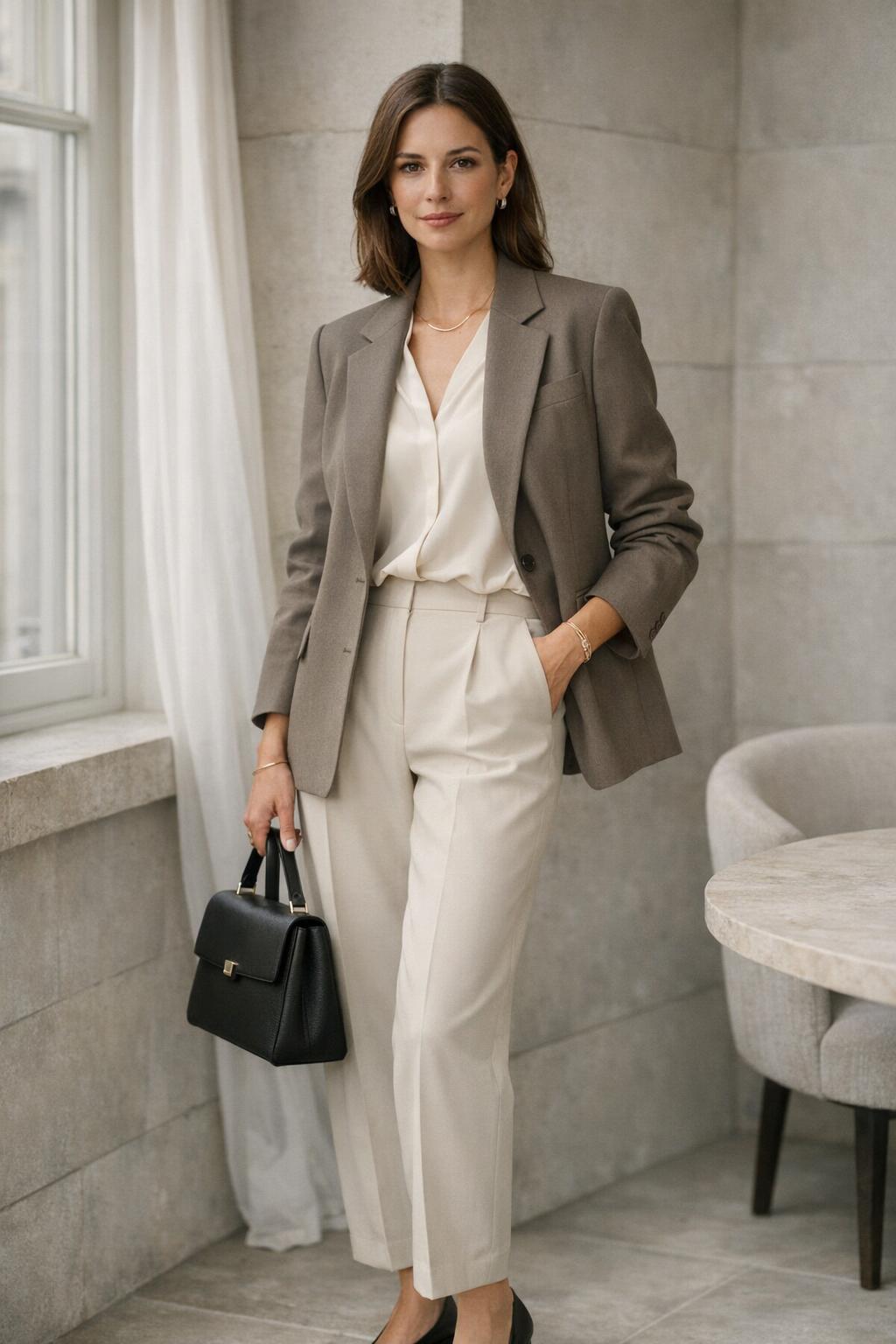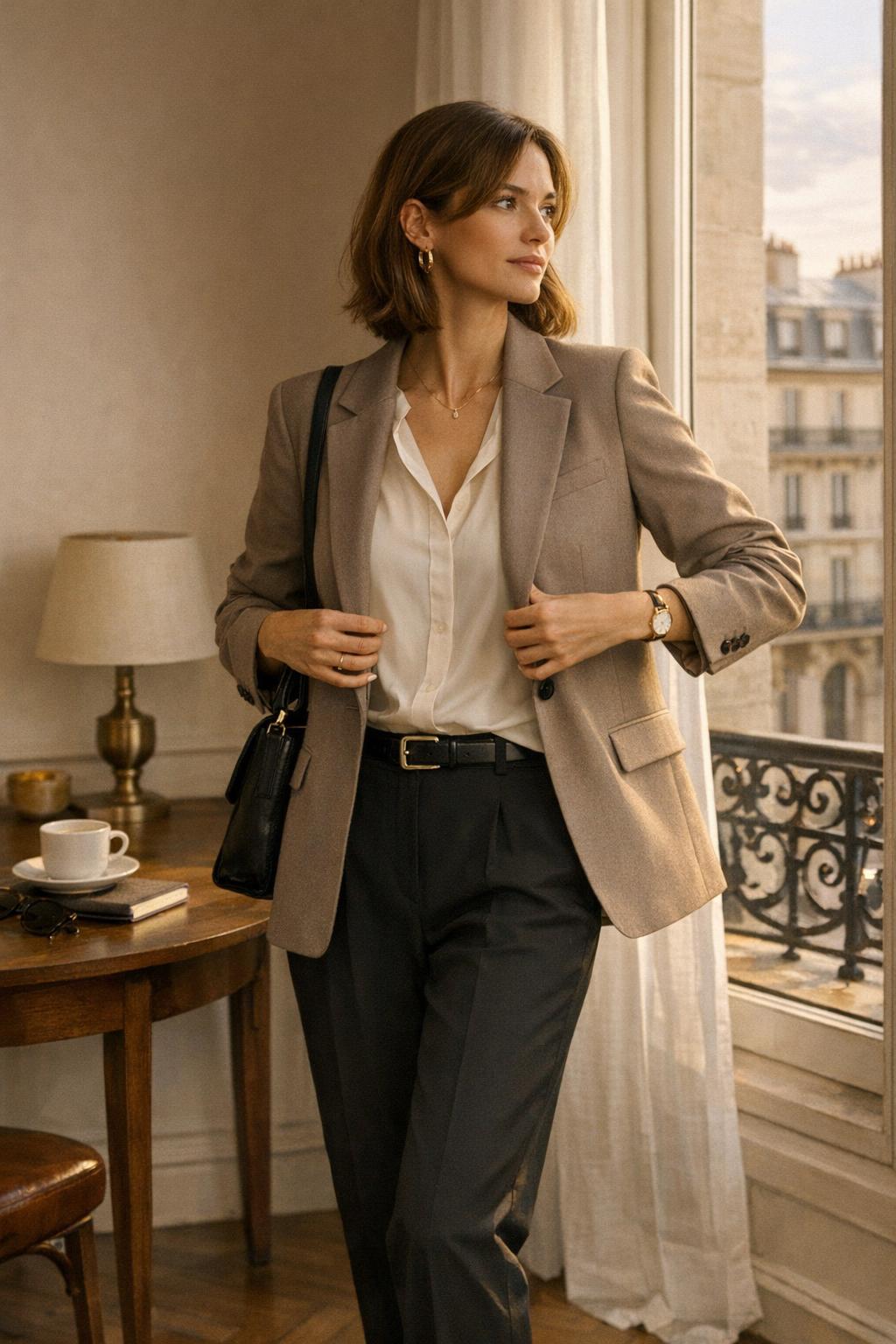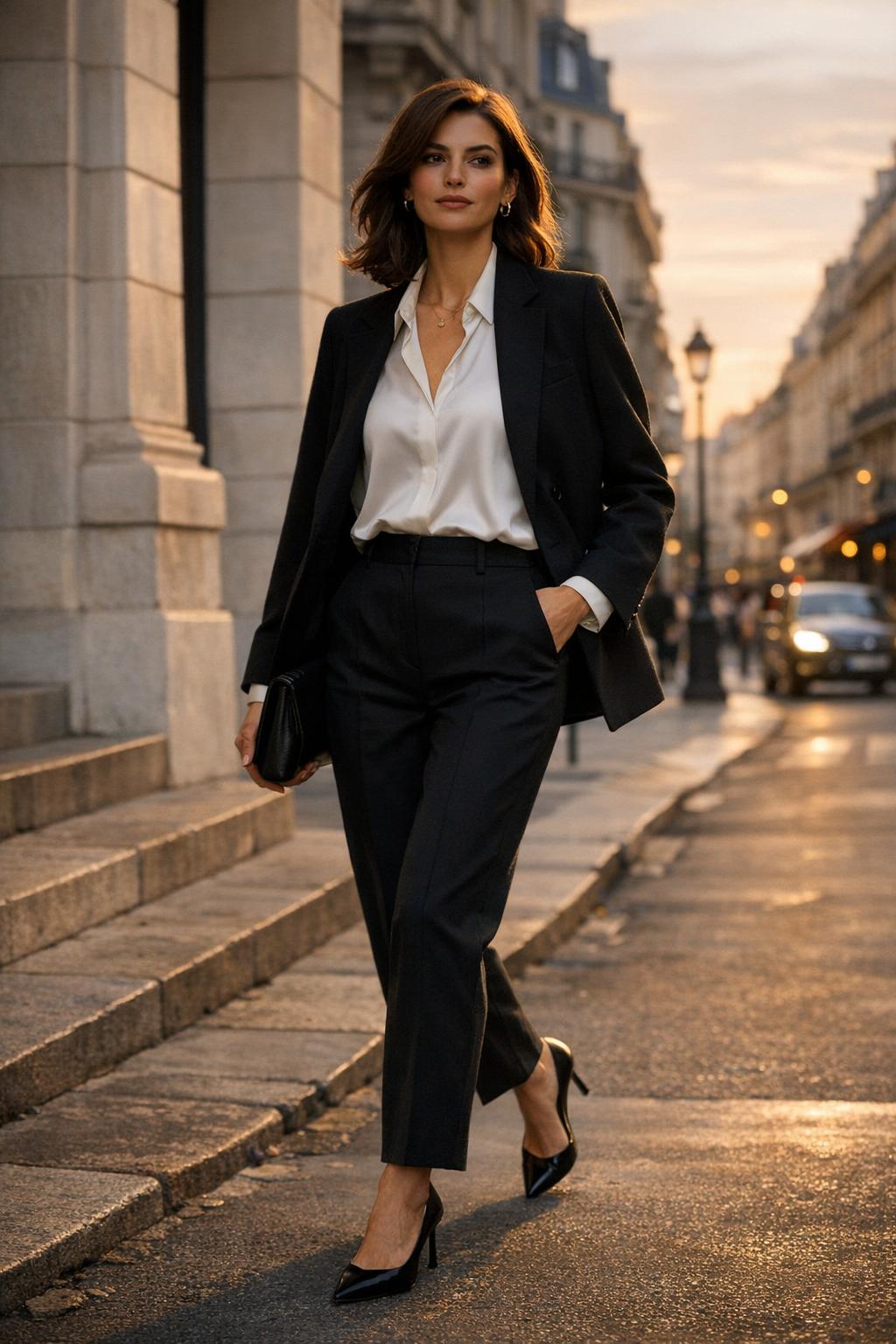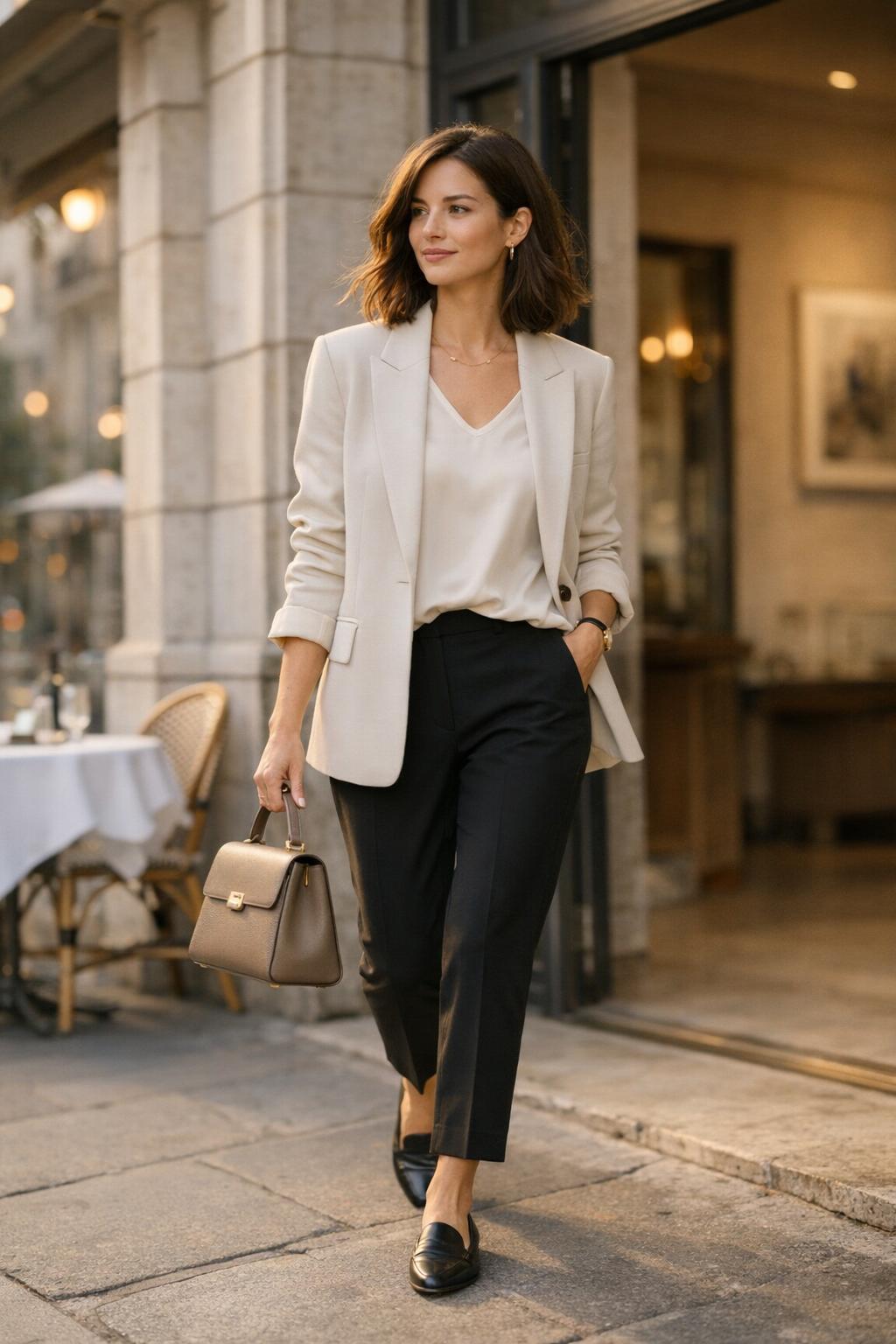
Category: Outfit Aesthetic

Outfit Aesthetic is all about creating a cohesive, recognizable style that reflects your personality and lifestyle. Instead of focusing on individual pieces, an outfit aesthetic looks at how colors, silhouettes, fabrics, and details work together to form a distinct visual identity. From timeless minimalism and quiet luxury to Parisian chic, Scandinavian simplicity, and modern street style, exploring different aesthetics can help you refine your wardrobe and develop a more intentional approach to fashion.

In this category, you’ll find curated inspiration, styling guides, and outfit ideas that highlight popular fashion aesthetics while remaining practical for everyday wear. Each post focuses on wearable combinations, balanced proportions, and versatile pieces that can easily integrate into a modern wardrobe. Whether you prefer clean neutral outfits, elevated casual looks, or romantic feminine styling, understanding outfit aesthetics makes it easier to build outfits that feel polished and consistent.

Our editorial approach is grounded in real fashion experience, combining insights from fashion retail, styling principles, and long-term wardrobe building. Rather than chasing short-lived trends, we focus on aesthetics that translate into timeless outfits you can adapt across seasons and occasions.

If you’re looking for fresh outfit inspiration, clear styling ideas, and guidance on defining your personal fashion identity, this Outfit Aesthetic category will help you discover styles that feel both authentic and effortlessly stylish.

  • Polished Ease: The Picnic Outfit That Photographs Well

    Polished Ease: The Picnic Outfit That Photographs Well

    Introduction

    The picnic outfit is one of the few style problems that asks you to be both poetic and practical at the same time. You’re dressing for a scene: soft light, a spread of food, a blanket that never lies perfectly flat, and the gentle choreography of sitting, standing, and walking on grass. The visual identity that wins here is relaxed refinement—pieces that look intentional in a Lookbook Outfits kind of way, yet behave well when the day gets real.

    Think of the mood as “polished ease”: clean lines tempered by breathable textures, romantic silhouettes grounded by comfortable footwear, and colors that photograph beautifully without feeling costume-like. This is why the aesthetic has such staying power—it reads as modern, but it’s built on timeless wardrobe logic: proportion, movement, and fabric choice.

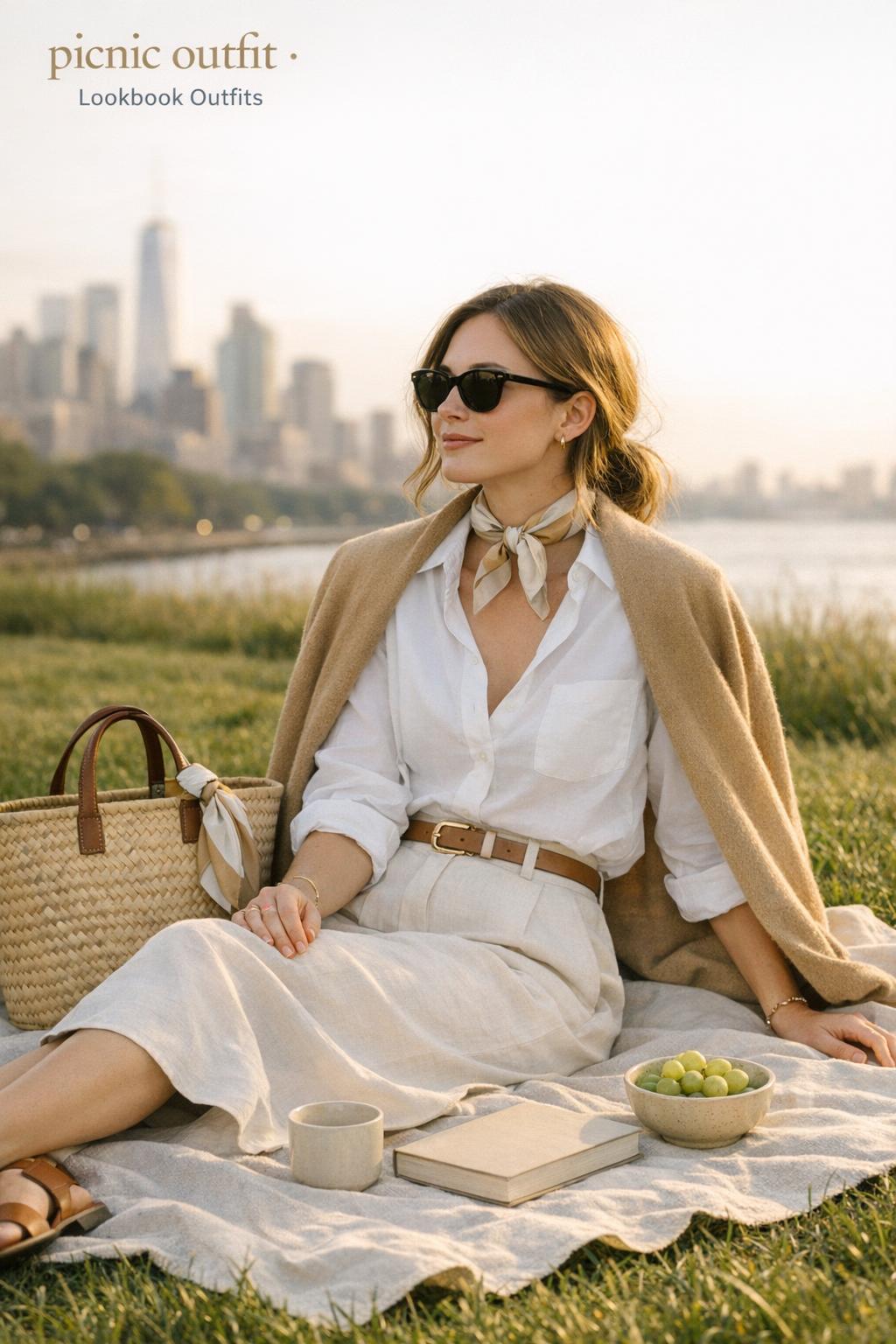
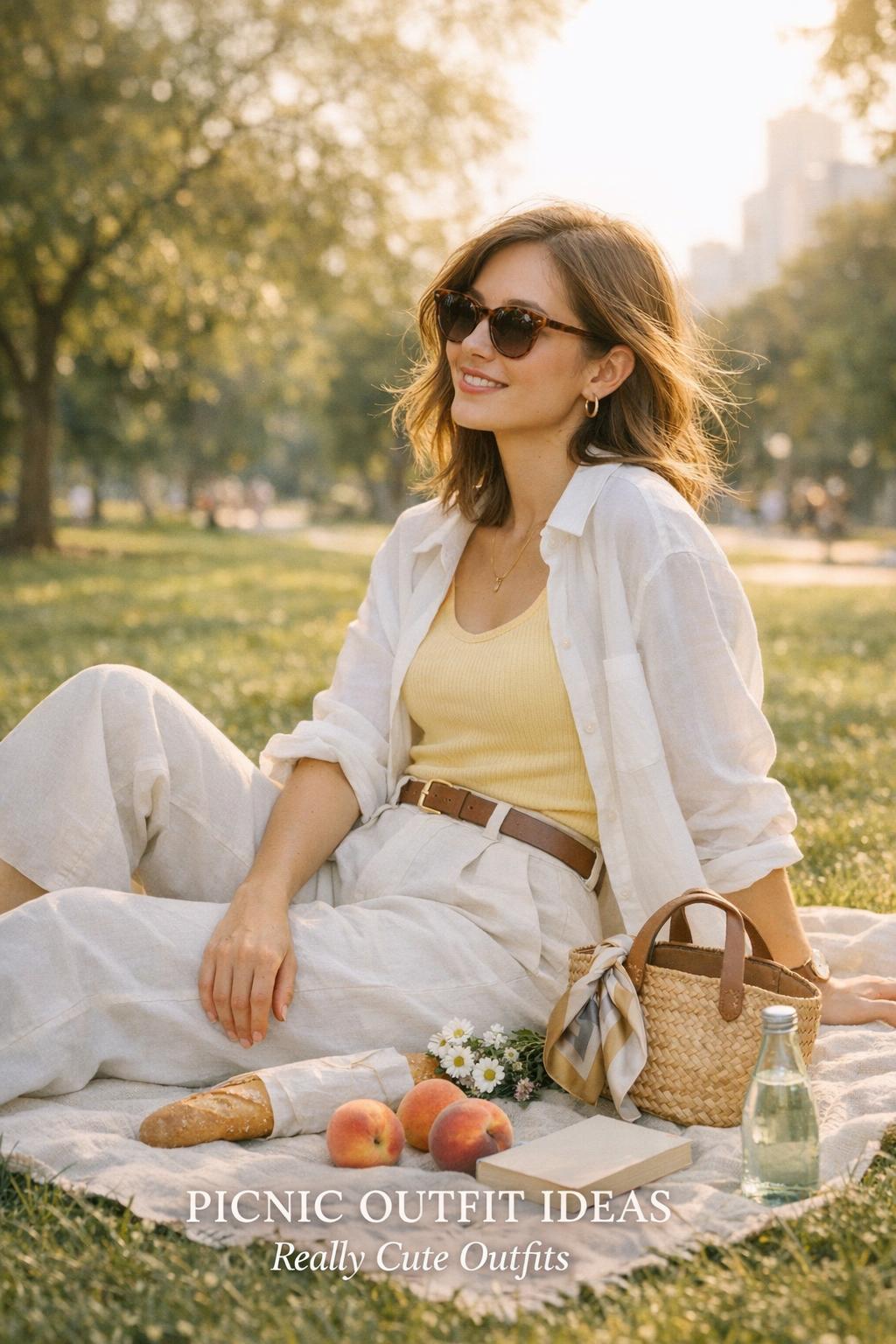
    Chic picnic outfit lookbook in golden-hour city park with linen blanket, woven tote, neutral trousers and white shirt
    A stylish woman relaxes on a linen blanket in warm golden-hour light, showcasing a refined neutral picnic outfit with effortless accessories.

    Where is it worn? Anywhere a picnic actually happens—city parks, backyard tables, vineyard lawns, beach-adjacent grass, or an impromptu roadside stop. And why does it feel so appealing? Because it’s a rare occasion where really cute outfits can still prioritize comfort, sun, wind, and the realities of sitting for hours. The best mode inspiration for a picnic isn’t about buying something new; it’s about composing a look that holds its shape, keeps you cool, and looks effortless from every angle.

    The picnic outfit aesthetic: what makes it work

    A successful outfit for a picnic is built on three quiet principles: a silhouette that moves well (and sits well), fabrics that breathe, and styling that feels coherent rather than “theme-y.” This is where picnic casual outfits can become elevated—by treating the look like a small capsule with a clear color story and a few deliberate textures.

    Silhouette matters more than people expect. A cinched waist or a defined shoulder can keep an outfit feeling intentional even when you’re lounging. Meanwhile, a skirt or wide leg that drapes cleanly will read elegant in motion, but it must also cooperate with the blanket-and-breeze reality of a park afternoon.

    Finally, the aesthetic loves details that feel “quietly styled”: a tied scarf, a basket-like tote shape, sunglasses that balance the face, and footwear chosen for terrain. This is not the moment for anything that demands constant adjustment. The best looks feel as if they were meant for the day you’re having—not a day you’re trying to perform.

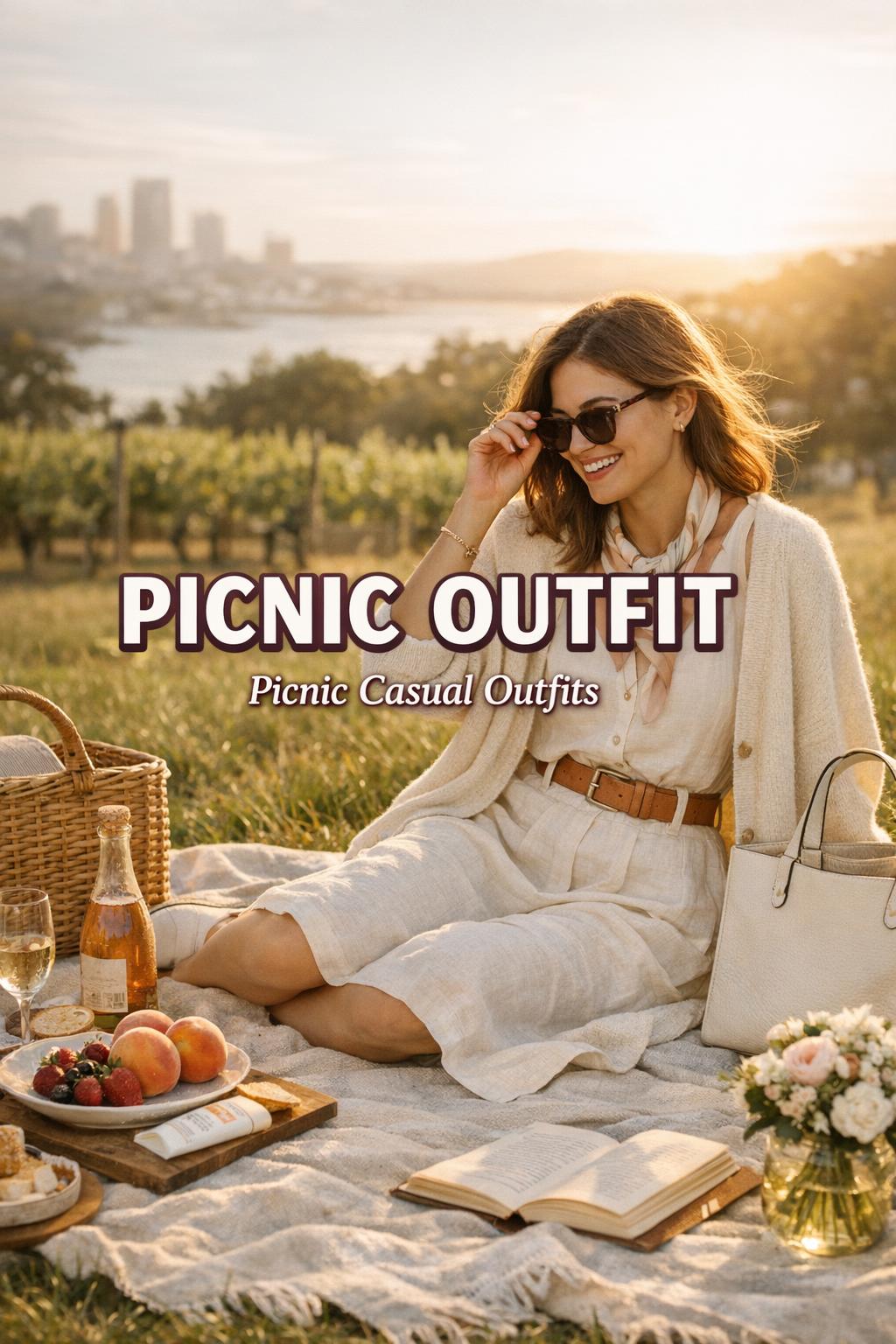
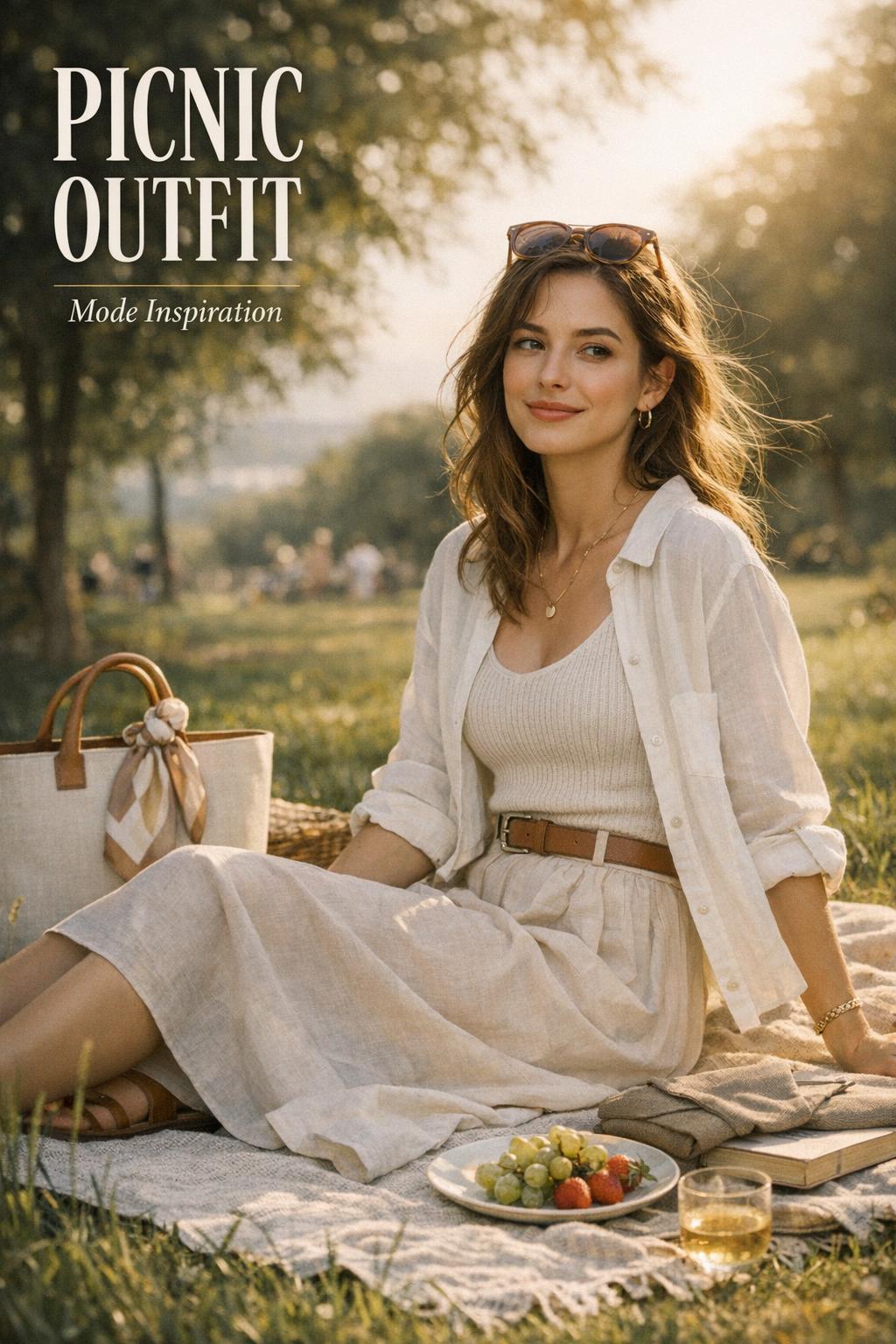
    Picnic outfit in golden-hour city park picnic scene with woman in belted linen dress adjusting sunglasses on blanket
    A sunlit, golden-hour picnic scene captures a modern woman in a polished picnic outfit, laughing as she adjusts her sunglasses.

    Look: soft weekend minimalism in sun-washed tones

    This look is for the person who wants the romance of a picnic without leaning into literal gingham nostalgia. The silhouette is simple, slightly structured at the top, and gently fluid through the leg—an outfit that photographs cleanly while still feeling like you can sprawl on a blanket without thinking twice.

    Build the palette around sun-washed neutrals—cream, oatmeal, soft white, pale sand—then add one muted accent that feels modern rather than sweet. A crisp sleeveless knit or a lightweight button-front top creates a tidy upper line; a relaxed trouser or an airy midi skirt finishes the shape with movement. Choose fabrics that breathe and don’t cling when you sit: cotton blends, linen-like weaves, and soft knits with enough body to hold a line.

    • Key garments: sleeveless knit or crisp short-sleeve top; wide-leg trouser or fluid midi
    • Footwear: low-profile sneakers or flat leather sandals suited to grass
    • Accessories: slim sunglasses, a simple belt, and a tote that sits close to the body

    Why it fits the aesthetic: the restraint is the point. When your outfit for a picnic is pared back, the scene does the talking—light, texture, and proportion. This is the kind of mode inspiration that always looks “right,” even if your location shifts from a city park to a backyard.

    Look: romantic ease with a modern waistline

    Romance, here, is not frill for frill’s sake. It’s a controlled softness: a gently defined waist, a skirt that moves, and sleeves that catch the breeze in a flattering way. The mood is tender but not precious—really cute outfits that still feel like grown-up style.

    Start with a midi dress or a matching set that creates a continuous line. Look for subtle shaping: smocking, wrap styling, or a tie waist that can be adjusted after lunch. The color story can lean light—soft pastels, warm blush, creamy whites—or go deeper with a single saturated shade that feels elegant in sunlight. Texture does the heavy lifting: eyelet-like patterning, a lightly crinkled cotton, or a matte fabric that resists looking overly shiny in photos.

    • Key garments: midi dress with adjustable waist or a coordinated top-and-skirt set
    • Footwear: flat sandals, espadrille-style flats, or sturdy low wedges if the ground is even
    • Accessories: a hair scarf, small hoops, and a structured mini bag or basket-inspired tote

    Why it fits the aesthetic: the modern waistline keeps the look intentional, while the softer volume stays comfortable when you sit. If you want picnic casual outfits that still feel “editorial,” this is the sweet spot—romantic, but composed.

    Picnic outfit laid out on a blanket with straw hat, sandals, and woven bag in soft sunlight
    A charming picnic outfit is neatly arranged on a blanket with sun-kissed accessories for an effortless outdoor look.

    A quick styling tip: how to stay polished when you’re sitting on a blanket

    Most picnic outfits look perfect standing up and slightly less convincing the moment you sit. The fix is not more “coverage”—it’s better construction. Look for pieces that keep their shape: a top with a defined neckline, bottoms that don’t ride sharply at the waist, and fabrics with a touch of structure. If you’re wearing a skirt, a midi length with some weight or lining tends to behave better in wind than an ultra-light mini.

    If you’re in a dress, consider how it moves when you bend your knees and how it falls when you stand again. The most refined outfit for a picnic is the one you don’t have to keep re-arranging. In real life, that’s the difference between looking styled and looking like you’re constantly “managing” your clothes.

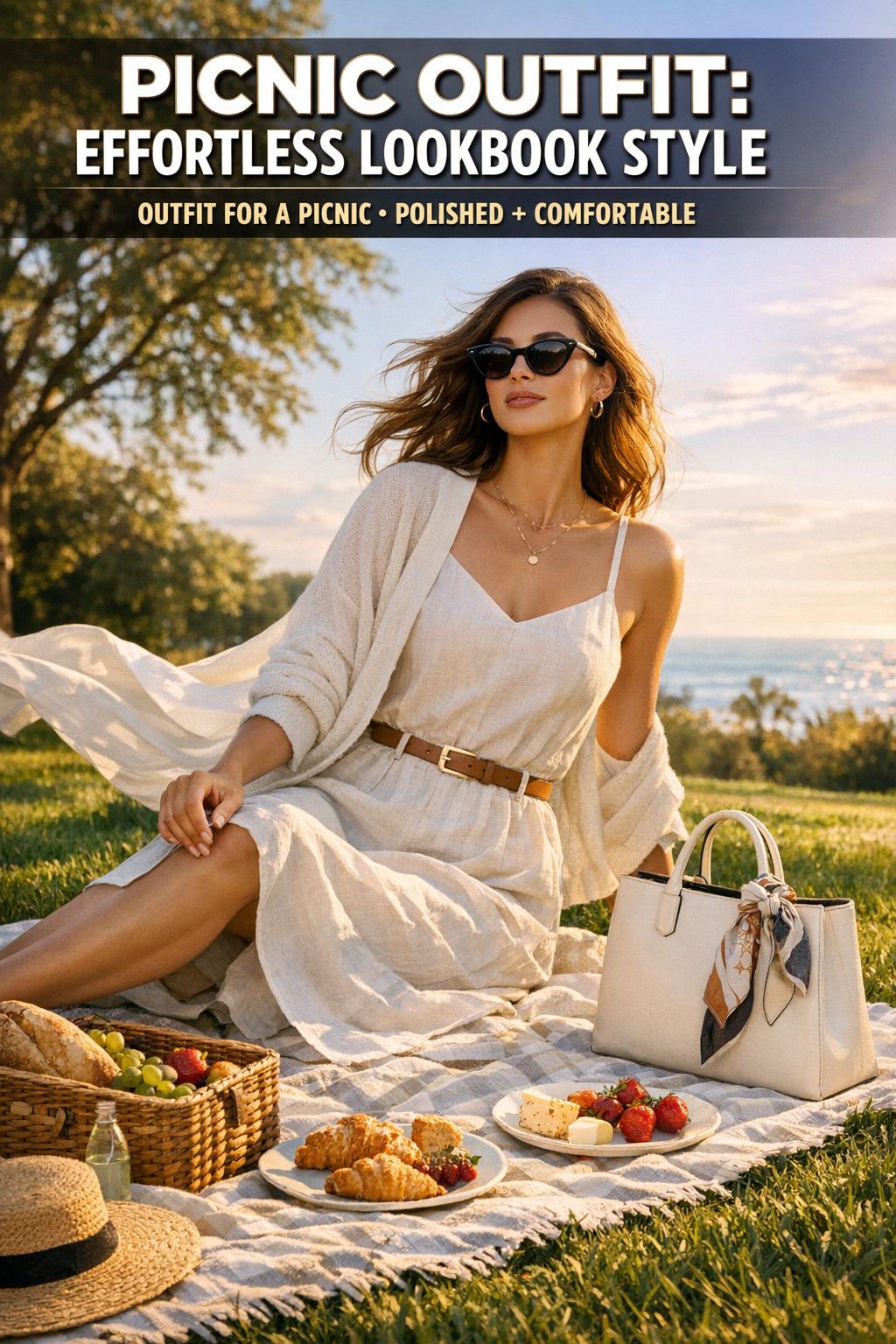
    Woman in a sunlit city park wearing a chic picnic outfit on a linen blanket with baguette, peaches, and wildflowers
    A stylish woman relaxes on a linen picnic blanket in golden-hour light, showcasing an effortless picnic outfit with fresh summer details.

    Look: tailored and relaxed—city-park chic

    This is the picnic outfit for the person who wants a sharper outline—something that nods to Paris or Copenhagen without feeling overdressed on grass. The silhouette plays with contrast: a tailored layer on top, relaxed pieces beneath, and an overall line that looks crisp even after a long afternoon.

    Anchor the look with a structured outer layer—think a lightweight blazer, a cropped jacket, or a clean overshirt—then keep the base easy: a simple tank or tee and straight-leg pants or a streamlined skirt. The palette works best with controlled neutrals (black, white, navy, stone) plus one accent tone if you want a fashion edge. Textures should be matte and modern: a smooth cotton, a compact knit, or a soft twill that resists wrinkling.

    • Key garments: lightweight blazer or overshirt; tank or tee; straight-leg pant or sleek midi
    • Footwear: minimal sneakers or flat loafers if the terrain allows
    • Accessories: refined sunglasses, a slim crossbody, and understated jewelry

    Why it fits the aesthetic: tailoring gives you presence. Even among picnic casual outfits, a touch of structure reads sophisticated—and it’s surprisingly practical when the weather shifts. This is also an easy look to recreate from existing basics, which is exactly how Lookbook Outfits should function: aspirational, yet wearable.

    Look: coastal lightness with an airy layer

    Some picnics come with wind—near water, on open lawns, or in late afternoon when the temperature drops. This look treats that as part of the aesthetic. The mood is breezy and calm, with layers that move elegantly rather than flap and fight you.

    Start with a base that feels almost weightless: a slip-style midi skirt with a matte finish, or relaxed shorts balanced by a longer top. Then add an airy layer—an open shirt, a thin cardigan, or a light sweater draped and tied with intention. Keep the palette fresh: white and blue, sand and cream, or soft gray with a pale accent. The key is proportion: if the layer is longer, keep the base sleeker; if the base has volume, choose a shorter layer to define the waistline.

    • Key garments: fluid skirt or tailored shorts; simple top; light shirt or knit layer
    • Footwear: flat sandals or clean canvas sneakers
    • Accessories: a cap or scarf for wind, plus sunglasses for glare

    Why it fits the aesthetic: it’s composed, but not stiff. An airy layer gives you adaptability—an underrated luxury when you’re planning an outfit for a picnic that may stretch from midday sun into cooler evening shade.

    Key pieces that make the aesthetic effortless

    Rather than chasing novelty, build your picnic outfit around a small set of pieces that behave well outdoors and photograph beautifully. These are not “must-buys.” They’re wardrobe building blocks that consistently deliver the mood: refined, comfortable, and quietly intentional.

    • A top with a clean neckline (square, scoop, or a crisp collar) to frame the face in sunlight
    • A bottom with movement (midi skirt, wide-leg trouser) that doesn’t restrict sitting
    • A light layer (shirt, cardigan, blazer) to handle shade and breeze without ruining the silhouette
    • Comfortable shoes chosen for grass, paths, and the walk to your spot
    • One “styling” accessory (scarf, sunglasses, belt) that makes the look feel finished

    Notice what’s missing: anything that requires constant attention. The best really cute outfits are the ones that stay composed while you’re living in them—reaching for food, shifting on a blanket, walking to a view.

    Look: playful print, grounded styling

    Print can be the quickest path to picnic charm, but it becomes chic only when it’s grounded by clean supporting pieces. This look takes a playful pattern and treats it with restraint—an editorial balance that feels modern rather than costumey.

    Choose one printed hero: a patterned dress, a printed skirt, or a statement top. Then keep everything else quiet and refined—solid-color shoes, simple jewelry, and a bag with structure. The silhouette should be readable at a glance: if the print is bold, keep the shape streamlined; if the print is delicate, you can afford a touch more volume in sleeves or skirt. Stick to a palette that already exists inside the print, so the outfit feels composed rather than “matched.”

    • Key garments: printed midi or printed skirt with a solid top
    • Footwear: neutral sandals or simple sneakers
    • Accessories: minimal jewelry, sunglasses, and a clean tote

    Why it fits the aesthetic: it delivers instant personality while staying elegant. In Lookbook Outfits terms, it reads as styled—not styled-up. That’s the difference between a print that wears you and a print you’re confidently wearing.

    What stylists quietly avoid: common picnic outfit mistakes

    Outdoor dressing is unforgiving, and the “wrong” choice is rarely about taste—it’s about physics. One common misstep is choosing fabrics that show every wrinkle or cling when you sit. Another is wearing shoes that look perfect on pavement but sink into grass or rub during the walk from the car. And then there’s the temptation to overdress with layers that look editorial in theory but feel fussy in practice.

    If you’ve ever spent a picnic tugging at a hem, adjusting straps, or avoiding sitting comfortably, you’ve learned the core rule: comfort is part of the aesthetic. The most convincing outfit for a picnic looks effortless because it is effortless to wear.

    Look: sporty-polished picnic casual outfits

    There’s a version of sporty that still feels refined—a look that’s crisp, fresh, and quietly confident. This is the outfit for a picnic that involves movement: a long walk to the perfect spot, a casual game, or simply the desire to feel unbothered by the day.

    Keep the lines clean: a fitted tank or tee balanced by a tailored short or a straight skirt, then add a light layer you can remove without disrupting the outfit. The palette is best kept minimal—white, navy, black, gray, or muted green—so the sporty elements feel intentional rather than gym-adjacent. Texture is where you elevate it: a crisp cotton, a slightly structured knit, or a smooth, matte fabric that looks finished even when simple.

    • Key garments: clean tank or tee; tailored shorts or straight skirt; light overshirt
    • Footwear: low-profile sneakers that handle grass and gravel
    • Accessories: cap or sunglasses, plus a compact crossbody for hands-free ease

    Why it fits the aesthetic: it’s the practical sibling of romantic picnic style—still photogenic, still composed, just more mobile. As mode inspiration, it’s also one of the easiest looks to adapt from basics you already own.

    How to recreate the look without overthinking it

    If you want the visual impact of curated Lookbook Outfits without turning your closet into a project, start with one anchor: either a silhouette (midi dress, wide-leg trousers, tailored shorts) or a palette (creamy neutrals, crisp monochrome, soft pastels). Then build around that anchor with one layer and one accessory that “finishes” the story.

    A useful rule is the 3-point balance: one structured element, one relaxed element, and one detail that feels personal. For example, a crisp collar (structured), a fluid skirt (relaxed), and a scarf tied at the neck (detail). This framework keeps picnic casual outfits from feeling random, and it helps you repeat the aesthetic across seasons.

    Weather and timing: the quiet factors that change everything

    In U.S. settings, the same picnic location can shift dramatically from midday to golden hour. Heat peaks, shade creeps in, and wind tends to arrive just as the light turns pretty. Dressing well is often less about the “perfect” outfit and more about building a flexible system: breathable base, removable layer, and shoes that won’t punish you for choosing a scenic spot.

    If the sun is strong, prioritize coverage that still feels airy—think sleeves with volume rather than thick fabric, or a light layer worn open. If you expect cooler air later, a soft knit or structured overshirt will keep the silhouette intact while adding warmth. The goal is to avoid carrying a bulky extra piece that doesn’t belong to the outfit’s visual language.

    Look: golden-hour monochrome for really cute outfits that photograph well

    Monochrome is a fashion editor’s favorite trick for instant polish. For a picnic, it has an added benefit: it looks cohesive against busy backgrounds—grass, blankets, baskets, and food—without competing with the scene. The mood is sleek, modern, and quietly romantic.

    Choose a single color family and work within it: all-white with tonal texture, all-black softened by lightweight fabric, or a warm neutral story that feels luminous in late afternoon light. The silhouette should be uncomplicated but intentional—perhaps a fitted top with a long skirt, or a clean dress with a defined waist. Use texture to create depth: a ribbed knit against a smooth skirt, or a matte top with a subtly textured bottom.

    • Key garments: tonal top and skirt, or a monochrome dress with definition at the waist
    • Footwear: minimalist flats or clean sneakers in a matching tone
    • Accessories: sunglasses and one refined metal accent (belt hardware, jewelry)

    Why it fits the aesthetic: it’s simple, but never basic. Monochrome reads as deliberate composition—the essence of Mode inspiration—while staying comfortable enough for an unhurried afternoon.

    Conclusion

    The most memorable picnic outfit is not the loudest or the most literal—it’s the one that looks composed in sunlight, feels comfortable on the ground, and stays true to your style identity. Treat the day like a small editorial: a coherent palette, a silhouette designed for movement, and details that feel personal. With that approach, picnic casual outfits become effortlessly refined, and you can adapt the aesthetic to whatever park, backyard, or coastline you call your picnic.

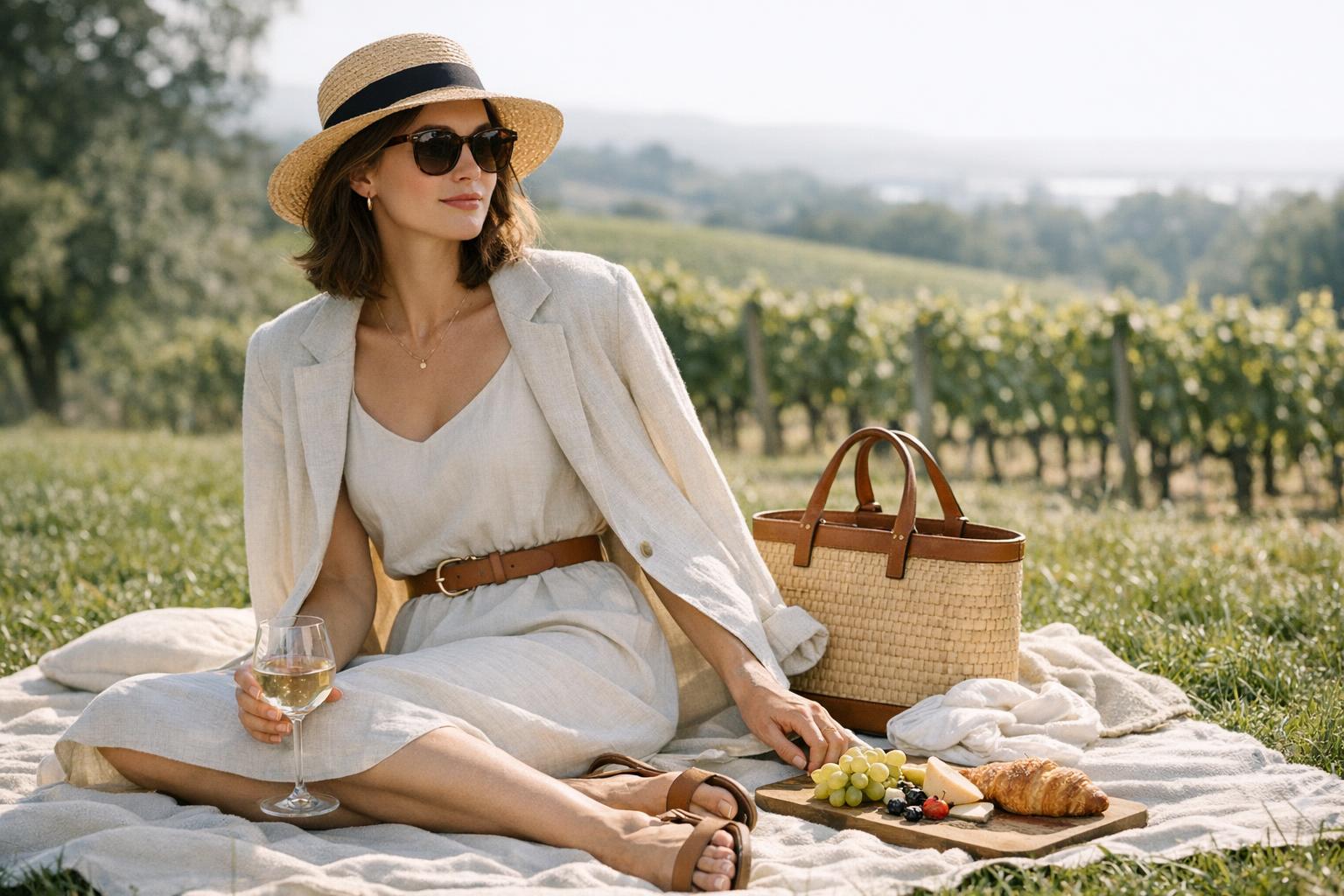
    Woman in a chic picnic outfit sitting on a linen blanket in a sunlit city park with basket, fruit, and tote bag
    In warm golden-hour light, a stylish woman relaxes on a linen blanket with a wicker basket and soft, modern picnic details.

    FAQ

    What is the best picnic outfit if I want to look cute but stay comfortable?

    A flattering, comfortable picnic outfit usually combines a breathable base (like a light top with a midi skirt or relaxed trousers) with supportive shoes and one easy layer for shifting temperature; the “cute” factor comes from a coherent color palette and one styling detail such as sunglasses or a scarf, not from fussy pieces that need constant adjusting.

    What shoes work best for a picnic on grass?

    Choose flat, stable footwear that can handle uneven ground—minimal sneakers, flat sandals, or other low-profile options—because heels and overly delicate shoes often sink into grass or become uncomfortable during the walk to your spot, which can quickly undermine an otherwise polished look.

    How do I make picnic casual outfits look more polished?

    Use structure strategically: a clean neckline, a defined waist, or a lightweight tailored layer instantly elevates casual pieces, and keeping the palette controlled (neutrals or tonal dressing) helps the outfit read intentional even in a relaxed outdoor setting.

    What should I bring as a layer for a picnic that goes into the evening?

    A light layer that preserves the outfit’s silhouette—such as a shirt worn open, a thin cardigan, or a structured overshirt—is typically more useful than a bulky piece, because it adds warmth without making the look feel heavy or disconnected from the rest of your styling.

    How can I recreate Lookbook Outfits energy for a picnic without buying new clothes?

    Pick one anchor (either a clear silhouette like a midi dress or wide-leg trousers, or a tonal palette), then add one structured element and one personal detail; this simple framework creates the curated, editorial feel of Lookbook Outfits while relying on versatile basics you likely already own.

    What fabrics tend to work best for an outfit for a picnic?

    Fabrics that breathe and keep their shape—lightweight cotton blends, linen-like weaves, and soft knits with some body—tend to perform well outdoors because they move comfortably, don’t feel stifling in sun, and look more composed after sitting than overly clingy or ultra-wrinkly materials.

    How do I prevent a dress or skirt from feeling fussy at a picnic?

    Prioritize secure, adjustable construction—such as a defined waist you can tweak and a midi length with enough weight to move cleanly—because the goal is to sit and stand comfortably without repeatedly tugging at hems or worrying about fabric shifting in the breeze.

    What colors photograph well for really cute outfits at a picnic?

    Sun-washed neutrals, tonal monochrome, and soft, controlled palettes generally photograph beautifully outdoors because they look cohesive against busy backgrounds like grass and picnic setups, while a single muted accent can add interest without overpowering the scene.

    What’s the simplest way to add mode inspiration to a basic picnic outfit?

    Add one intentional styling element that completes the story—like refined sunglasses, a scarf, or a clean belt—then keep everything else streamlined; the outfit reads more editorial when the details feel deliberate and balanced rather than layered for the sake of looking “styled.”

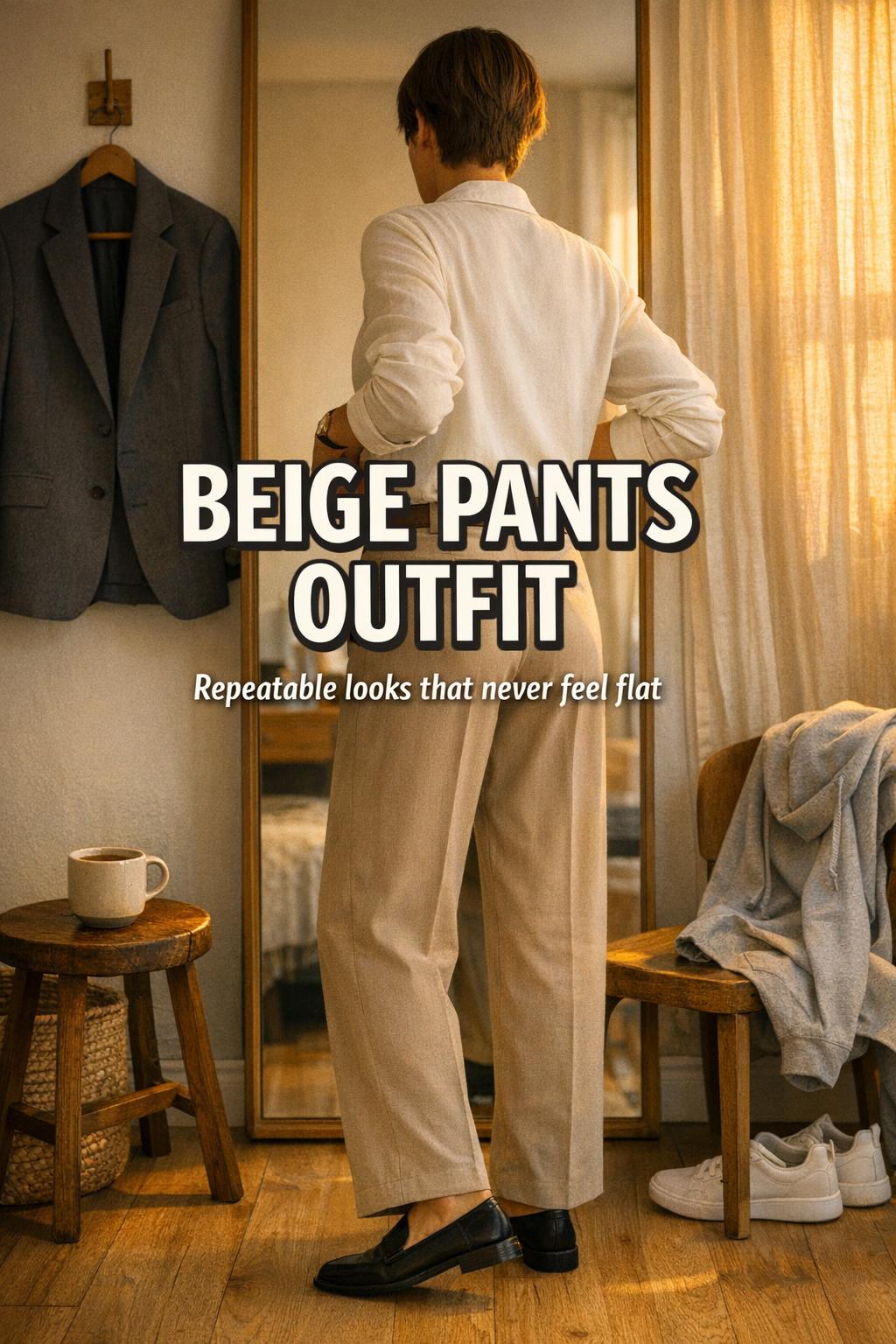
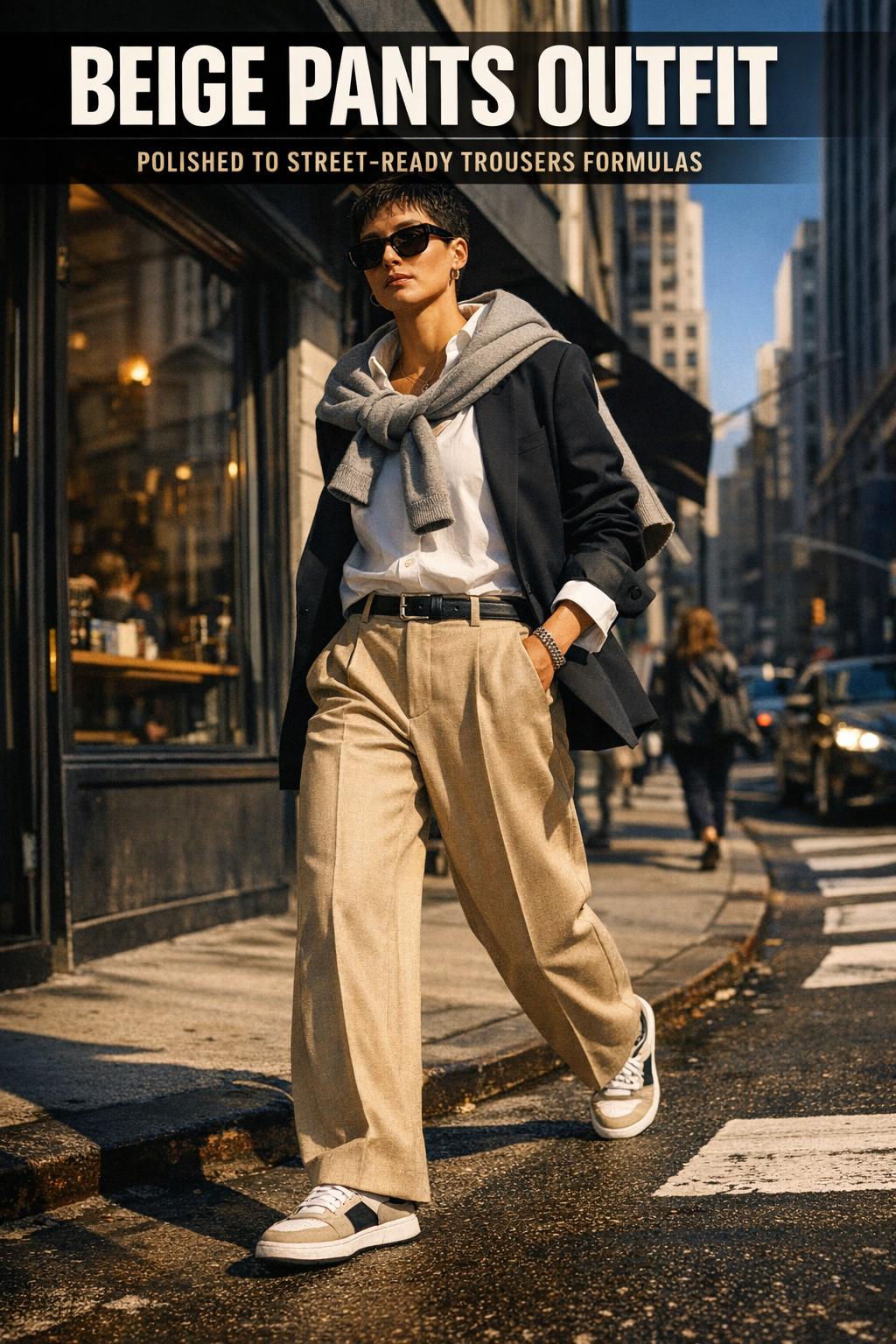
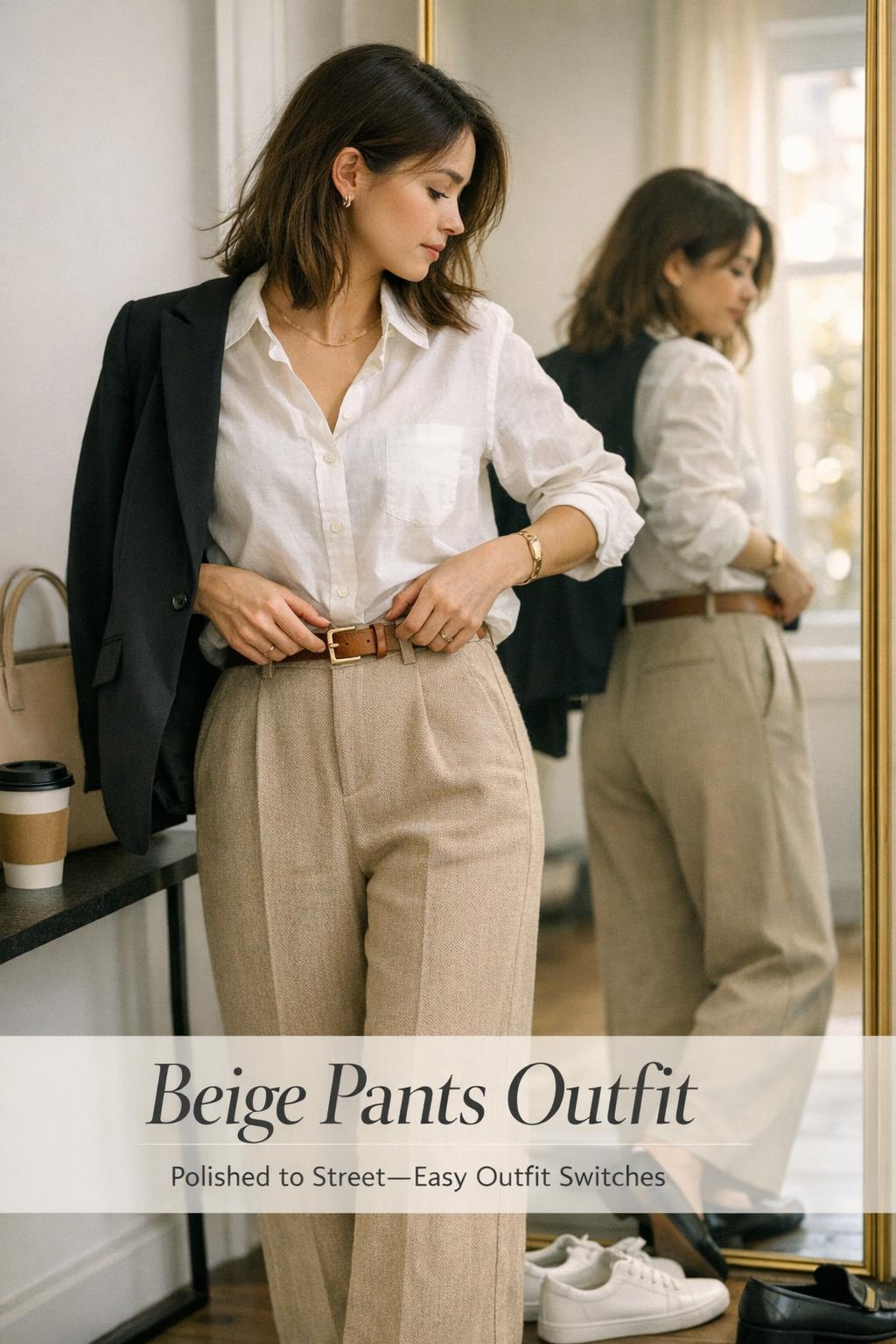
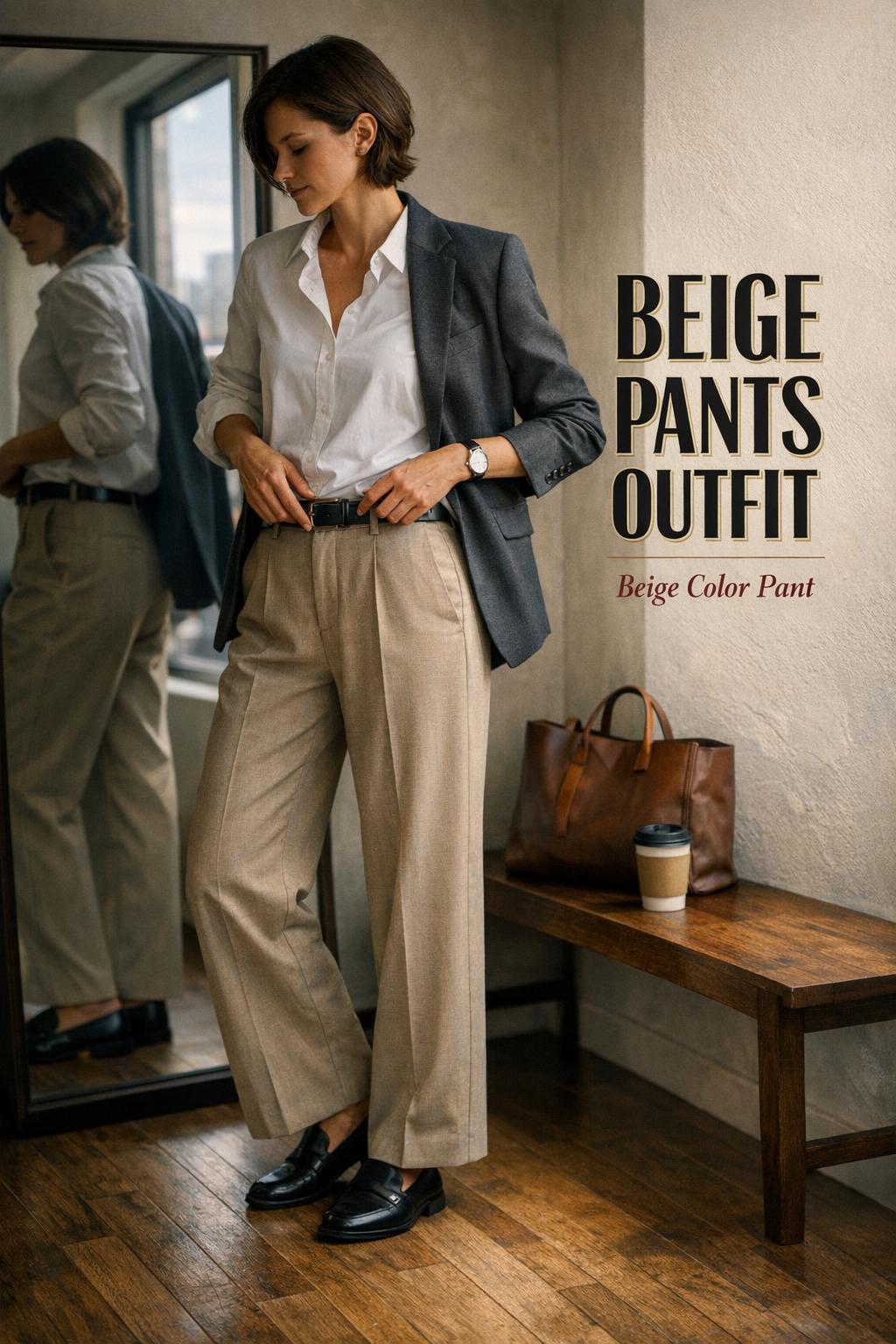
  • Beige Pants Outfit Formulas for Polished-to-Street Days

    Beige Pants Outfit Formulas for Polished-to-Street Days

    There’s a particular moment in the mirror—often before work, sometimes before a weekend coffee run—when beige pants feel both like the simplest choice and the most puzzling one. The color is neutral, the concept is classic, yet the final effect can swing from sharp and modern to oddly flat with one wrong top, shoe, or fabric. That’s why the beige pants outfit continues to be discussed in the same breath as minimalist dressing and street style: both aesthetics lean on restraint, and both can start from the same pair of trousers.

    This comparison matters because the overlap is real. Minimalist wardrobes often center on neutrals and tailored structure—beige trousers, a white shirt, a clean loafer—while contemporary street style also borrows beige as an anchor, pairing it with hoodies, sneakers, and oversized silhouettes. On a hanger, the pants may look identical; on a person, the styling philosophy makes them entirely different.

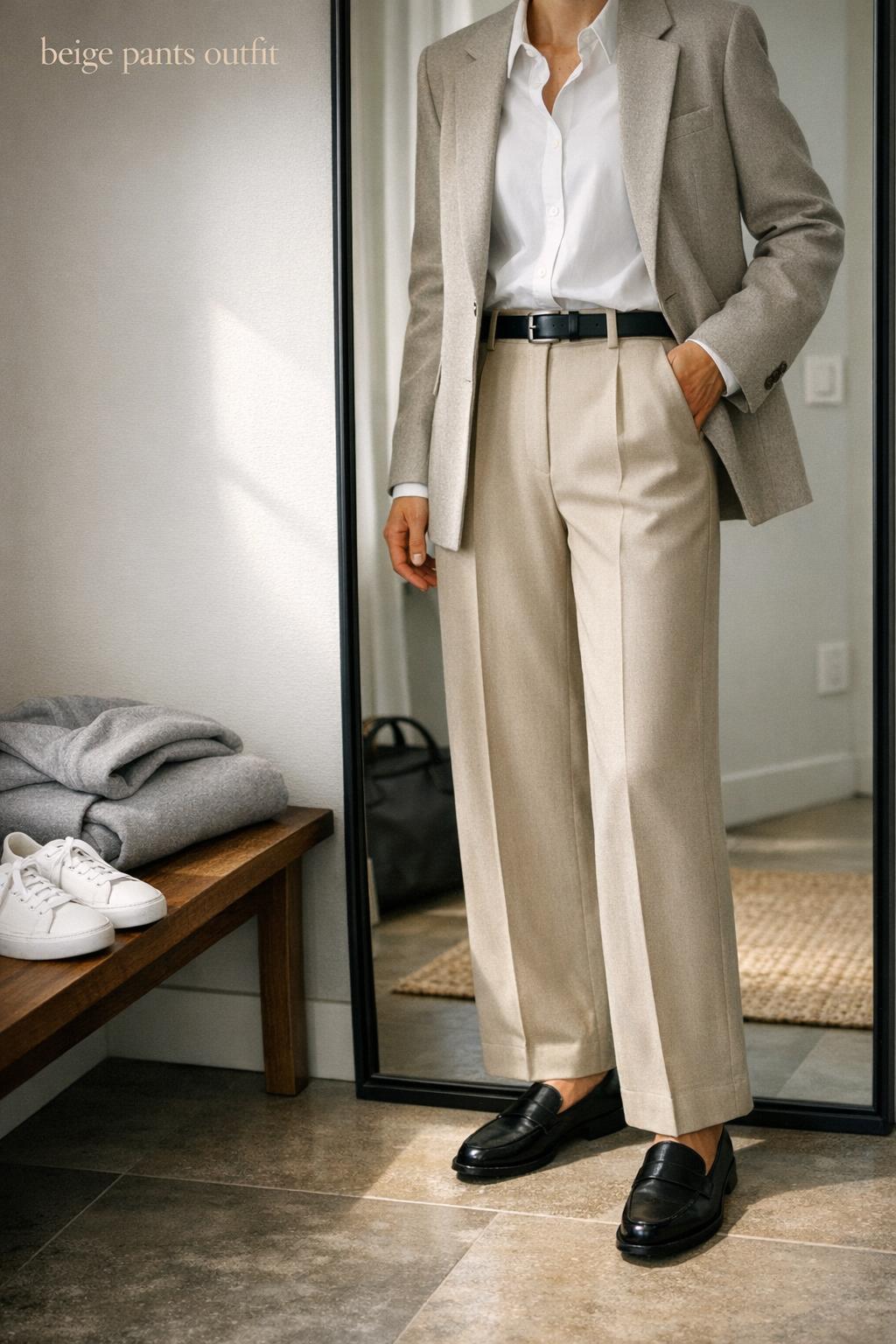
    Beige pants outfit mirror check in a modern city apartment entryway with tailored trousers, blazer, and loafers
    A polished beige pants outfit is captured in soft morning light as a tailored silhouette meets minimalist city-entryway elegance.

    Below, we’ll break down two core approaches to styling beige pants—polished minimalism and urban street style—then compare how each uses silhouette, contrast, texture, and accessories. You’ll leave with practical outfit formulas for office, casual weekends, evening, and travel, plus the small finishing decisions (belts, footwear, layering) that keep beige from fading into the background.

    Style overview: polished minimalism with beige trousers

    Polished minimalism treats beige pants as a wardrobe cornerstone—quiet, intentional, and designed to make everything else look more expensive through restraint. The defining characteristic is clarity: clean lines, thoughtful proportion, and a controlled palette of neutrals punctuated by dark accents like navy, black, or charcoal when needed.

    Typical silhouettes are straight, tailored, or wide-leg with a composed drape. A beige color pant in this style often comes in fabrics that hold shape or move elegantly—wool/tailored options for a professional look, cotton twill or cotton blends for everyday structure, and linen for warm weather with an intentionally relaxed refinement.

    Texture is not decoration here; it’s depth. Minimalist outfits frequently rely on subtle contrast—matte trousers with a crisp button-down, a soft knit against a sharper waistband, or a structured blazer layered over a simple top—to keep the neutral story from reading as unfinished.

    Beige pants outfit mirror check in a warm modern apartment entryway with blazer, loafers, and cozy golden-hour light
    A refined beige pants outfit comes to life in warm golden-hour light as a minimalist look meets subtle street-style accents.

    Style overview: urban street style and casual neutrals

    Urban street style uses beige pants as a grounding device, not a headline. The mood is modern, relaxed, and slightly athletic, built on comfort and a confident ease with volume—hoodies, oversized tops, and cargo-inspired silhouettes that create a lived-in, city-ready feel.

    In this lane, beige pants are often chinos, relaxed trousers, or beige cargo pants. The silhouette is less about perfect tailoring and more about proportion: looser legs balanced by a cropped jacket, an oversized hoodie countered by cleaner footwear, or a wide-leg shape that becomes the outfit’s architecture.

    Texture and contrast do heavier lifting. Street style leans into visible pairings—knit with cotton, denim accents, even leather touches through shoes or belts—so the beige base feels intentional rather than “safe.” Sneakers are common, but the overall look is still composed: beige is the anchor, and everything else is tuned around it.

    Beige pants outfit with crisp white shirt and neutral accessories in a modern street style photo
    A refined beige pants outfit pairs effortlessly with a crisp white shirt and neutral accessories for a timeless look.

    Why these styles get confused—beige as the shared anchor

    Both aesthetics begin with the same premise: beige pants are neutral, versatile, and easy to repeat. Both also rely on outfit formulas—repeatable combinations that work across seasons—because beige trousers can move from office to weekend with minimal changes.

    The confusion comes from the shared color story. A neutral outfit can look minimalist or street depending on the silhouette, footwear, and the “finish” of the fabrics. Linen beige pants with a white tee could read resort-polished or downtown casual; a tailored beige trouser with a dark top could be professional or deliberately edgy. Beige doesn’t declare the style on its own; the styling logic does.

    Key differences: minimalist beige pants outfits vs street-style beige pants outfits

    Silhouette and structure

    Minimalism favors structure: straight legs, tailored waists, wide-leg trousers that fall cleanly, and proportions that feel measured. Street style favors ease and volume: relaxed chinos, cargo joggers, or wider shapes paired with oversized layers. Both can use wide-leg beige pants, but minimalism keeps the top sleek and defined, while street style often lets the top go bigger—hoodie, oversized sweatshirt, or roomy jacket—to create an intentional slouch.

    Color palette: tonal restraint vs high-contrast punctuation

    Minimalist dressing tends toward tonal neutrals—beige with off-white, cream, ivory, taupe—then adds controlled dark accents like navy, black, or charcoal for clarity. Street style is comfortable with stronger punctuation: black hoodies, charcoal layers, olive utility pieces, or burgundy accents that pop against beige trousers. The beige base stays steady, but the palette in street style often feels more graphic.

    Formality and context

    A beige pants outfit in minimalist mode can slide naturally into office settings: a tailored trouser, button-down, belt, and loafers reads professional without looking rigid. Street style leans casual by default—sneakers, hoodies, and relaxed fits—though it can still be polished if the proportions are clean and accessories are intentional.

    Styling philosophy: “less, but exact” vs “relaxed, but intentional”

    Minimalism is about editing. Each piece has a job: define the waist, extend the line of the leg, sharpen the shoulder, keep the palette calm. Street style is about balance and attitude—mixing textures, playing with volume, and letting beige anchor the outfit so the oversized elements don’t feel chaotic. Both require intention; they simply express it differently.

    Visual style breakdown: how the differences show up in real outfits

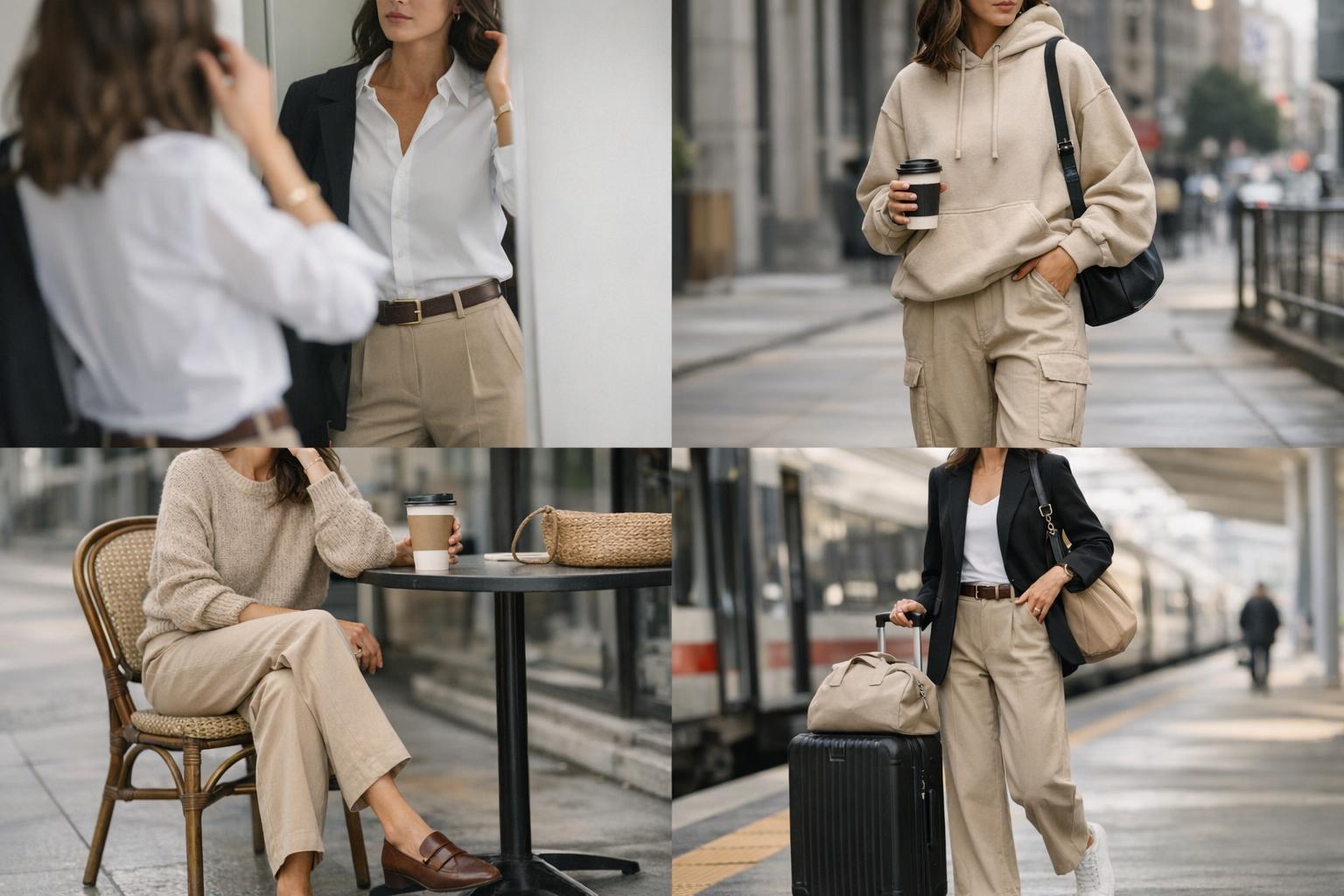
    Beige pants outfit mirror check in a modern entryway, woman adjusting belt with coffee and tote in soft morning light
    In soft morning light, she perfects her beige pants outfit with a quick mirror check before stepping out.

    Layering approach

    Minimalist layering is clean and vertical: a structured blazer over a simple top, or a knit that skims rather than swallows. Street layering is more dimensional: hoodie under a jacket, relaxed outerwear, and pieces that create depth through volume. Beige trousers are flexible enough for both, but the layering changes the entire mood—minimalism reads composed; street style reads lived-in and urban.

    Garment proportions and waist definition

    In minimalist looks, waist definition is a quiet priority. A tuck, a belt, or a top that ends at the right point keeps tailored beige pants looking intentional. In street style, waist definition may be softened; the proportion is often set by an oversized hoodie or a longer top. The key is still balance: if the top is large, keep the leg line clean, or choose a cargo shape that looks designed to be roomy rather than simply oversized.

    Accessories: the “finish” that decides the style

    Accessories are where beige outfits either sharpen or soften. Minimalism prefers restraint—an intentional belt, understated jewelry, a bag that matches the palette. Street style uses accessories to underline attitude: sneakers, bolder contrasts, and functional pieces that feel ready for the city. In both cases, the advice is the same: keep accessories intentional. Beige is subtle, so anything careless looks louder than you expect.

    Footwear choices: loafers vs sneakers (and what they signal)

    Footwear is the fastest way to “declare” the outfit. Loafers shift beige trousers toward office polish; sneakers pull the same pants into a casual, street-led register. Boots can lean either way depending on the rest: with tailored wool trousers they read refined; with cargo pants and an oversized hoodie they read urban. The point is not the shoe itself, but the overall balance—beige pants reflect whatever style language your footwear speaks.

    Fabric and texture: the invisible architect of a beige pants outfit

    Beige is particularly sensitive to fabric. A linen trouser tells one story—summery, breathable, slightly relaxed—while a wool/tailored pant tells another—structured, professional, and crisp. Cotton blends and chinos sit in the versatile middle, easily styled up or down depending on top and shoe choices.

    Texture is also the antidote to flatness. Beige can look monochrome in the wrong way if everything is the same finish. Mixing textures—knit with cotton, denim accents with tailored trousers, leather details through a belt or shoes—adds visual interest without abandoning the neutral palette. This is why so many strong beige looks rely on texture, not busy color.

    Tips: how to keep beige from looking “washed out”

    In practice, beige outfits fail for two reasons: insufficient contrast or insufficient structure. If your beige color pant is close to your skin tone, introduce contrast through a navy, charcoal, or black top, or through sharper texture differences like a crisp shirt against a softer pant fabric. If the outfit feels shapeless, refine the silhouette—define the waist, choose a straighter leg, or add a layer with cleaner lines.

    • Use contrast deliberately: navy, black, or charcoal can add immediate definition.
    • Mix textures: knit tops, denim accents, or leather details keep neutrals lively.
    • Let beige anchor the outfit: avoid competing focal points if the palette is subtle.
    • Keep accessories intentional: belts and footwear should look chosen, not accidental.

    Color pairings compared: tonal neutrals vs darker accents vs earth tones

    Color pairing is where minimalism and street style sometimes borrow from each other. Both love a neutral foundation, but the emphasis differs: minimalism often goes tonal first, while street style often starts with contrast. The most useful approach is to decide what you want beige pants to do—blend seamlessly or sharpen the outfit through contrast—then choose your palette accordingly.

    Neutrals and off-whites (cream, ivory, taupe)

    This is the minimalist stronghold: beige trousers with a cream knit, an off-white tee, or an ivory button-down. The sophistication comes from small shifts in tone and fabric finish—matte next to crisp, soft next to structured. Street style can use this palette too, but it will typically introduce a more relaxed silhouette, like beige cargo pants with an oversized off-white top and sneakers.

    Dark accents (navy, black, charcoal)

    Dark accents bring clarity to beige, and they are particularly effective for U.S. office settings where you may want to look professional without defaulting to all-black. A navy top with beige pants reads classic and grounded; black adds sharpness; charcoal feels modern and slightly softer than pure black. Street style often uses black and charcoal in hoodies and outerwear, creating that urban contrast that makes beige look intentional rather than simply neutral.

    Warm and earth tones (olive, burgundy, pastel notes)

    Earth tones add depth to beige without breaking its calm. Olive is especially at home in street style—utility-coded, practical, and easy with cargo silhouettes—while burgundy offers a richer contrast that can also work for evening. Pastel accents can soften a beige pants outfit and keep it seasonal, especially when the fabric is lighter like linen.

    The capsule approach: silhouettes that behave differently in each style

    If you want versatility, think in silhouettes rather than collecting endless pairs. The same wardrobe can support minimalist and street style looks if you choose shapes that can “translate” with styling. Three silhouettes appear again and again in strong beige pants outfits: wide-leg, straight/tailored, and cropped or slimmer fits. Each has a different relationship to footwear, layers, and waist definition.

    Wide-leg beige pants

    Wide-leg beige pants are a modern staple because the silhouette does the work. Minimalism pairs them with a cleaner top—button-down, fine knit, or a sleek layer—so the volume stays elegant. Street style amplifies the volume with oversized pieces, but the look succeeds only when the outfit remains balanced: if everything is oversized, it can drift into shapelessness.

    A notable fashion-media example of this wide-leg direction is the beige suede wide-leg pants trend associated with Sofia Richie Grainge, highlighted in a celebrity-style context and connected to SRG Atelier. Here, the message isn’t that suede is mandatory, but that fabric choice can turn a neutral pant into the centerpiece of a seasonal look—especially in fall/winter styling where texture carries the outfit.

    Straight or tailored beige trousers

    This is the most office-friendly option. Tailored beige trousers pair naturally with white shirts, blazers, and loafers, creating a professional silhouette without harsh color. For street style, the same pants can be made casual through a hoodie and sneakers—but the trouser’s structure will keep the look from feeling too lounge-adjacent.

    Cropped or slimmer beige pants

    Cropped beige pants can look crisp and intentional, especially when paired with loafers or sleek shoes that emphasize the ankle line. Minimalism uses this silhouette to keep outfits sharp and clean. Street style can use cropped pants too, but it works best when the rest of the outfit keeps a confident simplicity—clean sneakers, a relaxed top, and accessories that don’t compete.

    Occasion comparisons: how each style handles the same real-life moments

    The most useful comparison is not theoretical—it’s situational. Most people aren’t choosing a “style identity” every morning; they’re dressing for a calendar. Below are side-by-side interpretations of common occasions, using the same beige pants foundation but different style logic.

    Office and professional settings

    Minimalist approach: start with tailored beige trousers in wool or a structured blend. Add a white shirt or a crisp button-down, then sharpen the outline with a belt and loafers. The look is calm, clean, and built on proportion—waist definition, a straight line through the leg, and minimal distractions.

    Street-style approach: keep the beige trousers, but relax the top into a hoodie or an oversized layer in charcoal or black. Sneakers shift the outfit into a modern office-casual territory where dress codes allow. The trick is to keep accessories intentional—one clean belt or a considered bag—so it still reads as an outfit, not an errand run.

    Casual weekend (coffee, errands, a walkable afternoon)

    Minimalist approach: chinos or straight beige pants with an off-white tee or a knit, plus loafers for a polished daytime ease. This is where tonal dressing shines—beige, cream, and soft neutrals—with texture doing the heavy lifting.

    Street-style approach: beige cargo pants with an oversized hoodie and sneakers. The appeal is comfort, but the success is in the balance: if the hoodie is oversized, keep the pant leg clean or structured enough that it looks designed. Mix textures—cotton with knit, perhaps denim accents through outerwear—to avoid a flat monochrome.

    Evening and dressier moments

    Minimalist approach: lean into dark accents. Beige trousers with a black top create contrast that feels immediately elevated; add a refined belt and sleek footwear to keep lines clean. Texture becomes more important at night—wool trousers, a smoother knit, and accessories that feel deliberate.

    Street-style approach: keep the contrast, but let the silhouette stay relaxed—beige pants with a darker top, clean sneakers, and a layer that adds depth. This is where street style can look unexpectedly polished: the outfit reads intentional because beige anchors the palette while the darker tones frame it.

    Travel and capsule dressing

    Minimalist approach: choose beige trousers in a cotton blend that holds shape after hours of sitting. Pair with an off-white top, then add a structured layer for temperature shifts. The palette stays cohesive, making repeats feel chic rather than repetitive.

    Street-style approach: opt for chinos or cargo joggers for movement and comfort, then build around sneakers and a hoodie. The best travel version uses contrast strategically—charcoal or navy up top—so beige stays crisp even after a long day. Accessories matter here: a belt can reintroduce shape after hours in transit.

    Accessories and finishing: the small decisions that change the style category

    Because beige is quiet, finishing details become disproportionately visible. Belts, footwear, and the choice between minimal jewelry or none at all can pull your beige pants outfit toward refined minimalism or relaxed street style with very little effort.

    Belts: structure vs styling

    In minimalist outfits, a belt is often structural—defining the waist and creating a clean break between top and trousers. In street style, the belt is more of a styling cue: it can add a subtle edge, but it’s less about perfect proportion and more about intentionality. Either way, beige pants benefit from a belt when the outfit feels “unfinished,” especially with tucked tees or button-down shirts.

    Shoes: the quickest lever you can pull

    Loafers are a minimalist staple with beige trousers because they keep the line refined and office-ready. Sneakers are the street-style staple because they support relaxed silhouettes and long days. Boots can sit between the two; their effect depends on the trouser shape and the top’s structure. When in doubt, choose footwear that matches the intended formality of the day, then adjust the top to reinforce that message.

    Tips: a practical “intentional accessories” check

    Before leaving, look for one intentional focal point. Beige is forgiving, but it can also read as background if everything is neutral and soft. A dark shoe, a crisp white shirt, a textured knit, or a clean belt can be enough to make the outfit feel finished. If you add multiple focal points, keep them within the same story—contrast and structure for minimalism, or contrast and volume for street style.

    Common beige pants outfit mistakes—and how each style avoids them

    Beige pants are often purchased with the promise of versatility, then worn less than expected because the results feel inconsistent. The good news is that the most common problems are simple: flatness, imbalance, and mismatched context. Both minimalism and street style offer solutions, but they prioritize different fixes.

    • Flat tonal dressing: Minimalism fixes this with texture (knit vs crisp cotton) and clean structure; street style fixes it with stronger contrast (black/charcoal tops) and more obvious layering.
    • Shapeless proportions: Minimalism brings back waist definition and tailored lines; street style rebalances volume (oversized top with cleaner leg, or cargo leg with a simpler layer).
    • Wrong level of formality: Minimalism adjusts with loafers, button-downs, and blazers; street style adjusts with sneakers, hoodies, and relaxed silhouettes.
    • Accessories that feel accidental: Both styles rely on intentional finishing—belts and footwear are not afterthoughts with beige.

    City-style lens: beige pants in New York vs Los Angeles vs Chicago

    Even within U.S. style, beige trousers take on different energy depending on city rhythm and weather. The same neutral base can read sharper or more relaxed depending on how you layer and what shoes you choose for a day that actually involves walking, commuting, or shifting temperatures.

    New York: contrast and pace

    New York dressing often rewards contrast because the city is visually busy and the day is long. Beige pants grounded with black, charcoal, or navy feel crisp and practical. Street style thrives here—hoodies and sneakers make sense—but the best looks keep accessories intentional, so beige remains an anchor rather than an afterthought.

    Los Angeles: relaxed structure

    In Los Angeles, beige pants naturally skew casual and sunlit. Linen and cotton blends feel at home, and tonal neutrals can look effortless rather than flat when the fabrics have texture. Sneakers work, but loafers with straight beige trousers can look equally natural—minimalism becomes softer, less corporate, more ease-driven.

    Chicago: seasonality and layering

    Chicago style often has to negotiate weather. That makes layering and fabric choice more important: wool/tailored trousers feel relevant, and darker accents like charcoal or navy help anchor beige in cooler months. Street style layering—hoodies, heavier layers—can be practical, but keeping the silhouette balanced prevents bulk from overpowering the outfit.

    Celebrity and brand signals: when beige becomes a trend, not just a staple

    Beige is timeless, but certain iterations become more visible when fashion media and celebrity styling highlight a specific fabric or silhouette. The recent emphasis on suede—particularly beige suede wide-leg pants—shows how a neutral can shift into trend territory through texture. Sofia Richie Grainge’s association with this look, alongside the SRG Atelier name, signals a specific mood: luxury neutrals, elevated simplicity, and a fabric-led approach that makes beige feel intentional for fall/winter.

    The practical takeaway is not that everyone needs suede, but that a beige pants outfit can become significantly more “fashion” with one considered element: a distinctive fabric, a wide-leg silhouette, or a sharper contrast pairing. Minimalists can adopt the texture story without changing their palette; street-style dressers can adopt the wide-leg trend while keeping sneakers and oversized layers.

    When to choose each style—and how to blend them without losing clarity

    Minimalism is the natural choice when you need polish: office days, meetings, dinners where you want to look refined without looking dressed up. It’s also the better option when you want beige trousers to look expensive through fit and fabric behavior—tailoring, clean lines, and intentional restraint.

    Street style is the natural choice when your day is physical: commuting, travel, long walks, casual social plans. It’s also ideal when you want to use beige pants as a grounding piece while playing with volume—hoodies, oversized layers, cargo shapes—without relying on loud color.

    Blending the two is often the most realistic wardrobe strategy. A tailored beige trouser with a hoodie can look modern if the hoodie is clean and the shoes are intentional. A beige cargo pant with a crisp button-down can look surprisingly sharp if the proportions are balanced. The hybrid rule is simple: mix one element of structure with one element of ease, and keep the palette controlled—neutrals with either tonal nuance or one dark accent.

    Tips: the “one switch” method for fast outfit changes

    If you want your beige pants to work harder, change only one category at a time. Swap sneakers for loafers and keep everything else the same to move from street to office-casual. Or keep sneakers and switch a tee to a crisp white shirt to move from weekend to a smarter day. Beige is an anchor; small changes ripple through the whole look.

    A refined cheat sheet: quick comparisons you can actually remember

    • Minimalist beige pants outfit: tailored or straight trousers, tonal neutrals or controlled dark accents, clean layering, loafers, defined waist.
    • Street-style beige pants outfit: chinos or cargo pants, oversized hoodie or relaxed layers, stronger contrast (black/charcoal/olive), sneakers, texture-forward styling.
    • If your outfit looks flat: add contrast (navy/black/charcoal) or add texture (knit/denim accents/leather details).
    • If your outfit looks bulky: simplify one element—either the top or the pant silhouette—so beige remains the calm center.

    Conclusion: the real distinction is not beige—it’s intention

    A beige pants outfit can speak two fluent style languages: polished minimalism or urban street style. The difference is not the color, and often not even the trousers—it’s the architecture around them. Minimalism relies on clean structure, tonal intelligence, and restrained finishing. Street style relies on proportion play, contrast, and texture-driven depth, with beige acting as the stabilizer.

    Once you learn to identify the signals—loafers vs sneakers, tailored lines vs oversized layers, tonal nuance vs graphic contrast—you can choose the approach that suits your day. And when you blend them, keep one foot in structure and one in ease. Beige, at its best, doesn’t disappear. It quietly holds the outfit together.

    Beige pants outfit mirror check in a modern city apartment entryway with blazer, white shirt, and loafers
    A stylish professional adjusts a belt in the entryway mirror, showcasing a refined beige pants outfit in soft morning light.

    FAQ

    How do I style beige pants for different body types?

    Use silhouette and waist definition as your main tools: wide-leg beige pants create an elongated line when the waist is defined and the top is cleaner, while straight or tailored beige trousers offer the most universal balance; if you prefer cropped or slimmer beige pants, keep footwear sleek to maintain a continuous leg line and use layering (like a blazer or structured jacket) to add shape.

    What tops pair best with beige trousers for an office setting?

    A crisp white shirt or button-down is the simplest professional pairing, and navy, black, or charcoal tops add clarity and contrast; for a polished minimalist feel, choose structured or refined fabrics and consider a belt and loafers to keep the outfit intentional.

    How can I wear a beige pants outfit without looking washed out?

    Add either contrast or texture: contrast can come from navy, black, or charcoal near the face, while texture can come from knits, denim accents, or leather details through footwear or a belt; if your beige color pant is close to your skin tone, a darker top is often the fastest fix.

    Are beige cargo pants best styled as street style?

    Beige cargo pants naturally align with street style because they suit oversized hoodies, sneakers, and relaxed layering, but they can still look polished if you simplify the palette, keep accessories intentional, and balance volume with a cleaner top or more structured outerwear.

    What shoes work best with beige pants: loafers, sneakers, or boots?

    Loafers push beige trousers toward a refined, office-ready look; sneakers emphasize casual, urban ease and work especially well with chinos or cargo silhouettes; boots can move either direction depending on whether the trousers are tailored (more polished) or relaxed (more street), so match the shoe to your intended formality and overall proportions.

    How do I mix textures with beige pants without overcomplicating the outfit?

    Start with one clear contrast in finish—like a knit top with cotton trousers, or a crisp shirt with linen pants—then keep the rest of the palette neutral; beige works best when textures add depth but the silhouette remains clean enough to read as intentional.

    What are the easiest color pairings with beige pants?

    Off-whites and neutrals (cream, ivory, taupe) create a tonal, minimalist look, while navy, black, and charcoal add strong definition; olive and burgundy offer warmer, earth-toned depth, and pastel accents can soften the outfit when the fabrics are lighter like linen.

    How can I make one pair of beige trousers work for travel and multiple occasions?

    Choose a versatile fabric like a cotton blend or structured chinos, then rely on small switches: sneakers and a hoodie for travel ease, loafers and a button-down for polish, and a dark accent top (black, navy, or charcoal) when you need the beige pants outfit to look sharper with minimal effort.

  • The Calm Approach to a Polished Date Outfit, Anywhere You Go

    The Calm Approach to a Polished Date Outfit, Anywhere You Go

    Date outfit decisions, solved: looking right without overthinking it

    A date outfit sounds simple until you’re standing in front of your closet, trying to decode the evening: Is it a coffee date or dinner date? Is the venue relaxed or quietly formal? Will you be walking, sitting, outside, under aggressive air-conditioning, or all of the above? The real challenge isn’t finding something “cute.” It’s building a look that reads intentional—without feeling like a costume.

    The stakes feel higher on a first date, but the same tension applies to any date night: you want comfort that lasts past the first hour, and polish that holds up in real light—not just the mirror at home. Dresses can be effortless, but the wrong fabric can crease or cling. Blazers can elevate instantly, but the wrong cut can feel stiff. Accessories can refine the outfit, or turn it fussy.

    Minimalist NYC-meets-Paris street style date outfit with blazer over satin slip dress, loafers, and small shoulder bag
    A polished date outfit glides down a clean city sidewalk, balancing a satin slip dress and structured blazer with quiet accessories.

    This guide approaches date outfits the way an editor would: as a series of small, solvable styling problems. You’ll learn the essential building blocks (dresses, separates, tailoring, shoes, outerwear), how to adjust by venue and season, and a set of outfit formulas you can repeat—casual, dressy, smart-casual, and business casual outfits that go office-to-date—without losing your personality.

    Understanding the styling challenge: venue, weather, and the comfort trap

    Most date-night wardrobe mistakes aren’t about taste; they’re about context. A look that feels “perfect” at home can fall apart when you factor in a long walk to the restaurant, a crowded bar, or a coffee shop with outdoor seating. The common trap is dressing for the idea of the date rather than the logistics of the date.

    Weather is the quiet decision-maker. Warm evenings tempt minimal outfits, yet restaurants can be cold enough to make a satin mini dress feel exposed and impractical without a layer. In cooler months, heavy outerwear can crush a sleek silhouette unless you plan the proportions—especially around blazers, coats, and hemlines. Even footwear has “venue physics”: heels behave differently on cobblestones, stairs, and standing-room spaces than they do on a smooth floor.

    The solution is not owning more clothing. It’s choosing versatile pieces—tailoring, dresses, skirts, trousers, outerwear—and then letting fabric, color, and accessories do the fine-tuning. Think of it as building a date outfit with range: it should look right in motion, in different lighting, and across the casual-to-dressy spectrum.

    Golden-hour apartment entryway photo of stylish woman adjusting blazer with coffee, showcasing a chic date outfit
    In a warm golden-hour entryway, she adjusts her blazer with coffee in hand, showcasing a polished yet effortless date outfit.

    Key dressing principles that make date outfits work (nearly) everywhere

    Start with a clear “formality anchor”

    Every strong date-night look has one item that sets the tone. It might be a satin dress, a blazer with minimalist tailoring, or sleek trousers. Once you decide the anchor, the rest of the outfit becomes editing: keep the supporting pieces quieter so the look reads deliberate, not busy. This is how timeless outfits are built—less about trend-chasing, more about a coherent message.

    Use comfort as a styling tool, not a compromise

    Comfort isn’t the opposite of chic; it’s what allows chic to look effortless. A dressy top that restricts your shoulders changes your posture. Shoes you can’t walk in make you look preoccupied. The best date outfits balance comfort and polish: a smart-casual silhouette, refined fabrics, and footwear that lets you move naturally through the night.

    Build “versatility” into the outfit on purpose

    Versatility is the hidden advantage of top-ranking date-night formulas: day-to-night transitions, casual-to-dressy flexibility, and layering that adapts to temperature shifts. A blazer over a dress, or a change in shoes and accessories, can shift the entire mood without requiring a full outfit swap. If you want a perfect outfit, plan at least one adjustable element—outerwear, a removable layer, or accessories that change the finish.

    Think in silhouettes: structure + softness

    Reliable date-night styling often comes down to contrast. Pair tailored structure (blazer, trousers, a clean jacket line) with softer textures (satin, knit, a fluid skirt) for a modern silhouette. This balance reads sophisticated in a way that feels natural—an approach seen across minimalist wardrobes and chic outfits inspired by fashion capitals like NYC, with a nod to the refined restraint of Paris and Milan.

    The core wardrobe catalog: pieces that power most date outfits

    Instead of chasing dozens of “ideas,” it helps to know which garment categories repeatedly appear in successful date-night looks. Across casual, smart-casual, and formal styling, the same pillars return: dresses (especially satin), separates with tailored intent, and outerwear and shoes that complete the story.

    Stylish date outfit with a chic evening look, perfect for a romantic night out
    A chic, thoughtfully styled date outfit sets the tone for a memorable evening out.

    Dresses: the fastest route to a date-night finish

    A dress is a one-step silhouette, which is why it dominates date night outfits. The key is choosing a dress that matches the venue and your tolerance for fuss. Satin dresses—like the satin mini dress archetype—signal “evening” immediately, especially under low restaurant lighting. More understated dressy pieces can read timeless with minimal accessories, while still feeling special.

    Practical note: dresses are most successful when you plan the layer and the shoe at the same time. A jacket or blazer can keep the look refined when the temperature drops, and it also adds a tailored frame that photographs well without trying too hard.

    Separates: the intelligent choice for by-venue flexibility

    Separates—jeans with a dressier top, skirts with refined knit or blouse pairings, tailored trousers with a sleek top—excel when you need to calibrate. A dinner date might demand more polish than a coffee date, but your personal style might prefer a grounded base. Separates let you adjust one element (the top, the shoe, the outerwear) without rebuilding everything.

    Jumpsuits sit beautifully in this category too: one-piece simplicity with the presence of tailoring. They’re especially effective for smart-casual settings where you want clean lines and minimal styling decisions.

    Outerwear and shoes: where the outfit becomes credible

    Outerwear and footwear are not afterthoughts on a date night; they are the difference between “styled” and “thrown on.” A blazer is the classic bridge across dress codes, moving seamlessly from office-to-date and from casual to dressy. Shoes—whether dress shoes, ankle boots, loafers, or streamlined sneakers—should align with the setting and the amount of walking the night requires.

    For men’s date-night styling, the same logic applies even more visibly: a suit or blazer sets the tier (sleek casual, smart-casual, formal), while the shirt and shoes refine the message. Color coordination does the quiet work—cohesion reads confident.

    Fabric, color, and accessory language: how to look intentional without overdoing it

    Date outfit on a sunlit city sidewalk: woman in ivory satin slip dress and camel blazer walking past a minimalist cafe
    Golden-hour street style captures a chic date outfit pairing an ivory satin slip dress with a structured camel blazer outside a minimalist cafe.

    Fabrics by date type: why satin and knit behave differently at night

    Fabric is not just aesthetic; it’s performance. Satin has a luminous finish that flatters evening lighting, but it also shows wrinkles and can feel revealing without a layer. Knit offers comfort and movement and can lean casual unless balanced with tailoring. Silk blends and refined textures (including lace-like finishes when used subtly) can read dressy, but they need clean styling around them to avoid visual clutter.

    If you’re planning outfits to wear on a date casual, fabric choice is the fastest way to keep the look elevated: choose a dressier finish in one piece (a satin skirt, a refined top) and let the rest stay simple. For dressy date night outfits, you can reverse that—keep the base streamlined and let accessories add shine.

    Color story by season: small palette shifts that feel current

    Seasonal date looks don’t require a total wardrobe reset. The palette simply adjusts. In spring, lighter tones and softer contrasts keep the outfit feeling fresh; in autumn, deeper tones and richer texture create warmth and dimension. In winter, minimalism and tailoring look especially polished, while summer invites lighter construction and breathable styling choices—crucial if you’re building a date night casual outfit summer that still looks intentional.

    Color coordination matters most when you’re wearing separates. A cohesive palette makes jeans and a dressier top look planned rather than accidental. It’s also a practical confidence boost: you stop thinking about whether the outfit “works” and start enjoying the evening.

    Accessories and finishing touches: the edit that changes everything

    Accessories are the language of refinement: shoes, a bag, and jewelry can shift a look from day to night in seconds. The most timeless date-night approach is restraint—choose a single focal point (a polished shoe, a sleek bag, or a sculptural piece of jewelry) and let it punctuate the outfit. This keeps the styling confident and modern, especially when the clothing already has texture (satin, lace-like detail, layered fabrics).

    • If your outfit is sleek and tailored, choose one accessory with presence.
    • If your outfit is romantic or textured, keep accessories clean-lined and minimal.
    • If your date involves walking, let the shoe be the “hero” by being both polished and realistic.

    Outfit solutions: by venue, by mood, and by real-life constraints

    Below are outfit solutions designed as repeatable formulas. Each one solves a specific constraint—temperature changes, venue ambiguity, first-date nerves, or the need for versatility—while staying rooted in the core date-night entities: dresses, blazers, tailoring, shoes, outerwear, and accessories.

    Outfit solution: coffee date polish that still feels effortless

    A coffee date is deceptively tricky: it’s casual, but the close proximity and daylight can make an outfit feel exposed if it’s overly “night.” The most reliable approach is smart-casual with a clean silhouette. Start with jeans and a dressier top—something with a refined finish rather than overt sparkle—then add a blazer for minimalist tailoring. Finish with comfortable shoes that look intentional, like sleek sneakers or loafers depending on your style.

    Why it works: jeans keep the outfit grounded and approachable, while the blazer signals effort without trying to dominate the room. It’s an ideal solution for first-date outfit ideas because it reads natural, confident, and adaptable if the date extends beyond the coffee shop.

    Outfit solution: dinner date elegance with a satin anchor

    For a dinner date, lighting and ambiance do half the styling for you—so choose an anchor that responds beautifully to evening: a satin dress or satin mini dress silhouette, styled with a structured layer. Add a blazer or sleek jacket to give the look architecture, then choose dress shoes that can handle a full evening (standing at the bar, walking between venues) without making you look guarded.

    Why it works: satin reads instantly “date night,” while tailoring keeps it modern and composed. This balance is the essence of dressy casual: romantic texture controlled by clean lines.

    Outfit solution: outdoor date practicality without sacrificing style

    An outdoor date—walks, casual evening plans, or any setting where weather and terrain matter—calls for a look that moves. Start with separates: a refined knit top with a skirt or trousers, then add outerwear that layers cleanly. Ankle boots are a natural choice when the ground is uneven or temperatures shift; if the forecast is warm, keep the outfit light and let the jacket be a removable styling piece rather than a heavy commitment.

    Why it works: you’re dressing for motion and temperature changes while keeping a polished outline. The outfit doesn’t collapse when you add or remove layers—an underrated feature of well-built date outfits.

    Outfit solution: office-to-date business casual outfits that don’t feel corporate

    The office-to-date problem is specific: you need to look credible at work and still feel like yourself later. The answer is business casual outfits with a subtle after-hours shift. Keep the tailored base—trousers or a skirt and a refined top—then change one element for the date: swap in a dressier shoe, add a more evening-leaning accessory, or adjust the outerwear to a sharper blazer rather than a purely practical layer.

    Why it works: tailoring creates authority; the evening edit creates intimacy. You’re not “changing personalities,” you’re simply shifting the styling language from professional to social.

    Outfit solution: sleek casual for men (the blazer-first strategy)

    Men’s date outfits are often decided by one question: do you need a blazer? For most dates where you want to look intentional without going formal, the blazer-first strategy wins. Pair a blazer with a simple shirt and well-fitted trousers or dark denim, then let shoes do the finishing—clean dress shoes for dinner, or a polished casual shoe for relaxed venues.

    Why it works: it places you confidently in the smart-casual tier without forcing a suit. It also photographs well and remains comfortable for a longer date night.

    Outfit solution: formal date night, distilled (structure, shine, restraint)

    Formal date nights don’t require maximalism; they require control. Choose a formal anchor—an elegant dress or a sharply tailored suit—then keep everything else in harmony: streamlined outerwear, minimal accessories, and careful color coordination. If your garment already has a statement texture (like satin), let it carry the look and choose quieter companions.

    Why it works: formal looks succeed when the silhouette is uninterrupted. Too many competing elements dilute the impact. Restraint, here, is the most confident styling choice.

    Seasonal date outfits without the wardrobe overhaul

    Seasonality is less about buying new pieces and more about switching the emphasis: fabric weight, layering logic, and color story. Done well, the same core entities—dresses, separates, blazers, shoes—translate across months with small, intelligent edits.

    Spring date outfits: light layers and refined simplicity

    Spring styling thrives on clean lines and breathable comfort. A dress with a light blazer feels fresh and considered, and separates in lighter tones can look polished without feeling heavy. The key is layering that can be removed easily—spring evenings can shift quickly, and an adaptable outfit prevents you from spending the date thinking about the temperature.

    Summer date night casual outfit summer: airy, but still elevated

    Summer date nights reward minimal construction, but they also expose styling shortcuts. To keep a date night casual outfit summer from looking too daytime, use one dressy signal: a satin finish, a sharper silhouette, or a more structured shoe. If you’re choosing outfits to wear on a date casual, keep the skin-to-fabric balance in mind—an overly bare look can feel uncomfortable in cold interiors, so bring a light outerwear piece that doesn’t overwhelm the outfit.

    Autumn date looks: texture, layering, and chic outfits energy

    Autumn is made for layering and texture. This is where minimalist tailoring and outerwear shine: a blazer over a knit, a jacket framing a dress, ankle boots grounding a skirt. The goal is warmth without bulk, and contrast without chaos. If you’re drawing inspiration from chic outfits, focus on proportion: keep one line sleek (a clean trouser, a narrow skirt) and let the layer add depth.

    Winter date-night strategy: warmth that doesn’t flatten the silhouette

    Winter style is a study in structure. If your coat is substantial, keep what’s underneath streamlined—tailored separates, a dress that doesn’t bunch, shoes that look refined but remain stable. The most common winter pitfall is an outfit that looks great indoors but feels disjointed once outerwear enters the picture. Choose layers that nest cleanly: blazer under coat when needed, or a coat that complements the blazer’s line rather than fighting it.

    Local and regional cues: how U.S. settings subtly change the dress code

    Even within the same “date night” label, the U.S. can read differently depending on the city and venue culture. In NYC, restaurant settings often reward minimalist tailoring and a polished shoe—an editorial approach that feels at home among clean lines and darker palettes. In more relaxed, casual-leaning environments, the same outfit can soften: trade a stricter shoe for something easier, keep the blazer but choose a less rigid styling finish.

    The practical takeaway is simple: dress for the venue first, then for the city’s baseline. If you’re unsure, aim for dressy casual with one elevated piece (satin, tailoring, or a refined accessory). It’s the most forgiving zone—and the most repeatable.

    Tips that make a date outfit feel like your perfect outfit

    Plan your outfit around the longest part of the night. If you’ll be walking or standing, footwear becomes the priority; if you’ll be seated in a restaurant, consider how the fabric behaves when you sit—satin can crease, knits can cling, tailoring can pull if too tight. A perfect outfit is the one that doesn’t demand your attention once you leave the house.

    Use the “one-step elevation” rule. If you feel underdressed, add structure: a blazer, a sharper jacket, a more refined shoe. If you feel overdressed, relax one element: switch to a softer top, simpler accessories, or a less formal shoe while keeping the anchor intact. This is how you keep date outfits versatile without starting over.

    Keep accessories purposeful. A small bag, a considered piece of jewelry, and shoes that align with the venue are often enough. The goal is to look composed, not decorated.

    Common mistakes that sabotage otherwise great date-night looks

    Mistake: dressing for a fantasy version of the venue

    This happens when you choose a formal outfit for a casual coffee shop or a purely casual look for a dressier dinner date. The fix is to anchor your outfit to the venue’s baseline, then express style through fabric and silhouette—satin with tailoring, denim with a dressier top, a blazer to bridge the gap.

    Mistake: ignoring the outerwear equation

    If your coat or jacket doesn’t harmonize with what’s underneath, your look loses its rhythm the moment you step outside. Outerwear should be part of the styling plan: it frames the outfit, affects proportions, and signals formality before you even enter the room.

    Mistake: choosing shoes you can’t actually live in

    Footwear discomfort changes posture, mood, and confidence. The better approach is to choose a shoe that suits the terrain and duration, then let the rest of the outfit match its level of polish. Your date-night look should support you, not test you.

    A calmer way to choose date outfits, every time

    When you treat a date outfit as a problem to solve—venue, season, comfort, silhouette—the choices become simpler and the result looks more refined. Start with an anchor (a satin dress, tailored trousers, a blazer, a suit), then build the supporting pieces to match the setting. Use fabric and accessories to fine-tune the mood, and keep versatility in the plan so the outfit can adapt as the night unfolds.

    Over time, the goal isn’t to memorize dozens of looks; it’s to master a handful of formulas you trust. That’s the quiet secret behind timeless date-night style: thoughtful composition, repeated with confidence.

    Date outfit guide: woman in black satin slip dress and charcoal blazer walking past a NYC corner cafe after rain
    A polished date outfit formula pairs a black satin slip dress with a charcoal blazer for a confident city-to-cafe stroll.

    FAQ

    How can I make a date outfit feel more confident?

    Choose one “anchor” piece that matches the venue—like a satin dress, a blazer with tailored structure, or sleek trousers—then keep the rest simple so you’re not fussing with your outfit all night; confidence usually comes from comfort, clean proportions, and a look that feels intentional rather than over-styled.

    What should I wear on a first date if I don’t know the dress code?

    A smart-casual formula is the safest: jeans with a dressier top or tailored trousers with a refined top, plus a blazer or sleek jacket; it reads approachable for a casual venue but can look polished enough if the date shifts into a dinner setting.

    What are the best date outfits by venue (coffee date vs. dinner date)?

    For a coffee date, lean into casual polish—denim or easy trousers with a dressier top and minimal accessories; for a dinner date, add an evening signal like satin, a more refined dress silhouette, or sharper tailoring, then finish with shoes that match the restaurant’s formality.

    How do I build a date night casual outfit summer without looking too casual?

    Keep the silhouette light and breathable, but add one dressy element—such as a satin finish, a structured blazer, or a more polished shoe—so the outfit reads “date night” rather than daytime; a light outerwear layer also helps when indoor spaces are cold.

    How can I adapt a date outfit so I can wear it multiple times?

    Build around versatile core pieces—dresses, tailored separates, blazers—and change the finish with accessories, shoes, and outerwear; the same base can shift from casual to dressy by swapping one key element while keeping the anchor consistent.

    What’s the simplest way to make outfits to wear on a date casual feel elevated?

    Elevate one component instead of everything: pair jeans with a dressier top, add minimalist tailoring through a blazer, or choose a refined shoe; this keeps the outfit relaxed but clearly styled, which is the essence of timeless dressy casual.

    How do I choose accessories for date night without overdoing it?

    Pick a single focal point—shoes, a bag, or one jewelry element—and keep the rest minimal; if your outfit already has texture like satin or layered fabrics, clean-lined accessories will look more modern and composed.

    What makes business casual outfits work for an office-to-date transition?

    A tailored base creates polish for work, and a small evening edit makes it date-ready—typically a sharper blazer, a dressier shoe, or refined accessories; this approach preserves versatility while shifting the mood from professional to social.

  • The Calm, Modern White Shirt Outfit for Real-Life Days

    The Calm, Modern White Shirt Outfit for Real-Life Days

    The white shirt outfit, seen through a real wardrobe

    There’s a particular moment—usually five minutes before you need to leave—when even a carefully edited closet can feel oddly silent. You want to look composed, modern, and intentional, but you don’t want to look “done.” In that narrow space between effort and ease, the white shirt outfit quietly does what very few styling ideas can: it creates clarity. A white shirt brings a clean line to the body, a calm note to color, and a sense of finish to even the simplest base. It’s the kind of piece that doesn’t demand attention, yet somehow makes everything around it look more considered.

    This is why white shirt outfits endure across aesthetics—from a crisp, buttoned-up look di moda sensibility to a softer, lived-in approach that still reads looks chic. And because “white shirt” can mean many things (a classic shirting piece, a relaxed poplin, a sleek knit, or a white T shirt outfit), the styling possibilities are less about rules and more about composition: proportion, fabric behavior, and the subtle architecture of layering.

    White shirt outfit styling in a minimalist apartment entryway with tailored charcoal trousers, black loafers, tote, and espresso.
    A confident woman perfects a white shirt outfit with tailored charcoal trousers and sleek travel-ready essentials in soft morning light.

    What follows is an editorial way to think about the white shirt—not as a single “idea,” but as a framework you can adapt to real days, real weather, and real movement.

    Defining “white shirt”: one color, multiple personalities

    “White shirt” sounds definitive, but in practice it’s a category. The difference between a crisp shirt and a soft T-shirt changes the entire mood of an outfit, even if the color stays constant. Before styling, it helps to name what you’re working with, because the silhouette will tell you what it wants.

    The structured white shirt

    This is the classic: a shirt with enough body to hold a collar line and a cuff. It creates a precise frame around the face and shoulders, which is why it reads instantly polished. In white shirt outfits, structure becomes the anchor—especially when the rest of the look is relaxed.
    The relaxed white shirt

    A softer version (often looser through the torso) shifts the energy from boardroom to weekend, without losing the clean brightness white brings. This is where “effortless” can still look intentional, provided you control proportion—what’s tucked, what’s left loose, and where the volume sits.

    The white T shirt outfit

    A white T-shirt is the minimalist’s shorthand: less structure, more ease. But because it offers fewer built-in lines (no collar, no placket), it benefits from thoughtful pairing—tailoring, strong denim, or a sharper layer—to achieve that “looks chic” finish rather than “just basic.”

    White shirt outfit in warm golden-hour entryway, woman adjusting cuff in minimalist European apartment with travel tote
    In warm golden-hour light, a woman in a crisp white shirt outfit moves effortlessly through a minimalist city entryway.

    Why white shirt outfits look chic: the quiet math of silhouette and contrast

    White is visually assertive precisely because it’s simple. It reflects light, lifts surrounding colors, and highlights shape. In a white shirt outfit, that means the shirt becomes a spotlight: it emphasizes collarbones, shoulder width, and the line of the torso. This can be incredibly flattering—but it also means the rest of the outfit needs to be chosen with intention.

    Three quiet principles tend to separate a look di moda white shirt moment from a look that feels unfinished: contrast, proportion, and finish. Contrast can be tonal (white against cream) or graphic (white against black). Proportion is about balance—volume on top versus volume on bottom, and where the waistline is visually placed. Finish is the small discipline of styling: a clean tuck, deliberate sleeves, and shoes that match the level of polish you’re implying.

    White shirt outfit styled with tailored trousers and loafers in natural daylight
    A crisp white shirt outfit pairs effortlessly with tailored pieces for a polished, modern look.

    The crisp-and-relaxed equation: tailoring that doesn’t feel stiff

    One of the most reliable white shirt outfits is built on a deliberate tension: a structured white shirt paired with a more relaxed element, or the reverse. Think of it as a styling conversation—one piece brings authority, the other brings ease.

    A crisp white shirt with tailored trousers can read commanding, but it can also feel severe if everything is equally sharp. The solution is subtle: soften one element without losing the line. Slightly relaxed trousers, a more fluid drape, or a shoe choice that doesn’t shout can make the outfit feel modern rather than corporate.

    Styling breakdown: building the “clean line”

    Start with the shirt as the architecture. Button it high for a graphic, editorial neckline, or open the top slightly to let the collar fall naturally. Then decide where you want the waist to appear. A full tuck is the most polished; a half tuck can look intentional when the shirt has enough structure; leaving it untucked works best when the hemline and the pant rise cooperate rather than compete.

    • For a sharper look: keep the shirt smooth through the torso, define the waist, and let the trouser line stay clean.
    • For a softer look: add a touch of ease through sleeves and shoulders, and allow the fabric to move when you walk.
    • For a balanced “looks chic” result: keep one area crisp (collar, cuff, waistband) and let another area relax (leg line, drape, layering).
    White shirt outfit inspiration: stylish woman walking in a sunlit European city street with coffee and tote at golden hour
    A stylish woman strolls through a sunlit European street in a crisp white shirt outfit, coffee in hand, poised and effortless.

    The white T shirt outfit as modern minimalism (not an afterthought)

    The white T shirt outfit is often treated as the baseline, but in practice it’s one of the most revealing style tests: without structure, the outfit relies on composition. A white T-shirt can look deliberately pared-back—almost Parisian in its restraint—if the rest of the look is edited and the silhouette is clear.

    Because the T-shirt doesn’t provide built-in sharpness, give it a partner that does. This could be a clean trouser line, a more tailored skirt shape, or a structured layer worn over it. The goal isn’t to “dress up” the T-shirt; it’s to create a modern silhouette where the T-shirt reads as intentional negative space.

    Tips: make a white T-shirt look editorial

    Keep the neckline and shoulder fit under control; if it collapses or gapes, the whole look loses clarity. A small sleeve roll can give the upper arm a more sculpted line, and a precise tuck—either full or subtly bloused—creates a waist without forcing one. Finish matters here: when the top is simple, the overall outfit needs a clear “endpoint,” whether that’s a defined waistband, a crisp hemline, or a deliberate shoe.

    Layering with a white shirt: depth without heaviness

    Layering is where white shirt outfits become truly versatile. White behaves like visual light, which means it can brighten a layered look and keep it from feeling heavy. But layering also introduces a common challenge: bulk at the shoulders and waist. The most refined layered looks treat the shirt as a thin, bright layer that creates separation between heavier pieces.

    Consider how the collar and cuffs appear—or don’t. A glimpse of cuff under a sleeve reads intentional and precise; an awkward bunch at the wrist reads accidental. The same goes for the collar: either let it frame the neck cleanly or hide it entirely. Indecision is what makes layering look messy.

    Choosing the “visible points”

    If you’re wearing a white shirt under a layer, decide in advance which parts will be seen: collar, cuffs, hem, or none. A look di moda approach often shows one or two of these points deliberately, using white as a highlight rather than a full statement.

    • Collar visible, cuffs hidden: sharp at the neckline, clean at the wrists.
    • Cuffs visible, collar hidden: understated polish, especially for relaxed layers.
    • Hem visible, everything else quiet: a modern, layered line that elongates the torso when done carefully.

    Color strategy: letting white do the work

    White is rarely “neutral” in effect—it’s bright, crisp, and high-contrast. That’s why it can make even familiar pieces feel newly intentional. In white shirt outfits, color strategy is less about chasing novelty and more about building a palette that looks composed in daylight, indoors, and in photos.

    A white shirt can sharpen dark tones, soften warm neutrals, and clarify muted palettes. The key is to avoid competing whites: if your outfit includes multiple “whites,” ensure they look like a choice rather than a mismatch. When in doubt, let the shirt be the brightest element and keep everything else slightly warmer or deeper.

    Tips: when white feels “too bright”

    If a white shirt feels stark, the fix is usually not to abandon it, but to cushion it with softer tones and texture. Pairing with warmer neutrals can reduce harsh contrast, and adding a textured layer can make the white feel integrated rather than spotlighted. You can also adjust how much white is visible: opening the neckline slightly or adding a layer changes the visual intensity immediately.

    Texture and fabric behavior: what makes a white shirt outfit look expensive

    In styling, “expensive” is often a shorthand for coherence: the fabrics behave well together, the outfit holds its shape, and nothing looks fussy. White amplifies fabric quality because it shows wrinkles, sheerness, and pulling more clearly than darker colors. That doesn’t mean you need perfection—it means you need awareness.

    Pay attention to how the shirt moves when you sit, reach, and walk. A shirt that gaps at the buttons changes the entire impression of polish. A shirt that’s overly stiff can feel costume-like if the rest of the outfit is relaxed. The most successful white shirt outfits pair fabric weights thoughtfully: a crisp shirt against a fluid bottom, or a soft shirt against a structured layer. The relationship creates depth.

    A practical note on sheerness

    White fabric can be unforgiving under bright light. If you find yourself constantly adjusting, the outfit will never feel effortless. The most wearable approach is to treat comfort as part of polish: choose underlayers that disappear under the shirt and prioritize a fit that stays in place throughout a normal day.

    Where white shirt outfits live: office, weekend, dinner, and travel days

    A white shirt is often described as versatile, but versatility is only useful when you can see the outfit in a real setting. The same white shirt can read differently depending on proportion, shoe choice, and how “finished” the styling is. Rather than separate your closet into rigid categories, think in terms of context sliders: more structure or less, more contrast or less, more skin at the neckline or less.

    The office, interpreted modernly

    For an office-appropriate white shirt outfit, the goal is quiet authority. Keep lines clean through the shoulders and waist, and let the shirt look intentional rather than fussy. If you add a layer, ensure it doesn’t fight the collar. If you keep it simple, ensure the fit is precise enough to carry the look on its own.

    The weekend that still looks chic

    Weekend white shirt outfits work best when they feel airy and unforced. A relaxed white shirt worn with easy bottoms can look beautifully nonchalant, but it needs one point of structure—sleeves rolled with intention, a clean tuck, or a crisp collar line. Without that, it can slip into “just thrown on.”

    Dinner and evening: shine without sparkle

    White at night is striking because it catches light. An evening-leaning white shirt outfit doesn’t require embellishment; it requires clarity. A slightly open neckline can feel modern, and a sharper silhouette through the waist or hip adds presence. The goal is not to make the white shirt something it isn’t, but to let it look intentional in a more refined setting.

    Travel days: composed, comfortable, and photograph-ready

    For travel, a white shirt can be surprisingly practical—if you plan for movement. You’ll sit, lift bags, reach overhead, and likely encounter temperature shifts. A white T shirt outfit becomes especially useful here because it layers easily, but a white shirt can work too if it’s comfortable at the shoulders and doesn’t crease into chaos. Consider how the outfit looks after three hours, not three minutes.

    Common missteps that make a white shirt feel less refined

    White is honest. It doesn’t flatter a styling choice just because it’s classic. If a white shirt outfit feels “off,” it’s usually one of a few correctable issues—small decisions that disrupt the line or the finish.

    • Unclear proportion: too much volume everywhere, or no structure anywhere, so the outfit loses shape.
    • Accidental wrinkles in the wrong places: a slightly relaxed texture can feel charming; crushed fabric at the midsection often reads careless.
    • Mismatch in formality: a very crisp white shirt paired with overly casual elements can look disjointed unless you intentionally bridge the gap with a third piece.
    • Overstyling: too many focal points competing with a bright, clean shirt.
    • Neglected finishing details: collar and cuffs that look limp, or a tuck that bunches unevenly.

    The quiet fix is nearly always the same: simplify and decide. Decide on the silhouette, decide what’s crisp and what’s relaxed, and decide where the eye should go first.

    Micro-styling that changes everything: collars, cuffs, and tucks

    In a white shirt outfit, the “styling” is often a matter of centimeters. A collar that stands too rigidly can feel severe; a collar that collapses can feel tired. Cuffs that are precisely folded signal intention; cuffs that are pushed up without control can overwhelm the wrist and shorten the arm line. These details may sound minor, but white makes them visible—so they become part of the outfit’s message.

    Tips: the three tucks, and what each one communicates

    A full tuck is the most polished and elongates the leg line when paired with a higher rise. A half tuck can read look di moda when it’s clean and deliberate—especially with a structured shirt—yet it can look messy if the fabric is too soft or bulky. Wearing the shirt untucked can feel modern and relaxed, but it depends on hem length: if the shirt cuts the body at an awkward point, it shortens the silhouette rather than lengthening it.

    Cuff discipline for “looks chic” ease

    Rolled sleeves can be charming, but the roll needs intention. A neat fold that stops at the forearm creates a clean line and reveals the wrist—one of the simplest ways to make a white shirt feel lighter and more modern. If the roll is uneven, it can pull attention in the wrong direction, especially against the crispness of white.

    Seasonal thinking: keeping white wearable year-round

    White is often associated with warm weather, but a white shirt doesn’t belong to a single season. The styling shifts are mostly about fabric weight, layering logic, and how much skin is exposed at the neckline and wrist. If your white shirt outfits feel seasonal, it’s usually because the surrounding pieces are seasonal—not the shirt itself.

    In warmer months, white can be the entire point: light on the body, bright in daylight, and clean against sun-warmed tones. In cooler months, white becomes a highlight, a way to break up deeper palettes and add dimension to layers. The result can feel quietly European in spirit—understated, composed, and never overly precious.

    Tips: managing temperature without losing the line

    If you’re layering for air-conditioning or a temperature swing, prioritize thin layers that slide rather than bunch. Keep the shirt closest to the skin when you want crispness at the collar and cuff; use a white T shirt outfit as the base when you need maximum comfort and easy layering. The goal is to stay comfortable without creating bulk at the shoulders or waist, which can make even beautiful white shirt outfits look heavy.

    Making “look di moda” feel personal, not performative

    The appeal of a look di moda white shirt moment is its confidence: it feels current without being loud. But there’s a difference between styling that looks editorial and styling that looks like you’re trying to look editorial. The difference is usually practicality. If you can’t move, sit, or live in the outfit, it stops being style and becomes costume.

    Consider the day you actually have. If you’re commuting, you need an outfit that stays composed when you carry a bag and walk quickly. If you’re in and out of meetings, you need a collar that holds its line and a shirt that doesn’t require constant adjustment. If you’re traveling, you need a base that can handle temperature changes. A white shirt outfit can be all of these things—but only if it’s styled for the context, not for an imagined photograph.

    A simple reality check

    Before you leave, do three movements: sit, raise your arms, and walk briskly across the room. If the shirt pulls, gaps, or rides up in a way that will distract you, adjust the styling now—change the tuck, loosen the neckline, or swap to a white T shirt outfit that behaves more predictably. Refinement is not rigidity; it’s ease that has been thought through.

    White shirt outfits as a personal uniform: repeating without looking repetitive

    The most stylish people don’t avoid repetition; they refine it. A white shirt is ideal for this because it’s stable. You can repeat the white shirt and shift the outfit through silhouette and finish—changing the story without changing the core.

    To keep repetition feeling intentional, vary one of the following: the volume (oversized vs. neat), the neckline (buttoned vs. slightly open), the base (tailored vs. relaxed), or the layer (none vs. structured). This is where “white shirt outfits” becomes a wardrobe language rather than a single idea—and where looks chic becomes a habit rather than an event.

    • Change the shirt styling first: collar, cuffs, and tuck can create a new silhouette without buying anything.
    • Change the base second: the same white shirt will read differently with a clean line versus a softer shape.
    • Change the finish last: shoes and overall polish determine whether it feels daytime, office-ready, or evening-leaning.
    White shirt outfit with stylish woman adjusting cuff by window in modern European boutique hotel interior
    A stylish woman in a crisp white shirt outfit adjusts her cuff in soft window light inside a modern European-inspired room.

    FAQ

    What makes a white shirt outfit look polished instead of plain?

    A polished white shirt outfit usually comes down to clear proportion and finishing details: a deliberate tuck (or an intentional untucked hem), sleeves styled neatly, and an overall silhouette that balances structure with ease rather than feeling shapeless or overly stiff.

    How do I make a white T shirt outfit look chic?

    Because a white T-shirt has less built-in structure than a button-up, it looks most chic when paired with pieces that add clean lines—such as a more tailored shape elsewhere—and when the T-shirt fit at the shoulders and neckline is controlled so it reads intentional rather than sloppy.

    Is a white shirt outfit appropriate for the office?

    Yes, a white shirt outfit can be office-appropriate when the shirt holds a clean collar line, the overall silhouette looks composed, and the styling avoids extremes—neither too relaxed to feel unfinished nor so rigid that it reads severe.

    What’s the easiest way to update white shirt outfits without buying anything new?

    The simplest update is micro-styling: adjust how the collar sits, roll the sleeves with intention, and experiment with a full tuck versus a half tuck to change the apparent waistline and proportion while keeping the same core pieces.

    Why does my white shirt outfit sometimes look messy even when the pieces are classic?

    White highlights small issues—uneven tucks, bunching at the wrists, unclear volume distribution, or wrinkles concentrated at the midsection—so classic pieces can still look messy if the silhouette isn’t decided and the finishing details aren’t deliberate.

    How can I layer with a white shirt without adding bulk?

    Choose which shirt details will be visible (collar, cuffs, hem, or none) and keep layers thin enough to slide smoothly; bulk usually happens when too many elements compete at the shoulders or when fabric bunches around the waist and wrists.

    What does “look di moda” mean in the context of a white shirt?

    In practice, a look di moda white shirt outfit feels modern and editorial through intentional contrast—one element crisp, another relaxed—plus clean styling decisions that look purposeful in motion, not just in a still mirror moment.

    How do I stop a white shirt from feeling too bright or stark?

    Reduce the intensity by softening the surrounding palette and textures, and by adjusting how much white is visually dominant—opening the neckline slightly or adding a layer can integrate the shirt so it feels balanced rather than glaring.

  • Minimalist Running Outfit for Sleek Early-Morning Miles

    Minimalist Running Outfit for Sleek Early-Morning Miles

    Running outfit, reimagined as a modern aesthetic

    A running outfit is often treated like equipment—useful, forgettable, purely functional. Yet the most compelling runner outfits have a clear visual identity: clean lines, intentional proportions, and a quiet confidence that reads as athletic wear for runners and as everyday style. This is where performance fabrics meet restraint—where moisture-wicking, quick-dry textures, and four-way stretch are composed with the same care you’d give a polished capsule wardrobe.

    The mood is modern and precise. Think minimalist silhouettes with strategic ventilation, matte-black or soft-neutral palettes punctuated by reflective elements, and layering that looks deliberate rather than accidental. It’s the aesthetic you see on early city miles—New York sidewalks at dawn, a San Francisco waterfront loop, a Chicago lakefront long run—when the light is low and visibility matters, but so does looking like yourself.

    Minimalist running outfit on a dawn waterfront path, neutral technical layers with reflective accents and monochrome shoes
    A refined runner stands at a misty dawn waterfront, showcasing a minimalist running outfit in neutral technical layers with subtle reflective details.

    Part of the appeal is that this style adapts to real conditions: summer heat, winter wind, rain, humidity, and the particular demands of running—movement, sweat, friction, temperature shifts. The best running clothes don’t just “work”; they hold their shape, support your comfort, and keep the look coherent from warm-up to cooldown, from easy jog to marathon outfits that need to last for hours.

    The anatomy of a great running outfit: the style logic beneath the gear

    Running outfit guide featuring a minimalist runner on a golden-hour city waterfront path with warm dawn light
    A quietly confident runner moves through warm dawn light on a city waterfront, showcasing a sleek minimalist running outfit.

    Before the looks, the principles. A runner outfit succeeds when the aesthetic decisions align with what the body will experience: sweat, airflow, temperature change, repetitive motion, and the subtle irritations that ruin an otherwise good run. The point isn’t to overcomplicate; it’s to make each piece earn its place—visually and practically.

    Fabric technology: texture that performs

    Start with fabric science, because it dictates the feel of the entire look. Moisture-wicking and quick-dry materials keep the silhouette crisp instead of heavy; four-way stretch allows clean lines without restriction; mesh ventilation and lattice-like panels add breathability where you actually heat up. In rainy runs, water resistance matters, and a DWR coating can help an outer layer shed light moisture without turning your outfit into a sauna. Recycled polyester appears frequently in performance contexts for a reason: it’s often used in technical fabrics that balance durability with a smooth, modern finish.

    Fit and comfort: the invisible architecture

    Aesthetic running style lives or dies on fit. Compression wear creates a sleek, streamlined silhouette—useful when you want the outfit to look intentional and reduce fabric movement—while a looser fit can feel airy and relaxed, especially in heat. The detail that separates a good idea from a wearable one is seam construction: seams and seam placement influence chafing, and the most refined looks are the ones you don’t have to adjust mid-run.

    Layering principles: a composed silhouette in motion

    Layering is not just warmth; it’s temperature control and proportion. A base layer manages moisture against the skin, a mid-layer adds light insulation, and an outer shell handles wind and precipitation. The aesthetic payoff is coherence: a running outfit that looks designed—rather than piled on—because each layer is purposeful and the bulk is controlled.

    Color and visibility: style that respects safety

    Running style has a unique constraint: you may need reflective gear or high-contrast elements when the light is low. Visibility doesn’t have to feel loud. Reflective details can read as modern, almost architectural—thin lines, minimal placements—while color psychology does its quiet work: lighter hues feel cooler in summer, deeper tones feel grounded in winter, and a single accent color can make an otherwise neutral kit look unmistakably intentional.

    Look: relaxed minimal layers for the everyday run

    Runner wearing a breathable running outfit on a sunny city street during a morning workout
    A focused runner moves through a sunlit street in a breathable running outfit designed for comfort and speed.

    This look is the foundation—effortless, clean, and slightly understated, with a silhouette that moves easily. It’s the kind of running outfit that looks composed even if the run is casual: a short loop, a post-work reset, a weekend morning with no pace goals. The vibe is minimalist but not severe—soft structure, simple lines, and a calm palette.

    Anchor it with a moisture-wicking base layer in a matte neutral, paired with shorts or fitted bottoms that have enough four-way stretch to keep the shape stable. Add a light outer shell that reads refined rather than technical—wind protection without excess volume. Keep color choices quiet: black, graphite, soft stone, or muted navy, with reflective elements that appear as subtle punctuation rather than decoration.

    • Key garments: moisture-wicking top, stretch shorts or fitted bottoms, light windproof jacket
    • Footwear: running footwear aligned with your run (easy miles vs. longer efforts)
    • Accessories: reflective details, a minimal cap, and a simple layer you can tie at the waist if temperatures shift

    Why it works: the minimal approach lets fabric and fit do the styling. Because the pieces are technical—quick-dry, breathable running clothes—the look stays sharp as you warm up, which is the real test of “effortless” in motion.

    Look: neutral street style runner outfit for city miles

    Athletic runner in a minimalist running outfit on a dawn waterfront path with a softly blurred city skyline
    A calm, confident runner moves through cool dawn light in a minimalist winter running outfit beside the waterfront.

    City running has its own aesthetic language: slightly more polished, a touch more structured, and always aware of surroundings. This runner outfit is designed for urban texture—crosswalk pauses, wind corridors between buildings, and that moment you stop for a coffee after the cooldown without feeling like you’re wearing a costume.

    Build the look with a breathable running top that holds its line—no twisting, no cling—and bottoms that feel secure but not restrictive. A mid-layer can be introduced here, especially during transitional weather: a sleek, lightweight piece that adds warmth without breaking the silhouette. Keep the palette neutral and tonal, then add visibility through reflective gear that feels integrated, not tacked on.

    Why it works: the city version of a running outfit benefits from a controlled proportion. The outfit looks intentional when the upper half has a little structure (through layering) and the lower half remains clean and athletic. It’s the same logic you’d use in modern street style—just translated into running apparel.

    Style tip: treat reflective elements like jewelry

    Reflective details are often treated as a compromise. Instead, use them as design lines. A thin reflective strip can visually lengthen a leg line; a small reflective panel can create balance at the shoulder. If you run early or late—common in places like New York or Chicago—this is one of the rare cases where safety and style genuinely align.

    Look: hot-humid minimalism (ventilation first, always)

    Hot-humid running demands humility. The aesthetic here is pared back to the essentials, because anything extra becomes weight. The mood remains refined—clean and intentional—but the silhouette is lighter, with strategic openness and a focus on airflow. Think of it as minimalism designed for sweat management.

    Choose breathable running clothes with visible ventilation—mesh panels or lattice-like construction—and a fabric that dries quickly so the outfit doesn’t darken and drag. Keep colors light where possible; the look reads fresh and visually “cool.” This is also where fit becomes personal: some runners prefer a closer fit to prevent fabric movement; others prefer a looser cut to encourage airflow. Either can look polished if the proportions are deliberate.

    • Key garments: quick-dry top with mesh ventilation, lightweight shorts, minimal base layer approach
    • Accessories: cap for sun coverage, small reflective element if you run at dawn or dusk
    • Fabric focus: moisture-wicking, quick-dry, and breathable construction

    Why it works: the aesthetic remains cohesive because it’s disciplined. Instead of adding style through layers, you add it through fabric texture—matte technical knits, subtle mesh, and a crisp color palette that stays controlled even under heat stress.

    Look: rain-ready refinement (the quiet power of an outer shell)

    Rain transforms the mood of a run. The air feels heavier, surfaces change, and your outfit has to hold up under moisture without losing its shape. This look embraces a streamlined, slightly sharper silhouette—almost like a modern uniform—because an outer layer becomes the visual centerpiece.

    Start with a base layer that manages sweat, because you will still warm up under a shell. Add an outer layer with water resistance; a DWR finish is often associated with shedding light rain while maintaining breathability. Underneath, choose pieces that dry quickly so you don’t feel chilled as you slow down. Keep the palette deep and composed—charcoal, black, navy—then use reflective elements as crisp highlights.

    Why it works: the shell provides structure, and structure reads polished. In rain, a refined running outfit isn’t about looking “cute”—it’s about maintaining comfort and composure as conditions shift.
    Look: running outfit winter, styled like a capsule wardrobe

    A running outfit winter needs to solve a paradox: warmth without bulk, protection without overheating. The most elegant cold-weather runner outfits borrow from the logic of a capsule wardrobe—layered essentials that combine cleanly, so you can adjust without losing the look.

    Begin with a base layer that keeps moisture moving; sweat trapped against the skin becomes discomfort quickly when temperatures drop. Add a mid-layer for insulation, then finish with a windproof jacket or outer shell that blocks gusts. The silhouette should remain athletic and controlled—avoid excessive volume that flaps or bunches. Winter is also where seam comfort becomes non-negotiable: long runs amplify small annoyances, and chafing becomes more likely when layers shift.

    • Key garments: moisture-wicking base layer, insulating mid-layer, windproof jacket
    • Color palette: deep neutrals with one high-visibility accent or reflective detail
    • Practical detail: layers you can remove and re-wear without losing shape

    Why it works: winter style looks strongest when it’s edited. The outfit feels intentional because every layer has a clear job, and the overall proportion stays sleek—more modern silhouette than “bundled up.”

    How to choose between compression and relaxed fit without losing the aesthetic

    Compression wear tends to read sleek, minimal, and sharply athletic—excellent for a refined runner outfit, especially when you want clean lines and less fabric movement. A relaxed fit reads softer and more casual, often better for heat or for runners who dislike tight waistbands and high-contact fabrics. Neither is universally “better,” and the most stylish running outfits are honest about the trade-off: compression can feel more controlled but less forgiving; relaxed silhouettes feel freer but require better proportion to avoid looking shapeless.

    A practical approach is to choose one fitted anchor piece and keep the rest controlled. If bottoms are compression-style, keep the top slightly looser but not oversized. If the top is close to the body, balance it with shorts that have a clean hem and minimal bulk. The aim is a modern silhouette that looks designed for running, not borrowed from lounging.

    Look: women’s running outfit with soft structure and precision

    This look leans into softness without losing performance. The aesthetic is sleek, lightly sculpted, and composed—more “studio minimalism” than flashy race kit. The silhouette is designed to feel stable through movement, with a controlled waistline and a top that stays aligned as you run.

    Choose a women’s running top that prioritizes moisture-wicking and quick-dry performance, ideally with seam placement that reduces friction. Pair it with bottoms that offer four-way stretch and a supportive feel, then add a light layer when the weather calls for it. Color choices work best in tonal families—soft neutrals, deep monochrome, or muted shades—so the overall effect is refined rather than busy.

    Why it works: soft structure reads modern when the fabric is technical. When the materials are breathable and the fit is intentional, the outfit looks clean and confident—built for running, but styled with a fashion editor’s restraint.

    Look: men’s running outfit with streamlined essentials

    The most effective men’s running outfit is often the simplest—an edited set of essentials where fit does the talking. The mood is precise and athletic, with a silhouette that stays close enough to look intentional but comfortable enough for distance.

    Start with men’s running shorts that move well and don’t ride up, paired with a running top that stays breathable as you heat up. Add a windproof jacket when conditions demand it, keeping the layering minimal so the line of the outfit remains clean. In transitional weather, a mid-layer can add warmth without changing the overall aesthetic, especially if it maintains a smooth, technical texture.

    Why it works: a streamlined kit makes small styling decisions matter—color balance, reflective accents, and fabric finish. The result is an understated runner outfit that looks composed on a 30-minute run and credible on a long-run morning.

    Unisex and gender-neutral running gear: when simplicity is the point

    Unisex performance pieces are often the purest expression of the aesthetic: clean shapes, minimal branding, and a focus on function. The styling advantage is flexibility—one layer can work across multiple outfits, and the overall look stays coherent regardless of whether you’re building a men’s running outfit, a women’s running outfit, or something in between.

    The key is sizing and proportion. A unisex outer shell can look sharp if shoulders align and sleeves don’t swallow the hands. A unisex base layer works when it sits close enough to manage moisture without constricting. Done well, unisex running apparel supports that modern, European-leaning minimalism—more Copenhagen restraint than loud trend.

    Key pieces that make the aesthetic (and keep it practical)

    In a strong running outfit, each piece plays a specific role. This is less about collecting “more gear” and more about choosing the right building blocks so you can create variations—summer, rain, winter, race day—without losing your style identity.

    • Base layer: moisture-wicking and quick-dry, comfortable seams, stable fit
    • Bottoms: four-way stretch, minimal bulk, a silhouette that stays consistent in motion
    • Mid-layer: light insulation for temperature swings without heaviness
    • Outer layer: windproof jacket or water-resistant shell (especially for rain and cold)
    • Visibility: reflective elements integrated into the look
    • Accessories: small, purposeful additions (cap, minimal storage) that don’t disrupt the silhouette

    Think of these as a wardrobe system. When fabrics and colors harmonize, you can mix and match for cost efficiency and for style continuity—a key advantage if you’re building a budget running outfit without sacrificing the polished effect.

    Budget-smart outfit building: the refined approach to value

    Budget-friendly doesn’t mean compromising the aesthetic; it means investing where it changes the experience. High-tech fabrics can be worth it when they solve a problem you feel every time you run: a base layer that never dries, seams that irritate, an outer layer that traps heat. The return on investment is often comfort and longevity, not novelty.

    Essentials vs. optional upgrades

    Essentials are the pieces that make running possible with comfort: a reliable moisture-wicking top, bottoms that don’t chafe, and a layer strategy appropriate for your climate. Upgrades are the pieces that refine performance in specific conditions—rain shells with water resistance, windproof jackets for cold corridors, or specialized ventilation for hot-humid environments. A thoughtful wardrobe treats upgrades like targeted solutions, not default purchases.

    How to mix and match without looking mismatched

    To keep the look cohesive on a budget, build a tight palette—two neutrals and one accent—then repeat it across seasons. If your outer layer is deep and minimal, your base layers can rotate beneath it without changing the outfit’s identity. This is the easiest way to create multiple runner outfit combinations with limited pieces, while still looking polished.
    Tips for shopping and sizing decisions that prevent waste

    Use return policies thoughtfully, especially for sizing when you’re deciding between compression and relaxed fits. Fit often changes once you run—waistbands move, hems ride, sleeves shift—so the most reliable “try-on” is a short test run indoors or on an easy loop. The goal is to avoid a closet full of almost-right running gear and instead build a small, consistent system you trust.

    Brand and fabric notes: familiar names, modern performance cues

    Even when you’re not building a look around labels, it helps to understand the language of the category. Brands like Nike, Adidas, Lululemon, and On appear frequently in conversations about running apparel, and they often serve as shorthand for certain styling directions: streamlined performance, sport heritage, elevated athleisure, or minimalist technical design. A Nike running outfit, for example, may lean sleek and sport-forward; Adidas running gear can bring a classic athletic sensibility; a Lululemon running top often signals a polished studio-to-street mood; On running apparel frequently reads modern and pared back.

    What matters most is translating brand cues into your own wardrobe logic: prioritize moisture-wicking and quick-dry fabrics for comfort, look for mesh ventilation when heat is the issue, consider UPF protection for sunny conditions, and choose outer layers with wind or rain resistance when weather is unpredictable. Labels can guide you, but the aesthetic comes from composition—how color, proportion, and texture work together.

    Look: athleisure edge—performance gear styled for after the run

    This is the look that blurs the line between running kit and everyday uniform, without drifting into costume. The mood is modern athleisure: clean, slightly elevated, and designed to transition—warm-up, run, errands, an unplanned stop to meet a friend. The silhouette is intentionally balanced so you don’t feel “half dressed” once you’re off the route.

    Start with performance pieces that look refined: a smooth, breathable running top; bottoms with a stable waistband and minimal seams; a mid-layer that drapes cleanly and can be worn beyond the run. Keep the palette tonal, and use one accent—perhaps a brighter layer or a reflective detail—to keep the look alive. Texture does the heavy lifting here: matte technical knits, subtle stretch, and purposeful ventilation that reads like design rather than purely function.

    Why it works: the outfit doesn’t rely on “trend” to feel stylish. It relies on balance—athleisure, yes, but grounded in performance fabrics that make sense for running and still look polished when the run is over.

    Race-day polish: marathon outfits and 5k outfit ideas that still feel like you

    Race-day dressing is a distinct category because it’s emotional and practical at once. You want an outfit that feels sharp in photos, but more importantly, one that behaves predictably under stress. Marathon outfits, especially, must hold up for hours: sweat management, seam comfort, and temperature shifts become non-negotiable. For 5k outfit ideas, the logic changes slightly—less time on course can mean you can tolerate a slightly bolder styling choice, but comfort still rules.

    Look: the disciplined race kit (minimal, fast, composed)

    This race-day runner outfit is all restraint: a crisp silhouette, minimal layers, and a palette that photographs cleanly. It’s not about being plain; it’s about reducing variables. Fabric choices lean moisture-wicking and quick-dry, fit is stable, and reflective details are placed with intention. The aesthetic reads quietly elite because nothing looks accidental.

    Look: the confident 5k statement (small accent, big impact)

    For a 5K, keep the base classic—breathable running clothes with clean lines—then introduce one statement element: a brighter top within an otherwise neutral set, or a sharp contrast between layers. The silhouette stays athletic and controlled, so the accent looks designed rather than busy. It’s the easiest way to bring personality without jeopardizing comfort.

    Tip: rehearse your race-day outfit like you rehearse pacing

    Race-day is not the moment for unfamiliar seams or a waistband you’ve only worn around the house. A short test run reveals what mirrors won’t: how fabric behaves with sweat, whether layers trap heat, and if anything shifts as you accelerate. This is one of the simplest ways to protect both performance and the calm, polished look you want at the start line.

    Distance planning: outfits that make sense from 5K to marathon

    Distance changes the styling calculus. The longer the run, the more your outfit must manage temperature swings, friction points, and drying time. Your running outfit should look consistent, but it must also behave consistently—which is why a distance-based approach is quietly sophisticated.

    • 5K: prioritize breathable fabric and a stable fit; one accent detail can elevate the look without adding complexity
    • 10K: balance ventilation with comfort; consider light layering if your warm-up is chilly but you’ll heat up quickly
    • Half marathon: choose seams and fabrics you trust; avoid pieces that become heavy with sweat
    • Marathon: build for predictability—moisture-wicking base layers, minimal friction, and a layering plan you can adjust without chaos

    These aren’t rigid rules; they’re decision frameworks. A runner in hot-humid weather may dress for a half marathon like it’s summer minimalism, while a runner facing wind may need an outer shell even for shorter distances.

    Common running outfit mistakes that undermine both comfort and style

    Most style mishaps in running come from ignoring how fabric behaves in motion. The outfit may look fine in a mirror, then collapse into discomfort after two miles. If you’re aiming for a refined aesthetic, these are the pitfalls that quietly undo the effect.

    • Over-layering in winter: too much bulk breaks the silhouette and often leads to overheating once you start running
    • Choosing non-breathable fabrics in heat: without moisture-wicking and ventilation, the outfit darkens, clings, and feels heavy
    • Ignoring seams: seam placement can create friction points that make even premium-looking running gear unwearable
    • All-dark kits with no visibility plan: reflective elements matter, especially for early or late city runs
    • Mismatch in proportion: oversized tops with loose bottoms can read shapeless; overly tight everything can feel restrictive

    The correction is usually simple: edit the outfit, prioritize one strong silhouette idea, and ensure the fabric technology supports the conditions—windproof when it’s windy, quick-dry when it’s humid, and water resistance when rain is likely.

    Care and longevity: keeping technical fabrics looking intentional

    Technical running clothes are designed to work hard, but they also need care to keep their finish—especially if you’re building a wardrobe where pieces rotate across seasons. The aim is longevity: garments that keep their shape, stretch, and performance so your running outfit continues to look refined rather than worn out.

    Tips for washing and drying without dulling performance

    Quick-dry and moisture-wicking finishes perform best when fabrics aren’t weighed down by residue. Keep your wash-dry cycle gentle and consistent, and pay attention to how outer layers behave over time—water resistance can diminish if a shell isn’t treated thoughtfully. If you rely on a windproof jacket or water-resistant outer shell, preserve it as you would a core wardrobe piece: it’s the visual anchor of many cold and rainy looks.

    Rotation strategy: the quiet secret of a polished runner outfit

    Rotating pieces isn’t only practical; it keeps the aesthetic intact. When you alternate base layers and give fabrics time to recover, stretch remains stable and seams stay comfortable. It also helps you build a consistent visual identity—your “running outfit” becomes a recognizable style, not a random assortment of running gear.

    How to recreate the aesthetic in your own wardrobe (a simple workflow)

    Think like a stylist, not a shopper. Start by choosing the conditions—summer heat, winter wind, rain, or hot-humid air—then choose distance, then choose silhouette. From there, select fabrics that match: moisture-wicking and mesh ventilation for heat, windproof layers for cold, water resistance for rain, and quick-dry pieces for humidity. Finally, edit the palette so everything belongs together.

    A practical formula that stays elegant is: one neutral base, one supportive or structured layer, one detail that signals intention (reflective elements, a clean contrast, or a single accent color). This approach works whether your wardrobe leans Nike, Adidas, Lululemon, On, or a mix—because the cohesion comes from proportion and fabric logic, not branding.

    Running outfit on a calm runner at dawn on a misty waterfront path with city skyline and wet pavement
    A quietly confident runner moves through blue-hour mist in a minimalist running outfit along a wet waterfront path.

    FAQ

    How do I choose the right fabric for my skin and climate?

    Start with moisture-wicking and quick-dry fabrics as your baseline, then match the rest to conditions: mesh ventilation and lighter colors for heat or hot-humid runs, windproof layers for cold, and water-resistant outer shells (often with a DWR finish) for rainy weather; the best choice is the one that keeps you comfortable without trapping heat or staying wet against the skin.

    What makes a running outfit feel polished instead of random?

    A polished running outfit has a clear silhouette (either streamlined or intentionally relaxed), a controlled color palette, and fabric choices that hold their shape in motion; small details like reflective elements and clean seam construction often make the difference between “just running clothes” and an outfit that looks designed.

    Do I need specialized footwear, or can I mix and match with outfits?

    You can mix and match visually, but functionally your running footwear should make sense for your running, because comfort and consistency affect how the entire outfit feels; the most cohesive runner outfit is the one where footwear and clothing support the same goal—easy miles, long runs, or race-day effort—without forcing compromises.

    How should I layer for a running outfit winter without overheating?

    Use a base layer to manage moisture, a light mid-layer for insulation, and a windproof outer layer for protection, keeping bulk minimal so the silhouette stays controlled; this setup helps you warm up comfortably while preventing sweat from turning into chill when you slow down or conditions shift.

    What are smart 5k outfit ideas that still feel performance-ready?

    Keep the foundation simple—breathable, moisture-wicking pieces with a stable fit—then add one intentional accent (a brighter top, a sharp contrast layer, or a refined reflective detail) so the look feels styled without introducing anything that could distract or irritate once you start running.

    What should I prioritize when planning marathon outfits?

    Prioritize predictability: fabrics that manage sweat (moisture-wicking and quick-dry), seam comfort to reduce friction over time, and a layering plan suited to your weather (windproof for cold, water resistance for rain, ventilation for heat) so your outfit behaves consistently for the full distance.

    How can I build a budget-friendly running outfit that lasts?

    Invest first in the pieces that affect comfort most—base layers and bottoms with reliable fit and seam comfort—then add condition-specific upgrades like a windproof jacket or water-resistant shell as needed; keeping a tight, mixable color palette also helps you create multiple outfits with fewer items.

    Are unisex running pieces a good option, or should I stick to gender-specific kits?

    Unisex pieces can be excellent when the proportion fits your body well, especially for outer layers and minimalist mid-layers; gender-specific sizing can feel more precise for tops and bottoms where seam placement and support matter most, so the best approach is often a mix based on comfort and fit rather than a strict rule.

    How do I know if my running outfit fits correctly once I’m actually running?

    A correct fit stays stable in motion: waistbands don’t roll, hems don’t ride excessively, seams don’t rub, and layers don’t trap heat as you warm up; a short test run is the most reliable way to confirm fit, because running reveals issues that standing in front of a mirror can’t.

  • Smart Casual Outfit Rules: From Office to Dinner in Style

    Smart Casual Outfit Rules: From Office to Dinner in Style

    Smart casual outfit vs. business casual vs. dressy casual: why the line feels blurry now

    The modern American calendar is full of invitations that demand translation: “smart casual,” “business casual,” “dressy casual,” “upscale casual.” The words arrive without a mood board, yet they imply a very specific balance—tailoring tempered by ease, polish softened by comfort. It’s why a smart casual outfit can feel deceptively simple until you’re standing in front of your closet deciding whether sneakers are a clever contrast or a step too far.

    What makes these styles so frequently confused is that they share many of the same building blocks: the blazer, the white shirt or button-up, dark-wash jeans, loafers, sleek sneakers, a midi dress, a well-chosen coat. The difference is not the presence of these pieces, but how they’re composed—silhouette, proportion, fabric choice, and the overall intention of the look.

    Smart casual outfit street style outside a modern NYC office building with blazer, white shirt, dark trousers, loafers, and tote
    A refined smart casual outfit captures an office-to-dinner moment outside a modern New York City building.

    This comparison breaks down smart casual alongside its closest cousins—business casual and dressy casual—through a distinctly real-world lens: office-to-evening transitions, weekend brunch, travel days, and the subtle signals sent by footwear and layering. Along the way, we’ll use recognizable reference points—from New York street-style moments to celebrity-led styling cues (Gigi Hadid, Kendall Jenner, Margot Robbie, Jennifer Lawrence), and from luxury polish (Dior, Hermès, Bottega Veneta, Saint Laurent, Prada, Toteme) to accessible wardrobe staples (J.Crew, Suitsupply, Theory) and shopping ecosystems (Nordstrom, Net-a-Porter, MyTheresa).

    Style overview: smart casual (the calibrated mix of tailoring and ease)

    Smart casual is the art of contrast made wearable. It’s built on the idea of mixing one “smart” element—tailoring, a crisp button-up, a refined shoe, a structured coat—with one “casual” element such as denim, a tee, relaxed proportions, or sneakers. The aesthetic mood is polished but not rigid, modern but not overly trend-driven, and designed to move between settings: lunch to meetings, office to dinner, gallery opening to after-work drinks.

    Silhouette tends to be intentional: a blazer that adds structure over a fine knit tee, wide-leg pants balanced with a streamlined top, or an oversized shirt anchored by clean trousers. Color is often restrained—neutrals, dark denim, crisp white shirts—then lifted with accessories like aviator sunglasses or a leather bag. The texture story matters: cotton poplin against denim, wool blends against a smooth tee, or a sleek shoe against a relaxed hemline.

    Smart casual signatures you’ll see again and again

    Across the most recognizable smart casual moments—whether celebrity sightings in New York or outfit galleries from fashion publications—the signatures repeat: the blazer as the anchor, the white shirt as the clarifier, denim as the casual counterweight, and footwear that reads “considered.” Smart casual is less about a single uniform and more about the relationship between pieces.

    • A structured blazer over a tee or fine knit
    • A classic button-up (often a white shirt) layered under knitwear or outerwear
    • Dark-wash jeans paired with sleek shoes rather than sporty trainers
    • Loafers or streamlined sneakers that look intentional, not incidental
    • Accessories that elevate: a refined bag, minimal sunglasses, polished outerwear

    Style overview: business casual (work-first polish with fewer “surprises”)

    Smart casual outfit on a stylish woman in NYC at golden hour near a cafe window, blazer with white top and dark denim
    A stylish New Yorker wears a smart casual outfit in warm golden-hour light beside a café window and brownstone façade.

    Business casual is the office’s comfort zone: professional, clean, and predictable in the best way. It borrows from tailoring—dress pants, chinos, button-down shirts, knitwear—and keeps the casual elements controlled. The aesthetic mood is pragmatic and understated, built for credibility in meetings and reliability across a workweek.

    Silhouettes lean structured and neat rather than deliberately contrasted. Think shirts and pants as the foundation, with a blazer or coat as a finishing layer. Footwear typically reads more “office” than “street,” with loafers often feeling like the natural endpoint. If smart casual is a blend, business casual is a boundary—flexible, but still clearly workplace-led.

    Where business casual shows up most clearly

    The most consistent business casual framework is component-driven: shirts, pants, footwear, and a few rules on what to avoid. It’s especially common when you need to reduce risk—presentations, first days, client-facing environments—because the formula is recognizable at a glance.

    Style overview: dressy casual (occasion-first, with a softer structure)

    Smart casual outfit with blazer, shirt, and chinos in a modern urban street setting
    A refined smart casual outfit pairs a tailored blazer with a crisp shirt and chinos for effortless city style.

    Dressy casual—often used interchangeably with “upscale casual”—is built around the social setting rather than the workplace. It tends to be more expressive than business casual and less tailored than smart casual, depending on the person. A midi dress with boots, a polished top with denim, or a sleek outerwear moment can all fit, as long as the overall mood reads elevated for a casual environment.

    Dressy casual can lean romantic or relaxed, especially when dresses and boots enter the conversation. It’s also where accessories can do more of the heavy lifting: a better bag, a sharper shoe, or a coat that makes the entire outfit feel “planned.” In many closets, dressy casual is the category people reach for when “jeans are fine, but make it chic.”

    Key differences: smart casual vs. business casual vs. dressy casual

    Silhouette and structure: tailoring as a choice vs. a requirement

    Business casual treats structure as the baseline: shirts and trousers keep their lines clean, and the outfit’s job is to look competent. Smart casual treats structure as a styling tool: a blazer can be boxy, an oversized shirt can be deliberate, wide-leg pants can feel modern—because the “casual” counterbalance makes room for shape. Dressy casual may use structure, but it often relies on drape and ease—especially when a midi dress replaces tailored separates.

    Formality level: what you’re signaling to the room

    Business casual signals workplace alignment first. Smart casual signals versatility—capable of an office moment, but equally at home in a restaurant or a creative setting. Dressy casual signals social intention: you’re dressed up relative to the setting, even if you’re not wearing formalwear. In practice, smart casual is often the sweet spot for office-to-evening transitions, precisely because it can read polished without feeling corporate.

    Color palette: controlled neutrals vs. “elevated casual” contrast

    All three styles can live comfortably in neutrals, but they use them differently. Business casual tends to be consistent and restrained. Smart casual often uses contrast—crisp white against dark denim, a tailored jacket against a soft tee—so neutrals look purposeful rather than plain. Dressy casual may introduce more texture-led variety: a coat, boots, or a dress that shifts the mood even if the palette stays simple.

    Typical wardrobe pieces: the same cast, different casting

    The pieces overlap—blazers, button-ups, jeans, loafers, sneakers—but their roles change. In business casual, jeans may be optional, and sneakers are often a debate. In smart casual, jeans (especially dark-wash) can be central, and sleek sneakers can be acceptable when balanced with tailoring. In dressy casual, denim can remain, but dresses, boots, and accessories often become the “dressy” lever.

    Visual style breakdown: how these aesthetics look in motion

    Smart casual outfit on a stylish woman walking in golden hour Manhattan, blazer and white tee with tote, NYC street bokeh
    A stylish New York City street moment captures a smart casual outfit in warm golden-hour light, effortlessly office-to-dinner.

    The quickest way to spot the difference is to watch how an outfit is built from the top layer down. Smart casual relies on layering to create a refined frame—often with a blazer, a lightweight coat, or a trench—then relaxes the base with denim or a tee. Business casual builds from the base up: shirt and pants first, then a blazer or knit as a controlled finishing layer. Dressy casual often starts with a single strong piece—a dress, a standout coat, a polished top—and lets the rest support it.

    Layering: the blazer, the button-up, the oversized shirt

    Smart casual layering thrives on contrast. A classic button-up under a blazer is a familiar formula, but smart casual also makes room for the oversized shirt as a modern silhouette—especially when paired with wide-leg pants or dark denim. This is the territory where celebrity references are useful, not because you need designer labels, but because the logic is consistent: structure on top, ease below, and a few sharp details to finish.

    Business casual layering is quieter: a button-down, a neat knit, an office-friendly coat. Dressy casual layering can be more about mood: a coat and accessories shifting a simple base into something that feels occasion-ready.

    Accessories: where “looks chic” often happens

    Accessories are the silent punctuation. Smart casual often uses them to elevate the casual parts—think aviator sunglasses with a blazer-and-denim look, or a leather bag that makes a tee feel intentional. Luxury references like Hermès, Bottega Veneta, Saint Laurent, Prada, Dior, Toteme, and Reformation appear so often in smart casual storytelling because accessories and polished finishes are a fast shorthand for refinement. The principle holds even without designer pieces: clean lines, good materials, and restraint signal “smart.”

    Footwear taxonomy: loafers vs. sleek sneakers vs. boots

    Footwear is where these styles separate most decisively. Business casual tends to default to loafers and other office-appropriate shoes, because they align with the work-first message. Smart casual allows sleek sneakers—especially when the rest of the outfit is tailored. Dressy casual often leans into boots (ankle boots are a common visual cue), especially with dresses or darker denim.

    A practical rule that plays out in real wardrobes: the more casual the shoe, the more “smart” your top half needs to be. If you want sneakers, earn them with a blazer, a crisp white shirt, or a clean, structured coat.

    Smart casual outfit philosophies: three approaches, three moods

    Within smart casual itself, there are distinct aesthetics that show up repeatedly across celebrity examples, magazine styling, and shopping categories. Understanding these sub-approaches helps you choose a smart casual outfit that feels authentic—rather than like you borrowed someone else’s uniform.

    The “New York balance”: tailored on top, relaxed below

    This is the look most people picture when they hear smart casual: a blazer layered over a tee, paired with jeans or tailored pants, finished with loafers or sleek sneakers. It’s the street-style logic frequently associated with New York: you may be walking a lot, you may be moving between environments, and you want your outfit to flex without losing polish. Celebrity anchors like Gigi Hadid and Kendall Jenner are often referenced in this context because their off-duty styling leans into that precise tension—clean, modern, and pragmatic.

    The “formal-to-country balance”: coats and accessories doing the work

    Some smart casual outfits read smart not because the base is particularly formal, but because the outerwear and accessories refine it. A coat can shift denim into something dinner-appropriate; a bag can make a knit and trousers feel purposeful. This is where brand storytelling—Dior, Hermès, Bottega Veneta, Saint Laurent—often appears: not as a requirement, but as a visual language of finishing details.

    The “oversized shirt modernity”: ease with intention

    The oversized shirt—worn as a deliberate silhouette rather than an afterthought—has become one of smart casual’s clearest modern signals. It can stand in for a blazer on warmer days, or it can layer under outerwear when you want dimension. The key is proportion: if the shirt is roomy, keep the rest of the look clean and anchored—wide-leg pants with a refined shoe, or dark denim with a crisp accessory.

    Outfit logic comparisons: the same scenario, styled three ways

    Instead of treating outfits as fixed recipes, it’s more useful to compare how each style solves the same problem. Below, each scenario is intentionally ordinary—because most wardrobes are built for real life, not runway moments.

    Scenario: “Jeans are allowed, but it should look polished”

    In business casual, jeans—if permitted—tend to be dark and paired with a button-down and a neat shoe, keeping the message workplace-first. In a smart casual outfit, jeans become a core player: dark-wash denim balanced by a blazer and a fine knit tee, with loafers or sleek sneakers depending on how relaxed the setting is. In dressy casual, denim is often dressed up through a more evening-leaning top or a sharper accessory story, aiming for “looks chic” rather than “office-ready.”

    Scenario: “Brunch, but you might extend the day”

    Business casual can feel slightly overdressed at brunch unless you soften it—less structure, fewer crisp elements. Smart casual is naturally at home here: a blazer over a tee, or a button-up with relaxed trousers, built for comfort and a possible pivot into afternoon plans. Dressy casual leans into the social mood—perhaps a midi dress with boots, or a polished top with denim—more about the occasion than the calendar efficiency.

    Scenario: “Office-to-evening with no time to change”

    This is smart casual’s most persuasive argument. Business casual can be too corporate for evening unless you add a deliberate accessory or swap shoes. Dressy casual can work, but it may not read professional enough for the day. Smart casual sits between them: tailored structure with a relaxed base, plus accessories that can be adjusted quickly—sunglasses off, bag swapped, coat added, and you’re ready.

    Casual work outfits vs. stylish work outfits: where smart casual fits

    In the U.S., “Casual Work Outfits” often describes what’s simply acceptable: comfortable, functional, and minimal effort. “Stylish Work Outfits” suggests something else entirely—composition, silhouette, and the sense that you chose your outfit rather than defaulted to it. Smart casual is the bridge between the two. It takes workplace-appropriate elements and introduces a controlled ease that still reads intentional.

    A useful mental model: business casual is primarily a dress code; smart casual is more of a styling philosophy. If your office is relaxed, smart casual can elevate casual work outfits without feeling like you’re wearing a uniform. If your office is more traditional, smart casual still works—but you’ll lean closer to business casual in footwear and tailoring, then add subtle ease through fabric and proportion.

    Tips: a quick “polish check” before you leave

    When you’re trying to land smart casual (especially for work), do one mirror check that has nothing to do with trends: does any single element look accidental? Smart casual forgives a tee, even sneakers, but it doesn’t forgive sloppiness. Keep your focal point clear—either the blazer, the crisp shirt, or the refined shoe—so the look reads intentional from the first glance.

    • If your outfit is mostly casual (tee, denim), add a tailored blazer or structured outerwear.
    • If your outfit is mostly tailored (button-up, trousers), soften it with a fine knit tee or relaxed proportions.
    • If you choose sneakers, keep them sleek and the rest of the outfit clean-lined.
    • If you choose loafers, you can afford slightly more relaxed denim or an oversized shirt.

    Celebrity anchors as style shorthand: what to borrow (and what to ignore)

    Celebrity examples endure in smart casual conversations because they offer a fast read on proportion and contrast. Gigi Hadid and Kendall Jenner often represent that crisp, city-ready blend: blazer plus denim, white shirt layered cleanly, accessories that feel deliberate. Margot Robbie and Jennifer Lawrence are frequently associated with variations that feel approachable—smart pieces anchored by relaxed staples, rather than head-to-toe formality.

    What’s worth borrowing is the styling logic: the clean line of a blazer, the grounding effect of dark denim, the lift of a refined shoe. What’s worth ignoring is the assumption that the brand label is the magic. Dior, Prada, Saint Laurent, Hermès, Bottega Veneta, Toteme, and Reformation appear as reference points because they communicate a polished finish—yet the underlying principle is composition, not price.

    Tip: treat brands as a “finish level,” not a requirement

    When you see smart casual styled with luxury accessories, translate it into finish: smooth materials, minimal fuss, crisp edges. The same outfit formula—blazer, tee, jeans—can look convincingly smart with mid-market staples from places like J.Crew and Theory, especially when fit and proportion are handled with care.

    Fabric and season: smart casual through U.S. weather (and tendances mode automne)

    A smart casual outfit only looks effortless if it behaves well in real conditions: heat, air-conditioning, rain, long walks. Fabric choice is where many outfits succeed or quietly collapse. In warm weather, linen and cotton keep the look breathable; in colder months, wool blends and merino support layering without bulk. The goal is not to dress for a studio photo—it’s to stay composed through a day.

    Summer clarity: linen and cotton as “smart” fabrics, not just casual ones

    Linen and cotton can read smart casual when the silhouette is intentional: a clean button-up, tailored pants, or structured outerwear in a lightweight form. If you’re relying on denim in summer, keep the top half crisp—this is where a white shirt earns its status as a core entity in smart casual dressing.

    Fall and winter composition: wool blends, merino, and thoughtful layering

    Tendances mode automne are often less about novelty and more about texture: wool blends, merino knits, and coats that give the outfit architecture. Smart casual looks especially convincing in cooler seasons because layering is built into its identity—button-up under knitwear, blazer under a coat, denim balanced by a refined shoe. The trick is to avoid piling on volume everywhere; keep one layer structured, one layer relaxed.

    A location note: why New York smart casual reads differently than a warmer coast

    Even within the U.S., “smart casual” shifts with climate and daily movement. In a New York context—where street style is a real-world reference point—outerwear and layering carry much of the look: blazers, coats, and polished accessories can travel across multiple plans. In warmer regions, smart casual often relies more heavily on shirts, clean trousers, and footwear choices, because heavy layers are impractical.

    This is not a strict regional rule so much as a practical one: the more your environment demands comfort and mobility, the more smart casual becomes a design problem—how to look refined without dressing formally. That’s precisely where smart casual’s balance philosophy outperforms stricter dress codes.

    Look di moda, without the costume: proportion and restraint

    A look di moda doesn’t require loud elements; it requires coherence. Smart casual, at its best, is quietly fashionable because it understands proportion. A boxy blazer looks modern when the pants are clean and the shoe is sleek. Wide-leg pants feel elegant when the top half is streamlined. An oversized shirt looks intentional when accessories are refined and the hemline is balanced.

    Restraint is also what keeps smart casual from drifting into either extreme: too casual (like joggers without structure) or too formal (like a full suit with no relaxed counterpoint). Smart casual is the middle space where a few choices carry the entire mood.

    Tips: the three proportion “anchors” that prevent outfit drift

    When smart casual misses, it’s usually because everything is the same level—either all relaxed or all structured. Anchor your outfit with one strong decision, then let the rest support it. This is the styling intelligence behind so many blazer-and-denim combinations seen in magazines and celebrity street style.

    • Anchor with structure: a blazer or tailored outerwear that frames the body cleanly.
    • Anchor with a crisp line: a white shirt or button-up that sharpens the neckline and sleeves.
    • Anchor with footwear: loafers for a refined baseline, or sleek sneakers if the top half is tailored.

    The capsule approach: fewer pieces, more smart casual outcomes

    If smart casual feels complicated, it’s often because the closet is full of one-off items that don’t speak to each other. A capsule approach—centered on the repeat entities that define the style—makes smart casual feel automatic. Blazers, button-downs, dark denim, tailored pants, and versatile shoes create a wardrobe that can pivot across work, weekends, and evenings.

    Think of it as building a small cast of reliable performers. A blazer becomes the centerpiece, a white shirt becomes the translator between casual and smart, jeans become the relaxed base, and loafers or sleek sneakers handle the formality dial. Retailers and ecosystems like Nordstrom sit naturally in this conversation because they mirror how people actually shop for mixed wardrobes—some practical staples, some elevated pieces—without forcing you into one style identity.

    Tip: keep one “clean” outfit ready for last-minute plans

    In real life, smart casual is often needed quickly: a meeting added to a travel day, a dinner after work, a casual invitation that still matters. Keep one default formula ready—a blazer, a fine tee, dark-wash jeans or tailored pants, and your most polished everyday shoes. This is the backbone of many stylish work outfits because it’s reliable, comfortable, and looks intentional under different lighting and in different venues.

    Common mistakes that make smart casual look either too stiff or too sloppy

    Smart casual lives in nuance, so the mistakes are rarely dramatic—they’re small misalignments that change the message. The goal is not perfection; it’s coherence. If the outfit reads confusing, it’s usually because the “smart” and “casual” elements are fighting rather than balancing.

    • Too many relaxed pieces at once (for example: very casual sneakers with an overly slouchy top and unstructured denim), which can dissolve the “smart” side of the equation.
    • Over-correcting into formality (a fully formal look with no relaxed counterpoint), which often reads business casual or even semi-formal rather than smart casual.
    • Ignoring footwear signals: the shoe often decides whether denim looks intentional or merely casual.
    • Layering without shape: piling on pieces without a clear silhouette can flatten the look.

    A subtle but important point: smart casual is not only about what you wear, but how it sits on the body. Fit and proportion are the quiet force behind outfits that look composed, even when they’re built from simple staples.

    A brief note on interpretation: why smart casual means different things to different people

    Smart casual is famously interpretive. Perception varies across men’s and women’s attire, and it’s part of why the term persists: it’s flexible enough to cover many wardrobes while still implying a standard of polish. In practice, this means it’s wise to dress for the most likely expectation of the room—especially for work-related settings—then adjust with one detail (shoe choice, blazer vs. oversized shirt, denim vs. tailored pants) to match the tone.

    If you’re unsure, the safest smart casual move is to prioritize clean lines and a refined top layer. A blazer and a crisp shirt rarely look inappropriate; the casual note can come through denim, a fine knit tee, or sleek sneakers if the environment allows.

    Smart casual shopping ecosystems (without turning your closet into a logo wall)

    Smart casual is often described through brands because they serve as shorthand for different finish levels. J.Crew and Theory often represent polished staples and tailored ease; Suitsupply is a familiar reference point in men’s smart casual conversations because it speaks to clean, wearable tailoring. On the more aspirational side, Dior, Hermès, Bottega Veneta, Saint Laurent, Prada, Toteme, and Reformation appear as reference markers for refined silhouettes, accessories, and finishing.

    Retail platforms like Nordstrom, Net-a-Porter, and MyTheresa are frequently part of the smart casual landscape because they gather these ideas in one place: tailoring, denim, elevated basics, and accessories. Still, the most editorially sound approach is to shop for shape and material first. A smart casual outfit succeeds when it has a clear silhouette and a cohesive mood—whether the label is designer or not.

    AI styling and the new smart casual reality: helpful, but not the final editor

    AI-assisted styling has entered the smart casual conversation as a way to generate outfit ideas by occasion—brunch, office, evenings—based on what you already own or what’s available in real-time inventories. Used well, it can reduce decision fatigue and help you see combinations you might overlook, especially within the repeating formulas of smart casual: blazer plus tee, button-up plus trousers, denim balanced with polished shoes.

    Still, the final edit is human. Smart casual depends on context—how long your day is, whether you’ll be walking, what the venue feels like, how formal your workplace is. AI can propose; you refine. The most effective use is as a prompt that respects your personal comfort and the room’s expectations.

    FAQ

    What does smart casual mean in the U.S.?

    In the U.S., smart casual generally means a balanced outfit that mixes one polished element (like a blazer, a crisp white shirt, tailored pants, or refined shoes) with one relaxed element (like dark-wash jeans, a tee, or sleek sneakers), creating a look that feels intentional without reading fully formal.

    Is smart casual the same as business casual?

    No—business casual is typically more work-first and predictable, built around shirts, trousers or chinos, and office-appropriate footwear, while smart casual allows more contrast (like denim with a blazer, or a tee under tailoring) and is designed to flex from daytime to social settings.

    How do I dress smart casual with jeans?

    Use dark-wash jeans as the casual base and add a smart anchor such as a structured blazer or a crisp button-up, then finish with loafers or sleek sneakers; the more casual the shoe, the more tailored your top half should look.

    Can I wear sneakers with a suit jacket or blazer?

    Yes, in many smart casual settings, sleek sneakers can work with a blazer when the rest of the outfit is clean and refined—think a fine knit tee or crisp shirt and dark denim or tailored pants—so the sneakers read as a deliberate contrast rather than an accidental mismatch.

    Are ripped jeans acceptable for a smart casual outfit?

    Ripped jeans usually push the look toward casual rather than smart casual; if you need the outfit to read polished for work, a meeting, or a dinner, dark-wash jeans with a clean finish are the safer choice for maintaining the “smart” side of the balance.

    What shoes are safest for smart casual?

    Loafers are the safest smart casual shoe because they instantly add polish, while sleek sneakers can also work when paired with tailored pieces; ankle boots often fit best when the outfit leans dressy casual or when you want a more evening-appropriate finish.

    What’s a reliable smart casual outfit for office-to-evening?

    A dependable option is a blazer layered over a tee or button-up with tailored pants or dark-wash jeans, finished with loafers or sleek sneakers and a refined bag; it reads professional enough for daytime while staying relaxed enough for an evening setting.

    How should I adapt smart casual for summer vs. winter?

    For summer, prioritize breathable fabrics like linen and cotton in clean silhouettes (crisp shirts, tailored pants, lighter layers), and for winter, rely on layering with wool blends and merino to keep structure without bulk—often using a blazer or coat to maintain a polished frame.

    Why do celebrity examples matter for smart casual styling?

    Celebrity references—such as Gigi Hadid, Kendall Jenner, Margot Robbie, and Jennifer Lawrence—are useful because they consistently demonstrate smart casual’s core logic: pairing tailored pieces like blazers with relaxed staples like tees and denim, then refining the look with accessories and footwear that keep the balance polished.
  • Quietly Romantic First Date Outfit Ideas for City Nights

    Quietly Romantic First Date Outfit Ideas for City Nights

    The minutes before a first date have a particular kind of pressure: you’re not only choosing clothes, you’re choosing how to feel in your own skin. A first date outfit has to do more than photograph well—it has to carry you through real life: walking to a café, sitting for an hour in a museum, leaning in across a dinner table, stepping outside into unpredictable weather.

    The challenge is that “date-night” can mean almost anything. One person imagines satin and heels; another is thinking denim, a leather jacket, and a city stroll. Add comfort, practicality, and the desire to look like yourself (not a costume), and it’s easy to overthink every hemline and shoe choice.

    First date outfit styling: woman in dark denim, ivory silk blouse and black blazer outside a modern cafe at dusk
    A polished first-date ensemble pairs dark straight-leg denim with an ivory silk blouse, tailored black blazer, and understated gold accents outside a modern café at dusk.

    This guide solves that dilemma with a fashion-editor approach: clear dressing principles, activity-based outfit templates, and refined styling logic—so your first date looks feel polished, confident, and realistically wearable. Consider it your blueprint for first date outfits that move well, layer well, and read effortlessly “put together,” whether the plan is coffee, a cultural outing, or a dinner date.

    Understanding the styling challenge: why first date dressing feels complicated

    A first date is a live setting, not a static mirror moment. You’re navigating weather (warm afternoon turning into a cool evening), environments (indoors with strong air conditioning, outdoor walks between venues), and movement (sitting, standing, reaching, walking). That’s why outfits that look perfect on a hanger can feel distracting the moment you step outside.

    The most common tension is between comfort and allure—an idea echoed across modern date-night fashion. If you push too far toward “dressy,” you risk feeling self-conscious; too far toward “casual,” and you may feel underdone for the occasion. The smartest first date outfits sit in the middle: a relaxed base with one or two refined elements—think denim with an elevated top, or a slip dress grounded by a blazer.

    There’s also the “not trying too hard” factor. Many first-date looks fail not because they’re unfashionable, but because they feel overly engineered. The goal is a confident silhouette and a cohesive palette, with thoughtful textures—silk skirt, lace camisole, satin dress, or structured blazer—doing the work quietly.

    First date outfit inspiration: stylish woman in blazer and dark denim by a city cafe window in warm golden-hour light
    A polished, romantic first date look shines in golden-hour light beside a marble café table before an evening city stroll.

    Key dressing principles that make a first date outfit work

    Start with an outfit formula, not a single “perfect” piece

    Editors and stylists return to formulas because formulas are reliable under pressure. A formula is a repeatable structure—dress plus blazer, denim plus elevated top, silk skirt plus jacket—that you can adapt to seasons and venues. The benefit is psychological as well as practical: you’re less likely to second-guess when the building blocks are proven.

    Balance structure and softness for modern, date-ready polish

    A tailored blazer brings clean lines and intention; a lace cami, satin, or silk skirt brings softness and movement. That contrast reads sophisticated because it mirrors how people actually dress in cities: a bit of edge, a bit of ease. If your date includes a stroll, this balance also photographs well in motion—structured shoulders, fluid hem, and a purposeful shoe.

    Layer like you expect the plan to evolve

    Layering is the quiet power move of first date looks. A leather jacket can shift a floral midi dress from sweet to modern; a denim jacket can make a slip dress feel daytime-appropriate; a faux fur coat can elevate a simple base for an evening event. Think of your outerwear as a styling dial: it lets you adjust “casual vs. dressy” without changing the core outfit.

    Choose fabrics that behave well in real life

    Fabric is more than a vibe; it’s performance. Satin and silk look luxe for date-night outfit ideas, but they can show creases. Denim is sturdy and forgiving, ideal for casual first date outfits, while soft knits and cotton-like comfort (logically implied in casual tops and soft layering) can keep you relaxed. Your best choice is the one that won’t demand constant adjustment.

    Use accessories as punctuation, not a paragraph

    Statement accessories, gold jewelry, a sleek handbag, and heeled boots can finish the look—yet the outfit should still read coherent when you remove one element (like a coat or bold earring). For a first date, the goal is impact without distraction: a single focal point is usually enough.

    Activity-based outfit templates: first date outfits that match the plan

    Below are plug-and-play date outfits built around common first-date scenarios. Each one is designed to feel like “you,” only slightly more composed—exactly the energy most people want on a first meeting.

    Coffee or casual daytime date: polished comfort with a city-friendly edge

    For daytime, you want ease and approachability, but not “I just ran errands.” Start with denim as the anchor—straight-leg jeans are a clean, modern choice—then add an elevated top that feels intentional (a silk shirt is a classic upgrade). Finish with a blazer if you want instant structure, or a denim jacket if the café plan might turn into a walk.

    • Base: straight-leg jeans or refined denim
    • Top: silk shirt or a sleek, simple top that sits smoothly under layers
    • Layer: blazer for polish, denim jacket for relaxed practicality
    • Finish: minimal jewelry and a compact handbag to keep it effortless

    Why it works: denim keeps you comfortable and grounded; the elevated top signals care; the blazer (or jacket) gives shape in photos and in person. This is one of those first date looks that can stretch into an evening without feeling like you tried to predict the entire night.

    Museum date or cultural outing: smart-casual layering that can handle hours

    A museum date outfit should respect the setting: refined, understated, and ready to move. You’ll likely be walking and standing, so comfort matters as much as silhouette. A silk skirt paired with a blazer is a beautiful solution here—fluidity below, structure above. If you want a slightly more playful line, a midi skirt (or midi dress) keeps movement elegant without feeling precious.

    Alternatively, lean into wide-leg or straight-leg pants with a lace camisole and a jacket. The lace cami adds a softly romantic note; the jacket keeps the look from becoming too intimate too early. This is the art of first date outfits: subtle signals, never loud declarations.

    • Option A: silk skirt + tailored blazer + simple jewelry
    • Option B: straight-leg jeans or tailored pants + lace cami + jacket
    • Practical note: choose shoes you can genuinely walk in for a couple of hours

    Why it works: cultural venues reward smart casual. Your outfit looks considered, but the pieces are still wearable beyond the date—exactly the kind of versatility fashion editors favor.

    Stylish first date outfit with a classic jacket, fitted jeans, and clean sneakers in a city street setting
    A polished first date outfit pairs timeless layers with effortless confidence for an evening out.

    Dinner date or evening event: a refined statement balanced with ease

    Evening invites a touch more drama, but the trick is restraint. A satin dress or slip dress is a natural candidate for a first date dress because it reads “date night” immediately. To keep it modern—not overly formal—add a blazer for crisp contrast, or a leather jacket if you want a more urban edge.

    If you prefer separates, consider a lace camisole with a silk skirt: the textures do the talking, while the silhouette stays clean. A faux fur coat can elevate the look for colder nights, giving you that editorial finish without needing extra sparkle.

    • Dress route: slip dress or satin dress + blazer or leather jacket
    • Separates route: lace cami + silk skirt + structured jacket
    • Finish: heeled boots for confidence and stability, plus a small handbag

    Why it works: you get the romance of satin or silk, tempered by structure. The result is a date-night look that feels attractive without feeling like a performance.

    Outdoor or relaxed date: weather-aware layering that still feels styled

    Outdoor plans can be deceptively tricky. You want comfort and practicality, but you still want a clear silhouette. Start with denim (again, dependable), then add a blazer if the setting is more “city stroll” than “park bench,” or a denim jacket for easy layering. If you love dresses, a floral midi dress with a leather jacket is one of the most reliable outfit pairings: romantic print meets confident outerwear.

    Why it works: you’re protected against the elements, and your outfit has shape. The leather jacket adds definition at the waist and shoulders; the floral midi dress keeps the overall mood light, making it a strong first date outfit for transitional weather.

    Core outfit formulas: the building blocks behind most great first date looks

    If you want a wardrobe-based approach rather than a one-night solution, these formulas are the backbone of many editor-approved first date outfits. They’re also easy to personalize, which matters: confidence tends to rise when your clothes feel like an extension of your style, not a borrowed persona.

    Stylish woman in blazer, silk top and jeans walking past a cafe at golden hour, first date outfit inspiration
    A stylish woman strides past a softly lit café at golden hour in a modern, quietly romantic first date look.

    The classic dress + blazer (the fast track to “polished”)

    A blazer brings immediate authority to a dress—whether that dress is a midi, a slip dress, or a satin option that leans more evening. The blazer also solves the practical problem of temperature changes, especially in restaurants. For first date looks, the appeal is that you get softness and structure in one outfit, which reads balanced and modern.

    Variation to consider: if your dress already has a strong detail (off-shoulder silhouette, a bold satin shine), keep the blazer clean and tailored so the look doesn’t compete with itself.

    Denim + elevated top + heeled boots (casual, but never careless)

    This is the quintessential casual first date outfit formula because it’s comfortable and familiar, yet it offers clear upgrade points. Denim is the base; the elevated top can be a silk shirt or a sleek, refined piece that catches light; heeled boots add height and confidence without the fragility of a delicate heel. Add a blazer when you want sharper lines, or keep it simpler with a jacket.

    Trade-off: denim can skew very casual if the styling is too relaxed. The solution is to keep the top crisp and the accessories intentional—minimal jewelry, a streamlined handbag, and a jacket that fits well at the shoulders.

    Silk skirt + lace cami + jacket (texture-led romance with real-world control)

    This formula is quietly powerful because it uses texture instead of excessive detail. A silk skirt moves beautifully; a lace camisole adds softness near the face; a jacket—blazer for refined, leather jacket for edgy—keeps the look grounded. This is a strong answer to “what to wear on a first date” when you want something distinctly date-night, but still tasteful and composed.

    Practical note: because silk and lace can feel delicate, make sure the fit is secure. You want to enjoy the evening, not adjust straps or waistbands.

    Statement dress, simplified styling (let one piece do the work)

    If you love the idea of a first date dress that feels memorable, choose a silhouette with a clear point of view—an off-shoulder mini dress, a satin maxi dress, or a polka dot dress with a vintage-inspired mood. Then simplify everything else: one bag, one jewelry story (gold jewelry works particularly well here), and outerwear that complements rather than competes.

    This approach is especially useful when you don’t want to “build” an outfit from multiple components. It’s also one of the easiest ways to look intentional in photos without looking overly styled in person.

    Fabrics, fit, and color: the quiet details that read as confidence

    Fabric choices that align with the mood (and the mirror test)

    Think about how a fabric behaves over time. Satin and silk offer that luminous, evening-ready finish—ideal for date-night outfit ideas—but they can show wrinkles and require a bit more care. Denim is durable and forgiving, excellent for daytime and outdoor plans. Soft knits (as seen in knit dress ideas) are comfortable and sleek, but the fit must be right to avoid constant tugging.

    A simple rule: if you can sit, stand, and walk without adjusting anything, you’ve chosen a fabric-and-fit combination that supports confidence rather than stealing focus.

    Fit notes across body types: petite, tall, plus-size (the proportion principle)

    Great styling is often proportion, not size. For petite frames, a blazer that fits cleanly at the shoulder and hits at a flattering point can prevent a “swallowed” effect—especially when paired with a midi skirt or wide-leg silhouettes. For tall frames, longer lines like a satin maxi dress or a fluid silk skirt can look effortlessly elongated, particularly with a structured jacket to add definition. For plus-size styling, the same formulas apply: prioritize pieces that feel secure and smooth at key points (waistband, bust, straps), and rely on jackets and blazers to create a composed outline.

    What matters most on a first date: you should feel held, not restricted. If a piece is technically your size but feels fussy, it’s not the right choice for this particular event.

    Color coordination that feels modern and natural

    Color is one of the fastest ways to look “styled.” Monochrome outfits can feel sleek and intentional, especially for evening. For daytime, a softer palette paired with denim reads approachable. If your piece is already expressive—floral midi dress, polka dot dress, statement mini—keep the rest of the palette calmer so the outfit feels coherent rather than busy.

    The goal isn’t to follow rigid rules; it’s to avoid visual noise. Clean color balance lets fabric texture—satin sheen, silk drape, lace detail—be the sophisticated headline.

    Accessorizing for impact without overdoing it

    Accessories are where many first date outfits tip from “refined” into “overdone.” A better approach is editorial restraint: select pieces that support the silhouette and the setting. Statement accessories work best when they’re treated as the singular focal point, not one of five competing highlights.

    Jewelry: minimal, intentional, and close to your personal style

    Gold jewelry is a classic for a reason: it reads warm and polished under both daylight and evening lighting. If you’re wearing lace or satin, keep jewelry streamlined so the textures remain the focus. If your outfit is denim-forward and clean-lined, a single bolder piece can elevate the entire mood without changing the base formula.

    Bags and shoes: choose the pair that matches how you’ll move

    A small handbag is practical and keeps the look tidy. For footwear, heeled boots are a frequent favorite because they add height and intention while offering more stability than a delicate heel. If your plan involves walking—museum halls, city blocks—choose shoes that won’t change your posture or mood halfway through the date.

    One of the most useful real-world checks: if you can comfortably walk the distance from parking or transit to the venue, your shoes are supporting you rather than demanding attention.

    Location cues: how to look right for your date without overthinking it

    Even within the United States, “date-night” dressing shifts with context. Urban evenings often invite sharper layering—blazer, leather jacket, clean silhouettes—while a suburban café can feel more natural with denim and a refined top. The secret is not to stereotype the location, but to read the environment: lighting, walking distance, how long you’ll be outside, and the likely formality of the venue.

    For a city stroll, prioritize layers that photograph and function: a structured blazer over a slip dress, or a leather jacket over a floral midi dress. For a quiet neighborhood spot, keep it relaxed but elevated: denim with a silk shirt and minimal jewelry, finished with a jacket that fits beautifully.

    This is where outfit formulas shine. They let you adjust the “volume” of your look—swap outerwear, shift shoes, refine accessories—without starting over.

    Tips: quick adjustments that instantly improve first date looks

    Tip: do a movement test before you commit. Sit down, stand up, take a few steps, and lift your arms. If anything slides, pinches, or requires constant fixing, choose the more stable option—especially with satin, silk, and lace camisoles.

    Tip: keep one “temperature layer” in play. A blazer, denim jacket, leather jacket, or faux fur coat isn’t just style; it’s comfort insurance. When you’re not worried about being cold (or overheated), you appear calmer and more confident.

    Tip: if you’re torn between two options, choose the one that feels like your best self on an ordinary day. First date outfits succeed when they amplify your style instead of replacing it. The person across the table is meeting you, not a character.

    Common mistakes that sabotage a first date outfit (and what to do instead)

    Mistake: dressing for a fantasy date, not the actual plan

    It’s easy to select a satin maxi dress when the plan is truly a casual coffee date, then feel overdressed and self-conscious. Instead, keep the formula aligned with the venue: denim plus elevated top for daytime, slip dress plus blazer for dinner, smart-casual layering for a museum date. When your outfit matches the environment, you relax into it.

    Mistake: choosing discomfort and calling it “confidence”

    Confidence is not enduring a strapless situation you have to adjust every ten minutes, or shoes you can’t walk in. It’s wearing a silhouette you can forget about. Swap fragile heels for heeled boots, add a blazer for stability over a lace cami, or choose a jacket that lets you move freely. The goal is presence, not persistence.

    Mistake: piling on details until the outfit feels loud

    A slip dress, statement accessories, bold jacket, and attention-grabbing shoes can each be beautiful—but together they can look like competing ideas. Instead, pick one hero element (off-shoulder mini dress, silk skirt, leather jacket) and let the rest support it with clean lines and calm styling.

    Mistake: ignoring the power of tailoring and proportion

    A blazer that fits poorly can make even a great first date dress feel off. Likewise, denim that collapses or bunches can drag down an otherwise elevated top. Prioritize fit at shoulders, waistbands, and hems; it’s the quickest route to that polished, editorial ease associated with the best date-night looks.

    Bringing it all together: a calm approach to first date outfits

    The most successful first date outfit is rarely the most complicated. It’s the one built on a clear formula, matched to the activity, and finished with thoughtful layers and accessories. Start with structure and comfort, add a refined texture—silk, satin, lace, or a sleek knit—and then edit. When the look feels effortless to wear, it reads effortless to everyone else.

    Keep these principles in your back pocket and you’ll be able to dress not just for this first date, but for the next invitation too: coffee, museum, city stroll, or dinner date. Style, at its most elegant, is simply good decision-making—made visible.

    First date outfit editorial photo of a stylish woman walking by a cafe window at golden hour with bold text overlay.
    A stylish woman strolls past a softly lit café at dusk in a polished first date outfit with cinematic city glow.

    FAQ

    What should I wear on a first date if I don’t know the vibe yet?

    Choose a flexible formula that can lean casual or dressy with one swap: denim with an elevated top and a blazer is a safe center point, and you can adjust with shoes and outerwear once you understand the setting.

    What’s the best first date outfit for a coffee date?

    A polished casual look works best: straight-leg jeans or refined denim, a silk shirt or similarly elevated top, and a blazer or denim jacket for structure and comfort in changing temperatures.

    What’s a smart museum date outfit that still feels romantic?

    Try a silk skirt with a tailored blazer, or a lace camisole layered under a jacket with clean-lined pants; both options feel refined for a cultural setting while keeping the mood soft and date-appropriate.

    What’s a good first date dress for dinner?

    A slip dress or satin dress is reliably dinner-ready, especially when balanced with a blazer for polish or a leather jacket for a more city-forward edge.

    How do I look attractive without seeming like I’m trying too hard?

    Build the outfit around one refined element—like a silk skirt, lace cami, or satin dress—then keep everything else clean and tailored; a structured blazer and minimal jewelry often create that effortless “not trying too hard” effect.

    Are jeans acceptable for first date outfits?

    Yes—denim is one of the most common foundations for first date looks, and it becomes date-ready when paired with an elevated top, a well-fitting blazer or jacket, and intentional accessories.

    What shoes work best for a first date when I’ll be walking?

    Choose shoes that support movement and posture; heeled boots are a strong option because they add polish and stability for walking between venues like cafés, museums, or an evening stroll.

    How can I make a casual first date outfit feel more elevated?

    Add structure and texture: a blazer over a simple top, a silk shirt with denim, or a leather jacket over a floral midi dress; finish with minimal jewelry and a streamlined handbag to keep the look refined.

    What colors are best for a first date look?

    Prioritize cohesive color coordination over strict rules: monochrome can feel sleek for evening, while softer pairings with denim suit daytime; if you’re wearing a floral midi dress or polka dot dress, keep the supporting pieces calmer so the outfit stays balanced.

  • Street Style Formula: Grey Sweatpants Outfit, City-Polished

    Street Style Formula: Grey Sweatpants Outfit, City-Polished

    Grey sweatpants, recomposed: the modern grey sweatpants outfit

    Grey sweatpants have slipped far beyond the gym floor and the sofa. In Los Angeles, they show up in daylight with a small shoulder bag and an unexpected shoe; in New York, they read sharper under a long coat, moving with the pace of the street. The appeal is simple: a grey sweatpants outfit offers comfort, yes, but also a neutral base that can be edited into something polished—streetwear, smart-casual, elevated athleisure—depending on proportion, layering, and footwear.

    This is not about treating sweatpants as an afterthought. It’s about treating them as a foundation piece—like denim or tailored trousers—then composing a look around silhouette and texture. The details that matter are the ones people actually notice: whether your sweatpants are baggy, slim, or straight; whether the hem stacks over sneakers or sits clean above loafers; whether your outerwear brings structure; and whether the shoe choice follows the expected path or deliberately breaks it.

    Grey sweatpants outfit street style with camel coat and black loafers outside a modern cafe in natural daylight
    A stylish woman elevates a grey sweatpants outfit with a camel wool coat, black turtleneck, and polished loafers outside a modern café.

    Along the way, you’ll see how the same grey joggers can shift mood with a denim jacket, a blazer, a leather jacket, a long coat, or a puffer. You’ll also see why Gen Z’s “wrong shoe theory,” often referenced by stylist Allison Bornstein, has helped reframe outfits with grey sweatpants—especially when heels or ballet flats enter the conversation. Consider this an editorial wardrobe guide: refined enough to feel intentional, practical enough to wear tomorrow.

    Why grey sweatpants became a wardrobe staple (and why they keep winning)

    Grey sits in a sweet spot that black and white don’t always manage. It softens an outfit without making it feel precious, and it pairs with almost any palette—from monochrome to pop colors—without demanding attention. That’s why so many styling guides treat grey sweatpants as a “neutral base”: they’re a calm anchor that lets other elements—outerwear, shoes, accessories—do the talking.

    The wider cultural shift is equally important. Athleisure normalized comfort as everyday clothing, and streetwear made relaxed silhouettes feel deliberate. That’s how we arrived at today’s landscape: grey sweatpants are worn as a styling choice, not a compromise. You’ll see them framed as “elevated basics,” “sports-luxe,” “smart-casual upgrades,” and “statement streetwear,” depending on the edit.

    What makes them endure is versatility. A sweats outfit can be made lean and minimal with a crisp top and clean sneakers, or directional with a belt, a bomber, and unexpected footwear. The same pair can read gym-ready with a hoodie and trainers, then pivot into a city look under a longline coat. The fabric may be casual, but the composition can be remarkably sophisticated.

    Grey sweatpants outfit styled with camel coat and white sneakers, walking past a glowing coffee shop at golden hour.
    A polished grey sweatpants outfit pairs structured outerwear and clean sneakers for an effortlessly chic golden-hour street-style moment.

    The silhouette conversation: baggy, slim, straight—and what each one demands

    Before you pick a top or a shoe, decide what you want the outline of the outfit to communicate. Most modern styling falls into three fit families—baggy, slim, and straight—and each brings a different rhythm to proportion.

    Baggy sweatpants outfit: volume as the main character

    A baggy sweatpants outfit feels contemporary when the rest of the look is edited. Oversized doesn’t mean shapeless; it means the volume is intentional. A cropped jacket, a fitted top, or a clean base layer keeps the silhouette from drifting into “borrowed from the laundry pile.” Baggy fits also make footwear more visible: chunky sneakers read naturally; slim shoes can work too, but they’ll look best when the hem is controlled rather than puddled.

    Slim fits: clean lines, less visual noise

    Slim grey joggers create a narrow leg line that pairs beautifully with structured layers—think a blazer, a leather jacket, or an overshirt. Because the pant line is tidy, you can go broader up top without losing balance. Slim fits also transition well into work-appropriate casual styling, especially when paired with loafers and a button-up shirt.

    Straight-leg sweatpants: the quiet middle ground

    Straight grey sweatpants are often the most flexible: they don’t cling, they don’t balloon. That makes them ideal for layered outfits—hoodie plus coat, tee plus denim jacket, sweater plus puffer vest—where you want a modern silhouette without extremes. If you’re building a capsule approach to outfits with grey sweatpants, straight-leg is the most adaptable starting point.

    Grey sweatpants outfit styled with a relaxed hoodie and sneakers in a casual streetwear look
    A grey sweatpants outfit pairs effortlessly with a cozy hoodie and clean sneakers for an easy everyday look.

    The three-layer rule, adapted for real life

    Many of the strongest grey sweatpants outfits follow a simple layering logic often framed as a three-layer rule: base, mid, and outer layer. It’s not about piling on clothes; it’s about giving the outfit dimension so sweatpants don’t look like a single-purpose item.

    • Base layer: white T-shirt, graphic tee, fitted tank, turtleneck sweater, or a crisp button-up shirt.
    • Mid layer: hoodie, sweatshirt (a Nike sweatshirt is a familiar reference point), cardigan, or overshirt.
    • Outer layer: denim jacket, leather jacket, bomber jacket, blazer, long coat, or puffer jacket/puffer vest.

    The payoff is visual: the outfit gains lines, structure, and contrast. This is especially useful for dark grey sweatpants outfits, where tonal depth can look rich but may also look heavy if you don’t introduce a different texture or a sharper edge via outerwear.

    Grey sweatpants outfit on a stylish woman walking in NYC with iced coffee, camel coat, and white sneakers in golden daylight
    A stylish New Yorker steps out for coffee in polished grey sweats, crisp layers, and a structured coat under soft golden light.

    Footwear as the mood switch: sneakers, loafers, heels, ballet flats

    Grey sweatpants are unusually sensitive to footwear. Change the shoe, and you change the message. Sneakers keep things anchored in sport and street; loafers signal polish; heels and ballet flats create deliberate tension—the kind of “styled on purpose” contrast that has helped grey sweatpants re-enter fashion conversation through Gen Z and influencer culture.

    White sneakers: the cleanest default

    White sneakers are a consistent supporting entity across grey sweatpants styling because they brighten the base and sharpen the look without feeling formal. They work especially well with a white T-shirt, a denim jacket, or a hoodie—simple pieces, but composed with intention. If your sweatpants are heathered or marl grey, white sneakers make the color look fresher rather than dull.

    Loafers: the smart-casual upgrade

    Loafers with grey sweatpants are the quickest route to “comfortable but considered.” The key is structure elsewhere: a blazer, a crisp button-up, or a turtleneck sweater that holds its shape. If the sweatpants are too baggy, the look can feel conflicted; slim or straight fits typically carry loafers more naturally, especially for work-appropriate casual days.

    Heels and ballet flats: the “wrong shoe theory” in practice

    Pairing sweatpants with heels, ballet flats, or even sparkly sandals can feel counterintuitive—until you see how it reframes the entire silhouette. This approach is often discussed through the lens of Allison Bornstein’s “wrong shoe theory”: choosing a shoe that seems unexpected for the outfit, which creates tension and therefore style. The grey sweatpants remain relaxed, but the shoe introduces a refined, almost editorial note. To keep it elegant rather than gimmicky, streamline the rest: a fitted top, a clean coat, and a simple handbag.

    Outfit narratives that actually work: from streetwear to smart-casual

    Instead of copying a single template, build your grey sweatpants outfit by choosing a narrative—streetwear edge, elevated athleisure, monochrome minimalism, or weekend explorer. Each narrative has a distinct relationship between fit, layering, and shoe choice.

    Monochrome, but not flat: the smart-casual grey spectrum

    A monochrome grey look succeeds when it’s tonal, not uniform. Start with grey sweatpants, then introduce a slightly different grey in the top layer—perhaps a sweatshirt or knit—then add structure with a blazer or long coat. The contrast comes from texture and shape rather than color. Finish with loafers for polish, or clean sneakers for a modern, pared-back finish. This is the kind of gray sweatpants outfit that looks composed enough for a casual meeting day without pretending to be formalwear.

    Practical note: if your sweatpants are very light grey, a charcoal outer layer can ground the outfit; if you’re wearing dark grey sweatpants outfits, a lighter top keeps the look from becoming visually heavy.

    Statement streetwear: bomber jackets, oversized tees, chunky sneakers

    Streetwear versions of outfits with grey sweatpants lean into proportion. An oversized tee over baggy sweatpants can work, but it’s strongest when one element has a clear line—rolled sleeves, a tucked front, or a defined jacket shape like a bomber. Chunky sneakers make sense here; they match the visual weight of the pant. If you want color, this is where “pop colors” and bolder hoodies come in—think a red hoodie or a pink beanie detail, as seen in trend-led outfit galleries.

    Brands like Nike and Adidas are frequently referenced in this space because the styling language is familiar: sweatpants plus sweatshirt plus sneaker, sharpened through modern volume. The fashion intelligence comes from restraint—one strong statement at a time.

    Elevated athleisure: hoodie plus structured outerwear

    Elevated athleisure is essentially a study in contrast: relaxed knitwear under a more structured outer layer. Try grey sweatpants with a hoodie, then layer a long coat over the top. Or place a denim jacket above a sweatshirt to create a defined shoulder line. The sweatpants stay comfortable; the outerwear makes the outfit feel intentional, even in transit—think travel days, coffee runs, and evenings that might extend longer than planned.

    This approach also works beautifully with a puffer jacket or puffer vest, especially when you want warmth without sacrificing movement. The puffer brings volume; keep the base layer streamlined so the silhouette remains modern rather than bulky.

    Work-appropriate casual: button-up, blazer, loafers

    Not every workplace will welcome sweatpants, and it’s worth being honest about that. But in settings where smart-casual is acceptable, a refined sweats outfit can be built around three pieces: grey sweatpants in a clean fit, a button-up shirt (or turtleneck sweater), and a blazer. Add loafers to elevate, or minimal sneakers to keep it contemporary.

    The blazer matters because it introduces tailoring—the visual language that sweatpants lack. If the sweatpants have strong sporty details, the outfit can feel conflicted; simpler sweatpants read more “trouser-adjacent” and therefore work better here.

    Weekend city explorer: denim jacket, graphic tee, sneakers

    For an easy, city-ready formula, treat grey sweatpants like you would jeans. Add a graphic tee, then throw on a denim jacket. The denim brings texture and a slightly rugged line that balances the softness of the sweatpant fabric. Finish with sneakers, and you have an outfit that feels ready for errands, casual plans, or a day walking through an urban neighborhood.

    This look has a particular relevance in places like New York, where layers do a lot of work—temperature changes, indoor/outdoor transitions, and long walking days. A denim jacket is light enough to carry, structured enough to hold shape, and casual enough to keep the sweatpants grounded.

    Weather-ready layers: long coat, puffer, knitwear

    Winter styling is where grey sweatpants truly prove their value. A long coat over sweatpants creates a beautiful tension: tailored length over relaxed knit. Alternatively, a puffer jacket makes the look sporty and warm, especially with a hoodie underneath. Knitwear—whether a sweater or turtleneck—adds visual softness, which is helpful if you’re wearing darker outerwear.

    Texture is the quiet tool here. If everything is the same finish (matte sweatpants, matte hoodie, matte puffer), the look can feel flat. Break it up with denim, a leather jacket, or a blazer’s cleaner structure.

    Women’s styling perspectives: cropped proportions, belts, and the unexpected shoe

    Women’s grey sweatpants styling in recent outfit roundups often plays with proportion and small “twists” that make a casual base look styled. Cropped tops and fitted layers shift the balance: the relaxed pant becomes deliberate, not sloppy. A corset top with grey sweatpants, for example, is less about literal lingerie dressing and more about contrast—structured lines against soft fabric.

    Accessories do subtle work. A beanie—pink is a recurring accent in trend-led edits—can add personality without disrupting the neutrality of grey. Belted styling appears in more fashion-forward looks, creating a waist point and a slightly tailored impression even when the pant itself is relaxed. And of course, the “wrong shoe theory” pairing—ballet flats or heels—turns a daytime staple into an evening-adjacent outfit, especially when paired with a clean coat and a simple bag.

    If you’re referencing celebrity-inspired energy, keep it grounded. The goal isn’t to imitate a photographed moment; it’s to understand the formula: grey sweatpants as a canvas, then one elevated element—shoe, outerwear, or top—that changes the context.

    Men’s styling perspectives: casual-luxe, rugged layers, and clean minimalism

    Men’s styling ideas often fall into three lanes: casual-luxe (tonal, refined basics), rugged layering (denim, leather, boots or sneakers), and minimalist sport (hoodie, clean sneaker, simple outerwear). A black leather jacket over grey sweatpants is a classic contrast—sleek on top, relaxed below—while a bomber jacket pushes the outfit toward contemporary streetwear.

    Dark grey sweatpants outfits can look especially sharp in men’s styling when paired with a lighter top or a cleaner jacket line. Charcoal tones feel intentional when the fit is correct and the layers are balanced. If the outfit is built for movement—errands, travel, a casual meet-up—the best versions still look edited: a single strong outerwear piece, a considered shoe, and a top that complements rather than competes.

    For a modern gentleman approach, think in “vibes” rather than outfits: monochrome weekend cool, urban explorer minimalism, or gym-ready swagger with a pop color. Grey sweatpants are the constant; the mood is set by what surrounds them.

    Color coordination with grey: tonal intelligence over loud contrast

    Grey is forgiving, but it’s not indifferent. The easiest way to look refined is to treat grey as part of a neutral story: white, black, charcoal, and soft blues work naturally. An oversized blue shirt over grey sweatpants has become a reliable street-style idea because it introduces color without feeling loud; denim plays a similar role, offering blue through texture rather than brightness.

    If you want a bolder accent—pink twist, red hoodie, graphic tees—keep the rest of the palette calm. Grey sweatpants can support a statement, but too many competing details will make the outfit feel accidental. A simple rule: one hero color, one hero texture, one hero silhouette. Choose your priority, then let the other pieces behave.

    Texture and finish: the quiet difference between “lounging” and “styled”

    Many casual-day outfit roundups emphasize texture—plaid overshirts, layered fabrics, and tactile contrasts—because texture reads as effort. Grey sweatpants are usually soft and matte; pairing them with a plaid overshirt, a denim jacket, or a leather jacket introduces a second surface. That second surface is often what makes the outfit look deliberate from across the room.

    Think of texture as your substitute for tailoring. When you don’t have crease lines and pressed hems, you rely on contrast: denim’s grain, leather’s sheen, a blazer’s clean structure, a long coat’s drape. Even a simple hoodie becomes more elevated when an outer layer adds a sharper outline.

    Tips from the fitting room: small adjustments that elevate a sweats outfit

    Most grey sweatpants outfits fail for one reason: they look unfinished. Not because sweatpants are “too casual,” but because the styling stops at comfort. A few realistic adjustments—made in under a minute—change the entire impression.

    • Watch the hem: if the pant stacks excessively over the shoe, the outfit can look heavy; if it sits too high, it can look accidental. Aim for a clean break, especially with loafers or ballet flats.
    • Add one structured piece: blazer, denim jacket, leather jacket, or long coat. Even the simplest tee-and-sweatpants base looks styled with structure on top.
    • Keep the top intentional: an oversized hoodie can work, but choose it deliberately. If both top and bottom are oversized, use a jacket or accessories to create shape.
    • Choose one focal point: graphic tee, pop-color hoodie, or unexpected shoes. Let that be the story; keep the rest calm.
    • Respect the setting: gym-ready looks are perfect when you’re actually moving; smart-casual upgrades are better for dinners, meetings, and city days.

    A final practical tip: if you’re experimenting with heels or ballet flats, simplify everything else. The shoe is the statement. A clean top and an elegant outer layer make the contrast feel fashion-minded rather than random.

    Common mistakes that make grey sweatpants look less elevated

    There’s a difference between relaxed and careless, and grey sweatpants sit right on that line. If you’ve ever put on a grey sweats outfit and felt strangely underdressed, it’s usually because one of the following elements is off-balance.

    • Too many “athletic” cues at once: sweatpants plus hoodie plus sporty jacket plus running shoes can lean gym-only unless you sharpen one element (outerwear, shoe, or accessories).
    • No contrast in the outfit: head-to-toe similar fabric finishes can look flat; introduce denim, leather, a blazer, or a textured overshirt.
    • Mismatched proportions: extremely baggy sweatpants with an equally oversized top can swallow the frame unless you create structure with a coat or define the waist with styling.
    • Ignoring footwear logic: the shoe is the anchor. If it feels disconnected, the outfit will too—unless you’re intentionally using the “wrong shoe theory,” in which case everything else must be streamlined.
    • Overcomplicating the palette: grey can handle color, but it looks best when one accent is chosen and the rest stays composed.

    These are not rules to police creativity—they’re checks to keep the outfit looking intentional. The most stylish grey sweatpants looks are often the simplest, with one thoughtful twist.

    Occasion dressing: where grey sweatpants shine in real American life

    In the U.S., the question is rarely “Can I wear sweatpants?” and more often “Which version of sweatpants styling fits the moment?” The best approach is to match the styling language to the context while keeping the comfort that made you reach for grey sweatpants in the first place.

    Travel days and long errands: elevated athleisure that still feels human

    For travel, prioritize movement and temperature changes. Grey sweatpants with a hoodie and a long coat is a reliable formula: the hoodie keeps it comfortable, the coat makes it look finished. If you prefer a sportier silhouette, replace the coat with a puffer jacket or add a puffer vest over a hoodie. Clean sneakers keep it functional; a simple handbag can polish the look without turning it into a costume.

    Casual dinners and relaxed social plans: structure plus a sharper shoe

    For a casual dinner, structure matters more than formality. A blazer over a minimal top instantly refines grey sweatpants. Finish with loafers for a smart-casual note, or lean into the modern contrast of ballet flats or heels if that’s your style language. Keep the palette tonal—grey, black, white, denim blue—so the outfit feels composed.

    Street-style days in New York or Los Angeles: let the city set the volume

    In New York, layering is practical and visual; denim jackets, overshirts, and long coats read naturally against the pace of the city. In Los Angeles, the styling often feels lighter—grey sweatpants with a fitted top, a small accessory moment, and a deliberately “wrong” shoe, photographed as an everyday statement. Both cities share the same principle: sweatpants are the base, but the final look is defined by the outer layer and the shoe.

    Style capsules: building outfits with grey sweatpants from a few reliable pieces

    If you want maximum outfit variety without a chaotic wardrobe, build around a small set of pieces that repeatedly appear in strong grey sweatpants styling. These aren’t “must-buys” so much as proven partners—items that change the tone of your sweatpants without changing who you are.

    • Top layers: white T-shirt, graphic tee, button-up shirt, turtleneck sweater, hoodie, sweatshirt.
    • Outerwear: denim jacket, leather jacket, bomber jacket, blazer, long coat, puffer jacket, puffer vest.
    • Footwear: white sneakers, chunky sneakers, loafers, ballet flats, heels.
    • Accessories: beanie (including pink beanie styling), a simple handbag.

    From this capsule, you can build multiple directions: denim jacket plus graphic tee for weekend ease; blazer plus button-up for smart-casual; hoodie plus long coat for elevated athleisure; leather jacket for contrast; and—if you enjoy a fashion-forward edge—ballet flats or heels to activate the “wrong shoe” effect.

    Dark grey sweatpants outfits: how to keep charcoal tones feeling intentional

    Dark grey sweatpants outfits have a natural sophistication, but they can also skew heavy if the rest of the look is equally dark and equally matte. The solution is not necessarily bright color; it’s strategic lightness and structure.

    Try a lighter top—white tee, pale knit, or an oversized blue shirt—to create a clean break above the waistband. Add a structured layer like a blazer or long coat to keep the look sharp. If you prefer streetwear, use a bomber jacket and chunky sneakers, but make sure at least one element has clarity: crisp sneaker shape, a defined jacket hem, or a deliberate graphic.

    Charcoal also pairs beautifully with denim and leather because those textures bring dimension. A black leather jacket over dark grey sweatpants is one of the most reliable contrasts in modern casual dressing: sleek above, soft below, finished with sneakers or loafers depending on the occasion.

    Woman in a grey sweatpants outfit on a rainy NYC sidewalk at golden hour, wearing a camel coat and loafers
    A stylish woman steps out on a golden-hour coffee run in New York, showcasing a refined grey sweatpants outfit with luxe layering.

    FAQ

    How do I make a grey sweatpants outfit look polished and not like loungewear?

    Add one structured element and one intentional styling choice: a blazer, long coat, denim jacket, or leather jacket immediately sharpens the silhouette, while clean footwear (white sneakers or loafers) keeps the look finished. Texture contrast—like denim or leather against the soft sweatpant fabric—does much of the elevating work.

    What shoes go best with grey sweatpants?

    White sneakers are the most versatile and create a clean, modern base, while loafers deliver a smart-casual upgrade when paired with a blazer, button-up, or turtleneck. For a fashion-forward approach popular in Gen Z styling, heels or ballet flats can work beautifully with grey sweatpants when the rest of the outfit is streamlined and intentional.

    Can I wear grey sweatpants with a blazer?

    Yes—this is one of the most effective “smart-casual upgrade” formulas. Choose slim or straight grey sweatpants for a cleaner line, keep the top refined (button-up shirt or turtleneck sweater), and finish with loafers or minimal sneakers so the blazer’s structure reads as purposeful rather than mismatched.

    How do I style a baggy sweatpants outfit without looking sloppy?

    Balance volume with editing: pair baggy sweatpants with a more fitted top or a cropped/structured jacket so the outfit has shape. Keep the shoe choice visually aligned—chunky sneakers often match the weight of the pant—and avoid adding a second overly oversized layer unless you introduce structure through outerwear.

    Reliable options include a white T-shirt, graphic tee, hoodie, sweatshirt, turtleneck sweater, and a crisp button-up shirt. An oversized blue shirt is a particularly chic option because it introduces color softly, while fitted or structured tops create contrast that makes sweatpants look styled rather than purely casual.

    How do I style dark grey sweatpants outfits so they don’t feel too heavy?

    Introduce lightness through a lighter top (like a white tee or lighter knit) or a contrasting texture such as denim, and add structure with a blazer or long coat. Dark grey looks most intentional when tonal pieces are separated by clear lines—clean footwear, a defined jacket hem, or a crisp layer that breaks up the matte palette.

    What is the “wrong shoe theory,” and how does it apply to grey sweatpants?

    The “wrong shoe theory,” often associated with stylist Allison Bornstein, is the idea of pairing an outfit with an unexpected shoe to create stylish tension. With grey sweatpants, that might mean swapping sneakers for heels or ballet flats; the key is to keep everything else clean and composed so the contrast feels deliberate and elevated.

    Are grey sweatpants only for athleisure, or can they work for everyday city outfits?

    They work extremely well for everyday city outfits when styled with thoughtful layers and footwear. In urban settings like New York and Los Angeles, grey sweatpants frequently appear with denim jackets, long coats, blazers, and even unexpected shoes, proving that the same base can read streetwear, smart-casual, or elevated athleisure depending on the styling choices.

  • A City-Ready Black Dress Outfit for Gallery Nights & Dinner

    A City-Ready Black Dress Outfit for Gallery Nights & Dinner

    The black dress outfit, reimagined as a modern aesthetic

    There’s a particular calm confidence that arrives the moment a black dress is involved. Not because it’s “safe,” but because it’s visually decisive: clean lines, controlled drama, and a silhouette that can move from day to night without changing your sense of self. In U.S. city life—where a dinner invite can follow a workday, and a last-minute event can appear between errands—the black dress outfit becomes less of a single look and more of a styling language.

    This aesthetic leans polished and editorial, with a quiet European sensibility: minimalist foundations, sharp proportion, and accessories chosen for contrast rather than noise. It’s the kind of outfit formula fashion editors return to for a reason—because it’s adaptable. Vogue’s enduring fixation on the little black dress and Who What Wear’s editor-approved outfit ideas both circle the same truth: a black dress can read classic, modern, playful, or severe depending on what you build around it.

    Black dress outfit on a confident woman outside a modern art gallery entrance at dusk, holding a leather bag
    A poised woman in a tailored black dress outfit steps toward a bright gallery entrance, styled with sleek leather and subtle gold accents.

    Where is it worn? Everywhere that demands a composed presence: a night out outfit that still feels intelligent, a summer look that stays chic without effort, or a party-season uniform that holds up in real rooms—dim restaurants, bright galleries, busy sidewalks. The appeal is simple: the black dress doesn’t compete with you. It frames you.

    How to think like an editor: the black dress outfit as a “formula,” not a costume

    A black dress outfit succeeds when it’s treated as structure. The dress is the base—your visual anchor—while the styling does the storytelling. That’s why editor-driven roundups tend to focus on “ideas” rather than “rules”: the same black dress can become multiple identities with shifts in footwear, hosiery, and jewelry.

    To keep the aesthetic cohesive, focus on three levers: silhouette (fitted vs. relaxed), contrast (matte vs. shine, bare leg vs. tights), and intention (everyday, summer, boots, party season). This is also where all-black styling comes into play: monochrome can look severe if it’s flat, but it looks expensive when you introduce texture, proportion, and one strategic focal point.

    Black dress outfit on a confident woman in a modern U.S. city at golden hour with bold text overlay
    A confident woman in a minimalist black dress stands on a modern city sidewalk at golden hour, framed with bold editorial text.

    Look: The Vogue-leaning little black dress with a refined daytime edge

    This look is the kind of understated fashion confidence you notice in motion: clean, compact, and slightly architectural. The mood is quietly assertive—more “gallery opening” than “trend moment.” It works when you want the little black dress to feel like a wardrobe staple, not an occasion piece.

    Choose a simple black dress with a crisp silhouette—think streamlined and uninterrupted. Keep the palette fully black, but avoid letting it go flat by mixing finishes: a matte dress against sleeker accessories, or a minimal neckline paired with sharper elements elsewhere. The result is modern, not austere.

    • Key garments: a simple little black dress with clean lines
    • Footwear: refined, minimal shoes (keep the shape sleek)
    • Accessories: restrained jewelry and a polished bag

    Why it fits the aesthetic: it channels the fashion-forward clarity often associated with Vogue’s approach to the LBD—focused on shape and styling intelligence. It’s also a practical U.S. city uniform: you can wear it through a full day and still look intentional at night without feeling “overdone.”

    Black dress outfit styled with minimalist accessories for a chic evening look
    A chic black dress outfit paired with minimalist accessories creates an effortlessly elegant evening look.

    Look: Elevated editor-approved black-dress outfit with a “shop-the-look” polish

    This is the black dress outfit as an editorial favorite: elevated, pulled together, and designed to photograph well while still functioning in real life. The silhouette reads purposeful from the first glance—nothing accidental, nothing fussy.

    Start with a black dress that feels current through proportion rather than novelty. Then add a controlled layer of interest via accessories: a slightly more prominent bag shape, a more deliberate shoe choice, and jewelry that signals taste without dominating. Think of it as the styling equivalent of a well-edited sentence—tight, elegant, memorable.

    Why it fits the aesthetic: Who What Wear’s editor-approved approach tends to reward outfits that are both wearable and elevated. This look borrows that sensibility—an outfit you can replicate without needing a new identity, just clearer choices.

    Look: Summer black dress outfit that stays chic in heat and sunlight

    A summer black dress outfit has a specific challenge: black can feel heavy when the day is bright. The solution isn’t to abandon the color—it’s to lighten the mood through styling. The silhouette should feel breathable and unforced, with visual space around the body rather than compression.

    Keep the dress uncomplicated and let the outfit read “summer” through restraint: less layering, cleaner accessories, and footwear that feels warm-weather appropriate. The goal is chic simplicity, the kind that looks right at a late lunch and still works at dinner without a full change.

    • Key garments: a black summer dress with an easy drape
    • Footwear: sandals or minimal warm-weather shoes
    • Accessories: light, unfussy jewelry and a daytime-to-evening bag

    Why it fits the aesthetic: it aligns with the “always look chic” promise of summer-black styling—where the black dress becomes a cooling visual anchor, and the overall impression stays effortless rather than severe.

    Look: Black dress and boots—2024’s practical contrast for real weather

    Boots change the entire mood of a black dress outfit. Suddenly, the look becomes grounded—more street, more seasonal, more tactile. It’s also one of the most practical combinations for U.S. climates where transitional weather is unpredictable and you need your outfit to handle wind, chill, and long walking days.

    The silhouette works best with clear balance: a black dress that doesn’t fight the boot shaft, and a boot shape that feels intentional rather than purely functional. Keep the palette black-on-black if you want a sleek, all-black line, or introduce subtle variation through texture so the outfit doesn’t read flat in daylight.

    • Key garments: black dress with a hemline that pairs cleanly with boots
    • Footwear: boots that feel structured and season-ready
    • Accessories: minimal jewelry; consider one statement element to break up the line

    Why it fits the aesthetic: this is the editorial version of “easy”—the kind of black dress and boot pairing that looks deliberate even when you’re dressing quickly. It’s also a smart answer to the question, “How do I keep my black dress outfit from feeling too formal?”

    Black dress outfit on a stylish woman walking toward a modern art gallery entrance on a bright city sidewalk.
    A confident woman in a minimalist black dress steps toward a contemporary gallery entrance in soft, golden daylight.

    Look: Party-season LBD with black tights and white heels (the Alexa Chung approach)

    Party season invites contrast—especially the kind that reads crisp in city light. The black tights and white heels pairing is a classic example: graphic, memorable, and slightly playful while still polished. It’s a formula that feels particularly at home in New York City, where evening dressing often leans sharp rather than sparkling.
    Anchor the look in a little black dress with a clean shape, then add black tights to create an uninterrupted line through the leg. The white heels become the punctuation mark—bright, intentional, and editorial. The overall palette stays minimal (black and white), but the impact is strong because the contrast is strategic.

    • Key garments: little black dress + black tights
    • Footwear: white heels for high-contrast polish
    • Accessories: keep jewelry refined; let the contrast do the work

    Why it fits the aesthetic: Alexa Chung’s influence here is less about copying a celebrity and more about understanding a styling principle—contrast creates a “styled” feeling without needing excessive detail. It’s ideal for evenings when you want to look considered, not costumed.

    Look: The ’90s-cool night out outfit—black dress with flip-flops (Jennifer Aniston energy)

    A night out outfit doesn’t always need height to feel elevated. The ’90s-inspired move—pairing a simple black dress with flip-flops—creates a confident nonchalance that reads modern precisely because it refuses to overperform. It’s a relaxed kind of chic: minimal, lightly irreverent, and surprisingly flattering when the dress silhouette is clean.

    To make this work, keep the black dress streamlined and avoid overly formal fabrics. The flip-flops should feel intentional—simple, pared back, and aligned with the dress’s minimal mood. Jewelry matters here: a subtle shine at the ears or wrist can keep the look from drifting into “too casual,” especially if your night includes a restaurant with a stricter vibe.

    • Key garments: simple black dress with a clean neckline
    • Footwear: flip-flops for a ’90s-leaning twist
    • Accessories: minimal jewelry to re-elevate the simplicity

    Why it fits the aesthetic: it’s celebrity style as a lesson in proportion and restraint—Jennifer Aniston’s appeal in these moments is that the styling feels lived-in. For warm evenings, vacations, or casual dinners, it’s a black dress outfit that looks cool without looking like you tried to look cool.

    All-black outfits: when monochrome becomes the point

    An all-black look can be transformative—graphic, elegant, and slightly cinematic. But it has a known risk: if everything is the same finish and weight, it can look flat, even tired. The difference between “all-black” and “just black” is composition.

    Use the black dress as the anchor and build dimension with subtle shifts: a softer texture against something sleeker, a sharper shoe against a calmer dress shape, jewelry that catches light without turning the outfit into an accessory parade. This is where the celebrity all-black context often resonates—because the best all-black outfits aren’t loud; they’re controlled.

    Style tip: the three “editing checks” that make a black dress outfit look expensive

    Before you leave the house, do three quick checks that stylists rely on—especially when the outfit is intentionally minimal. First, check proportion: if the dress is fitted, keep accessories sleek; if the dress is relaxed, add one structured element. Second, check contrast: if everything is matte, introduce a slight shine via jewelry or a bag; if everything is glossy, calm it down. Third, check intention: does the shoe choice match the mood (summer chic, boots for weather, party-season contrast, or ’90s ease)? A black dress outfit reads elevated when every choice feels like a decision.

    Where this aesthetic lives in the real U.S. calendar

    One reason the black dress outfit dominates search—and closets—is that it maps neatly onto real occasions without demanding a new wardrobe each time. Summer calls for the “always chic” approach: minimal layers and warm-weather shoes. Transitional months reward the dress-and-boots formula, which is as practical as it is stylish. Party season encourages stronger contrast—black tights, a sharper heel, more deliberate accessories—especially in city settings like NYC where evening looks often skew refined.

    And then there’s the everyday factor: editor-driven styling ideas often work best when they respect how people actually move through a day. If you’re commuting, standing for hours, or walking between venues, the “best” styling choice is the one you won’t regret by hour three.

    Key pieces for this aesthetic (without turning it into a shopping list)

    Editorial pages that feature black dresses often weave product cues into styling—Zara, Mango, and J.Crew appear as familiar reference points because they reflect what many wardrobes realistically include. You don’t need any single brand to achieve the mood, but it helps to think in categories: the dress silhouette you reach for, the shoe that sets the tone, and the accessory that adds intention.

    • A simple black dress that can handle multiple identities (day, summer, boots, party)
    • Two shoe directions: one sleek (heels) and one grounded (boots or minimal sandals/flip-flops)
    • One pair of black tights for party-season polish and weather realism
    • Jewelry that can shift the mood from “clean” to “evening” without excess

    The point isn’t accumulation; it’s versatility. A black dress outfit looks most modern when it’s built from repeatable elements you can remix, not one-off pieces that only make sense for a single photo.

    How to recreate the look: a practical styling map

    If you’re trying to build your own black dress outfit ideas the way editors do, start with a base dress and create three versions of it—each tied to an actual scenario. This prevents the common mistake of buying (or styling) for an imagined life rather than the week you’re actually living.

    • Day-to-dinner: refined minimal accessories and a sleek shoe that can handle walking
    • Summer: pared-back jewelry and warm-weather footwear for lightness
    • Cold or transitional: boots and, when needed, tights for a composed line
    • Party season: black tights plus a high-contrast shoe (like white heels) for editorial impact
    • Relaxed night out: the ’90s flip-flop twist when the venue allows it

    Notice what’s happening: you’re not changing who you are. You’re adjusting the visual punctuation. That’s the core of the aesthetic.

    Common styling mistakes (and what to do instead)

    The most frequent mistake with a black dress outfit is treating it as a default rather than a composition. If the dress is minimal and everything else is minimal in the same way—same finish, same visual weight—the result can look unfinished. The fix isn’t more; it’s better contrast: a clearer shoe, a sharper accessory, or hosiery that intentionally changes the line.
    Another misstep is forcing formality. A black dress can be formal, but it doesn’t have to be. Who What Wear’s range—from summer styling to boots to celebrity-led casual pairings—makes the point: “black dress” isn’t a dress code; it’s a foundation. If you’re overdressed for the venue, swap heels for boots or flip-flops (in warm weather) and keep jewelry restrained. If you’re underdressed for party season, add black tights and a more deliberate heel to tighten the mood.
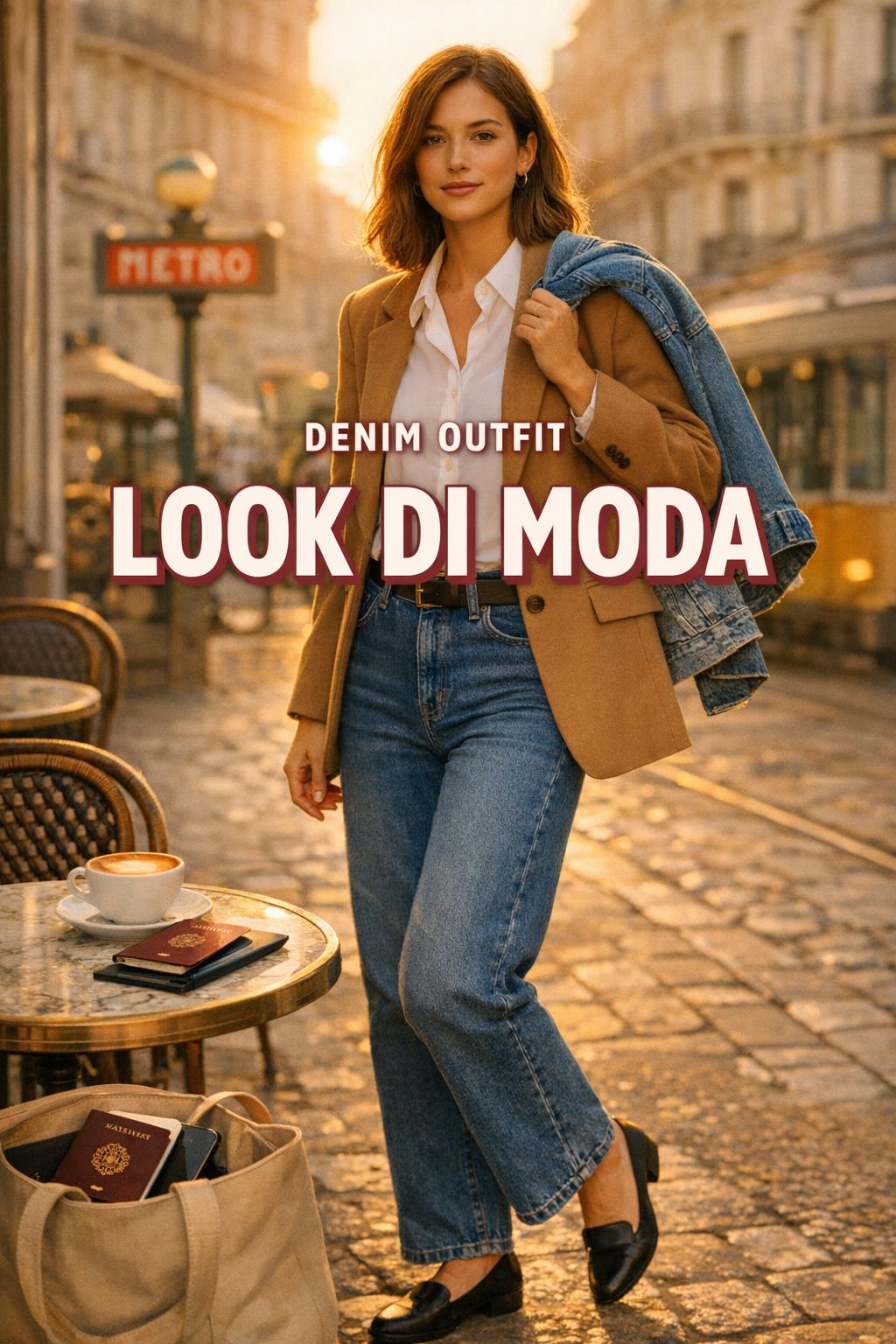
    Prom, interpreted through the black dress outfit lens

    Prom styling often brings “different types of prom dresses” into the conversation, but it’s worth remembering that a black dress can still deliver the sense of occasion—especially when the silhouette is clean and the styling is decisive. The same logic seen in party-season LBD formulas applies: structure plus contrast equals impact. Hosiery, heels, and jewelry can shift the dress from simple to event-ready without turning it into something unrecognizable.
    That said, there’s a trade-off: black can photograph as a single shape if the lighting is low or the fabric is very matte. If prom photos matter to you, consider styling that introduces definition—tights with a deliberate shoe choice, or jewelry that catches light—so the look reads clearly both in person and on camera.

    A note on dress cosplay: when a black dress becomes a character, and how to keep it chic

    Dress cosplay can be playful, and a black dress often serves as the easiest base for a more character-driven outfit idea. The challenge, if you still want the ModePrima-level polish, is avoiding a look that feels like a pile of references rather than an outfit. The most elegant approach is to keep the black dress silhouette clean and let one or two accessories do the “story,” not every element at once.

    Think of it as editorial restraint applied to a themed idea: the dress remains the anchor, the styling becomes the hint. In practice, that means you choose a single focal point—shoe direction, tights, or jewelry—and keep the rest quiet so the overall effect stays intentional rather than chaotic.

    Black dress outfit in a modern city at night, woman walking past a lit art gallery in a minimalist little black dress
    A calm, confident woman in a minimalist black dress outfit strolls past a softly lit city art gallery at night.

    FAQ

    What shoes work best with a black dress outfit?

    The most reliable options depend on the mood: boots make the look grounded and seasonal, minimal sandals keep it chic for summer, and heels sharpen the outfit for party season—especially when paired with black tights or a high-contrast choice like white heels.

    How do I style a black dress outfit for summer without it feeling heavy?

    Keep the silhouette easy and the styling light: reduce layering, choose warm-weather footwear, and use restrained jewelry so the black reads sleek rather than dense in bright light.

    How can I wear a simple black dress and make it look updated?

    Treat the dress as a base and change the “story” through styling: swap between boots and heels, add black tights for party-season definition, or lean into a ’90s-cool approach with flip-flops for a relaxed night out outfit when the setting allows.

    Do black dresses look good with boots in 2024?

    Yes—black dresses with boots remain an easy, modern pairing because the contrast of a clean dress silhouette with structured footwear feels intentional and is also practical for transitional weather and city walking.

    How do I make an all-black outfit feel intentional instead of flat?

    Introduce dimension through texture and contrast: keep the palette black but mix finishes, add a deliberate accessory or jewelry that catches light, and ensure your footwear choice clearly signals the occasion.

    What’s a good party-season formula for a little black dress?

    A refined party-season approach is a little black dress with black tights and a crisp contrasting heel—white heels create a graphic finish—paired with restrained jewelry so the contrast remains the focal point.

    Can I wear a black dress outfit to prom, considering different types of prom dresses?

    You can, especially if you style it with clear event intent: use heels, consider tights for a polished line, and add jewelry for definition so the dress reads celebratory in photos as well as in person.

    How do I incorporate dress cosplay ideas without losing the chic black-dress aesthetic?

    Keep the black dress simple and let one or two accessories carry the reference; editorial restraint is what prevents the look from feeling like a costume while still allowing a character-inspired styling direction.

  • Modern Interview Outfit Rules: From Finance Formal to Tech Casual

    Modern Interview Outfit Rules: From Finance Formal to Tech Casual

    Interview outfit logic: business formal polish vs. smart casual ease

    The modern interview outfit sits at the intersection of style and strategy. You are not dressing for a runway, and you are not dressing for a normal workday either. You are dressing for a moment where strangers assess your judgment in minutes—often through the shorthand of fabric, fit, and formality. That is why “what to wear to an interview” remains a perennial question across fashion media and career advice, and why the answer keeps splitting into two aesthetics that are endlessly discussed together: business formal and smart casual.

    They are often confused because they share key building blocks—especially the blazer, tailored pants, and conservative shoes—and because industry norms have blurred the old lines. A finance or consulting interview still tends to reward conservative structure, while technology and startups are famous for a more relaxed baseline where overdressing can feel out of tune. Add the reality of virtual interviews (where a look must read well on camera), and the spectrum gets even more nuanced.

    This style breakdown compares business formal and smart casual through the lens of real interview scenarios in the United States: how silhouettes differ, how neutral color palettes signal intent, how fabrics behave under office lighting or on video, and how to build a modular, three-piece capsule that adapts across sectors. Along the way, you’ll see how to translate the same core pieces into men’s business outfits and stylish mens suits, and how to make industry-aware choices—from a Google interview to a social work job interview outfit—without losing your sense of self.

    Style overview: business formal interview dressing

    Business formal is the most structured end of the interview attire spectrum. Its defining characteristic is clarity: crisp lines, controlled proportions, and a composed finish. The silhouette is typically tailored—think blazer and matching trousers (a pantsuit) or a skirt suit—designed to look intentional from every angle, including when you sit down, cross your legs, or stand to shake hands.

    The color palette leans heavily on neutrals: navy, black, white, and other restrained tones that rarely invite debate. This is where “black vs navy interview suit” becomes a genuine consideration—not because one is universally right, but because both are understood as low-risk signals of professionalism. Fabrics often appear smoother and more substantial; the aesthetic mood is controlled, credible, and classic, built to align with conservative expectations and hiring-manager instincts.

    In practice, business formal is less about looking expensive and more about looking prepared. Fit and tailoring do much of the work here: a blazer that sits cleanly at the shoulder, trousers with a confident drape, and a blouse or shirt that doesn’t pull, gape, or distract.

    Interview outfit guide: man adjusting navy blazer in mirror at home office, business formal vs smart casual
    A well-dressed man fine-tunes his interview outfit at home in warm golden-hour light, comparing business formal and smart casual options.

    Style overview: smart casual interview dressing

    Smart casual is the more relaxed cousin that still reads “professional wardrobe,” just in a softer voice. Its defining characteristic is ease with intention: a blazer might be present, but it can be more flexible in structure; tailored pants may be swapped for dress pants that feel less severe; and styling often relies on thoughtful coordination rather than strict matching.

    Smart casual leans on clean, modern silhouettes—often a blazer with a simple top, or a polished knit-like look achieved through a conservative blouse and refined accessories. The color palette still favors neutrals, but there is slightly more room for a personal palette within the safe zone: a softer white, a deeper navy, or a calm tonal pairing that reads well on camera and in person.

    The mood is “serious but not overbearing,” a phrase that fits tech-company culture especially well. It communicates competence and good taste without implying you misunderstand the room. For roles where team fit and modern sensibility matter, smart casual can be the most elegant answer to “job interview outfit” because it respects industry norms while preserving approachability.

    Classic interview outfit laid out on a chair with blazer, white shirt, and polished shoes in natural light
    A timeless interview outfit styled with tailored layers and polished details for a confident first impression.

    The formality spectrum: why industry norms decide the rules

    Most interview attire advice fails when it treats formality as a single standard. In reality, interview dress codes are negotiated through industry expectations and company culture. A conservative sector may read a relaxed outfit as a lack of seriousness; a casual sector may read a very formal look as poor calibration.

    Technology interviews are the clearest example. Guidance around how to dress for a Google interview—and similar advice for Google and Facebook (Meta)—centers on balance: polished, professional, and comfortable, without drifting into a suit-and-tie severity that can feel out of sync with an informal corporate environment. Meanwhile, finance and consulting lean toward business formal because the work itself is closely associated with conservative dress and visible credibility.

    • Tech & startups: often rewards smart casual done cleanly—tailored pieces without excessive formality.
    • Finance & consulting:</strong frequently expects business formal—structured suits, restrained palette, minimal accessories.

    When you’re uncertain, the safest editorial approach is to choose a classic base (blazer + tailored bottom + conservative top) and adjust the level of structure. That is the quiet power of a modular interview outfit: it lets you calibrate without starting from zero.

    Key differences: business formal vs. smart casual, piece by piece

    Silhouette and structure

    Business formal is architectural. The blazer is sharper, the trousers are more precisely tailored, and the overall outline looks composed even at a distance. Smart casual is still tailored, but less rigid: the blazer can feel more like a refined layer than a uniform, and proportions can be slightly more relaxed as long as they remain intentional.

    Color palette and visual risk

    Both styles rely on a neutral color palette because neutrals reduce the chance that your outfit becomes the story. The difference is in how strictly those neutrals are used. Business formal tends toward uniformity—matching pieces or clearly coordinated classics like navy, black, and white. Smart casual allows tonal dressing and softer combinations, provided the look still reads professional under office lighting and on video.

    Level of formality and the “message” it sends

    Business formal signals respect for hierarchy and tradition; it is a visual shorthand for seriousness. Smart casual signals competence plus cultural fluency—an ability to look professional without leaning on the strictest version of business attire. Neither is “better.” The better choice is the one that aligns with the norms of the room you are trying to enter.

    Styling philosophy: uniform vs. capsule

    Business formal often behaves like a uniform: fewer decisions, fewer variables, fewer chances to misstep. Smart casual behaves like a capsule: a blazer anchors the look, but the top and bottom can shift to suit the company and the day. This is where many men’s business outfits now live—using tailored structure, but avoiding extremes.

    Visual style breakdown: how these aesthetics read in real life

    Imagine two candidates walking into the same building. Both are wearing a blazer. Both chose neutrals. Yet the visual story is different, and hiring teams notice—even if they never name it aloud.

    Interview outfit in a modern office lobby: professional in navy blazer and white blouse holding a portfolio in golden-hour light
    A poised professional in a navy blazer and white blouse steps through a sunlit office lobby, ready for an interview.

    Layering and proportion

    Business formal layering is deliberate and flat in the best way: a structured blazer over a blouse or shirt that sits cleanly at the neckline, with trousers or a skirt that continues the line. Smart casual may introduce a softer contrast—still refined, but with slightly more relaxed drape through the body. The goal is to look composed without looking uncomfortable.

    Accessories: punctuation, not paragraphs

    Across both styles, accessories should complement rather than overpower. Business formal typically uses minimal accessories to maintain a conservative silhouette. Smart casual can tolerate a touch more personality, but the best approach remains editorial restraint: one strong choice (a clean bag, a classic watch) rather than a collection of statements competing for attention.

    Footwear choices

    Footwear is where the styles separate quickly. Business formal expects conservative shoes that echo the tailored structure of the outfit. Smart casual can accommodate loafers more naturally—an idea frequently repeated in interview outfit discussions—because loafers sit between formal and relaxed. The common thread is polish: clean lines, tidy condition, and a professional finish.

    Camera-read for virtual interviews

    Virtual interviews compress style into a smaller frame. The blazer becomes even more valuable because it creates structure on screen, while a conservative top keeps the focus on your face. The smartest approach is to prioritize fit through the shoulders and neckline—areas most visible on camera—and to keep the palette calm so you don’t create visual “noise” against your background.

    The shared foundation: a three-piece interview capsule that adapts

    Behind most successful interview outfits is the same simple architecture: blazer + top + bottom. This three-piece capsule works because it is easy to calibrate. Make the blazer sharper and the palette more uniform, and you move toward business formal. Relax the structure slightly and choose a softer pairing, and you move toward smart casual—without changing your entire wardrobe.

    The blazer as the anchor piece

    The blazer appears across nearly every credible “what to wear to an interview” framework because it does one job exceptionally well: it frames you. In business formal, that frame is structured and classic; in smart casual, it can be slightly more flexible, but still tailored. Prioritize a clean shoulder line, a stable lapel, and sleeves that feel intentional rather than improvised.

    Bottoms: tailored pants, dress pants, or a skirt

    Bottoms carry the quiet authority of the look. Tailored pants push the outfit toward business formal; dress pants with a slightly softer feel can read smart casual while remaining professional. A skirt can work beautifully when the length and fit are conservative and the overall outfit remains balanced—especially when paired with a blazer that keeps the silhouette refined.

    Tops: the conservative blouse or shirt

    The top should support, not compete. A conservative blouse or shirt in a neutral—often white—is a classic for a reason: it reflects light nicely, looks crisp under a blazer, and keeps attention on your face. In more fashion-forward environments, a shell top can serve the same function: clean, minimal, and easy under tailoring.

    Color, fabric, and fit: the “silent language” of interview attire

    Most hiring decisions are not made on clothing alone, yet clothing contributes to first impressions because it communicates judgment. Color choices imply restraint or experimentation; fabric choices hint at comfort and preparation; fit suggests attention to detail. This is why neutral palettes and tailoring dominate interview attire guidance across industries.

    Color palettes by industry: neutrals as diplomacy

    Neutrals—navy, black, white, and related subdued tones—function as diplomacy. In finance and consulting, they align with conservative expectations. In tech, they read as modern and unfussy. In creative settings, they provide a calm base so any personality you introduce feels intentional, not chaotic. If you’re debating black vs. navy, the more useful question is whether you want the sharper severity of black or the slightly softer authority of navy—and how either will read in your interview context.

    Fabric choices: how materials behave under pressure

    Interviews involve movement, waiting, and sometimes travel—conditions that reveal fabric behavior quickly. Smooth, stable fabrics read crisp; others wrinkle and look tired by the time you arrive. In a virtual interview, fabric texture can also create distracting visual effects if it catches light oddly. The practical approach is to choose fabrics that keep their shape and sit cleanly, especially in the blazer and through the front of the top where the camera focuses.

    Tailoring and fit: the difference between “fine” and convincing

    Tailoring is the overlooked lever of interview dressing. A modest blazer that fits impeccably can look more professional than a statement piece that doesn’t. Alterations matter because they refine proportion: sleeves that stop at the right place, trousers that break cleanly, a waistband that lies flat. This is also where inclusivity becomes practical—whatever your size or body type, the goal is a clean line that lets you move comfortably and sit with ease.

    Industry comparisons: translating the same outfit into different sectors

    Think of industry norms as the styling brief. The same building blocks—blazer, pants or skirt, conservative blouse, loafers or other professional shoes—become different messages depending on how you tune the details. Below are sector-specific interpretations designed to show the logic, not prescribe a uniform.

    Technology & startups: the calibrated “Google interview” balance

    For a Google interview, or interviews at similarly informal tech firms, the sweet spot is professional without feeling overly formal. A blazer is still a strong choice, but the outfit should not look like it belongs to a different industry. Smart casual typically wins here: tailored pants, a clean top, and polished shoes that feel modern. The signal you want is competence and cultural fit—serious, not overbearing.

    Finance & consulting: conservative structure as credibility

    Finance and consulting tend to reward business formal clarity. This is where a coordinated suit (pantsuit or skirt suit) in a neutral palette feels most at home. Accessories should be minimal and purposeful; shoes should read conservative. If you are building stylish mens suits for this world, the same principle applies: clean tailoring, restrained color, and a composed finish that communicates reliability.

    Healthcare & education: composed, practical, and calm

    Healthcare and education interviews often sit between business formal and business casual, depending on the role and institution. The most effective interview outfit is usually conservative styling that feels functional: a blazer for structure, tailored pants or a skirt with easy movement, and shoes you can walk in confidently. The aesthetic should feel reassuring—professional wardrobe choices that suggest steadiness and respect.

    Creative/media: personality with boundaries

    Creative and media environments can be more receptive to fashion-forward detail, but interviews still require restraint. A blazer can become a subtle statement piece here—through cut or proportion—while the rest of the outfit stays calm. The best creative interview looks are edited: clean lines, intentional palette, and one controlled point of interest rather than a head-to-toe trend narrative.

    Example comparisons: the same scenario styled two ways

    Rather than listing endless options, it is more useful to see how business formal and smart casual solve the same problem. These comparisons show the styling logic behind each approach, using the same core wardrobe pieces.

    Example comparison: the classic office interview

    Business formal interprets the classic office interview with a matching pantsuit or skirt suit in navy or black, a conservative blouse or shirt in white, and conservative shoes. The composition is uniform-like: minimal contrast, clean tailoring, accessories kept quiet. Smart casual takes the same situation and softens it slightly—still a blazer, still tailored pants, still a restrained top, but the blazer may be less rigid and the overall effect more modern than traditional.

    Example comparison: the tech campus interview day

    Business formal can look too intense for a casual tech environment unless you deliberately relax the styling; a full suit may read as miscalibrated in an informal corporate setting. Smart casual tends to land better: a blazer with tailored pants and polished loafers creates a professional silhouette without signaling that you misunderstood the culture. This is where men’s business outfits often benefit from a tailored jacket and clean shirt rather than the strictest suit formula.

    Example comparison: the social work job interview outfit

    A social work job interview outfit typically benefits from conservative styling that feels approachable. Business formal can work if the setting is very formal, but it may risk looking too severe. Smart casual often communicates the right balance: a blazer for credibility, tailored pants for professionalism, and a simple, conservative top that feels calm. The goal is to look competent and respectful, while still human—an outfit that supports conversation rather than dominating it.

    Example comparison: the virtual interview

    On camera, business formal reads sharp and authoritative: structured blazer, neutral top, minimal accessories that won’t catch glare. Smart casual reads polished and modern: still a blazer, but perhaps with a slightly softer feel, paired with a calm, neutral blouse that keeps attention on your face. In both cases, the neckline and shoulder fit become the focal points because that’s what the webcam captures.

    Tips from the fitting room: making the outfit behave in real life

    The gap between a good interview outfit and a great one is rarely about buying more. It is about ensuring the pieces perform under real conditions: walking, sitting, waiting, and being seen under unforgiving lighting or a laptop camera.

    • Do a sit-test: sit down in your full outfit and check for pulling at the buttons, gaping at the blouse, or a skirt riding up beyond your comfort.
    • Check the “wrinkle timeline”: wear the outfit for 20 minutes at home; if it creases heavily, it may look tired before the interview begins.
    • Keep patterns restrained: loud patterns can distract in person and on video, where they can appear even busier.
    • Let one piece lead: if the blazer is a statement, keep accessories minimalist; if accessories are distinctive, keep the blazer classic.

    A final practical note: bring your interview attire to the level of the job, not the level of your anxiety. Overcorrecting into extreme formality can feel as risky as underdressing, particularly in tech. Calibration is its own form of competence.

    Grooming and fragrance: the invisible part of “professional”

    Interview attire is not only clothing. Grooming choices—hair, makeup, and fragrance—shape how polished an outfit appears. The most reliable approach is moderation: grooming should look intentional and clean, not theatrical. In a close conversation or a small room, fragrance becomes louder than you think, so it is wise to keep it subtle to avoid overshadowing the interview itself.

    This is where minimalism is not about denying personality; it is about directing attention. A neat finish lets the blazer, the clean lines, and your communication take the lead.

    Shopping and sizing: value, versatility, and the case for alterations

    If you are building an interview wardrobe from scratch, the smartest purchases are the pieces that can repeat across scenarios: a blazer that works for tech and finance with small styling changes, tailored pants that pair with multiple tops, and shoes that remain comfortable through long waits. This is also where AI-assisted outfit planning and visualization tools have started to appear in interview dressing conversations—not as a replacement for taste, but as a way to pre-visualize combinations and reduce decision fatigue.

    Budget and investment pieces can both work if the fit is right. A lower-cost blazer that’s tailored can outperform a more expensive piece that doesn’t sit correctly. If you are assembling stylish mens suits or refining men’s business outfits, the same principle applies: prioritize fit at the shoulders, clean lines through the torso, and trousers that fall neatly without constant adjustment.

    Tips: a calm, repeatable buying framework

    Start with a neutral blazer and one tailored bottom you can wear multiple ways, then add a conservative top that photographs well for virtual interviews. Use accessories—bag, shoes, watch—as quiet anchors, not focal points. If you’re tempted by a trendy element, keep it contained to one item so the interview look stays timeless rather than time-stamped.

    When to choose business formal vs. smart casual

    The most sophisticated interview dressing is situational. You are choosing a style language based on industry norms, role expectations, and the setting—office, campus, or video call.

    • Choose business formal when you expect conservative standards, when the organization signals tradition, or when you want maximum clarity and authority in your presentation.
    • Choose smart casual when the company culture is known to be informal (as in many tech environments), when the role rewards approachability, or when you want polished ease rather than strict uniformity.
    • Blend the two when you’re unsure: keep the blazer and neutral palette, then choose how structured the rest should feel.

    This is also the simplest answer to “what to wear to a job interview” when you cannot confirm the dress code: build from a conservative base and calibrate with structure, not with loud color or heavy accessories.

    A final checklist for a confident job interview outfit

    The strongest interview outfits are memorable for the right reasons: they look polished, they respect the room, and they let your conversation lead. Before you leave (or log on), run a quick edit.

    • Blazer fits cleanly at the shoulders and sits neatly when you move.
    • Top is conservative and camera-friendly, with no pulling or gaping.
    • Bottom is tailored enough to look intentional and comfortable enough to sit confidently.
    • Shoes are professional, clean, and aligned with the formality level.
    • Accessories complement rather than compete.
    • Grooming is neat; fragrance is subtle.
    • Outfit looks good standing and sitting, in daylight and indoor lighting.

    Whether your path leads to finance, a creative studio, a classroom, a hospital, or a Google interview, the most persuasive interview outfit is rarely the loudest. It is the one that demonstrates judgment: a refined silhouette, a neutral palette, and styling restraint that reads as readiness.

    Professional woman in a U.S. office lobby wearing an interview outfit with navy blazer, ivory blouse, and black trousers
    In warm morning light, a poised professional refines her interview outfit in a modern office lobby, portfolio in hand.

    FAQ

    What should I wear to an interview if I don’t know the dress code?

    Start with a neutral three-piece base—blazer, conservative top, and tailored pants or a skirt—then adjust the level of structure: sharper and more uniform for business formal, slightly softer for smart casual, while keeping accessories minimal and professional.

    Is a blazer always necessary for an interview outfit?

    A blazer isn’t the only option, but it is the most reliable because it adds instant structure and professionalism across industries; it also reads especially well on video by framing the shoulders and making the overall silhouette look intentional.

    How should I dress for a tech interview like a Google interview?

    Aim for polished, professional, and comfortable rather than overly formal: smart casual typically works well, using tailored pants, a clean top, and a blazer that looks refined without feeling severe, so you align with an informal corporate environment.

    Should I choose black or navy for an interview suit?

    Both are classic neutral choices; decide based on the tone you want to project and the industry context, keeping the rest of the outfit conservative so the overall impression stays low-risk and professional.

    What’s the difference between business formal and smart casual for interviews?

    Business formal is more structured and uniform-like, often centered on a coordinated suit and restrained accessories, while smart casual keeps the look professional but slightly more relaxed, using tailored pieces and clean styling without the strictest level of formality.

    What should I wear for a virtual interview to look professional on camera?

    Choose a blazer and a conservative top in a calm neutral palette, prioritize fit at the shoulders and neckline (the most visible areas), and keep accessories minimal so nothing distracts under lighting or against your background.

    How do I build men’s business outfits that work for interviews?

    Build around tailored structure and neutral colors: a well-fitting blazer or suit with clean lines, a crisp shirt, and conservative shoes; for stylish mens suits, the deciding factor is almost always fit and restraint rather than bold styling.

    What makes a good social work job interview outfit?

    Choose conservative styling that feels composed and approachable: a blazer for credibility, tailored pants or a skirt for professionalism, and a simple top with minimal accessories, aiming for a calm, respectful look that supports conversation.

    What are the most common interview outfit mistakes?

    The most frequent issues are poor fit, garments that wrinkle or look unkempt quickly, overly loud patterns, and excessive accessories or fragrance that distract; a polished, neutral, well-tailored look usually performs best across interview settings.