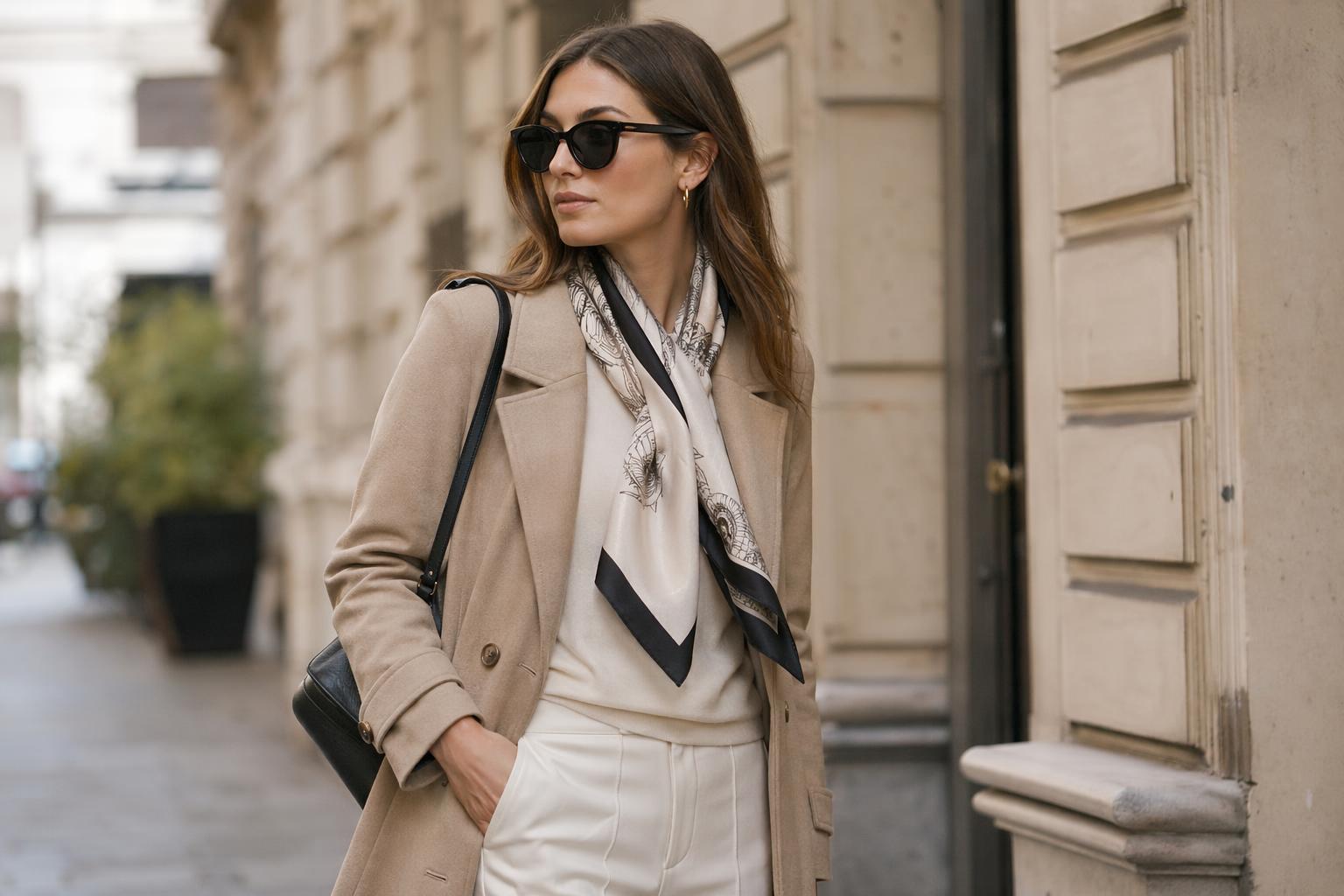
A scarf outfit often looks effortless in photographs, yet in real life it can become surprisingly complicated. The scarf shifts, adds bulk where you do not want it, competes with a jacket collar, or simply feels too decorative for an everyday wardrobe. That tension is exactly why many women own scarves they admire but rarely wear.
The challenge is not only aesthetic. A scarf has to work with weather, movement, necklines, outer layers, and the overall balance of an outfit. Whether you lean toward Paris polish, Milan structure, or the cleaner practicality often associated with Copenhagen dressing, the most successful scarf styling depends on proportion and purpose. This guide approaches the scarf as a functional style tool, showing how to make it look refined, wearable, and modern.
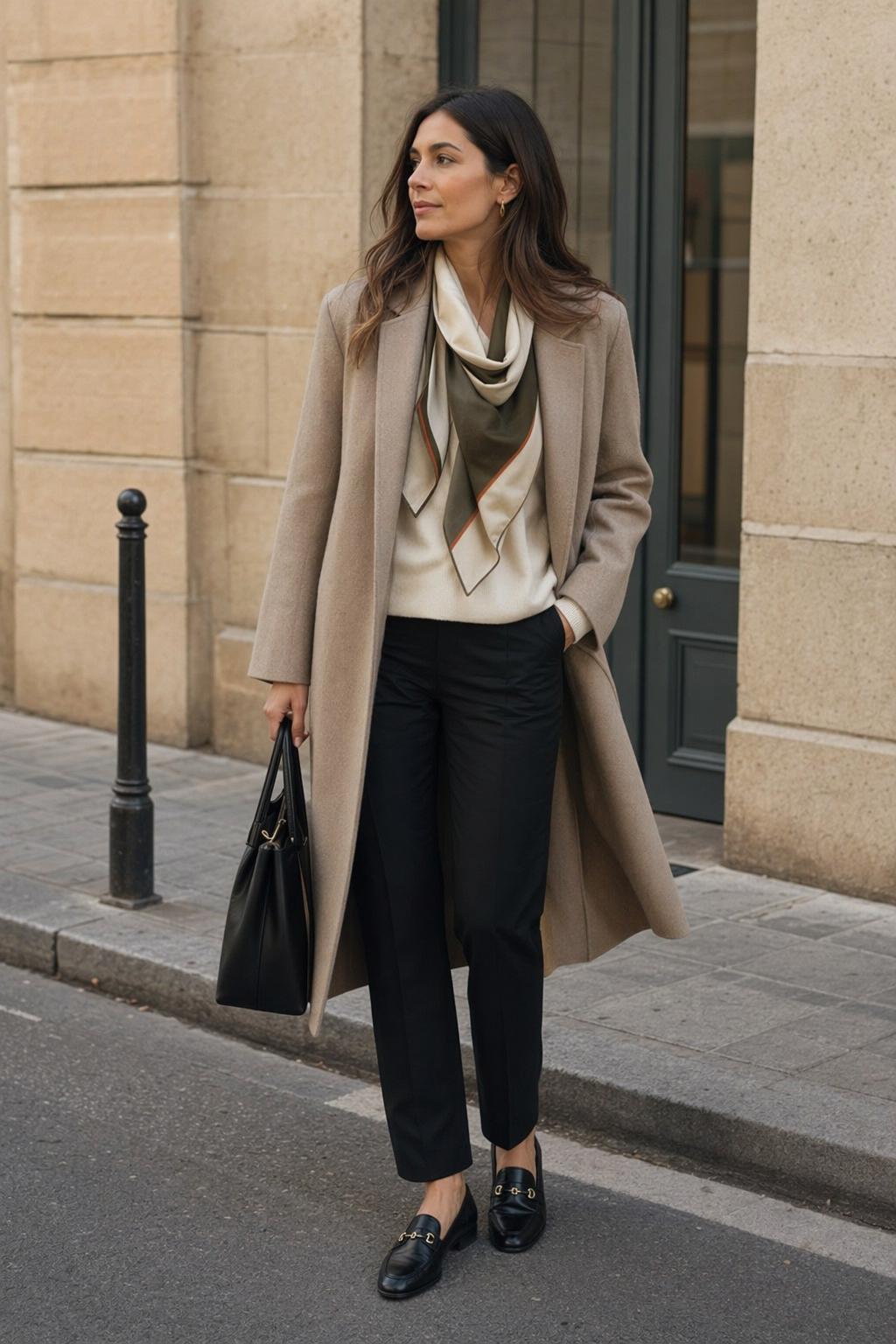
Why a scarf outfit can feel harder than it should
Scarves sit at a visually important point in the outfit: near the face, across the shoulders, and often over the opening of a coat, blazer, or knit. That makes every choice more noticeable. A scarf can soften tailoring, add contrast to minimal basics, or bring a silk scarf outfit to life with very little effort. It can also overwhelm a petite frame, clutter a neat neckline, or interrupt the clean line of elevated basics if the fabric or scale is wrong.
This is why so many scarfs outfits fail for practical reasons rather than style alone. Winter weight scarves may feel too heavy indoors. Lighter silk versions can look elegant but may slip or feel too formal if the rest of the outfit is casual. A scarf tied too tightly can fight with a structured blazer layered over a fine knit. One draped too loosely may read unfinished. The problem is rarely the scarf itself. It is the relationship between the scarf, the garment opening, and the silhouette beneath it.
Your wedding has a lot of moving pieces. Your plan can still feel composed.
Zarellea organizes guests, vendors, budget, and timelines in one shared space — so you can make decisions with clarity, not stress.
Readers interested in looks chic, 60 fashion, or fashion over 50 often face this issue in a particularly thoughtful way. The aim is not novelty for its own sake, but a polished composition that feels intelligent, flattering, and easy to wear through a full day.
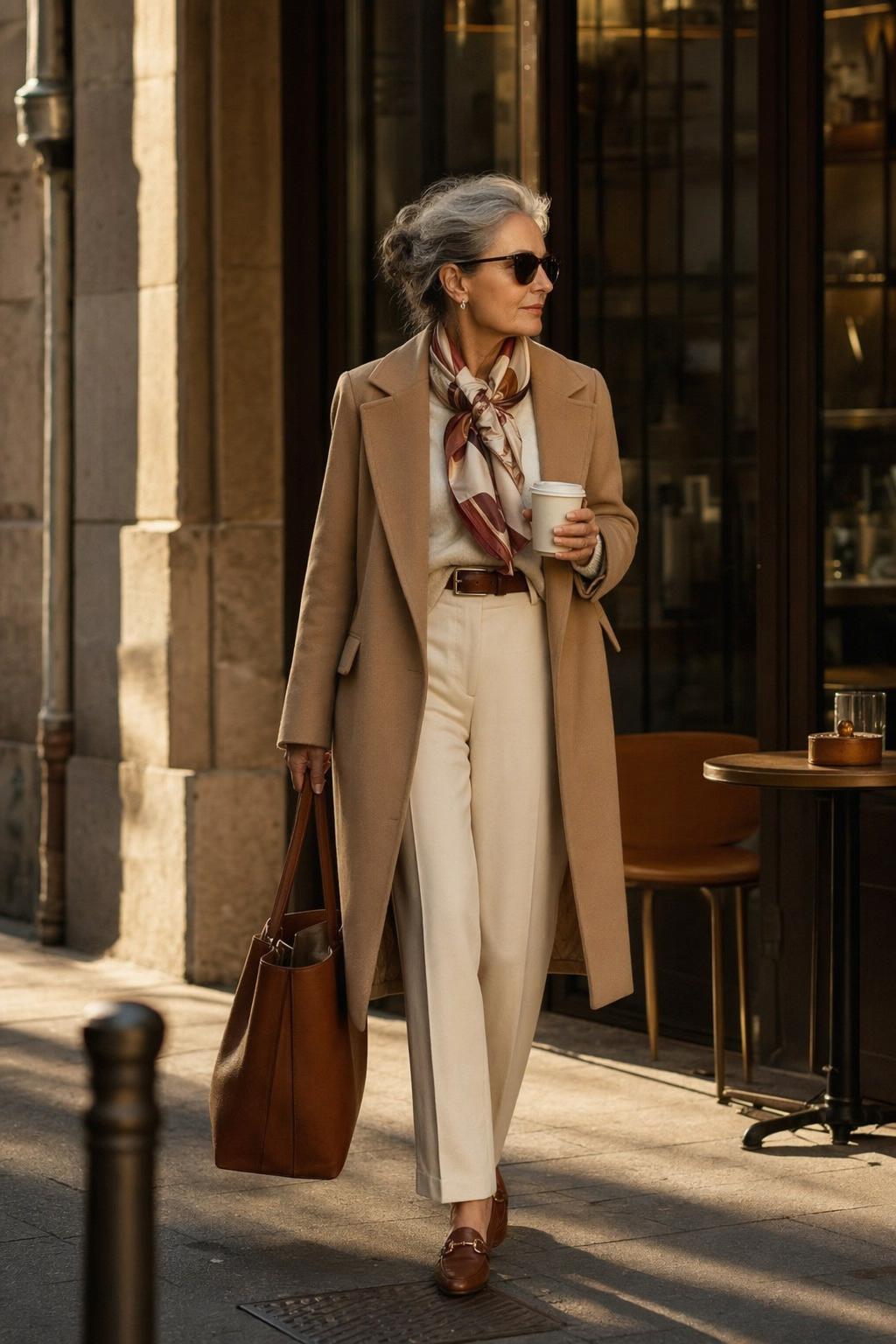
The styling logic that makes scarves work
A strong scarf outfit begins with restraint. Because the scarf already adds movement, texture, and attention, the rest of the look benefits from clarity. Clean lines, tailored structure, and balanced volume help the scarf feel intentional rather than incidental. This is one reason fashion magazines so often return to scarves as styling punctuation rather than the main event.
Think in terms of silhouette first
If the body of the outfit is relaxed, the scarf should usually be lighter or more controlled in its drape. If the outfit is sharply tailored, the scarf can introduce softness. The principle is contrast with discipline. A tailored silhouette contrasted with relaxed textures often looks more considered than matching every element to the same mood.
Match scarf weight to the neckline and outer layer
Chunky scarves work best when the coat opening is simple and the shoulder line can carry visual volume. A silk scarf outfit, by contrast, works beautifully with shirts, crewnecks, fine knits, and lightly open blazers because the fabric sits closer to the body and does not disrupt the line of the jacket.
Use color balance instead of too much pattern
When the scarf carries print or sheen, keep the surrounding palette grounded. Soft neutral tones balanced with one richer accent create a polished everyday look. This is where a scarf can perform like jewelry: not by dominating the outfit, but by sharpening it.
Dress for movement, not only the mirror
A scarf outfit has to survive commuting, indoor heating, restaurant seating, office transitions, and the simple reality of turning your head. The most wearable scarf styling is secure without looking fussy. A good test is whether the scarf still makes sense once the coat comes off. If it only works as an outdoor flourish, it may not be practical enough for daily wear.
Where the problem usually starts: weather, comfort, and proportion
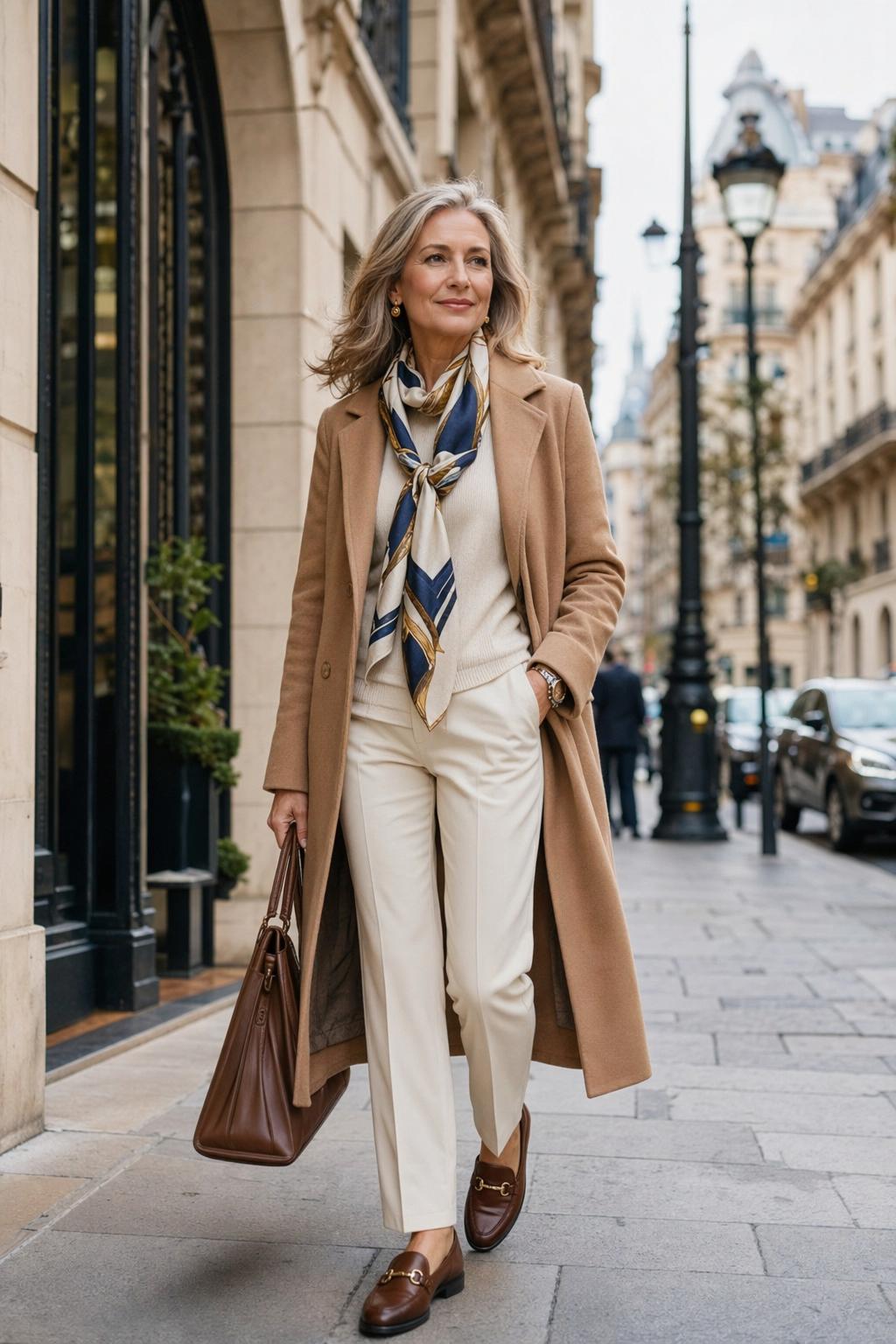
Cold weather often encourages over-layering, and that is where many scarf outfits lose their refinement. A thick knit, a high-neck sweater, and a substantial scarf can create too much density around the upper body. The result feels heavy, especially in small spaces or once you move indoors. In milder weather, the opposite issue appears: a scarf may seem visually unnecessary unless it is integrated with care.
Comfort matters as much as visual balance. Some readers want neck coverage without overheating. Others prefer an accessory that frames the face but does not feel restrictive. These are not small concerns. They shape the scarf size, fabric choice, and styling method. A refined wardrobe is not built on pieces that need constant adjustment.
For fashion over 50 and readers drawn to 60 fashion references, scarves can be especially useful because they provide color, softness, and versatility near the face. Yet they are most flattering when they skim rather than swamp the neckline. Elegance here comes from editing. One considered scarf often does more than several competing accessories.
A city-ready scarf outfit built around elevated basics
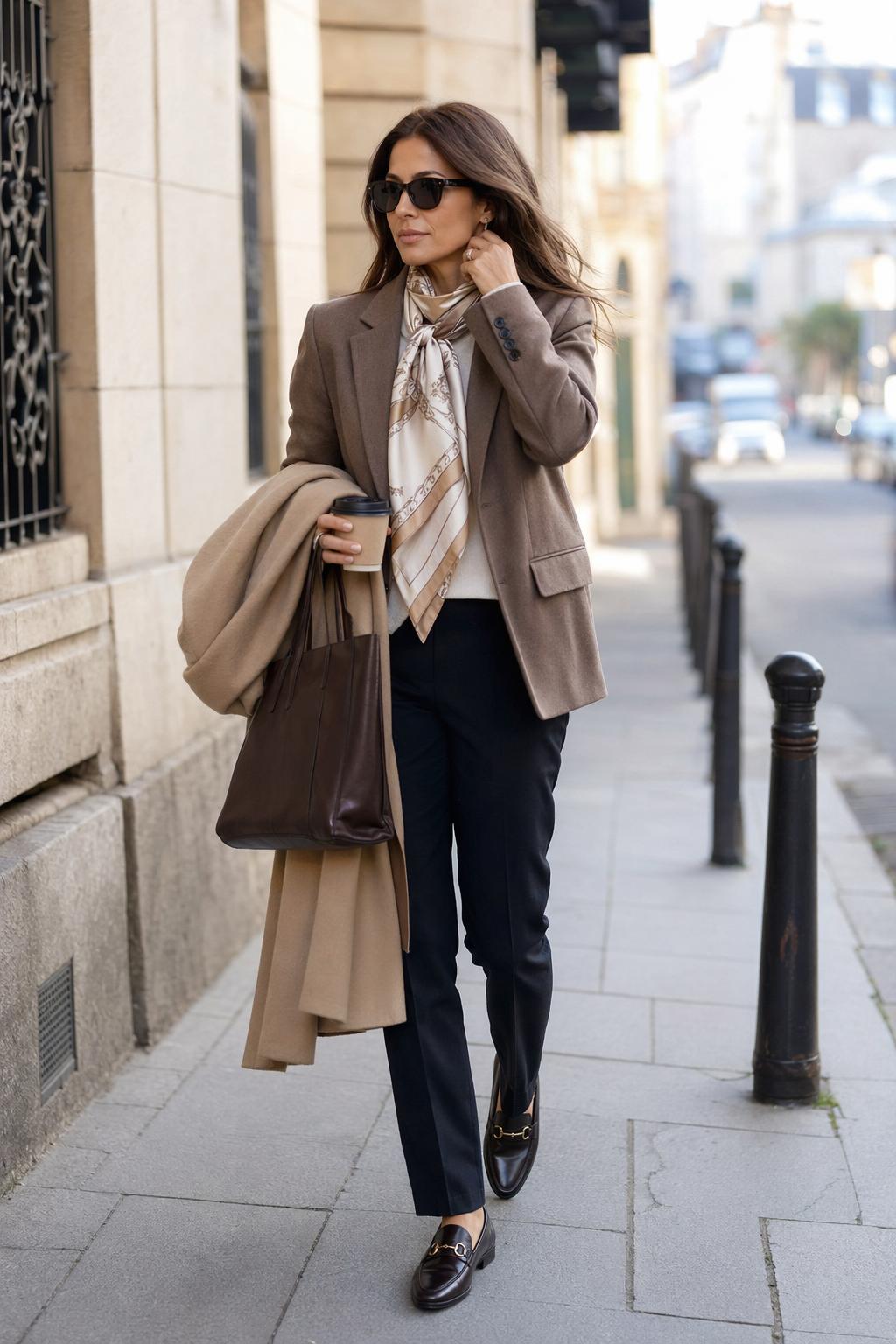
One of the easiest ways to make a scarf outfit feel modern is to build it on elevated basics. Imagine straight-leg trousers, a fine knit, and a structured blazer layered over the top. Add a silk scarf tied close to the neck or tucked slightly into the blazer opening. The effect is polished without becoming precious.
This combination works because each piece has a clear role. The trousers keep the line clean. The knit provides softness and comfort. The blazer introduces tailored structure. The scarf then functions as the finishing note, drawing the eye upward and giving the outfit character. This is the kind of look often associated with Paris and Milan because it depends less on novelty and more on sharp composition.
For readers who want looks chic without overcomplication, this is a reliable formula. Choose a scarf with a restrained print or elegant color contrast, especially if the blazer is dark and the knit is neutral. The scarf should not spill too far beyond the lapels. That smaller scale keeps the neckline refined and wearable through a full day.
Why this look solves the problem
It prevents the scarf from floating awkwardly over casual pieces and anchors it within a tailored frame. It also translates well from outdoors to indoors. Once the coat is removed, the scarf still belongs to the outfit rather than feeling like an afterthought.
The soft knit approach for cooler days
When the weather calls for warmth, the instinct is often to reach for the biggest scarf available. A more refined approach is to simplify the knitwear first. Start with a lower-bulk sweater or neat cardigan, then add a medium-weight scarf with enough drape to fall cleanly rather than puff outward.
A scarf outfit in this mood should feel cocooning but not crowded. Consider a soft neutral palette with tonal layering: cream, camel, gray, or navy. The scarf can stay in the same color family or introduce one deeper accent. Clean lines matter here. If the sweater is oversized, keep the scarf narrower. If the coat is roomy, let the scarf hang longer rather than wrapping it repeatedly around the neck.
This style has strong everyday usefulness. It works for walking through the city, commuting, or spending long hours between indoors and out. In practice, it also reduces the common problem of overheating, because the layers are easier to loosen without dismantling the outfit.
Tips for keeping winter scarf styling polished
- Leave some vertical line visible at the front of the coat or knit so the upper body does not look blocky.
- Choose one soft texture as the focus rather than combining several heavy fabrics around the neck.
- Let the scarf echo the coat tone if you want a longer, leaner visual effect.
- Avoid wrapping so tightly that the scarf lifts the shoulders and shortens the neck.
The silk scarf outfit that makes simple clothes look intentional
A silk scarf outfit solves a different problem: how to make very simple clothes feel complete. A white shirt, straight jeans, and loafers may already be sound, but the addition of a silk scarf at the collar or tied lightly beneath an open neckline turns basics into a considered ensemble.
What makes silk so effective is its controlled lightness. It adds color, print, and gloss without adding bulk. That makes it ideal for transitional weather and for women who want the refinement of an accessory without the warmth of a winter scarf. It also works well in wardrobes inspired by fashion magazines because it carries an editorial note while remaining practical.
For a more understated result, tuck the scarf slightly inside the shirt or knit so only part of it shows. For a more visible statement, tie it neatly and let it frame the face. Either way, the surrounding outfit should stay composed. A silk scarf outfit looks strongest with garments that have clear shape: a crisp shirt, a structured blazer, a simple knit, or a clean trench.
How to keep a silk scarf from feeling too formal
Pair it with grounded pieces. Denim, flat shoes, and easy tailoring stop the scarf from reading ceremonial. This is especially useful for readers who admire the elegance of Who What Wear, Woman & Home, Marie Claire, or broader fashion magazine styling but want an interpretation that feels natural in daily life.
Scarfs outfits for travel days and long hours out
Travel is one of the most convincing reasons to wear a scarf well. The outfit needs flexibility, temperature control, and enough polish to move through different settings. In this context, the scarf should function as both layer and visual anchor.
A practical travel look might center on relaxed trousers, a jersey or fine knit top, a blazer or light coat, and a scarf draped in a way that can be tightened or loosened quickly. The ideal scarf here is not the most dramatic one in the wardrobe. It is the one that folds easily, resists looking crumpled, and integrates with the rest of the palette.
The styling logic is simple: when the base outfit is comfortable, the scarf adds finish. When the environment turns cold, the scarf adds function. This is one of the clearest examples of balancing style and practicality rather than sacrificing one to achieve the other.
A useful travel mindset
Choose a scarf that can work in at least three ways: as a neat neck accent, a looser drape over a coat, and a soft layer indoors over simple basics. Versatility is what makes an accessory earn its place in a real wardrobe.
How fashion over 50 can use scarves with more clarity and less fuss
Scarves have long appealed to women interested in fashion over 50 because they offer flexibility without relying on trend-driven dressing. They can soften tailoring, brighten neutrals, and bring focus toward the face. The key is not to treat the scarf as camouflage or as a compulsory finishing piece. It should support the outfit, not replace it.
A refined approach often begins with better scale. Medium-size scarves are generally easier to style than very tiny ones or oversized blankets. They allow drape without excess and sit well with jackets, knits, and dresses. For readers inspired by 60 fashion, there is also room for a more graphic silk scarf tied with precision, but it looks best when the rest of the outfit remains sleek.
Looks chic at this stage often depend on line and light rather than abundance. A scarf in a flattering tone can illuminate the complexion, especially when paired with a coat or knit in a clean neutral. The elegance comes from control: a thoughtful knot, a visible neckline, a jacket with enough structure to hold the composition together.
What usually works best
- Scarves that drape cleanly instead of creating excessive volume.
- Colors that complement the face and sit comfortably with existing wardrobe neutrals.
- Simple outfit foundations such as a blazer, knit, shirt, tailored trousers, or straight denim.
- One focal accessory at a time, allowing the scarf to read as deliberate.
The polished coat-and-scarf formula for real weather
There is a particular challenge in cold-weather dressing: how to feel protected without losing shape. A coat and scarf can either create a strong vertical silhouette or produce a dense, rounded upper half. The difference usually lies in the coat opening, scarf length, and wrap method.
A structured coat with a clear shoulder line benefits from a scarf that hangs with some length, even if one end is slightly shorter than the other. This creates movement and preserves the front line of the body. If the coat is softer and more relaxed, the scarf can be tucked more closely so the outfit does not lose definition.
Paris styling often leans on this kind of disciplined ease: the scarf appears casual, but the proportions are controlled. Milan tends to push a little more structure and finish. Copenhagen style, logically implied in many modern wardrobes, often embraces ease and practicality with cleaner, lower-fuss layering. Each approach can work. What matters is coherence between the scarf and the outerwear.
Tips for coat pairings
If your coat has a strong collar, let the scarf sit inside it rather than overloading the exterior. If the coat front is minimalist, the scarf can sit more visibly on top. When in doubt, reduce one element: either simplify the scarf or simplify the coat shape. The outfit rarely needs both to compete.
A scarf with dresses and softer silhouettes
Scarves are not only for tailoring. They can also solve the problem of making dresses feel more seasonally adaptable or more visually complete. A simple dress can look unfinished in cooler weather, particularly if the neckline is open and the outer layer is removed indoors. A lighter scarf can bridge that gap elegantly.
The important thing is to preserve the line of the dress. If the dress has fluidity, use a scarf with a similarly soft hand so the transition feels natural. If the dress is more structured, a silk scarf outfit can bring subtle contrast. Avoid overly bulky wraps with delicate dresses unless the look is explicitly built around heavy layering.
This approach is especially useful for lunches, gallery visits, dinners, or occasions where you want elegance without feeling overdressed. The scarf becomes a refined intermediary between accessory and layer, adding practical warmth while maintaining the grace of the dress silhouette.
Common mistakes that make a scarf outfit look awkward
Most scarf styling problems come from excess, not absence. Too much volume, too much print, too many layers, or too much tension around the neck. Because the scarf sits in such a visible position, small mistakes become prominent.
- Pairing a bulky scarf with an already high or crowded neckline, which compresses the upper body.
- Using a highly patterned scarf with equally busy clothing, which weakens the outfit’s focal point.
- Letting a scarf float over casual basics without any visual anchor, making it look disconnected.
- Choosing a scarf for color alone without considering weight, drape, or the shape of the coat or jacket.
- Wrapping repeatedly for warmth when a better solution would be a different fabric or a less bulky base layer.
The correction is usually straightforward: simplify the outfit foundation, reduce thickness, or change the tying method. A scarf should feel like part of the outfit architecture, not a decorative add-on applied at the end.
Small adjustments that instantly make scarves look chic
There is often no need to buy anything new. A scarf outfit can become more refined through a few measured adjustments. These changes are subtle, but they are exactly what create the editorial quality associated with looks chic.
Refine the knot
A knot that sits too high or too tight can feel rigid. Lowering it slightly often restores ease. With silk, a neat tie close to the neck can look sharp, but it should still feel breathable and natural.
Let one line stay visible
Whether it is the opening of a blazer, the center line of a coat, or the neckline of a knit, visible structure helps the eye read the outfit. Scarves look better when they interact with existing lines rather than covering all of them.
Use texture with intention
A smooth scarf with a brushed coat, or a soft wool scarf against sharper tailoring, creates controlled contrast. This is more effective than piling similar heavy textures together.
Edit the accessories
If the scarf is the visual accent, reduce competing statements nearby. The overall impression becomes cleaner and more expensive-looking, even with very familiar wardrobe pieces.
Building a scarf outfit from your own wardrobe
The most successful scarf styling rarely begins with the scarf. It begins with the question: what does this outfit need? More warmth, more color, more structure near the face, or simply a finished feeling? Once that is clear, choosing the scarf becomes easier.
Start with a dependable base. This might be tailored trousers and knitwear, a shirt and jeans, a simple dress and coat, or a blazer with elevated basics. Then assess the neckline and outer layer. If the clothes already create volume, choose a lighter scarf. If the outfit is visually flat, a printed silk scarf can introduce just enough movement. If the day involves changing temperatures, prioritize drape and adjustability over drama.
That is the practical intelligence behind a strong scarf outfit. It is not about memorizing one formula. It is about reading the role the scarf needs to play and styling it accordingly.
FAQ
How do I make a scarf outfit look modern instead of dated?
Keep the base outfit clean and current, with simple tailoring, elevated basics, and controlled proportions. A scarf looks more modern when it complements a clear silhouette rather than competing with too many layers, prints, or decorative details.
What is the easiest way to wear a silk scarf outfit every day?
Pair the silk scarf with grounded pieces such as a crisp shirt, straight jeans, loafers, or a blazer. This keeps the scarf elegant but practical, so it feels integrated into daily dressing rather than reserved for special occasions.
Are scarves flattering for fashion over 50?
Yes, particularly when the scale and drape are well chosen. Scarves can soften tailoring, add color near the face, and make simple outfits feel polished, but they are most flattering when they do not overwhelm the neckline or create unnecessary bulk.
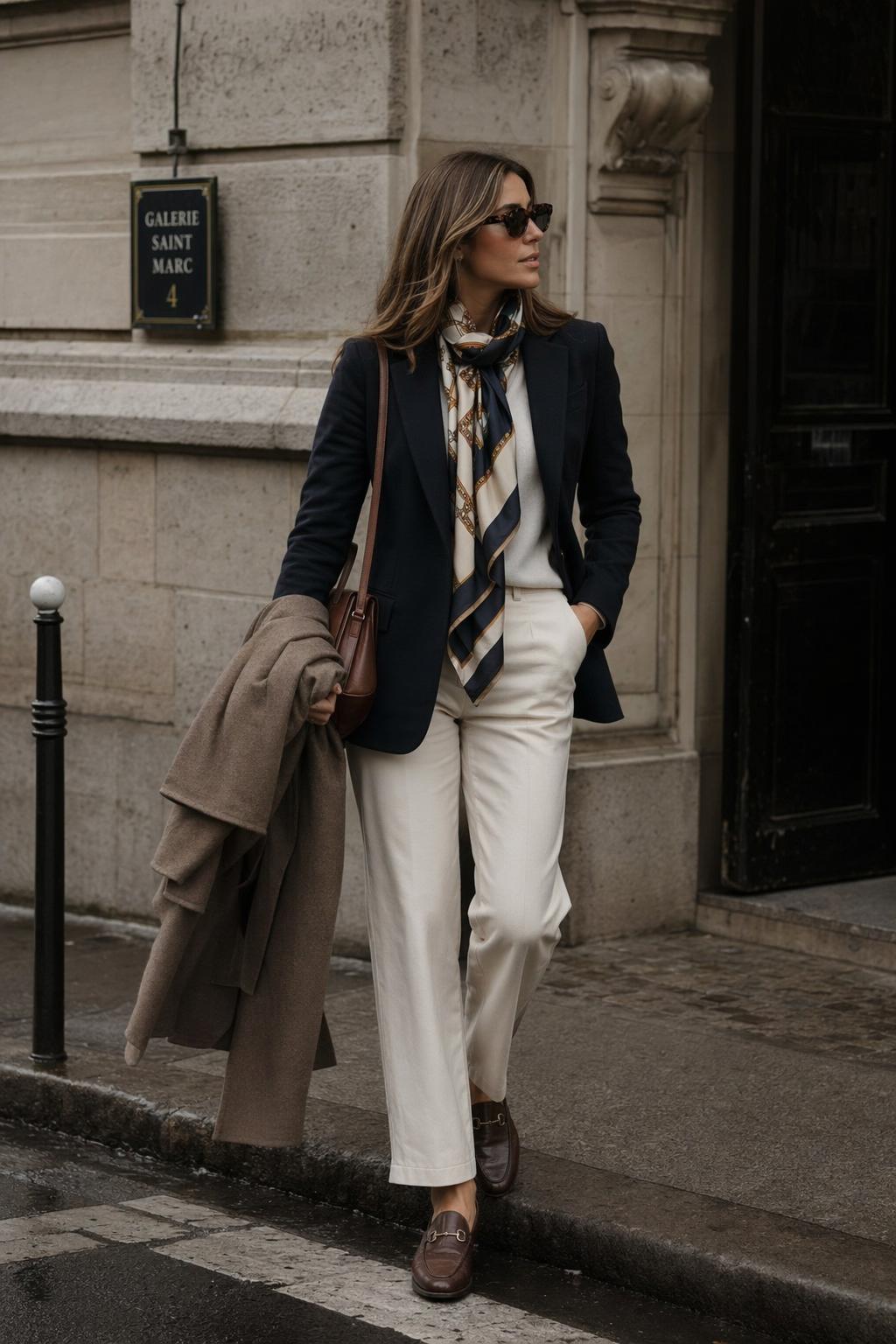
How do I wear a scarf with a blazer without looking too formal?
Use a lighter scarf, ideally in silk or another fluid fabric, and combine it with relaxed but polished pieces such as straight denim or simple trousers. Let the blazer provide structure while the scarf adds a softer accent rather than a ceremonial finish.
What scarf style works best for cold weather?
A medium-weight scarf with enough drape to fall cleanly is often more wearable than the heaviest option in your wardrobe. It gives warmth while preserving shape, especially when paired with a coat that has a simple opening and a lower-bulk knit underneath.
Why do some scarfs outfits feel bulky?
Bulk usually happens when the scarf, neckline, and outerwear all add volume in the same area. A high-neck sweater, thick scarf, and structured coat collar can crowd the upper body, so reducing one element usually restores balance.
Can I wear a scarf with a dress?
Yes, especially when the scarf matches the visual weight of the dress. A lighter scarf works well with fluid dresses, while a silk scarf can add a refined touch to more structured styles without interrupting the overall line.
How can I create looks chic with scarves without over-accessorizing?
Let the scarf be the focal point and keep the rest of the accessories restrained. Clean tailoring, balanced color, and one thoughtful scarf usually create a more polished result than adding multiple competing details.
Do scarves work with 60 fashion inspiration?
They can work very well, especially in silk and with more graphic precision. The key is to balance that reference with a sleek modern outfit so the result feels inspired by 60 fashion rather than costume-like.
What should I prioritize when choosing a scarf for travel?
Prioritize versatility, comfortable fabric weight, and a color palette that coordinates easily with your outerwear and basics. The best travel scarf can shift from functional warmth to polished styling without needing constant adjustment.
Leave a Reply