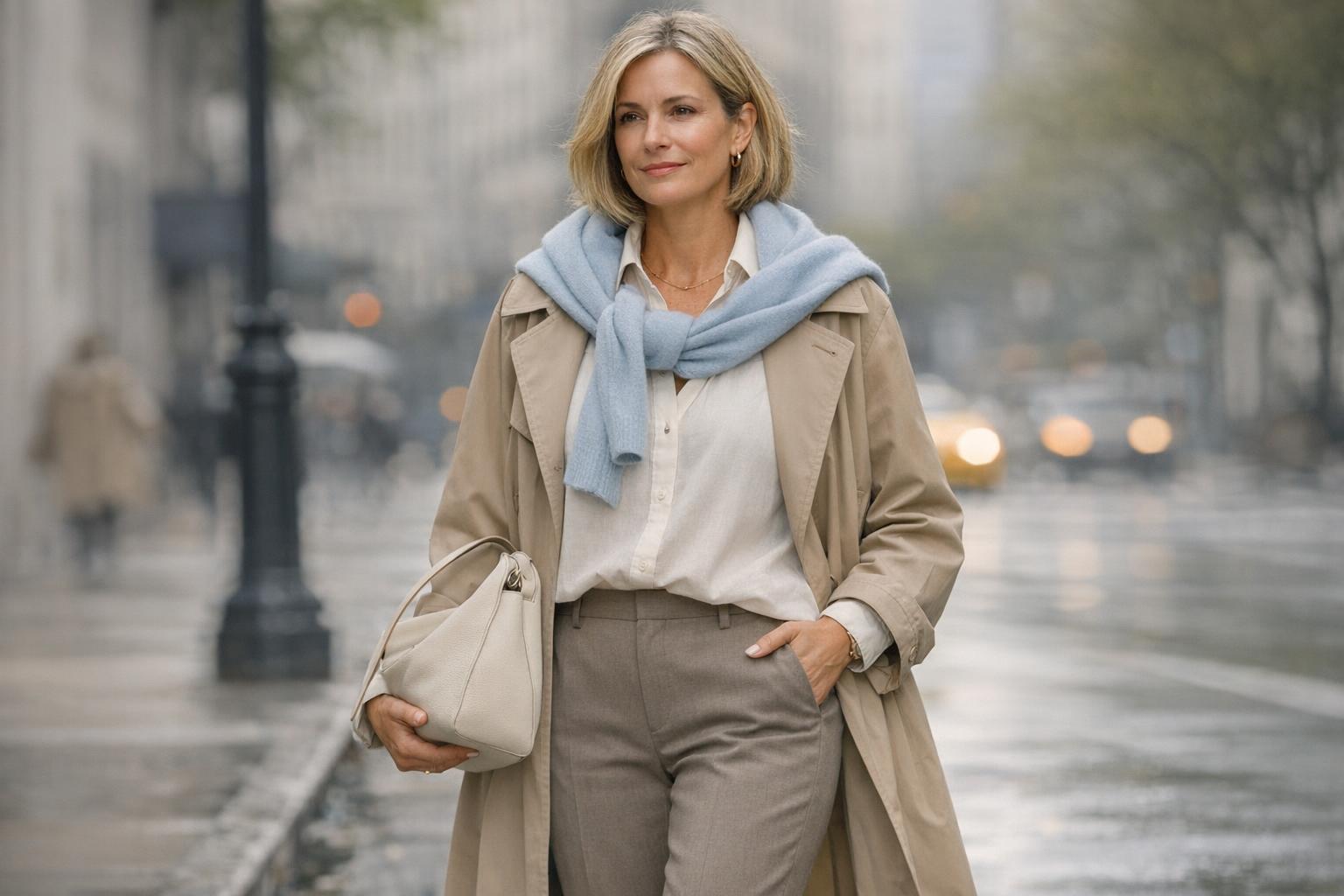
Spring Scandinavian outfits, translated for real American days
There’s a particular moment in early spring when getting dressed feels like a negotiation: the morning is cold, the afternoon turns bright, and by evening the air goes damp again. This is exactly where spring scandinavian outfits make sense—not as a “trend,” but as a method. Scandi fashion is built on intelligent layering, disciplined silhouettes, and a quiet confidence with color that flatters changing light. It’s why Copenhagen street style—especially around Copenhagen Fashion Week—keeps influencing what looks modern and wearable across the U.S., from Seattle drizzle to New York’s wind-tunnel avenues.
In ModePrima terms, the appeal is simple: Scandinavian fashion treats clothing as composition. A trench coat isn’t just outerwear; it’s architecture for the body. Tailored trousers aren’t “dressy”; they’re a line that makes knits and shirts look deliberate. Neutral palettes aren’t boring; they’re the canvas that lets texture, proportion, and subtle accessories carry the look. Consider this your Look di moda edit of Nordic minimalism for spring—practical enough for 40–60°F days, refined enough to feel elevated, and flexible enough to build a capsule wardrobe that actually gets worn.
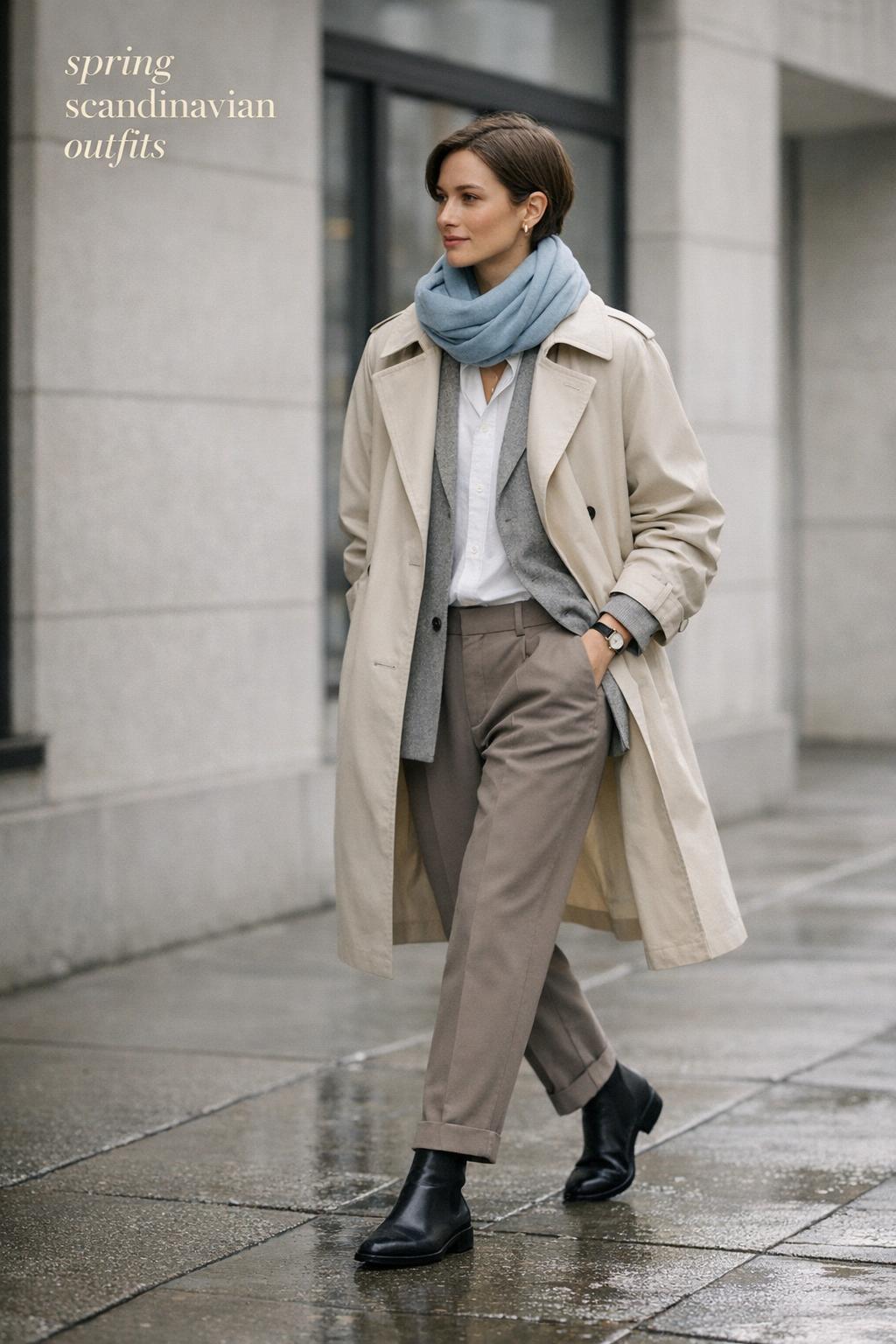
The spring Scandi aesthetic: minimalism with intention, not austerity
“Scandi style” is often reduced to “minimal,” but in practice it’s more specific: clean lines, controlled volume, and a preference for pieces that hold shape. In spring, this becomes a study in lightness—less bulk, more mobility—while keeping structure in the silhouette. The best spring Scandinavian outfits look effortless because every element has a job: a collar that frames the face, a straight leg that lengthens the line, a coat that anchors the outfit in shifting weather.
Nordic minimalism, updated: the quiet shift from strict to playful
Across Scandinavian fashion coverage, you’ll notice a recurring tension: Nordic minimalism remains the foundation, but the styling has room for personality—sometimes through proportion (an oversized outer layer over slim trousers), sometimes through a soft pop of color (pale pastels beside creams and taupes), and sometimes through texture (knit against crisp cotton). Copenhagen street style in particular tends to show this evolution clearly: the outfits still read “simple,” yet they feel current because of small, intentional disruptions—an unexpected boot choice, a relaxed suit shape, a scarf used as a graphic accent.
Your wedding has a lot of moving pieces. Your plan can still feel composed.
Zarellea organizes guests, vendors, budget, and timelines in one shared space — so you can make decisions with clarity, not stress.
Fabrics that make spring layers look expensive
Spring in Nordic climates rewards fabrics that breathe but still insulate, and the same logic works in the U.S. Light layers perform better than one heavy piece because they can be removed, rebalanced, and re-styled throughout the day. A crisp shirt in cotton or a cotton blend gives clean contrast under knits. Lightweight wool and wool blends keep warmth without stiffness. Linen and linen blends deliver that airy, matte elegance that reads especially refined in neutral palettes.
Nordic neutrals in spring: creams, taupes, beiges—and the soft edge of color
The phrase “Nordic neutrals” comes up repeatedly for a reason: a cream trench, a taupe trouser, a beige knit—these tones create continuity across outfits, which is the secret to a functional capsule wardrobe. In spring, the palette can widen without losing the Scandi effect. Pale pastels work best when treated as near-neutrals: a soft color used in one element (a knit polo, a scarf, or a bag) while the rest stays grounded in creams and greys. The result is gentle rather than loud, modern rather than overly sweet.
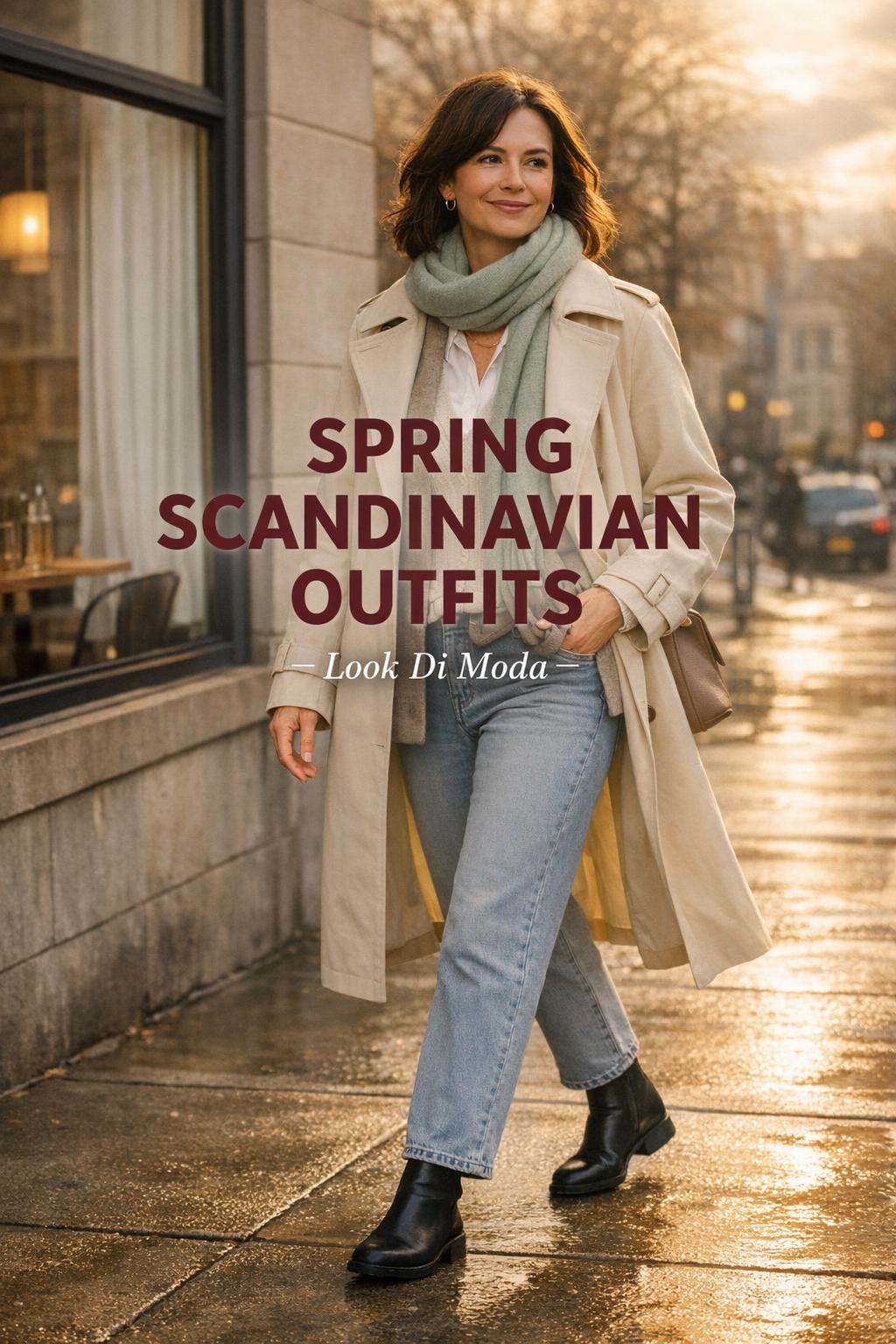
The capsule mindset: Scandinavian fashion as wardrobe architecture
A Nordic approach to spring dressing is inherently capsule-driven: fewer pieces, worn in more combinations, with an emphasis on versatility. This is why “capsule wardrobe” content sits so naturally beside Scandi fashion—both rely on a coherent palette and repeatable outfit formulas. The trick is to choose items that can swing between casual and polished: a trench coat that works over denim and tailored trousers, ankle boots that handle damp sidewalks but still complement a dress, a lightweight sweater that layers under a blazer without bunching.
Core essentials that anchor spring Scandinavian outfits
Instead of chasing novelty, build around pieces that create clean lines and reliable proportions. If your closet already has most of these, the Scandi effect is often a matter of styling rather than shopping.
- A neutral trench coat (the classic Scandi spring outer layer)
- A crisp shirt (white or softly neutral, structured enough to stand on its own)
- Lightweight knitwear (sweater and/or knit polo for refined texture)
- Tailored trousers (straight or gently relaxed, for that composed Nordic silhouette)
- Straight-leg denim (a casual counterpoint that still reads clean)
- A structured cardigan (to soften tailoring without losing shape)
- Ankle boots (practical in rain, polished in silhouette)
- Loafers (for drier days, still minimalist)
- A blazer (for lightweight suiting and transitional warmth)
- Minimal jewelry and a minimalist bag (quiet finishing touches)
Tip: build “outfit continuity” with repetition, not uniformity
The most wearable Scandi capsules repeat certain ideas: similar tones, similar silhouettes, and similar levels of polish. That doesn’t mean every day looks identical. Try repeating one constant (for example, a cream base) while changing the mood through texture (cotton shirt versus knit polo), or through structure (blazer versus cardigan). This is how Copenhagen street style looks varied while staying cohesive: the wardrobe speaks one language, but each outfit tells a different sentence.
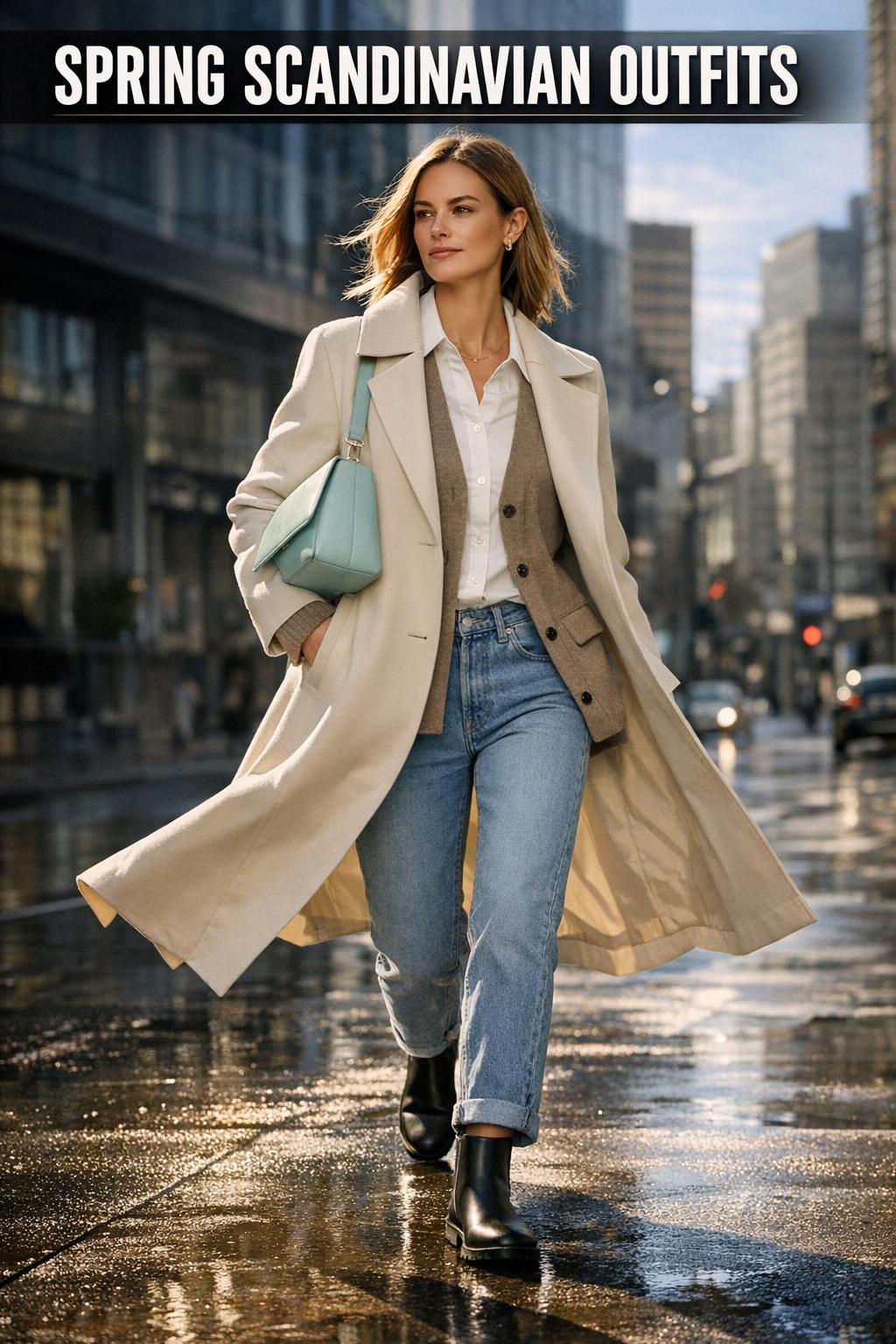
Outfit formulas with a Nordic point of view (and why they work)
What makes spring Scandinavian outfits so easy to recreate is that they’re built on formulas—pairings that rely on proportion and texture rather than loud statements. Below are editor-tested combinations you can adapt to your own wardrobe, with notes on silhouette and small adjustments that shift the look from casual to polished.
The crisp shirt under a trench: clean lines with weather intelligence
This is the backbone of Scandi spring dressing: a crisp shirt creating a sharp neckline and sleeve line, topped with a neutral trench coat that moves beautifully as you walk. Add straight-leg denim for ease, or tailored trousers when you want the outfit to feel more architectural. The reason it works is contrast—structured cotton under fluid outerwear—plus a palette that stays disciplined (creams, beiges, and soft greys).
Tips: In damp conditions, ankle boots make the look feel intentional rather than “caught in the rain.” On brighter days, switch to loafers to keep the outfit light and modern. Minimal jewelry is the finishing note that reads distinctly Scandinavian: nothing fussy, nothing loud, just enough shine to feel finished.
Knit polo with tailored trousers: refined ease for office-to-weekend
A knit polo is one of those pieces that instantly lifts a spring outfit without making it feel formal. The knit brings texture; the collar adds structure around the face. With tailored trousers, you get a controlled silhouette that still moves. This pairing shows up repeatedly in Scandi fashion coverage because it’s flattering, practical, and naturally aligned with Nordic minimalism.
Variation: If you’re styling for a cooler morning, add a blazer as a top layer. If the day warms up, swap the blazer for a structured cardigan that keeps the outfit soft while still composed. The footwear choice—ankle boots or loafers—becomes the dial that sets the mood.
Midi dress plus structured cardigan: softness, balanced by shape
Scandi minimalism isn’t allergic to femininity; it simply prefers balance. A midi dress brings fluidity, while a structured cardigan adds a clear shoulder line and a sense of containment. For early spring, knee-high boots create warmth and a sleek vertical line; for later in the season, ankle boots keep things sharp and weather-ready.
What matters here is proportion. The cardigan should sit in a way that defines the waist or creates a deliberate boxy shape—either is “right” as long as the choice is intentional. The palette stays in Nordic neutrals, with room for a pale pastel dress if the cardigan and boots remain grounded in cream, taupe, or black.
White-on-white with a camel overcoat: the Scandinavian light trick
Layering light tones is one of the most effective ways to make spring outfits look expensive without trying too hard. White-on-white (or cream-on-ivory) creates a soft column, then a camel or beige overcoat frames it. The result feels calm and luminous—particularly in spring’s shifting daylight. This is a classic Look di moda move in Scandinavian fashion: restraint that still reads strong.
Tip: The sophistication comes from texture differences. If your top is a smooth knit, let the trousers be more structured. If your shirt is crisp cotton, consider a softer knit layer. The outfit stays monochrome, but it never looks flat.
Neutral skirt, knit top, and a moto-inspired jacket: minimalism with edge
Scandi style often plays with a controlled edge—nothing costume-like, just a slight tension between soft and structured. A neutral-toned skirt (think beige or taupe) paired with a knit top sets a calm base. Add a moto-inspired jacket to sharpen the outline and bring a little bite. The key is to keep everything else quiet: minimal jewelry, a minimalist bag, and ankle boots that hold the line.
This formula is especially useful in the U.S. when spring feels unpredictable. The jacket functions as armor against wind and drizzle, while the knit keeps the outfit comfortable indoors. The skirt adds movement, making the whole look feel editorial rather than purely utilitarian.
Monochrome neutrals with one soft color: a modern Scandinavian balance
One of the simplest ways to update Nordic neutrals for spring is to introduce a single soft color—then stop. The outfit remains primarily neutral (cream trench, taupe trousers, beige knit), but one element shifts the mood: perhaps a pale pastel scarf, or a softly colored knit polo under a trench. Because the rest of the look is controlled, the color reads sophisticated rather than playful.
Practical note: This approach is forgiving when you’re dressing quickly. Even if the neutral shades don’t match perfectly, the overall effect stays cohesive because the palette remains restrained and the silhouette is clean.
Lightweight suiting, relaxed: tailoring without stiffness
Spring is the season when tailoring wants to breathe. Lightweight suiting with relaxed silhouettes—blazer and trousers that skim rather than cling—captures the Scandinavian preference for comfort that still looks sharp. This is where the influence of Copenhagen Fashion Week street style becomes practical: the outfits look composed, but they’re built for movement and weather shifts.
Wear a crisp shirt underneath when you want structure, or a lightweight sweater for softness. The footwear decides the level of formality: loafers for polished city errands, ankle boots when the pavement is damp or the temperature drops.
Denim plus lightweight knit plus scarf: a quiet street-style signature
There’s a reason this combination shows up in Copenhagen spring outfit edits: it’s functional, and it photographs well because the textures read clearly. Straight-leg denim anchors the look. A lightweight knit keeps the silhouette simple. Then a scarf—minimal, not bulky—adds warmth and a graphic line near the face. It’s a small styling choice, but it’s often what separates “basic” from “editorial.”
Tip: Let the scarf echo your palette. In Nordic neutrals, even a subtle shift—cream against ivory, taupe against beige—creates dimension while staying refined.
The longline vest as a trench alternative: lighter, still architectural
On days when a trench feels like too much, a longline vest can deliver a similar vertical line with less warmth. Layer it over a button-down for a crisp, tailored effect; add tailored trousers to keep the silhouette elongated. This is a very Scandinavian solution: replacing weight with structure. It’s also an easy way to shift your spring capsule toward early summer without abandoning the Scandi fashion language.
If your day includes temperature swings—cold commute, warm midday, cool evening—the vest earns its place. You can add or remove a lightweight sweater beneath it without losing the outfit’s shape.
Bias-cut dress with a structured coat: “edgy minimalism” done right
This formula is less about romance and more about line. A bias-cut dress gives a fluid, body-skimming silhouette; a structured coat creates contrast and keeps the look grounded in Nordic minimalism. The strongest version is monochrome—black, cream, or a tightly controlled neutral range—finished with ankle boots or knee-high boots depending on temperature.
It’s the kind of outfit that works for dinners, gallery openings, or any evening that still feels like spring outside. The coat does the heavy lifting; the dress keeps the movement soft. Together, they create a deliberate tension that feels modern, not overstyled.
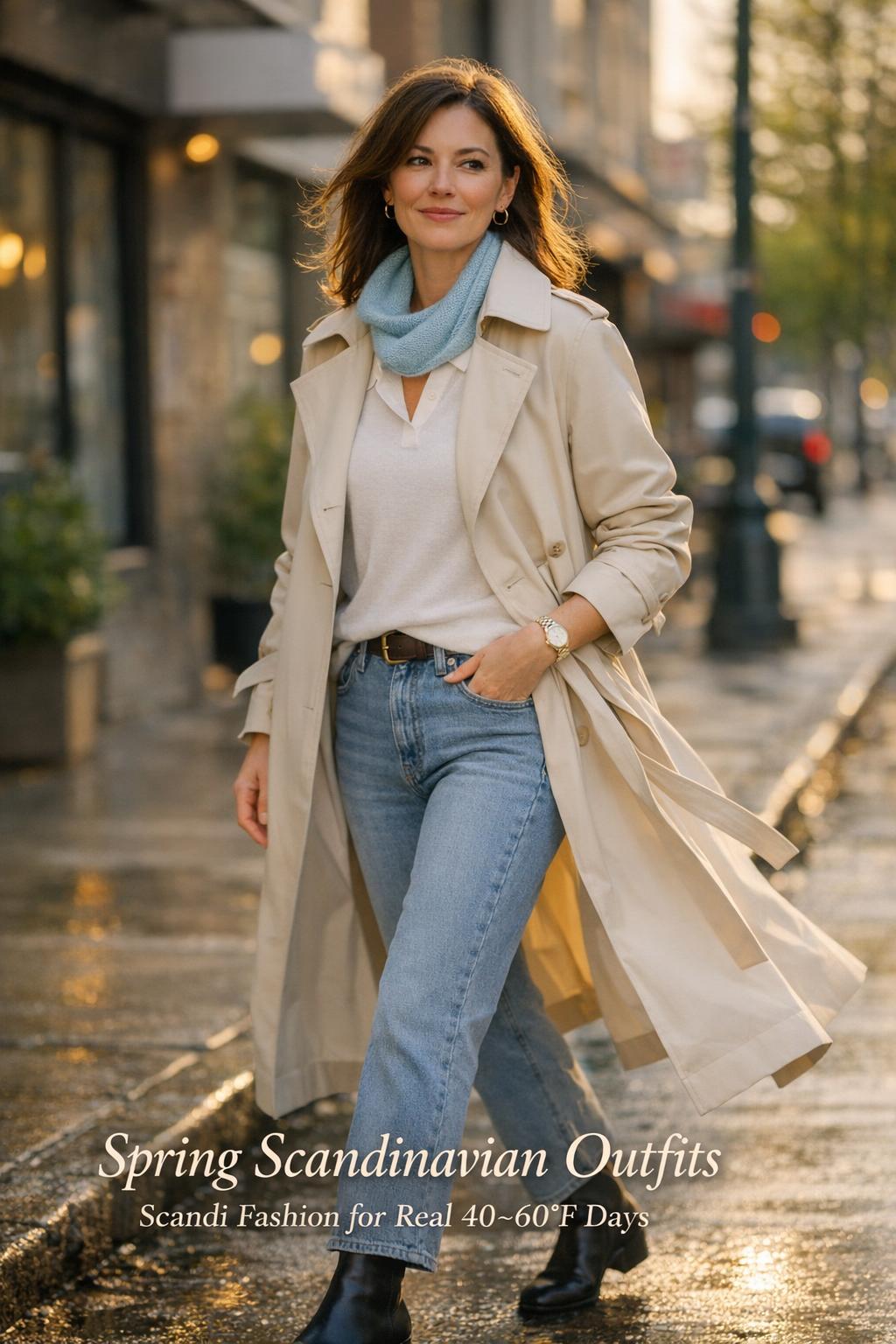
Copenhagen street style as a compass: how to read it without copying it
Copenhagen has become a shorthand for Scandinavian fashion influence, largely because Copenhagen Fashion Week concentrates designers, editors, and influencers into one visible, street-level conversation. But the lesson isn’t to replicate a single look exactly. The lesson is to observe the decisions: how outerwear is used as the outfit’s anchor, how minimal jewelry finishes rather than distracts, how a neutral palette allows experimentation with silhouette.
Three styling habits you’ll notice again and again
- Outerwear leads: trench coats, overcoats, and structured layers define the silhouette before you even register the outfit underneath.
- Tailoring meets softness: tailored trousers with knits, blazers with denim, dresses with structured cardigans—contrast is the point.
- Neutrals are rarely “plain”: creams, beiges, and taupes are layered in slightly different tones to create depth without loud color.
The practical takeaway for U.S. wardrobes is liberating: you don’t need a new closet. You need a few reliable shapes and a disciplined palette, then you style them with intention. That’s why scandi fashion translates so well—because the method is repeatable across climates and budgets.
Regional nuance: Copenhagen, Stockholm, Oslo—and why it matters in spring
“Scandinavian” is often used as a single aesthetic label, but the style conversations are frequently anchored in cities. Even when you’re simply looking for spring Scandinavian outfits in the U.S., it helps to borrow these city-coded cues as styling frameworks. Think of them as different settings for the same wardrobe: the pieces can overlap, but the emphasis shifts.
Copenhagen: street style confidence and practical layers
Copenhagen street style is the most visibly documented, and it often balances Nordic minimalism with bolder touches—an oversized silhouette, a statement texture, a sharper boot. The clothes still function in changeable weather, which is why Copenhagen-inspired spring outfits frequently spotlight outerwear and boots. For an American adaptation, keep the foundation neutral and let one element carry the fashion point: a knit polo with tailored trousers, or a trench layered over a crisp shirt with straight-leg denim.
Stockholm: polished minimalism and restrained color
Stockholm minimalism, in the way it’s commonly referenced, leans into refinement—clean tailoring, crisp shirts, and a calm palette. The silhouette tends to feel sleek rather than oversized, with an emphasis on pieces that look precise. In spring, this can mean white-on-white layering with a camel overcoat, or lightweight suiting in Nordic neutrals with minimalist accessories. The mood is composed: less contrast, more continuity.
Oslo: utilitarian ease that still reads modern
Oslo’s utilitarian thread complements spring’s practical demands. The idea isn’t ruggedness; it’s readiness—pieces that work in damp conditions without sacrificing shape. Ankle boots become essential, outerwear stays structured, and layering is treated as a comfort system. In U.S. terms, this is the look you reach for on a long day that includes commuting, walking, and unpredictable rain: denim plus knit plus scarf, topped with a trench or a structured coat.
Weather-ready Scandinavian dressing: the 40–60°F playbook
A major reason Scandinavian fashion resonates in spring is that it’s built for real weather, not just a seasonal mood board. Many Copenhagen spring outfit guides focus on the realities of rain and chill—conditions that mirror much of the U.S. in March, April, and even May. The goal isn’t to overdress; it’s to layer intelligently so you can adjust without losing the look.
Layering strategies by temperature band (and how they affect silhouette)
Think in layers that can be removed while keeping a complete outfit underneath. The silhouette should look intentional at every stage—coat on, coat off, scarf added, scarf removed.
- 40–45°F (4–7°C): start with a crisp shirt or lightweight sweater, add a blazer or structured cardigan, finish with a trench coat or structured coat. Choose ankle boots for warmth and traction in damp conditions.
- 46–55°F (8–13°C): knit polo or shirt with tailored trousers works beautifully; add a trench as your main outer layer. A scarf becomes optional and can function as a styling accent rather than necessity.
- 56–60°F (14–15°C): longline vest over a button-down, or lightweight suiting with relaxed silhouettes. Loafers become more practical, while boots still work if rain is in the forecast.
Material-mix guidance: warmth without bulk, polish without stiffness
Scandi fashion succeeds in spring because the fabrics are chosen to perform. Lightweight wool or wool blends provide warmth with a clean drape; cotton blends keep shirts crisp and breathable; linen blends add a matte softness that feels distinctly seasonal. The most flattering outfits mix at least two textures—crisp with soft, smooth with tactile—so the neutral palette reads dimensional rather than flat.
Footwear in damp conditions: why ankle boots keep showing up
Ankle boots are a recurring product entity in Scandinavian spring styling for a practical reason: they handle wet sidewalks, they visually “ground” wide or relaxed trousers, and they maintain a streamlined line under coats. Loafers are the elegant alternative, best saved for drier days when you want the outfit to feel lighter. Knee-high boots are the cold-snap option—especially strong with midi dresses and structured cardigans—because they keep the silhouette sleek while adding warmth.
Brands that shape the Scandi conversation (and how to use them as references)
Even if you’re not shopping, it’s useful to know the brands most associated with Scandi fashion because they act as visual references for silhouette and palette. Labels like COS, Arket, and Ganni appear often in Scandinavian fashion discussions, partly because they offer recognizable Nordic cues—clean lines, modern tailoring, and a considered approach to color. Birrot is also referenced in the broader Nordic label mix. Use these names the way an editor would: as shorthand for proportions, textures, and styling logic you can translate into your own wardrobe.
Tip: use brand “signatures” to refine your styling decisions
If your outfit feels close to Scandi but not quite there, adjust one variable using a brand signature as inspiration: a COS-like preference for clean structure in outerwear, an Arket-like capsule mentality in neutrals, or the Copenhagen street style willingness—often associated with Ganni’s orbit—to introduce a slightly bolder element while keeping the rest restrained. The goal isn’t to mimic a label; it’s to sharpen your eye for balance.
Common missteps that flatten the Scandi effect (and how to correct them)
Spring Scandinavian outfits look “easy,” but they’re rarely accidental. When the formula doesn’t work, it’s usually because the outfit loses structure, loses contrast, or ignores the weather logic that makes Scandi style believable. A few small corrections can bring the look back into focus.
Too many loose pieces at once
Relaxed silhouettes are part of the Nordic vocabulary, but head-to-toe looseness can read shapeless. If your trench coat is oversized, keep the base cleaner—tailored trousers or straight-leg denim. If your trousers are relaxed, choose a more structured top layer like a blazer or crisp shirt. The point is a composed outline, not volume for its own sake.
Neutrals without texture
Nordic neutrals depend on texture to feel rich. If everything is the same flat knit or the same smooth cotton, the outfit can look unfinished. Introduce contrast: a knit polo with tailored trousers, a crisp shirt under a trench, a structured cardigan over a fluid dress. Even minimal jewelry can add a subtle highlight that keeps the look from fading.
Ignoring the “rain reality”
Copenhagen-inspired dressing is pragmatic. If you style loafers on a day that’s clearly wet, the outfit stops feeling intentional. Likewise, skipping an outer layer when temperatures hover around 40–55°F can force you into bulky emergency layers later. Build a weather-ready baseline: trench or structured coat, ankle boots when needed, and lightweight knits that can be layered without losing shape.
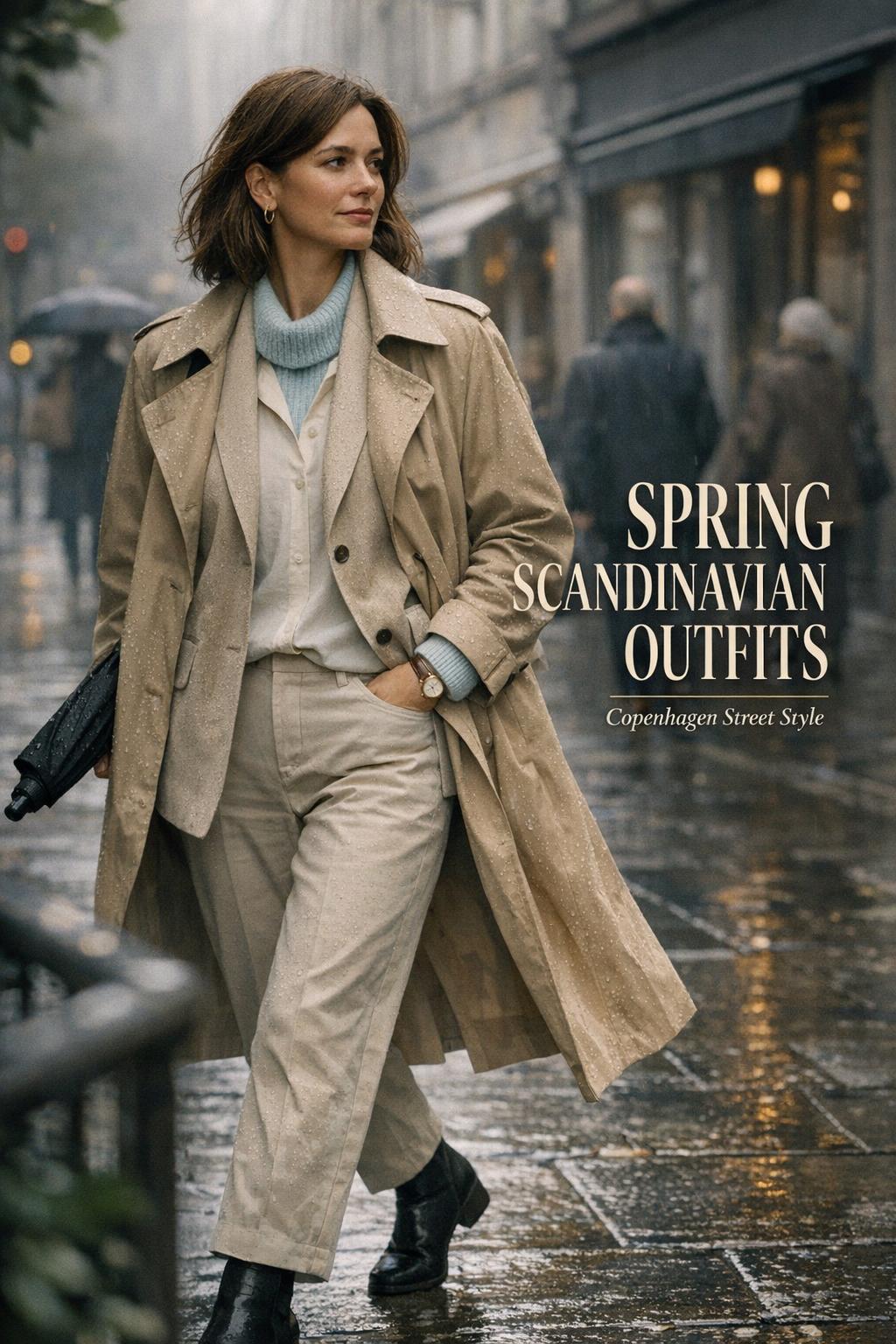
A destination-specific edit: spring Scandinavian outfits for rainy U.S. cities
If you live in a city where spring rain is frequent—think the kind of days where the temperature sits in that 40–55°F zone—the Copenhagen playbook becomes especially useful. The goal is to stay polished without pretending it’s not wet outside. Prioritize outerwear that holds its line, footwear that can handle damp pavement, and layers that won’t feel heavy indoors.
Three rain-proof outfit ideas that still look editorial
- Trench + lightweight sweater + tailored trousers + ankle boots: clean, composed, and easy to adjust if the temperature rises.
- Structured coat + crisp shirt + straight-leg denim + scarf: the scarf adds warmth and a deliberate styling point near the face.
- Midi dress + structured cardigan + knee-high boots: a sleek solution that reads refined while keeping you warm and protected from chill.
Each of these outfits can be neutral-on-neutral, which is where Scandinavian fashion looks most authentic. If you want color, treat it as an accent—one soft pastel element—rather than letting it dominate the composition.
How to transition Scandi spring style into early summer without starting over
The best capsule wardrobes don’t reset every season; they pivot. To move from spring into early summer in a Scandi fashion register, reduce weight while keeping structure. Swap a trench coat for a longline vest. Trade a heavy knit for a knit polo or a lighter sweater. Keep tailored trousers in rotation, but pair them with a crisp shirt worn more casually. The silhouette remains clean, the palette stays in Nordic neutrals, and the outfit still reads intentional—even when the weather shifts again.
Tip: keep one “structure piece” even as you get lighter
A common spring-to-summer mistake is going too soft too quickly—everything becomes drapey, and the Scandi clarity disappears. Choose one structured element per outfit: a blazer, a crisp shirt, tailored trousers, or a structured cardigan. Then let the rest breathe with lighter fabrics like linen blends and cotton blends. This is how you keep the Scandinavian fashion effect while dressing for warmer days.
FAQ
What defines spring Scandinavian outfits compared to other spring styles?
Spring Scandinavian outfits are defined by Nordic minimalism: clean lines, thoughtful layering, and a controlled palette of Nordic neutrals (creams, beiges, taupes) with occasional soft pastels. The focus is on silhouette, proportion, and texture—crisp shirts with tailored trousers, lightweight knits under structured outerwear—rather than loud prints or overly decorative details.
What colors look best in spring for Scandi style?
The most reliable spring Scandi palette centers on creams, beiges, taupes, and other Nordic neutrals, often layered tone-on-tone for depth. If you want a seasonal update, introduce one soft pastel as an accent while keeping the rest of the outfit neutral, which preserves the refined Scandinavian fashion mood.
Can Scandi fashion work in rainy U.S. cities?
Yes—Copenhagen-inspired dressing is built around weather-ready logic, which translates well to rainy U.S. spring conditions. A neutral trench or structured coat, ankle boots for damp sidewalks, and breathable layers like lightweight wool blends and cotton blends help you stay polished without sacrificing comfort in 40–55°F rain.
What are the most important pieces in a Nordic spring capsule wardrobe?
A Nordic spring capsule typically centers on a neutral trench coat, crisp shirts, lightweight knitwear (including a knit polo), tailored trousers, straight-leg denim, and practical footwear like ankle boots and loafers. These pieces mix easily, support layered outfits, and maintain the clean silhouette associated with scandi fashion and Copenhagen street style.
How do I layer for 40–60°F weather without looking bulky?
Use multiple light layers rather than one heavy piece: start with a crisp shirt or knit polo, add a blazer or structured cardigan, then top with a trench or structured coat. Keep the silhouette balanced by pairing an oversized outer layer with straighter trousers or denim, and rely on texture contrast (knit against cotton, smooth against tactile) to make neutrals feel dimensional.
What footwear fits the Scandinavian spring look best?
Ankle boots are the most versatile because they’re streamlined, practical in damp weather, and visually ground tailored trousers and relaxed silhouettes. Loafers work well on drier days when you want a lighter finish, while knee-high boots are particularly effective with midi dresses and structured cardigans during colder spring weeks.
How does Copenhagen Fashion Week influence spring Scandinavian outfits?
Copenhagen Fashion Week acts as a concentrated showcase for Scandinavian fashion, where designers, editors, and influencers demonstrate how Nordic minimalism evolves through proportion, layering, and small styling shifts. The street style often highlights trench-led outfits, relaxed tailoring, and neutral palettes enhanced by texture, which makes the looks both modern and practical for spring weather.
Which brands are commonly associated with Scandi fashion in spring?
Brands frequently referenced in Scandi fashion discussions include COS, Arket, Ganni, and Birrot, often as examples of Nordic silhouettes, capsule-friendly essentials, and the balance between minimalism and personality. Even if you don’t shop these labels directly, they can serve as useful visual references for structure, palette, and styling restraint.
How do I transition Scandinavian spring outfits into early summer?
Keep the same neutral palette and clean silhouette, but lighten the layers: swap a trench for a longline vest, choose lighter knits, and incorporate linen blends and cotton blends while maintaining one structured element (like tailored trousers, a crisp shirt, or a blazer). This preserves the Scandinavian fashion effect while adapting to warmer days.
Leave a Reply