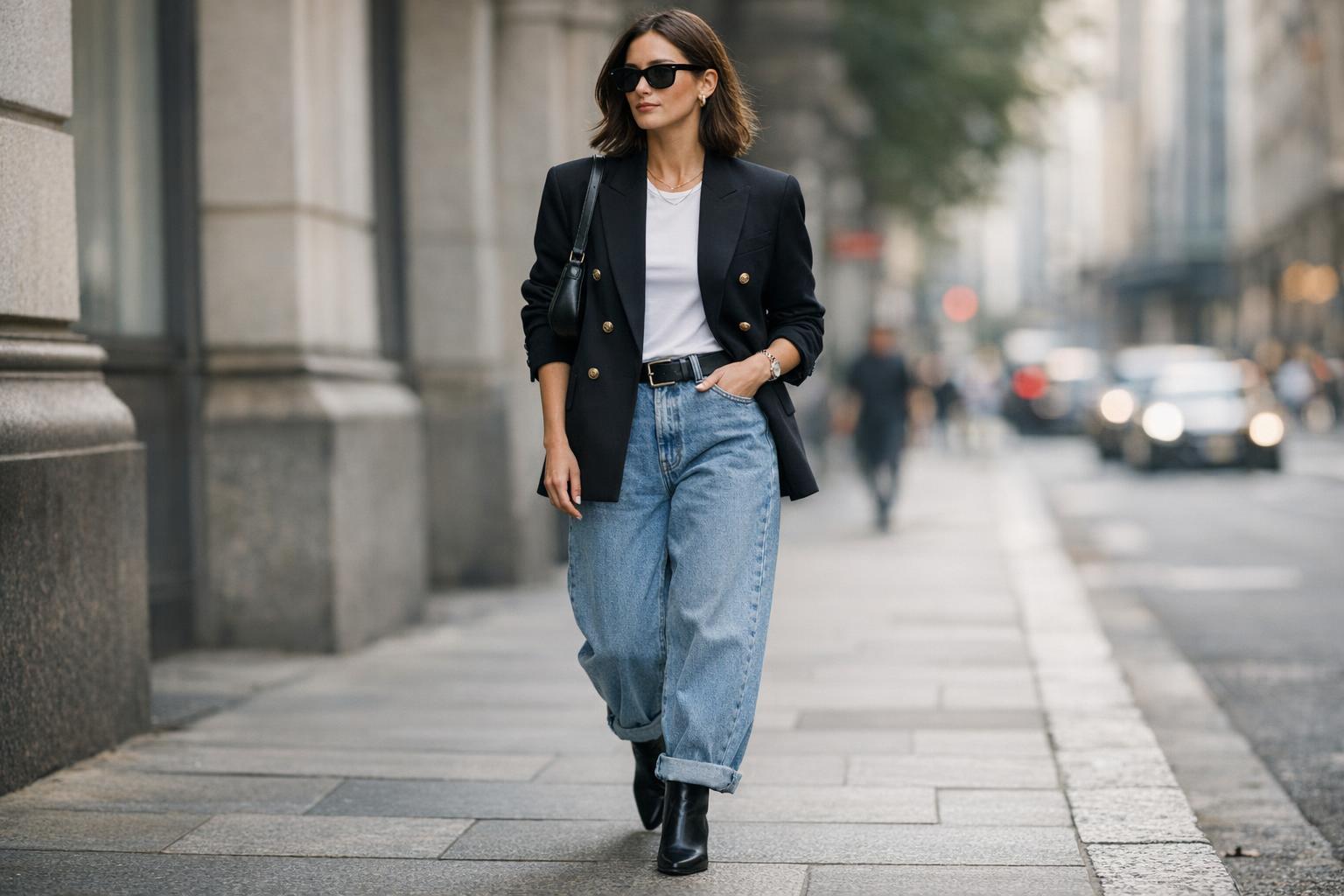
Loose jeans outfit: the modern case for relaxed denim
The most convincing loose jeans outfit rarely announces itself as a “trend.” It simply looks right: a relaxed leg line that moves easily, anchored by something with intention—clean tailoring, a fitted knit, a decisive shoe. That’s the real appeal of loose fit jeans right now. They can read polished without becoming precious, casual without becoming careless, and unmistakably current while still nodding to the 1990s—especially when the styling leans into what looks vintage rather than overly new.
You’ll notice the strongest references in today’s outfit formulas aren’t abstract; they’re specific and wearable. Jennifer Aniston’s wide-leg jeans approach centers on balance—volume below, structure above. Hailey Bieber’s mix of a Saint Laurent bomber jacket with Gap low-rise jeans makes the high-low equation feel effortless. Julianne Hough’s baggy jeans with a double-breasted blazer proves relaxed denim can hold its own in a more tailored context. And Jennifer Lopez, stepping into barrel-leg jeans (notably via Free People), reminds us that silhouette itself can be the statement.
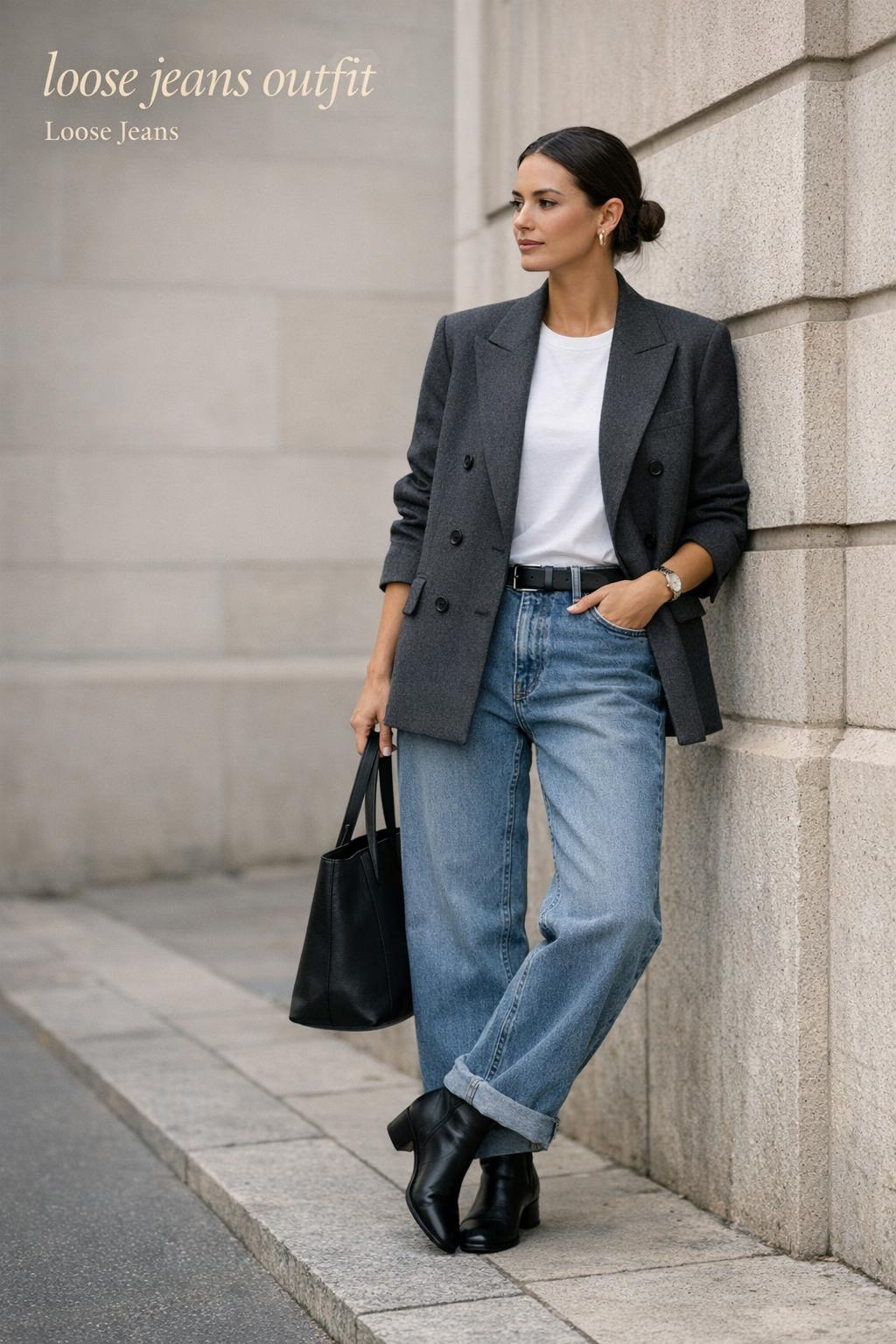
What follows is an editorial playbook: how to choose a loose silhouette that flatters, how to build proportion, how to handle shoes (including cuffed jeans with ankle boots), and how to adapt your styling across warm weather and the texture-heavy months. The goal isn’t to copy a look; it’s to understand why it works so you can repeat the effect in your own wardrobe.
Why loose denim still feels timeless (even when it’s trending)
Relaxed denim cycles through fashion because it solves a perennial style problem: comfort that doesn’t compromise on silhouette. Baggy jeans and wide-leg jeans create a long, fluid line, and when paired thoughtfully they can make the entire outfit feel intentional. The 1990s resurgence is part of this story—low-rise loose jeans, bomber jackets, and a certain nonchalance—but the enduring element is proportion. A looser leg gives you room to play with shape: cinch the waist, sharpen the shoulder, or keep everything minimal and let the jeans provide the texture.
Your wedding has a lot of moving pieces. Your plan can still feel composed.
Zarellea organizes guests, vendors, budget, and timelines in one shared space — so you can make decisions with clarity, not stress.
In practice, loose jeans succeed when you treat them as the foundation of an outfit architecture. If the denim is relaxed, something else must provide clarity: a fitted top, a structured jacket, or a shoe with definition. Without that counterpoint, loose denim can look like an afterthought. With it, the look becomes refined—more “editor off duty” than weekend errands, even if you’re doing both.
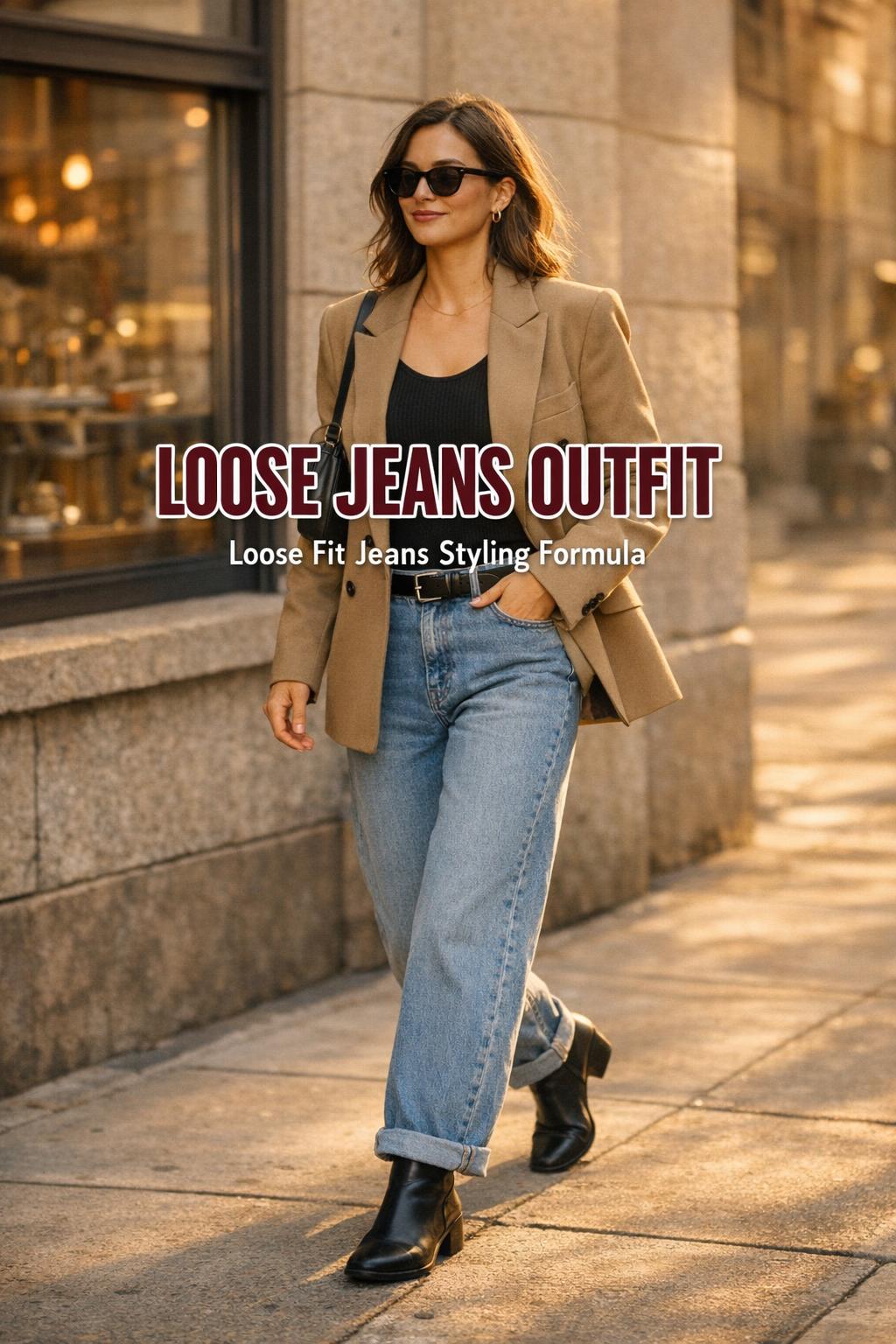
Fit first: choosing loose fit jeans that flatter in real life
“Loose” is not one cut. It’s a family of silhouettes—baggy straight, wide-leg, barrel-leg, and low-rise variations—each with its own behavior. Before you plan outfits, choose the shape that best supports how you move through a day: sitting, commuting, walking, and, very realistically, dealing with changing weather and footwear.
A simple fit framework you can use without overthinking
Start with two questions: where do you want definition (waist, hip, or none), and what line do you want from knee to hem (straight, wide, or curved)? Baggy/loose straight jeans tend to skim and elongate with minimal drama. Wide-leg jeans emphasize flow and can look especially elegant with a more fitted upper half. Barrel-leg jeans create a rounded volume through the leg—fashion-forward, but demanding a cleaner top and a confident shoe. Low-rise loose jeans shift the visual “start point” of the leg and lean more overtly into a 1990s attitude.
- If you want the easiest styling: baggy/loose straight tends to integrate into most wardrobes quickly.
- If you want maximum elegance: wide-leg jeans look composed with tailored layers and deliberate footwear.
- If you want a statement silhouette: barrel-leg jeans deliver shape, but require restraint elsewhere.
- If you want a clear ’90s cue: low-rise loose jeans work best with sharp outerwear or a fitted top to avoid looking undone.
The most common frustration with loose denim isn’t the leg; it’s the length. A hem that pools excessively can feel heavy, while a hem that’s too short may make the volume look abrupt. That’s why footwear planning belongs in the fitting room conversation—not as an afterthought once the jeans are home.
The silhouette playbook: baggy straight, wide-leg, barrel-leg, and low-rise
Think of this as a style editor’s set of “rules you can break once you understand them.” Each loose silhouette has a different relationship to structure. Your job is to decide where that structure lives: in the top, the jacket, the waist, or the shoe.
Baggy or loose straight: the cleanest route to an elevated everyday
Baggy straight jeans are often the most forgiving. They read modern without feeling costume-like, and they pair beautifully with wardrobe staples. The key is to avoid adding more “softness” everywhere. If you wear an oversized top with baggy jeans, you’ll need an anchoring detail—defined shoulders, a tidy hemline, or a shoe that sharpens the outline.
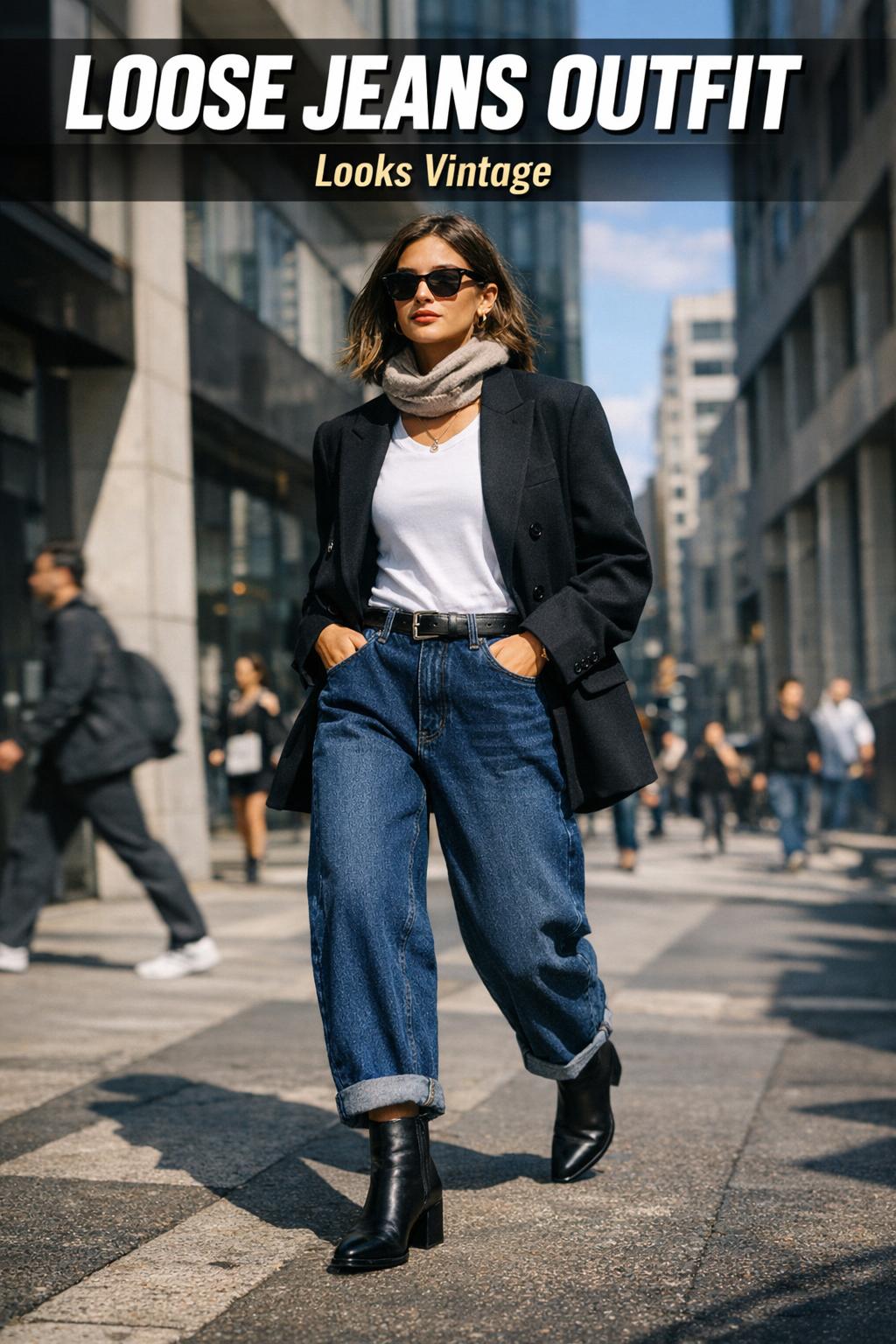
For a refined daytime look, imagine a fitted top under a structured layer: a blazer that holds its shape, or a jacket with intentional lines. This is why Julianne Hough’s baggy jeans paired with a double-breasted blazer lands so well: the blazer supplies architecture, the denim supplies ease, and the whole outfit reads composed rather than casual-by-default.
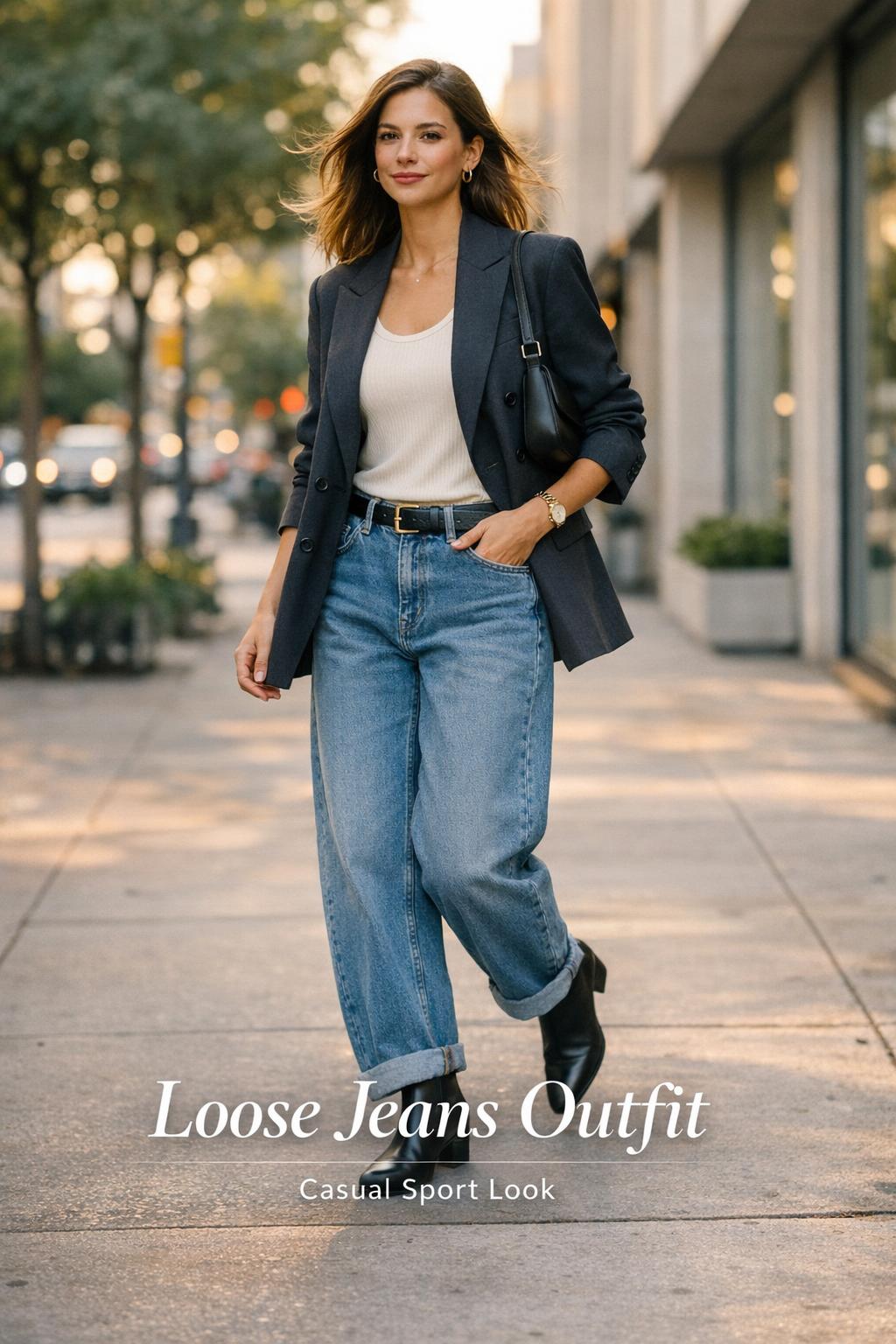
For a casual sport look, baggy straight jeans work when the top half stays clean and the styling feels deliberate. A simple tee can be enough, but keep the neckline and fit considered—too oversized and you lose the crispness that makes relaxed denim look editorial.
Wide-leg jeans: the quiet luxury of proportion
Wide-leg jeans have an inherently polished sweep, especially when the denim falls cleanly. They’re also the silhouette most associated with the “balanced formula” seen in Jennifer Aniston’s styling: volume below, refinement above. It’s a simple idea, but it’s one of the most reliable ways to make a loose jeans outfit feel intentional.
A fitted or structured top is the usual partner here—not because you must “counter” the volume, but because the outfit needs a focal point. With a wide leg, a neatly fitted top clarifies the waist and keeps the silhouette long. If you prefer looser tops, choose one with some structure—an intentional shoulder, a clean placket, or a hem that ends decisively rather than drifting.
Footwear matters more than people expect. Wide-leg denim can swallow a shoe; choose something that reads clearly from the side and front. This is less about height and more about definition. When the hem is full, your shoe becomes punctuation.
Barrel-leg jeans: sculptural, modern, and best styled with restraint
Barrel-leg jeans—seen in celebrity styling moments like Jennifer Lopez in Free People—bring shape into the center of the outfit. The curve through the leg is the point, which means everything else should support it rather than compete. Keep your top line clean. Choose layering pieces that don’t add extra bulk at the hips. Let the denim be the interesting volume.
Barrel silhouettes are also where fabric behavior becomes more noticeable. If the denim collapses, the shape looks less intentional; if it holds, the silhouette reads sculptural. In real life, that translates to a simple question: does the leg keep its form when you sit and stand, or does it crease into a different cut entirely?
Low-rise loose jeans: the ’90s reference, updated with precision
Low-rise loose jeans are the most explicitly era-coded. Hailey Bieber’s outfit—pairing Gap low-rise jeans with a Saint Laurent bomber jacket—works because the bomber adds a controlled shape and a high-fashion finish to a very casual denim mood. The effect is modern nostalgia: clearly 1990s-inspired, but styled with today’s taste for clean lines and carefully chosen outerwear.
Low-rise cuts also change how you think about proportions. A fitted top can look sleek, but you’ll want to be mindful of comfort and movement across a long day. If you prefer a little more coverage without losing the low-rise attitude, rely on a structured jacket or a blazer to keep the outfit feeling finished.
Styling logic: how to balance volume without looking boxy
Most loose denim styling problems are really proportion problems. The fix is rarely “buy a new top.” It’s adjusting where the eye lands: at the waist, at the shoulder, or at the shoe. The strongest loose jeans outfits create one area of definition and one area of ease.
The tailored-outerwear rule (and why it works)
A tailored jacket—think blazer or a crisp bomber—gives loose denim a frame. That frame matters because denim is visually dense. A double-breasted blazer over baggy jeans reads confident and city-ready, an outfit you could imagine in New York without it feeling overstyled. It’s also a practical formula for transitional days: you can remove the jacket and still have a coherent outfit underneath, as long as the top remains considered.
The fitted-top approach (Aniston’s enduring formula)
Jennifer Aniston’s wide-leg styling is a masterclass in understatement: relaxed denim paired with a more fitted or structured top, then finished with accessories that keep the look balanced. The point isn’t to appear “tight on top”—it’s to clarify the silhouette. When the top is clean and close to the body, the jeans read purposeful rather than merely loose.
This approach is especially useful when you want the outfit to look refined without additional layers—think warm weather days when you’d rather not rely on a jacket to provide structure.
Warm weather, cool polish: loose jeans outfits that breathe
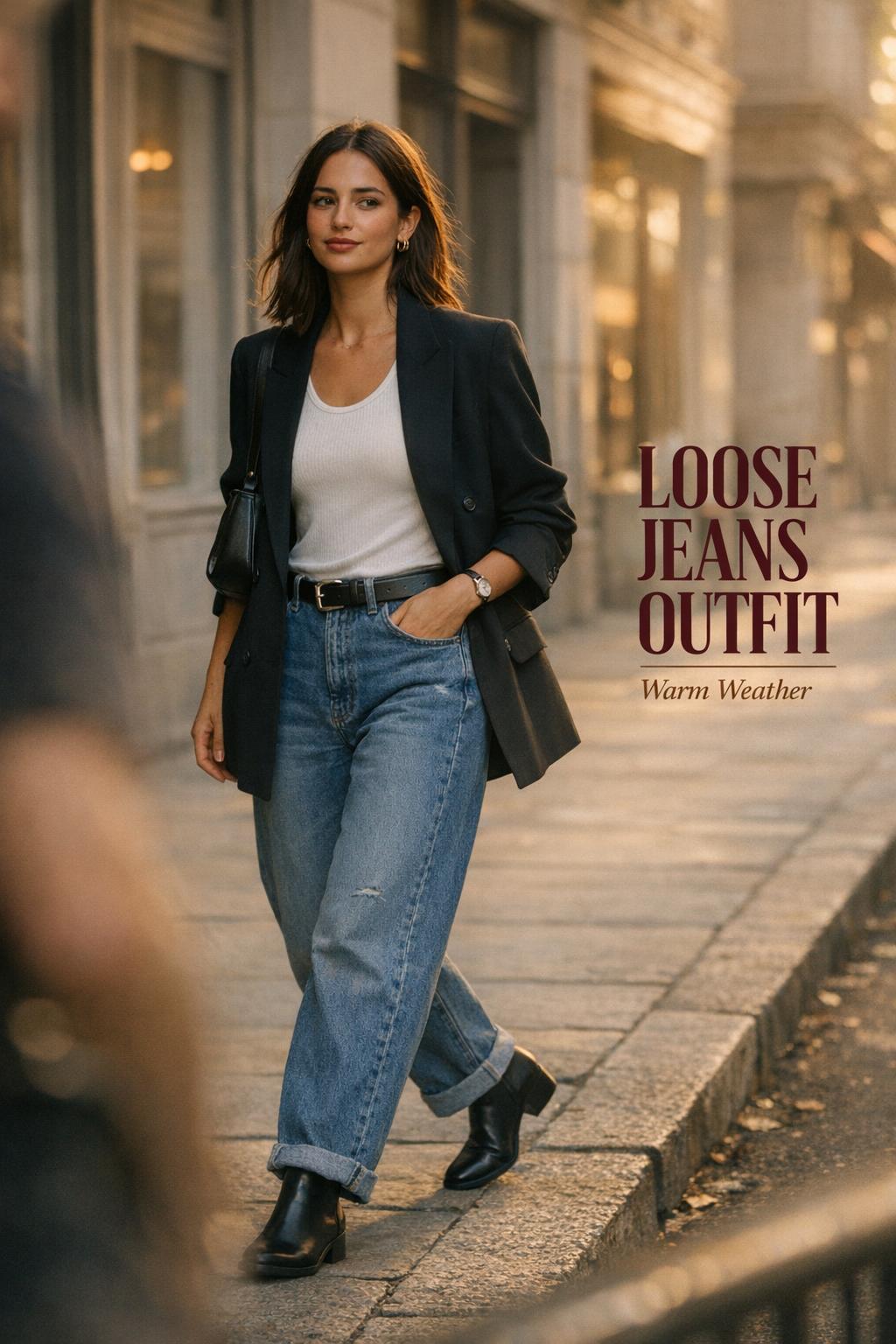
In warm weather, loose jeans can be surprisingly comfortable—if the outfit is composed with lightness in mind. The temptation is to go oversized everywhere. Instead, aim for a breathable, edited silhouette: a streamlined top, an open neckline, and accessories that keep the look intentional.
Light layering without the bulk
Summer styling is less about piling on pieces and more about choosing a single anchor. Loose jeans with a clean top can look modern and effortless; add a structured jacket only when the temperature drops or the occasion demands a sharper line. If you do layer, keep it light and crisp so the denim remains the main texture.
A casual sport look can work beautifully here: relaxed denim paired with a minimal, fitted top and a practical shoe choice that still reads polished. The difference between “athletic-inspired” and “just casual” is editing—clear lines, no unnecessary volume, and a tidy finish.
Tips for warm-weather loose denim that still looks refined
- Keep one element sleek: a fitted top, a clean neckline, or a sharp jacket.
- Let the denim do the work: avoid adding multiple competing textures if the day is hot.
- Use accessories for structure: a belt can define the waist, and a bag can add a polished focal point.
Warm-weather dressing is also where “looks vintage” can feel most natural. A slightly relaxed, 1990s-inflected silhouette—loose jeans and a minimal top—can read timeless if the finish is clean and the proportions are intentional.
Fall and winter: texture, layering, and the return of ankle boots
As the season turns, loose denim becomes a layering tool. The outfit gains depth from knitwear and outerwear, but the guiding principle stays the same: keep the silhouette legible. This is where cuffing becomes more than a styling trick; it’s a proportion strategy.
Cuffed jeans with ankle boots: a proportion move, not just a detail
Cuffed jeans with ankle boots are a recurring styling idea for good reason. The cuff creates a clear endpoint, and the ankle boot provides structure. Together, they prevent a loose hem from swallowing the foot and make the outfit look designed. This pairing can shift the mood from relaxed to sharply urban—equally at home on Paris streets or in Brooklyn, depending on how you build the top half.
If you’re working with very baggy jeans, cuffing can also lighten the look visually. It introduces a deliberate break in the line, which helps balance heavier layers above—especially when you’re wearing a blazer or a more substantial jacket.
Low-rise loose jeans for fall: how to keep it grown-up
Low-rise loose jeans can transition into fall when you rely on smart layering. A structured jacket—bomber or blazer—keeps the outline clean. The more relaxed the denim, the more the upper half should look intentional. This is also the season when you can lean further into the 1990s styling reference without it feeling costume-like: crisp outerwear, defined footwear, and a restrained color story.
In practice, consider your day: if you’ll be outdoors, sitting for long periods, or moving between temperatures, prioritize ease at the waist and a hem length that works with boots. Loose fit jeans that feel effortless standing up but restrictive when seated won’t get worn—no matter how good they look in photos.
Celebrity styling, decoded: what to borrow and what to ignore
Celebrity style is useful not because it’s aspirational, but because it’s often built from clear, repeatable formulas. When you break down the outfits into components—silhouette, structure, footwear, finishing details—you can adapt them to your own wardrobe rather than chasing exact pieces.
Jennifer Aniston: wide-leg jeans with a fitted counterpoint
Aniston’s approach to wide-leg jeans highlights the most reliable styling relationship in relaxed denim: a looser leg with a more fitted or structured top. The outfit reads calm and intentional, never fussy. The lesson is balance—if your denim takes up visual space, your top should provide clarity. Accessories then act as quiet refinement rather than decoration.
Hailey Bieber: Gap low-rise jeans with a Saint Laurent bomber jacket
Hailey Bieber’s look underscores a modern styling truth: mixing accessible and luxury items can feel more current than an outfit that’s expensive head-to-toe. Gap low-rise jeans bring the 1990s energy; the Saint Laurent bomber jacket sharpens it. The takeaway isn’t “buy a designer jacket.” It’s to pair casual, era-coded denim with something that reads structured and deliberate, so the look feels intentional rather than accidental.
Julianne Hough: baggy jeans with a double-breasted blazer
This is relaxed denim stepping into a polished context. A double-breasted blazer introduces a clear shoulder and a tailored line down the torso, which makes baggy jeans look sleek rather than sloppy. The outfit also speaks to seasonality: it’s an easy template for spring days that start cool and end warm, or for offices that lean casual but still appreciate structure.
Jennifer Lopez: barrel-leg jeans as a silhouette statement
Barrel-leg jeans—like the Free People pair associated with Jennifer Lopez—show how a single sculptural shape can carry an entire outfit. When the denim is the focal point, the rest should be calm: clean top lines, restrained layering, and shoes that support the silhouette. This is the opposite of maximalism; it’s impact through shape.
The accessory and footwear playbook: grounding loose denim
Accessories are not an afterthought in a loose jeans outfit; they’re the finishing logic. Loose denim softens the outline, which can be beautiful—but it also means the outfit benefits from small points of structure. Belts and shoes do the heavy lifting here, and bags often provide the visual “center” that keeps the look refined.
Belts and waist definition: when to add structure
A belt is most useful when your jeans are very loose through the hip or when you’re wearing a fitted top and want a clear waistline. It’s less about cinching dramatically and more about signaling intention. In wide-leg and barrel-leg silhouettes especially, a defined waist can keep the volume looking designed instead of merely roomy.
Shoes: the proportion “editor” of every loose fit
Shoes determine whether loose denim reads relaxed, tailored, or overtly 1990s. Ankle boots pair naturally with cuffed hems, creating a crisp break and a streamlined finish. Sneakers can push the outfit into a casual sport look—best when the top half is tidy and the denim length is controlled. Heels can refine wide-leg jeans by extending the line, but the real goal is definition: the shoe should look like a choice, not an afterthought hidden under a hem.
- Ankle boots: ideal with cuffed jeans; add structure and a clean endpoint.
- Sneakers: best with an edited top and controlled hem; supports a casual sport look.
- Heels: elongate wide-leg lines; especially useful when the denim is long and fluid.
Bags and jewelry are the quieter details that can move the outfit from casual to polished. Even when you keep them minimal, they help communicate that the looseness is intentional—an aesthetic choice, not a lack of effort.
Denim fabric and care: why the material changes the silhouette
Loose denim is more sensitive to fabric behavior than many people realize. The same cut can look sharply tailored or gently collapsed depending on how the denim hangs. That’s why two pairs of loose fit jeans can feel completely different: one holds its shape through the day, the other softens and changes character with wear.
Denim weight, stretch, and wash: the practical impact
In a looser silhouette, denim weight influences drape. A pair that falls cleanly can make wide-leg jeans look elegant and composed; a softer, more relaxed feel can lean into the “looks vintage” mood. Stretch content affects how the jeans move and how the shape holds over time—particularly important for barrel-leg styles, where the curve is the point. Wash also matters aesthetically: it can emphasize the 1990s reference in low-rise loose jeans or keep the look crisp and modern depending on the overall outfit composition.
Tips for keeping loose jeans looking intentional, not tired
- Pay attention to shape retention: if the denim collapses quickly, the silhouette can lose its designed volume.
- Protect the hem: wide and baggy styles can drag more, especially when worn with different shoe heights.
- Rotate footwear thoughtfully: changing shoes changes the hem behavior, which changes the whole line of the outfit.
Care is not glamorous, but it’s central to making relaxed denim look refined. When the jeans keep their line—through the knee, at the hem, and around the waist—the outfit reads polished with minimal effort.
Occasion dressing: taking loose jeans from weekend to workwear energy
The best argument for loose jeans is versatility. With the right companions, the same denim can shift context. It’s not that baggy jeans magically become formal; it’s that you can build a more tailored outfit around them. A structured blazer is the obvious move, but the real skill is choosing one focal point and keeping the rest quiet.
For a city day (New York polish, Paris restraint)
Start with loose straight or wide-leg jeans, add a structured blazer (double-breasted if you want sharper lines), and keep the top fitted or cleanly cut. Finish with ankle boots—especially effective if you cuff the jeans slightly. The result reads composed and practical, the kind of outfit that works for meetings, galleries, or a long lunch that turns into evening plans.
For an off-duty weekend (the elevated casual sport look)
Choose baggy jeans that sit comfortably, then keep the top streamlined so the outfit doesn’t drift into “all volume.” Sneakers can work here, but the success of the look depends on editing: a clean silhouette up top, and denim that isn’t excessively long. This is where relaxed denim earns its place in a real wardrobe—comfort without abandoning shape.
For evening energy without trying too hard
Wide-leg jeans are often the simplest route to a dressed-up feel because they already have movement and presence. Keep the top more fitted or structured, and let the denim create the drama. If you lean into a 1990s mood, take a note from the Hailey Bieber formula: pair era-coded denim with a piece that reads sharp and intentional, so the nostalgia feels modern.
Common styling mistakes (and the quick fixes editors actually use)
Loose denim can be wonderfully forgiving, but it’s not effortless by default. Most “something feels off” moments come down to proportion, length, or competing volume. The solution is usually small: a cuff, a change of shoe, a more structured top layer.
- Too much volume everywhere: if the jeans are baggy, keep the top fitted or structured; if the top is oversized, consider a cleaner jean silhouette.
- Hem swallowing the shoe: try cuffing (especially with ankle boots) to create a deliberate endpoint.
- Low-rise looks unintentionally messy: add a sharp outer layer (a bomber jacket or blazer) to restore structure.
- The outfit feels “flat”: introduce one defining element—belt at the waist, a structured jacket, or a decisive shoe.
These adjustments sound minor, but they’re the difference between loose jeans looking like a styling choice and loose jeans looking like you didn’t have time to think. In editorial terms, you’re not adding more—you’re clarifying the line.
A minimalist shopping mindset: choosing brands and pieces without chasing hype
It’s telling that some of the most discussed loose denim moments combine recognizable names with everyday accessibility. Gap low-rise jeans appear in the same conversation as a Saint Laurent bomber jacket; Jennifer Lopez’s barrel-leg moment spotlights Free People. The lesson is not that one label is better than another, but that the styling logic matters more than the logo.
When you evaluate loose fit jeans, prioritize what will make them wearable: a silhouette you can style with your existing tops, a length that works with your most-used shoes, and a fabric that holds the intended shape. The rest—trend timing, exact celebrity references—can be inspiration, not obligation.
Tips for verifying fit (especially if you’re experimenting with a new silhouette)
Try on loose denim with two shoe types you actually wear—one flat option and one with more structure, like ankle boots. Walk, sit, and stand. If the knee bagging or hem drag feels distracting within minutes, it will be worse after a full day. A great loose jeans outfit depends on ease, but it also depends on control.
FAQ
How do I style a loose jeans outfit so it looks polished and not sloppy?
Use one clear element of structure: a fitted or cleanly cut top (as in Jennifer Aniston’s wide-leg approach), a tailored blazer (as in Julianne Hough’s baggy jeans styling), or a sharp jacket like a bomber. Then keep the rest edited—especially the hem length and the shoe choice—so the outfit has a defined outline.
What tops work best with wide-leg jeans?
Wide-leg jeans pair most reliably with fitted or structured tops because they clarify the waist and keep the silhouette long. If you prefer a looser top, choose one with intentional shape—clean lines and a decisive hem—so you don’t end up with volume competing against volume.
How can I wear low-rise loose jeans without looking too “throwback”?
Keep the 1990s reference controlled by pairing low-rise loose jeans with a structured piece like a bomber jacket or blazer; Hailey Bieber’s Gap low-rise jeans with a Saint Laurent bomber jacket is a clear example of that modern balance. The goal is nostalgia with precision, not a full costume.
Do cuffed jeans with ankle boots work with baggy jeans?
Yes—cuffing is often the easiest way to make baggy jeans look intentional with ankle boots because it creates a clean endpoint and shows the boot’s structure. This pairing also helps prevent a wide or loose hem from swallowing the shoe, which is a common proportion issue.
How do I make loose fit jeans work for warm weather?
In warm weather, keep the outfit light and edited: choose a streamlined top, rely on minimal layering, and use small details—like a belt or a defined shoe—to keep the look refined. Loose denim can feel airy, but it looks best when the silhouette stays clear.
What’s the difference between baggy, wide-leg, and barrel-leg jeans in styling terms?
Baggy or loose straight jeans are the most adaptable and tend to look clean with either fitted tops or tailored outerwear. Wide-leg jeans emphasize flow and often look most polished with a fitted or structured top, following the balance seen in Jennifer Aniston’s styling. Barrel-leg jeans, associated with statement silhouettes like Jennifer Lopez’s, create a curved volume and look best when the rest of the outfit is restrained and clean.
Can I wear baggy jeans with a blazer for a more formal look?
Absolutely—baggy jeans can look surprisingly polished with a tailored blazer, especially a double-breasted style like the one seen on Julianne Hough. The blazer supplies structure at the shoulders and torso, which makes the relaxed denim read intentional and elevated.
How do I keep a loose jeans outfit looking “vintage” in a good way?
Focus on restraint and clean composition: a 1990s-inspired shape like low-rise loose jeans or relaxed wide-leg denim can look vintage when the outfit avoids excess. Pair the denim with a structured jacket or a fitted top, and keep the finish crisp so it reads like purposeful nostalgia rather than an accidental throwback.
What’s the easiest way to fix proportions if my loose jeans feel overwhelming?
Make one quick adjustment that adds definition: swap to a more fitted top, add a structured outer layer, or cuff the hem and choose a more structured shoe like ankle boots. Loose denim looks best when there’s a clear focal point—waist, shoulder, or footwear—so the volume feels designed.
Leave a Reply