Blog

  • Parisian Chic Style Outfits: The Polished Uniform Formula

    Parisian Chic Style Outfits: The Polished Uniform Formula

    Parisian chic style outfits: a practical definition you can actually wear

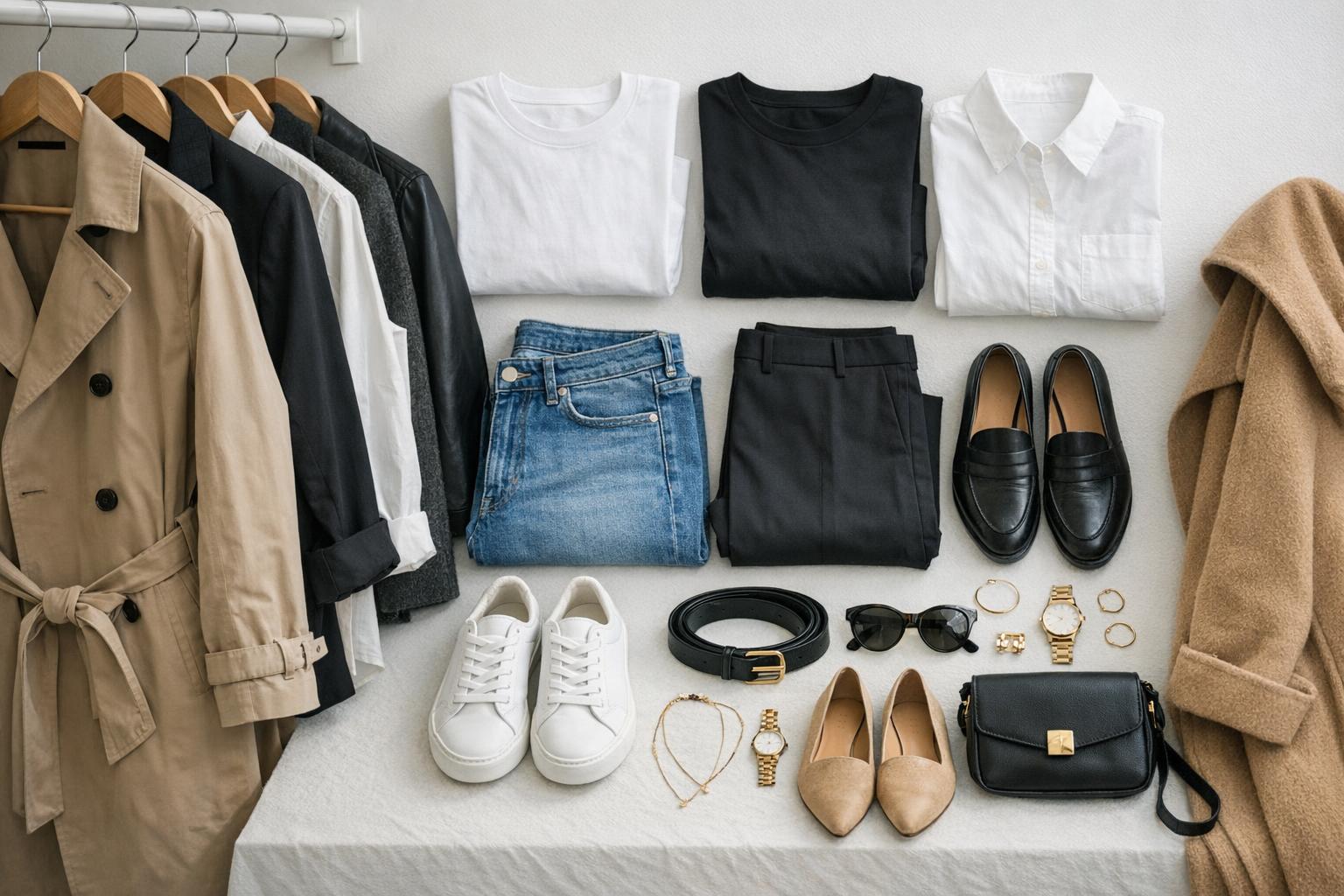
    You’re standing in front of an open suitcase—or an overstuffed closet—trying to build an outfit that feels polished without looking “styled.” That tension is where parisian chic style outfits live: the sweet spot between ease and intention. The look isn’t loud, and it doesn’t depend on constant newness; it’s built on a small set of reliable wardrobe staples (think trench coat, white shirt, neutrals, tailored pieces) and the confidence to repeat them in slightly different combinations. In the U.S., the appeal is practical: these are paris outfits you can wear to work, on a plane, to dinner, or while walking all day without feeling overdressed.

    Parisian style is often described as “French chic” or “effortless French chic,” but the “effortless” part is usually the result of planning—especially a capsule wardrobe mindset. You’ll see it in celebrity snapshots that read as modern uniforms: a Paris capsule wardrobe anchored by minimalism and a neutral palette (as seen in Rosie Huntington-Whiteley’s Paris-focused packing approach), a trench coat styled with crisp simplicity (a Kaia Gerber-style cue), or classic pieces elevated by context, like Nicole Kidman’s wide-leg jeans and oversized white shirt moment tied to a Chanel show atmosphere. This guide translates those cues into repeatable decisions you can make every morning.
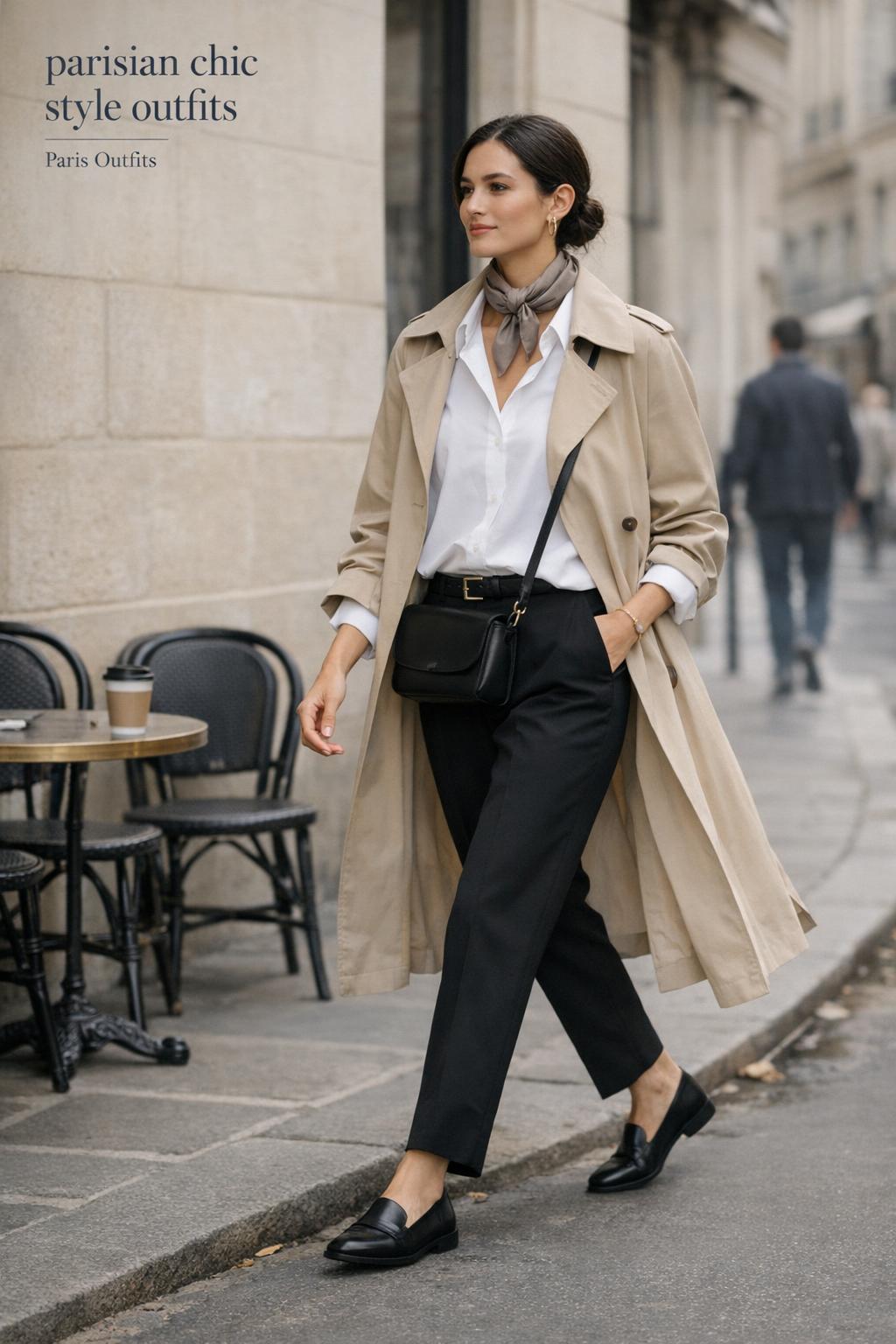
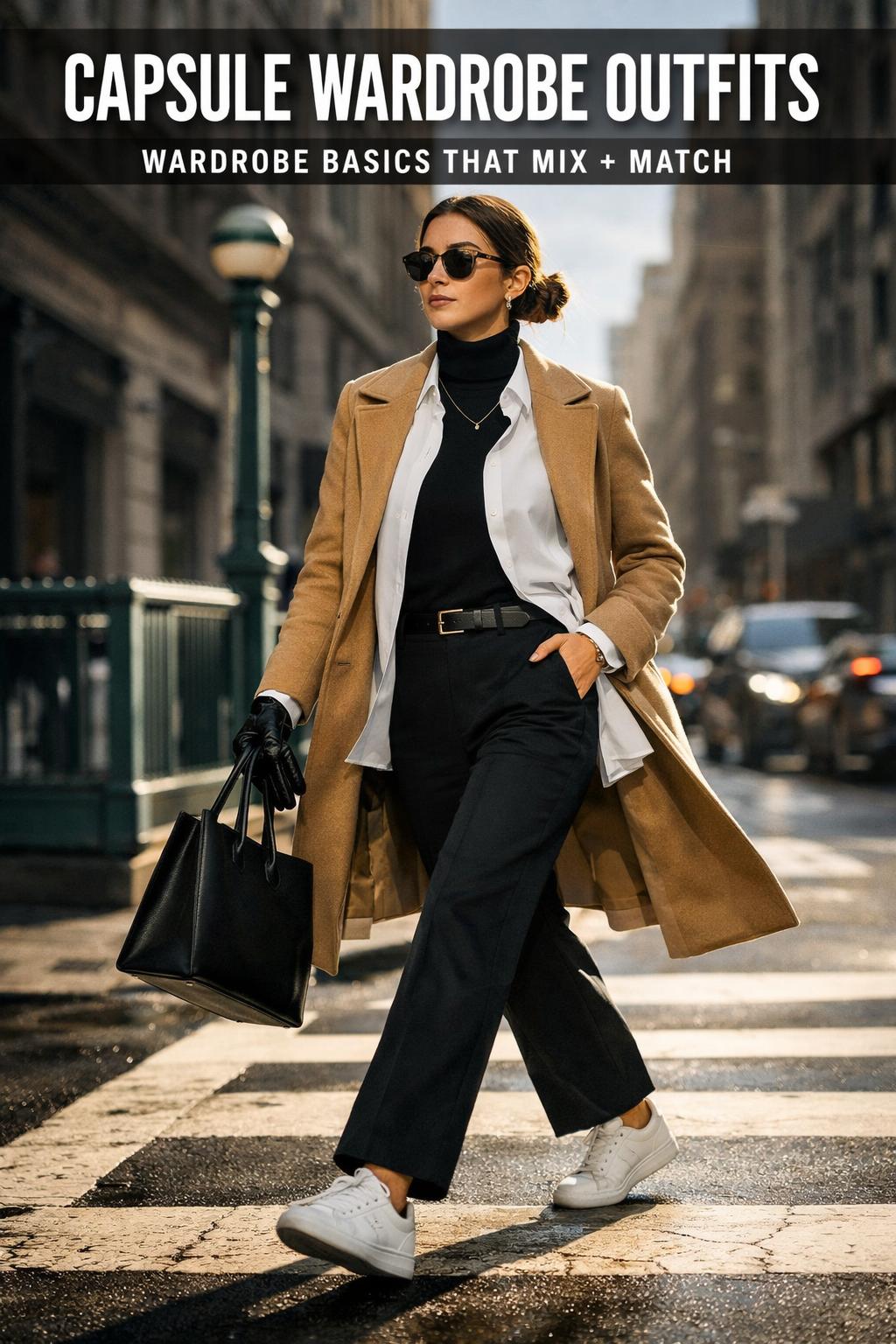
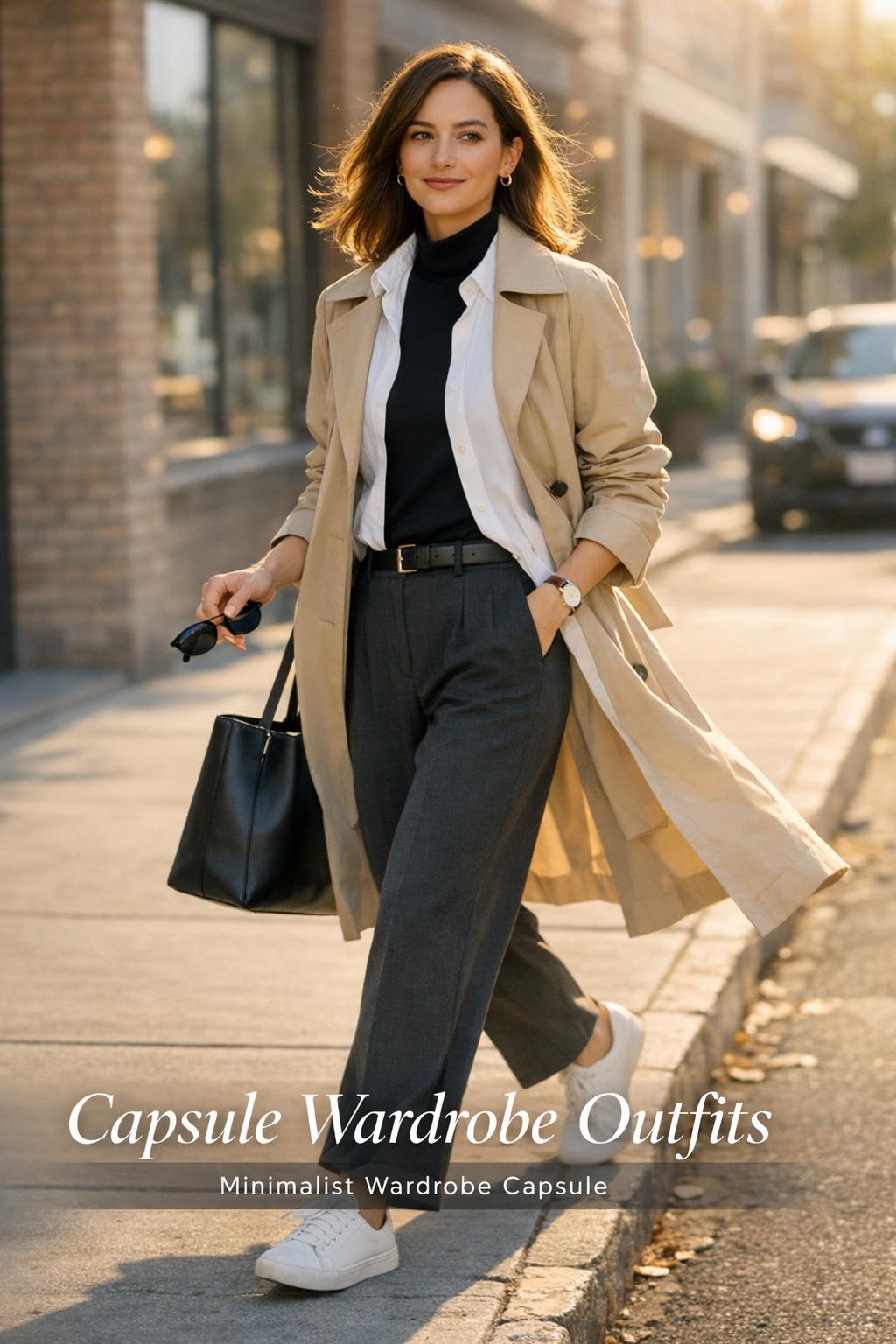
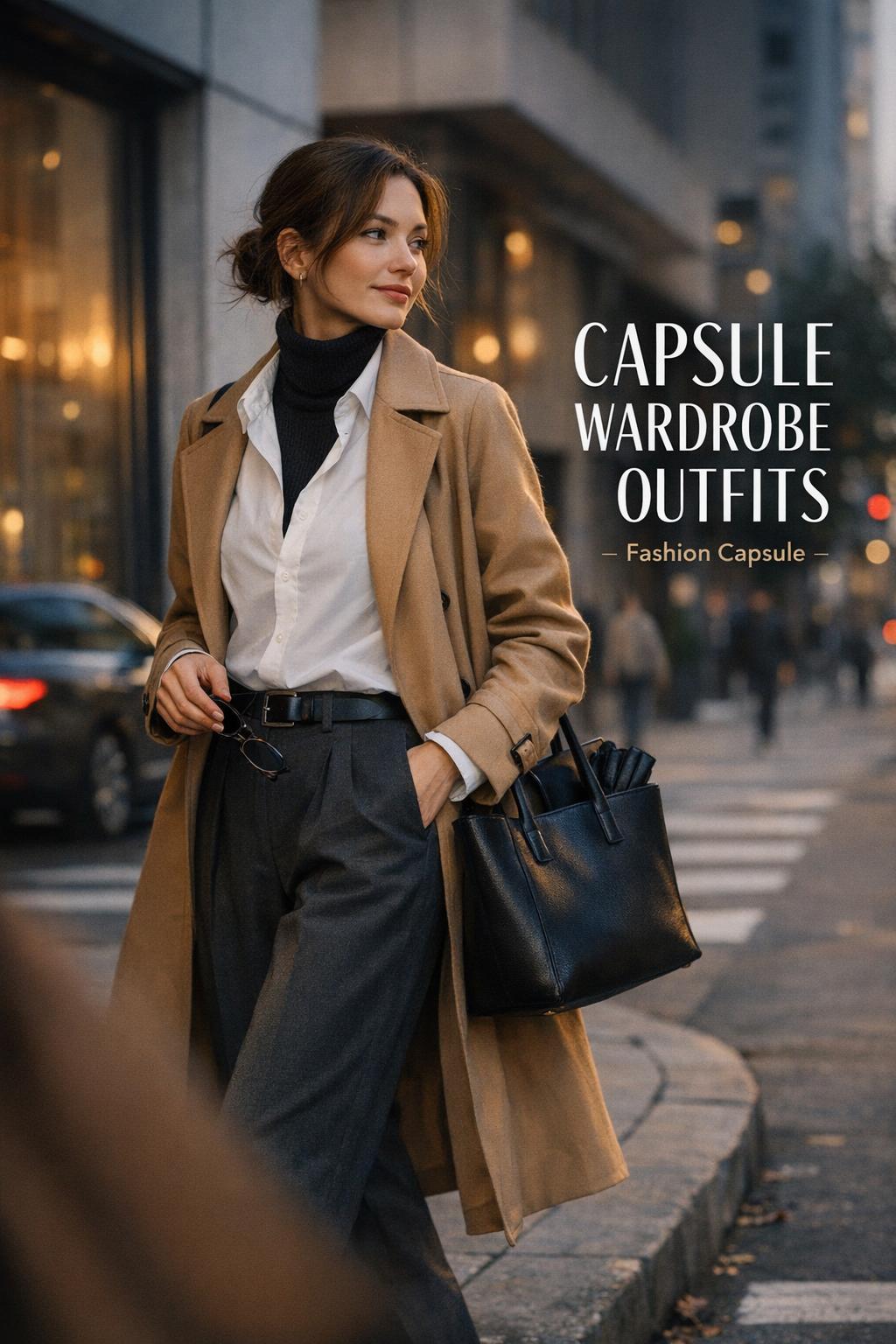
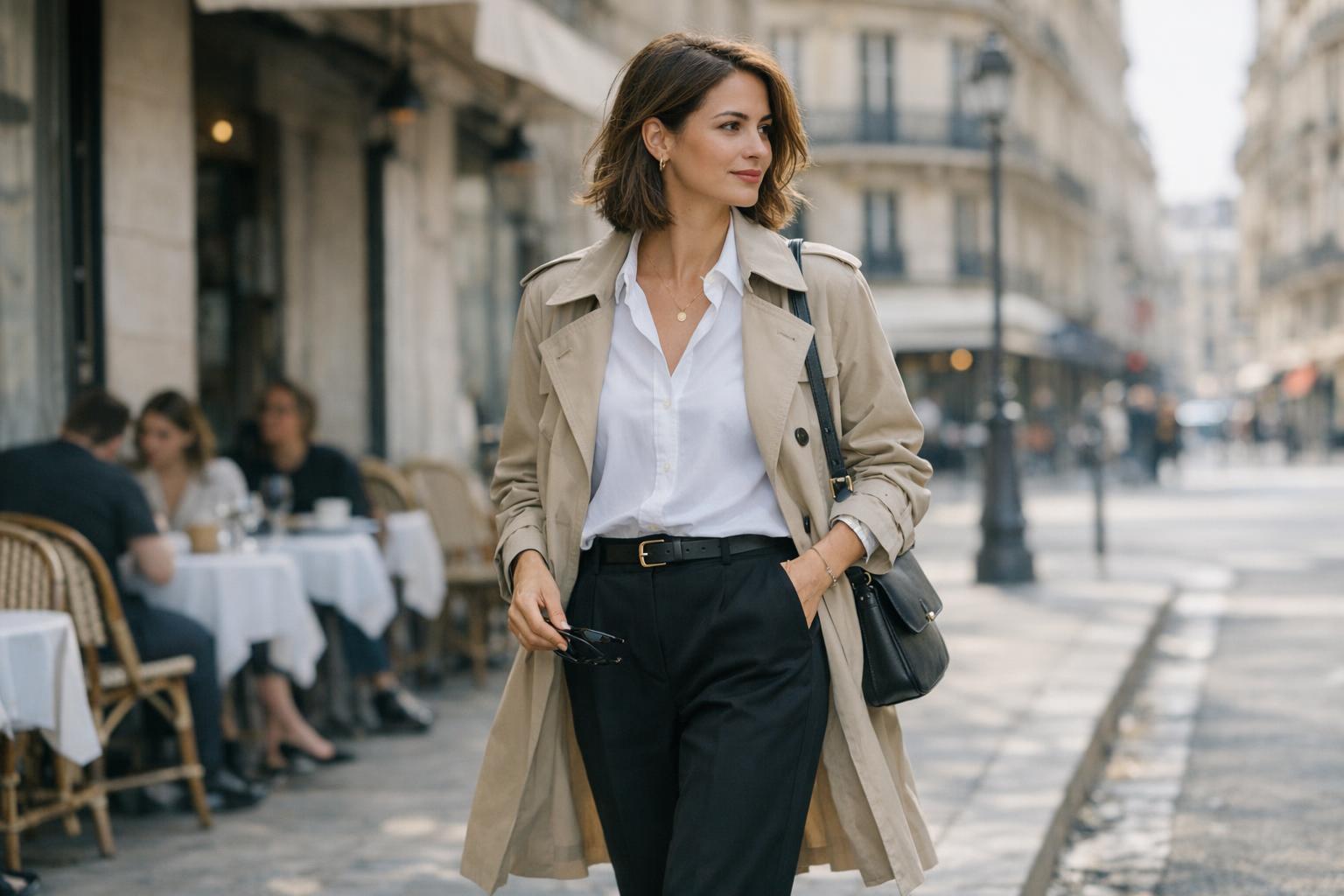
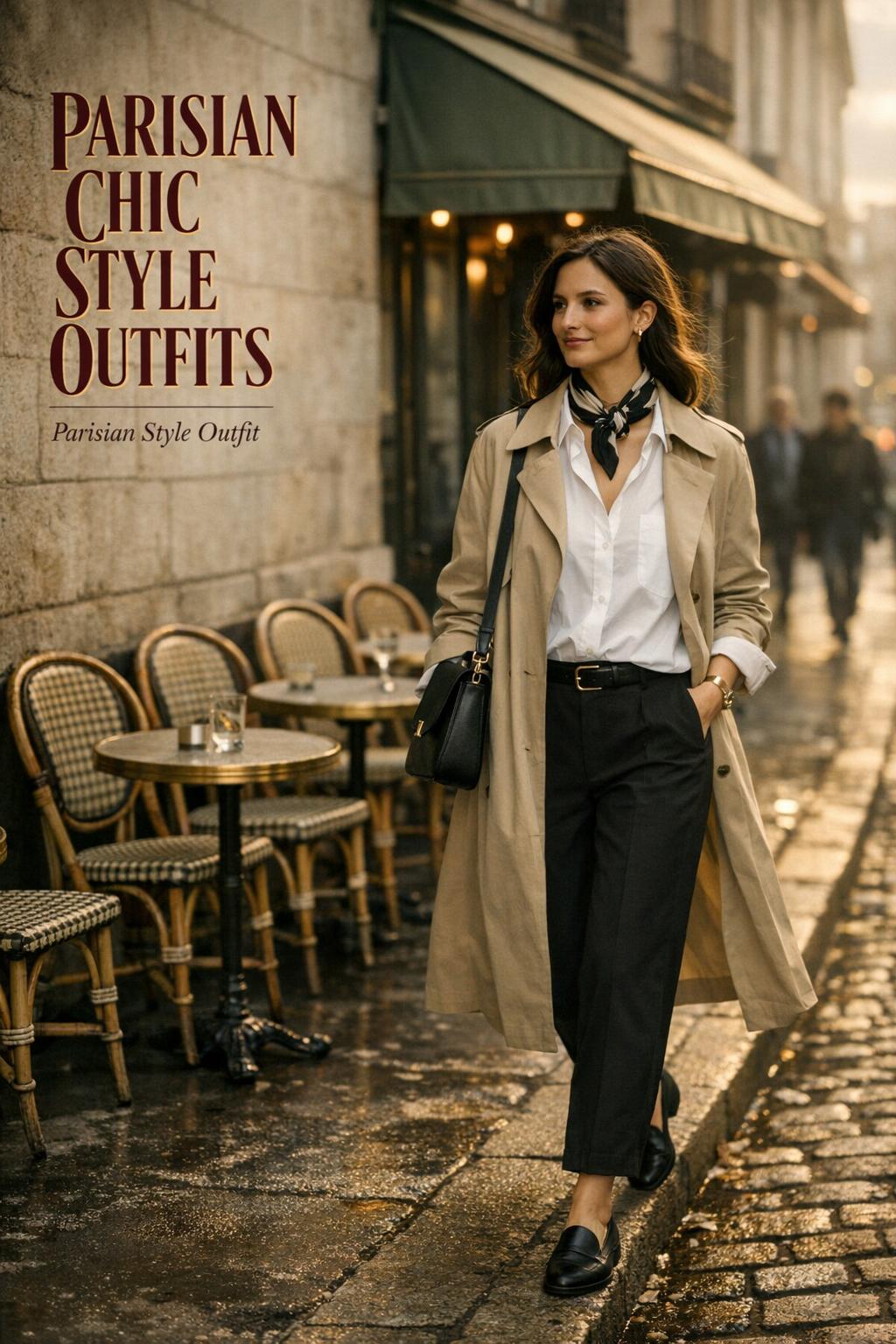
    Parisian chic style outfits: stylish woman in beige trench and black trousers walking past a minimalist Paris cafe
    A poised Paris street moment captures quiet luxury with a beige trench, crisp white shirt, and tailored black trousers outside a minimalist café.

    The Parisian style mindset: understated choices, strong structure

    Before outfits, start with the mindset that holds them together. Parisian chic is not a costume; it’s a logic. The logic is built around neutral tones, clean lines, and fit that looks deliberate. “Tailored silhouettes” show up repeatedly because they create instant structure, even when the pieces are simple. A white shirt becomes a style statement when the shoulders sit right and the hem behaves under a coat. A trench coat looks “Parisian” when the length and drape match your proportions rather than fighting them.

    Minimalist style doesn’t mean boring—it means editing. Instead of stacking trends, Parisian style outfits tend to focus on one idea at a time: a strong coat, a crisp shirt, a monochrome column of color, or a single accessory that looks chosen rather than accumulated. That’s why day-to-night transitions work so well in this aesthetic: the base stays the same, and you change the emphasis.

    Tips: how to tell if an outfit reads “French chic” or just “basic”

    If you’re wearing simple pieces but the look feels unfinished, the difference is usually structure and restraint. Choose one tailored anchor (a blazer, tailored pants, or a trench coat), keep the palette tight (neutrals or deliberate monochrome), and let one detail do the work—like the collar of a white shirt, the line of wide-leg jeans, or the way a coat is belted. If you add more than one “statement,” the outfit often loses the quiet confidence that makes parisian style distinct.
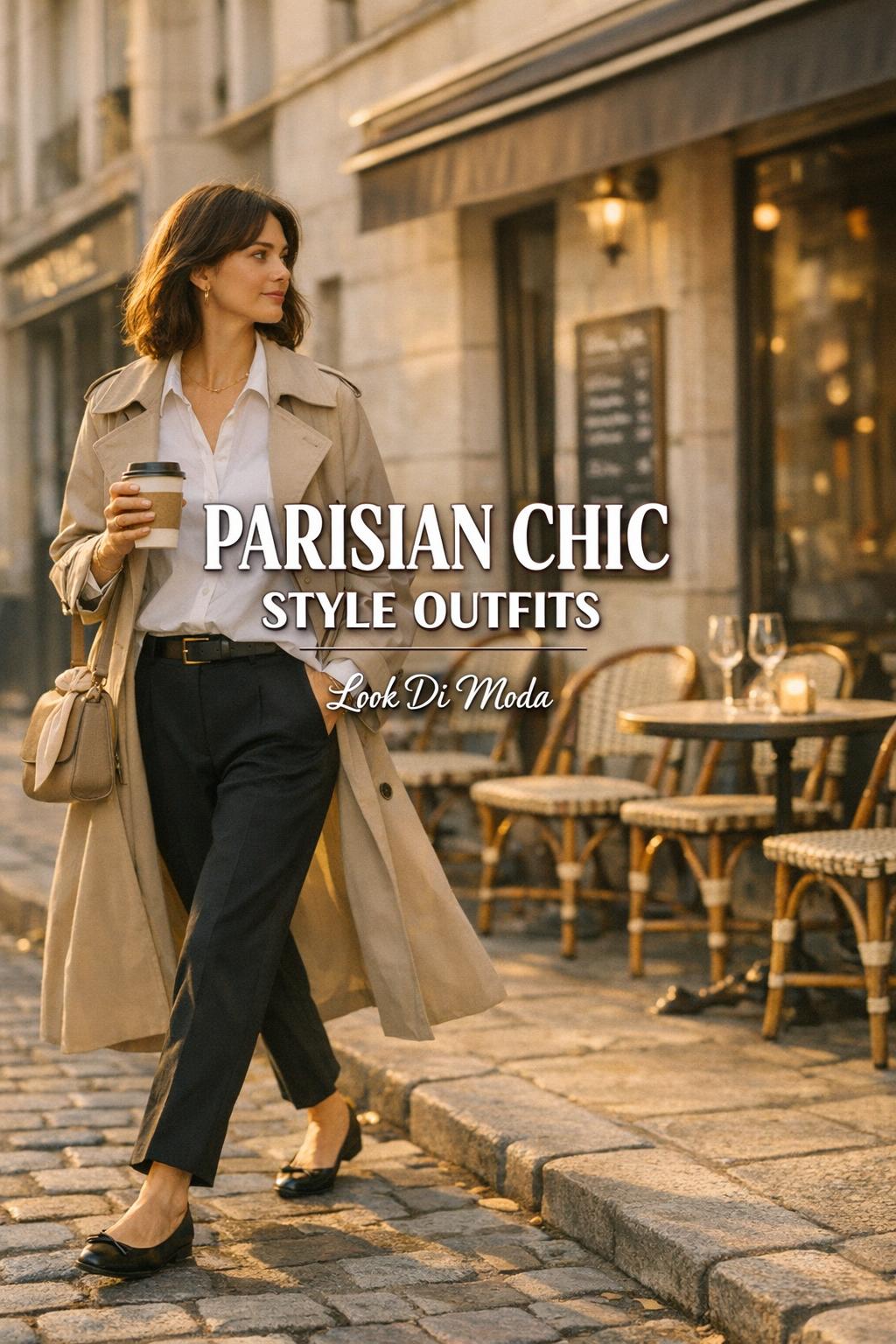
    Parisian chic style outfits on a woman in beige trench coat walking past a Paris street café at golden hour
    A stylish woman in a beige trench and tailored black trousers strolls past a Paris café terrace with a takeaway coffee in warm golden-hour light.

    The backbone pieces: trench coats, white shirts, and tailored neutrals

    Across modern “Parisienne fashion” interpretations—from travel packing lists to street-style outfit ideas—certain items keep reappearing because they solve real-life wardrobe problems. The trench coat is the clearest example: it’s weather-aware, layers easily, and elevates even casual basics. The white shirt is another: it creates crispness next to denim, tailored pants, or a skirt, and it photographs well in a way that reads “pulled together” without needing embellishment.

    Neutrals matter here less as a rule and more as a strategy. A neutral palette creates mix-and-match flexibility, which is why capsule wardrobe advice dominates so much parisian style content. When you build around black, white, and other muted tones, you can repeat silhouettes—tailored pants one day, a skirt the next—without your outfit looking identical. That repeatability is the real secret behind “effortless”.

    • Trench coat as the all-season outer layer that instantly signals Parisian style
    • White shirt as the “polish layer” for denim, skirts, and tailored pieces
    • Tailored pants or black trousers for clean lines and day-to-night flexibility
    • Wide-leg jeans for a relaxed silhouette that still looks intentional
    • A blazer for structure when you want minimalist style with sharper edges
    • A striped Breton top as the classic pattern that pairs naturally with trench coats and tailoring

    The 20-item Parisian capsule wardrobe template (built for real life)

    A Parisian capsule wardrobe works because it narrows choices while expanding combinations. Instead of chasing endless outfit variety, you build a small system: a few outer layers, a few tops, a few bottoms, one or two dresses, and accessories that finish without distracting. This is the same logic behind a Paris capsule wardrobe for travel—pack fewer things, wear them more, and rely on tailored silhouettes and neutrals to keep everything cohesive.

    Below is a 20-item template you can adapt for work, weekends, and travel. It’s not meant to be restrictive; it’s meant to be repeatable. If your lifestyle leans casual, keep the tailored elements in outerwear and pants. If you dress up more often, keep the structure but shift the proportion toward dressier pieces like an LBD and sharper layering.

    Spring/summer essentials for Paris outfits (and beyond)

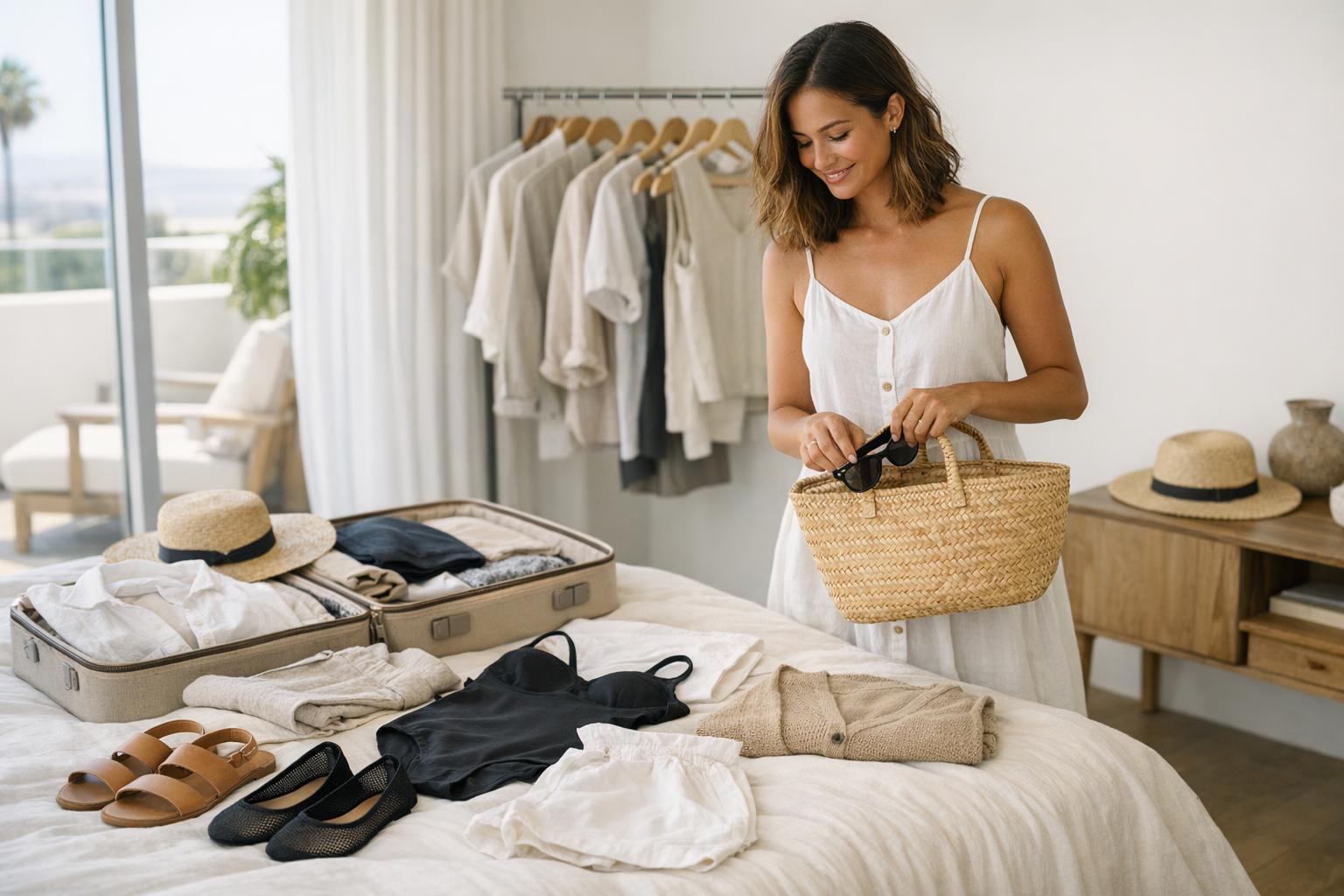
    Warm-weather Parisian style outfits still rely on structure—just with lighter layers and simpler lines. The goal is to avoid outfits that feel fussy in heat or while walking all day. Think of these pieces as the core that lets you create multiple paris outfits with minimal packing and maximum cohesion.

    • White shirt (crisp, versatile, easy to layer or wear open)
    • Striped Breton top (the classic pattern that keeps basics from feeling flat)
    • Lightweight blazer (for meetings, dinners, or any moment you want instant polish)
    • Tailored pants (a summer-weight option keeps the silhouette clean)
    • Wide-leg jeans (relaxed but deliberate, especially with a tucked-in shirt)
    • Midi skirt (easy movement, elegant line, simple to dress up)
    • Little black dress (the simplest answer to “what do I wear tonight?”)
    • Ballet flats or loafers (choose based on comfort and the mood you want)

    Fall/winter essentials: the layered Parisian style outfit approach

    Cool-weather dressing is where Parisian chic can look most convincing, because coats and layers create shape. Travel-focused guides often emphasize timeless outerwear and accessories—items that can handle long days and changing temperatures without forcing you into heavy, trend-driven styling.

    • Trench coat (especially useful in transitional weather)
    • Tailored blazer (a second structure layer when coats come off indoors)
    • Black trousers (a foundation piece for minimalist style)
    • Wide-leg jeans (comfortable for walking, elevated with a white shirt)
    • Long-sleeve tops that layer cleanly under coats (keep the line smooth)
    • Closed-toe flats or loafers (a practical, polished option)

    Accessories and footwear: the “restraint” zone

    Many Parisian style outfit ideas hinge on accessories, but the key is editing. A scarf, a belt, or a crossbody bag can elevate a basic uniform, yet too many accessories can start to look like you’re trying to “perform” French chic. Travel-focused Parisian style content often highlights scarves and bags because they pack small and change an outfit’s mood quickly.

    • Scarf for texture and color without committing to a loud garment
    • Belt to define shape over a trench coat or blazer
    • Crossbody bag for city walking and hands-free ease
    • Subtle jewelry (keep the focus on silhouette and fabric)
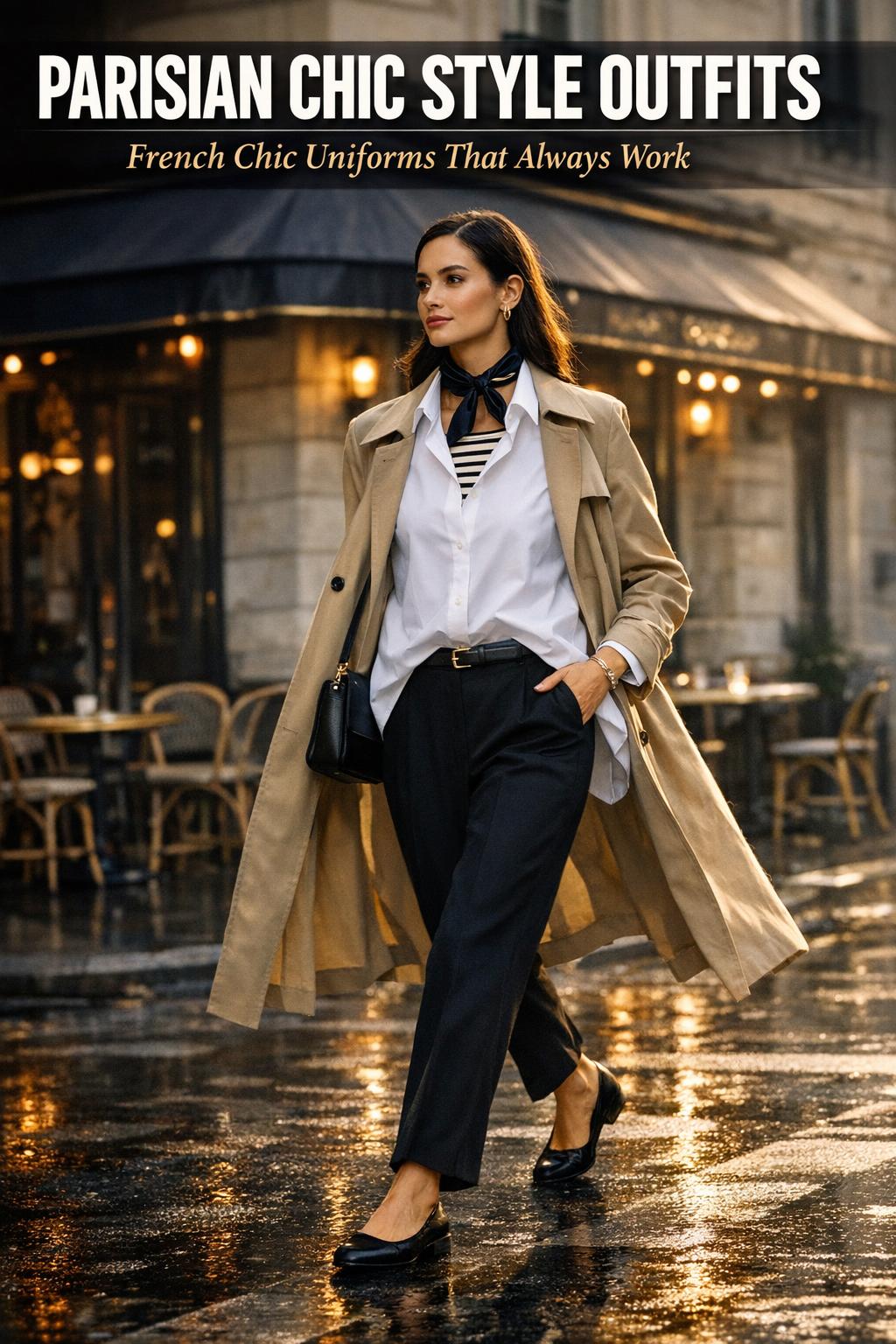
    Parisian chic style outfits photographed on a stylish woman walking a Paris street in a tailored blazer and scarf
    A stylish woman strolls down a Paris street in timeless layers that define effortless Parisian chic.

    Outfit logic you can recycle: three signature formulas that always work

    If you want parisian chic style outfits to feel effortless, rely on outfit formulas. Formulas reduce decision fatigue and improve consistency, which is why they show up across Paris outfit idea articles and “how to dress like a Parisian” guides. The point isn’t to copy a uniform; it’s to give yourself a stable structure you can personalize with small choices—shoe type, sleeve styling, and how sharp or relaxed your tailoring feels.

    The trench + Breton + tailored pants formula (a modern Parisian trench coat outfit)

    This is the clearest “French girl style” structure because each piece does a specific job. The trench coat brings movement and polish, the striped Breton top breaks up neutrals with a classic pattern, and tailored pants keep the silhouette intentional. It’s also easy to adjust: swap tailored pants for wide-leg jeans when you want the look to feel more relaxed without losing the Parisian effect.

    In real life, this formula is ideal for travel days. You’ll be comfortable sitting, walking, and changing temperatures, and you’ll still look like you planned your outfit. The trench coat is the anchor—similar to the way a Kaia Gerber trench moment reads instantly Parisian because the coat does most of the storytelling.

    The little black dress with subtle accessories formula

    The LBD works in Parisian style because it’s a clean canvas. Keep the accessories subtle—one bag, one pair of flats or loafers—and let the dress be the line that carries the outfit. This formula also solves the “day-to-night” challenge: you can wear the same base to a daytime plan and then shift the mood by adding a blazer and changing your bag.

    Where this can go wrong is over-accessorizing. If the LBD becomes a backdrop for too many details, it stops feeling Parisian and starts feeling like a costume. Choose one focal point: the neckline, the hemline, or a scarf, but not all of them at once.

    The monochrome day-to-night formula (minimalism with impact)

    Monochrome styling is a shortcut to “expensive-looking” because it creates a continuous line. In a Parisian style outfit, this often means neutrals from head to toe. Start with black trousers and a black top, or a white shirt with light-toned pants if you prefer brighter neutrals. Add a blazer or trench coat for structure, and you’re ready for most scenarios—from work to dinner—without changing the foundation.

    Monochrome is also a smart way to incorporate “Look Di Moda” energy without chasing trends: the look feels editorial because it’s cohesive, but it’s still built from timeless pieces you’ll wear repeatedly.
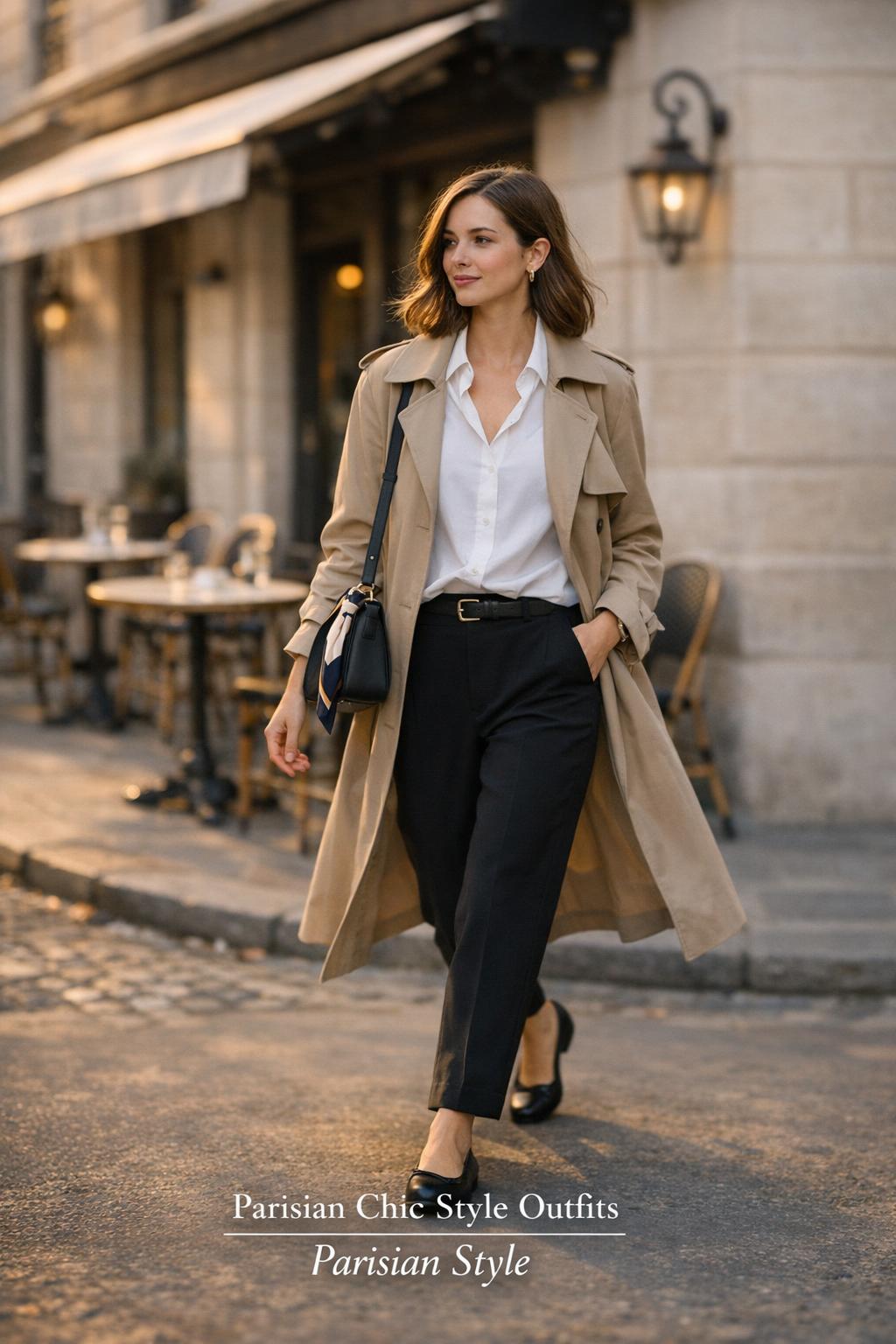
    Parisian chic style outfits: woman in beige trench walking past Saint-Germain cafe in golden-hour light, Paris
    A stylish woman in a beige trench coat strolls past a Saint-Germain café in warm golden-hour light, embodying effortless Parisian chic.

    Icon pieces, styled the Parisian way: fit, fabric, and restraint

    Most style guides can list staples; fewer explain how those staples should behave on the body. In Parisian style, the difference is in the specifics: where the shoulder seam sits, how a coat falls when unbuttoned, how wide-leg jeans skim without swallowing your frame. If you’ve ever tried to recreate French chic and felt “off,” it’s usually because the fit is fighting the idea.

    Trench coat: your year-round anchor

    A trench coat reads Parisian because it’s functional and elegant at the same time, which is why it appears so often in Parisian outfit idea roundups. For a more authentic effect, pay attention to length and movement: a trench that swings slightly as you walk feels relaxed, while a stiff, overly structured trench can feel costume-like. Belt it when you want a defined waist; leave it open when you want a longer, cleaner line over tailored pants or wide-leg jeans.

    White shirt: the polish layer you’ll never regret packing

    The white shirt shows up in Paris Fashion Week-adjacent styling because it photographs cleanly and makes an outfit look deliberate. Nicole Kidman’s oversized white shirt styling paired with wide-leg jeans captures a key Parisian principle: contrast. The relaxed volume of the shirt works because the rest of the look stays simple. If you try this at home, keep the styling tidy—clean lines at the collar, sleeves pushed with intention, and a front tuck if you need waist definition.

    Ballet flats vs. loafers: choosing the mood and the mileage

    Both shoes can belong in a Parisian capsule wardrobe, but they signal slightly different energy. Ballet flats lean delicate and classic, while loafers feel sharper and more tailored. For long walking days, choose what supports your routine and your posture; Parisian style is as much about how you carry yourself as what you wear. If your outfit is already soft (midi skirt, airy top), loafers can add structure. If your outfit is already tailored (blazer, black trousers), ballet flats can make it feel less severe.

    Parisian style by neighborhood: using place as a styling guide

    Parisian chic is tied to Paris not just as a concept, but as a real place with distinct visual moods. Thinking in neighborhoods is a helpful way to decide how your outfit should feel—minimal, classic, or quietly luxurious—without changing your entire wardrobe. This is also a more realistic way to approach “how to dress Parisian”: you’re choosing a context, not copying a stereotype.

    Le Marais minimalism: clean lines, edited color

    Le Marais-inspired styling leans into minimalism. Think tailored pants, a trench coat worn open, and a striped Breton top used sparingly—more graphic than cute. Keep the palette neutral and let silhouette do the work. If you want an easy update without buying anything new, focus on proportion: pair wide-leg jeans with a cleaner, more structured top like a white shirt to keep the look intentional.

    Saint-Germain quiet luxury: classic pieces with soft confidence

    Saint-Germain-des-Prés cues skew polished and timeless: a blazer over a white shirt, black trousers, and subtle accessories. The goal is not flash; it’s the sense that your wardrobe is built to last. This is the neighborhood mindset that aligns naturally with investment dressing and the heritage influence associated with Chanel in Paris fashion culture. If you’re building a parisian style outfit for a dinner or a work event, this is the easiest direction to follow.

    Real-world inspiration: celebrity Paris moments translated into wearable outfits

    Celebrity style can be useful when you treat it like a case study rather than a shopping list. The most relevant Parisian moments aren’t about owning “the exact piece”; they’re about understanding why the outfit works. In this aesthetic, the “why” is usually one of three things: a disciplined palette, tailored silhouettes, or a capsule wardrobe approach that repeats strong basics.

    Rosie Huntington-Whiteley: the Paris capsule wardrobe approach

    Rosie Huntington-Whiteley’s Paris capsule wardrobe framing highlights a modern version of French chic: minimalist, high-quality pieces in neutral tones, often leaning into tailored silhouettes. The takeaway is strategic packing. If you want paris outfits that work for multiple settings, choose a tight color story and repeat silhouettes—like pairing a white shirt with both tailored pants and wide-leg jeans, then using a blazer or trench coat to shift the formality.

    Kaia Gerber: trench coat as the “instant Parisian” signal

    Kaia Gerber’s trench styling is a reminder that one iconic piece can anchor an entire Parisian style outfit. Even when trends shift—like the presence of 90s skirt silhouettes around trench coats—the core remains the same: a classic outer layer that makes everything beneath it look more considered. If you’re unsure where to invest, a trench coat is one of the most flexible choices because it works across seasons and settings.

    Nicole Kidman: wide-leg jeans + oversized white shirt, influenced by a Chanel show moment

    Nicole Kidman’s styling moment—wide-leg jeans with an oversized white shirt—shows how Parisian chic handles volume. The look works because the palette stays clean and the shapes are controlled: one piece is relaxed, the rest stays simple. Tied to the atmosphere of a Chanel show, it also reflects how Paris Fashion Week energy can translate into everyday dressing: you don’t need a runway wardrobe, just a strong silhouette and classic pieces.

    Travel-ready Paris outfits: packing like you’ll actually walk all day

    A lot of Parisian style advice becomes truly useful when you treat it as a travel system. Paris is a walking city in the imagination of most travelers, and the best paris outfits account for comfort without sacrificing polish. Travel-oriented Parisian guides consistently emphasize simple pieces elevated with accessories, plus outerwear that handles unpredictable weather—especially trench coats and layering staples.

    For U.S. travelers, the biggest challenge is overpacking “options” instead of packing a plan. If your suitcase is full of unrelated statement pieces, you’ll default to the same safe outfit anyway. A capsule wardrobe approach prevents that: you pack fewer items, but each one works with the rest, giving you more outfits in practice.

    Tips: the three-item rule for a strong Parisian style outfit on the go

    When you’re dressing quickly—hotel room, early train, long day—use a three-item structure: one anchor (trench coat or blazer), one clean base (white shirt or Breton top), and one polished bottom (tailored pants or wide-leg jeans). Add one accessory (a scarf or crossbody bag), and stop there. This keeps the look French chic rather than overloaded, and it’s reliable enough to repeat across multiple days without feeling repetitive.

    Parisian style outfits for different ages: elegant, not age-coded

    Parisian chic adapts well across decades because it’s built on classics. It’s also why Parisian travel wardrobes are often framed as “elevated looks,” including guidance specifically for women over 40. The point isn’t to dress “younger” or “older”—it’s to dress with clarity. Tailored pieces, a neutral palette, and well-chosen accessories tend to look modern at any age because they’re rooted in fit and proportion rather than trend intensity.

    If you’re refining your wardrobe over time, Parisian style offers a useful editing principle: invest attention in pieces you’ll wear frequently (outerwear, tailoring, shoes you can walk in) and keep the rest simple. This creates consistency—an underrated kind of style confidence that reads as French chic more than any single item does.

    Shopping for Parisian chic: building the look from budget to investment

    Shopping for parisian chic style outfits is easiest when you shop by role, not by impulse. Each purchase should fit into your outfit formulas: an outer layer that anchors, a top that adds polish, a bottom that holds the silhouette, and accessories that finish. This approach also helps you decide when it’s worth paying more. A trench coat or blazer that fits beautifully will change the way your entire closet works; a trendy extra may not.

    Parisian content often balances shopping desire with practicality: some readers want investment pieces influenced by heritage fashion culture (with Chanel frequently serving as a reference point), while others want accessible wardrobe basics that still feel Parisian. Both are valid. The “French chic” result comes more from cohesion and fit than from a specific price point.

    Tips: a simple cost-per-wear mindset for Parisian staples

    If you’re debating whether to upgrade a piece, ask how often it will appear in your real-life rotation. Trench coats, white shirts, tailored pants, and a blazer show up across multiple Parisian style outfits and travel scenarios, so they typically earn their place quickly. More specialized items can still be fun, but they shouldn’t crowd out the basics that make the system work.

    Common mistakes that make “French chic” feel like a costume

    Most people don’t “fail” at Parisian style because they chose the wrong item; they stumble because the outfit is trying too hard. Parisian chic depends on restraint and repetition, and that can feel unfamiliar if you’re used to building looks around obvious statements.

    • Buying pieces that are “Parisian” in theory but don’t fit your life (for example, shoes you can’t walk in for travel-heavy days)
    • Over-accessorizing a simple base outfit until it loses its minimalist style clarity
    • Ignoring tailoring and proportion, especially with wide-leg jeans and oversized shirts
    • Mixing too many trends at once instead of anchoring the look with a trench coat, blazer, or clean trousers
    • Assuming neutrals alone create Parisian style, without the structure that tailored silhouettes provide

    If you recognize yourself in any of these, the fix is usually simple: return to one outfit formula, tighten the palette, and make one intentional fit adjustment (hem, tuck, belt, or sleeve styling). Parisian style looks calm because the decisions have already been made.

    Finishing touches: confidence, grooming, and the “quiet” details

    Parisian style is often described as confidence, but confidence here is practical: you’re not fussing with your outfit all day. That comes from comfort, movement, and thoughtful finishing. A crossbody bag that sits correctly, shoes you can walk in, and a coat that doesn’t restrict your arms matter more than chasing a perfect “French girl” image.

    Another quiet detail is consistency. If your wardrobe is built around a capsule, your outfits start to feel like a signature. That signature is what makes the look believable—whether your inspiration comes from Paris Playbook-style outfit ideas, a travel guide’s packing list, or a Paris Fashion Week-adjacent celebrity moment.
    Parisian chic style outfits: woman in beige trench coat walking past a Saint-Germain cafe terrace in Paris
    A poised woman in a beige trench coat strolls past a quiet Saint-Germain café terrace, embodying timeless Parisian elegance.

    FAQ

    What are parisian chic style outfits, in simple terms?

    Parisian chic style outfits are built around understated elegance: a neutral palette, well-fitting basics, and tailored silhouettes, often anchored by staples like a trench coat and a white shirt, then finished with restrained accessories.

    What pieces are most associated with a Parisian style outfit?

    The most common staples are a trench coat, a white shirt, tailored pants or black trousers, a striped Breton top, a blazer, and comfortable polished shoes like ballet flats or loafers.

    How do I build a Parisian capsule wardrobe without overbuying?

    Start with a small, cohesive set of neutral, mix-and-match items—outerwear, tops, bottoms, and one dress—then add only what supports repeatable outfit formulas, such as trench + Breton + tailored pants or monochrome day-to-night looks.

    How can I style a trench coat like a Parisian?

    Use the trench coat as the outfit’s anchor, keep the layers underneath clean and simple (a white shirt or striped Breton top with tailored pants or wide-leg jeans), and avoid over-accessorizing so the silhouette and movement stay the focus.

    How do wide-leg jeans fit into Parisian style?

    Wide-leg jeans work well in Parisian style when paired with a crisp top like an oversized white shirt and kept within a minimal, neutral palette; the look feels intentional when volume is balanced and the rest of the outfit stays streamlined.

    How do I make my outfits look “French chic” rather than plain?

    Choose one tailored anchor piece (a trench coat, blazer, or tailored pants), keep your colors cohesive, and make one deliberate styling choice—like a clean tuck, a defined belt, or a carefully chosen scarf—so the outfit looks edited, not accidental.

    Does Parisian style work for travel and long walking days?

    Yes, because many Paris outfits are built around practical staples—trench coats, comfortable flats or loafers, and simple layers—that can handle changing weather and long days while still looking polished and cohesive.

    How does Paris Fashion Week influence everyday Parisian style?

    Paris Fashion Week often spotlights classic pieces in modern proportions—like oversized white shirts and tailored silhouettes—showing how timeless staples can feel current through fit, balance, and minimal styling rather than heavy trend layering.

    Is Chanel relevant to Parisian chic styling today?

    Chanel is frequently referenced as part of the Paris fashion context, especially around show moments, but you don’t need Chanel items to dress in a Parisian way; the more transferable lesson is prioritizing classic pieces, clean lines, and a refined, understated finish.
  • Quiet Luxury Signals: old money classy outfits for U.S. Events

    Quiet Luxury Signals: old money classy outfits for U.S. Events

    Old money classy outfits: why the “quiet” details read the loudest

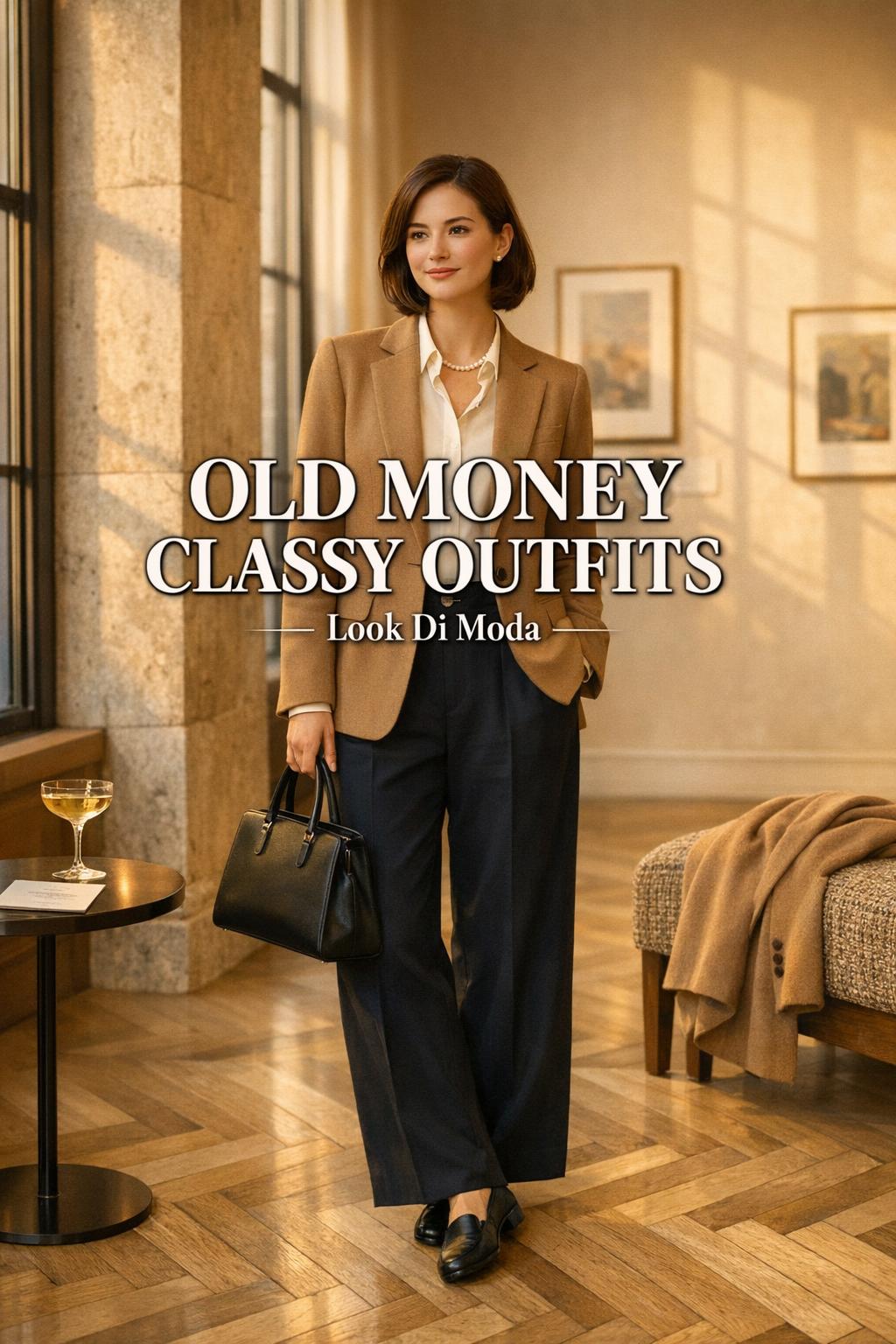
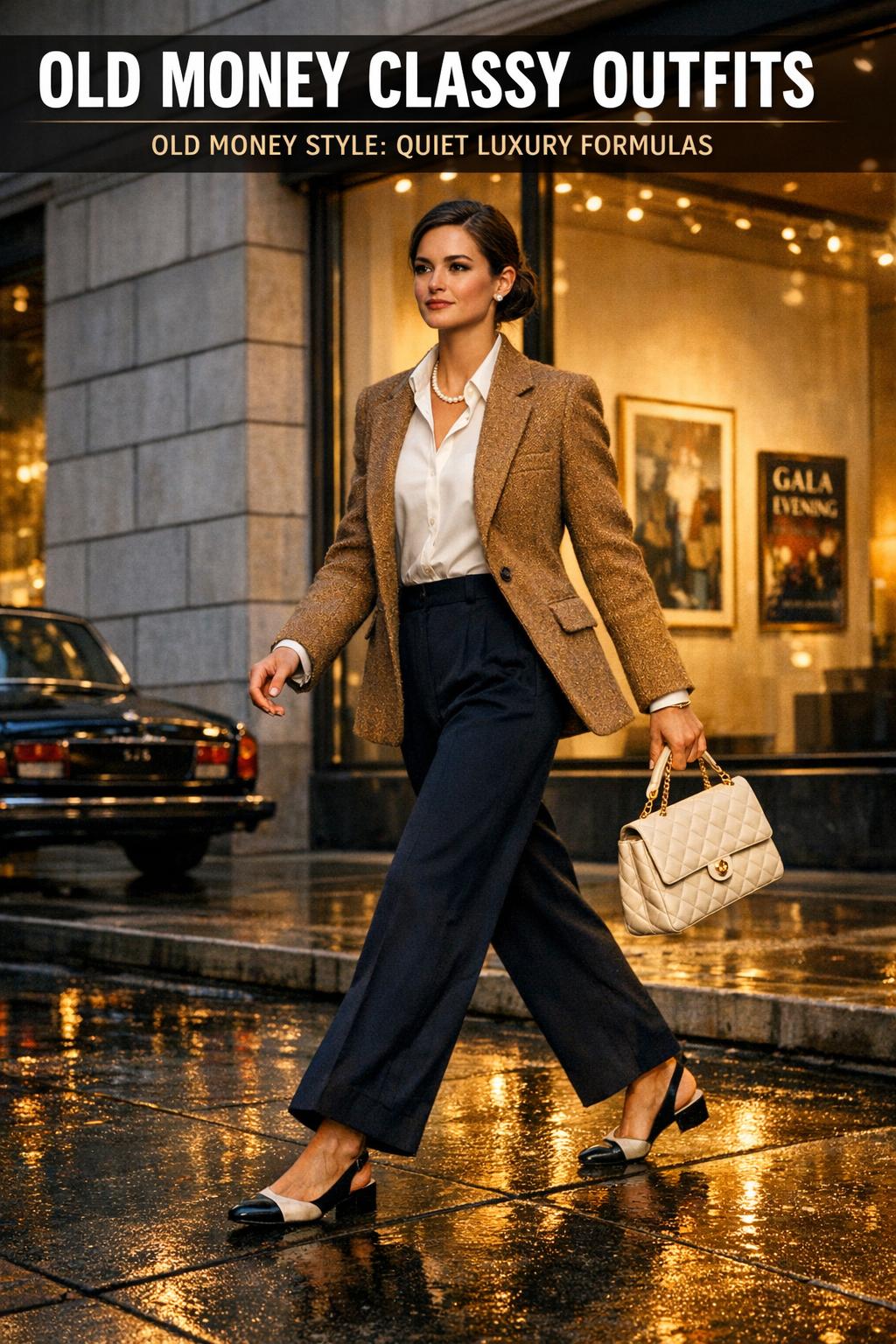
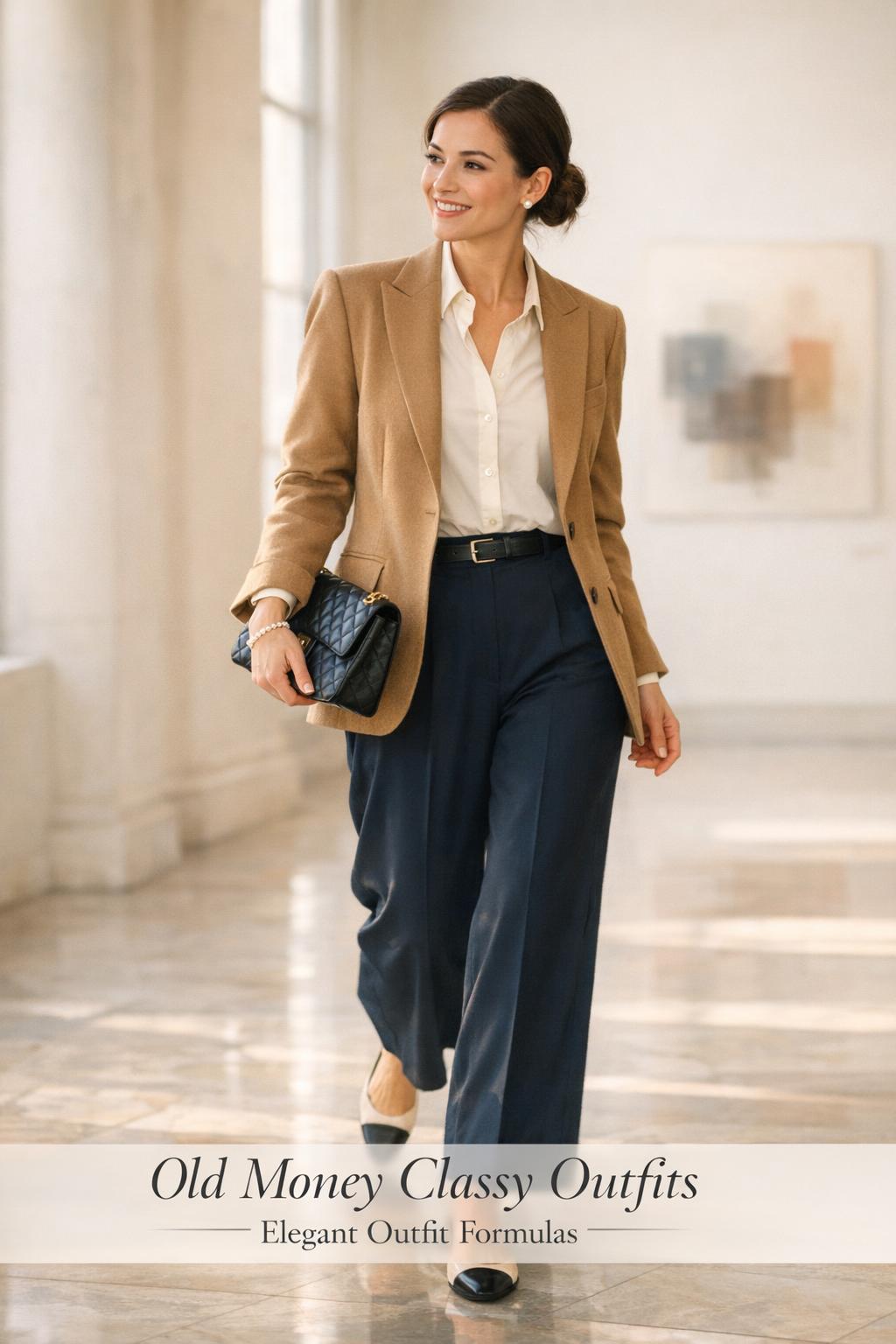
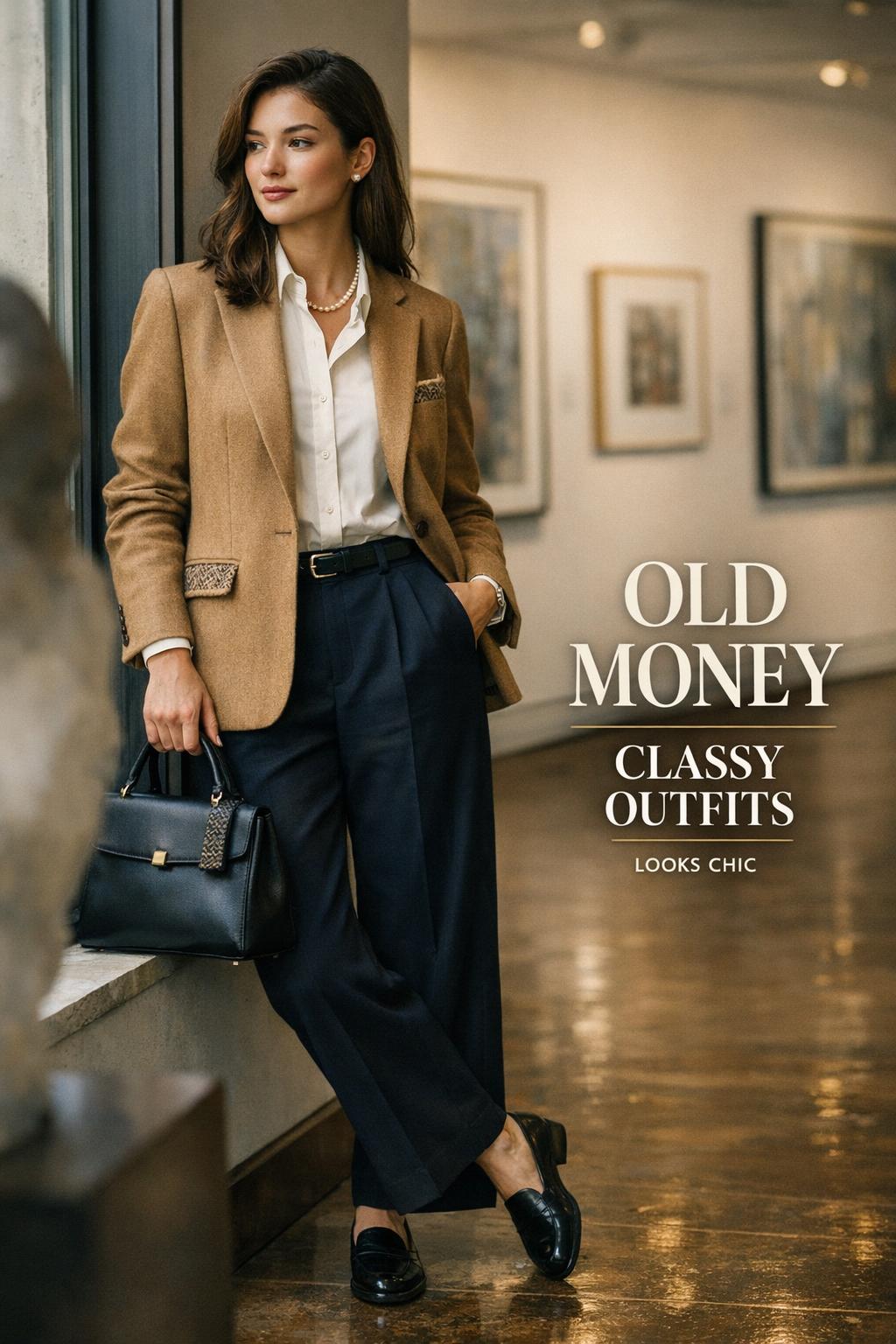
    You can spot old money classy outfits in a room long before you register any single item. It’s the calm confidence of a tailored blazer that sits clean at the shoulder, trousers that fall in a straight, unbroken line, loafers that look polished without trying to be trendy, and a neutral palette that feels intentional rather than “safe.” In U.S. settings—from a gallery opening in New York to a country-club brunch outside Boston—the old money aesthetic signals restraint, practicality, and taste. It overlaps with quiet luxury, but it’s more than minimalism: it’s about proportion, fabric, and continuity across seasons and occasions.

    This guide approaches old money style the way a well-built wardrobe actually works in real life: a small set of evergreen building blocks (blazers, trench coats, wool coats, crisp shirts, knitwear, structured handbags, pearl jewelry) remixed into elegant outfit ideas for the calendar events that keep coming back—afternoon tea, a day at the races, cocktail parties, galas, city strolls, upscale brunches, and art galleries. You’ll also see how to translate the look into a modern business outfit without drifting into loud branding or costume-like “preppy chic.”

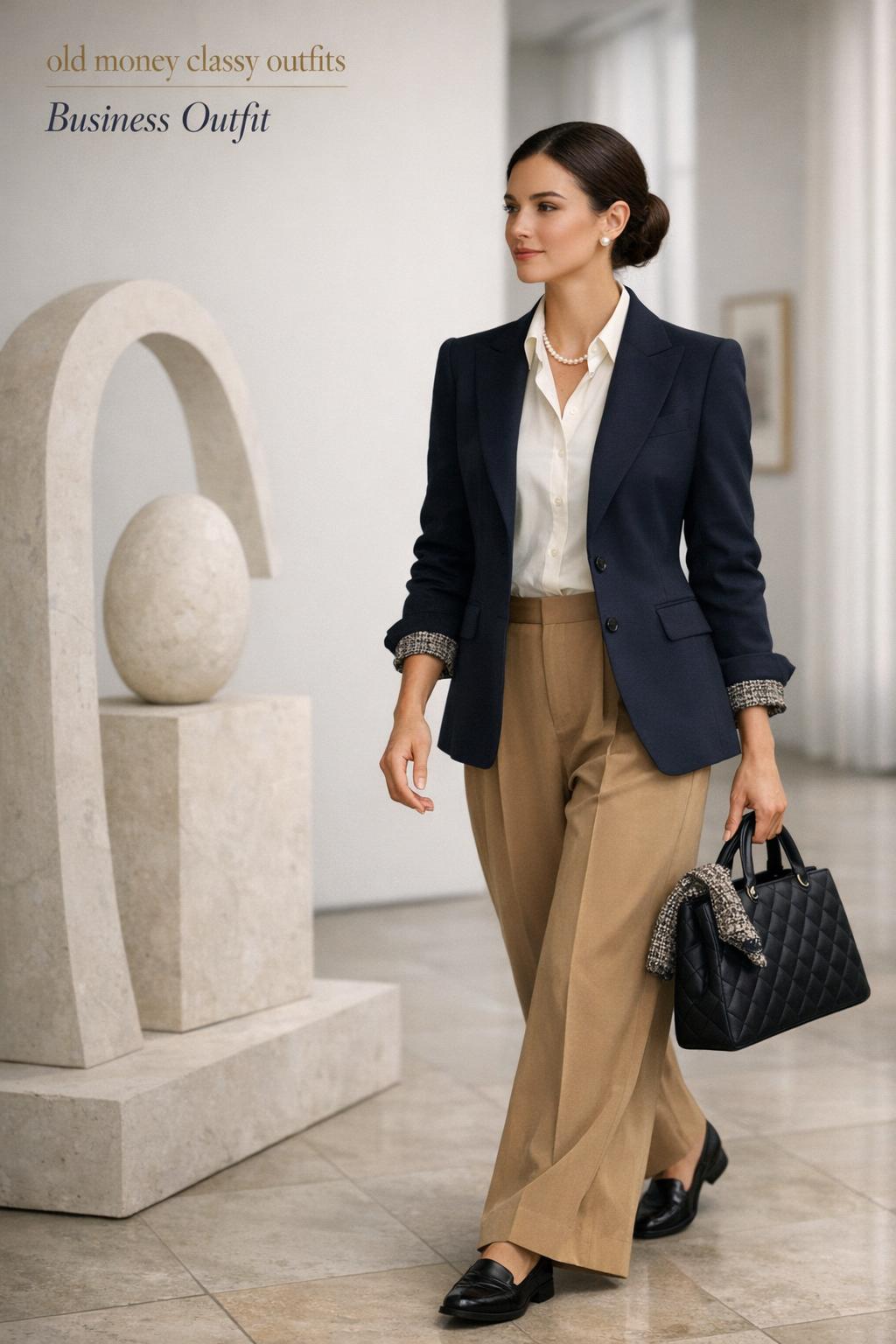
    Old money classy outfits business look in a New York art gallery: navy blazer, ivory shirt, camel trousers, pearls.
    A poised woman strides through a sunlit New York gallery in an old-money business ensemble of navy, ivory, camel, and pearls.

    What defines the old money aesthetic in 2026 (and what it isn’t)

    Old money style is built on a few principles that consistently show up across the most timeless outfit formulas: tailored silhouettes, neutral colors (camel, navy, ivory, beige), subtle accessories, and a “quality-first” approach that values longevity. The goal isn’t to look flashy or obviously expensive; it’s to look composed in every context, from elevated casual to formal events. Quiet luxury is the closest adjacent concept: both prioritize understated elegance, minimal logos, and a refined color palette. The difference is that old money dressing often leans into heritage cues—tweed jackets, trench coats, classic loafers, pearls, and structured bags—pieces that look at home in traditional settings like yacht club afternoons or the races.

    What it isn’t: a rigid uniform, or an excuse to strip away personality. Old money classy outfits can be monochrome, duo-tone, or softly patterned, and they can be modern—wide-leg trousers, a clean midi dress in navy wool, or a sharp cropped jacket—so long as the effect is disciplined and the styling stays intentional. When the look fails, it’s usually because the outfit is trying to “announce” wealth instead of demonstrating taste through fit, texture, and context.

    Tip: use “restraint” as your styling filter

    If you’re unsure whether an item fits the old money aesthetic, ask a practical question: would this still look refined at an art gallery, then at upscale brunch, then at a cocktail party—without changing the vibe? Pieces that pass that test tend to be the same ones you’ll rewear for years: tailored blazers, straight or wide-leg trousers, trench coats, wool coats, crisp white shirts, fine knitwear, loafers, pearl jewelry, and structured handbags.

    Old money classy outfits in a New York art gallery lobby, woman in camel blazer and navy trousers in golden-hour light
    In a sunlit New York gallery lobby, she embodies old-money elegance with a camel blazer, pearls, and tailored navy trousers.

    The wardrobe backbone: pieces that quietly do most of the work

    The easiest way to build old money outfits is to stop thinking in “special occasion looks” and start thinking in building blocks. Across timeless style guides and outfit lists, the same categories repeat because they solve real problems: they layer well, they photograph well without being loud, and they can be dressed up or down with small accessory shifts.

    Top-tier tailoring: blazers, trousers, and skirts

    Tailoring is the clearest signal in old money style because it changes how everything else behaves. A tailored blazer creates structure over a crisp shirt or fine knit. Straight-leg trousers read polished with minimal effort, and wide-leg trousers can look especially refined in neutral colors when the hem and drape are clean. Skirts—especially classic silhouettes like a pencil skirt—bring instant formality without needing loud accessories. The common thread isn’t strictness; it’s balance. If your blazer is sharp and structured, keep the trousers simpler. If you choose wide-leg trousers, keep the top streamlined so the silhouette stays intentional.

    • Tailored blazer in a neutral tone for day-to-night flexibility
    • Straight-leg trousers for a classic, disciplined line
    • Wide-leg trousers in beige or ivory for modern quiet luxury
    • Pencil skirt paired with a crisp white shirt for an elegant outfit that never feels dated

    Outerwear as a signature: trench coats, wool coats, and capes

    Outerwear is where old money classy outfits become unmistakable, especially in fall and winter. A trench coat is a functional classic that works across city strolls and more formal settings, while a wool coat in camel, navy, or black offers a clean finish over tailored separates. A cape is more niche, but in the right fabric and neutral palette, it reads polished and intentional—ideal for evenings when you want warmth without losing shape.

    The practical insight here is comfort: long events (a day at the races, a gallery opening that turns into dinner) require layers that don’t restrict movement. A trench coat and a wool coat solve that while still looking refined. Keep the styling simple underneath—shirt and trousers, or a navy wool midi dress—so the outerwear stays the hero without becoming dramatic.

    Shirts and knitwear: crisp whites, fine knits, and cashmere energy

    A crisp white button-down shirt is a cornerstone because it can anchor beige trousers, a pencil skirt, or a suit and still feel appropriate for a city day or an upscale brunch. Knitwear adds the quiet luxury layer: fine knits, cashmere-like softness, and tidy necklines that fit neatly under blazers and coats. The old money effect isn’t about bulk; it’s about clean lines and texture that looks rich without shouting.

    If you’ve ever felt “too formal” in a blazer, knitwear is the bridge. A fine knit under a tailored blazer keeps the look relaxed enough for elevated casual while still reading as old money style. In warmer months, you can keep the same idea with a crisp shirt worn open at the neck—still disciplined, just lighter.

    Footwear and accessories: loafers, slingbacks, pearls, and structured handbags

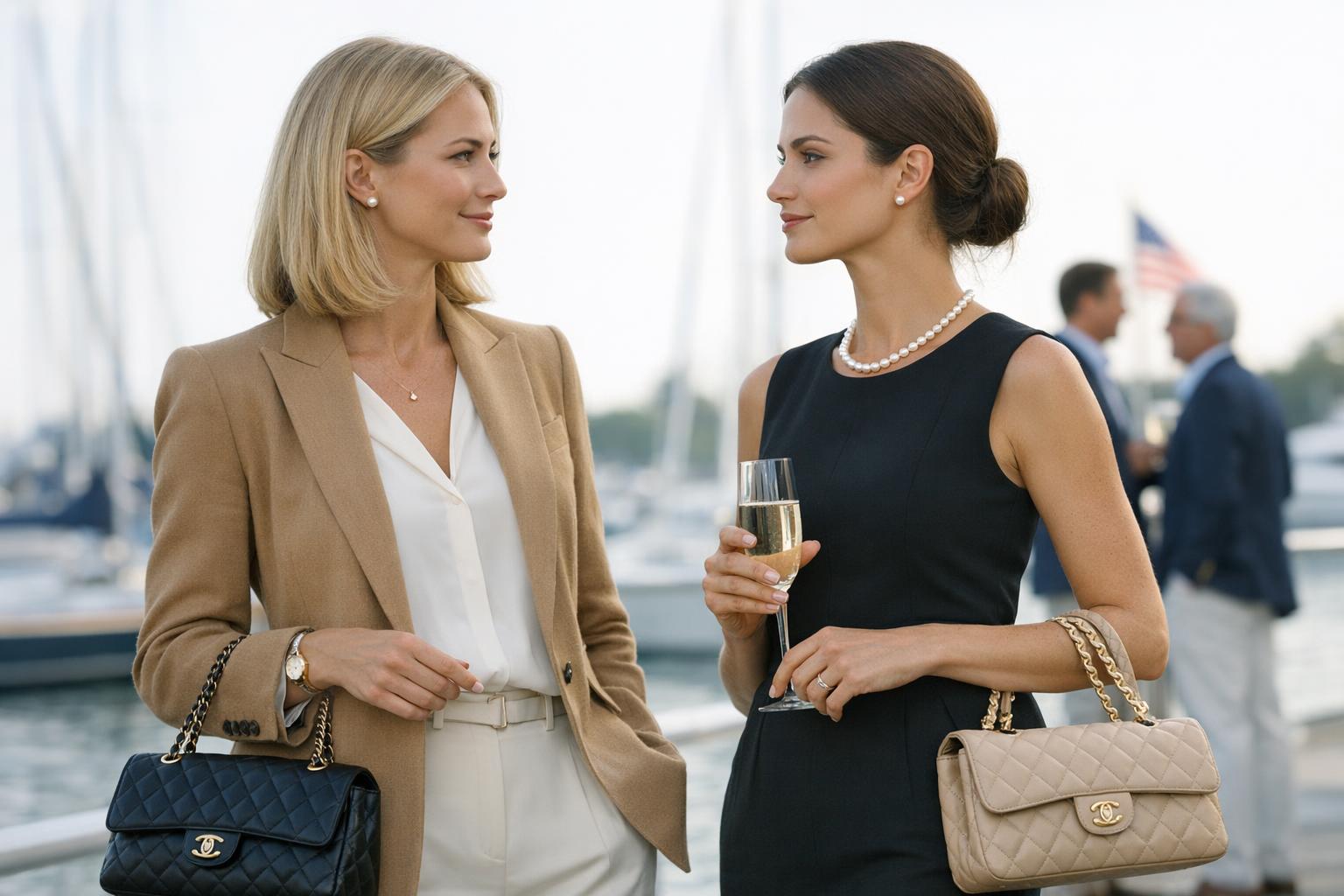
    Accessories in old money outfits are meant to look chosen, not collected. Loafers are the most consistent footwear anchor because they’re polished, comfortable, and work with trousers, skirts, and even dresses. Ballet flats can create a softer line, while classic duo-tone slingback heels offer an elegant lift for cocktail parties or evening events without tipping into flashy territory. Structured handbags and quilted handbags show up frequently because they hold shape and look intentional even with simple outfits. Pearl necklaces and restrained gold jewelry are the “quiet finishing touches” that make a neutral outfit look complete.

    • Loafers for daytime polish (and comfort during long city walks)
    • Duo-tone slingback heels for cocktail parties and gallery evenings
    • Pearl jewelry (especially a pearl necklace) for understated elegance
    • Structured handbag for clean lines; quilted handbag for a softer classic finish
    • Minimal gold jewelry for subtle warmth against navy, ivory, and camel
    Old money classy outfits photographed in soft natural light, featuring tailored blazers, pleated trousers, and loafers.
    Timeless tailoring and understated accessories define these old money classy outfits in soft, natural light.

    Color and pattern strategy: neutrals, monochrome, and restrained prints

    Old money classy outfits rely on a controlled palette not because color is “forbidden,” but because neutrals make fabrics, tailoring, and proportion more visible. Camel, navy, ivory, beige, and black are the recurring anchors. Olive can work as a muted alternative when you want depth without brightness. With neutrals, the goal is cohesion: pieces should look like they belong in the same wardrobe, not like separate styling experiments.

    Monochrome styling is one of the simplest ways to look expensive without trying. A cream or beige monochrome look—fine knit plus wide-leg trousers, finished with a structured bag—reads calm and refined. Navy monochrome feels especially classic in the U.S., and it’s a strong choice for a navy wool midi dress in old money outfits style. If you add pattern, keep it restrained: a tweed jacket, a patterned skirt with a quiet color story, or a subtle duo-tone shoe. The pattern should support the silhouette, not compete with it.

    Tip: pick two “home base” colors and one accent neutral

    For real-life wardrobe planning, choose two core neutrals you’ll repeat (for example, navy and ivory) and one accent neutral (camel or beige). This keeps your outfits looking intentional across seasons and reduces the temptation to over-accessorize. It also makes your business outfit rotation feel cohesive, especially if you wear tailored pieces often.

    Stylish woman in camel blazer and navy trousers walking in a New York gallery, showcasing old money classy outfits
    A poised woman strolls through a sunlit New York gallery in a camel blazer and navy trousers, embodying timeless elegance.

    Looks chic in motion: outfit ideas that work for real U.S. settings

    The best old money outfits look effortless, but they’re engineered to perform: you can sit through brunch, walk through a museum, stand at a cocktail party, or spend a long afternoon at the races without tugging at hems or adjusting straps. The outfit ideas below are organized by context so you can choose based on your calendar, not a numbered template.

    City strolls and art galleries: polished, comfortable, and camera-ready

    For city outings and galleries, the key is refined practicality. A tailored blazer over a fine knit with straight-leg trousers creates a clean line that works indoors and outdoors. Finish with loafers for comfort on pavement and a structured handbag that keeps the silhouette sharp. If you prefer something softer, swap the trousers for a pencil skirt and keep the top crisp—this reads composed without feeling like officewear.

    A smart alternative is a tweed blazer with beige wide-leg trousers and a crisp white shirt. The tweed adds heritage texture; the wide-leg cut modernizes it. Keep jewelry minimal—pearl earrings or a delicate pearl necklace—so the texture remains the focal point.

    Upscale brunch: elevated casual that still feels intentional

    Upscale brunch is where “too formal” can look out of place, but “too casual” breaks the old money illusion. A reliable formula is crisp shirt + beige trousers + loafers, with a trench coat if the weather is unpredictable. If you want a softer, more feminine line, a midi skirt with a fine knit works well—add a quilted handbag for classic texture and keep colors in ivory, camel, or navy.

    This is also a great moment for subtle duo-tone details, like classic duo-tone slingback heels if you’re skipping long walks. The duo-tone element adds interest without introducing a bright color that fights the palette.

    Afternoon tea and yacht-club energy: classic accessories do the talking

    Afternoon tea and yacht-club-adjacent settings reward tradition: tailored pieces, restrained jewelry, and fabrics that hold structure. Think a cropped jacket with a pencil skirt, or a tweed jacket over a crisp shirt and straight trousers. Pearl jewelry fits naturally here, especially when your clothing stays neutral and clean-lined. A structured handbag keeps the look refined, and loafers or ballet flats maintain a polished daytime feel.

    If you’re choosing between a blazer and a trench coat for a daytime event, consider the venue. Indoors, a blazer reads more “finished.” Outdoors near water, a trench coat gives you movement and weather protection without losing the old money aesthetic.

    A day at the races: tailoring plus a statement texture

    Races are one of the clearest occasions where old money classy outfits feel culturally “correct.” The easiest way to get it right is to keep the silhouette tailored and let one element add interest: a tweed blazer, a cape, or a beautifully cut trench coat. Pair with straight-leg trousers or a skirt that stays put as you walk and sit. Shoes matter more than people expect at the races; you’ll be on your feet. Loafers and structured flats can be more realistic than heels, but if you do choose heels, keep them classic—duo-tone slingbacks are a refined option that doesn’t look overdone.

    Because races often involve hours outside, prioritize layers. A wool coat works in colder months; a trench coat handles wind and light rain. Keep accessories understated—pearls, minimal gold jewelry, structured or quilted handbag—so the outfit reads composed even after a long day.

    Cocktail parties: quiet luxury after dark

    Cocktail parties are where quiet luxury and old money style overlap most clearly. You don’t need sparkle to look expensive; you need clean lines and a deliberate palette. A navy wool midi dress is a strong anchor because it reads classic and refined with minimal styling. Add duo-tone slingback heels and a structured handbag; finish with pearl jewelry or minimal gold jewelry, but not both at maximum volume. If you’d rather wear separates, a tailored blazer with a sleek skirt keeps the look sharp and understated.

    A practical note: cocktail settings often involve dim lighting and close conversation. That’s when texture matters most. A tweed jacket, a fine knit, or a crisp shirt fabric adds depth that reads “rich” without needing loud accessories.

    Galas: formal, but never flashy

    Galas are high-formality events, but old money classy outfits still avoid obvious statements. The guiding principle is restraint: a refined dress with a clean silhouette, paired with classic accessories. If you go with a dress, keep the palette grounded—navy, black, or ivory—and let the tailoring and fabric do the work. If you wear a suit-inspired look, the blazer should be sharply tailored and the trousers should drape cleanly, finished with understated jewelry and a structured handbag.

    In formal settings, it’s tempting to add “one more thing.” Usually, that’s where the look breaks. Choose one focal point—pearl necklace, impeccable blazer line, or a beautifully structured bag—and keep everything else quiet.

    The modern business outfit, interpreted through old money style

    A business outfit can easily align with old money style because both rely on tailoring and polish. The challenge is avoiding a look that feels rigid or corporate. The solution is subtle softness: fine knitwear under blazers, neutral monochrome palettes, and accessories that are classic rather than trendy.

    For an office day that shifts into a city evening, try a tailored blazer with a crisp white shirt and straight-leg trousers in navy or beige. Add loafers for daytime and keep a pair of duo-tone slingback heels ready if you have a cocktail party or gallery opening afterward. This kind of switch preserves the old money aesthetic because the foundation stays the same; only the footwear and jewelry change.

    Tip: the “meeting-to-dinner” swap list

    • Swap loafers for classic duo-tone slingback heels
    • Trade a tote-style carryall for a structured handbag
    • Add a pearl necklace or minimal gold jewelry (choose one)
    • Smooth the silhouette by buttoning the blazer or adding a trench coat as a finishing layer

    If your workplace is more relaxed, an elevated casual approach still works: fine knit plus wide-leg trousers, topped with a trench coat. Done in a neutral palette, it stays looks chic and professional without feeling like a uniform.

    Heritage houses and recognizable names (used with restraint)

    Old money dressing is often described without brand callouts, but certain heritage houses are closely associated with the mood because of their long-standing signatures. Burberry is frequently referenced in the context of trench coat aesthetics; Chanel is associated with classic texture and refined accessories; Ralph Lauren is tied to heritage-inspired American polish; Hermès is associated with craftsmanship and understated luxury. The key is not the logo—it’s the alignment between the piece and the wardrobe principles: timeless silhouette, neutral palette, and lasting wear.

    In practice, these names are useful as “north stars” for what a category should feel like. If you’re evaluating a trench coat, you’re looking for that clean, classic line and versatile color that works from upscale brunch to a day at the races. If you’re choosing a tweed blazer, you want structure and texture that elevates simple trousers. Whether you buy heritage or not, the old money aesthetic depends on coherent choices, not on name-dropping.

    Tip: avoid the “brand-first” trap

    If you build outfits around a recognizable label instead of around tailoring and palette, the result often reads louder and less refined. Start with the silhouette (blazer, trousers, skirt, trench coat), then the color (camel, navy, ivory, beige), then the accessories (loafers, pearls, structured bag). Brands should support those decisions, not replace them.

    Place-based style: how New England and the East Coast influence the mood

    Old money style in the U.S. is strongly shaped by place and social setting. New England references—Boston, Newport, and the broader East Coast club and country-club culture—help explain why the aesthetic favors tradition and practicality. These are environments with real weather shifts, lots of walking, and social calendars that move from daytime gatherings (afternoon tea, brunch) to evening events (cocktail parties, charity-style galas). That’s why trench coats, wool coats, and tailored separates show up so consistently: they perform across settings and look appropriate in conservative venues.

    New York adds another layer: city pace and gallery culture. Here, a more streamlined approach often looks most natural—monochrome neutrals, a sharp blazer, straight-leg trousers, and polished loafers. The location doesn’t change the core rules; it changes the emphasis. In Newport energy, heritage texture like tweed can feel especially at home. In a New York gallery, a clean navy-and-ivory palette can read more modern quiet luxury.

    Seasonal planning without starting over every three months

    One reason old money classy outfits look “effortless” is that the wardrobe is designed to rotate through seasons. Instead of building separate closets, you keep the same anchors and adjust fabrics and layers. Outerwear and knitwear do most of the seasonal work, while tailored pieces stay consistent.

    Fall: where old money feels most natural

    Fall is peak season for the aesthetic because wool coats, scarves, and knitwear naturally add the texture that reads refined. Pair a tweed blazer with beige trousers, or layer a trench coat over a crisp shirt and straight-leg trousers. Keep accessories classic—loafers, structured handbag, minimal jewelry—so the outfit stays timeless rather than “styled.”

    Winter: structure plus warmth, not bulk

    In winter, a wool coat becomes the centerpiece. Choose tailoring underneath that doesn’t bunch: fine knits, crisp shirts, straight-leg trousers, and skirts with clean lines. A navy wool midi dress can also be an elegant outfit solution when you want one piece that feels formal enough for evening but comfortable for long wear. The goal is warmth with shape—nothing too puffy or distracting.

    Spring: lighten the layers, keep the discipline

    Spring is about the trench coat’s return and slightly lighter combinations: crisp white shirts, tailored blazers, and neutral trousers. This is also a strong season for monochrome cream looks because the palette feels fresh without needing bright color. If your spring calendar includes gallery openings and brunches, keep footwear practical—loafers or refined flats—so you can move comfortably through a full day.

    Summer: old money without looking heavy

    Summer old money style depends on keeping the silhouette clean while reducing layers. Crisp shirting becomes more important, and accessories do more of the finishing work. Stick to ivory, beige, and navy, and let the outfit breathe: tailored trousers with a crisp shirt, or a simple dress with classic shoes and understated jewelry. The restraint matters most in summer because it’s easy for an outfit to slip into “vacation casual” and lose its polished edge.

    Look di moda, not costume: styling decisions that separate timeless from trendy

    It’s easy to mistake old money style for a strict set of rules, but the best versions are flexible and modern—look di moda in a way that still feels timeless. The difference comes down to decision-making: what you emphasize, what you remove, and how you tailor the look to your day.

    For example, wide-leg trousers can look modern and refined, but only if the waist and hem are clean and the top half stays streamlined. A tweed blazer can look heritage and elegant, but only if the rest of the outfit doesn’t become overly “themed.” A cape can look dramatic in the wrong context; it works best when the rest of the outfit is quiet, the color is neutral, and the event supports a slightly elevated feel (a formal evening, a gala, or a high-end cocktail party).

    Tips: quick refinements that make outfits look expensive

    When you want looks chic results without adding more pieces, focus on refinement rather than novelty. Prioritize clean lines, cohesive neutrals, and classic accessories that hold their shape. Small improvements—like keeping jewelry restrained or choosing a structured handbag—often change the entire impression more than adding another trend item.

    • Keep the palette tight: two neutrals plus one accent neutral is often enough
    • Use texture for depth (tweed, fine knit) instead of loud accessories
    • Let one element lead: either the blazer, the coat, or the pearls
    • Choose footwear based on the day’s walking and standing, not just the mirror

    Common mistakes that dilute the old money aesthetic (and how to fix them)

    Most “misses” happen when outfits chase the idea of wealth rather than the discipline of good dressing. The fix is usually simple: return to tailoring, neutral colors, and understated accessories.

    Mistake: relying on one “statement” item to do everything

    A single dramatic piece can easily overwhelm the old money vibe, especially if the rest of the outfit is unstructured. Fix it by pairing the statement with classics: a cape over a clean monochrome base, or a tweed blazer with simple straight-leg trousers and loafers. The statement should read like a deliberate choice, not a rescue attempt.

    Mistake: mixing too many signals at once

    Pearl necklace, quilted handbag, patterned skirt, and bold shoes all at once can tip into costume. Choose one or two classic signals and keep everything else quiet. If you’re wearing pearl jewelry, keep the bag structured and the outfit mostly neutral. If your bag is quilted and textured, keep jewelry minimal.

    Mistake: ignoring comfort and venue reality

    Old money outfits are meant to look composed over time, not just in a photo. If you’ll be walking through a city or standing at the races, prioritize loafers or comfortable classic shoes. If the event runs long and temperatures change, choose a trench coat or wool coat that layers cleanly. A look that forces constant adjustment never reads effortless.

    A practical mini-gallery: mix-and-match outfit formulas you’ll actually reuse

    Instead of one-off “perfect outfits,” the most useful approach is a set of repeatable formulas. Each formula below uses the same core pieces—tailoring, neutrals, classic accessories—but shifts the emphasis for different situations.

    Formula 1: the crisp shirt anchor

    Start with a crisp white shirt and build outward. Pair it with beige wide-leg trousers for a modern quiet luxury feel, or with straight-leg trousers for a sharper business outfit. Add a tailored blazer for structure and loafers for polish. For a more event-ready finish—like a gallery opening—swap loafers for duo-tone slingback heels and add a structured handbag.

    Formula 2: the tweed texture lift

    Use a tweed blazer (or tweed jacket) as the texture story and keep everything else calm. Choose neutral trousers or a pencil skirt, minimal gold jewelry or pearls, and a bag with structure. This formula excels for afternoon tea, a day at the races, and polished city errands because it looks intentional without looking overly formal.

    Formula 3: navy as the quiet powerhouse

    Navy is one of the easiest ways to communicate classic elegance in the U.S. A navy wool midi dress creates an instant elegant outfit foundation for cocktail parties and even some formal evenings, especially when paired with restrained accessories. If you prefer separates, navy trousers with a fine knit and a tailored blazer keep the mood refined and adaptable for day-to-night.

    Formula 4: the trench coat finishing layer

    A trench coat can be the entire “old money” signal if the pieces underneath are simple and well-fitted. Wear it over a crisp shirt and trousers for upscale brunch, or over a knit and skirt for a more dressed-up daytime look. Add loafers for walking-heavy days; add slingbacks when the venue is mostly seated or indoors.

    Formula 5: monochrome cream for a clean, look di moda silhouette

    Monochrome in ivory, cream, or beige reads modern and quietly luxurious when the fit is precise. Try a fine knit with wide-leg trousers, finished with a structured handbag and minimal jewelry. The key is keeping the tones close and the lines crisp; the payoff is a looks chic result that feels current without being trendy.

    Shopping and sourcing mindset: budget-to-bespoke without the stress

    Old money style is often misunderstood as “buy the most expensive version.” In reality, the wardrobe is about choosing fewer pieces that integrate seamlessly. Whether you’re shopping entry-level, investing gradually, or aiming for aspirational pieces, the decision framework stays the same: prioritize fit, fabric feel, and classic shapes that repeat across your life—work, weekends, and events.

    Start with the items that appear in the widest range of outfits: a tailored blazer, straight-leg trousers, a crisp white shirt, loafers, and a trench coat. Then add one texture piece (tweed blazer) and one dress option (a classic midi dress, especially in navy) to cover cocktail parties and more formal invitations. Accessories come last, but they matter: pearl jewelry and a structured handbag elevate even the simplest neutral outfit.

    Tip: build around “most-worn” categories first

    If you’re deciding between buying a new dress for a single gala or upgrading a blazer you’ll wear weekly, the blazer usually creates more value in an old money wardrobe. Dresses are useful, especially for cocktail parties, but tailored pieces generate the repeating outfits that define the aesthetic over time.

    Old money classy outfits in a New York art gallery, stylish woman in camel blazer and navy trousers by a window
    A poised woman in a camel blazer and navy trousers embodies old-money elegance in a sunlit New York art gallery.

    FAQ

    What is old money style, exactly?

    Old money style is a timeless approach to dressing built on restraint, tailored silhouettes, neutral color palettes (camel, navy, ivory, beige), and understated accessories like loafers, pearl jewelry, and structured handbags, creating a refined look without obvious flash.

    How is quiet luxury different from the old money aesthetic?

    Quiet luxury and the old money aesthetic overlap in their preference for minimal branding and refined basics, but old money style leans more heavily into heritage cues like tweed jackets, trench coats, classic loafers, and traditional event dressing for settings such as the races, tea, and formal gatherings.

    What are the easiest starter pieces for old money classy outfits?

    A practical starter set is a tailored blazer, straight-leg trousers, a crisp white shirt, loafers, and a trench coat, then a wool coat for cold weather and one classic dress option such as a navy wool midi dress for cocktail parties and evenings.

    How do I make a business outfit look old money without feeling too formal?

    Use tailoring as the foundation (blazer and trousers or a pencil skirt) and soften the feel with fine knitwear or a crisp shirt in a neutral palette; keep accessories classic and subtle, and rely on loafers for day polish with an optional swap to duo-tone slingback heels after work.

    Which colors look most “old money” in everyday life?

    Camel, navy, ivory, beige, and black are the most consistent anchors because they highlight fabric texture and tailoring; olive can work as a muted alternative when you want depth while keeping the overall palette restrained.

    Are loafers always the best shoe for this style?

    Loafers are the most reliable daytime option because they read polished and are comfortable for city strolls and long events, but ballet flats and classic duo-tone slingback heels also fit the aesthetic when the occasion is dressier or involves less walking.

    How do I dress old money for a day at the races?

    Choose a tailored foundation (blazer with trousers or a refined skirt), add one heritage texture like tweed or a classic finishing layer like a trench coat or wool coat, and keep accessories understated with pearls and a structured bag so the outfit stays refined through hours of standing and walking.

    What accessories make an outfit look quietly expensive?

    Pearl jewelry, minimal gold jewelry, a structured handbag (or a classic quilted handbag), and polished shoes like loafers or duo-tone slingbacks tend to elevate neutral outfits because they add intentional detail without overwhelming the look.

    How can I avoid looking like I’m wearing a costume version of old money style?

    Keep the outfit grounded in modern fit and real-life practicality: use one or two classic signals (like tweed or pearls), maintain a tight neutral palette, and prioritize tailoring and comfort so the look feels natural across settings like brunch, galleries, cocktail parties, and formal events.

  • 2026’s Business Casual Capsule Wardrobe for Real Office Days

    2026’s Business Casual Capsule Wardrobe for Real Office Days

    The modern business casual capsule wardrobe: why it feels harder than it used to

    It’s 8:10 a.m., you’re scanning the calendar, and the dress code feels like it changes by the hour: a regular office morning, a client-facing meeting, and maybe an after-work dinner. That’s the real reason a business casual capsule wardrobe matters now—“business casual” has evolved, and the threshold for what looks polished can vary from team to team, and even day to day. A well-built capsule doesn’t just simplify decisions; it gives you a reliable baseline for looking professional without overthinking every outfit.

    This guide is designed for U.S. workplaces where business casual is the norm but not always clearly defined. You’ll learn how to build a cohesive work capsule (sometimes called a capsule business casual wardrobe or capsule wardrobe work) around core pieces—tailored trousers, button-downs, blazers, dresses, practical carryalls, and office-friendly shoes like structured flats or loafers. You’ll also see how to stretch a small set of items into repeatable outfit formulas, how to handle seasonal edits (including fall), and how to avoid common mistakes that make capsules feel restrictive instead of freeing.

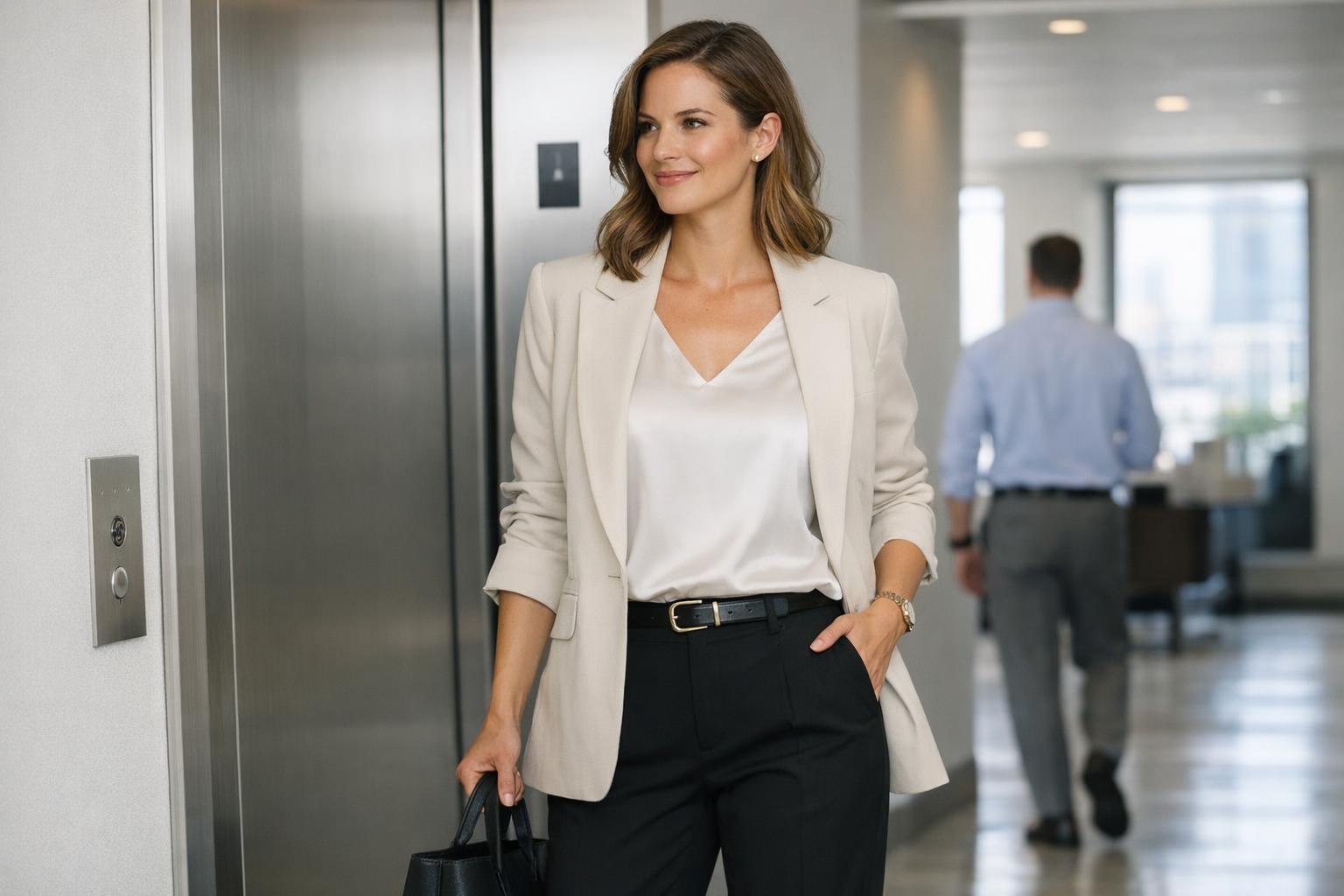
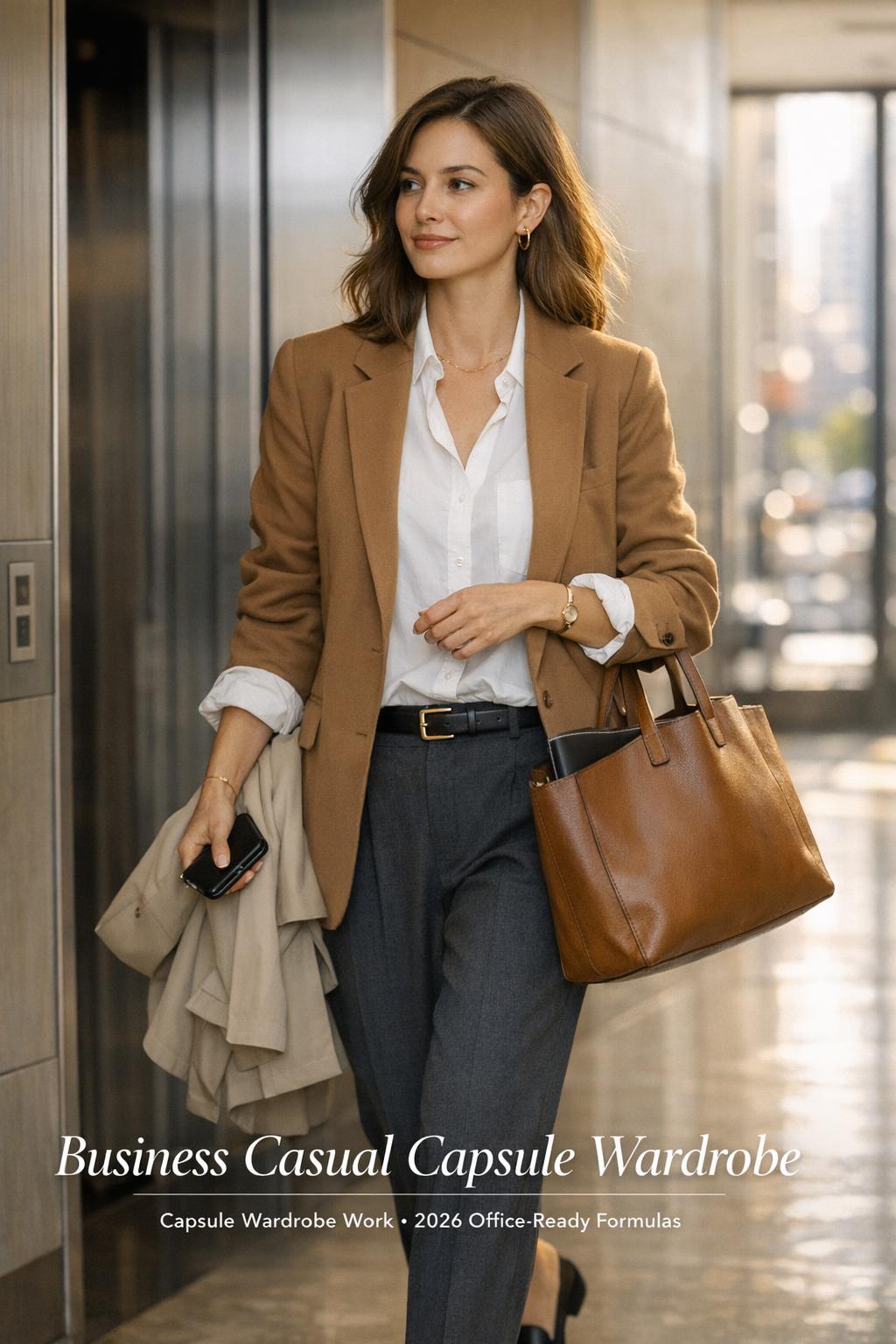
    Professional woman in hallway near elevators wearing a business casual capsule wardrobe with blazer, trousers, tote, and trench coat
    A calm, confident professional models a refined business casual capsule wardrobe in a bright modern office hallway by the elevators.

    What “business casual” means in U.S. offices in 2026 (and why it’s not one look)

    In practice, business casual is a range, not a single uniform. At one end, it’s close to traditional office dressing—structured blazers, tailored trousers, button-downs, sleek footwear like pumps. At the other end, it borrows from relaxed everyday style—quality tees under an oversize blazer, midi skirts with structured flats, or easy dresses paired with a practical tote. The key is that the overall impression remains intentional and work-ready: clean lines, thoughtful proportions, and pieces that hold their shape through a full day.

    A capsule wardrobe is the strategy that makes this range manageable. Instead of building outfits from dozens of disconnected items, you curate a small set that mixes effortlessly. That’s why “business casual” and “capsule wardrobe” show up together so often: the capsule creates consistency, while business casual provides the guardrails for appropriateness.

    One practical way to think about business casual is to ask: “Would this look right in an office hallway at 2 p.m. on a random Tuesday?” If the answer is yes, it’s likely within the business casual threshold. If it’s only comfortable on a casual Friday, it may still belong in your closet—but it shouldn’t be a core capsule item unless your workplace truly runs casual all week.

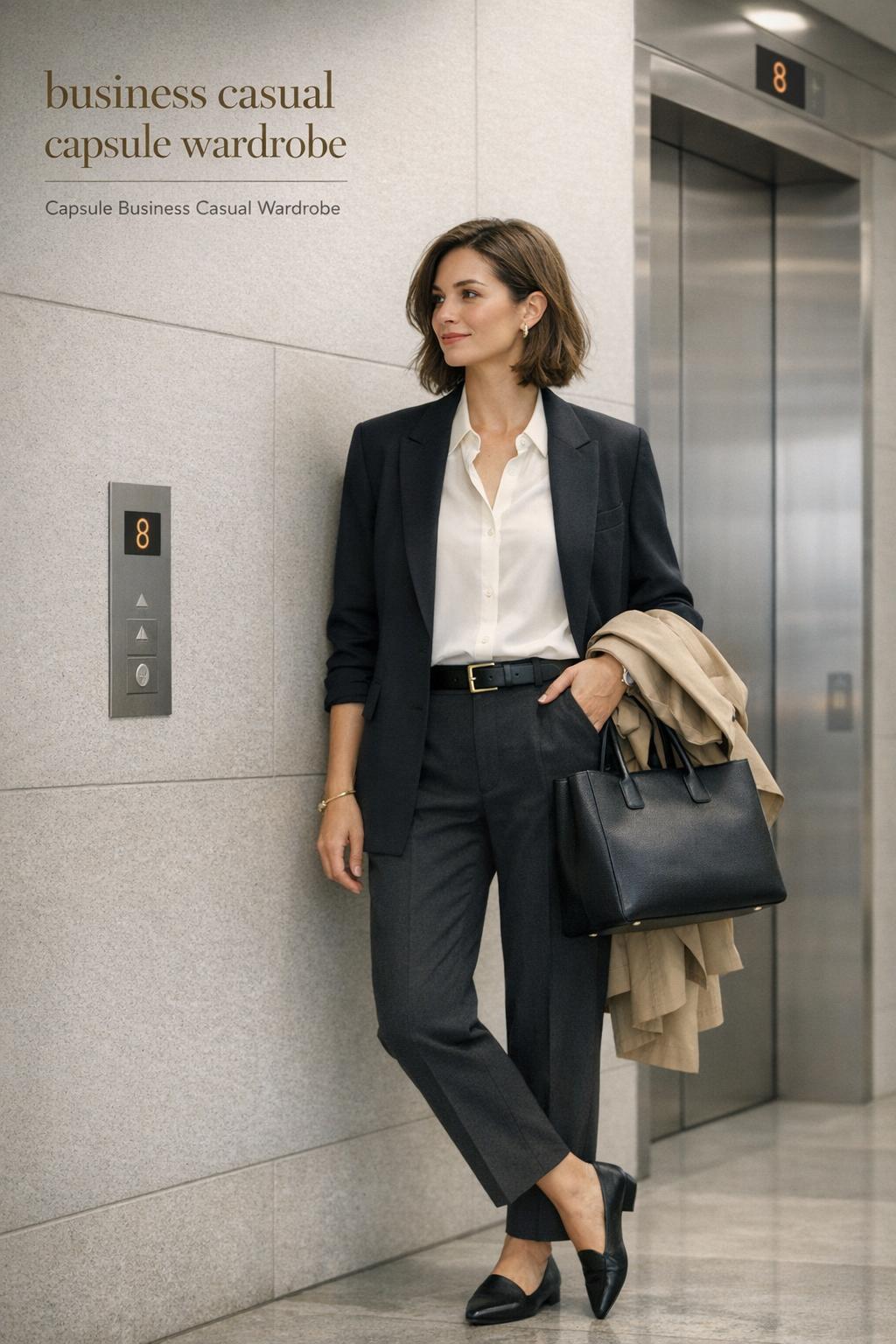
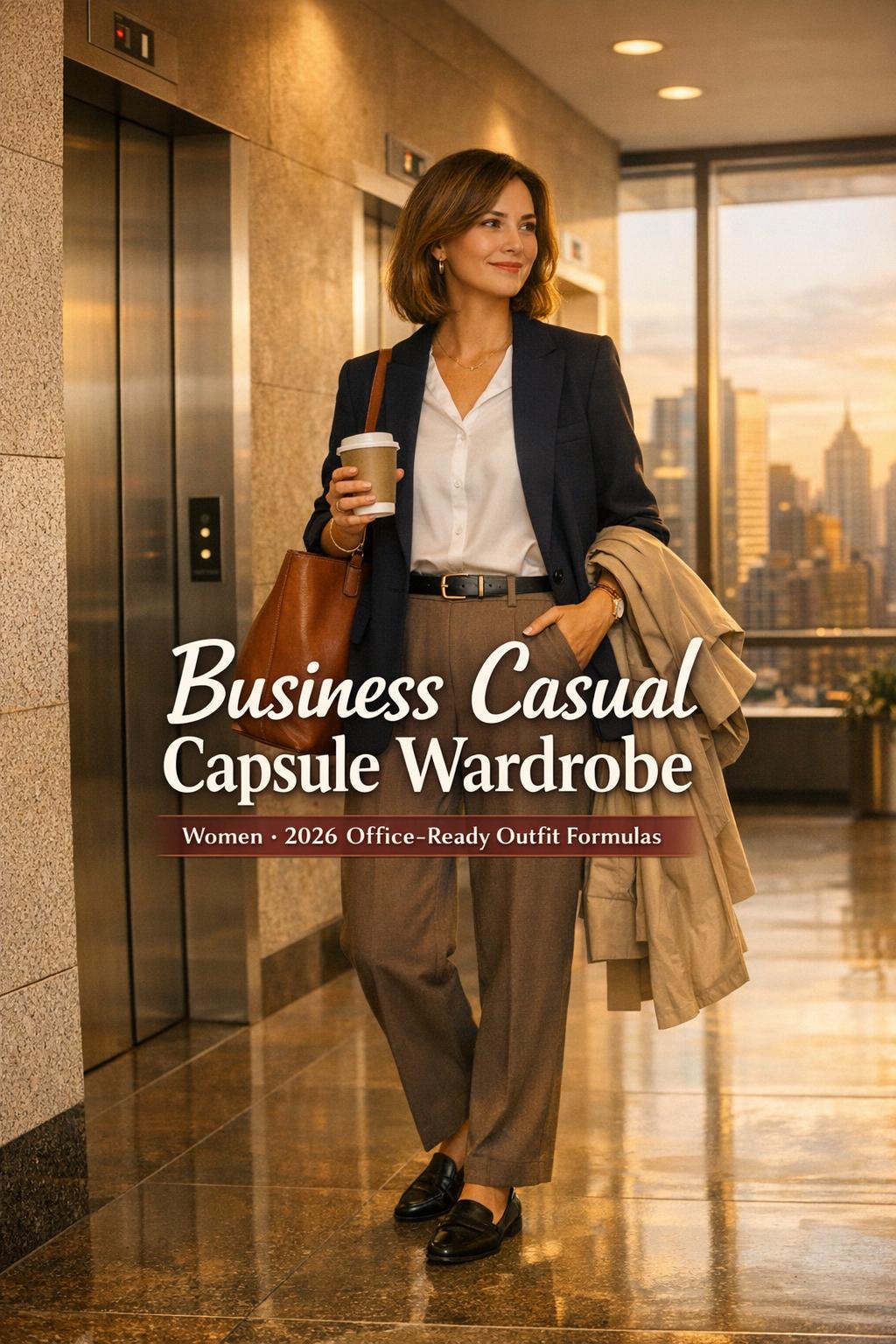
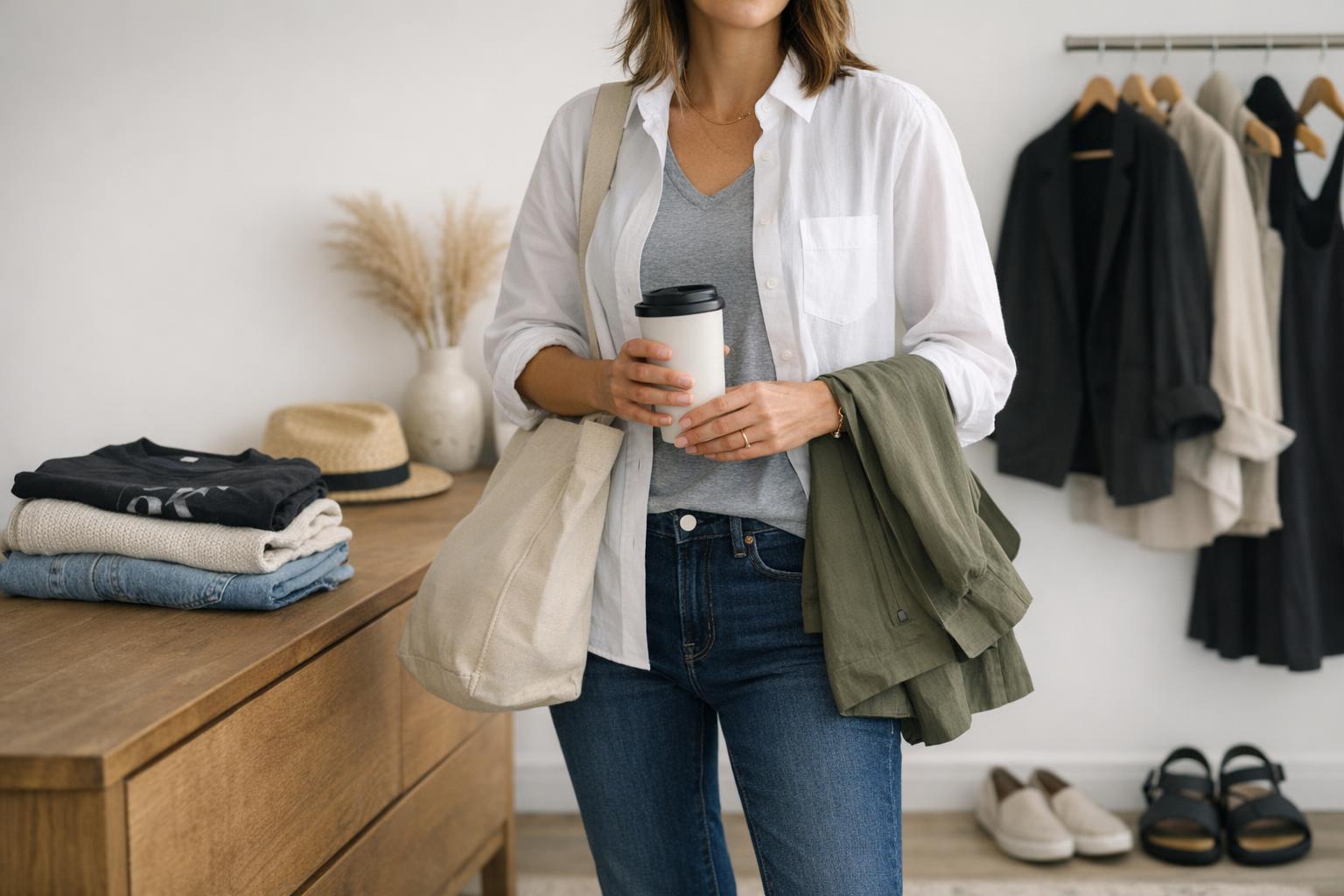
    Woman in blazer by elevators with tote and coffee, business casual capsule wardrobe in warm golden-hour office hallway
    In warm golden-hour light, a polished woman stands by modern elevators, showcasing an office-ready business-casual capsule look.

    The capsule logic: build around outfit archetypes, not one-off purchases

    The strongest capsule wardrobes are built from archetypes—the repeatable building blocks that show up across modern workwear. Across the most useful business casual capsule wardrobes, the same categories keep proving their value: relaxed or tailored trousers, button-downs and polished tops (including silk blouses), structured outerwear like blazers or a trench coat, versatile dresses, and office-friendly shoes (loafers, pumps, structured flats, and even strappy sandals in warm months).

    Thinking in archetypes makes shopping and styling more grounded. Instead of chasing a specific “perfect” item you saw once, you’re filling a functional role in your wardrobe—like “a blazer that elevates tees and dresses” or “trousers that balance a lightweight top.” This is also the difference between a closet full of clothes and a work outfit capsule wardrobe that actually delivers outfits on busy mornings.

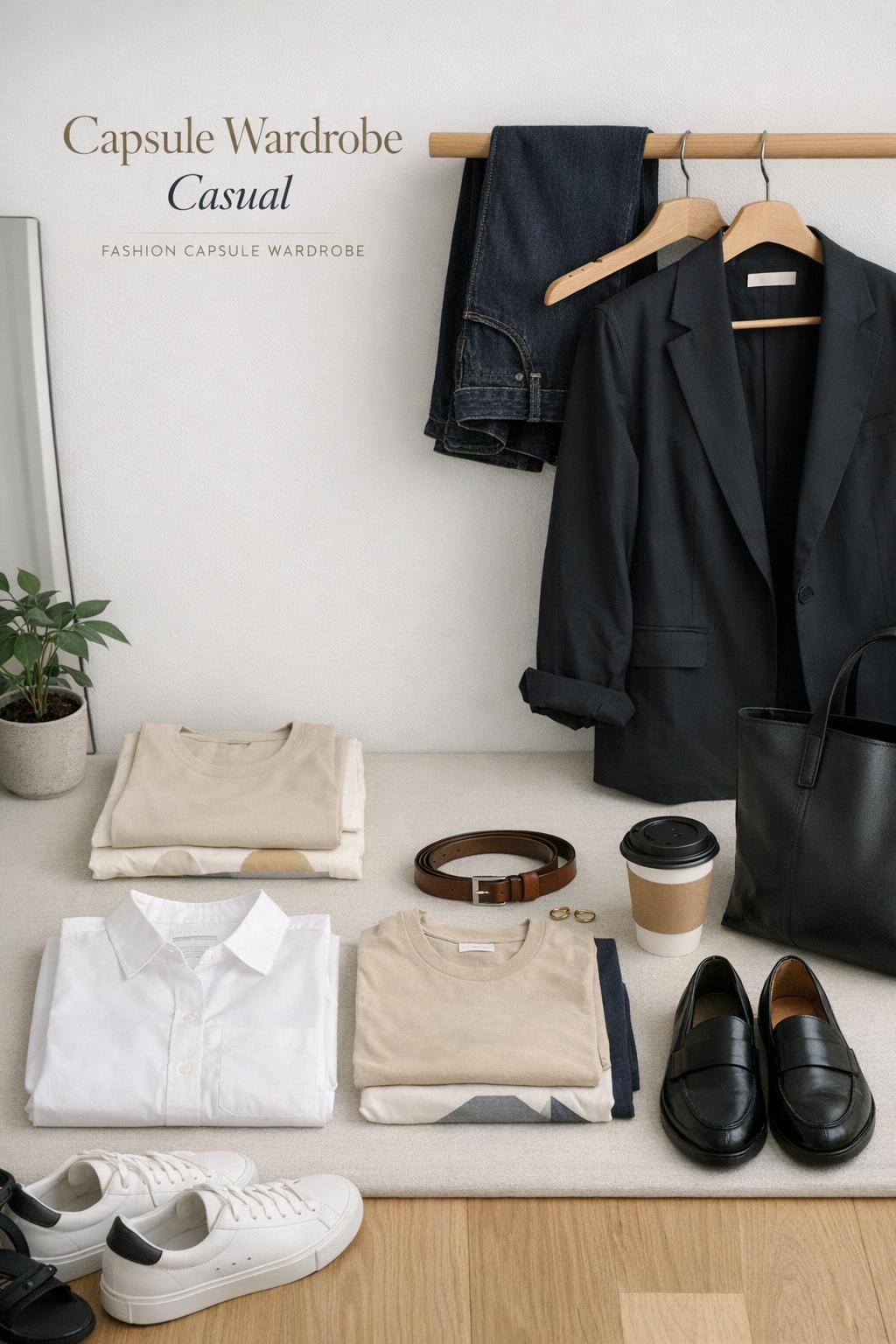
    Business casual capsule wardrobe with neutral blazers, trousers, and shirts neatly arranged on hangers
    A streamlined business casual capsule wardrobe in neutral tones is arranged neatly for effortless weekday styling.

    A 12–14 piece core that still feels like you (business casual capsule wardrobe women included)

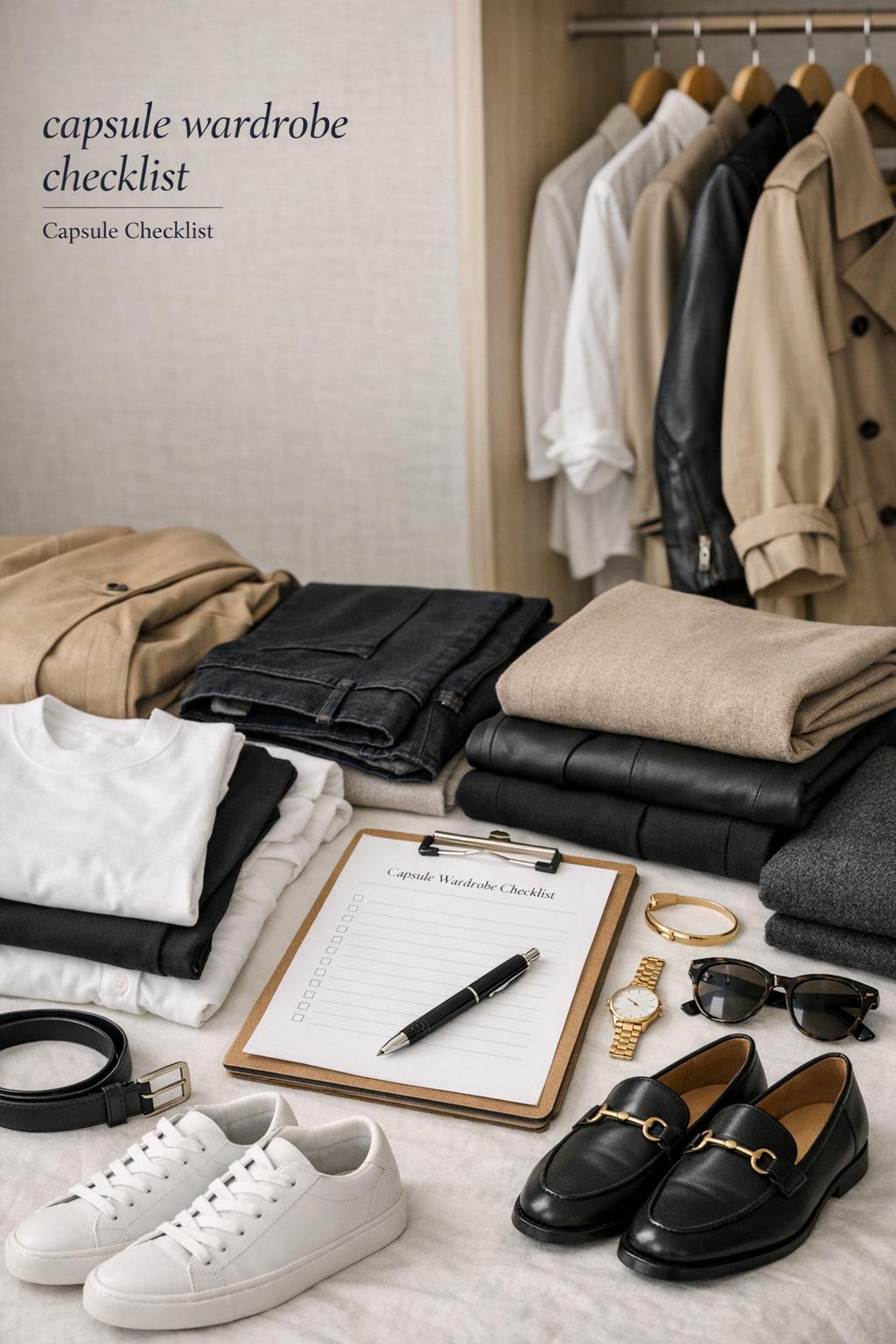
    You’ll see capsules that run 16 pieces with 40+ outfits, and you’ll also see larger guides that list 35 essential pieces. Both approaches can work. If you want the smallest core that still reads polished in most U.S. office settings, aim for 12–14 essentials. It’s enough variety for repetition to feel intentional, not noticeable—especially if you choose pieces that can dress up or down.

    • 2–3 polished tops (a button-down and/or silk blouse, plus a lightweight top)
    • 1–2 quality tees (useful under blazers or with midi skirts)
    • 2 pairs of trousers (one more tailored, one more relaxed)
    • 1 skirt option (often a midi skirt; a pencil skirt also fits many offices)
    • 1 easy dress (office-appropriate and comfortable for long days)
    • 1 oversize or structured blazer (the “instant polish” layer)
    • 1 sleek outerwear option like a trench coat for transition weather
    • 2 shoe types (structured flats and loafers are the most flexible; add pumps if your role is more formal)
    • 1 practical carryall (a tote or work bag that handles daily essentials)
    • 1–2 accessories (a belt or simple jewelry to finish without overcomplicating)

    This core is intentionally neutral about gender presentation, but it maps especially well to business casual capsule wardrobe women searches because it includes the most-requested categories: dresses, midi skirts, polished tops, and versatile flats. It also respects how many people actually dress for work now: not rigidly formal, but still professional and put-together.

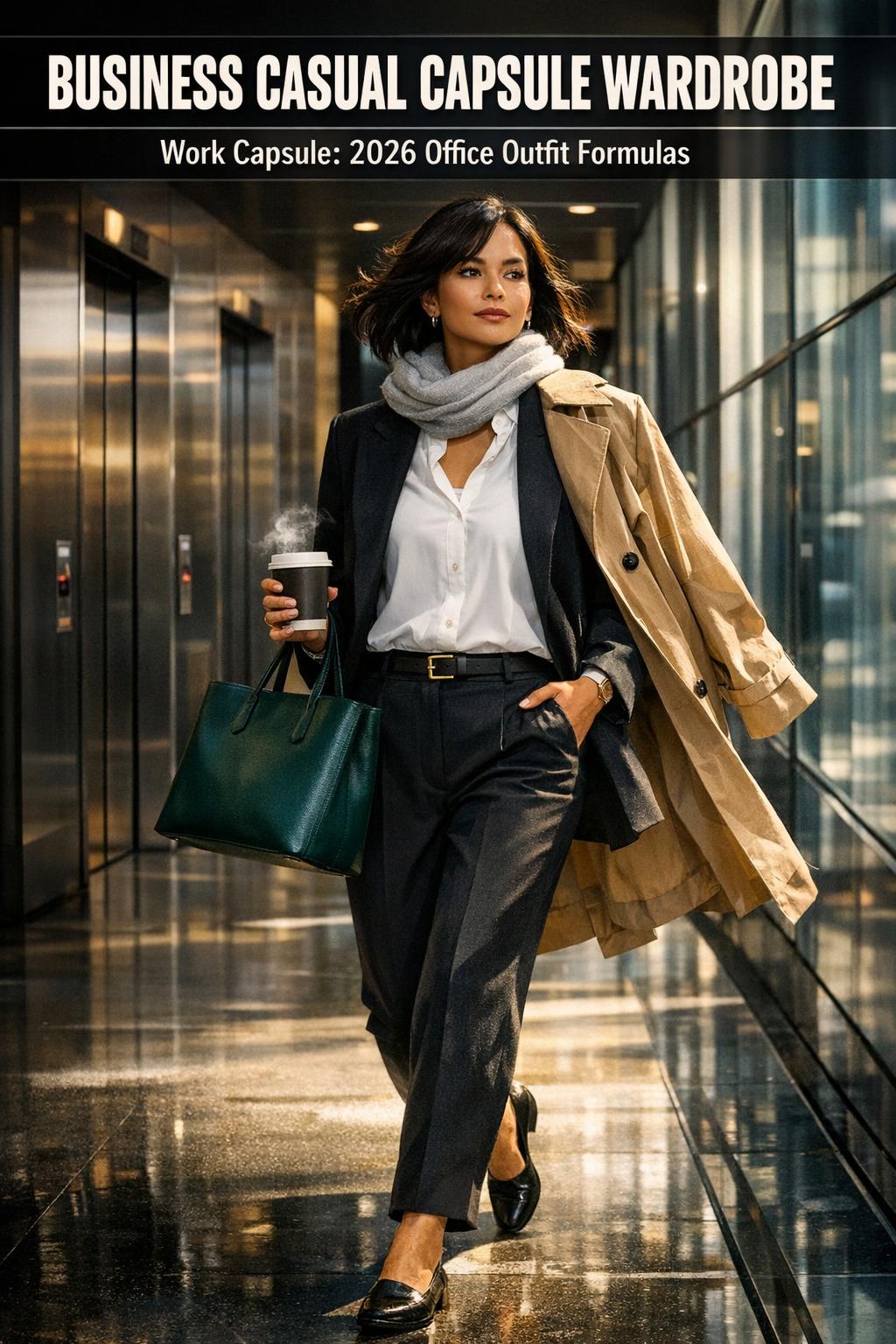
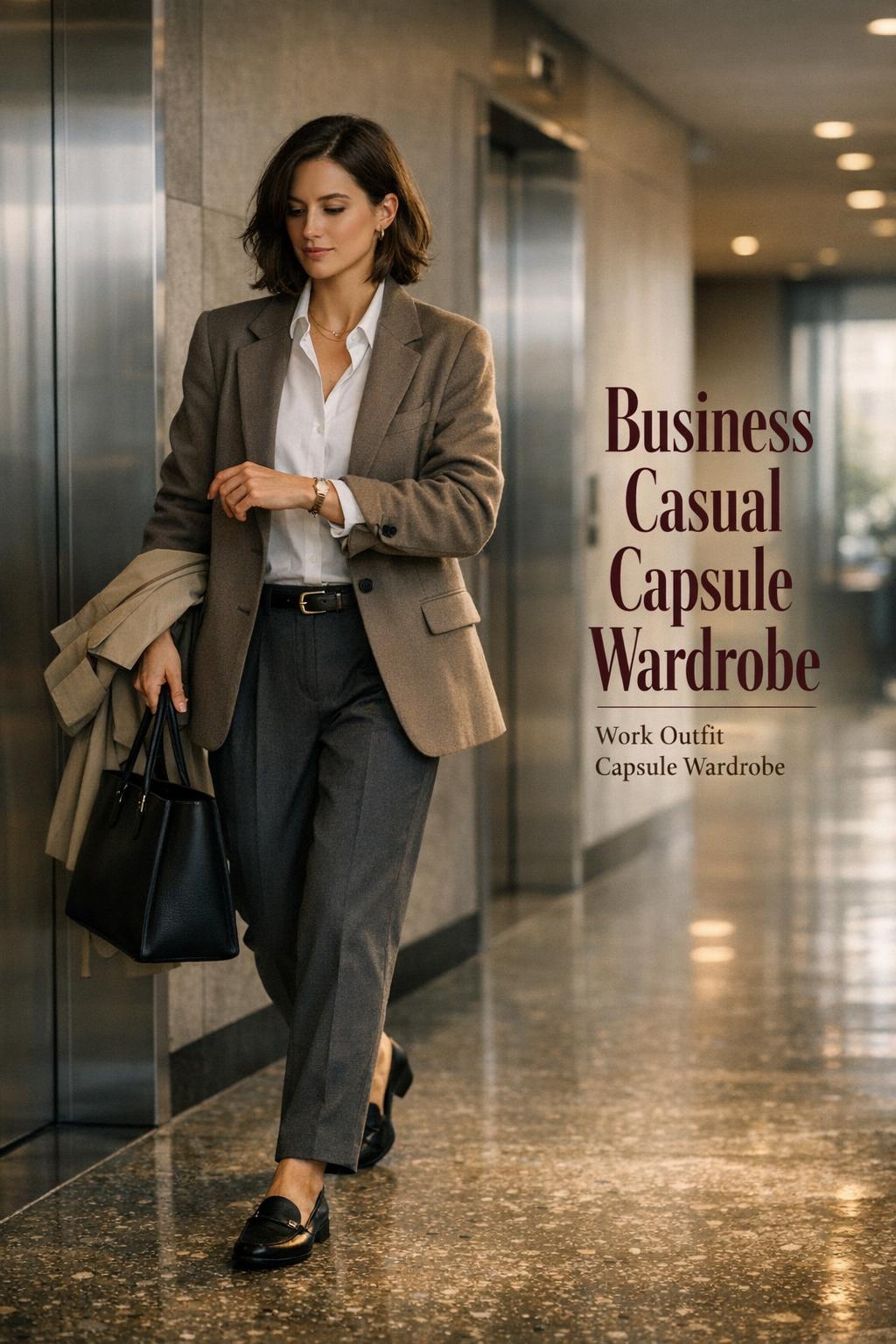
    Business casual capsule wardrobe look: professional woman leaving an office elevator in blazer, trousers, and tote
    A stylish professional strides from the elevator in a business casual capsule wardrobe, ready for a full day in the city.

    The pieces, explained: what to look for and why each one earns its spot

    Relaxed trousers vs. tailored trousers: the balancing act

    Relaxed trousers are a modern anchor because they offer comfort without signaling “weekend.” Tailored trousers remain the sharp option for meeting-heavy days. The best capsule includes both because they solve different problems: relaxed trousers pair naturally with button-downs, quality tees, and oversize blazers; tailored trousers create immediate authority with polished tops and sleek outerwear. If you only pick one, choose based on your office’s baseline—more formal offices reward tailoring, while more flexible workplaces make relaxed trousers the daily hero.

    Button-downs, silk blouses, and “polished tops” that don’t feel fussy

    Polished tops are the quiet workhorses of capsule wardrobe work dressing. A button-down reads crisp and works across roles; a silk blouse (or similar elevated top) adds softness and drape without sacrificing professionalism. Lightweight tops are valuable for layering under blazers or trench coats and for handling office temperature swings. In a capsule, you’re not collecting dozens of tops—you’re choosing a few that coordinate with every bottom you own.

    Tip: When a top feels “hard to wear,” it’s often because it only works with one bottom. Before buying, picture it with your trousers, your midi skirt, and under your blazer. If it doesn’t play well with at least two of those, it’s not a capsule piece—it’s a special-occasion item.

    Quality tees: the business casual upgrade you’ll use weekly

    Business casual now frequently includes a tee—when the tee is high quality and the rest of the outfit is structured. This is where an oversize blazer, tailored trousers, or a midi skirt does the heavy lifting. The tee keeps the outfit comfortable and modern; the structure keeps it office-appropriate. If your workplace is more conservative, reserve tees for days without client meetings and lean on button-downs and polished tops for higher-stakes moments.

    Midi skirts and pencil skirts: movement, polish, and versatility

    Skirts earn their place in a work capsule because they create easy outfit variety with minimal effort. Midi skirts are particularly versatile: they can feel modern with structured flats or loafers, and they’re often comfortable for a full day of sitting, standing, and commuting. Pencil skirts tilt more traditional and can look especially sharp with a button-down or silk blouse. Whichever you choose, the capsule rule is the same: it should work with your blazer and at least two of your tops.

    Easy dresses: the one-piece solution for overloaded days

    Easy dresses are a core entity in business casual capsule wardrobes for a reason: they create a finished look in one step. For real-world wear, prioritize a silhouette that layers well with a blazer or trench coat and pairs with structured flats. Dresses also help when you want to look polished without assembling separates—ideal for presentations, travel days, or any morning when you’d rather keep decisions minimal.

    Oversize blazers, structured blazers, and sleek outerwear

    A blazer is the capsule’s credibility piece. An oversize blazer can modernize trousers, tees, and dresses; a structured blazer can make even simple outfits look intentional. A trench coat adds another layer of polish—especially during seasonal transitions when a heavy coat feels too much but you still need a top layer that looks office-ready.

    Tip: If your blazer feels “wrong,” check proportion before you blame the item. Oversize blazers typically need a cleaner line underneath (a tucked top, a sleeker trouser, or a fitted dress). Structured blazers can handle more volume underneath, but they still look best when the outfit has one clear focal point, not competing shapes everywhere.

    Footwear that respects the office: loafers, pumps, structured flats, and strappy sandals

    Shoes decide whether an outfit reads “work” or “weekend.” Loafers are a backbone choice because they balance comfort and polish, and they work with trousers, midi skirts, and dresses. Pumps are useful when you need a sleeker finish. Structured flats hit the sweet spot for daily wear and look particularly sharp with tailored pieces. Strappy sandals can fit warm-weather business casual, especially when the rest of the outfit is grounded in office staples like relaxed trousers, button-downs, and a practical carryall.
    Practical carryalls and the accessories that do the most with the least

    A practical carryall—often a tote—matters because it’s part of the silhouette. In business casual, your bag is visible in elevators, meetings, and hallways, and it contributes to the overall impression of being pulled together. Accessories should be few but intentional: a belt can sharpen trousers and define shape over dresses; simple jewelry can elevate a tee-and-blazer day without turning your capsule into a styling project.

    Color, fabric, and fit: the behind-the-scenes rules that make a capsule feel cohesive

    Most capsule frustrations aren’t about not owning enough clothes—they’re about pieces that don’t “talk” to each other. Cohesion comes from three quiet decisions: a consistent color palette, reliable fabrics, and fit that supports your day.

    Color doesn’t need to be complicated. Many work capsules rely on a neutral base with one or two accent tones. The benefit is practical: when your trousers, blazer, and shoes live in a compatible range, your tops can rotate without requiring new purchases. This is also why so many editorial capsules can generate 40+ outfits from 16 pieces or expand 28 pieces into 60 outfits—compatibility does the math.

    Fabric choice is where business casual succeeds or fails in real life. The office is a long-wear environment: you’re sitting, walking, commuting, and moving between temperatures. Prioritize fabrics that hold shape and feel comfortable for hours. A silk blouse can look polished but may require more care; cotton shirts and quality tees are easier day-to-day. Outerwear like blazers and trench coats is where structure matters—these pieces often define whether your outfit reads professional.

    Fit is the final layer. A capsule works best when each piece has a clear role and sits well on the body. If something is constantly being tugged, slouched, or adjusted, you’ll avoid it—no matter how “essential” it’s supposed to be.

    Tip: Before adding new items, do a quick fit audit on your current favorites. Identify what you love about them (waist placement, sleeve length, drape). Use that as your standard for future purchases so your capsule becomes more consistent over time.

    Seasonal edits that feel realistic: from spring/summer to fall/winter (U.S. climate aware)

    Seasonal dressing is where many people abandon their capsule—only because they try to rebuild from scratch. A more sustainable approach is to keep the same core and make targeted edits: swap fabrics, add one or two layers, and rotate footwear. This keeps your capsule wardrobe work system intact while still respecting weather.

    Spring and summer: keep structure, lighten the feel

    Warm-weather business casual is easiest when you maintain structure somewhere in the outfit. If you’re wearing strappy sandals, keep the rest polished: relaxed trousers with a button-down, or an easy dress with a blazer for chilly office air. Lightweight tops become more important here, especially for layering under outerwear when mornings are cool and afternoons are hot.

    Fall and winter: layering without bulk (and why fall capsules are so popular)

    Fall business casual capsules show up again and again because the season naturally supports layering: blazers look right, trench coats shine, and trousers become daily uniform pieces. If you’ve ever followed the “turn a set of pieces into 60 outfits” approach, fall is where it feels most believable—because you can repeat the same base outfit and change the top layer, shoe, or accessory and still look intentional.

    In colder months, the trick is avoiding bulky layers that distort your silhouette. Keep your base streamlined—tailored trousers or a midi skirt with a polished top—and use your blazer or trench coat as the main warmth-and-polish layer when appropriate. The goal is to stay comfortable without losing the clean lines that define business casual.

    Location and office culture: how the same capsule reads in NYC, SF, Chicago, and Dallas

    A business casual capsule wardrobe doesn’t exist in a vacuum; it lives inside local expectations. Even within the U.S., office norms can vary widely. A helpful way to plan is to identify your workplace’s “polish baseline,” then build a capsule that can flex one step more formal or one step more relaxed.

    Consider four familiar context anchors that show up in modern workwear conversations: New York (NYC), San Francisco (SF), Chicago, and Dallas. These aren’t rigid style rules, but they help illustrate how to calibrate a capsule without changing the entire formula.

    • NYC-style baseline: You may lean into structured pieces—tailored trousers, a sharp blazer, polished tops like silk blouses, and sleek footwear such as pumps or structured flats.
    • SF-style baseline: The capsule might emphasize comfort-forward polish—quality tees under an oversize blazer, relaxed trousers, loafers, and a practical carryall.
    • Chicago-style baseline: A trench coat and versatile outerwear become especially useful for transitions; trousers and layered tops help you stay office-ready through changing conditions.
    • Dallas-style baseline: Warm-weather flexibility matters—lightweight tops, easy dresses, and office-appropriate sandals can play a bigger role, anchored by structured elements so the look stays professional.

    The takeaway: don’t copy someone else’s capsule item-for-item. Copy the structure—tops, bottoms, blazer, outerwear, shoes, carryall—then calibrate the “formality dial” to your office and region.

    Mix-and-match in the real world: outfit formulas that survive a full workday

    Outfit formulas are where a capsule becomes practical. They’re not rigid rules; they’re templates you can repeat with small changes. Many guides show how a capsule generates dozens of outfits (including 16 example business casual outfits from one capsule). The reason it works is simple: when your pieces are compatible, swapping one top or one shoe changes the mood without changing the level of professionalism.

    Below are formula-style ideas you can adapt to your own closet. Instead of listing “Outfit 1–16,” use these like a menu—choose what matches your day’s demands.

    • Meeting-ready structure: tailored trousers + silk blouse + structured blazer + pumps or structured flats.
    • Everyday polished: relaxed trousers + button-down (tucked or half-tucked) + loafers + practical carryall.
    • Modern business casual: quality tee + oversize blazer + midi skirt + structured flats.
    • One-and-done: easy dress + blazer (optional) + loafers or flats.
    • Warm-weather office day: relaxed trousers + lightweight top + strappy sandals + carryall (add a blazer for cold A/C).
    • Transition-weather commute: tailored trousers + button-down + trench coat + loafers.

    Tip: If you’re aiming for a true work capsule, build your formulas around the items you’ll wear on your most demanding days. Then create one “relaxed” formula for lighter days. This prevents the classic capsule problem: owning pieces you love, but not the pieces you actually need for the office.

    Common mistakes that quietly break a work capsule (and how to fix them fast)

    Most capsule wardrobe issues don’t look like “bad style.” They look like wasted potential: pieces that should work but don’t. The fixes are often small—one swap, one layer, one better pairing.

    Mistake: buying items that only work with one outfit

    This is the fastest way to end up with a closet full of clothes and nothing to wear. The fix is a compatibility test: each new item should pair with at least two tops and two bottoms (or, for a dress, it should work with both your blazer and your trench coat). That’s how a capsule stays efficient.

    Mistake: skipping outerwear and expecting outfits to feel finished

    In business casual, outerwear isn’t just for warmth—it’s a polish layer. If outfits feel “unfinished,” it’s often because you don’t have a reliable blazer or trench coat. The fix is to invest attention here: a blazer that fits your shoulders and a trench coat that works with your work shoes can elevate nearly everything else.

    Mistake: building a capsule around “ideal life” instead of actual office days

    If your calendar includes presentations, client calls, or leadership meetings, your capsule needs at least one meeting-ready formula you can reach for without thinking. If your office is more relaxed day-to-day, you still need pieces that hold you up when you want to look sharper. The fix is to map your week: pick the most common day type and the most demanding day type, then ensure both are supported.

    Mistake: not addressing the jeans question honestly

    Many people ask, “Can I include jeans in my business casual capsule wardrobe?” The practical answer depends on your workplace norms. If jeans are part of your office’s standard business casual (not just casual Friday), they can be included. If jeans are an occasional exception, treat them as optional—not a core capsule anchor—so your capsule still performs on any given Tuesday.

    Shopping with intention: brands, price tiers, and how to keep the capsule coherent

    A business casual capsule wardrobe often becomes shopping-forward because people want examples. Brands can also be helpful shorthand for style direction: J.Crew and Theory are often associated with polished work staples; Mango and Zara can provide trend-aware silhouettes like oversize blazers; Madewell is frequently linked to modern essentials; H&M and Gap show up in accessible wardrobe building; Vince can signal understated polish; Reformation and Staud appear in outfit-driven edits; Quince and Open Edit appear in capsule-friendly recommendations; Nanushka is referenced in the context of elevated, fashion-forward pieces. Treat brand examples as starting points, not rules.

    To keep your work outfit capsule wardrobe coherent across price points, decide what you’re willing to repeat most often. Many people choose to prioritize the pieces that anchor the outfit’s structure—blazers, trousers, and shoes—then save on tops and accessories. Others reverse it because they want variety near the face (tops) while keeping bottoms consistent. Either can work if the overall capsule stays compatible.

    Budget, mid-range, and investment: a practical way to split the list

    A balanced capsule usually mixes tiers. Accessible retailers like H&M and Gap can help you test silhouettes—like whether you prefer relaxed trousers or a midi skirt in daily rotation—before you commit. Mid-range brands like J.Crew, Madewell, Mango, Zara, and Quince often appear in capsule wardrobes because they offer a wide spread of work-friendly pieces. For investment-leaning staples, names like Theory and Vince tend to be associated with refined workwear polish. The right mix is the one that you’ll wear consistently; a capsule only “works” when it gets used.
    Tip: When you’re tempted by a single standout item, pause and ask what role it would play in your capsule wardrobe work system: is it a top that will rotate weekly, or is it a special piece that needs a very specific day? Both can be worthwhile, but only the first belongs in the core capsule count.

    Fit, alterations, and tailoring: the professional polish multiplier most people skip

    If there’s one factor that consistently separates “fine” from “exceptionally put-together” in business casual, it’s fit. Tailoring and alterations can make even simple pieces—trousers, midi skirts, blazers—look intentional. This is especially important in capsule dressing because you repeat items more often; the better they fit, the more expensive and professional the entire capsule appears.

    Think of tailoring as a way to protect your capsule from small annoyances that reduce wear: trousers that puddle at the hem, sleeves that swallow your hands, a blazer that pulls at the shoulders. You don’t need to tailor everything. Prioritize the pieces that define structure: blazers, trousers, and the dress you rely on when you need a one-step polished look.

    Tip: If you’re unsure what to alter first, start with trouser length and blazer sleeves. These are the details people notice subconsciously, and they have an outsized effect on whether an outfit reads clean and professional.

    Sustainability in a capsule wardrobe: buy fewer pieces, wear them harder, replace them smarter

    A capsule wardrobe naturally leans toward a more sustainable mindset because it rewards longevity. The goal isn’t perfection; it’s fewer, better decisions over time. When you build a capsule business casual wardrobe around timeless silhouettes—trousers that don’t feel dated quickly, blazers that work with tees and button-downs, dresses that layer across seasons—you reduce the urge for constant replacement.

    Durable fabrics and consistent care habits matter here, even if you’re mixing price tiers. A silk blouse can be a beautiful capsule piece if you’ll actually wear it and care for it; cotton shirts and quality tees can carry a lot of days with less fuss. The practical carryall and shoes also benefit from durability because they see heavy rotation. Sustainability in a work capsule is ultimately about realism: choose what you’ll repeat, choose what holds up, and build slowly so each new item has a clear purpose.

    A two-week “fast-fail” build: how to start a capsule wardrobe work system without overcommitting

    Many people delay building a capsule because it feels like a big project. A more effective method is a short trial that reveals what’s missing quickly. Over two weeks, aim to wear only your most office-reliable items and track friction points: what you keep wishing you had, what doesn’t mix, what feels off for meetings. This is how you build a work capsule based on evidence from your own days, not an idealized list.

    • Days 1–3: repeat two bottoms (trousers or skirt) with your best tops; note what combinations feel the most “you.”
    • Days 4–7: add your blazer or trench coat daily; observe which outfits instantly look more professional.
    • Week 2: stress-test with one meeting-ready formula and one more relaxed formula; notice where shoes or accessories change the feel the most.
    • End of week 2: choose just one gap to fill first (often shoes, a blazer, or a polished top).

    This approach protects your budget and your closet space. If the capsule idea doesn’t match your workplace reality, you’ll learn that quickly—and adjust the plan without ending up with a pile of “should” pieces you never reach for.

    Practical checklist: keep your business casual capsule wardrobe running smoothly

    Once you have a core set, the maintenance becomes simple: rotate, refresh, and refine. Use this checklist to keep the system functional across seasons and schedule changes.

    • Confirm you have at least one meeting-ready outfit formula you can assemble in under five minutes.
    • Ensure every top works with at least two bottoms, and every bottom works with at least three tops.
    • Keep one “temperature swing” layer ready (blazer or trench coat) for unpredictable office climates.
    • Check shoe rotation: if one pair is doing all the work, add a second option (loafers, pumps, or structured flats).
    • Reassess once per season: swap in lightweight tops or add outerwear as needed rather than rebuilding the capsule.

    A capsule is not a static wardrobe. It’s a living system that gets better as you learn what your office actually rewards: structure, consistency, and a sense of ease.

    Business casual capsule wardrobe look in a modern office hallway, stylish woman adjusting blazer by elevator in soft window light.
    A polished professional strides through a modern office hallway, showcasing a refined business-casual capsule wardrobe in neutral tones.

    FAQ

    What is a business casual capsule wardrobe, and how is it different from a regular capsule wardrobe?

    A business casual capsule wardrobe is a small, curated set of mix-and-match pieces chosen specifically to meet office-appropriate expectations, using staples like trousers, blazers, button-downs, polished tops, versatile dresses, and work-ready shoes; a general capsule wardrobe can be more casual or lifestyle-focused and may not reliably cover professional settings.

    How many pieces should a work capsule include?

    Many people succeed with a tight 12–14 piece core for daily business casual, while others prefer structured plans like 16 pieces that can create 40+ outfits or broader guides that include up to 35 essentials; the best number is the smallest set that consistently covers your real office week without leaving you short on meeting-ready options.

    Can I include jeans in my business casual capsule wardrobe?

    You can include jeans if your workplace norms treat jeans as standard business casual (not just casual Friday), but if denim is only occasionally acceptable, it’s better kept as an optional item so your capsule still performs for typical midweek expectations.

    What shoes work best for business casual without feeling too formal?

    Loafers and structured flats are the most flexible choices because they pair well with trousers, midi skirts, and easy dresses while staying polished; pumps are useful for more formal moments, and strappy sandals can work in warm weather when the rest of the outfit is anchored by structured, office-appropriate pieces.

    How do I make a capsule wardrobe look professional if I prefer comfortable outfits?

    Use comfort-forward basics like relaxed trousers and quality tees, then add structure through an oversize or structured blazer, office-friendly shoes like loafers, and a practical carryall; the comfort comes from the base layer, and the professional signal comes from the structured pieces.

    What are the most common mistakes when creating a capsule wardrobe for work?

    The biggest mistakes are buying items that only work with one outfit, skipping key outerwear like blazers or trench coats that make outfits look finished, and building around an “ideal life” instead of your actual office schedule, which can leave you without reliable formulas for meeting-heavy days.

    How do I adapt my capsule wardrobe work pieces for fall and winter?

    Keep the same core items and make seasonal edits by leaning more on blazers, trench coats, and trousers, rotating footwear toward loafers and closed-toe options, and using layering to stay comfortable while maintaining clean lines so outfits don’t feel bulky.

    Which brands are commonly used as examples for building a business casual capsule wardrobe?

    Common examples span accessible to investment-leaning options, including J.Crew, Gap, H&M, Mango, Zara, Madewell, Quince, Open Edit, Theory, Vince, Reformation, Staud, and Nanushka, which are often referenced to illustrate different capsule categories like blazers, trousers, polished tops, and dresses.

  • Rushed Mornings, Solved: Capsule Wardrobe Casual Staples

    Rushed Mornings, Solved: Capsule Wardrobe Casual Staples

    Capsule wardrobe casual: the everyday style problem it actually solves

    There’s a specific moment most closets fail: a regular morning when you need something comfortable, presentable, and weather-appropriate—and you’re not dressing for a runway, a gala, or a niche aesthetic. You’re dressing for errands, a coffee meeting, a last-minute video call, a walk that turns into lunch, and maybe dinner later. A capsule wardrobe casual approach is built for exactly that kind of day: a small, intentional set of clothes that mix easily, repeat without feeling repetitive, and cover real-life needs without constant shopping.

    In U.S. wardrobes, this usually means leaning on casualwear: jeans, tees, easy dresses, light layers, and shoes you can actually walk in. But the best casual capsule isn’t just “basics.” It’s a system—one that uses a neutral palette, versatile pieces, and thoughtful repetition so you can get dressed fast while still feeling like yourself. If you’ve ever admired the polish of a stylist’s off-duty uniform, that’s the logic at work.

    Capsule wardrobe casual flat lay with white shirt, dark jeans, blazer, sneakers, loafers, and minimal accessories in bright entryway
    A calm, bright morning vignette showcases a capsule wardrobe casual lineup of timeless essentials and refined accessories.

    That’s why capsule wardrobe content from fashion magazines and brand guides tends to converge on the same ideas: timeless staples (like a white shirt and tailored trousers), a short list of essential pieces (sometimes framed as “easy pieces”), and seasonal rotation based on climate and lifestyle. And it’s also why personal frameworks—like a former Nordstrom stylist mapping out seven key casual items—resonate: they connect the concept to specific clothing categories you can picture, wear, and re-wear.

    What a fashion capsule wardrobe is (and what it isn’t)

    A fashion capsule wardrobe is a curated collection of clothing—often built around wardrobe basics—that’s intentionally limited in size and designed for mix-and-match outfits. The aim isn’t to own “as little as possible.” It’s to own fewer pieces that work harder: a consistent color story, silhouettes you trust, and layers that adapt as your day changes.

    It’s also helpful to separate the concept from a few common misconceptions. A capsule is not automatically a strict minimalist wardrobe capsule, and it doesn’t require identical outfits or a single uniform. In practice, most casual capsules balance repeatable foundations (like jeans and tees) with a few items that keep things interesting (a graphic tee, a dress that can go day-to-night, or sporty sandals that change the feel of denim).

    • A capsule wardrobe is: a strategy for versatility, outfit cohesion, and easier decision-making.
    • A capsule wardrobe is not: a rule that bans trends, color, or personality.
    • A casual capsule is: built around comfortable, everyday pieces (jeans, tees, easy dresses, practical shoes).
    • A casual capsule is not: limited to loungewear or “only basics.”

    For capsule wardrobe women building around casualwear, the biggest unlock is noticing how a few staple categories create dozens of realistic combinations: a white shirt changes denim; a lightweight jacket refines a tee; a versatile dress removes the need to coordinate separates. The capsule becomes less about the number and more about the relationships between pieces.

    capsule wardrobe casual morning outfit with woman getting ready in a modern bedroom beside a neutral capsule wardrobe rack
    A calm golden-hour morning scene captures a woman styling a capsule wardrobe casual look beside a curated neutral wardrobe rack.

    A quick origin story: why “easy pieces” still matters

    The capsule wardrobe has a well-known fashion lineage, including Donna Karan’s “7 Easy Pieces.” That idea—getting dressed through a set of modular essentials—still maps cleanly onto today’s casual capsule wardrobe, even when the pieces are more relaxed. The lasting lesson is that outfits become easier when clothing is designed to layer and combine: tops that sit well under jackets, bottoms that work with multiple shoes, and a palette that doesn’t fight itself.

    Modern capsule thinking takes that “easy pieces” logic and applies it to everyday life: lighter denim for warm months, sport sandals that keep you moving, or a tank dress that can read casual with sneakers and feel more intentional with a jacket. The concept hasn’t changed; the styling context has.

    Core principles that make a casual capsule actually wearable

    Capsule wardrobes fail when they’re built as an abstract checklist instead of a realistic routine. The most reliable principles are simple, but they require honest decision-making: what you wear most, how your climate behaves, and what your week looks like.

    Versatility beats volume (especially in casualwear)

    Casual style has a deceptively high “wear frequency.” If you’re reaching for jeans and tees several days a week, you’ll notice quickly whether your capsule is functional. A versatile piece earns its spot when it works across multiple settings: errands, travel, a relaxed office, or a weekend dinner. That’s why capsule checklists keep returning to staples like jeans, a white shirt, and a lightweight jacket or blazer—because these items move easily between contexts.

    A neutral palette makes mixing effortless (and still leaves room for personality)

    Many capsule wardrobe guides emphasize a neutral palette because it reduces friction: fewer clashes, more combinations, and less “nothing goes together” frustration. Neutrals also make repeating outfits feel intentional. Personality doesn’t disappear; it shifts to details—like a graphic tee, the shape of your denim, or your choice of shoes (sneakers vs. loafers vs. sporty sandals).

    Seasonal rotation is part of the system, not an extra project

    Brand guides that focus on how to build a capsule wardrobe frequently highlight seasonal rotation and climate. That’s practical: a U.S. wardrobe might need lightweight layers and breathable pieces for warm seasons, then heavier layers for cooler months. Thinking in seasonal capsules removes pressure to make one small set of clothes cover every temperature.

    Tips: If you’re new to the idea, don’t aim for perfection. Start by identifying the pieces you wear repeatedly and build outward. Your first capsule is more like a draft than a final answer.

    Capsule wardrobe casual outfits neatly arranged on a clothing rack in a bright, minimalist room
    A curated capsule wardrobe of casual essentials brings effortless style to everyday dressing.

    The essential casual capsule pieces (a wearable core you can build around)

    Different articles frame the core list differently—some highlight universal staples like a white shirt, tailored trousers, and a leather jacket; others focus on a stylist’s personal “musts” like a tank dress, lightweight jeans, sporty sandals, and a graphic tee. You can reconcile both by focusing on categories that do the heavy lifting in a casual capsule: tops that layer, bottoms that anchor outfits, one-piece outfits (dresses), and shoes that match your pace.

    1) The white shirt (button-down or cotton shirt)

    A white shirt is one of the most repeated capsule wardrobe staples because it’s a style translator: it makes denim look cleaner, softens tailored trousers, and layers easily under a lightweight jacket or blazer. In casualwear, it’s also a practical “reset” piece—useful when your other items lean sporty, relaxed, or graphic.

    How it works in real life: If your week includes at least one moment where you need to look slightly more polished without dressing up, the white shirt does that with minimal effort.

    2) Jeans you can live in (dark wash or lightweight)

    Jeans are the backbone of a casual capsule wardrobe, and the key is choosing a pair that supports your climate and lifestyle. Dark wash jeans read more refined and pair cleanly with a white shirt or a blazer. Lightweight jeans can be more comfortable when temperatures rise, while still giving the structure that makes casual outfits feel “finished.”

    In shopping-focused capsule content, denim brands often appear alongside the concept—names like Good American, FRAME, Rag & Bone, and AG show up as examples of the category. You don’t need a specific label for the strategy to work, but it’s useful to note the pattern: the denim slot matters enough that many stylists and editors treat it as an anchor investment piece.

    3) The everyday tee (neutral) and a graphic tee for variety

    A neutral T-shirt is classic wardrobe basics territory: it layers under jackets, pairs with jeans, and works with skirts or tailored trousers. Adding one graphic tee can keep the capsule from feeling too uniform and adds personality without breaking the neutral palette strategy (because the base of the outfit can remain simple).

    Tips: If you find yourself bored by “basics,” use the tee category to solve it. Keep one tee neutral for maximum versatility and let one graphic tee carry the mood when the rest of your outfit is straightforward.

    4) A lightweight jacket or an unstructured blazer

    This is the piece that turns casual into intentional. A lightweight jacket is practical for temperature swings, while an unstructured blazer gives a bit of shape without feeling formal. This category is also the bridge between high-level capsule staples (the “tailored” idea) and modern casualwear (the “throw it on and go” reality).

    When you’re building a minimalist wardrobe capsule, this layer is also where cost-per-wear can make sense: you’ll reach for it on repeat, and it affects the overall impression of your outfit more than a trend piece would.

    5) A versatile dress (tank dress, T-shirt dress, white dress)

    Dresses appear frequently in casual capsule discussions because they eliminate outfit math. A tank dress is a warm-weather workhorse; a T-shirt style is easy and casual; a white dress can feel crisp and elevated without requiring complicated styling. The key is versatility: you want a dress that works with sneakers, sporty sandals, or a light layer when temperatures drop.

    In stylist-led casual capsule examples, dresses often get their own callouts (tank dress, white dress) because they create multiple outfits with minimal additional pieces—especially when paired with the same jacket and shoes you already rely on.

    6) Shoes that match your real schedule (sneakers, loafers, sporty sandals)

    Shoes can make or break a capsule wardrobe casual plan because they control comfort and determine where an outfit can realistically go. Sneakers keep things grounded and practical. Loafers can tilt the same jeans-and-tee outfit more polished. Sporty sandals are a key warm-weather staple in many casual capsule lists, often shown alongside brands like Nike or Birkenstock as recognizable examples of the category.

    Real-world check: If your capsule includes shoes you avoid wearing for long walks or busy days, the capsule will fail in practice. The “right” shoe is the one you’ll actually put on without hesitation.

    7) A lightweight sweater or cardigan for layering

    Even in warm seasons, indoor air conditioning, evenings, and travel days make a light knit valuable. A sweater or cardigan also helps stretch the wear of sleeveless dresses and tanks, turning them into multi-season pieces without requiring a complete wardrobe overhaul.

    8) A few accessories that quietly do the work

    Accessories in a casual capsule shouldn’t be a distraction; they should be finishers. A belt can give denim a cleaner line. Minimal jewelry adds intention without turning casualwear into “overstyled.” A scarf can add interest while staying within a neutral palette. The point is restraint: a small set that repeats across outfits helps your style feel consistent.

    The Nordstrom stylist approach: why “seven key pieces” resonates

    One of the most compelling casual capsule wardrobe narratives comes from a former Nordstrom stylist, Jennifer Sattler, who frames her approach through a practical set of core items—tank dress, lightweight jeans, sporty sandals, a white dress, a shorts set, and a graphic tee among them—organized through her Closet Choreography framework. What makes this angle useful isn’t just the shopping list; it’s the logic: pick categories that generate outfits quickly and repeat comfortably.

    There’s also a subtle but important signal in this type of stylist-led capsule: the emphasis on wearability. A Nordstrom stylist perspective implies the clothes need to work for many customers, many lifestyles, and many daily demands. That bias toward practicality is exactly what a fashion capsule wardrobe needs—especially if your goal is everyday style rather than aspirational dressing.

    Brands often appear in these capsules (COS, & Other Stories, Free People, Ganni, Tory Burch, alongside denim brands like FRAME, Rag & Bone, AG, and Good American). You can treat those names as examples of how editors and stylists shop the categories: a mix of clean staples and a few personality pieces. The more transferable insight is to keep your capsule centered on categories, then choose the specific items that fit your comfort and routine.

    How to assemble your casual capsule without starting from scratch

    The most sustainable way to build a capsule wardrobe is to begin with what you already wear. That’s especially true for capsule wardrobe women who have a closet full of “almost right” pieces: you don’t need to replace everything; you need to identify the pieces that reliably get you through a day and then fill the gaps strategically.

    Start with a closet audit that focuses on behavior, not fantasy

    When you audit, don’t just ask “Do I like this?” Ask “Do I wear this in a normal week?” Put your most-worn casualwear in one zone: the jeans you reach for, the tees that feel right, the dress you wear when you’re tired but still want to look pulled together. These are the beginnings of your capsule.

    • Pull out the items you wear repeatedly: jeans, tees, a light layer, easy shoes.
    • Note what you avoid wearing and why (comfort, fit, styling difficulty, weather mismatch).
    • Identify gaps by situation: workday casual, weekend errands, travel, last-minute plans.

    Define your lifestyle profile before you define your item count

    Many capsule guides discuss item counts and suggest ranges (often around a few dozen items). That can be helpful, but lifestyle matters more than an arbitrary number. If your week is mostly casual, your capsule should prioritize casual shoes, denim, tees, and practical layers. If you need occasional polish, the “elevators” matter more: a white shirt, tailored trousers, and a blazer that doesn’t feel stiff.

    Tips: Think in “use cases,” not categories alone. Your closet doesn’t need three versions of the same top if your real friction point is footwear or layering for temperature swings.

    Create a color palette that supports repetition

    A neutral palette shows up again and again in capsule guidance because it makes repetition look cohesive instead of accidental. The simplest approach is to choose a base of neutrals and keep any statement elements concentrated in a few pieces, such as a graphic tee or a standout dress. This helps you get dressed quickly while still letting your capsule feel like a fashion capsule, not a uniform.

    Test outfits for a week and revise like a stylist would

    Once you’ve assembled a first draft, wear it. If you keep reaching for the same jeans and ignoring the others, that’s information. If you love a dress but never wear it because you don’t have the right shoes, that’s a solvable capsule gap. This is where capsule thinking becomes practical rather than aspirational: the capsule evolves based on daily decisions.

    Seasonal capsule templates with a U.S. climate mindset

    Seasonality is a recurring theme in capsule wardrobe advice because it’s one of the biggest reasons “perfect capsules” fail. A casual capsule that works in one season can feel unwearable in another. Rotating in and out by season keeps your daily choices simple without forcing one set of clothing to do the impossible.

    Spring/Summer casual capsule: light layers and easy footwear

    For warmer months, the categories that tend to earn their place are breathable tops, lightweight jeans, dresses (especially tank dresses), shorts sets, and shoes that suit heat and walking—often sporty sandals. This is also the season when a white dress can do a lot of work: it reads fresh and intentional while staying simple.

    • Lightweight jeans plus a neutral tee for daily wear
    • Tank dress for one-and-done outfits
    • Sporty sandals for comfort and warm-weather practicality
    • One light layer (a lightweight jacket) for evenings and air conditioning
    • A graphic tee to keep the capsule from feeling too plain

    Fall/Winter casual capsule: structure, warmth, and repeatable layers

    Cooler months push your capsule toward layering and more substantial staples. This is where darker denim can feel especially useful, and where a blazer or structured jacket can be worn repeatedly without looking out of place. While high-level capsule lists often reference items like tailored trousers and a leather jacket, the casual version of the same idea is simple: one warm layer that elevates your basics, and bottoms that work with multiple shoes.

    Tips: If you’re building a minimalist wardrobe capsule across seasons, keep the “role” of each item consistent. You might swap a tank dress for a more covered dress, but the function stays the same: a versatile one-piece that reduces outfit effort.

    Outfit chemistry: why certain pairings always look right

    Capsule dressing becomes easy when you understand a few repeatable outfit formulas. You’re not reinventing your style every morning; you’re rotating combinations that already work. The same staples appear across fashion magazines, brand guides, and stylist capsules because the pairings are dependable.

    The white shirt + jeans formula (casual, but never sloppy)

    This pairing is a capsule classic because it balances structure (the shirt) and ease (the denim). It also holds up across settings: add sneakers for errands, swap to loafers for a more refined casual look, or throw on a lightweight jacket for temperature changes. If your capsule wardrobe casual plan needs one “default” outfit, this is often it.

    The dress + practical shoe formula (the fastest path to looking finished)

    A tank dress with sneakers or sporty sandals reads intentionally casual and is especially useful on busy days. A white dress can feel slightly more elevated with minimal effort. The reason this works is psychological as well as visual: a dress looks like a complete outfit, even when you’ve put in less time than it takes to coordinate separates.

    The tee + blazer (or lightweight jacket) formula (the casual-to-polished bridge)

    Layering a neutral tee under a blazer or lightweight jacket is a repeatable way to sharpen casualwear without sacrificing comfort. This is where the capsule’s versatility becomes obvious: the same tee you wear with jeans can also sit under a jacket and feel appropriate for a meeting or dinner.

    Tips: When an outfit feels “off,” check whether it needs either structure (a jacket, a cleaner shoe) or ease (a tee instead of a crisp top). Most casual capsule fixes fall into one of those two adjustments.

    capsule wardrobe casual woman stepping out of a sunlit apartment with iced coffee, phone, tote, and white shirt with jeans
    A stylish woman steps into the morning light with an iced coffee and tote, embodying capsule wardrobe casual ease.

    Common mistakes that make a casual capsule feel harder than it should

    Most capsule issues aren’t caused by a lack of taste—they’re caused by mismatched expectations. A casual capsule is meant to reduce decisions, not create new rules that you have to manage. If your capsule feels difficult, it usually comes down to a few predictable problems.

    Buying “perfect” items that don’t fit your actual lifestyle

    If your capsule includes tailored trousers you never reach for, or shoes you can’t walk in, you’ll default back to the same two outfits and feel bored. That’s why lifestyle-based capsule guidance is so practical: it forces the wardrobe to match your routine rather than a concept.

    Ignoring climate and then blaming the capsule

    Seasonal rotation is not optional in a functional capsule. If you try to keep a single set of pieces for every temperature shift, you’ll end up with outfits that feel uncomfortable or impractical. A capsule should make dressing easier; if you’re constantly fighting the weather, the system needs a seasonal adjustment.

    Overloading on “statement” and underbuilding the basics

    Graphic tees, standout dresses, and brand-forward pieces can absolutely belong in a fashion capsule. But they work best when the wardrobe basics are strong enough to support them. If you have multiple eye-catching pieces and not enough neutrals to anchor them, outfits become harder to assemble quickly—which defeats the point of a capsule wardrobe casual approach.

    Shopping the categories: using brands as reference points, not rules

    Many casual capsule wardrobe articles integrate shopping recommendations, often pointing to recognizable retailers and labels. Nordstrom shows up prominently in stylist-led capsule content, and brands like COS, & Other Stories, Free People, Ganni, Tory Burch, Nike, Birkenstock, Good American, FRAME, Rag & Bone, and AG appear as examples across staple categories—from denim to sandals to easy tops and dresses.

    It’s useful to treat these names as shorthand for a type of item rather than a requirement. The category thinking is what transfers: pick the best jeans you’ll actually wear, the shoes that match your pace, and the dress silhouette you’ll reach for when you need a no-thought outfit. If you prefer to shop within one retailer for convenience (as many U.S. shoppers do), the capsule approach still works—your goal is cohesion and repeat wear, not collecting labels.

    Where a minimalist wardrobe capsule and a fashion capsule diverge (and how to blend them)

    Some people come to capsules for minimalism; others come for style clarity. A minimalist wardrobe capsule leans heavily on repetition, restrained color, and a tight edit. A fashion capsule wardrobe often leaves room for a few personality-driven pieces—like a graphic tee, a standout dress, or a specific shoe silhouette—while keeping the foundations stable.

    Blending the two is usually the sweet spot for capsule wardrobe women building casual closets. Keep the core neutral and versatile (white shirt, jeans, tees, layering piece), then choose one or two items that make you feel like you’re not wearing the same outfit every day. That might be a white dress in summer, or a blazer that changes the tone of denim. The capsule remains small, but it doesn’t feel sterile.

    Tips for making a casual capsule survive real life

    Tips: Keep one outfit combination “ready” that you know works every time—something like a white shirt with dark wash jeans and sneakers. When mornings get rushed, that default outfit prevents the spiral of trying on three things and feeling like nothing fits.

    Tips: If you’re experimenting with a new category—like switching from sneakers to loafers, or adding sporty sandals—test it on a day with a realistic schedule. A capsule only works if the pieces hold up through movement, errands, and long hours.

    Tips: Treat your capsule like a living closet choreography. If you notice you’re avoiding a piece repeatedly, it’s either uncomfortable, hard to style, or mismatched to your season. Replace it with something that solves the same job more reliably.

    Capsule wardrobe casual outfit in a modern apartment entryway, woman styling a white button-down with jeans in morning light
    In soft morning window light, she refines a capsule wardrobe casual look with effortless confidence and modern ease.

    FAQ

    What does “capsule wardrobe casual” mean?

    A capsule wardrobe casual approach is a curated set of everyday casualwear—like jeans, tees, easy dresses, light layers, and practical shoes—chosen to mix and match easily so you can get dressed quickly with consistent results.

    How many pieces should be in a casual capsule wardrobe?

    Capsule guidance commonly points to a limited range (often discussed as a few dozen pieces) but the more reliable answer is to build around your lifestyle and climate, then adjust by season so your capsule stays wearable rather than artificially small.

    What are the most important wardrobe basics for a casual capsule?

    The most repeated essentials across capsule guidance are versatile staples like a white shirt, dependable jeans (dark wash or lightweight), a neutral tee, a lightweight jacket or blazer, a versatile dress, and shoes you can realistically wear all day.

    Can a capsule wardrobe still feel like a fashion capsule wardrobe and not boring?

    Yes—keep your core pieces neutral and versatile, then add a small number of personality items such as a graphic tee, a standout dress (like a white dress), or a distinctive shoe style; the foundations keep outfits cohesive while the accents prevent sameness.

    How do I adapt a capsule wardrobe for seasons and changing weather?

    Use seasonal rotation: keep the same core roles in your wardrobe (tops, bottoms, layers, shoes, a dress option) but swap in warmer- or lighter-weight versions as needed, so the capsule stays practical in different temperatures.

    What is “7 Easy Pieces,” and how does it relate to a casual capsule?

    “7 Easy Pieces” is associated with Donna Karan and reflects the idea of modular essentials that layer and combine into multiple outfits; a casual capsule uses the same logic, just with more relaxed daily items like tees, jeans, tank dresses, and practical footwear.

    Do I need to buy specific brands like Nordstrom, COS, or Rag & Bone to build a capsule?

    No—those brands often appear as shopping examples in capsule content, but the transferable strategy is category-based: choose the jeans, tees, dresses, layers, and shoes you’ll actually wear, whether you shop at Nordstrom or elsewhere.

    What’s a practical first step if I’m overwhelmed by capsule rules?

    Start with a closet audit focused on what you already wear most, then build your first capsule draft around those repeat pieces; once you wear it for a week, you’ll quickly see which gaps to fill and which items don’t earn their place.

  • A Calm, Cool Soft Summer Capsule Wardrobe for Real Life

    A Calm, Cool Soft Summer Capsule Wardrobe for Real Life

    A soft summer capsule wardrobe, in real life: the morning you stop second-guessing

    There’s a particular kind of wardrobe frustration that shows up when your closet is full, yet outfits feel “off” the moment you leave the mirror. Colors compete instead of harmonize, a top looks too bright in daylight, or a jacket feels too heavy against everything else you own. For many people drawn to the soft summer color season, that disconnect isn’t about having “nothing to wear”—it’s about having the wrong intensity. A soft summer capsule wardrobe solves that problem by anchoring your clothing choices to a cool, muted soft summer color palette, then narrowing your closet to a set of pieces that mix without constant negotiation.

    This article takes a practical approach: what soft summer means in clothing, how a capsule wardrobe actually functions day to day, and how to choose foundational pieces (tops, bottoms, and outerwear) in colors like mushroom, rose brown, dusky pink, lilac, and soft gray—plus accents like dusty rose, sage, and smoky teal. You’ll also find fabric guidance (silk, cashmere, cotton tees, and wool blends), a realistic 25–33 piece framework, and the 70/30 rule for balancing neutrals with color. If you’re building a soft summer wardrobe from scratch or refining one that’s close-but-not-quite, the goal is simple: a closet that creates calm, cohesive outfits on repeat.

    Soft summer capsule wardrobe on a minimalist rack with smoky gray outfits, neutral sandals, and jewelry in soft daylight
    A calm, minimalist soft summer capsule wardrobe vignette in soft daylight, styled with tonal garments, refined accessories, and neutral footwear.

    Understanding the soft summer color palette (and why it feels so wearable)

    Soft summer sits in the world of seasonal color theory as a palette that reads cool and muted rather than bright or high-contrast. In outfit terms, that means your best colors tend to look a little softened—think “subdued palette” and “tonal harmony” rather than crisp, saturated statements. This is why a soft summer color palette often feels naturally aligned with minimalism: when tones are gentle, you can combine them without creating visual noise.

    When you hear people describe soft summer colors, they’ll often reach for nature-like language—dusty, smoky, muted, soft. That’s not poetic fluff; it’s a functional guideline. If a color looks like it has been slightly gray-toned or “turned down,” it’s more likely to play well with other soft summer color palette clothes. If it looks neon, overly warm, or very stark, it can steal attention from the overall harmony a capsule wardrobe relies on.

    The soft summer “neutral set” you’ll lean on most

    Capsules work when your neutrals do the heavy lifting. For soft summer, neutrals don’t have to be black-and-white; in fact, many people find those extremes create too much contrast. A more wearable neutral set often includes mushroom, soft gray, dusty navy, and rose brown. These shades behave like anchors: they repeat across bottoms and outerwear, quiet down accent colors, and make outfits look intentional even when you’re dressing quickly.

    Tip: If you’re unsure whether a shade works as a soft summer neutral, place it next to something clearly muted (like soft gray) and ask one question: does it blend or shout? In a capsule, you want more “blend.”

    Accent colors that still feel calm

    Accents in a soft summer wardrobe are where you get to express personality without breaking cohesion. Colors like dusty rose, dusky pink, lilac, sage green, and smoky teal offer variety while staying inside the muted, cool-leaning mood. The trick is to treat accent colors as supporting actors: they’re meant to enrich your core neutrals, not fight them.

    Because these accents share a similar softness, you can often create “tonal” outfits (different shades with similar muted intensity) that look sophisticated without feeling dressed up. That tonal cohesion is one of the reasons a minimalist wardrobe for soft summer can still feel interesting.

    Soft summer capsule wardrobe on a minimal clothing rack in warm bedroom light, with tonal tops, trousers, and accessories
    A warm, golden-hour bedroom scene featuring a soft summer capsule wardrobe on a minimalist rack, ready for effortless outfits.

    How a capsule wardrobe works for soft summer: structure before shopping

    A capsule wardrobe is a curated set of clothing designed for maximum mix-and-match. Instead of chasing endless variety, you build a small ecosystem of pieces that connect through color, function, and fabric. With soft summer, that ecosystem becomes especially efficient because your palette naturally discourages loud outliers. If you keep your colors within a consistent “muted cool” range, most items will coordinate—meaning fewer outfit dead-ends.

    Two frameworks show up repeatedly in soft summer capsule planning: the 25–33 piece baseline and the 70/30 rule. Together, they create a practical boundary that keeps your closet cohesive without feeling restrictive.

    The 25–33 piece framework: a realistic baseline

    Many people aim for a 25–33 piece capsule wardrobe as a functional core. This isn’t a moral rule or a minimalist badge—it’s a planning tool. Within that range, you can usually cover tops, bottoms, outerwear, and accessories with enough variety to dress for different days and moods while still repeating pieces often enough to justify quality.

    Tip: If 25–33 pieces sounds intimidating, start with a “quick-start guide” mindset. Choose a small cluster of foundational pieces you can wear immediately, then fill in gaps only after you’ve worn the first set enough to identify what’s missing.

    The 70/30 rule: neutrals first, then color

    The 70/30 rule is a simple way to keep your soft summer capsule wardrobe from drifting into chaos. Roughly 70% of your capsule sits in your core neutrals (mushroom, soft gray, dusty navy, rose brown), while about 30% comes from accent shades (dusty rose, lilac, dusky pink, sage, smoky teal). This balance keeps outfits easy: neutrals allow repetition; accents prevent boredom.

    In practice, the 70% often shows up as bottoms and outerwear, while the 30% shows up as tops, layering pieces, and accessories. That distribution is less about strict math and more about repeat-wear reality: people tend to rewear bottoms and jackets more frequently, so they benefit from being highly mixable.

    Soft summer capsule wardrobe with light neutral outfits neatly arranged on hangers in a bright, airy closet
    A softly lit selection of neutral, breathable pieces creates an effortless soft summer capsule wardrobe.

    Foundational pieces that make soft summer outfits feel effortless

    Foundational pieces are the backbone of your soft summer wardrobe. They’re the items you reach for when you need to look put-together without thinking too hard: cotton tees that layer under everything, trousers that work with both knits and blouses, and outerwear that doesn’t clash with your palette. Good foundations don’t have to be boring—but they do have to be reliable.

    Tops: the “face-framing” category

    Tops do a lot of visual work because they sit close to your face. In a soft summer capsule wardrobe, tops are a smart place to use dusty rose, dusky pink, lilac, and sage, alongside softer neutrals like cream and soft gray. If you love the idea of “soft summer outfits inspiration,” start here: a muted top can make an otherwise simple outfit feel intentional.

    • A cotton tee in cream or soft gray for layering and casual outfits
    • A silk blouse in dusty rose for polished days without harsh contrast
    • A knit top or lightweight sweater that stays within the subdued palette (soft gray, rose brown, or sage)

    Tip: Keep at least one top in a “quiet neutral” (soft gray, mushroom, cream) specifically for days when your outerwear or trousers already carry color. This prevents the “too many competing tones” problem that can make muted palettes look muddy.

    Bottoms: where capsule wardrobes either succeed or fall apart

    Bottoms are the workhorses of a capsule wardrobe, which is why they’re often best in the most flexible neutrals. Dusty navy trousers are a prime example of a soft summer-friendly alternative to black: they create depth without the starkness. Mushroom and rose brown also function as sophisticated neutrals that pair easily with lilac, dusty rose, and smoky teal.

    • Dusty navy trousers for a grounded, cool neutral base
    • A skirt or trouser in mushroom for easy tonal outfits
    • A bottom in rose brown to add warmth without leaving the soft summer mood

    Real-life consideration: bottoms take the most friction—sitting, commuting, walking, and long days. If you’re choosing where to invest in your capsule, bottoms in dependable fabrics can dramatically improve how your wardrobe performs over time.

    Outerwear and layering pieces: the capsule’s “glue”

    Outerwear is where many wardrobes drift away from the palette—often because jackets and coats are expensive, so people keep older colors that no longer fit. In a soft summer capsule wardrobe, outerwear should be deliberately subdued. A cashmere cardigan in sage green, a soft gray layering piece, or a lightweight jacket that sits comfortably in your neutral range can tie together outfits that would otherwise feel mismatched.

    • A cashmere cardigan in sage green for soft structure and warmth
    • A lightweight jacket in a subdued hue (soft gray or dusty navy)
    • A coat that avoids harsh contrast and blends with your core palette

    Tip: If you often move between air-conditioned interiors and outdoor heat (a common U.S. summer reality), prioritize layering pieces that pack easily and don’t wrinkle or lose shape. The goal is a wardrobe that works for long days, not just photos.

    Stylish woman in modern entryway with muted cool rack, soft summer capsule wardrobe outfit and palette board in window light
    In soft morning window light, a woman prepares for her commute beside a muted cool-toned Soft Summer capsule rack and essentials.

    Color pairing strategies that keep a muted palette from looking dull

    The fear with muted colors is that outfits will look washed out or too quiet. The solution isn’t to add a random bright; it’s to build intentional contrast inside the soft summer range. That’s where tonal harmony becomes a strategy, not just a vibe. By varying depth (light to medium to deeper muted tones) and texture (silk versus cotton tees versus knits), you create visual interest without breaking the palette.

    Tonal outfits: the easiest path to “put-together”

    A tonal outfit uses related shades that share the same softness. For example, mushroom with soft gray, or dusty navy with smoky teal. These combinations look cohesive because they sit at a similar saturation level, which is one of the defining mechanics of soft summer color palette clothes. The outfit reads intentional even when the silhouette is simple.

    Soft summer outfits inspiration often looks elevated because the eye moves smoothly across the outfit; nothing is jarring. Tonal dressing achieves that. It’s also forgiving when you’re in a rush—if everything is in the same muted family, it’s hard to make a mistake.

    Soft contrast: using depth instead of brightness

    If you miss the punch of high-contrast outfits, recreate that impact with depth rather than intensity. Pair a lighter muted top (cream, soft gray, lilac) with a deeper neutral bottom (dusty navy, rose brown) and finish with an outer layer that sits between them (mushroom or sage). This creates structure without introducing stark black-and-white contrast that can overpower soft summer coloring.

    Tip: When an outfit feels flat, check whether every piece is the same depth. Adding one deeper element—often trousers, a skirt, or outerwear—can solve the problem without changing the palette.

    Prints and textures: gentle patterns that still read “soft”

    Prints can absolutely live in a soft summer capsule wardrobe, but they work best when they respect the palette’s muted quality. Muted florals, subtle patterning, and low-contrast designs tend to integrate more easily than bold, high-saturation graphics. Texture is another powerful tool: silk blouses add sheen, cashmere adds softness, and wool blends add a quiet structure that makes even simple outfits look considered.

    A useful guideline: if a print feels like it would dominate an outfit, it may be harder to rotate across a 25–33 piece capsule. If it feels like it could pair with multiple bottoms and outerwear options, it’s more likely to earn its place.

    Fabric and quality: why soft summer colors look better in certain materials

    Soft summer is as much about how color behaves as what the color is. Fabrics change how muted tones appear in natural light, how they drape, and how they hold up after repeated wear. This matters in a capsule wardrobe because you’ll rewear items often. When color and fabric work together, your wardrobe looks consistent; when they fight, muted tones can look faded, dull, or uneven.

    Fabrics that complement a subdued palette

    Natural fibers and quality knits show soft summer tones beautifully because they tend to have a refined surface and better drape. Silk blouses can make dusty rose and lilac look luminous rather than flat. Cashmere sweaters and cardigans create a soft, blended look that suits tonal dressing. Cotton tees form the backbone of casual outfits, especially in cream and soft gray, while wool blends add structure for outerwear and layering pieces.

    • Silk for blouses when you want polish without harshness
    • Cashmere for cardigans and sweaters that look soft, not bulky
    • Cotton tees for breathable foundations in muted neutrals
    • Wool blends for outerwear that holds shape and looks refined

    Care habits that protect muted tones

    In a soft summer wardrobe, maintaining the “muted but not tired” look is key. When colors fade unevenly, they can drift away from that intentional softness and start reading as worn out. Even without getting overly technical, it helps to treat your capsule pieces like repeat-wear essentials: handle knits gently, be mindful with delicate blouses, and keep an eye on how often you rotate bottoms and outerwear.

    Tip: If you’re building your capsule around a small set of core items, plan for recovery time. Rotating between two cotton tees instead of wearing the same one nonstop can keep your basics looking crisp longer—especially important when your palette relies on subtlety.

    Shopping and budgeting for a soft summer capsule wardrobe (without buying everything at once)

    Capsules can accidentally trigger over-shopping: the idea of a “perfect” set of pieces can make it feel like you need to replace everything immediately. In reality, most successful soft summer capsule wardrobe edits happen in phases. You identify your palette, choose your foundations, and then gradually refine fabrics and fit as you learn what you actually wear.

    Some wardrobes are built around brand-aligned guides, including ecommerce-adjacent content from Palmer Clothing, which links soft summer palette choices to specific garment types like silk blouses, cashmere sweaters, cotton tees, trousers, and coats. Whether you shop from one brand or many, the underlying strategy is the same: color cohesion first, then piece quality, then small accents that keep outfits interesting.

    Invest vs. save: a practical capsule budget split

    Not every category needs the same budget. In a 25–33 piece capsule, certain items carry disproportionate weight: bottoms and outerwear get worn often, and knitwear can define the whole “soft” feeling of your outfits. Meanwhile, some basics are easier to replace as they wear out. A balanced approach reduces regret and keeps your capsule adaptable.

    • Consider investing in outerwear and knitwear (cashmere cardigans, well-made coats) because they shape the look of many outfits
    • Prioritize fit and fabric for trousers, since they’re repeated frequently in a capsule
    • Save strategically on basics like cotton tees, especially if you expect frequent laundering

    Tip: If you’re deciding between two purchases, choose the one that connects to more outfits. In capsule terms, versatility is a measurable value: a soft gray layering piece that works with every top may outperform a single statement color that only pairs with one bottom.

    A quick-start closet audit that respects the soft summer palette

    A closet audit is less about throwing things out and more about clarifying what’s already working. Pull out your most-worn items and check whether they align with the soft summer color palette: do they feel muted, cool-leaning, and easy to combine? Then note where friction happens—often in outerwear (a too-harsh coat) or tops (colors that feel too bright in daylight).

    If you’re keeping certain pieces for practical reasons—like a coat you need for weather—treat them as “temporary outliers” and avoid buying new pieces that only match that outlier. Over time, you can replace the mismatched item with something in soft gray, dusty navy, or mushroom and bring your wardrobe back into harmony.

    Soft summer outfits inspiration: outfit formulas you’ll actually reuse

    Outfit inspiration becomes useful when it translates into repeatable formulas. The best soft summer outfits inspiration relies on the same principles you’re building into your capsule: a neutral base, a muted accent near the face, and a layering piece that blends rather than dominates. Below are a few formulas you can adapt using your own tops, bottoms, and outerwear.

    The polished-but-low-effort formula (for workwear or meetings)

    Start with dusty navy trousers as your base, then add a silk blouse in dusty rose. Finish with a soft gray cardigan or a lightweight jacket in a subdued hue. This works because dusty navy creates depth, dusty rose adds soft color near the face, and soft gray bridges the two without creating sharp contrast. It’s a reliable formula when you need to look composed without looking overly formal.

    The tonal weekend formula (for errands, travel days, and casual plans)

    Pair a cotton tee in cream with a mushroom bottom and a sage green cashmere cardigan. The palette stays quiet, but the outfit looks intentional because the tones are related and the textures vary. This is where soft summer color palette clothes shine: you can dress simply and still look styled, especially when the knitwear adds softness and shape.

    The “cool and calm” formula (for warm weather with strong A/C)

    Choose a lilac or soft gray top with a rose brown bottom, then keep a lightweight jacket in dusty navy nearby. In many U.S. settings, summer means hot streets and cold interiors; this formula anticipates that by keeping the layering piece within the same muted range. The outfit remains cohesive whether the jacket is on or off.

    The subtle-statement formula (when you want color without loudness)

    Use soft gray or mushroom as the base (top or bottom), then introduce smoky teal as a controlled accent—either in a top, layering piece, or a small accessory. Because smoky teal stays muted, it reads as sophisticated rather than bold. The key is restraint: keep the rest of the outfit in core neutrals so the accent looks intentional, not accidental.

    Accessories and finishing touches: the quiet power of cohesion

    Accessories can either reinforce your soft summer capsule wardrobe or disrupt it. In a muted palette, finishing touches matter because the overall look is subtle; a single overly bright or high-contrast item can pull focus. While many capsule guides mention accessories as a category, the more useful approach is to treat them as connectors—pieces that help transition between mushroom and dusty navy, or between soft gray and dusty rose.

    Tip: When you’re unsure about an accessory, ask whether it would work with at least three of your core outfits. If it only works with one top, it’s likely to sit unused in a capsule setup.

    Climate, lifestyle, and the U.S. reality: making the capsule practical

    A capsule wardrobe isn’t built in a vacuum; it has to handle your actual days. In the U.S., many people experience rapid shifts between heat and heavy air conditioning, and seasonal wardrobe planning often means building a summer capsule that still includes layering pieces. The practical takeaway is that your capsule should be organized by function as much as by color: breathable tops, dependable bottoms, and outerwear that supports rather than overwhelms your palette.

    If your lifestyle leans casual, cotton tees and cardigans may dominate your 25–33 pieces. If you need more polish, silk blouses and structured trousers may take up more space. The soft summer color palette is flexible enough to support both; what changes is the proportion of categories. That’s why rigid “one-size” capsule lists can feel wrong—your capsule is a system that should mirror your routines.

    Tips for organizing your capsule so you can see the palette

    Many people struggle with soft summer because their closet isn’t visually organized by tone. When muted colors are scattered among brights and stark neutrals, it’s harder to see your workable combinations. A simple re-organization—grouping items by your core neutrals, then your accents—often reveals that you already own the start of a soft summer wardrobe.

    • Group core neutrals together: mushroom, soft gray, dusty navy, rose brown
    • Group accent colors together: dusty rose, dusky pink, lilac, sage, smoky teal
    • Place layering pieces (cardigans, lightweight jackets) between tops and outerwear so you remember to use them

    Tip: If you’re experimenting with minimalism, keep a small “trial rack” of your most cohesive soft summer pieces for two weeks. You’ll quickly learn which colors and fabrics you reach for—and which items create friction.

    Common pitfalls: why soft summer capsules sometimes feel “meh”

    Soft summer wardrobes can miss the mark in predictable ways. Usually, it’s not because the palette is wrong—it’s because the capsule lacks structure, depth variation, or quality fabrics that help muted colors look rich. Understanding these pitfalls makes it easier to course-correct without scrapping your entire closet.

    Pitfall 1: treating “muted” as “faded”

    Muted colors should look intentional, not tired. If your soft summer color palette clothes look washed out, it may be a fabric issue (a tee that doesn’t hold dye well) or a balance issue (too many light tones with no grounding depth like dusty navy or rose brown). The fix is often to add one deeper neutral and one higher-quality fabric piece that elevates the overall look.

    Pitfall 2: too many accent colors, not enough anchors

    Dusty rose, lilac, sage, and smoky teal are beautiful—but if they dominate your capsule, outfits become harder to build. The 70/30 rule exists for a reason: neutrals create repeatability. If you find yourself constantly searching for “the one bottom that matches,” that’s a signal to strengthen your neutral foundation with pieces like dusty navy trousers or mushroom bottoms.

    Pitfall 3: harsh contrast sneaking in through “default” choices

    Many wardrobes rely on default items—especially outerwear—that don’t match the soft summer palette. A very stark piece can make everything else feel less cohesive. If you’re not ready to replace a coat or jacket, work around it by keeping the rest of the outfit strongly tonal and muted, using soft gray or mushroom close to the face to preserve the soft summer effect.

    Pitfall 4: forgetting that a capsule wardrobe is meant to be worn hard

    A capsule wardrobe isn’t a museum collection. If you choose delicate items exclusively, you may avoid wearing them, and your capsule stops functioning. A smart soft summer wardrobe includes a mix of fabrics: durable cotton tees for everyday wear, knitwear like cashmere for comfort and polish, and selective silk pieces for elevated moments. The capsule works when it matches the rhythm of your week.

    Putting it all together: a simple planning rhythm for seasonal wardrobe planning

    Seasonal wardrobe planning is where a soft summer capsule wardrobe becomes a long-term system. Rather than rebuilding from scratch each season, you keep your core neutrals stable (mushroom, soft gray, dusty navy, rose brown) and rotate a small set of accents (dusty rose, lilac, dusky pink, sage, smoky teal) based on what you want to wear most right now. Over time, your closet becomes more consistent, and shopping becomes more targeted.

    Tip: When you add something new, ask two questions: does it fit the soft summer color palette, and does it connect to at least two of your existing foundational pieces (tops, bottoms, outerwear)? If the answer is no to either, it may be a beautiful item—but not a capsule item.

    If you prefer brand-led shopping, you can also use guided collections (including those from Palmer Clothing) as a way to stay aligned with capsule logic: select a silk blouse in dusty rose, a cashmere cardigan in sage green, and trousers in dusty navy, then build around them with cotton tees in cream and soft gray. Whether you shop one source or many, your success comes from repeating the same principles: muted palette cohesion, reliable foundations, and thoughtful accents.

    Soft summer capsule wardrobe in a minimal entryway: woman with tote and iced coffee in muted capsule outfit by window light.
    In soft morning window light, a woman readies for her commute in a muted soft summer capsule wardrobe beside a minimalist clothing rack.

    FAQ

    What is a soft summer capsule wardrobe?

    A soft summer capsule wardrobe is a curated set of mix-and-match clothing built around the soft summer color season, focusing on cool, muted tones and a cohesive soft summer color palette so outfits look harmonized and easy to assemble.

    How many pieces should a soft summer capsule wardrobe have?

    A common baseline is a 25–33 piece framework that covers foundational pieces across tops, bottoms, outerwear, and accessories; it’s best treated as a flexible planning range rather than a strict rule.

    What is the 70/30 rule for a soft summer wardrobe?

    The 70/30 rule means building roughly 70% of your capsule in core neutrals (such as mushroom, soft gray, dusty navy, and rose brown) and about 30% in muted accent shades (such as dusty rose, lilac, sage, smoky teal, and dusky pink) to keep outfits both cohesive and interesting.

    Which colors work best as soft summer neutrals?

    Soft summer-friendly neutrals typically include mushroom, soft gray, dusty navy, and rose brown because they anchor outfits without creating harsh contrast, making it easier to mix tops, bottoms, and outerwear within a muted palette.

    What fabrics are recommended for soft summer color palette clothes?

    Fabrics commonly recommended include silk for blouses, cashmere for sweaters and cardigans, cotton for tees and everyday basics, and wool blends for outerwear, since these materials tend to drape well and support the refined look of muted tones.

    How do I create soft summer outfits inspiration without buying a whole new closet?

    Start by identifying the items you already own in muted, cool-leaning shades, then build outfits using tonal harmony (related muted colors together) and add one deeper neutral—like dusty navy trousers—to create structure before purchasing any new pieces.

    Can I wear black in a soft summer capsule wardrobe?

    Black can create a level of stark contrast that often fights the soft summer “muted” effect, so many people find softer alternatives like dusty navy or soft charcoal easier to integrate; if you do wear black, pairing it with soft gray or other subdued tones can help it feel less harsh.
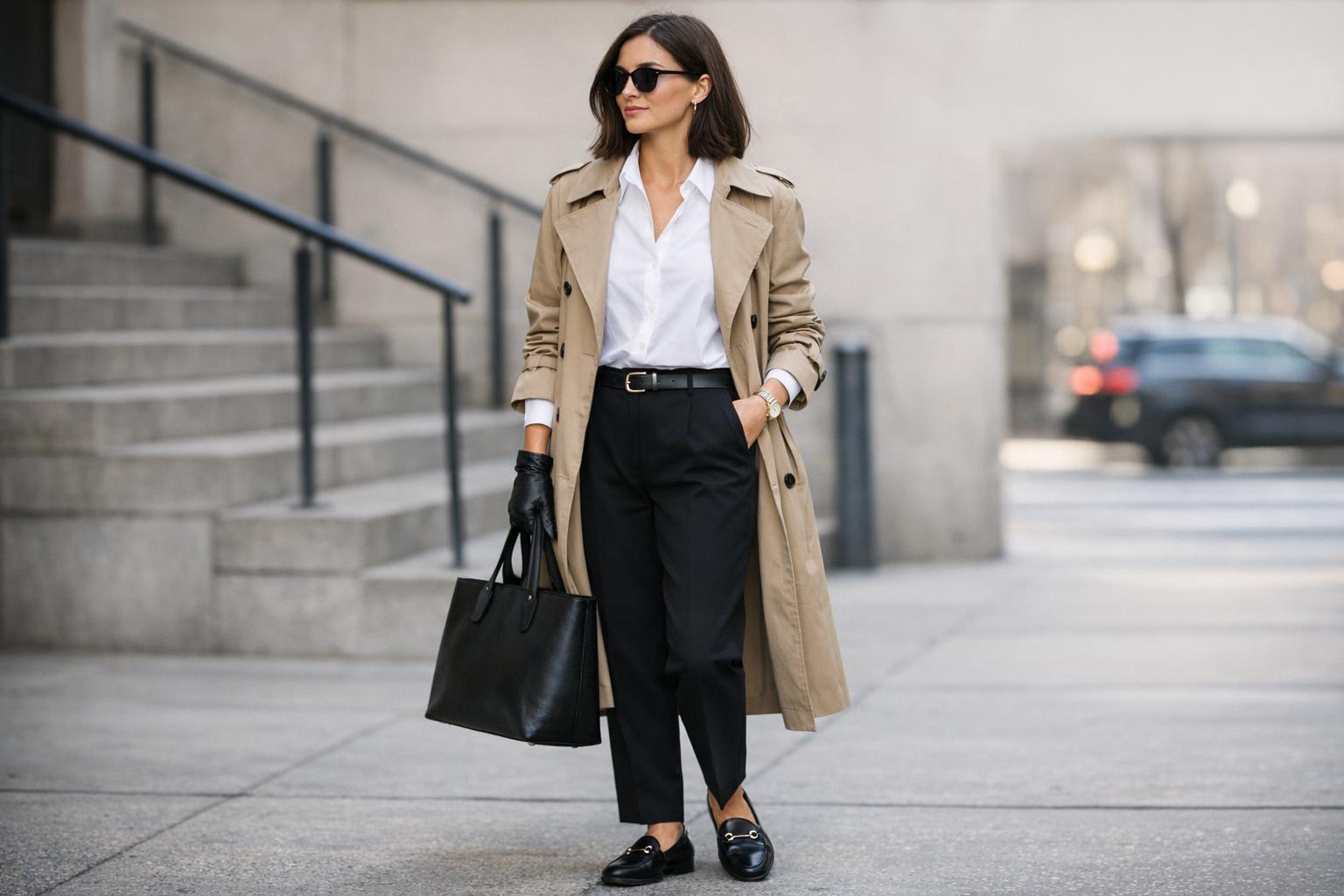
    How do I adapt a soft summer capsule to climate and lifestyle?

    Adjust the proportion of categories rather than changing the palette: prioritize breathable tops and reliable bottoms for warm weather, keep layering pieces like cardigans and lightweight jackets for air-conditioned interiors, and choose foundational pieces that match whether your routine is more casual or more polished.

  • Summer Travel Capsule Wardrobe: 15 Pieces, Endless Outfits

    Summer Travel Capsule Wardrobe: 15 Pieces, Endless Outfits

    The summer travel capsule wardrobe: a smarter way to pack light and still feel put-together

    A summer travel capsule wardrobe is a small, mix-and-match set of clothes designed to handle warm-weather trips without overpacking. Instead of packing for every hypothetical moment, you build a tight system of wardrobe basics—breathable tees, tanks, linen clothing, a summer dress, comfortable shoes like white sneakers and walking sandals, plus a couple of accessories—so you can repeat pieces confidently while changing the look. This approach fits U.S. travel realities: hot cities, beach days, air-conditioned restaurants, and the occasional cool evening that calls for layering.

    Most top capsule wardrobe thinking for summer travel centers on versatility and breathable fabrics, especially linen and cotton, with occasional mentions of TENCEL for comfort and drape. You’ll also see a consistent “core set” of pieces across destinations—from Miami to Italy to Spain to Turks and Caicos to Vermont—because what actually works in a suitcase is repeatable: a basic tee, a classic button-down, linen pants, a quality bathing suit, and footwear you can walk in for hours. If you’re building a capsule wardrobe women can rely on for multiple types of trips, the goal isn’t to be boring—it’s to make every item earn its space.

    Summer travel capsule wardrobe flat lay on bed with neutral outfits, shoes, suitcase and passport in soft morning light
    A minimalist summer travel capsule wardrobe flat-lay in soft morning light pairs neutral essentials with a muted navy accent beside an open suitcase.

    This guide walks you through a complete fashion capsule wardrobe for summer travel: the philosophy, a practical 10-piece “core” you can adapt, destination-based adjustments, outfit ideas, and packing techniques (including packing cubes and simple garment-care tactics) so you arrive with clothes you’ll actually wear.

    How a fashion capsule wardrobe works for summer travel (and why it beats overpacking)

    A capsule wardrobe is a curated set of clothing where each piece coordinates with the others, creating many outfits from a few items. For summer travel, the best results come from treating your capsule like a system: you pick a color palette, choose travel-friendly fabrics (linen and cotton show up again and again for a reason), and prioritize silhouettes that can shift between daytime and evening.

    Overpacking often happens when items don’t connect. You bring “single-purpose” pieces: a cute top that only matches one bottom, or shoes that work for photos but not for walking. A minimalist wardrobe capsule approach flips that. You start with “connectors”—linen pants that work with a tank, a basic tee, and a button-down; a summer dress you can wear to lunch or dinner; white sneakers that can handle miles of walking in a city and still look clean with a dress.

    It also supports a more sustainable packing philosophy: fewer pieces, more wears, and less impulse buying on the road. Some travelers go even further with circular fashion ideas like rental (for example, the vacation-ready capsule positioning seen in designer collaborations like Simon Miller with Rent the Runway), but even without renting, the capsule mindset naturally pushes you toward better decisions about what you already own.

    Tips: decide what your trip actually requires before you choose your pieces

    Before building your capsule, picture your itinerary as categories rather than individual outfits: walking-heavy days, beach/pool time, day-to-night dinners, and “in-between” moments like airports or cool indoor spaces. This is where the classic button-down, lightweight cardigan, and a breathable tank top earn their keep: they’re problem-solvers for changing temperatures without adding bulk.

    Summer travel capsule wardrobe packing scene with open suitcase on linen bed, neutral outfits, sneakers, sandals, passport.
    Warm golden-hour light highlights a minimalist summer packing setup designed for a polished capsule wardrobe on the go.

    The 10-piece minimalist wardrobe capsule framework (and how to personalize it)

    A reliable summer travel capsule wardrobe typically lands between 9 and 12 core pieces depending on trip length and laundry access. A 10-piece framework is a sweet spot for many warm-weather trips: enough variety to feel like you have options, but still focused enough to pack light.

    The easiest way to personalize a fashion capsule without breaking the system is to pick a “neutral base + accent” color approach. Neutrals (white, black, and other low-saturation tones) create the foundation; one or two accent colors keep things from feeling repetitive. This is especially helpful if you like colorful styling (as seen in some summer capsule approaches) but still want everything to mix easily.
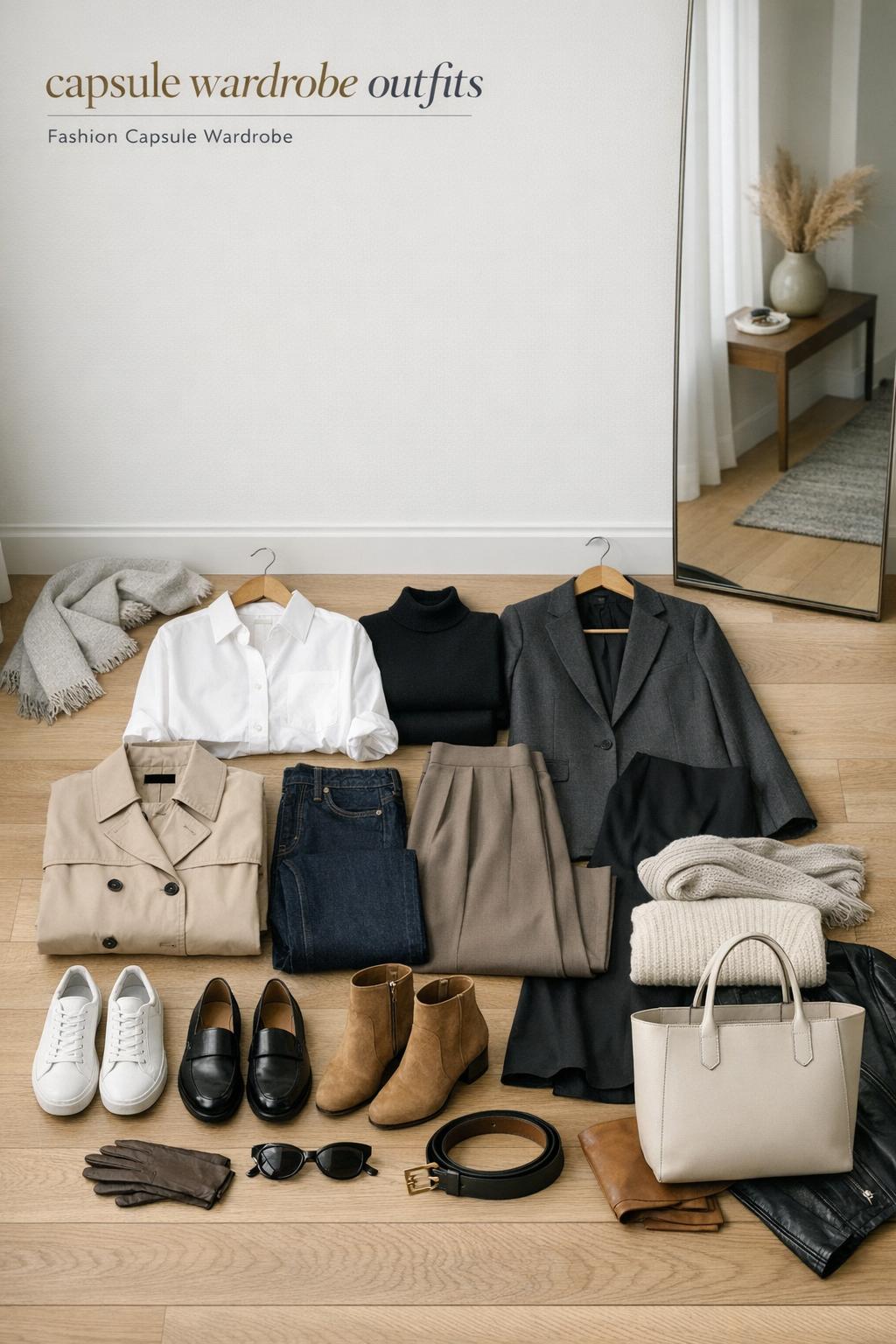
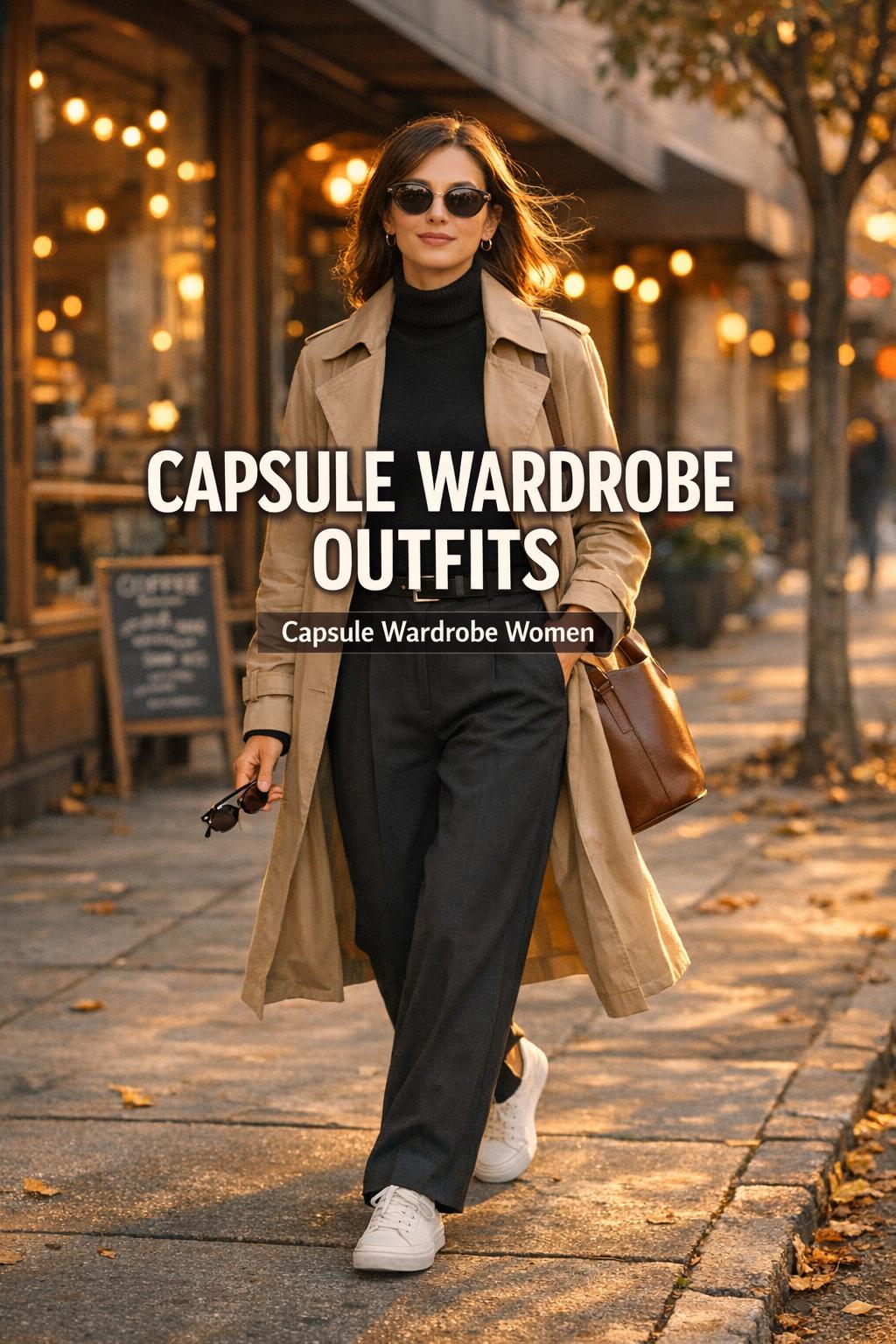
    • Neutral base: the color family that appears in most of your capsule pieces
    • Accent: a color you love wearing that still looks good with the base
    • Fabric rules: prioritize linen and cotton for breathability; consider TENCEL for a soft, travel-friendly drape
    • Silhouette rules: pick at least one “relaxed” and one “polished” option in each category so your outfits can shift from casual to elevated

    Now, let’s build the core wardrobe basics: tops, bottoms, a dress, a layer, shoes, and accessories. You can keep this brand-agnostic, but if you like to anchor your shopping with familiar names, examples that commonly show up in summer capsule conversations include Everlane, Reformation, Buck Mason, J.Crew, Bonobos, Aritzia, Lululemon, Vuori, Hill House Home, and Farm Rio. For budget-oriented capsules, Amazon-focused roundups often include everyday basics like a simple T-shirt, sneakers, and packable layers (for example, Reebok sneakers or a Wrangler denim jacket).

    Summer travel capsule wardrobe laid out with lightweight outfits, sandals, and accessories for a minimalist vacation
    A curated summer travel capsule wardrobe is arranged neatly with versatile outfits and warm-weather essentials.

    The core summer travel capsule wardrobe pieces (the 10-piece system)

    Think of the list below as a “default loadout” for warm-weather travel: it covers sightseeing, meals out, transit days, and water time. Each piece is included because it connects to multiple outfits and solves a real packing problem (heat, walking comfort, wrinkles, and styling flexibility).

    Tops: the breathable tank top, the basic tee, and the classic button-down

    1) White or neutral tee (basic tee): A basic tee is one of the most repeatable wardrobe basics for summer travel because it anchors outfits without competing. It works with linen pants, denim shorts, a midi skirt, and even layered under a classic button-down for sun coverage and air-conditioned interiors.

    2) Breathable tank tops: The breathable tank top earns space because it’s the easiest hot-weather base layer. It’s ideal for humid destinations like Miami, and it also works as a “change the vibe” piece—pair it with tailored bottoms for a cleaner look, or with shorts for peak casual comfort.

    3) Linen or cotton button-down (classic button-down): A classic button-down is the capsule’s utility player. Wear it open over a tank, buttoned with linen pants, or tied at the waist over a summer dress. Linen and cotton versions are especially useful because they breathe well while still offering coverage from sun or chilly indoor spaces.

    Bottoms: linen pants and the perfect short

    4) Linen pants: Linen pants show up as a core entity in summer capsules because they handle heat, look polished, and pack easily. They’re also forgiving for long travel days when comfort matters. In destinations like Italy or Spain—where you might want to look a bit more elevated while still walking a lot—linen pants paired with a basic tee or button-down creates an effortless uniform.

    5) Denim shorts (the perfect short): The “perfect short” is whatever makes you feel comfortable walking and sitting for hours, ideally in a moderate length that works in multiple settings. Denim shorts are a classic choice because they’re sturdy and match everything from breathable tanks to a breezy polo-inspired top, and they contrast nicely with softer fabrics like linen.

    Dresses and skirts: the day-to-night summer dress (and an optional midi skirt)

    6) Day-to-night summer dress: A summer dress is a high-impact capsule piece because it’s a complete outfit that takes up minimal suitcase space. A black dress is a popular option in travel capsules because it can shift from daytime sightseeing to dinner with a simple change of shoes and bag. For travelers who like more romance or color, brands like Reformation, Hill House Home, or Farm Rio often appear in style-forward travel capsule inspiration, but the key is the function: breathable, comfortable, and easy to re-wear.

    Optional swap or add-on: midi skirt: A midi skirt adds variety if dresses aren’t your favorite or if you want more mix-and-match options. It pairs with the basic tee, a breathable tank, or a button-down and can feel breezier than pants in humid conditions. If you’re keeping the capsule strict at 10 pieces, treat the midi skirt as a substitute for either shorts or one top rather than an addition.

    Layering and outerwear: lightweight cardigan, linen blazer, or even a denim jacket

    7) Lightweight cardigan or linen blazer: Summer travel still involves temperature swings: evening breezes, aggressively air-conditioned restaurants, and transit days. A lightweight cardigan is easy to pack and forgiving for casual outfits. A linen blazer is a sharper option if you expect dinners out and want structure without heavy fabric. If your style leans more casual or you’re traveling in variable climates, a denim jacket is a familiar capsule layer (and you’ll often see it in budget-oriented lists, including picks like a Wrangler denim jacket).

    Footwear: white sneakers and comfortable sandals (plus flip-flops if water is central)

    8) White sneakers: White sneakers are a repeat star in summer travel capsules because they balance comfort and style. They work with shorts, linen pants, a midi skirt, and a summer dress—especially useful when your day includes long walks, museums, or uneven streets. Some capsules call out specific options like Reebok sneakers, but the broader point is choosing a pair you can wear all day without planning your itinerary around your shoes.

    9) Comfortable sandals or a walking sandal: A walking sandal is often the unsung hero of warm-weather travel. It’s the shoe you’ll want for hot days, quick outfit changes, and beach-to-town transitions. If your trip leans beach-heavy, flip-flops are a practical addition, and you’ll see classic options like Havaianas referenced in summer vacation wardrobe capsules.

    Note on minimalist heels: If you love dressing up, minimalist heels can earn a spot, but only if you realistically have events or dinners where you’ll wear them. Otherwise, they can become “dead weight” in a suitcase—one of the most common capsule mistakes.

    Accessories: a lightweight scarf or travel wrap, and the essential handbag

    10) Lightweight scarf or travel wrap: A scarf is a deceptively powerful capsule tool: it adds variety, can be used for coverage, and adapts to changing temperatures. Some capsules emphasize a travel scarf or wrap as a dedicated piece because it upgrades basics without adding another garment category.

    Plus one practical “carry” piece: a minimal tote or crossbody (the essential handbag): Many summer travel capsule wardrobes include an essential handbag because it impacts every outfit and every day of travel. A small tote or crossbody can handle city sightseeing, dining out, and transit. If you’re strictly limiting items, treat the bag as a non-negotiable travel tool rather than an “extra.”

    How to choose fabrics for a summer capsule: linen, cotton, and TENCEL

    Fabric choice is where a summer travel capsule wardrobe succeeds or fails. Warm-weather travel is less forgiving: if something traps heat, wrinkles badly, or feels uncomfortable after a long day, you’ll stop wearing it—even if it looked good at home.

    Linen is the headline fabric in many summer capsule wardrobes because it’s breathable and naturally aligned with the relaxed polish travelers want. Linen pants and linen button-down shirts are recurring staples because they can be worn repeatedly across different settings. The trade-off is that linen can wrinkle; if wrinkles bother you, choose linen blends or reserve linen for pieces where texture feels intentional (like pants or a loose button-down).

    Cotton is a dependable capsule fabric for basic tees, breathable tanks, and button-downs. It tends to feel familiar and easy to wear, especially in high heat and humidity. The trade-off is that some cotton items can feel heavy or hold moisture depending on weave; prioritize lighter-weight cotton for peak summer.

    TENCEL appears as a logical capsule option when you want softness and drape. In practice, it can be especially good for pieces that need to look smooth with minimal effort, such as a breezy top or a dress silhouette meant to go day-to-night.

    Tips: pick “repeat-friendly” fabrics, not just “cute” pieces

    When you’re building a minimalist wardrobe capsule for travel, ask a simple question: “Will I want to wear this again two days from now?” Breathable fabrics help, but so do easy shapes and forgiving textures. A linen pant you can re-wear, a basic tee that doesn’t feel precious, and a button-down that works as a layer will outperform trend pieces that require perfect conditions.

    Destination-based capsules: adapt the same system for beach, city heat, and cooler summer towns

    The most reliable fashion capsule wardrobe is destination-agnostic at its core, then adjusted with a few swaps. Instead of building an entirely new packing list for every trip, keep the 10-piece core and make targeted changes based on climate and activities. Destinations commonly referenced in warm-weather travel scenarios—Turks and Caicos, Italy, Spain, Miami, and Vermont—highlight how different “summer” can feel depending on humidity, walking intensity, and evening temperatures.

    Summer travel capsule wardrobe neatly packed in an open carry-on suitcase on a white bed by a sunny window
    A bright, airy hotel room scene shows a minimalist carry-on packed with a summer travel capsule wardrobe by the window.

    Coastal and beach climates (Turks and Caicos-style trips)

    For a beach-forward trip, the capsule leans into water time and easy layers. The quality bathing suit becomes central, and the walking sandal and flip-flops matter more than an extra top. The summer dress is your fast track to looking finished after the beach, especially when paired with the essential handbag and a lightweight scarf for coverage or a little polish.

    • Prioritize: quality bathing suit, breathable tank tops, summer dress, sandals, flip-flops
    • Keep: linen pants for dinners and cooler evenings
    • Layer: classic button-down as a throw-on piece over a tank or swimwear

    Urban heat and humidity (Miami-style days, Spain and Italy city walking)

    In hot cities, your capsule should anticipate long walking days and indoor air conditioning. White sneakers become the workhorse shoe, and breathable basics—basic tees, tanks, and linen pants—do the heavy lifting. A classic button-down acts like a sun-and-AC shield: open it during the day, then button it up for a more polished look at night.

    If you expect more dining out, consider swapping denim shorts for tailored trousers (a piece that shows up in more fashion-forward travel capsules). Tailored trousers can still be comfortable in summer if the fabric is light and the cut is breathable, and they often feel more elevated with minimal effort.

    Cooler evenings or variable summer towns (Vermont-style trips)

    Even in summer, some destinations call for more layering—especially in the evenings. This is where the lightweight cardigan, linen blazer, or denim jacket becomes more than an afterthought. Keep your breathable daytime base (tee, tank, linen pants), but make sure your outer layer is something you’ll actually wear rather than a “just in case” item that never leaves the suitcase.

    • Prioritize: lightweight cardigan or denim jacket, closed-toe shoes like white sneakers
    • Keep: linen pants for day-to-night flexibility
    • Balance: one dress plus separates so you’re prepared for both casual and nicer plans

    Optional add-ons and swaps: tailoring your capsule wardrobe women will actually enjoy wearing

    A capsule only works if it fits your personal style and your real itinerary. Some travelers love dresses; others prefer trousers. Some want a colorful fashion capsule; others want a strict neutral minimalist wardrobe capsule. The best approach is to keep the structure (tops, bottoms, dress, layer, shoes, accessories) and swap within categories.

    Here are common, practical swaps that appear across summer travel capsule wardrobe ideas:

    • Swap shorts for a midi skirt if you want more airflow and a different silhouette without adding more tops.
    • Add tailored trousers if you expect dinners out and want a sharper look than linen pants alone can provide.
    • Include a breezy polo or breezy top if you dislike tanks but still want breathable structure.
    • Consider a black dress as your “default nice outfit,” especially if you want a single piece that can cover many situations.
    • Include minimalist heels only if you have a clear plan to wear them; otherwise, rely on sandals and sneakers.

    If you like a more fashion-forward angle, some capsule inspiration leans into specific statement pieces like a long vest, but the same rule applies: it should coordinate with your linen pants, basic tee, and dress, not compete with them.

    Outfit formulas: 7 mix-and-match looks from one fashion capsule wardrobe

    Outfit planning is where the capsule becomes real. The goal isn’t to pre-plan every day; it’s to know your “default formulas” so you can get dressed quickly and repeat items without it feeling repetitive. Each formula below uses core wardrobe basics found across summer capsule wardrobes: tees, tanks, button-downs, linen pants, shorts, a dress, sneakers, sandals, and a simple bag.

    • Airport and transit day: basic tee + linen pants + white sneakers + lightweight cardigan + essential handbag
    • Hot sightseeing day: breathable tank top + denim shorts + walking sandals + scarf as a sun/coverage tool
    • Casual city dinner: classic button-down (worn closed) + linen pants + sandals + minimal tote or crossbody
    • Day-to-night shift: summer dress + white sneakers during the day, swap to sandals for dinner
    • Beach-to-town: quality bathing suit + classic button-down worn open + shorts + flip-flops
    • Polished but easy: black dress + scarf + essential handbag + sandals
    • Cooler evening walk: basic tee + midi skirt (or linen pants) + white sneakers + denim jacket

    If you’re traveling in places like Italy or Spain where you might want a slightly more elevated feel without overpacking, lean on the linen pant + button-down combination and keep the accessory story consistent: one essential handbag and a lightweight scarf can make repeat outfits feel intentional.

    Brand-agnostic shopping: how to pick quality wardrobe basics without getting stuck on labels

    You can build a strong summer travel capsule wardrobe without chasing any specific brand. The most important “quality” indicators for travel are comfort, versatility, and how well the item plays with the rest of your capsule. That said, some travelers prefer a reference point, and well-known names often associated with capsule-friendly pieces include Everlane, Reformation, Buck Mason, J.Crew, Bonobos, Aritzia, Lululemon, and Vuori. For more playful vacation style, Farm Rio and Hill House Home are commonly linked with summer dresses and warm-weather energy. For straightforward travel basics at a range of prices, Amazon-based capsules often highlight simple staples like a T-shirt, a denim jacket, and sneakers (including Reebok).

    What to check before you commit to a piece

    Whether you’re buying from a fashion media favorite like Reformation or picking a basic tee from Amazon, apply the same capsule test: it should pair with at least two bottoms, work with at least two shoes, and feel comfortable in heat. If it fails one of those tests, it may be a great item—but it’s probably not a great capsule item.

    It’s also worth recognizing that “more elevated” doesn’t always mean “more useful.” A highly specific piece might photograph well, but for real travel—walking, sweating, changing plans—your capsule performs best when it’s built on breathable basics and reliable footwear.

    Packing strategies and tools: how to pack your capsule efficiently (and keep it wearable)

    A capsule wardrobe cuts volume, but packing technique still matters—especially for linen clothing and summer dresses that can wrinkle. The goal is to keep your clothes compact, accessible, and ready to wear on arrival.

    Packing cubes, folding vs. rolling, and keeping outfits modular

    Packing cubes are a practical system for capsule travel because they maintain structure: one cube for tops, one for bottoms, and one for underwear/swim. This makes it easier to rotate outfits without exploding your suitcase, and it keeps your capsule visible so you don’t forget items you packed.

    For folding vs. rolling, the key is consistency. Rolling can help reduce bulk for tees and tanks, while careful folding can help keep button-downs and dresses in better shape. If linen wrinkles easily for you, consider packing it so it’s not crushed under heavier items, and plan to wear linen pants early in the trip if you want them at their freshest.

    Garment care on the road: staying presentable without overthinking it

    Warm-weather travel is lived-in: you’ll re-wear linen pants, you’ll repeat a basic tee, and you’ll reach for the same white sneakers because they’re comfortable. The most practical garment-care mindset is to embrace “good enough” polish. Linen has texture; a breathable button-down looks better slightly relaxed than overly crisp; and a scarf can add instant intention to an outfit even when your clothes have traveled.

    Tips: pack for your laundry reality, not your fantasy

    If you won’t realistically do laundry on your trip, avoid bringing too many “single-wear” items. Instead, lean into repeatable wardrobe basics: two tops that rotate well with linen pants and shorts, one dress you can wear multiple times, and shoes you can rely on. This is also where choosing breathable tees and tanks matters: they’re the pieces you’ll wear the most, so comfort and washability are more important than novelty.

    Sustainability and durability: making your summer capsule wardrobe work beyond one trip

    A summer travel capsule wardrobe naturally supports a more sustainable approach because it reduces volume and encourages re-wearing. But sustainability isn’t only about owning fewer items—it’s also about choosing pieces you’ll keep reaching for. Linen pants, a classic button-down, and comfortable shoes like white sneakers are “return-on-investment” pieces: they show up across many capsule lists because they remain useful year after year.

    There’s also a space for alternative wardrobe models, like rental. Vacation-focused capsule collections—such as a designer capsule positioned through a collaboration like Simon Miller with Rent the Runway—highlight how travelers can access a cohesive warm-weather wardrobe without committing to ownership for every trend or special trip. That approach can be especially appealing if you want something statement-making for a specific destination but still prefer a minimalist wardrobe capsule at home.

    What sustainability can’t do is override comfort. If a fabric feels wrong in heat or shoes aren’t walkable, you won’t wear them, and unused items are the opposite of a responsible wardrobe. A balanced approach is to choose durable, repeatable basics first, then add personality with one or two pieces that still coordinate with the system.

    Common mistakes to avoid when building a fashion capsule for summer travel

    Even experienced travelers can build a capsule that looks great on paper but fails in real life. These are the issues that most often cause frustration—because they break the relationships between your core pieces (tees, linen pants, dresses, shoes) and the realities of travel.

    • Too many “special” items: pieces that only work in one outfit or one type of setting.
    • Ignoring shoes: packing heels you won’t walk in, or skipping a true walking shoe like white sneakers.
    • No temperature strategy: forgetting a lightweight cardigan or layer for air-conditioned spaces.
    • Underestimating humidity: choosing fabrics that don’t feel breathable compared with linen or cotton.
    • Overcomplicating color: packing colors that don’t coordinate, which reduces outfit combinations.

    If you correct just one of these, start with footwear. A capsule can survive repeating tops; it can’t survive shoes that derail your day.

    Summer travel capsule wardrobe packing scene with open suitcase on white bed, neutral outfits, shoes and passport by window
    A minimalist summer travel capsule wardrobe is neatly packed into an open suitcase on crisp white linens beside soft morning window light.

    FAQ

    What is a summer travel capsule wardrobe?

    A summer travel capsule wardrobe is a small set of mix-and-match wardrobe basics—often centered on breathable tees and tanks, linen pants, a classic button-down, a summer dress, and comfortable shoes like white sneakers and sandals—built to cover warm-weather travel without overpacking.

    How many items do I need in a summer capsule wardrobe for travel?

    Many travelers find 9–12 pieces workable, with a 10-piece core as a practical middle ground; the right number depends on trip length and whether you’ll do laundry, but the capsule works best when every item coordinates and can be re-worn comfortably.

    What are the most important wardrobe basics for warm-weather trips?

    The most repeated essentials are a basic tee, breathable tank tops, a linen or cotton button-down, linen pants, a summer dress (often chosen for day-to-night use), white sneakers for walking, comfortable sandals, and an essential handbag that suits daily sightseeing.

    How do I adapt my capsule for a beach vacation versus a city trip?

    For beach trips like Turks and Caicos, prioritize a quality bathing suit, sandals, flip-flops, and an easy summer dress while keeping linen pants for dinners; for city heat in places like Miami, Italy, or Spain, lean harder on white sneakers, breathable basics, and a button-down that handles both sun and air-conditioned interiors.

    Which fabrics work best for a summer travel capsule wardrobe?

    Linen and cotton are commonly favored for summer travel because they’re breathable and versatile, while TENCEL is often considered when you want a soft drape; the best choice is the fabric that stays comfortable in heat and still looks presentable after packing.

    Do I really need white sneakers for a capsule wardrobe?

    White sneakers are a frequent capsule staple because they’re walkable and match most outfits, from linen pants and denim shorts to a summer dress; if you already have another comfortable walking shoe that coordinates with your color palette, that can fill the same role.

    How can I keep linen pants and button-downs from wrinkling while traveling?

    Use a structured packing approach—often with packing cubes—so linen items aren’t crushed under heavier pieces, fold button-downs more carefully than tees, and accept that linen’s relaxed texture is part of its appeal; planning to wear linen early in the trip can also help it look its best.

    Should I include heels in my summer travel capsule?

    Minimalist heels can work if you have specific dinners or events that call for them, but many travelers find they go unworn compared with sandals and white sneakers; if you’re packing light, prioritize shoes you can walk in comfortably.

    Can I build a capsule wardrobe women can use without buying expensive brands?

    Yes—capsules work best when they’re built around versatile, breathable basics rather than labels; you can stay brand-agnostic or use references ranging from Everlane, Reformation, Buck Mason, J.Crew, Bonobos, and Aritzia to budget-friendly Amazon picks like a basic T-shirt, a denim jacket, or Reebok sneakers, as long as the items coordinate and suit your trip.

  • Capsule Wardrobe Checklist: 30 Timeless Staples for U.S. Life

    Capsule Wardrobe Checklist: 30 Timeless Staples for U.S. Life

    Capsule wardrobe checklist: a complete, actionable guide to a timeless closet

    A capsule wardrobe checklist is a practical way to build a smaller, more versatile closet using a focused set of essentials you can mix and match across outfits, occasions, and seasons. Instead of chasing constant “more,” you choose a tight edit of pieces—often around 30–37 items—that work together in color, silhouette, and function. Done well, a capsule reduces decision fatigue, makes packing easier, and keeps shopping intentional without requiring you to dress “boring.”

    This guide is designed for U.S. lifestyles and the reality of changing weather, commuting patterns, and dress codes—from casual weekends to office-appropriate looks to travel. You’ll get a complete wardrobe checklist you can actually use, a capsule wardrobe items list organized by category, a phased plan for building your capsule over time, seasonal transition guidance, and tips on shopping strategy and fabric care so your core pieces last. If you’ve ever wanted a wardrobe checklist woman can rely on year-round—without overhauling everything at once—this is the framework.

    Capsule wardrobe checklist flat lay with neutral capsule clothing, sneakers, loafers, and accessories in a modern closet setting
    A minimalist flat-lay capsule wardrobe checklist is styled with timeless neutral pieces, polished shoes, and sleek accessories in soft natural light.

    What is a capsule wardrobe and why it works in the U.S.

    A capsule wardrobe (sometimes called a capsule closet or minimalist wardrobe) is a curated set of clothing built around versatile basics—think a white button-down, tailored trousers, a trench coat, white sneakers—that can be styled in multiple ways. The focus is cohesion: neutral or compatible colors, repeatable silhouettes, and a balance of casual and polished items so you can dress for real life with fewer pieces.

    It works particularly well in the U.S. because many people need outfits that move across settings: workdays that swing from meetings to errands, weekends with social plans, and frequent seasonal changes. A fashion capsule wardrobe is less about strict minimalism and more about repeatable outfit formulas—your “default” jeans-and-tee uniform upgraded with a blazer, or a simple dress that can be layered under outerwear.

    The key idea: versatile basics that create more outfits than you own

    The strongest capsules rely on repeatable building blocks. When your tops coordinate with your bottoms, and your outerwear works with both, outfit creation becomes a simple system. That’s why checklists often start with essentials like neutral tees, black pants, jeans, and layerable outerwear (a blazer, a leather jacket, a trench coat). Add a small set of shoes and accessories, and the combinations multiply without needing more volume.

    A note on “rules”: 30–37 pieces and the 3-3-3 rule

    Many capsule wardrobe checklists use a 30–37 item baseline because it’s large enough to cover daily life but small enough to stay intentional. You may also see the 3-3-3 rule referenced as a styling shortcut: small sets of items that can be combined quickly (for example, a few tops, a few bottoms, and a few shoes). These are frameworks, not rigid requirements—use them to simplify decisions, not to create pressure.

    Capsule wardrobe checklist closet corner with neutral basics on rack, mirror, woven basket, shoes, and planner in warm light
    A warm golden-hour closet scene showcases a tidy neutral capsule wardrobe with a checklist planner and essential accessories.

    Core capsule pieces: the 30–37 essentials to own (capsule checklist)

    This capsule checklist is meant to function as a complete wardrobe checklist for most adult lifestyles, with room to adjust for climate and dress code. The goal is balance: enough tops to rotate, enough bottoms to anchor outfits, outerwear for layering, and shoes that cover your main activities.

    Use this capsule wardrobe items list as your starting point, then edit based on how you actually live. If you rarely wear heels, for example, you don’t need them in your core. If you’re in a city where a trench coat is a staple for transitional weather, prioritize it earlier.

    • Tops and tees (core rotation)
    • Bottoms (denim + tailored options)
    • Outerwear (layering system)
    • Shoes (comfort + versatility)
    • Accessories (small pieces that change the look)

    Tops and tees: the foundation for mix-and-match outfits

    Tops drive outfit variety in a capsule because they’re the most visible and easiest to swap. A strong set includes neutral tees (including a white tee and black tee), a white button-down, and a few elevated options that still coordinate with your bottoms. If you’ve ever built outfits that felt “almost right,” it’s usually because the tops weren’t cohesive in color or proportion with the bottoms and layers you own.

    For everyday U.S. dressing, many people find that a handful of high-rotation tops is more useful than a closet full of occasional pieces. This is where reliable basics from brands often referenced in capsule conversations—like Everlane and Madewell—tend to fit in as examples: simple silhouettes, neutral palettes, and pieces you can repeat often without feeling overly trendy.

    • 2–3 neutral tees (include a white tee and black tee)
    • 1–2 long-sleeve tops for layering
    • 1 white button-down (or a crisp neutral shirt)
    • 1–2 elevated tops you can wear to dinner or work
    • 1–2 knit or cozy layers for colder days

    Tips: making tops work harder in a fashion capsule wardrobe

    In practice, tops “earn their keep” when they work under multiple layers. Before you buy a new top, picture it under a blazer, under a trench coat, and with your main pair of jeans and your main pair of tailored trousers. If it only works in one scenario, it’s more of a specialty item than a capsule essential. Also pay attention to fabric care: easy-care basics are the ones you’ll actually reach for on busy weeks.

    Bottoms: trousers, jeans, and skirts that work in all seasons

    Bottoms are your outfit anchors. Most capsule wardrobes rely on a mix of denim and tailored options—jeans for everyday and tailored trousers for polish. Black pants are a frequent capsule staple because they can read casual with sneakers or more refined with a structured top and outerwear.

    Fit matters more here than almost anywhere else. A capsule wardrobe checklist can list “tailored trousers,” but your best version might be straight-leg, wide-leg, or ankle-length depending on what feels comfortable and what shoes you actually wear. The point is to choose silhouettes you can repeat across seasons and settings.

    • 1–2 pairs of jeans (a primary pair plus an optional backup wash)
    • 1 pair of tailored trousers
    • 1 pair of black pants (if different from your tailored trousers)
    • 1 optional skirt if you wear them regularly

    Outerwear: layering essentials for every U.S. season

    Outerwear is where U.S. climate differences show up fast, but the capsule principle stays the same: choose layers that work together. A trench coat is a classic capsule piece for transitional weather, a blazer adds structure for work and dinners, and a leather jacket can be the casual-cool layer that pulls an outfit together.

    If you live in a colder region, a wool coat becomes a key part of the system. In milder climates, you may rely more on lighter layers. The important part isn’t owning every type of coat—it’s owning the right layers for the weather you actually experience and the outfits you actually wear.

    • 1 blazer (workhorse layer for polish)
    • 1 trench coat (transitional outerwear)
    • 1 leather jacket (optional but versatile)
    • 1 warm coat (often a wool coat in colder regions)

    Shoes and accessories: completing your capsule wardrobe items list

    Shoes are where a capsule becomes livable. A pair of white sneakers can carry you through errands, travel days, and casual office looks, while a more structured option like loafers can shift the same outfit into “polished.” Accessories are the smallest category but often the highest leverage: sunglasses, a belt, or a simple bag can change the tone of a neutral outfit without adding clutter.

    • 1 pair of white sneakers
    • 1 pair of loafers (or another everyday polished shoe)
    • 1 optional dress shoe for occasions that require it
    • 1–2 simple accessories (for example, sunglasses and a belt)

    How to shop and style a capsule wardrobe (without overbuying)

    A capsule wardrobe checklist is only helpful if it prevents “duplicate buying”—grabbing another black tee, another pair of jeans, another jacket—because you’re unsure what you already have. The shopping and styling approach that tends to work is intentional: inventory first, identify gaps second, and only then consider purchases.

    Start with an inventory: keep, tailor, donate

    Before you shop, do a quick closet inventory. This step is often skipped, but it’s where a capsule becomes realistic. You’ll usually find you already own some core basics—maybe a white button-down, black pants, or a trench coat—that can serve as anchors. You may also find duplicates that can be donated, or pieces that could be revived with a small repair or better fabric care.

    • Pull out the pieces you wear weekly and set them aside as “core.”
    • Identify “almost right” items that might need tailoring or better styling.
    • Create a donate pile for items that don’t fit your current life or comfort.

    Build outfit formulas (and repeat them confidently)

    In day-to-day dressing, most people repeat a few outfit formulas. The capsule method makes those formulas easier to execute. For example: neutral tee + jeans + blazer + loafers; white button-down + tailored trousers + trench coat + sneakers; or an elevated top + black pants + leather jacket. The goal isn’t to reinvent your style daily—it’s to have reliable combinations that look intentional with minimal effort.

    Tips: use a “one-in, one-out” mindset during the build phase

    When you’re actively building a fashion capsule wardrobe, it’s easy to justify “just one more” because each piece seems useful. A practical rule is to replace rather than add whenever possible: if you buy a new pair of jeans, decide whether the older pair still belongs in your core rotation. This keeps the capsule from quietly turning back into an overflowing closet.

    Capsule wardrobe checklist on a clipboard with minimalist clothing laid out on a bed in soft natural light
    A capsule wardrobe checklist rests neatly beside a curated selection of timeless essentials in warm, natural light.

    A phase-based plan to build your capsule wardrobe (phase 1–phase 5)

    If you try to build a complete wardrobe checklist all at once, you’ll likely overspend or end up with pieces that don’t work together. A phased approach makes the process calmer and more accurate, because you learn what you actually reach for as you go. Think of phases as a sequence: secure the core basics first, then add polish, then refine for season and lifestyle.

    Phase 1: define your color story and daily uniform

    Start by deciding on a neutral-heavy palette you’ll actually wear. Most successful capsules lean on neutrals because they mix easily and make repeating outfits feel consistent. Then identify your real daily uniform—what you wear for work, weekends, and errands—so your capsule is built around reality, not aspiration.

    Phase 2: lock in your high-rotation basics

    This phase is about the pieces you’ll wear constantly: neutral tees (including a white tee and black tee), a dependable pair of jeans, and black pants or tailored trousers. These pieces should be comfortable and easy to care for, because they’ll be washed and worn often. If a basic is fussy, it won’t stay in rotation.

    Phase 3: add structure with outerwear and layering

    Once your base outfits are working, add the layers that make them feel complete: a blazer to sharpen casual looks, a trench coat for transitional weather, and (if it fits your style) a leather jacket for an effortless third piece. In colder climates, prioritize a warm coat that works with your most common outfits.

    Phase 4: refine with shoes and accessories that match your life

    Choose shoes that match your walking, commuting, and work needs. A capsule that looks good but hurts to wear is not a working system. A pair of white sneakers is a frequent cornerstone; loafers (or a similarly versatile polished shoe) add range. Keep accessories minimal and purposeful—small touches like sunglasses can change the vibe without adding clutter.

    Phase 5: fill true gaps and upgrade quality over time

    Only after living in your capsule for a while will your real gaps become obvious. This is the time to upgrade quality, replace worn-out basics, and refine fit. It’s also when you can thoughtfully add a piece that reflects your personal style—maybe a more distinctive top from a brand like Dôen if it fits your aesthetic—without breaking the capsule cohesion.

    Seasonal transitions: adapting your capsule for spring, summer, fall, and winter

    Seasonal transition is one of the biggest reasons people think capsules “don’t work.” In reality, capsules work best when you treat them as a year-round system with seasonal adjustments. You keep the core (jeans, black pants, neutral tees, white button-down), then swap a small number of weather-specific layers.

    Spring-to-summer: lighter layers and flexible outfits

    Spring and early summer often require outfits that handle temperature swings—cool mornings, warm afternoons, and air-conditioned indoor spaces. This is where a trench coat shines, because it layers over tees and button-downs without feeling too heavy. If you’re using a “micro-capsule” approach (like a 12-piece edit), you can take inspiration from celebrity-style capsule thinking—Kendall Jenner’s spring-to-summer capsule wardrobe is an example of a tightly curated seasonal set—but adapt it to your everyday needs rather than designer-only pieces.

    Fall: reintroduce structure

    Fall is often the easiest capsule season because layering is natural. Add a blazer more often, bring back the leather jacket, and rely on jeans and tailored trousers. The styling trick is contrast: a simple tee becomes “fall-ready” with a blazer and loafers, while the same tee stays casual with sneakers.

    Winter: focus on outerwear and fabric care

    In winter-heavy regions, outerwear becomes the visual centerpiece. A warm coat—often a wool coat—needs to work with your most common outfits and layers underneath. Winter is also where fabric care becomes a capsule superpower: caring properly for frequently worn basics helps your core items last through repeated wear.

    Tips: climate reality check for U.S. regions

    Even within the U.S., winter and summer can look very different depending on where you live. Instead of copying a universal list, use the checklist as a base and adjust outerwear first. If your area has mild winters, you may not need multiple heavy coats; if you face long cold stretches, a warm coat becomes non-negotiable and may take priority over trendier layers.

    Capsule wardrobe checklist on planner beside neutral clothes in a bright walk-in closet with shoes and accessories
    A bright, airy closet scene pairs neatly arranged neutral staples with a planner featuring a capsule wardrobe checklist.

    Budgeting, shopping strategies, and fabric care for capsule pieces

    A capsule wardrobe is often associated with “investment pieces,” but budgeting is personal. The strategy that tends to be most sustainable is to spend where wear is highest (your everyday shoes, your most-worn pants, your go-to outerwear) and stay practical on experimental pieces. A complete wardrobe checklist should guide you to fewer, better decisions—not force you into one price point.

    Quality vs. quantity: what to prioritize

    Prioritize durability and comfort for high-rotation items: tees you wear weekly, jeans you live in, a blazer that needs to hold shape, and outerwear that faces weather. Brands commonly referenced in capsule discussions—like Everlane and Madewell—are often used as examples for straightforward basics, while designer labels (The Row, Khaite, Maison Margiela, Courrèges, Isabel Marant) show up more in editorial or celebrity capsule inspiration. You don’t need designer pieces for a functional capsule; the useful takeaway is the emphasis on intentional selection and cohesive styling.

    Fabric care: the quiet skill that keeps capsules looking new

    Because capsule wardrobes rely on repeated wear, fabric care matters. Basics that are easy to wash and maintain are more likely to stay in rotation. Pay attention to how different materials behave over time and choose items you can realistically care for. If a piece requires constant special handling, it may be better as an occasional item rather than a core capsule staple.

    Tips: avoid the “fantasy self” shopping trap

    One of the most common capsule mistakes is buying for a life you don’t regularly live—extra dressy pieces for events you rarely attend, or trendy items that don’t integrate with your neutral basics. When evaluating a potential purchase, ask where it fits in your outfit formulas and which existing items it pairs with. If you can’t name at least a couple of strong combinations using your current capsule, it’s probably not a core piece.

    Visualizing your capsule: printables, tools, and a simple planning workflow

    Many people find that a capsule wardrobe checklist only “clicks” once it’s visible. Whether you prefer a printable capsule checklist or a simple planning method, the goal is the same: reduce uncertainty. Seeing your core pieces listed by category makes it easier to spot duplicates, identify true gaps, and plan outfits without last-minute stress.

    A practical workflow: print, inventory, plan

    A straightforward workflow is to start with a printable-style checklist mentality: print (or write) your categories, inventory what you own, then plan a few go-to outfits. This is especially effective if you’re rebuilding after a lifestyle change, a move to a different climate, or a shift in dress code.

    • Print or draft your capsule wardrobe items list by category.
    • Check off what you already own and actually wear.
    • Circle the missing essentials that would unlock multiple outfits.
    • Plan a week of outfits using only your checked items.

    Tips: treat your checklist like a living document

    Your capsule will evolve. A checklist is most useful when you revisit it after a few weeks of real wear—then adjust. If you notice you never reach for a certain top, it might be the wrong fit, the wrong fabric, or simply not aligned with your daily life. Replacing one weak link can improve the whole capsule more than buying multiple new items.

    Real-world examples: celebrity-inspired and everyday capsules

    Examples make capsule planning easier because they show how a small set of items becomes a real wardrobe. Editorial capsules often highlight designer pieces, while everyday capsules lean on approachable basics. Both can be useful: celebrity capsules can teach cohesion and restraint, and everyday capsules prove the system can work for errands, commuting, and repeat wear.

    Celebrity capsule inspiration (and how to translate it)

    A celebrity-driven capsule—like Kendall Jenner’s spring-to-summer capsule wardrobe—often centers on a tight set of statement-leaning staples, sometimes from designers such as The Row, Khaite, Maison Margiela, Courrèges, Éterne, or Isabel Marant. The practical takeaway isn’t that you need those labels; it’s that the pieces are chosen to mix cleanly and repeat. Translate that by selecting your own equivalents: a crisp shirt, a streamlined pant, a great coat, and shoes that work with everything.

    An everyday capsule scenario: a week of outfits from a small core

    Imagine a typical week: two workdays that require polish, a casual office day, a weekend brunch, errands, and a dinner. With a white button-down, neutral tees, jeans, tailored trousers, black pants, a blazer, a trench coat, white sneakers, and loafers, you can build multiple outfits by simply changing the layer and shoe. This is where capsules feel empowering: fewer items, but more “ready” combinations.

    Putting it all together: your complete wardrobe checklist for a capsule closet

    If you want one place to reference everything, this complete wardrobe checklist condenses the core categories into a single, actionable view. Use it as your wardrobe checklist woman can return to each season—especially during transitions when it’s easy to feel like you have “nothing to wear” despite owning plenty.

    • Tops: neutral tees (include a white tee and black tee), long-sleeve layer, white button-down, 1–2 elevated tops, 1–2 cozy layers
    • Bottoms: jeans, tailored trousers, black pants, optional skirt
    • Outerwear: blazer, trench coat, leather jacket (optional), warm coat (often wool coat in colder regions)
    • Shoes: white sneakers, loafers, optional dress shoe
    • Accessories: keep it minimal (for example, sunglasses and a belt)

    As you build, remember the central relationship that makes a capsule work: capsule wardrobe essentials support multiple outfits across occasions. If a piece doesn’t support that goal—because it doesn’t match, doesn’t fit your climate, or doesn’t suit your lifestyle—it belongs outside your core capsule, even if it’s beautiful.

    Woman reviewing a capsule wardrobe checklist in a minimalist walk-in closet with neutral clothing rack and accessories
    A stylish woman reviews a capsule wardrobe checklist beside a neatly curated rack of neutral essentials in warm window light.

    FAQ

    How many items should be in a capsule wardrobe checklist?

    Many capsule wardrobe checklists use a 30–37 item baseline because it’s enough to cover daily life while still feeling curated; treat that number as a guide and adjust based on your climate, lifestyle, and how often you do laundry.

    What are the most important capsule wardrobe essentials to start with?

    Start with high-rotation basics that anchor outfits: neutral tees (including a white tee and black tee), a white button-down, jeans, black pants or tailored trousers, plus a versatile layer like a blazer and an all-purpose shoe like white sneakers.

    What is the 3-3-3 rule and how does it help?

    The 3-3-3 rule is a simple styling shortcut that uses small sets of items (such as a few tops, a few bottoms, and a few shoes) to create quick combinations; it helps reduce decision fatigue and makes outfit planning easier within a capsule.

    How do I build a capsule wardrobe without buying everything at once?

    Use a phase-based plan: define your neutrals and daily uniform first, lock in your most-worn basics next, add outerwear layers, then refine shoes and accessories, and only after living in the capsule for a while fill true gaps or upgrade quality.

    How do I adapt my capsule closet for seasonal transitions?

    Keep the core pieces consistent (tees, button-down, jeans, black pants, tailored trousers) and swap a small number of weather-specific layers; for many U.S. wardrobes, a trench coat and blazer handle spring/fall well, while a warm coat becomes essential in winter-heavy areas.

    Do I need designer brands for a fashion capsule wardrobe?

    No—designer labels like The Row, Khaite, Maison Margiela, Courrèges, or Isabel Marant often appear in editorial or celebrity capsule examples, but the practical principle is intentional selection and cohesion; you can build a strong capsule with accessible basics from brands commonly referenced for staples, such as Everlane or Madewell, or with what you already own.

    What should I do with clothes that don’t fit my capsule checklist?

    Start with an inventory and separate items into core, “almost right,” and donate piles; pieces that don’t fit your lifestyle or coordinate with your essentials are often best donated, while “almost right” items may be improved with better styling, minor fixes, or more consistent fabric care.

    How can I make a printable-style capsule checklist useful day to day?

    Use the checklist as a living document: check off what you truly wear, circle the few missing pieces that unlock multiple outfits, and plan a week of outfits from your checked items to confirm what works before you shop.

  • Capsule Wardrobe Outfits: 12 Polished Everyday Formulas

    Capsule Wardrobe Outfits: 12 Polished Everyday Formulas

    Capsule Wardrobe Outfits: A Modern Guide to Timeless, Repeatable Style

    Capsule wardrobe outfits are the practical answer to a familiar problem: a closet full of clothes but nothing that feels easy to wear. Instead of chasing endless “new,” a capsule approach builds a small set of wardrobe basics—pieces like a trench coat, a white button-down, tailored trousers, denim, knitwear, and dependable shoes—so you can mix, match, and repeat outfits without feeling repetitive.

    This guide is designed for U.S. readers who want a Fashion Capsule Wardrobe that works in real life: commuting days, casual weekends, and the occasional evening plan. You’ll find the core frameworks (including the 30-piece method associated with Caroline Rector of Un-Fancy, the 10-item wardrobe approach linked to “Lessons from Madame Chic” by Jennifer L. Scott, and the 3–3–3 rule), a clear list of capsule essentials, and a deep bench of outfit formulas you can copy. You’ll also see how minimalist style icons like Carolyn Bessette Kennedy (CBK) and modern street-style moments—like Bella Hadid’s Milan Fashion Week look—translate into outfits that are simple, polished, and wearable.

    Capsule wardrobe outfits flat lay with neutral coats, knits, trousers, denim, and shoes in a modern apartment entryway
    A polished neutral capsule wardrobe flat lay brings effortless, editorial-ready style to a light-filled entryway.

    Think of this as a Minimalist Wardrobe Capsule playbook: less closet stress, more outfit confidence, and a system you can adjust seasonally—without needing to reinvent your personal style every morning.

    What a Capsule Wardrobe Is (and Why It Still Works)

    A capsule wardrobe is a curated collection of versatile clothing and shoes designed to be worn together in many combinations. In practice, it’s a strategy for reducing decision fatigue and increasing outfit consistency: you choose a limited palette of silhouettes and colors, rely on repeatable wardrobe basics, and rotate thoughtfully by season.

    In fashion media, capsule wardrobes are often explained through structured piece counts (commonly around 30 items, sometimes 30–37 depending on the approach) and a focus on timeless staples. The idea is not “never shop” or “wear the same outfit every day,” but to buy and style with intention so that each piece earns its place through versatility.

    From minimalism to modern “CBK” timelessness

    Minimalism is the aesthetic engine behind many capsule wardrobes, and few references are as enduring as the Carolyn Bessette Kennedy approach: clean lines, classic pieces (like a trench coat and a crisp white shirt), and a calm, polished look that holds up across years. More recently, celebrity street style has reinforced the same message. A Bella Hadid “look of the day” moment in Milan—built from items like trousers, a black turtleneck, a cardigan, a suede jacket, gloves, oval sunglasses, and a belt—shows how a small set of strong basics can look current without needing loud trend cycles.

    The most useful takeaway for Capsule Wardrobe Women is this: a capsule doesn’t restrict you; it clarifies you. With a smaller edit, you get more outfits that feel like “you,” because everything fits into a consistent styling story.

    Three Core Frameworks: 30-Piece, 10-Item, and the 3–3–3 Rule

    Capsule wardrobe outfits on city sidewalk: woman in beige trench coat, black turtleneck, wide-leg trousers and sneakers
    In warm golden-hour light, a stylish commuter strolls past a coffee shop in a timeless capsule wardrobe ensemble.

    The right framework depends on your lifestyle and tolerance for repetition. Some people want a tight Fashion Capsule; others prefer a broader capsule that still feels streamlined. These three methods are the most common starting points and can be combined.

    The 30-piece capsule (Caroline Rector / Un-Fancy influence)

    The 30-piece method is a structured way to reduce your closet to a workable, seasonal set. It’s often taught as a “reduce and rotate” practice: build one capsule for a season, wear it hard, learn what you actually reach for, then adjust next season. The benefit is breadth—you can include outerwear, layering pieces, and shoes while keeping the overall count disciplined. The trade-off is that it takes a bit more planning upfront, especially if you’re trying to balance work outfits and weekend outfits inside the same capsule.

    The 10-item wardrobe (quality-over-quantity approach)

    The 10-item wardrobe approach (popularized in modern capsule conversations through “Lessons from Madame Chic” by Jennifer L. Scott) narrows your “core” down dramatically. This can be powerful if you love simplicity, have a predictable routine, or want to build a Minimalist Wardrobe Capsule that forces clarity. In practice, many people use “10 core items” as the nucleus, then add supportive extras (like a workout item or special-occasion piece) so real life still fits. The advantage is ease and consistency; the downside is that a strict 10 can feel limiting if your week includes very different contexts (office, travel, events).

    The 3–3–3 rule (fast outfit generation)

    The 3–3–3 rule is an outfit-building shortcut: choose three tops, three bottoms, and three shoes, then create combinations from that mini set. It’s especially useful when you want capsule wardrobe outfits quickly—like packing for a trip, resetting after a closet clean-out, or testing a new silhouette (wide-leg pants versus tailored trousers, for example). The strength of this method is speed; the limitation is that it doesn’t automatically account for outerwear, layers, or accessories, which often make or break how “finished” an outfit feels.

    • If you want structure and flexibility: start with a 30-piece capsule.
    • If you want simplicity and strong repetition: build around a 10-item core.
    • If you want immediate outfits with minimal planning: run a 3–3–3 mini capsule for two weeks and refine.

    Wardrobe Basics: The Core Capsule Essentials That Do the Heavy Lifting

    Capsule wardrobe outfits arranged on a clothing rack with neutral basics and accessories in soft natural light
    A curated selection of neutral essentials and accessories creates effortless capsule wardrobe outfits for everyday wear.

    A strong capsule isn’t about owning the “perfect” version of every item; it’s about choosing pieces that work together. The essentials below show up repeatedly in capsule wardrobe conversations because they create outfits across work, weekend, and evening with small adjustments. You’ll also notice they align naturally with CBK-inspired minimalism: clean staples, crisp layers, and classic shoes.

    The capsule essentials list (build your base)

    • Trench coat (a classic topper that elevates denim, trousers, and dresses)
    • White button-down shirt (tucked, layered, or worn open over a tee)
    • Tailored trousers (a foundation for polished capsule wardrobe outfits)
    • Wide-leg pants (a modern silhouette that still reads timeless when styled simply)
    • Dark denim or classic jeans (the casual anchor)
    • Knitwear: a sweater and/or cardigan (for layering and texture)
    • Black turtleneck (a minimalist staple that works alone or under outerwear)
    • A simple tee (the under-layer that keeps outfits practical)
    • A midi dress (the one-and-done option that can skew day or evening)
    • Tailored blazer (structure for work and smart casual)
    • Leather jacket or a suede jacket (adds edge and contrast to basics)
    • Comfort-forward shoes: white sneakers, loafers, and ankle boots (the capsule trio)

    This list intentionally overlaps with the recurring staples seen across capsule wardrobes: trench coats, white shirts, tailored trousers, white sneakers, sunglasses, leather jackets, and loafers. If you already own versions you like, that’s your starting point—capsules work best when you begin with what you genuinely wear, then fill only what’s missing.

    How to think about “enough” pieces without overbuying

    When people try to build a Fashion Capsule Wardrobe, the most common trap is confusing “capsule essentials” with a shopping checklist. The better mindset is modular: each item should connect to at least three other items in your capsule. A trench coat should work with tailored trousers and loafers for a work look, with denim and sneakers for weekend, and over a midi dress for a dinner plan. If a piece only works in one highly specific outfit, it may belong outside the capsule or in a special-occasion category.

    Tips: If you’re on the fence about an item—like a denim maxi skirt, a knee-length skirt, or track pants—treat it as a “trial piece.” Wear it in at least three different outfits within two weeks. If you keep reaching for it, it earns a more permanent role.

    How to Mix and Match Capsule Wardrobe Outfits Without Feeling Repetitive

    Capsule wardrobe outfits: stylish woman in beige trench coat walking at golden hour with black tote and white sneakers
    A polished commuter look captures capsule wardrobe style in a beige trench and tailored trousers, glowing in golden-hour light.

    Capsule dressing becomes effortless when you stop thinking in single outfits and start thinking in formulas. A formula is a repeatable structure—like “turtleneck + tailored trousers + loafer + coat”—that you can refresh through small swaps: change the shoe, add a belt, switch from a wool coat to a trench, or trade a cardigan for a blazer.

    Three levers that create variety

    • Layering: cardigan, blazer, trench coat, wool coat, leather jacket, suede jacket
    • Silhouette: tailored trousers versus wide-leg pants; knee-length skirt versus denim maxi skirt
    • Finishing details: leather belts, sunglasses (including oval sunglasses), gloves, and a structured tote

    In practice, the biggest “outfit multiplier” is outerwear and layering. A black turtleneck and trousers can look like three different outfits with a tailored blazer, then a trench coat, then a suede jacket—especially when you rotate shoes between loafers, ankle boots, and white sneakers.

    Tips: If your capsule is mostly neutrals (a common minimalist approach), use texture to keep it interesting. Knitwear against denim, a crisp white shirt under a blazer, or a sleek leather jacket over a midi dress creates contrast without adding loud color.

    Outfit Ideas: Capsule Combinations by Scenario (Work, Weekend, Evening)

    The outfit ideas below are built from the same small set of wardrobe basics. They echo the kinds of combinations frequently shown in capsule outfit roundups: blazer + trousers, wool coat + pleated skirt + tights, bomber jacket + wide-leg jeans + sneakers, trench-based looks, and clean turtleneck outfits. Use these as templates, then adjust to your day.

    Work capsule wardrobe outfits (polished, repeatable)

    • Tailored blazer + white button-down + tailored trousers + loafers (add sunglasses and a structured tote for a CBK-leaning finish)
    • Black turtleneck + tailored trousers + trench coat + ankle boots (a simple uniform that still looks intentional)
    • Cardigan + tee + tailored trousers + loafers (swap cardigan for blazer when you need more structure)
    • White button-down + wide-leg pants + belt + ankle boots (belt defines the shape; boots sharpen the look)
    • Midi dress + blazer + loafers (switch to ankle boots for a slightly more modern edge)

    Real-world note: Work outfits often fail in the “middle”—too formal for everyday, too casual for meetings. Tailored trousers solve this because they flex: they look sharp with a blazer, but they don’t look out of place with a sweater and sneakers when styled cleanly.

    Weekend capsule outfits (comfortable, elevated)

    • Tee + denim + trench coat + white sneakers (a classic base that feels put-together with minimal effort)
    • Cardigan + black turtleneck + denim maxi skirt + ankle boots (sleek and easy; adjust hemline based on comfort and weather)
    • Sweater + wide-leg jeans + sneakers (add a leather belt to make it feel styled, not accidental)
    • Leather jacket + tee + denim + loafers (the loafers keep it refined even when the outfit is simple)
    • Track pants + knitwear + trench coat + white sneakers (sporty comfort, capsule structure)

    Tips: If you want weekend outfits to feel more “intentional,” choose one anchor that signals structure—loafers instead of beat-up sneakers, a trench coat instead of a random hoodie, or a belt that creates a clean line at the waist.

    Evening capsule outfits (minimal effort, maximum polish)

    • Black turtleneck + knee-length skirt + ankle boots (simple silhouette, strong proportions)
    • Midi dress + leather jacket + ankle boots (an easy day-to-night switch)
    • Tailored trousers + cardigan + belt + loafers (sleek and understated; swap loafers for ankle boots when you want more edge)
    • White button-down + tailored trousers + blazer (use accessories like sunglasses earlier in the day, then remove for a clean evening look)

    The capsule advantage shows up at night: you’re not scrambling for a “going-out top.” You’re upgrading the same wardrobe basics with sharper shoes, a more structured layer, and deliberate accessories.

    Brand Anchors and Shopping Notes (Nordstrom and Beyond)

    Many capsule wardrobe edits in the U.S. are shaped by retailer curation, and Nordstrom is frequently positioned as a one-stop destination for easy capsule building—especially when guided by a stylist’s perspective. In capsule-focused shopping roundups, you’ll often see staples paired with recognizable brands that cover a range of price points and aesthetics: Madewell, Mango, Topshop, Vince Camuto, Rag & Bone, Reformation, COS, & Other Stories, J.Crew, and even luxury cues like Gucci, Versace, Ganni, and Dear Frances.

    The point of naming brands in a Fashion Capsule Wardrobe context isn’t to say you need any single label. It’s to show how capsule staples appear across the market: a trench coat is a trench coat, but details like fabric, structure, and how it sits on the shoulder determine whether it reads “timeless” or “trend-only.” If you’re shopping, prioritize fit and versatility over hype—especially for pieces you’ll wear weekly, like trousers, denim, and outerwear.

    Tips: When you try on capsule basics, move like you’ll move in real life. Sit, walk, reach, and layer a cardigan under a coat. Capsule wardrobe outfits succeed when the clothes behave comfortably across a full day, not when they only look good standing still.

    Celebrity and Street-Style Inspiration: CBK Minimalism and the Bella Hadid Milan Moment

    Celebrity inspiration is most useful when you treat it as a blueprint, not a costume. Carolyn Bessette Kennedy remains a reference point for a timeless capsule because her look relies on repeatable wardrobe basics—trench coats, tailored white shirts, high-waisted trousers, loafers, and a structured tote—styled with restraint. That restraint is what makes the outfits portable: you can recreate the idea with many brands, from Gap and Levi’s to Banana Republic, Coach, Quince, Dolce Vita, or a curated mix that fits your budget.

    In a more current street-style example, Bella Hadid’s Milan Fashion Week look demonstrates the same capsule principles in motion: trousers anchored the outfit, a black turtleneck kept the base sleek, and layers like a cardigan and a suede jacket added depth. Finishing pieces—gloves, oval sunglasses, and a belt—did what capsule accessories do best: they made simple items feel deliberate.

    How to translate celebrity looks into your own capsule

    Start by identifying the “non-negotiable” structure of the look (usually the base layers and silhouette), then customize the rest. For example, the CBK-inspired structure might be “white shirt + tailored trousers + loafers + trench,” while the Milan look structure might be “turtleneck + trousers + layered knits + jacket.” Once you have the structure, you can choose your own versions—maybe COS or & Other Stories for clean lines, Mango for accessible tailoring, Madewell for denim, or Vince Camuto for wearable footwear—without losing the core effect.

    Tips: Avoid overcopying the exact accessories. In capsule wardrobes, accessories are the easiest place to drift into “impulse buy” territory. Choose a small set—sunglasses, one belt, and one dependable bag style like a structured tote—and wear them consistently.

    Seasonal and Climate-Specific Capsules (U.S.-Focused, Layering-First)

    Most capsule frameworks assume seasonal rotation, and that matters in the U.S., where what works in one month can fail the next. Even if you keep your core staples year-round, you’ll wear them differently depending on temperature shifts. A trench coat, knitwear, and boots can carry transitional days; a tee, white sneakers, and lighter layers handle warmer weeks.

    Transitional layering: the capsule skill that saves outfits

    Layering is how capsule wardrobe outfits stay functional across changing conditions. A black turtleneck can be a standalone top on a cool day, then become a base layer under a blazer, then sit under a trench coat for wind. A cardigan can serve as a lightweight jacket substitute and also as a mid-layer under outerwear when temperatures drop.

    Tips: Use a “three-layer test” when building a seasonal capsule: pick one base (tee or turtleneck), one mid-layer (cardigan or sweater), and one topper (trench coat, wool coat, leather jacket, or suede jacket). If those three layers work together without feeling bulky, your capsule is prepared for a wider range of days.

    Seasonal swaps that keep the capsule consistent

    • Swap shoes first: loafers and white sneakers for mild days; ankle boots when it cools.
    • Keep silhouettes stable: tailored trousers and denim stay; the top layers change.
    • Use one “warmth hero”: a wool coat or heavier knitwear for colder stretches.

    A capsule doesn’t need dramatic seasonal reinvention. The more consistent your base pieces are, the easier it is to adapt with only a handful of swaps.

    Sustainability and Longevity: The Hidden Advantage of a Minimalist Wardrobe Capsule

    A capsule wardrobe naturally nudges you toward longevity: fewer pieces, worn more often, chosen more carefully. While not every capsule shopper is driven by sustainability, the most functional capsules share the same habits—intentional buying, prioritizing quality, and avoiding excess. That’s also why resale value and durability matter more in a capsule than in a trend-only wardrobe: you’re building a small system, so each piece needs to hold up.

    In practical terms, longevity shows up in boring but important choices: a trench coat that keeps its shape, trousers that don’t bag out, denim that stays comfortable, and shoes that can handle frequent wear. If you’re building capsule wardrobe outfits for everyday life, “wearability over novelty” is a reliable filter.

    Tips: If you’re deciding between two similar items, choose the one that works across more scenarios. A loafer that looks right with denim and tailored trousers will earn more wears than a shoe that only looks right with one skirt length.

    How to Build Your Capsule Wardrobe: A Practical 30–60–90 Day Plan

    The hardest part of a capsule wardrobe isn’t understanding the concept; it’s making decisions in your actual closet. A timeline helps because it reduces rushed shopping and gives you time to learn what you truly wear. Use this plan whether you’re building a Capsule Wardrobe Women capsule from scratch or editing an existing closet into a Fashion Capsule Wardrobe.

    Days 1–30: Closet audit and outfit observation

    Start by pulling the pieces you already wear on repeat: your best trousers, the tee that fits right, the blazer you trust, the denim that works with multiple shoes. Then observe your outfit habits for a few weeks. The goal is to see patterns—like always reaching for a black turtleneck or always defaulting to white sneakers—so your capsule reflects real life, not an idealized fantasy self.

    • Choose a small set of “known winners” (outerwear, bottoms, and your most-worn tops).
    • Build 9 quick outfits using a 3–3–3 mini set (3 tops, 3 bottoms, 3 shoes).
    • Note what feels great and what you avoid (fit, comfort, or styling difficulty).

    Days 31–60: Define your framework and fill only true gaps

    Now choose your structure: a 30-piece capsule if you want room for multiple settings, or a 10-item core if you want a tighter Minimalist Wardrobe Capsule. Either way, only shop for gaps that block outfits you want to wear. For example, if you have trousers and tops but no shoes that feel right, a loafer or ankle boot will unlock more outfits than buying another sweater.

    Shopping note: This is where retailer curation can help. A Nordstrom-stylist style of roundup often highlights “easy staples” that mix well—use that logic even if you shop elsewhere. Look for pieces that connect, not pieces that compete.

    Days 61–90: Standardize outfit formulas and refine

    By now, you’ll know your go-to formulas. Standardize them into a small set you can rely on: “blazer + trousers + loafers,” “trench + denim + sneakers,” “turtleneck + skirt + boots,” “midi dress + jacket.” Then refine: if a piece isn’t earning wears, it’s either the wrong fit, the wrong silhouette for your life, or it doesn’t connect to enough items in your capsule.

    Tips: Refinement is where the capsule becomes personal. Two people can own the same wardrobe basics—white shirt, trench coat, denim, loafers—and still end up with totally different capsule wardrobe outfits based on proportions, comfort preferences, and how they layer.

    Common Mistakes (and How to Avoid Them)

    Capsules are simple, but they’re not foolproof. A few predictable mistakes can make a capsule feel boring or impractical. The fix is usually small: adjust the count, strengthen your shoe lineup, or add one more layer piece.

    Mistake: Picking pieces that look good alone but don’t mix well

    If your capsule items don’t connect, you’ll still feel like you have “nothing to wear.” The solution is to prioritize compatibility. Before adding a new item—like a pleated skirt, denim maxi skirt, or a standout jacket—mentally pair it with at least three existing capsule pieces (including shoes). If you can’t, it may be an “occasion piece,” not a capsule piece.

    Mistake: Over-indexing on trends instead of staples

    Trendy pieces can exist in a capsule, but the capsule must be built on wardrobe basics first. If you love a modern silhouette like wide-leg jeans, anchor it with classic partners: a white button-down, a black turtleneck, a trench coat, and simple sneakers or loafers. This keeps the look current without making the wardrobe fragile.

    Mistake: Ignoring shoes and outerwear

    Shoes and outerwear do disproportionate work in capsule wardrobe outfits. A strong trio—white sneakers, loafers, and ankle boots—covers most needs, and outerwear like a trench coat, wool coat, leather jacket, or suede jacket can transform the same base outfit. If your capsule feels stale, upgrade the “finish” before you buy more tops.

    Tips for Making a Fashion Capsule Feel Personal (Not Generic)

    A capsule can look generic if it’s copied without considering your actual routine. The goal is not to dress like a template; it’s to build a system that reflects your life. If you rarely go out at night, your capsule doesn’t need multiple “evening-only” items. If your weekends are active, track pants and sneakers might be more functional than a delicate skirt—even if both appear in capsule outfit inspiration.

    Tips: Choose one “signature” within your minimalist range. It can be your consistent silhouette (tailored trousers with loafers), your consistent layer (a trench coat), or a consistent accessory (a belt and sunglasses). A signature element makes repetition look intentional, which is the heart of CBK-coded minimalism and modern capsule dressing.

    When you want inspiration, use outfit galleries and brand examples as prompts. A COS-style clean line, a Mango blazer, a J.Crew-inspired classic combo, or a Reformation dress can all live in the same capsule logic as long as the pieces share a cohesive shape and styling purpose.

    Capsule wardrobe outfits style on a modern city sidewalk at golden hour, woman in camel trench with minimal accessories
    A stylish commuter in a camel trench and tailored trousers embodies capsule wardrobe outfits in a moody golden-hour city scene.

    FAQ

    How do I start building capsule wardrobe outfits if my closet is already full?

    Start by selecting your most-worn wardrobe basics (like denim, tailored trousers, a tee, a black turtleneck, and your best shoes), then build a 3–3–3 mini capsule for two weeks to identify what you actually reach for; once you see your patterns, you can edit toward a 30-piece capsule or a 10-item core without panic-shopping.

    What’s the difference between a 30-piece capsule and a 10-item wardrobe?

    A 30-piece capsule gives you more flexibility across scenarios and seasons and is often associated with the Caroline Rector / Un-Fancy style of structured rotation, while a 10-item wardrobe focuses on a very small core (often linked to “Lessons from Madame Chic” by Jennifer L. Scott) that prioritizes simplicity and repetition, sometimes supported by a few extra non-core pieces.

    What are the most important capsule wardrobe essentials to buy first?

    Prioritize the pieces that unlock the most outfits: a trench coat, a white button-down, tailored trousers, dependable denim, knitwear (sweater or cardigan), and versatile shoes like white sneakers, loafers, and ankle boots, because these items connect easily into work, weekend, and evening capsule wardrobe outfits.

    How can I make my capsule outfits look different without buying more clothes?

    Use outfit formulas and rotate layers and finishers: swap a blazer for a cardigan, a trench coat for a leather or suede jacket, loafers for ankle boots, and add consistent accessories like a belt, gloves, or sunglasses (including oval sunglasses) to make the same base pieces feel intentionally styled.

    How do I recreate a Carolyn Bessette Kennedy (CBK) capsule wardrobe vibe?

    Focus on clean, timeless wardrobe basics—trench coats, tailored white shirts, high-waisted trousers, loafers, and a structured tote—styled with restraint and repeatable silhouettes; the key is consistency and fit, not chasing exact items, so you can adapt the look across brands like Gap, Levi’s, Banana Republic, Coach, Quince, Dolce Vita, or other capsule-friendly retailers.

    What’s a simple work capsule outfit I can repeat without it feeling boring?

    A reliable repeatable formula is black turtleneck + tailored trousers + a structured layer (blazer or trench coat) + loafers or ankle boots, because small swaps in outerwear and shoes change the vibe while keeping the outfit polished and consistent.

    Can I include trend pieces like wide-leg pants, track pants, or a denim maxi skirt in a capsule?

    Yes, but treat them as connectors: make sure each trend-leaning item pairs with multiple capsule staples (like a white shirt, black turtleneck, cardigan, trench coat, and your core shoes), and if it only works in one specific look, keep it outside the main capsule and use it occasionally.

    Does a capsule wardrobe mean I have to shop at Nordstrom or buy specific brands?

    No—Nordstrom is often referenced because stylist-led curation makes it easy to see capsule combinations, but the capsule method works with any brands that offer versatile basics, whether that’s Madewell, Mango, COS, & Other Stories, J.Crew, Reformation, Rag & Bone, Vince Camuto, Topshop, or a mix that suits your budget and fit needs.

  • Summer Capsule Wardrobe: 15 Pieces for Heat, Travel & Plans

    Summer Capsule Wardrobe: 15 Pieces for Heat, Travel & Plans

    The Ultimate Summer Capsule Wardrobe: a 20–35 Piece, Mix-and-Match System for Hot Weather

    A summer capsule wardrobe is a curated set of warm-weather essentials designed to mix and match effortlessly, so you can get dressed faster, pack lighter, and still feel like you have plenty of outfit options. Instead of chasing a closet full of “maybes,” you build a small, breathable, versatile lineup—think linen shirts, cotton tees, a versatile sundress, lightweight shorts or pants, and a reliable pair of summer sandals—then repeat outfit formulas with small styling shifts.

    Most guides land in one of two directions: an aspirational edit of essentials (like the 12-item approach popularized by fashion magazines) or a practical, budget-conscious set (like a 9-piece framework built around pieces such as a raffia bag, button-down shirt, linen pants, and a white dress). The best approach for U.S. summer life usually sits between these: a core of roughly 20–35 pieces (plus shoes and a few accessories) that covers your real schedule—workdays, weekends, travel, and events—without forcing you to overbuy.

    Sunlit minimalist bedroom clothing rack styled as a summer capsule wardrobe with linen basics, sandals, tote and suitcase
    A sunlit minimalist dressing area showcases a refined summer capsule wardrobe of linen essentials, neutral shoes, and travel-ready accessories.

    This guide walks you through a complete build: how to define your capsule wardrobe for hot weather, how many pieces to aim for, how to pick breathable fabrics like linen, cotton, and lyocell/TENCEL blends, how to set a cohesive palette, and how to use repeatable outfit formulas. Along the way, you’ll see how both luxury-leaning and budget-friendly strategies can work—whether your anchor items come from brands like Eres, Nili Lotan, Everlane, Prada, Loewe, Ray-Ban, Dragon Diffusion, Birkenstock, Totême, The Row, Frame, Mango, Zara, H&M, Madewell, or COS, or you simply shop your own closet first and fill gaps intentionally.

    Why a Capsule Wardrobe Makes Summer Fashion Easier

    Summer dressing has a specific set of problems: heat, humidity, travel, more social events, and (for many) less tolerance for “fussy” outfits. A capsule wardrobe reduces friction by making sure your pieces are interchangeable. When your button-up works with your shorts, your linen pants, and over your swimsuit, you stop wasting time trying to rescue “orphan” items that only match one look.

    It also brings consistency to your style. Whether you lean classic-minimal or more playful, a capsule makes the through-line obvious: repeated silhouettes, compatible colors, and fabrics that actually perform in hot weather. This is why editors and stylists often focus on categories like seamless sundresses, breezy button-ups, staple swimsuits, practical shorts, and summer sandals—these become the backbone of outfits that can be dressed up or down with minimal effort.

    Benefits you’ll notice immediately

    • Less decision fatigue because your tops, bottoms, dresses, and shoes already “agree”
    • More outfits from fewer items through repeatable mix-and-match combinations
    • Better comfort by prioritizing breathable fabrics (linen, cotton, and lyocell/TENCEL blends)
    • Smarter shopping: you buy based on gaps and versatility, not impulse

    That said, a capsule isn’t automatically “better” for everyone. If you love a highly trend-driven closet or you need very different dress codes week to week, you may prefer a capsule core plus a small rotation of add-ons. The point is usefulness: a system that fits how you actually live in summer.

    Summer capsule wardrobe essentials laid out on a neutral rug in a sunlit bedroom, with sandals, tote, and iced coffee
    A warm golden-hour bedroom flat lay showcases a summer capsule wardrobe with breezy neutrals, simple accessories, and travel-ready details.

    What a Summer Capsule Wardrobe Is (and What It Is Not)

    At its simplest, a summer capsule wardrobe is a limited collection of warm-weather pieces chosen for breathability, comfort, and compatibility. It’s typically organized around a consistent color story and a small set of silhouettes—so you can repeat outfit formulas without repeating the exact same outfit.

    It is not a rigid rulebook that forces you into an arbitrary number of items. Some capsules are built as a compact edit (like a 9-piece summer capsule wardrobe for every budget). Others are structured as “essentials lists” that highlight around 12 must-haves, often supported by specific examples—like a great sundress, a button-up, a swimsuit, shorts, sunglasses, a bag, and sandals. A practical guide often lands on a broader range (about 20–35 core pieces) because real summer life usually involves multiple contexts: weekends, errands, dinners, travel, and sometimes workwear.

    It’s also not limited to one aesthetic. A capsule can be polished and luxury-leaning (think Totême or The Row for sandals, Prada or Loewe in the accessory orbit, Eres for swim, or Dragon Diffusion as a bag reference), or budget-driven and trend-aware (like Mango, Zara, H&M, Madewell, COS, or FRAME). The common denominator is the system: pieces chosen to function together.

    Summer capsule wardrobe essentials laid out neatly on a bed in soft natural light
    A curated summer capsule wardrobe is arranged in a clean flat lay for effortless seasonal styling.

    Plan Around Your Real Summer Life (The “Week in Summer” Exercise)

    The fastest way to build a capsule that fails is to build it around an imaginary lifestyle. Before you count pieces or shop, map your real week. This is where capsule wardrobes become practical instead of aspirational: you’re matching the wardrobe to the demands of your life—work, social plans, travel, and climate—rather than forcing your life to match the wardrobe.

    How to map your week

    • List 7 days and write what you actually do: office days, remote work, commuting, errands, weekends, dinners, travel days
    • Note your most common summer “event types”: casual, polished casual, swim/pool, and any dressier moments
    • Decide your dominant footwear reality: lots of walking, driving, or indoor/outdoor changes
    • Make a quick climate note: is your summer more coastal, urban heat, or dry desert?

    Once you have that, you can assign outfit formulas to each scenario. For example, if you have three office days and you prefer a cleaner, tailored look, it makes sense to include a mix-and-match workwear mini-capsule approach—similar in spirit to a coordinated set like Spanx’s WellSuited collection (tailored blazer, wide-leg pant, pencil skirt, tailored vest, and a sleeveless crewneck mini dress). If you’re mostly in casual settings, your “workwear” might simply be a crisp button-down shirt plus lightweight pants and sandals.

    Tip: If your week includes frequent swim time or travel, elevate swimwear from “extra” to “core.” Capsule lists that treat swimsuits as a foundational category reflect how often swimwear acts as a base layer in summer—paired with shorts, a breezy button-up, and sandals.

    How Many Pieces Do You Really Need?

    There’s no single correct number, but a practical range that shows up in capsule planning is about 20–35 core pieces, plus footwear and outer layers. Smaller edits (like 9-piece or 12-essential wardrobes) can work well if your lifestyle is consistent and casual or if you’re building a travel capsule. A larger core is often more realistic for U.S. summers, where a single season can include city heat, air-conditioned interiors, weekend trips, and varied social plans.

    A decision guide for your piece count

    • Choose closer to 20 if you work remotely, repeat outfits happily, and have a consistent dress code
    • Choose closer to 35 if you need more variety across work, social events, and travel
    • Use a smaller “essentials” list (9–12 items) as your core anchors, then add supporting pieces only when they increase combinations

    A useful way to keep the count honest is to focus on interchangeability. If a piece doesn’t work with at least three other items in your capsule, it often becomes an “orphan,” which breaks the promise of a capsule wardrobe for hot weather: effortless mixing and matching.

    Summer capsule wardrobe laid out on a bed as a woman holds a linen shirt in a sunlit apartment entryway
    In a bright, sunlit entryway, a woman reviews a neatly styled summer capsule wardrobe of neutral essentials.

    Fabric First: Breathable Materials That Perform in Summer

    Summer capsules succeed or fail on fabric. Breathable fabrics show up repeatedly in strong capsule guidance because they affect comfort, polish, and how often you’ll actually reach for a piece. Linen and cotton are staples for a reason, and lyocell/TENCEL blends are often mentioned as a breathable option that drapes well for warm-weather silhouettes.

    The core summer fabric trio

    • Linen: ideal for breezy button-ups, light pants, and relaxed tops
    • Cotton: dependable for breathable cotton tees, sundresses, and everyday layers
    • Lyocell/TENCEL blends: useful for lightweight pieces that need a softer drape

    Fabric also influences how “capsule-ready” an item is. A crisp button-down in a breathable weave functions as an overshirt at the beach, a top with shorts, and a light layer over a dress. Similarly, lightweight pants (linen or breathable blends) can flex between casual and more polished looks depending on your sandals and accessories.

    Tip: When you’re deciding between two similar pieces, choose the one you can imagine wearing on the hottest day you still need to look presentable. In real life, that’s often the difference between a capsule you love and a capsule that looks good on paper but sits untouched.

    Palette and Patterns: Build a Cohesive Color Story

    A cohesive palette is what turns a pile of summer clothes into a capsule wardrobe. The simplest structure is a neutral base plus 1–2 accent colors, anchored by one print family. This approach supports the central capsule goal: mix-and-match summer clothes without constant second-guessing.

    A practical capsule palette framework

    • Two neutrals as your base (so tops and bottoms are easy to combine)
    • Two accents for personality (so your wardrobe doesn’t feel repetitive)
    • One print family that works across categories (so it coordinates naturally)

    This is where luxury and budget capsules often look similar from a distance: both rely on repeatable colors and shapes. Whether your sunglasses are Ray-Ban or your sandals are Birkenstock, or you choose a raffia bag style like the ones frequently highlighted in budget-friendly capsules, the palette is what makes everything look intentional.

    Tip: If you find yourself tempted by lots of single-purpose colors, set a “compatibility test”: if the color doesn’t work with your chosen neutrals and at least one accent, it’s likely to become an orphan piece.

    The Core Set: Tops, Bottoms, Dresses, Layers, Shoes, and Accessories

    A complete summer capsule wardrobe is easiest to build by category. Many editors present an “essentials list” (often around 12 items), while more practical wardrobe planners lean into broader totals that still stay streamlined. A helpful middle path is to choose a category breakdown that matches the 20–35 piece reality, but keep the “essential” categories at the center: seamless sundresses, breezy button-ups, staple swimsuits, practical shorts, summer sandals, and a reliable bag.

    Tops (aim for 7–12)

    Tops do the heavy lifting in summer capsules because they’re the easiest way to change the look of the same bottoms. Strong capsule guidance often emphasizes a top edit that includes breathable staples like linen shirts and tops, button-down shirts, and cotton tees. A breezy button-up is especially powerful: it works open as a light layer, tucked for polish, or thrown over a swimsuit.

    • Breezy button-ups (a category often highlighted for maximum versatility)
    • Breathable cotton tees for repeat wear
    • A warm-weather “going out” top such as a halter top (common in smaller, budget-forward capsules)
    • Optional: a lightweight knit or simple top that pairs with skirts or tailored bottoms

    Brand examples show how this plays out across budgets: a button-up might come from Everlane or Nili Lotan in a more elevated edit, or from Mango, Zara, H&M, COS, or Madewell in a budget-conscious build. The key is not the label—it’s whether the top integrates with the rest of your capsule colors and silhouettes.

    Bottoms (aim for 4–8)

    Bottoms create your outfit structure. The capsule sweet spot is a small selection of lightweight shorts or pants, plus one to two more “statement” silhouettes that still function as neutrals. Capsule lists frequently include practical shorts (sometimes framed as “not-so-short shorts”) and light pants like linen pants for breathability.

    • Lightweight shorts (easy with tees, button-downs, and swim)
    • Linen pants (a common capsule staple for comfort and polish)
    • An optional trend-leaning staple like capri pants (often featured in compact, budget-aware capsules)
    • Optional: a midi/maxi skirt for an easy dress-up option (also common in 12-piece capsule frameworks)

    If your summer includes office days, you can borrow from mix-and-match workwear capsule thinking: a pencil skirt and wide-leg pant can extend your outfit range without adding many pieces, especially when paired with a consistent top palette. This is the same logic behind coordinated workwear collections built around interchangeable items like a tailored blazer, tailored vest, and streamlined dress.

    Dresses and one-pieces (aim for 3–6)

    Dresses are often the quickest route to looking “done” in summer. Many capsule essentials lists prioritize seamless sundresses because they solve multiple scenarios: casual daytime, dinner, and even travel. A versatile sundress also reduces the need for additional separates when the weather is at its hottest.

    • A versatile sundress you can dress up or down
    • A white dress (frequently highlighted in minimal summer outfit edits)
    • Optional: a simple mini dress silhouette for polished ease (like a sleeveless crewneck mini dress in a workwear capsule context)
    • Optional: dresses in breathable fabrics that suit your climate and activity level

    In more aspirational capsules, editors sometimes point to specific dress examples (with brands like Ulla Johnson, Matteau, Merlette, Asceno, Hill House, and Esse Studios) to illustrate the range of silhouettes that still function as capsule pieces. Even if you’re not shopping those labels, the takeaway is useful: choose dresses that coordinate with your sandals and bag, and that can be layered with a button-up or lightweight cardigan.

    Swimwear (1–2 staple swimsuits)

    A staple swimsuit belongs in many summer capsules, not only for vacations but because swimwear often doubles as the base of an outfit: swimsuit plus shorts, or swimsuit under a breezy button-up. Editorial capsule lists regularly call out swim as a core category, and brand examples like Jade Swim, Eres, and Matteau show how swim can be treated as a true “wardrobe” item rather than a one-off purchase.

    Tip: Treat your swimsuit like a bodysuit in terms of coordination. If it works with your shorts, your linen pants, and your overshirt, it earns its place in the capsule.

    Layers (2–4 lightweight layers)

    Even in hot weather, layers matter—especially in air-conditioned indoor spaces, evenings, or travel days. Capsule guidance often includes lightweight cardigans or dusters, and button-ups also function as a key layer. The goal isn’t warmth; it’s flexibility and comfort without needing bulky outerwear.

    • A lightweight cardigan or duster for indoor AC and evenings
    • A breathable button-up to use as a shirt or layer
    • Optional: a light layer that matches your palette and works over dresses

    Shoes (3–5 pairs that cover your real walking life)

    Footwear can quietly make or break a capsule. Many summer capsules center on summer sandals because they pair with shorts, dresses, and pants. Depending on your preferences, sandals can lean minimalist and elevated (as in some luxury edits featuring Totême or The Row) or practical and comfort-first (with Birkenstock as a common reference point). Some capsules also incorporate mesh flats to bridge casual and slightly dressier looks without adding heels.

    • Everyday sandals (the cornerstone summer shoe)
    • An alternate flat option (often a mesh flat style in compact capsules)
    • Optional: a “dressier” sandal silhouette for dinners or events

    Tip: When in doubt, choose shoes that match your most repeated outfit formula. If most of your looks are tee + shorts or button-up + linen pants, your everyday sandal choice matters more than a special-occasion pair you rarely wear.

    Bags and accessories (2–4 essentials)

    Accessories are where you can refresh looks without expanding your closet. Capsule content often spotlights a single versatile bag—like a woven leather style from Dragon Diffusion in an aspirational wardrobe, or a raffia bag in a budget-friendly capsule—because texture reads summery and pairs well with simple clothing. Sunglasses also show up as a repeat essential, with Ray-Ban as a recognizable reference point.

    • One everyday bag (raffia or woven textures often fit summer capsules well)
    • Sunglasses that work with your wardrobe (Ray-Ban is a common example entity)
    • Optional: a sun accessory such as a hat (often implied in summer capsule accessory ecosystems)

    The Capsule Outfit Formula: 6–8 Repeatable Templates

    The fastest way to make your summer capsule wardrobe feel bigger is to rely on outfit formulas. Formulas are simply repeatable templates that you can run on autopilot—switching fabrics, colors, or accessories to create new combinations without reinventing the wheel. Practical capsule guides frequently include outfit formulas because they connect the abstract “capsule concept” to real mornings and real plans.

    Everyday formulas you can reuse all season

    • Breathable cotton tee + lightweight shorts + summer sandals
    • Breezy button-up (tucked) + linen pants + sandals
    • Breezy button-up (open) + swimsuit + shorts
    • Versatile sundress + sandals + sunglasses
    • White dress + mesh flats (or sandals) + a textured bag
    • Halter top + capri pants + minimal sandals
    • Midi/maxi skirt + cotton tee + sandals
    • Lightweight cardigan/duster over a dress for evenings or indoor AC

    These templates work because they’re built from categories that appear again and again in strong capsule guidance: tees, button-down shirts, linen pants, shorts, sundresses, and practical shoes. Once you identify your top three formulas, you can use them as your shopping filter: only buy new items if they improve these formulas or add a new scenario you truly need.

    Tip: If you want the capsule to feel more polished without adding more pieces, adjust the “finishing items,” not the outfit core. A consistent pair of sunglasses and a reliable bag can do more to unify your look than adding another top in a random color.

    How to Build It on a Budget (Without Sacrificing Versatility)

    Budget-friendly capsules work best when they copy the structure of elevated ones: fewer categories, more compatibility, and strategic emphasis on staples. Many accessible capsule edits use recognizable retailers (Mango, Zara, H&M, Madewell, COS, and FRAME) to show that you can build a cohesive set without leaning on luxury price points. The trick is to buy intentionally: you’re building a system, not collecting individual items.

    Practical shopping rules for a budget capsule

    • Shop your closet first and identify gaps (especially in breathable tops and versatile bottoms)
    • Buy for the outfit formulas you’ll repeat, not for one-off occasions
    • Avoid “orphan” pieces that don’t match your palette or don’t pair with at least three other items
    • Prioritize fabric comfort in key items you’ll wear weekly: tees, button-downs, linen pants, and your main sandals

    Budget also benefits from a smaller “mini-capsule” approach: start with a 9-piece core (button-down shirt, linen pants, a white dress, a halter top, capri pants, a raffia bag, mesh flats, and other staples in that spirit), then add only what your week-in-summer map proves you need. This keeps the capsule lean and reduces regret purchases.

    Tip: If you’re deciding where to spend a bit more, focus on the pieces that touch the most outfits: an everyday sandal, a breathable button-up, and a pair of pants or shorts that fit perfectly. These are the items you’ll wear on repeat—and the ones that make the entire capsule feel better.

    Keeping It Fresh Without Expanding Your Closet

    A capsule wardrobe isn’t about wearing the exact same outfit all summer; it’s about controlling the variables so you can create variety without chaos. The most reliable refresh strategies don’t require buying more clothes—they rely on rotation, layering, and small styling shifts.

    Low-effort refresh strategies

    • Rotate your top silhouettes: tee one day, button-up the next, halter for an evening plan
    • Use your button-up as both a top and a layer over swim or dresses
    • Swap footwear to change the mood: sandals vs mesh flats
    • Change your bag texture: woven/raffia style for day, a more structured option for polished looks

    Care and maintenance also matter. Breathable fabrics like linen and cotton are capsule favorites partly because they’re wearable and repeatable; when you take care of them, you can rely on them week after week. A capsule wardrobe is only as good as its readiness—pieces you avoid because they feel fussy or uncomfortable aren’t doing their job.

    Tip: If your capsule starts feeling stale, change only one variable at a time. For instance, keep your favorite linen pants and sandals, but swap a cotton tee for a breezy button-up. Small changes keep the wardrobe cohesive while still feeling new.

    Common Capsule Mistakes (and How to Fix Them)

    Most capsule problems aren’t caused by having “the wrong style.” They’re caused by mismatched planning: buying pieces that don’t fit your climate, your schedule, or your outfit formulas. When you troubleshoot a capsule, look for where the system breaks—usually in fabrics, palette, or footwear comfort.

    Mistake: Buying “fantasy life” pieces

    If your capsule is full of dressy items but your week is mostly errands and casual plans, the wardrobe will feel unusable. Fix it by returning to the week-in-summer map and prioritizing the categories you repeat: breathable tees, lightweight shorts or pants, and your everyday sandals.

    Mistake: Ignoring breathable fabrics

    Even a beautiful capsule fails if it’s uncomfortable in heat. Fix it by making linen, cotton, and lyocell/TENCEL blends the starting point for the items you wear most often, especially tops and pants. Comfort drives repeat wear, and repeat wear is the whole point of a capsule.

    Mistake: Too many colors, not enough coordination

    If you’re constantly searching for something that “goes,” your palette may be too scattered. Fix it by narrowing to two neutrals, two accents, and a single print family. This keeps combinations high even when your piece count is modest.

    Mistake: Underestimating shoes and accessories

    When your shoes don’t match the capsule’s vibe—or they’re not realistic for walking—your outfits feel off. Fix it by choosing 3–5 footwear options that align with your most common activities, and add a reliable bag and sunglasses to unify outfits. This is why items like summer sandals, a raffia bag, and Ray-Ban-style sunglasses appear repeatedly across capsule edits.

    Regional Variations: Coastal vs Urban vs Desert Summer Capsules

    Even within the U.S., “summer” can mean different things. Capsule guidance often mentions the importance of aligning with real conditions, and adapting your capsule to your dominant environment is one of the most practical upgrades you can make. The goal is to keep the core logic the same—breathable fabrics, mix-and-match categories, and outfit formulas—while adjusting what you emphasize.

    Coastal-focused capsule priorities

    If you’re coastal, swim often functions as a core layer. A staple swimsuit (or two) becomes as important as shorts, and breezy button-ups become the workhorse layer you throw over swim or wear to lunch. Textured bags like raffia or woven leather styles fit naturally into this ecosystem, and sandals that can handle sand-to-street transitions often matter more than dress shoes.

    Urban summer capsule priorities

    In urban heat, polish and comfort have to coexist—especially if you’re moving between outdoor heat and indoor air-conditioning. This is where lightweight pants (linen pants, wide-leg silhouettes) and breathable tops shine. A simple layer like a lightweight cardigan or duster earns its keep for indoor spaces, and a coordinated mini workwear capsule approach can be helpful if you have office days (the mix-and-match logic seen in tailored items like blazers, vests, and pencil skirts translates well).

    Desert summer capsule priorities

    In dry, intense heat, breathable fabrics still lead, but coverage choices may shift. You may lean harder on breezy button-ups and lightweight long pants instead of very short shorts, simply because they can feel more comfortable in constant sun while staying airy. The capsule still centers on the same essentials—tops that breathe, bottoms that work with multiple shoes, and a small accessory set that finishes outfits.

    Case Study: A Polished Mix-and-Match Capsule in Action

    One of the clearest real-world demonstrations of capsule thinking is a coordinated workwear mini-wardrobe: a small set of tailored pieces designed to be combined repeatedly. A collection like Spanx WellSuited is a straightforward example of this concept in action, with interchangeable items such as a tailored blazer, tailored vest, pencil skirt, wide-leg pant, and a sleeveless crewneck mini dress. The capsule logic is simple: each top works with each bottom, and the dress functions as a one-step outfit.

    Now translate that to summer beyond the office. Imagine a week that includes two office days, one dinner, a weekend trip, and one swim day. A capsule built around breathable button-ups, cotton tees, linen pants, practical shorts, a versatile sundress, staple swim, summer sandals, and a single cohesive bag/sunglasses set can cover all of it. The “workwear” pieces don’t have to be formal; they just have to coordinate. That’s the real lesson: capsule wardrobes work when they’re engineered like a set, not collected like souvenirs.

    For those who prefer a more editorial, timeless aesthetic, capsule narratives sometimes reference iconic minimal styling cues associated with figures like Carolyn Bessette Kennedy. The value of that kind of inspiration isn’t about copying a person; it’s about using a clear style North Star—clean lines, consistent palette, and repeatable essentials—so your summer wardrobe staples feel cohesive.

    Quick-Start Checklist and a 7-Day Summer Plan

    If you want to start today, you don’t need to perfect your entire closet. Build a minimum viable summer capsule wardrobe first, then refine. The goal is immediate usability: enough pieces to cover a full week with multiple outfit formulas, using breathable fabrics and a consistent palette.

    Quick-start checklist (shop your closet first)

    • 1–2 breathable cotton tees
    • 1 breezy button-up
    • 1 lightweight short
    • 1 pair of linen pants (or another lightweight pant)
    • 1 versatile sundress or white dress
    • 1 staple swimsuit (if swim is part of your real summer life)
    • 1 lightweight layer (cardigan/duster or an extra button-up)
    • 1 everyday sandal
    • 1 bag (raffia/woven or a simple neutral)
    • 1 pair of sunglasses

    A realistic 7-day plan using outfit formulas

    Run your week on repeatable templates: Day 1 tee + shorts + sandals; Day 2 button-up + linen pants + sandals; Day 3 sundress + sandals + sunglasses; Day 4 button-up (open) over swimsuit + shorts; Day 5 tee + midi/maxi skirt + sandals; Day 6 white dress + mesh flats (or sandals) + textured bag; Day 7 lightweight layer over a simple outfit for evening or indoor AC. As you wear these looks, you’ll quickly see what’s missing: maybe you need an alternate shoe, a second breathable top, or a better layer. That real-world feedback is how capsules become personal and reliable.

    Tip: Keep your first upgrade small: add one piece at a time, only after you’ve worn the capsule for a week. This prevents you from recreating the same closet clutter you’re trying to escape.

    Summer capsule wardrobe laid out on a white linen bed with neutral outfits, sandals, tote, sunglasses, and skincare by window light
    A refined summer capsule wardrobe is neatly arranged on crisp linen bedding, illuminated by soft late-afternoon window light.

    FAQ

    What is a summer capsule wardrobe?

    A summer capsule wardrobe is a curated collection of warm-weather essentials chosen to mix and match easily, typically emphasizing breathable fabrics (like linen, cotton, and lyocell/TENCEL blends) and versatile categories such as button-down shirts, tees, lightweight shorts or pants, sundresses, and summer sandals.

    How many pieces should a summer capsule wardrobe have?

    There isn’t a single correct number, but many practical approaches work well with roughly 20–35 core pieces plus shoes and a few accessories; smaller edits like 9-piece or 12-essential lists can work if your lifestyle is consistent or you’re building a tight travel-focused capsule.

    What are the best fabrics for a capsule wardrobe for hot weather?

    Breathable fabrics are central to summer capsules, with linen and cotton repeatedly prioritized for comfort and repeat wear, and lyocell/TENCEL blends often included as a breathable option that can offer a softer drape for warm-weather silhouettes.

    What are the most important summer wardrobe staples to include?

    Common core staples include a breezy button-up, breathable cotton tees, lightweight shorts or pants (often including linen pants), a versatile sundress or white dress, a staple swimsuit if you swim, summer sandals, and a small set of accessories like a reliable bag (raffia or woven styles are common) and sunglasses such as Ray-Ban-style frames.

    How do I build an affordable summer capsule wardrobe?

    Start by shopping your closet, then fill only true gaps with versatile pieces that support repeatable outfit formulas; budget-friendly capsules often use accessible retailers like Mango, Zara, H&M, Madewell, and COS while keeping the same capsule structure of coordinated colors, breathable fabrics, and items that pair with multiple outfits.

    What are “outfit formulas,” and why do they matter?

    Outfit formulas are repeatable templates (like tee + shorts + sandals or button-up + linen pants + sandals) that help you get more combinations from fewer items; they’re useful because they turn a capsule wardrobe from a list of pieces into a practical system you can rely on daily.

    How can I keep my capsule fresh without buying more clothes?

    Use small, intentional changes—rotate tops, wear a button-up as both a shirt and a light layer, switch between sandals and flats, and vary accessories like your bag and sunglasses—so outfits feel different while the underlying capsule stays cohesive and manageable.

    How do I avoid “orphan” pieces in a summer capsule?

    Choose a clear palette (neutrals plus a couple of accents and a print family) and test each potential item against your existing capsule; if it doesn’t match your colors and doesn’t work with at least three other pieces, it’s likely to become an orphan that reduces mix-and-match flexibility.

    Can a summer capsule include workwear?

    Yes—many people benefit from a small mix-and-match workwear mini-capsule within their summer wardrobe, using interchangeable pieces (such as a tailored blazer, wide-leg pant, pencil skirt, tailored vest, or a simple dress) alongside breathable summer staples so the wardrobe covers both office and off-duty days.

  • Beach Capsule Wardrobe: 10–13 Pieces for Effortless US Trips

    Beach Capsule Wardrobe: 10–13 Pieces for Effortless US Trips

    Beach Capsule Wardrobe: Build a 10–13 Piece Beach Vacation Wardrobe That Mixes, Matches, and Travels Well

    A beach capsule wardrobe is a small, coordinated set of clothing, swimwear, and accessories you can rotate through a trip without feeling underdressed—or overpacked. For a Beach Trip Capsule Wardrobe, the goal is simple: bring fewer items that do more, so you can move effortlessly from pool to sand to a casual dinner using the same core pieces. In practice, most people land on a 10–13 piece range because it’s enough for variety while still staying streamlined for a carry-on-friendly Beach Vacation Wardrobe.

    This guide walks you through how to build a Capsule Wardrobe For Beach Vacation travel using the same proven structure you see in the best beach packing frameworks: swimwear, cover-ups, breathable dresses, mix-and-match tops and bottoms, practical footwear (especially sandals), and a tight set of accessories like hats and bags. You’ll also get outfit formulas for day-to-night wear, fabric guidance (linen, cotton, gauze, and quick-dry options), and realistic packing and maintenance tips that matter once you’re actually on the coast.

    Beach capsule wardrobe flat lay with neutral resort outfits, sandals, straw hat and woven tote in sunlit coastal interior
    A sunlit coastal resort flat lay showcases a minimalist beach capsule wardrobe in airy neutrals and ocean blues.

    What a Beach Capsule Wardrobe Is (and What It Isn’t)

    A Beach Capsule Wardrobe is a mini capsule wardrobe built specifically for beach and resort settings: it prioritizes swimwear and cover-ups, but it also includes real clothes you’ll want beyond the water—an easy sundress, a versatile “am-to-pm” dress, a simple tee, and bottoms like shorts or a skirt. It’s designed around repeating pieces on purpose, not by accident. One practical rule used in beach capsule planning is to choose items you can wear at least three times in different combinations, so your outfits feel fresh without needing a separate look for every moment.

    What it isn’t: a giant “just in case” suitcase full of single-use outfits, or a purely shopping-driven list that only works if you buy everything new. A Travel Capsule Wardrobe Beach approach should also work with what you already own—then you fill gaps thoughtfully, such as adding a cover-up that can double as a light layer, or swapping a delicate sandal for something you’ll actually wear on boardwalks and around a hotel.

    Why the capsule approach works so well for beach trips

    Beach vacations repeat the same core activities: lounging, swimming, walking, grabbing casual food, and sometimes dressing up. Because your schedule has natural repetition, your clothes can too. The beach capsule approach leans into that reality: a couple of swimsuits, one or two cover-ups, a breathable dress, and a few mixable separates can handle most trip needs—especially when your accessories (sandals, a hat, and a bag) do the “style heavy lifting.”

    It also reduces decision fatigue. When every top works with every bottom, and your dresses can be styled both casually and slightly more polished, getting ready is faster. This matters on a real trip—when you’re leaving for the beach, running back to shower, then heading out again.

    Core Concepts for a Capsule Wardrobe For Beach Vacation Packing

    Before selecting pieces, set the “rules” of your Beach Vacation Wardrobe. These are the practical guardrails that make the capsule succeed.

    • Pick a cohesive coastal palette you actually wear. Many people default to coastal whites, beiges, and blues, but the real key is consistency so items coordinate easily.
    • Prioritize breathable fabrics. Linen, cotton, and gauze-like textures are common foundations for beach trips, while quick-dry synthetics can be useful for swim and heat.
    • Plan around day-to-night flexibility. If one “am-to-pm” dress can cover lunch, shopping, and dinner, you can pack fewer single-purpose outfits.
    • Choose footwear for reality, not fantasy. Sandals are a core beach capsule item, but you’ll want pairs that can handle heat and walking as well as looking good.
    • Build from categories, not random pieces. Strong beach capsules usually follow a repeatable structure: swimwear, cover-ups, shirts and shorts (or tops and bottoms), accessories, and bags.
    Beach capsule wardrobe packed in an open suitcase on a resort bed in warm golden-hour coastal bedroom light
    A sunlit coastal bedroom sets the scene for a neatly packed beach capsule wardrobe in airy neutrals and ocean blues.

    Fabric foundations: linen, cotton, gauze, and quick-dry options

    Fabric choice can make or break a Beach Trip Capsule Wardrobe. Linen and cotton are go-to choices because they’re breathable and feel aligned with coastal style. Gauze and cheesecloth-like textures (often used for airy layers and beach cover-ups) add that effortless beach look while staying light in a suitcase. Quick-dry materials are most relevant for swimwear and anything that might get splashed or worn straight from pool to patio.

    Tip: When deciding between two similar items, choose the one that works in more than one “environment.” A linen shirt that can be worn as a top, as a light layer, or even open over swimwear is usually a smarter capsule choice than a top that only works one way.

    The capsule “re-wear” mindset (without feeling repetitive)

    A common worry is that packing fewer items will look repetitive. In real life, beach settings are forgiving—especially when you rotate swimwear, change accessories, and shift how you layer. A matching set can be worn together one day, then separated into different outfits later. A simple tee with denim shorts feels different than the same tee tucked into a skirt. The capsule works when you build “outfit math” into your selection.

    Tip: Pack pieces you love wearing more than once. A capsule wardrobe fails when it’s filled with “aspirational” items you don’t reach for—like a dress that looks great on a hanger but doesn’t feel comfortable in heat or after a long day in the sun.

    Your 10–13 Piece Beach Capsule Wardrobe (with Practical Categories)

    Most successful beach capsules fall into a 10–13 piece range because it covers the essentials without slipping into overpacking. The list below uses the most common top-performing structure—swimwear, cover-ups, dresses, tops and bottoms, footwear, accessories, and bags—so you can adapt it to your own style and trip length.

    • 2 swimwear options (a one-piece swimsuit and/or a bikini)
    • 2 cover-ups (a light tunic or maxi cover-up plus a second option like a shirt-dress style)
    • 2 dresses (an easy sundress and one “am-to-pm” dress)
    • 2 tops (a tee plus a lightweight shirt you can layer)
    • 2 bottoms (denim shorts and one other breathable bottom like an easy skirt or linen shorts)
    • 2 footwear choices (sandals and a slightly more polished sandal or espadrille-style option)
    • 1–2 accessories (a hat, sunglasses)
    • 1 bag (a beach-friendly tote or similar)

    If you want to tighten the capsule closer to 10 pieces, focus on the most versatile items: one cover-up that works multiple ways, one dress that can go from day to night, and one pair of sandals that can handle both the beach and a casual dinner.

    Beach capsule wardrobe essentials laid out on sand with linen shirt, swimwear, straw hat and sandals in natural light
    A thoughtfully curated beach capsule wardrobe is arranged on warm sand in soft, natural light.

    Category-by-Category: How to Choose the Right Pieces

    Swimwear: bikinis, one-piece swimsuits, and why two is usually enough

    Swimwear is the engine of a Travel Capsule Wardrobe Beach plan. Two suits is often the sweet spot: one can dry while you wear the other, and you’ll still get variety in photos and outfits. Many beach capsule guides include both a one-piece swimsuit and a bikini because they serve different comfort levels and styling needs—especially when you’re pairing them with cover-ups or shorts.

    Brand examples that show up in beach capsule recommendations include Knix, Camilla Swim, and Seafolly. Use brand examples as references for the type of piece you want—supportive, comfortable, versatile—rather than as a requirement to buy a specific item.

    Tip: Think about how your swimwear interacts with the rest of your capsule. A swimsuit that can also read as a bodysuit under shorts or a skirt increases outfit options without adding more items.

    Cover-ups: the most underrated “capsule multiplier”

    Cover-ups are consistently central in beach capsule wardrobes because they’re functional (sun and modesty coverage) and they extend where you can wear swimwear—poolside, to the hotel lobby, or to a casual lunch. The best cover-ups for a Beach Vacation Wardrobe are lightweight and easy to throw on, like a tunic, a maxi cover-up, or a relaxed shirt-dress style that can double as a top layer over shorts.

    Some beach capsules highlight named cover-up styles through shopping-focused picks (for example, ASOS appears in beach capsule lists). Even if you’re not shopping, the practical lesson holds: choose cover-ups that coordinate with both swimsuits and at least one bottom in your capsule.

    Tips for choosing cover-ups that work harder: Look for a cut that can be belted or worn open, and a fabric that packs small but still looks intentional when you’re off the sand.

    Dresses: the easy sundress and the “am-to-pm” dress

    Dresses solve a common beach-trip problem: you want to look put-together with minimal effort in heat. A capsule approach often uses two dresses with different roles. The easy sundress is for daytime—breakfast, walking around, casual sightseeing. The “am-to-pm” dress is for the times you don’t want to return to your room and fully change before dinner.

    Brands often used as dress references in beach capsule edits include RIXO, DÔEN, Reformation, and Gap. You don’t need a closet full of options; you need one or two dresses that feel good on your body, match your color palette, and can be styled with the same sandals and bag you’re already packing.

    Linen dresses are frequently associated with beach and summer dressing, and a notable example in fashion coverage is a white linen dress linked to Nicole Kidman in French Riviera style context, with J.Crew mentioned. The bigger takeaway isn’t celebrity; it’s that linen is a proven warm-weather choice, and a simple silhouette in a breathable fabric can look elevated in a beach setting without extra effort.

    Tops: the tee + the lightweight shirt strategy

    For tops, a minimal beach capsule typically relies on two workhorses: a tee and a lightweight shirt. The tee is your everyday base layer—easy with denim shorts, a skirt, or even worn over swimwear. The lightweight shirt can act as a sun layer, an evening layer, or a cover-up alternative. Retailer-led capsule edits often call out staples like a tee as a core piece (for example, “The Tee” appears as a dedicated capsule item in beach holiday wardrobes).

    Tip: If you can only pack one “real top,” choose the lightweight shirt. It will do the tee’s job in a pinch, plus it functions as a layer—especially when you’re moving between indoor air conditioning and outdoor heat.

    Bottoms: denim shorts, linen shorts, and easy skirts

    Bottoms anchor your mix-and-match outfits. Denim shorts show up repeatedly in beach holiday capsule frameworks because they’re durable and pair with almost anything. Linen shorts (or other breathable shorts) bring a lighter, more beach-forward feel. An easy skirt can be a strong capsule choice if you prefer a bit more coverage or want another outfit silhouette without packing another dress.

    One practical rule: pick bottoms that work with both tops and at least one swimwear piece (as a bodysuit-style look). That one decision can add multiple outfits without adding anything else to your suitcase.

    Footwear: sandals first, then a second pair you’ll actually wear

    Footwear can quietly sabotage a capsule if it isn’t chosen for real conditions. Sandals are a staple across beach capsule wardrobes because they match cover-ups, dresses, and shorts, and they’re easy to slip on. Many capsule frameworks also include a second pair—often something a little more polished or structured, like an espadrille-style option—so you can dress up without packing a bulky shoe.

    Tip: Match your footwear to your trip’s walking reality. If you’ll be doing boardwalks, resort paths, or lots of casual strolling, a sandal that looks great but can’t handle a day of walking will force you into backup choices that may not fit the capsule’s outfits.

    Accessories: hats, sunglasses, and the power of a small set

    Accessories do two important jobs in a Beach Trip Capsule Wardrobe: they make repeated outfits feel different, and they support the “coastal” mood without requiring more clothes. The most common accessory categories in beach capsule lists are hats and sunglasses. A hat adds a beach signal instantly whether you’re in a swimsuit or an easy sundress, and sunglasses add polish even to a minimal look.

    Keep accessories cohesive with your palette and silhouettes. When accessories are too statement-heavy or don’t match your clothing tones, they can make a small capsule feel disjointed instead of intentional.

    Bags: a beach-friendly tote and why one is often enough

    Many category-based capsule guides separate “Bags” from other accessories for a reason: the right bag is functional (sunscreen, a book, a cover-up) but also visible in almost every outing. A beach-friendly tote or similar carryall is often enough for a Beach Vacation Wardrobe—especially if you select a style that works beyond the sand for casual lunches or walking around a coastal town.

    Outfit Formulas: Mix-and-Match Looks for Day-to-Night

    The easiest way to get more value out of a Capsule Wardrobe For Beach Vacation is to pre-plan a few outfit formulas you can repeat. You’re not creating rigid outfits—you’re creating reliable “templates” that can flex depending on how hot it is, where you’re going, and whether you’re heading from the beach straight to food.

    • Beach-to-lunch: Swimwear + cover-up + sandals + tote + sunglasses
    • Casual afternoon: Tee + denim shorts + sandals + hat
    • Pool-to-town: One-piece swimsuit (as a top) + skirt or breathable shorts + lightweight shirt worn open + sandals
    • Easy dinner: Am-to-pm dress + polished sandals (or espadrille-style pair) + sunglasses swapped for a cleaner, minimal accessory set
    • One-and-done daytime: Easy sundress + sandals + tote

    These formulas mirror what day-to-night vacation dressing tries to accomplish: fewer pieces, more combinations. Retail-style vacation guides often show multiple “looks” built from the same handful of categories, which is exactly how a beach capsule stays interesting without becoming bulky.

    Tip: If you’re unsure whether to pack an extra item, test it against these formulas. If it doesn’t unlock at least two additional outfits, it probably doesn’t belong in a tight Travel Capsule Wardrobe Beach plan.

    Beach capsule wardrobe flat lay in a woven tote on a seaside balcony at golden hour, ocean view softly blurred
    A sunlit seaside balcony scene showcases a minimalist beach capsule wardrobe arranged in a woven tote, ready for travel.

    Brand Examples (Used Strategically, Not as a Shopping Requirement)

    It’s common to see beach capsule wardrobes built around brand examples—especially in editorial shopping guides and retailer capsule edits. You can use these brand references as a shortcut to identify the type of item that tends to work well in a capsule: supportive swimwear, breathable dresses, and versatile separates you can style multiple ways.

    • Swimwear references: Knix, Camilla Swim, Seafolly
    • Dress and capsule-piece references: RIXO, DÔEN, Reformation, Gap
    • Beach cover-up references: ASOS appears in beach capsule roundups as an example source for cover-up styles
    • Retailer-led capsule frameworks: ME+EM highlights core staples like denim shorts, a tee, sandals, and an am-to-pm dress

    There’s also a broader fashion ecosystem around beach and resort capsules, including brand collaborations and shopping platforms like Rent the Runway and Moda Operandi being mentioned in surf/resort style contexts. Even if you’re not renting or shopping, the underlying principle applies: a capsule is built around coordinated, repeatable pieces, not one-off outfits.

    Size-Inclusive Considerations for a Beach Capsule Wardrobe

    A Beach Capsule Wardrobe should work across a spectrum of sizes and body types because the capsule idea is about function, cohesion, and comfort—not a single silhouette. The most reliable approach is to keep the categories consistent while adapting the cuts: if a matching set doesn’t feel supportive, swap it for separates that do; if a short dress doesn’t feel practical, choose a longer sundress; if a bikini isn’t your preference, build the swim portion around one-piece swimsuits and supportive shapes.

    In real packing terms, fit consistency matters more than trend. If you know a certain dress style rides up in humidity, or a waistband becomes uncomfortable after a long beach day, that’s a signal to choose a different cut—even if the “ideal” capsule checklist suggests otherwise. A capsule succeeds when you want to wear every item on repeat.

    Tip: When you try on your capsule before you travel, sit, walk, and lift your arms—then decide. Beach days are active, and the most-worn pieces are the ones that stay comfortable through movement and heat.

    Sustainable & Fabric-Focused Choices (Within a Beach Vacation Wardrobe)

    Even without committing to a fully “new” wardrobe, you can make more durable, longer-wearing choices by focusing on fabric and care. Linen and cotton are recurring foundation fabrics for a reason: they’re breathable and suited to warm weather. Gauze or cheesecloth-like pieces can be ideal for cover-ups and lightweight layers because they pack small and feel beach-appropriate. Quick-dry fabrics are practical for swimwear and any piece that may get wet or needs to dry fast between wears.

    Trade-offs are real. Linen can wrinkle; quick-dry fabrics can feel more technical; some gauzy pieces can be slightly sheer. The capsule decision is about selecting what you’ll actually wear repeatedly and what will perform for your trip. If you hate wrinkles, you may prefer a different breathable fabric or choose silhouettes that look good with natural texture.

    Tip: Build your capsule around fabrics that match your tolerance for maintenance. If you don’t want to iron or steam on vacation, choose items that still look intentional with a relaxed finish, and limit pieces that require precise pressing to look good.

    Destination-Informed Capsule Variations (Coastal and Resort Contexts)

    A beach capsule wardrobe should flex depending on where you’re going and what the vibe is. A “coastal” capsule can lean more classic and layered, while a resort-forward capsule can feel more dressy. Beach style references often pull from well-known coastal settings—Malibu and Miami are frequently used as U.S. examples of beach culture, while the French Riviera is a recognizable reference point for linen dresses and polished seaside style.

    The key is to let destination context influence proportions and your day-to-night balance. If your trip is mostly beach and casual meals, prioritize cover-ups, shorts, tees, and one easy dress. If your trip includes dinners where you want to feel more elevated, prioritize the am-to-pm dress and a second footwear option that reads slightly more polished.

    Tip: When you’re unsure what the destination demands, build the capsule around your daytime needs (because those are guaranteed), then add just one “upgrade” piece—typically the am-to-pm dress or a matching set—to cover evenings.

    Packing Tips, Maintenance, and a Simple Capsule Planner Method

    Packing is where the capsule earns its value. The goal isn’t just fewer items; it’s fewer items that arrive wearable and stay wearable. Beach trips also come with practical challenges: sand, sunscreen, humidity, and repeated outfit changes. A little planning makes the whole Beach Trip Capsule Wardrobe feel effortless once you’re there.

    How to pressure-test your Travel Capsule Wardrobe Beach before you go

    Before you pack, do a quick, realistic try-on session and build at least five outfits using your capsule pieces. Include at least one beach-to-lunch look, one casual afternoon look, and one dinner look. If you can’t build those without stress, your capsule likely needs better coordination—usually solved by simplifying colors, swapping in a more versatile cover-up, or choosing a dress that works harder.

    Wrinkle and wear management for linen, cotton, and gauzy layers

    Wrinkles and texture are part of coastal dressing, especially with linen. Instead of fighting that, choose pieces where a relaxed finish looks intentional. When you arrive, hanging items in the bathroom while you shower can help reduce deep creases in lightweight fabrics. Also consider how often you’ll re-wear items: tees, shorts, and cover-ups tend to get the most rotation, so they should be comfortable and easy to care for across multiple wears.

    Tip: Treat your capsule like a system. If one piece is high-maintenance, make the rest of the capsule lower-maintenance so you’re not spending vacation time managing clothes.

    A simple capsule planner method (no special tools needed)

    Use a three-column approach to keep your Beach Vacation Wardrobe cohesive: (1) categories (swimwear, cover-ups, dresses, tops, bottoms, footwear, accessories, bags), (2) your chosen palette, and (3) your outfit formulas (beach-to-lunch, casual afternoon, easy dinner). Fill the categories with the smallest number of items that can satisfy the formulas. If an item doesn’t fit the palette or doesn’t complete at least two formulas, it’s usually a “nice to have,” not a capsule essential.

    Common Mistakes to Avoid When Building a Beach Capsule Wardrobe

    Even experienced packers can end up with a suitcase full of clothing and “nothing to wear” if the pieces don’t connect. Beach capsules fail for predictable reasons, and the fixes are straightforward.

    • Too many statement pieces, not enough connectors. If everything is bold, nothing coordinates; a capsule needs simple tees, shorts, and cover-ups that bridge outfits.
    • Overpacking dresses and underpacking layers. Two great dresses beat five dresses you only wear once; a lightweight shirt and versatile cover-up extend your wardrobe more.
    • Ignoring real footwear needs. If your sandals aren’t comfortable, you won’t wear the outfits you planned.
    • Forgetting day-to-night transitions. Without an am-to-pm option, you’ll either overpack or feel stuck at night.
    • Choosing fabrics you don’t enjoy wearing in heat. Breathable fabrics matter; discomfort leads to unworn items.

    A great capsule should feel boring on paper and brilliant in real life. When every piece works with multiple others, you stop needing more clothing—and start enjoying your trip.

    How to Personalize Your Beach Capsule Wardrobe to Your Style

    A Beach Capsule Wardrobe isn’t one aesthetic; it’s a structure you tailor. Some people prefer coastal minimalism: simple tees, denim shorts, a linen sundress, neutral sandals, and a clean tote. Others want a more editorial vacation look: a matching set, a more statement sundress, and accessories that make the outfit feel intentional. Both work as long as the pieces coordinate and support the same outfit formulas.

    If you’re inspired by coastal style concepts—like the idea of “creating a coastal style” and building outfits from what you already own—start by pulling your most worn warm-weather items and test combinations. Then, add only what’s missing: usually a better cover-up, a more versatile am-to-pm dress, or sandals that match the majority of your outfits.

    Tip: When in doubt, make your swimwear and cover-ups your “style signature,” and keep tops and bottoms simpler. This keeps the capsule cohesive while still making it feel like you.

    Beach capsule wardrobe packing on a sunlit seaside hotel balcony with linen suitcase, neutral outfits, and ocean view
    A stylish traveler packs a beach capsule wardrobe into a linen suitcase on a breezy oceanfront balcony at golden hour.

    FAQ

    What is a beach capsule wardrobe?

    A beach capsule wardrobe is a small, coordinated set of beach-appropriate clothing built around core categories—swimwear, cover-ups, breathable dresses, mix-and-match tops and bottoms, sandals, and a few accessories—so you can create many outfits with fewer pieces while traveling.

    How many pieces should be in a Capsule Wardrobe For Beach Vacation travel?

    Many beach capsule wardrobes land in the 10–13 piece range because it provides enough variety for a trip while staying minimal; a common approach is two swimsuits, two cover-ups, two dresses, a couple of tops and bottoms, two footwear options, and a small set of accessories and a bag.

    What are the most important categories in a Beach Vacation Wardrobe?

    The most important categories are swimwear, cover-ups, a day dress (easy sundress), a versatile am-to-pm dress, mix-and-match tops and bottoms (like a tee and shorts), practical sandals, and a beach-friendly bag, with accessories like a hat and sunglasses to finish outfits.

    Which fabrics work best for a Beach Trip Capsule Wardrobe?

    Breathable fabrics like linen and cotton are common foundations for beach capsules, gauze or cheesecloth-like textures are popular for lightweight layers and cover-ups, and quick-dry materials are especially useful for swimwear and pieces that may need to dry fast between wears.

    How do I make a Travel Capsule Wardrobe Beach plan feel different each day?

    You can create variety by rotating swimwear, changing how you layer cover-ups and lightweight shirts, separating and recombining matching sets, and using accessories like hats, sunglasses, and bags to shift the look of repeated core items without adding more clothing.

    Do I need both a bikini and a one-piece swimsuit in my beach capsule wardrobe?

    You don’t have to pack both, but many people find two swim options useful for rotation and drying time; a one-piece swimsuit can be especially versatile because it can sometimes style like a bodysuit with shorts or a skirt, while a bikini can offer mix-and-match flexibility.

    What’s the difference between an easy sundress and an am-to-pm dress?

    An easy sundress is typically your daytime go-to for casual activities in heat, while an am-to-pm dress is chosen specifically for versatility so it can work from daytime plans into a dinner setting with simple styling changes, often anchored by the same sandals and accessories.

    How can I adapt a beach capsule wardrobe for different body types and comfort preferences?

    Keep the same capsule categories but adjust the silhouettes and support level to what you actually wear—choosing the swimwear cuts you prefer, swapping shorts for skirts if that’s more comfortable, selecting dress lengths you’ll reach for repeatedly, and prioritizing fit that stays comfortable during movement and heat.