
The modern business casual capsule wardrobe: why it feels harder than it used to
It’s 8:10 a.m., you’re scanning the calendar, and the dress code feels like it changes by the hour: a regular office morning, a client-facing meeting, and maybe an after-work dinner. That’s the real reason a business casual capsule wardrobe matters now—“business casual” has evolved, and the threshold for what looks polished can vary from team to team, and even day to day. A well-built capsule doesn’t just simplify decisions; it gives you a reliable baseline for looking professional without overthinking every outfit.
This guide is designed for U.S. workplaces where business casual is the norm but not always clearly defined. You’ll learn how to build a cohesive work capsule (sometimes called a capsule business casual wardrobe or capsule wardrobe work) around core pieces—tailored trousers, button-downs, blazers, dresses, practical carryalls, and office-friendly shoes like structured flats or loafers. You’ll also see how to stretch a small set of items into repeatable outfit formulas, how to handle seasonal edits (including fall), and how to avoid common mistakes that make capsules feel restrictive instead of freeing.
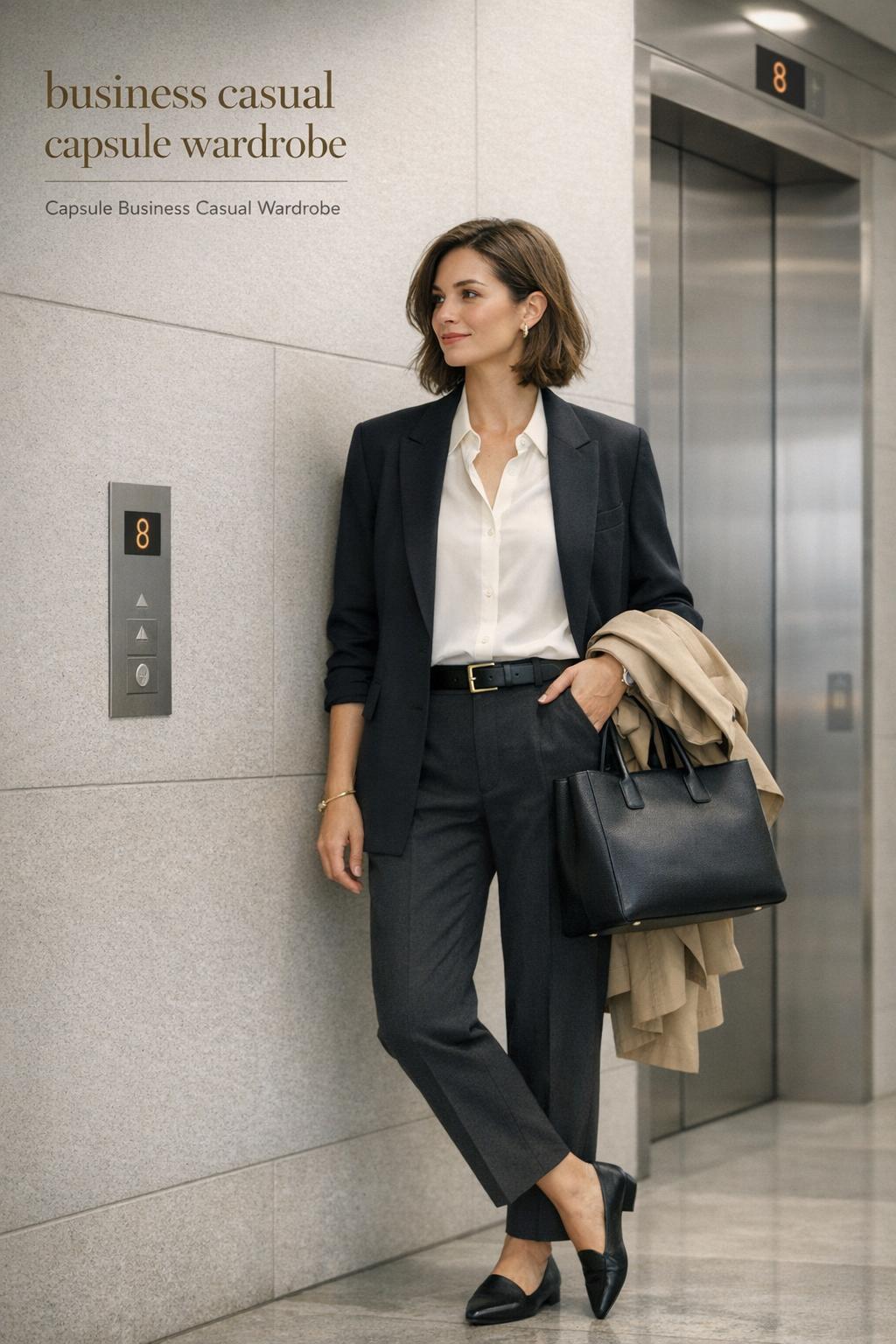
What “business casual” means in U.S. offices in 2026 (and why it’s not one look)
In practice, business casual is a range, not a single uniform. At one end, it’s close to traditional office dressing—structured blazers, tailored trousers, button-downs, sleek footwear like pumps. At the other end, it borrows from relaxed everyday style—quality tees under an oversize blazer, midi skirts with structured flats, or easy dresses paired with a practical tote. The key is that the overall impression remains intentional and work-ready: clean lines, thoughtful proportions, and pieces that hold their shape through a full day.
A capsule wardrobe is the strategy that makes this range manageable. Instead of building outfits from dozens of disconnected items, you curate a small set that mixes effortlessly. That’s why “business casual” and “capsule wardrobe” show up together so often: the capsule creates consistency, while business casual provides the guardrails for appropriateness.
Your wedding has a lot of moving pieces. Your plan can still feel composed.
Zarellea organizes guests, vendors, budget, and timelines in one shared space — so you can make decisions with clarity, not stress.
One practical way to think about business casual is to ask: “Would this look right in an office hallway at 2 p.m. on a random Tuesday?” If the answer is yes, it’s likely within the business casual threshold. If it’s only comfortable on a casual Friday, it may still belong in your closet—but it shouldn’t be a core capsule item unless your workplace truly runs casual all week.
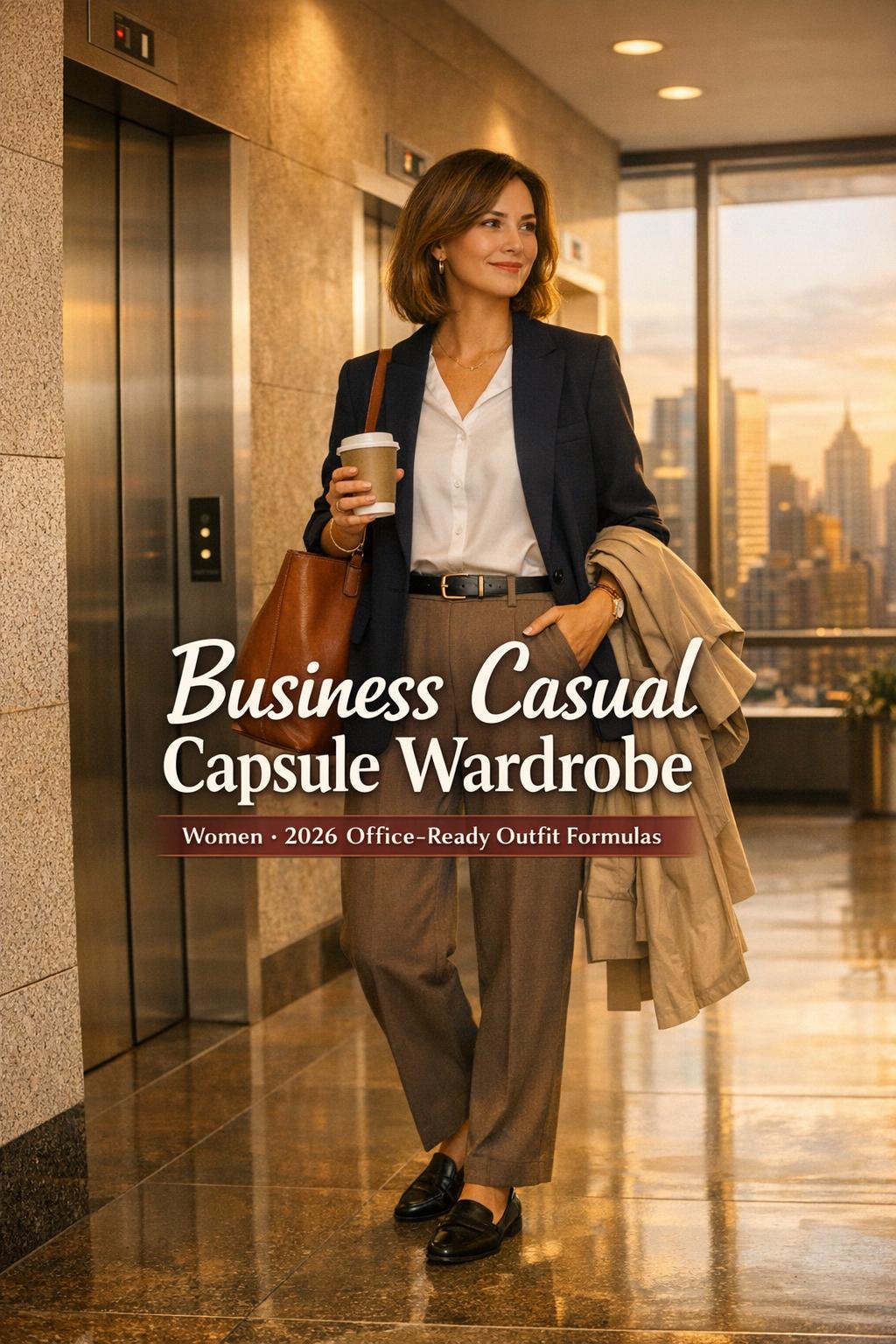
The capsule logic: build around outfit archetypes, not one-off purchases
The strongest capsule wardrobes are built from archetypes—the repeatable building blocks that show up across modern workwear. Across the most useful business casual capsule wardrobes, the same categories keep proving their value: relaxed or tailored trousers, button-downs and polished tops (including silk blouses), structured outerwear like blazers or a trench coat, versatile dresses, and office-friendly shoes (loafers, pumps, structured flats, and even strappy sandals in warm months).
Thinking in archetypes makes shopping and styling more grounded. Instead of chasing a specific “perfect” item you saw once, you’re filling a functional role in your wardrobe—like “a blazer that elevates tees and dresses” or “trousers that balance a lightweight top.” This is also the difference between a closet full of clothes and a work outfit capsule wardrobe that actually delivers outfits on busy mornings.
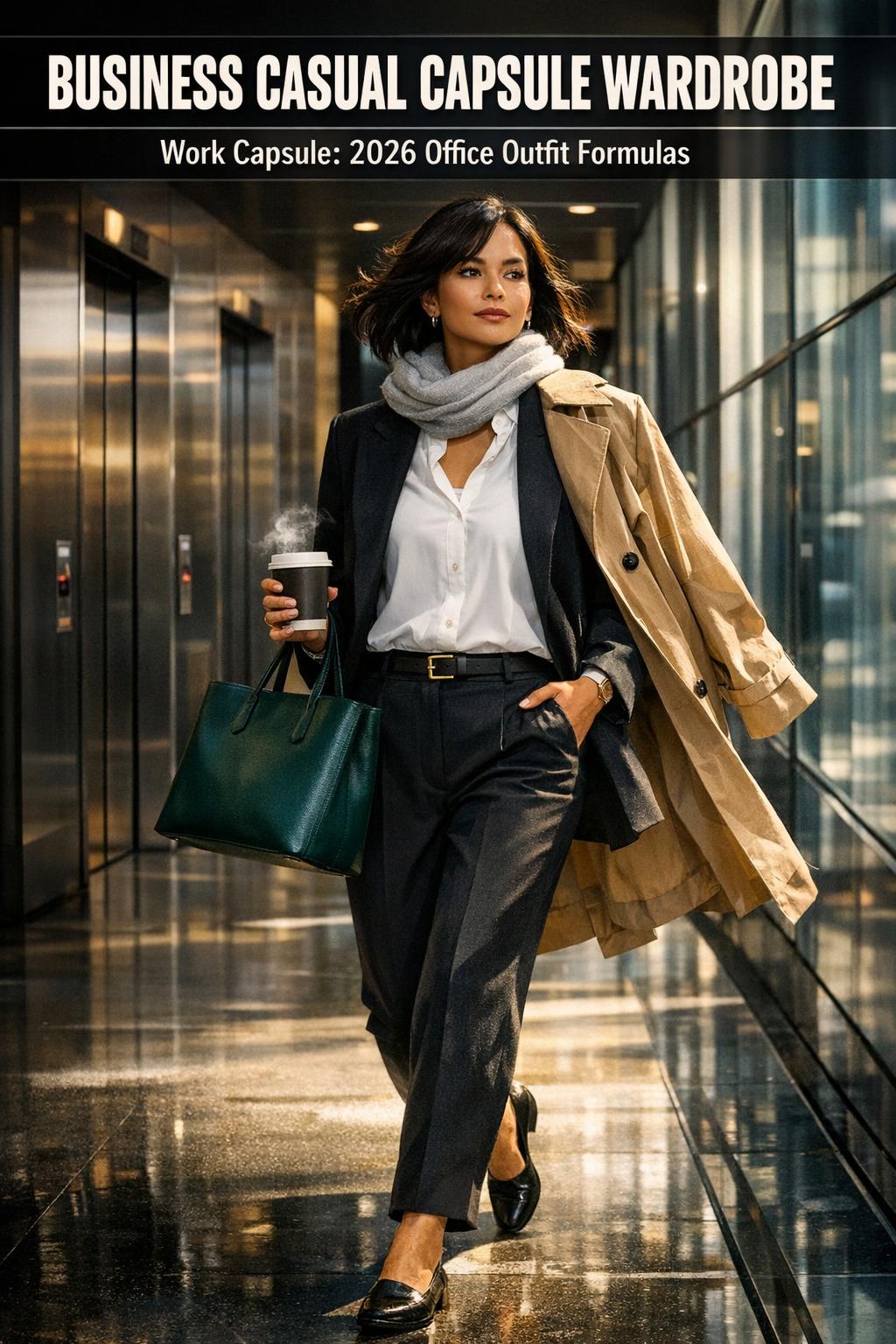
A 12–14 piece core that still feels like you (business casual capsule wardrobe women included)
You’ll see capsules that run 16 pieces with 40+ outfits, and you’ll also see larger guides that list 35 essential pieces. Both approaches can work. If you want the smallest core that still reads polished in most U.S. office settings, aim for 12–14 essentials. It’s enough variety for repetition to feel intentional, not noticeable—especially if you choose pieces that can dress up or down.
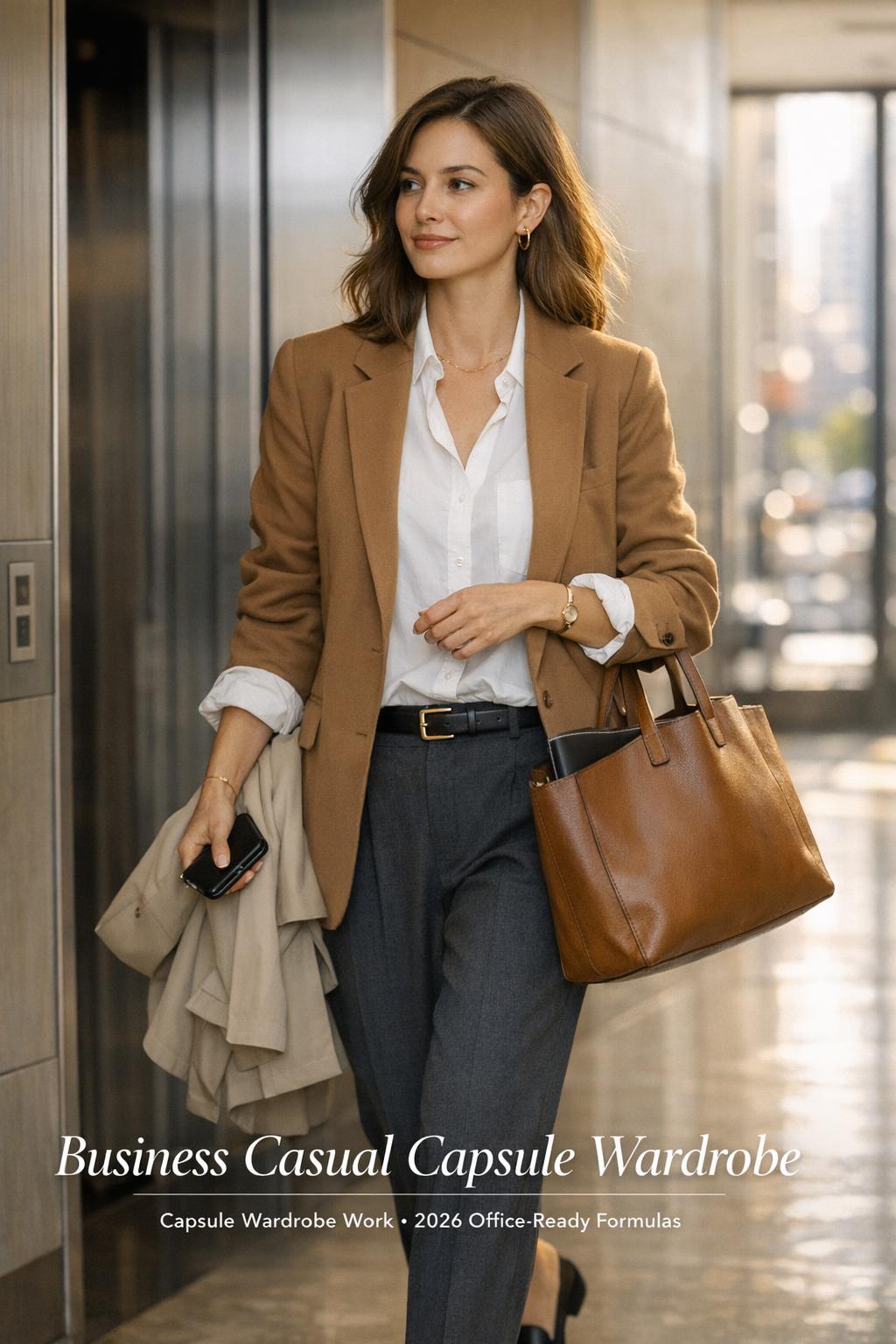
- 2–3 polished tops (a button-down and/or silk blouse, plus a lightweight top)
- 1–2 quality tees (useful under blazers or with midi skirts)
- 2 pairs of trousers (one more tailored, one more relaxed)
- 1 skirt option (often a midi skirt; a pencil skirt also fits many offices)
- 1 easy dress (office-appropriate and comfortable for long days)
- 1 oversize or structured blazer (the “instant polish” layer)
- 1 sleek outerwear option like a trench coat for transition weather
- 2 shoe types (structured flats and loafers are the most flexible; add pumps if your role is more formal)
- 1 practical carryall (a tote or work bag that handles daily essentials)
- 1–2 accessories (a belt or simple jewelry to finish without overcomplicating)
This core is intentionally neutral about gender presentation, but it maps especially well to business casual capsule wardrobe women searches because it includes the most-requested categories: dresses, midi skirts, polished tops, and versatile flats. It also respects how many people actually dress for work now: not rigidly formal, but still professional and put-together.
The pieces, explained: what to look for and why each one earns its spot
Relaxed trousers vs. tailored trousers: the balancing act
Relaxed trousers are a modern anchor because they offer comfort without signaling “weekend.” Tailored trousers remain the sharp option for meeting-heavy days. The best capsule includes both because they solve different problems: relaxed trousers pair naturally with button-downs, quality tees, and oversize blazers; tailored trousers create immediate authority with polished tops and sleek outerwear. If you only pick one, choose based on your office’s baseline—more formal offices reward tailoring, while more flexible workplaces make relaxed trousers the daily hero.
Button-downs, silk blouses, and “polished tops” that don’t feel fussy
Polished tops are the quiet workhorses of capsule wardrobe work dressing. A button-down reads crisp and works across roles; a silk blouse (or similar elevated top) adds softness and drape without sacrificing professionalism. Lightweight tops are valuable for layering under blazers or trench coats and for handling office temperature swings. In a capsule, you’re not collecting dozens of tops—you’re choosing a few that coordinate with every bottom you own.
Tip: When a top feels “hard to wear,” it’s often because it only works with one bottom. Before buying, picture it with your trousers, your midi skirt, and under your blazer. If it doesn’t play well with at least two of those, it’s not a capsule piece—it’s a special-occasion item.
Quality tees: the business casual upgrade you’ll use weekly
Business casual now frequently includes a tee—when the tee is high quality and the rest of the outfit is structured. This is where an oversize blazer, tailored trousers, or a midi skirt does the heavy lifting. The tee keeps the outfit comfortable and modern; the structure keeps it office-appropriate. If your workplace is more conservative, reserve tees for days without client meetings and lean on button-downs and polished tops for higher-stakes moments.
Midi skirts and pencil skirts: movement, polish, and versatility
Skirts earn their place in a work capsule because they create easy outfit variety with minimal effort. Midi skirts are particularly versatile: they can feel modern with structured flats or loafers, and they’re often comfortable for a full day of sitting, standing, and commuting. Pencil skirts tilt more traditional and can look especially sharp with a button-down or silk blouse. Whichever you choose, the capsule rule is the same: it should work with your blazer and at least two of your tops.
Easy dresses: the one-piece solution for overloaded days
Easy dresses are a core entity in business casual capsule wardrobes for a reason: they create a finished look in one step. For real-world wear, prioritize a silhouette that layers well with a blazer or trench coat and pairs with structured flats. Dresses also help when you want to look polished without assembling separates—ideal for presentations, travel days, or any morning when you’d rather keep decisions minimal.
Oversize blazers, structured blazers, and sleek outerwear
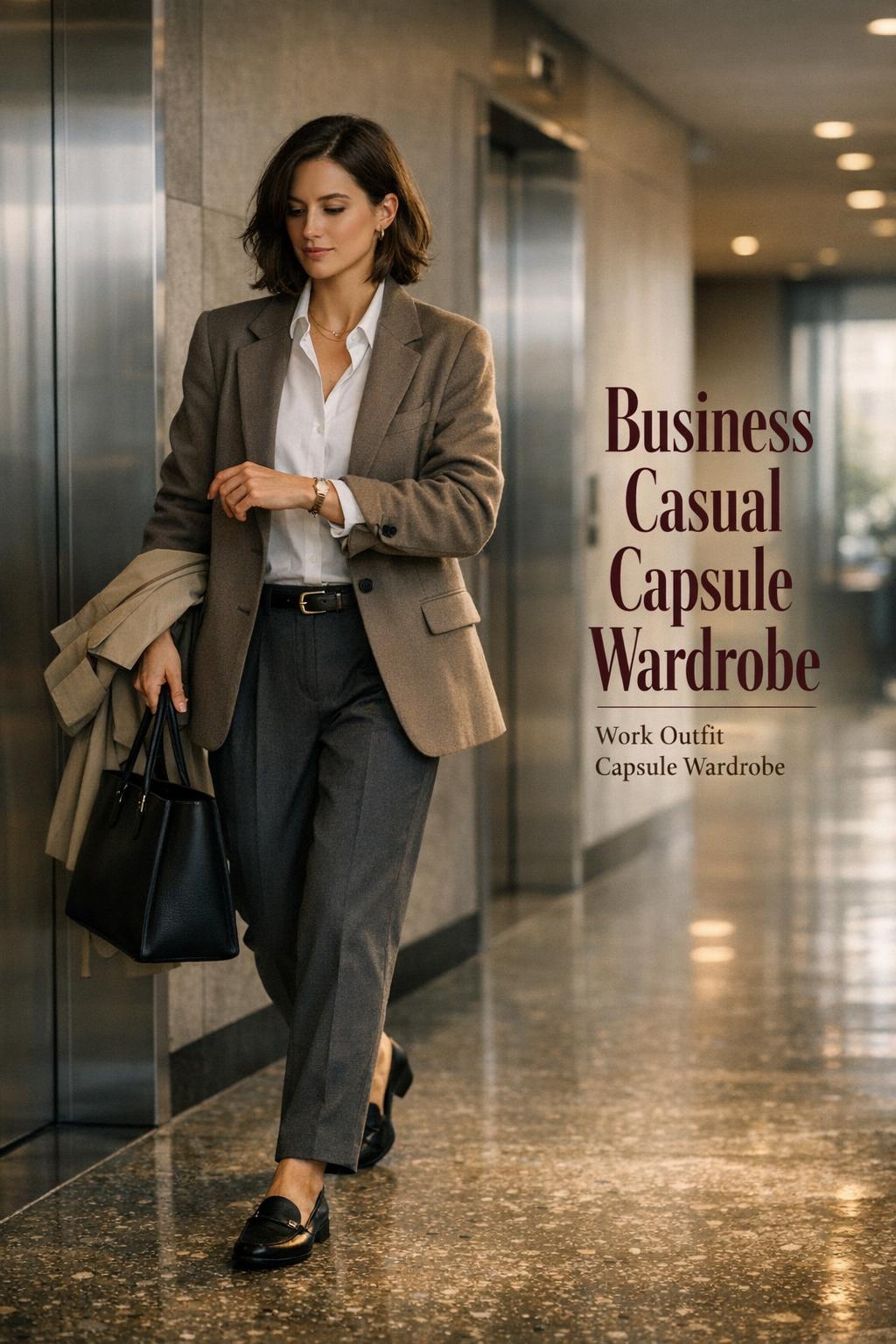
A blazer is the capsule’s credibility piece. An oversize blazer can modernize trousers, tees, and dresses; a structured blazer can make even simple outfits look intentional. A trench coat adds another layer of polish—especially during seasonal transitions when a heavy coat feels too much but you still need a top layer that looks office-ready.
Tip: If your blazer feels “wrong,” check proportion before you blame the item. Oversize blazers typically need a cleaner line underneath (a tucked top, a sleeker trouser, or a fitted dress). Structured blazers can handle more volume underneath, but they still look best when the outfit has one clear focal point, not competing shapes everywhere.
Footwear that respects the office: loafers, pumps, structured flats, and strappy sandals
Shoes decide whether an outfit reads “work” or “weekend.” Loafers are a backbone choice because they balance comfort and polish, and they work with trousers, midi skirts, and dresses. Pumps are useful when you need a sleeker finish. Structured flats hit the sweet spot for daily wear and look particularly sharp with tailored pieces. Strappy sandals can fit warm-weather business casual, especially when the rest of the outfit is grounded in office staples like relaxed trousers, button-downs, and a practical carryall.
Practical carryalls and the accessories that do the most with the least
A practical carryall—often a tote—matters because it’s part of the silhouette. In business casual, your bag is visible in elevators, meetings, and hallways, and it contributes to the overall impression of being pulled together. Accessories should be few but intentional: a belt can sharpen trousers and define shape over dresses; simple jewelry can elevate a tee-and-blazer day without turning your capsule into a styling project.
Color, fabric, and fit: the behind-the-scenes rules that make a capsule feel cohesive
Most capsule frustrations aren’t about not owning enough clothes—they’re about pieces that don’t “talk” to each other. Cohesion comes from three quiet decisions: a consistent color palette, reliable fabrics, and fit that supports your day.
Color doesn’t need to be complicated. Many work capsules rely on a neutral base with one or two accent tones. The benefit is practical: when your trousers, blazer, and shoes live in a compatible range, your tops can rotate without requiring new purchases. This is also why so many editorial capsules can generate 40+ outfits from 16 pieces or expand 28 pieces into 60 outfits—compatibility does the math.
Fabric choice is where business casual succeeds or fails in real life. The office is a long-wear environment: you’re sitting, walking, commuting, and moving between temperatures. Prioritize fabrics that hold shape and feel comfortable for hours. A silk blouse can look polished but may require more care; cotton shirts and quality tees are easier day-to-day. Outerwear like blazers and trench coats is where structure matters—these pieces often define whether your outfit reads professional.
Fit is the final layer. A capsule works best when each piece has a clear role and sits well on the body. If something is constantly being tugged, slouched, or adjusted, you’ll avoid it—no matter how “essential” it’s supposed to be.
Tip: Before adding new items, do a quick fit audit on your current favorites. Identify what you love about them (waist placement, sleeve length, drape). Use that as your standard for future purchases so your capsule becomes more consistent over time.
Seasonal edits that feel realistic: from spring/summer to fall/winter (U.S. climate aware)
Seasonal dressing is where many people abandon their capsule—only because they try to rebuild from scratch. A more sustainable approach is to keep the same core and make targeted edits: swap fabrics, add one or two layers, and rotate footwear. This keeps your capsule wardrobe work system intact while still respecting weather.
Spring and summer: keep structure, lighten the feel
Warm-weather business casual is easiest when you maintain structure somewhere in the outfit. If you’re wearing strappy sandals, keep the rest polished: relaxed trousers with a button-down, or an easy dress with a blazer for chilly office air. Lightweight tops become more important here, especially for layering under outerwear when mornings are cool and afternoons are hot.
Fall and winter: layering without bulk (and why fall capsules are so popular)
Fall business casual capsules show up again and again because the season naturally supports layering: blazers look right, trench coats shine, and trousers become daily uniform pieces. If you’ve ever followed the “turn a set of pieces into 60 outfits” approach, fall is where it feels most believable—because you can repeat the same base outfit and change the top layer, shoe, or accessory and still look intentional.
In colder months, the trick is avoiding bulky layers that distort your silhouette. Keep your base streamlined—tailored trousers or a midi skirt with a polished top—and use your blazer or trench coat as the main warmth-and-polish layer when appropriate. The goal is to stay comfortable without losing the clean lines that define business casual.
Location and office culture: how the same capsule reads in NYC, SF, Chicago, and Dallas
A business casual capsule wardrobe doesn’t exist in a vacuum; it lives inside local expectations. Even within the U.S., office norms can vary widely. A helpful way to plan is to identify your workplace’s “polish baseline,” then build a capsule that can flex one step more formal or one step more relaxed.
Consider four familiar context anchors that show up in modern workwear conversations: New York (NYC), San Francisco (SF), Chicago, and Dallas. These aren’t rigid style rules, but they help illustrate how to calibrate a capsule without changing the entire formula.
- NYC-style baseline: You may lean into structured pieces—tailored trousers, a sharp blazer, polished tops like silk blouses, and sleek footwear such as pumps or structured flats.
- SF-style baseline: The capsule might emphasize comfort-forward polish—quality tees under an oversize blazer, relaxed trousers, loafers, and a practical carryall.
- Chicago-style baseline: A trench coat and versatile outerwear become especially useful for transitions; trousers and layered tops help you stay office-ready through changing conditions.
- Dallas-style baseline: Warm-weather flexibility matters—lightweight tops, easy dresses, and office-appropriate sandals can play a bigger role, anchored by structured elements so the look stays professional.
The takeaway: don’t copy someone else’s capsule item-for-item. Copy the structure—tops, bottoms, blazer, outerwear, shoes, carryall—then calibrate the “formality dial” to your office and region.
Mix-and-match in the real world: outfit formulas that survive a full workday
Outfit formulas are where a capsule becomes practical. They’re not rigid rules; they’re templates you can repeat with small changes. Many guides show how a capsule generates dozens of outfits (including 16 example business casual outfits from one capsule). The reason it works is simple: when your pieces are compatible, swapping one top or one shoe changes the mood without changing the level of professionalism.
Below are formula-style ideas you can adapt to your own closet. Instead of listing “Outfit 1–16,” use these like a menu—choose what matches your day’s demands.
- Meeting-ready structure: tailored trousers + silk blouse + structured blazer + pumps or structured flats.
- Everyday polished: relaxed trousers + button-down (tucked or half-tucked) + loafers + practical carryall.
- Modern business casual: quality tee + oversize blazer + midi skirt + structured flats.
- One-and-done: easy dress + blazer (optional) + loafers or flats.
- Warm-weather office day: relaxed trousers + lightweight top + strappy sandals + carryall (add a blazer for cold A/C).
- Transition-weather commute: tailored trousers + button-down + trench coat + loafers.
Tip: If you’re aiming for a true work capsule, build your formulas around the items you’ll wear on your most demanding days. Then create one “relaxed” formula for lighter days. This prevents the classic capsule problem: owning pieces you love, but not the pieces you actually need for the office.
Common mistakes that quietly break a work capsule (and how to fix them fast)
Most capsule wardrobe issues don’t look like “bad style.” They look like wasted potential: pieces that should work but don’t. The fixes are often small—one swap, one layer, one better pairing.
Mistake: buying items that only work with one outfit
This is the fastest way to end up with a closet full of clothes and nothing to wear. The fix is a compatibility test: each new item should pair with at least two tops and two bottoms (or, for a dress, it should work with both your blazer and your trench coat). That’s how a capsule stays efficient.
Mistake: skipping outerwear and expecting outfits to feel finished
In business casual, outerwear isn’t just for warmth—it’s a polish layer. If outfits feel “unfinished,” it’s often because you don’t have a reliable blazer or trench coat. The fix is to invest attention here: a blazer that fits your shoulders and a trench coat that works with your work shoes can elevate nearly everything else.
Mistake: building a capsule around “ideal life” instead of actual office days
If your calendar includes presentations, client calls, or leadership meetings, your capsule needs at least one meeting-ready formula you can reach for without thinking. If your office is more relaxed day-to-day, you still need pieces that hold you up when you want to look sharper. The fix is to map your week: pick the most common day type and the most demanding day type, then ensure both are supported.
Mistake: not addressing the jeans question honestly
Many people ask, “Can I include jeans in my business casual capsule wardrobe?” The practical answer depends on your workplace norms. If jeans are part of your office’s standard business casual (not just casual Friday), they can be included. If jeans are an occasional exception, treat them as optional—not a core capsule anchor—so your capsule still performs on any given Tuesday.
Shopping with intention: brands, price tiers, and how to keep the capsule coherent
A business casual capsule wardrobe often becomes shopping-forward because people want examples. Brands can also be helpful shorthand for style direction: J.Crew and Theory are often associated with polished work staples; Mango and Zara can provide trend-aware silhouettes like oversize blazers; Madewell is frequently linked to modern essentials; H&M and Gap show up in accessible wardrobe building; Vince can signal understated polish; Reformation and Staud appear in outfit-driven edits; Quince and Open Edit appear in capsule-friendly recommendations; Nanushka is referenced in the context of elevated, fashion-forward pieces. Treat brand examples as starting points, not rules.
To keep your work outfit capsule wardrobe coherent across price points, decide what you’re willing to repeat most often. Many people choose to prioritize the pieces that anchor the outfit’s structure—blazers, trousers, and shoes—then save on tops and accessories. Others reverse it because they want variety near the face (tops) while keeping bottoms consistent. Either can work if the overall capsule stays compatible.
Budget, mid-range, and investment: a practical way to split the list
A balanced capsule usually mixes tiers. Accessible retailers like H&M and Gap can help you test silhouettes—like whether you prefer relaxed trousers or a midi skirt in daily rotation—before you commit. Mid-range brands like J.Crew, Madewell, Mango, Zara, and Quince often appear in capsule wardrobes because they offer a wide spread of work-friendly pieces. For investment-leaning staples, names like Theory and Vince tend to be associated with refined workwear polish. The right mix is the one that you’ll wear consistently; a capsule only “works” when it gets used.
Tip: When you’re tempted by a single standout item, pause and ask what role it would play in your capsule wardrobe work system: is it a top that will rotate weekly, or is it a special piece that needs a very specific day? Both can be worthwhile, but only the first belongs in the core capsule count.
Fit, alterations, and tailoring: the professional polish multiplier most people skip
If there’s one factor that consistently separates “fine” from “exceptionally put-together” in business casual, it’s fit. Tailoring and alterations can make even simple pieces—trousers, midi skirts, blazers—look intentional. This is especially important in capsule dressing because you repeat items more often; the better they fit, the more expensive and professional the entire capsule appears.
Think of tailoring as a way to protect your capsule from small annoyances that reduce wear: trousers that puddle at the hem, sleeves that swallow your hands, a blazer that pulls at the shoulders. You don’t need to tailor everything. Prioritize the pieces that define structure: blazers, trousers, and the dress you rely on when you need a one-step polished look.
Tip: If you’re unsure what to alter first, start with trouser length and blazer sleeves. These are the details people notice subconsciously, and they have an outsized effect on whether an outfit reads clean and professional.
Sustainability in a capsule wardrobe: buy fewer pieces, wear them harder, replace them smarter
A capsule wardrobe naturally leans toward a more sustainable mindset because it rewards longevity. The goal isn’t perfection; it’s fewer, better decisions over time. When you build a capsule business casual wardrobe around timeless silhouettes—trousers that don’t feel dated quickly, blazers that work with tees and button-downs, dresses that layer across seasons—you reduce the urge for constant replacement.
Durable fabrics and consistent care habits matter here, even if you’re mixing price tiers. A silk blouse can be a beautiful capsule piece if you’ll actually wear it and care for it; cotton shirts and quality tees can carry a lot of days with less fuss. The practical carryall and shoes also benefit from durability because they see heavy rotation. Sustainability in a work capsule is ultimately about realism: choose what you’ll repeat, choose what holds up, and build slowly so each new item has a clear purpose.
A two-week “fast-fail” build: how to start a capsule wardrobe work system without overcommitting
Many people delay building a capsule because it feels like a big project. A more effective method is a short trial that reveals what’s missing quickly. Over two weeks, aim to wear only your most office-reliable items and track friction points: what you keep wishing you had, what doesn’t mix, what feels off for meetings. This is how you build a work capsule based on evidence from your own days, not an idealized list.
- Days 1–3: repeat two bottoms (trousers or skirt) with your best tops; note what combinations feel the most “you.”
- Days 4–7: add your blazer or trench coat daily; observe which outfits instantly look more professional.
- Week 2: stress-test with one meeting-ready formula and one more relaxed formula; notice where shoes or accessories change the feel the most.
- End of week 2: choose just one gap to fill first (often shoes, a blazer, or a polished top).
This approach protects your budget and your closet space. If the capsule idea doesn’t match your workplace reality, you’ll learn that quickly—and adjust the plan without ending up with a pile of “should” pieces you never reach for.
Practical checklist: keep your business casual capsule wardrobe running smoothly
Once you have a core set, the maintenance becomes simple: rotate, refresh, and refine. Use this checklist to keep the system functional across seasons and schedule changes.
- Confirm you have at least one meeting-ready outfit formula you can assemble in under five minutes.
- Ensure every top works with at least two bottoms, and every bottom works with at least three tops.
- Keep one “temperature swing” layer ready (blazer or trench coat) for unpredictable office climates.
- Check shoe rotation: if one pair is doing all the work, add a second option (loafers, pumps, or structured flats).
- Reassess once per season: swap in lightweight tops or add outerwear as needed rather than rebuilding the capsule.
A capsule is not a static wardrobe. It’s a living system that gets better as you learn what your office actually rewards: structure, consistency, and a sense of ease.
FAQ
What is a business casual capsule wardrobe, and how is it different from a regular capsule wardrobe?
A business casual capsule wardrobe is a small, curated set of mix-and-match pieces chosen specifically to meet office-appropriate expectations, using staples like trousers, blazers, button-downs, polished tops, versatile dresses, and work-ready shoes; a general capsule wardrobe can be more casual or lifestyle-focused and may not reliably cover professional settings.
How many pieces should a work capsule include?
Many people succeed with a tight 12–14 piece core for daily business casual, while others prefer structured plans like 16 pieces that can create 40+ outfits or broader guides that include up to 35 essentials; the best number is the smallest set that consistently covers your real office week without leaving you short on meeting-ready options.
Can I include jeans in my business casual capsule wardrobe?
You can include jeans if your workplace norms treat jeans as standard business casual (not just casual Friday), but if denim is only occasionally acceptable, it’s better kept as an optional item so your capsule still performs for typical midweek expectations.
What shoes work best for business casual without feeling too formal?
Loafers and structured flats are the most flexible choices because they pair well with trousers, midi skirts, and easy dresses while staying polished; pumps are useful for more formal moments, and strappy sandals can work in warm weather when the rest of the outfit is anchored by structured, office-appropriate pieces.
How do I make a capsule wardrobe look professional if I prefer comfortable outfits?
Use comfort-forward basics like relaxed trousers and quality tees, then add structure through an oversize or structured blazer, office-friendly shoes like loafers, and a practical carryall; the comfort comes from the base layer, and the professional signal comes from the structured pieces.
What are the most common mistakes when creating a capsule wardrobe for work?
The biggest mistakes are buying items that only work with one outfit, skipping key outerwear like blazers or trench coats that make outfits look finished, and building around an “ideal life” instead of your actual office schedule, which can leave you without reliable formulas for meeting-heavy days.
How do I adapt my capsule wardrobe work pieces for fall and winter?
Keep the same core items and make seasonal edits by leaning more on blazers, trench coats, and trousers, rotating footwear toward loafers and closed-toe options, and using layering to stay comfortable while maintaining clean lines so outfits don’t feel bulky.
Which brands are commonly used as examples for building a business casual capsule wardrobe?
Common examples span accessible to investment-leaning options, including J.Crew, Gap, H&M, Mango, Zara, Madewell, Quince, Open Edit, Theory, Vince, Reformation, Staud, and Nanushka, which are often referenced to illustrate different capsule categories like blazers, trousers, polished tops, and dresses.
Leave a Reply