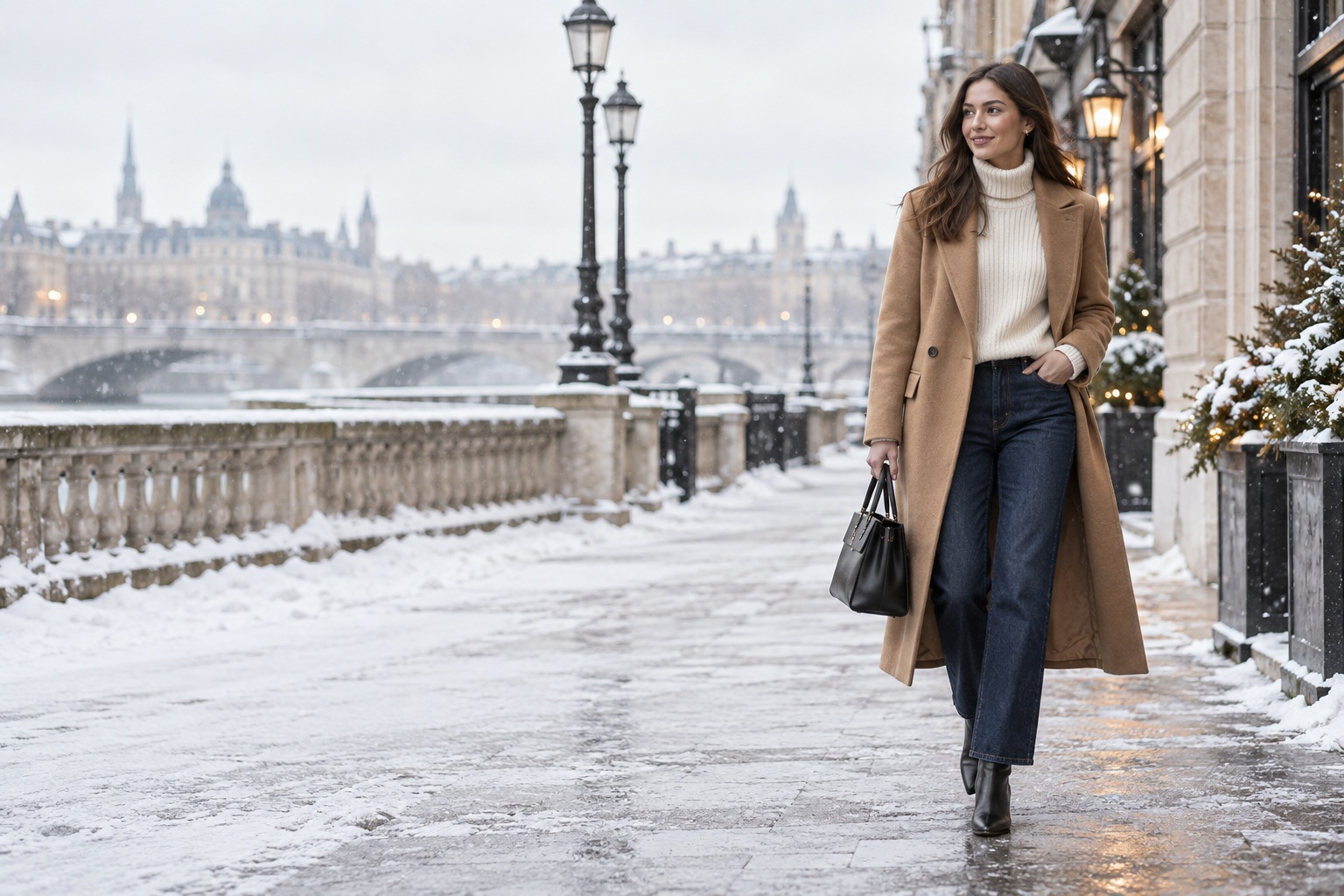
A jeans outfit winter problem usually starts with a familiar sentence: you have the jeans, but every cold-weather look turns into the same sweater, coat, and boots. The answer is not another long list of outfits. It is a better way to choose. When you decide what the outfit needs to do first, the same denim can look relaxed for errands, composed for work, or more intentional for dinner.
This guide compares five practical routes instead of declaring one perfect formula. You will match the jean shape to the shoe, decide whether the coat should add structure or volume, and use one visible contrast to keep the result from looking accidental. The goal is a warm outfit that still has a clear point of view when you remove the coat indoors.
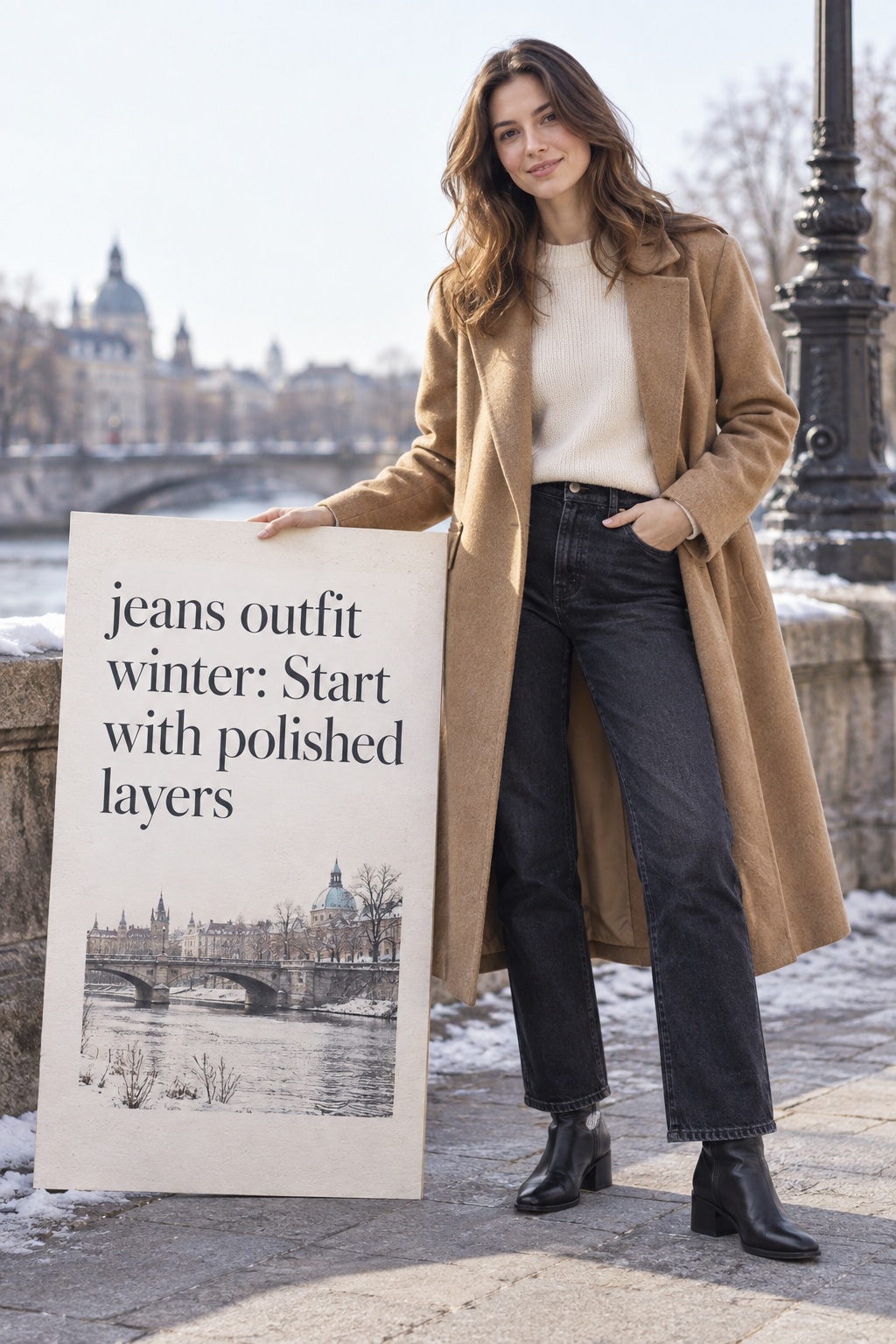
Use what is already in your closet. Blue, black, white, gray, and relaxed denim can all work in winter when the layers are ordered well. A wool coat can stand in for a tailored jacket, a cardigan can replace a sweater, and a weather-ready boot can replace a dressier shoe when the ground demands it. The formula is more useful than a shopping list.
Start with the decision: warmth, polish, and movement
Before you pull a pair of jeans from the closet, name the day. Are you walking outside for twenty minutes, moving between a heated office and the street, sitting at a restaurant, or trying to stay comfortable through a casual weekend? These situations can all use denim, but they do not need the same coat, shoe, or amount of layering.
Your wedding has a lot of moving pieces. Your plan can still feel composed.
Zarellea organizes guests, vendors, budget, and timelines in one shared space — so you can make decisions with clarity, not stress.
Choose the job before the aesthetic
Warmth comes from the whole system, not from a single heavy item. A thin base layer under a fine knit can be easier indoors than one bulky sweater. A long coat protects more of the outfit while a short jacket lets the jeans and shoes do more visual work. A pair of socks that fills the gap above a boot may matter more than adding another scarf.
- For long outdoor stretches, prioritize a substantial coat, covered ankles, and a stable sole.
- For office or restaurant days, use removable layers so the outfit still looks balanced without the coat.
- For casual weekends, let texture or one relaxed piece create interest while the shoes keep the hem practical.
- For a dressier plan, keep the denim simple and let the coat, bag, or boot provide the polish.
This small diagnosis prevents a common styling mistake: building an attractive outfit that fails the day. If you will spend most of the time indoors, a giant sweater under a giant coat may become uncomfortable. If you will walk through slush, delicate flats and a cropped hem may create constant maintenance. The best look is the one you can actually wear as planned.
Let the denim set the proportion
Think of the jeans as the first line in the outfit’s silhouette. Straight legs create a calm column. Wide legs bring movement and need an intentional top edge. Slim jeans leave room for volume above them and can tuck into taller boots. Bootcut and flare shapes want a shoe that can disappear under the hem or show as a deliberate point.
Color changes the message too. Dark indigo and black feel naturally crisp with wool, leather, and tailored pieces. Medium blue is easy with cream, camel, gray, and brown. Light wash denim can look winter-ready when the surrounding layers are substantial, such as a shearling jacket, dark knit, or long coat. White jeans need contrast from texture and footwear rather than an apology for being light.
Match the jeans shape to the winter shoe
Shoes are where a jeans outfit winter formula either becomes convincing or starts to feel unfinished. The question is not simply whether the shoe is fashionable. It is whether the hem meets the shoe cleanly, whether the sole suits the ground, and whether the visual weight of the footwear supports the denim.
Straight-leg jeans: the flexible starting point
Straight-leg jeans work with ankle boots, loafers on dry days, sneakers, and low-profile lug soles. A hem that ends just above or at the boot can look neat, while a longer hem can skim the shoe for a more relaxed line. Pair them with a long coat when you want a vertical silhouette, or with a shorter jacket when you want the jeans to remain the center of the outfit.
Wide-leg jeans: support the volume
Wide denim looks best when the shoe has enough presence to keep the hem from appearing heavy. A sturdy boot, platform sneaker, or pointed toe peeking from beneath the hem can all work. Avoid letting the jeans pool over a very delicate shoe unless the softness is deliberate. Keep the upper half edited: a fitted mock neck, a tucked fine knit, or a shorter coat gives the wider leg room to read.
Slim and cropped jeans: use the ankle as a design line
Slim jeans can tuck into tall boots, which makes them useful on wetter days when you want to protect the hem. They also work with ankle boots when the opening sits close to the leg. Cropped jeans need a deliberate transition at the ankle. Match the sock to the shoe for a longer line, or use a visible contrasting sock when the rest of the outfit is simple.
Bootcut and flare jeans: finish the line
Bootcut and flare jeans generally want a shoe that adds a little height or stays mostly hidden beneath the hem. A pointed boot creates a clean extension, while a low platform gives the jeans enough lift without turning the outfit formal. Keep the coat line clear and avoid a hem that drags through wet ground. If the jeans are long, check the full outfit in the shoes you will actually wear.
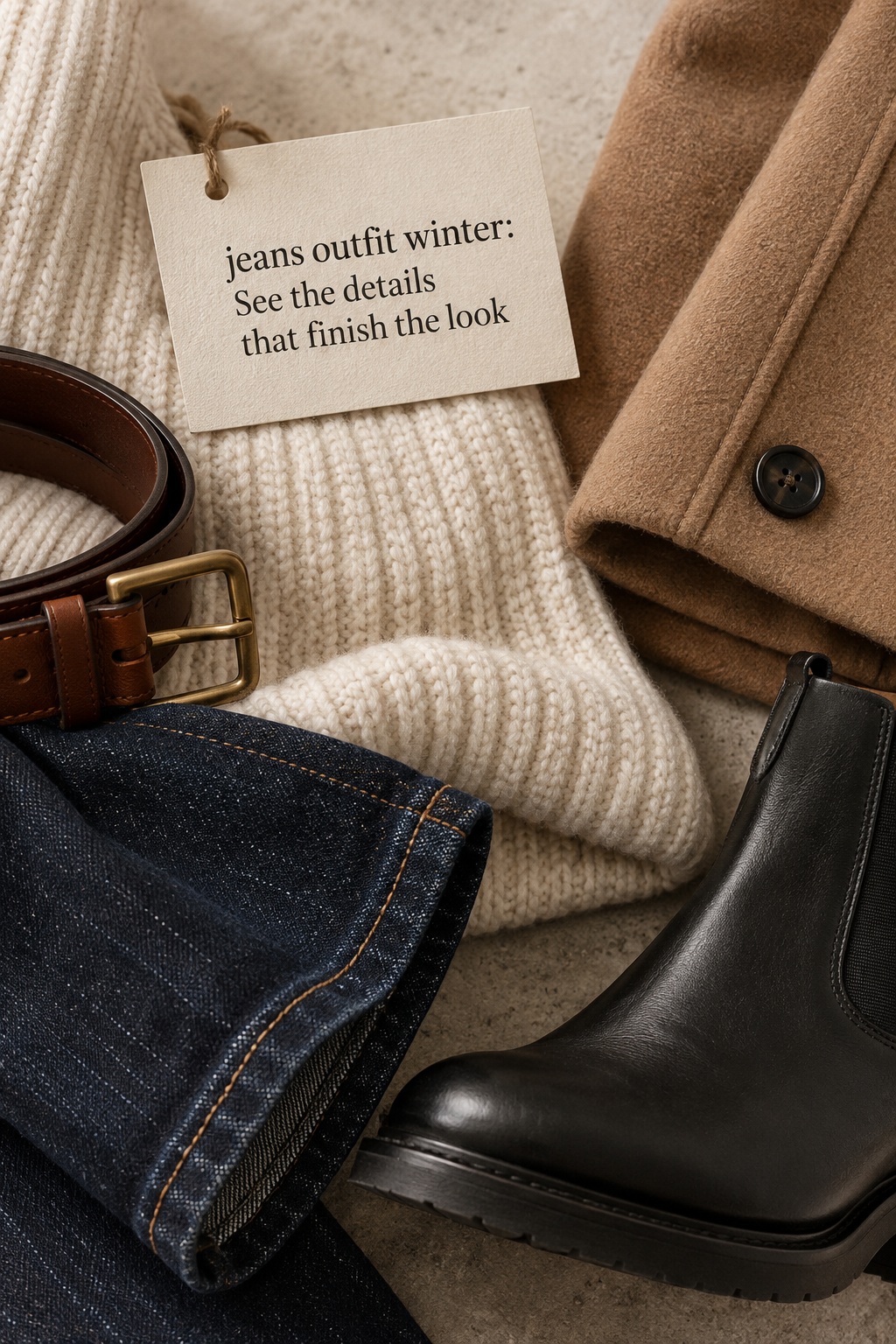
Five complete jeans outfit routes for winter
The following formulas are designed as choices, not rules. Each one solves a different styling problem. Use the first when you want quiet polish, the second when you need practical warmth, the third when texture should lead, the fourth when jeans need to look more intentional, and the fifth when you want to play with denim or pale color.
1. Long wool coat, straight jeans, and a clean ankle boot
This is the most adaptable route for work, travel days, and plans where you want to look composed without appearing overdressed. Start with straight-leg jeans in dark blue, black, or a clean medium wash. Add a fine knit or a striped base, then place a long wool coat over the top. Finish with an ankle boot whose shape is visible but not competing with the coat.
The strength of this formula is the long vertical line. Because the coat does most of the visual work, the inner layer can stay simple. Use a belt if the jeans need definition, or a small structured bag if the coat and denim feel too relaxed. Camel, charcoal, navy, and chocolate are useful coat colors because they create contrast without forcing the outfit into a single palette.
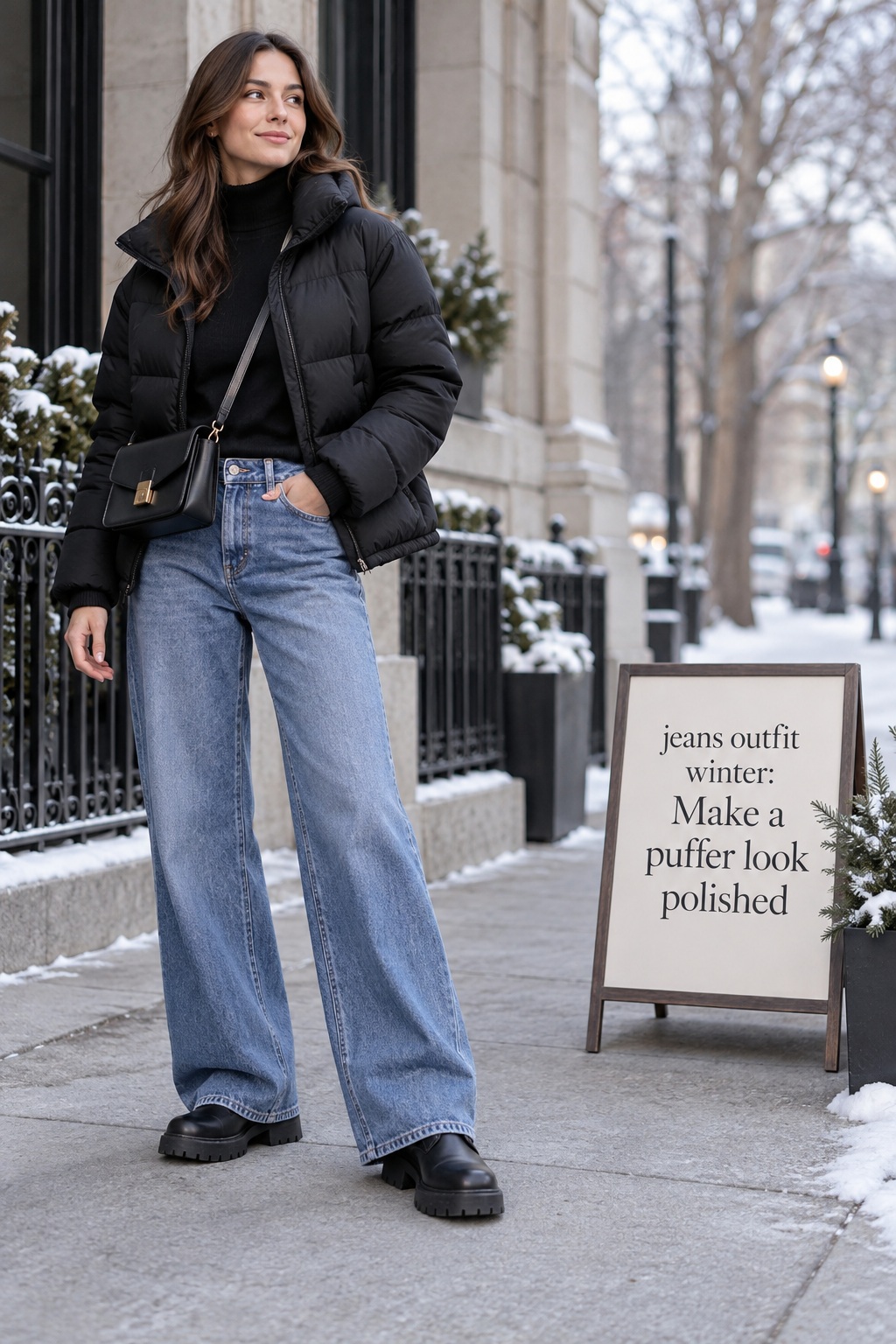
2. Elevated puffer, relaxed jeans, and a substantial sneaker or boot
Choose this route when warmth and movement matter more than formality. A puffer can look intentional when its shape is balanced by relaxed straight or wide-leg denim and a controlled base layer. Try a fine turtleneck, a close-fitting long-sleeve top, or a sweatshirt with a clean neckline. The shoe should be sturdy enough to make the lower half feel grounded.
To keep the outfit from becoming a pile of soft volume, create one firm edge. It might be a leather belt, a structured crossbody, a crisp cap, or a shoe with a defined sole. Keep the color story tight: dark jeans with a black or deep olive puffer feel streamlined, while medium or light denim can work with cream, chocolate, or muted red. If the puffer is short, let the waistband or belt show enough to make the proportion deliberate.
3. Shearling or textured jacket, light-wash jeans, and a dark boot
This is the route for days when texture should make the outfit interesting. A short shearling, faux-fur, or textured jacket pairs especially well with light-wash denim because the contrast keeps the combination from looking flat. Layer a knit hoodie, fine sweater, or simple long-sleeve top underneath. Use a dark boot to give the pale denim a clear finish.
The jacket is already a statement, so avoid adding several competing details. A large bag can work if the jacket is cropped and the jeans are relaxed, but a small shoulder bag may be better when the outer layer is voluminous. If the texture feels too casual for your plans, add a pointed toe, a belt, or a clean piece of jewelry rather than replacing the whole outfit.
4. Blazer, fine knit, dark jeans, and polished boots
Use this formula when you need denim to cross into a smarter setting. Choose dark, clean jeans with a straight, slim, or controlled wide shape. Add a fine knit or button-down shirt, then a blazer that has enough room for the layer underneath. Polished ankle boots, a belt, and a compact bag help the outfit look considered without making it feel like a costume.
Winter warmth comes from the layers beneath and above the blazer. A wool coat can go over the full combination on colder days. If the coat makes the shoulders feel crowded, use a thinner base or choose a blazer with a softer construction. Keep one element relaxed, such as an undone collar, a slightly longer hem, or a less formal bag. The contrast between tailoring and denim is what makes the route feel current.
5. Tonal white or denim-on-denim layers with one grounding accessory
This route gives familiar jeans a more editorial direction without requiring a dramatic piece. For a tonal white version, pair white or ecru jeans with a cream top, a gray or camel coat, and brown or black footwear. For denim-on-denim, use either a close wash match or a clear light-dark contrast. A black belt, dark boot, or structured bag can separate the layers and prevent the outfit from reading as one uninterrupted block.
Keep the underlayer simple. A slim turtleneck under a denim shirt, a white tee beneath a denim jacket, or a fine knit under a chore-style layer is enough. If both the jeans and jacket are relaxed, make the accessory more defined. If the denim is crisp and fitted, you can let the coat or shoe bring softness. The point is to control the relationship between the two denim pieces rather than adding more decoration.
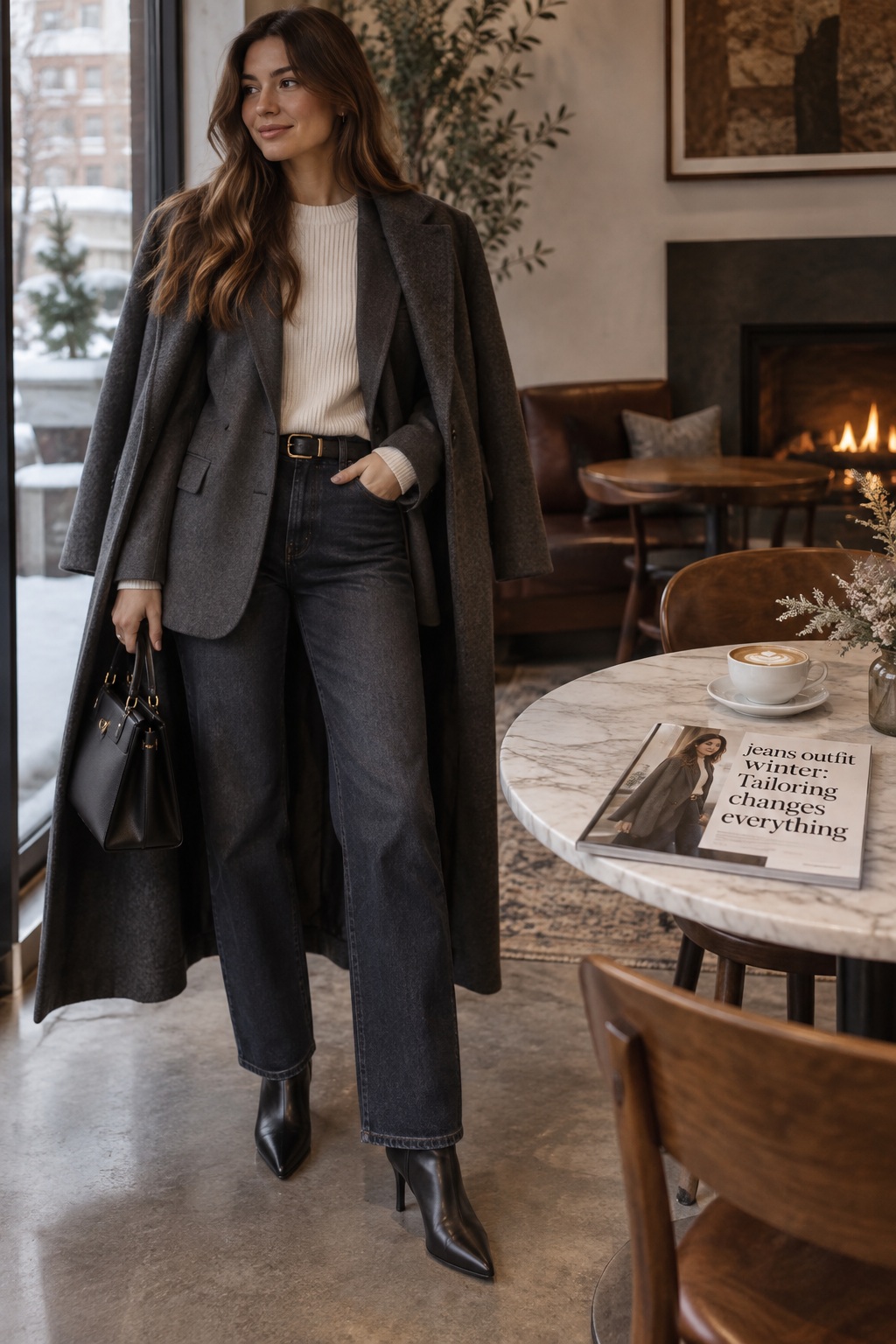
Make the formula work indoors and outdoors
The best winter outfit has a second version hidden inside it. When you enter a warm room, the coat comes off and the remaining layers should still look complete. When the temperature falls, the outer layer should add protection without destroying the proportion you built underneath.
Build from thin to substantial
Start with the closest layer to the body, then add the piece that creates the visual message, and finish with the weather layer. A thin mock neck under a cardigan under a wool coat is easier to adjust than one oversized sweater under a tight jacket. The same order works with a shirt, blazer, and puffer, as long as each layer has enough room for the next one.
Pay attention to the neckline and cuffs because they remain visible when the coat is open. A stripe, ivory collar, or small amount of color near the face can keep dark denim from feeling severe. At the wrist, a neat cuff or a fine knit sleeve looks more intentional than several thick layers competing for space.
Use texture instead of extra pieces
Denim is visually sturdy, so winter outfits benefit from a second texture. Wool, shearling, suede, leather, corduroy, ribbed knit, or a brushed scarf can add depth without adding a new color. Choose one texture to lead. If the coat is shaggy, keep the sweater smooth. If the knit is chunky, choose a simpler jacket and cleaner bag.
Let one accessory finish the argument
A belt can sharpen relaxed jeans. A scarf can connect a pale sweater to a dark boot. A bag can make a puffer feel more polished. Earrings or a visible watch can lift a basic tee and denim combination. Pick one job for the accessory instead of wearing every possible finishing piece. This keeps the outfit easy to read.
Mistakes and quick fixes
The hem puddles over the shoe
Try a shoe with more structure, a small cuff, or a different pair of jeans. Do not keep adding height to the shoe if the hem is dragging through wet ground. The practical fix may be a shorter inseam or a boot with a clean upper edge.
Every layer is oversized
Keep one edge neat. Tuck or half-tuck the knit, choose a close base layer, expose the waistband, or switch to a shorter jacket. Volume can be the point, but it needs a place to stop.
The outfit looks flat
Add contrast through texture, not a pile of accessories. A wool coat over denim, a suede boot with cotton, or a ribbed knit beside a smooth jacket can create enough depth. One warm accent color also helps, such as burgundy, camel, chocolate, or muted red.
The outfit is warm but too casual
Keep the puffer or sneaker, then add one polished element. A belt, structured bag, clean boot, neat collar, or darker denim can change the message quickly. You do not need to replace every comfortable item.
Sources and methodology
This guide was shaped by comparing ten US search results and opened page-level notes from British Vogue, Who What Wear, ELLE, and Marie Claire. The sources consistently emphasized the relationship between denim shape, outerwear, texture, and footwear. The formulas here are an original comparison framework based on those recurring styling problems, not a copy of any single outfit gallery. For additional visual context, see British Vogue’s winter jeans styling examples and ELLE’s boots and jeans combinations.
FAQ
What is the easiest jeans outfit winter formula?
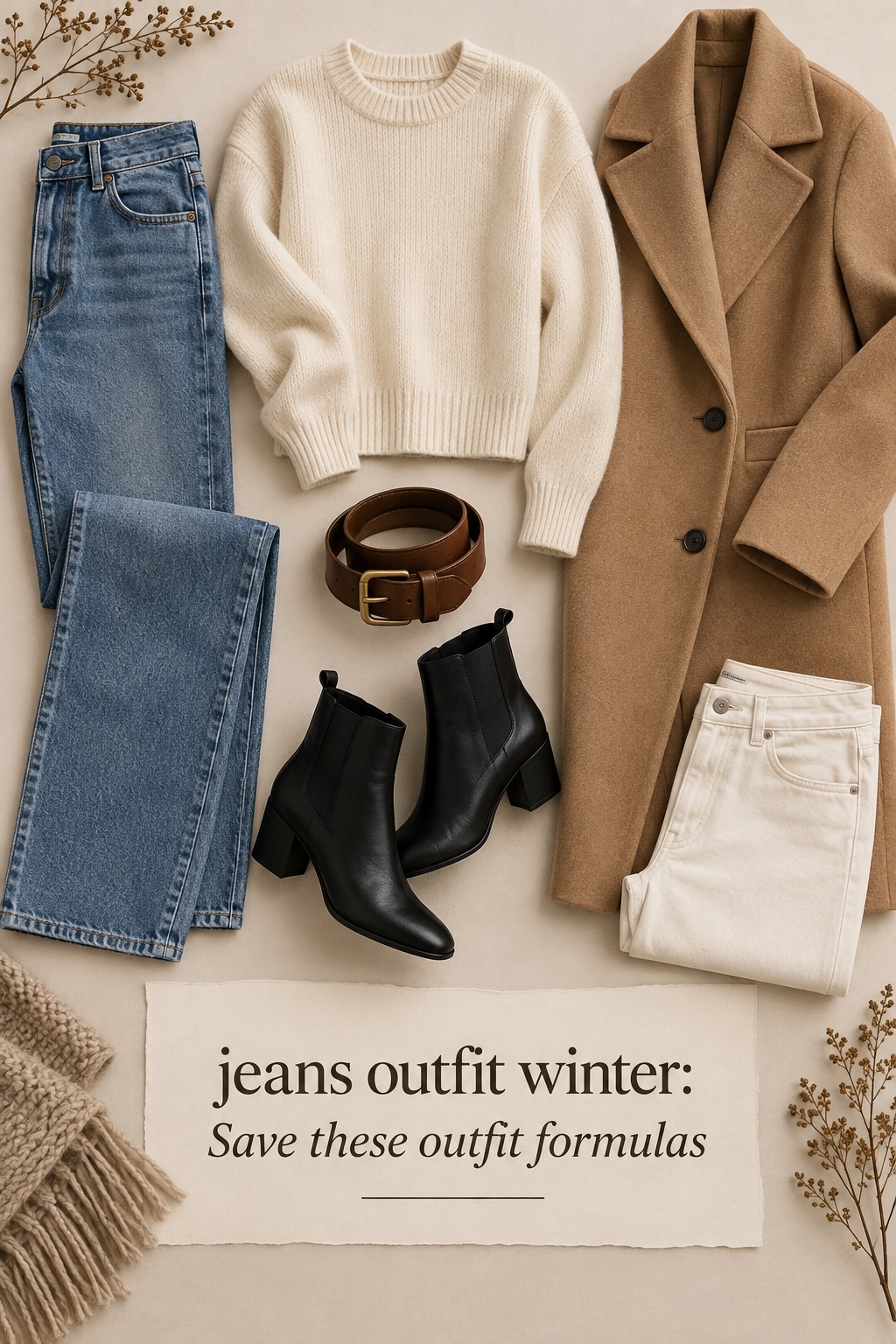
Start with straight-leg jeans, a fine or medium-weight sweater, a practical ankle boot, and a long coat. Add one finishing detail such as a belt, scarf, or structured bag. Change the coat and shoe when the weather or setting changes.
What shoes work best with jeans in winter?
Ankle boots are the most flexible choice for straight and slim jeans. Wide-leg jeans usually need a sturdier boot, platform sneaker, or pointed shoe that can support the hem. Tall boots work well when slim jeans can tuck in smoothly.
How do I wear wide-leg jeans when it is cold?
Use a warm base layer, a shorter or clearly structured top layer, and a shoe with enough visual weight. A long coat can work too, but keep the inner outfit clean so the coat and wide leg do not compete. Check that the hem clears wet ground.
Can I wear white jeans in winter?
Yes. Pair them with substantial textures such as wool, shearling, suede, or ribbed knit, then use brown, black, or dark gray footwear to ground the light denim. A tonal cream outfit can look polished when the textures are clearly different.
How can I make jeans look more polished in winter?
Choose clean denim, add a tailored coat or blazer, and finish with a defined shoe. A belt and structured bag can help, but the biggest change usually comes from proportion. Keep one layer neat when another is relaxed.
What coat should I wear with jeans in winter?
Choose a long wool coat for a polished vertical line, a puffer for practical warmth, a shearling or textured jacket for a more expressive casual look, or a shorter coat when you want the denim silhouette to be visible. Match the coat volume to the jeans and keep one inner layer controlled.
How do I avoid looking bulky in winter layers?
Layer thin to thick, choose one substantial volume, and keep the other pieces more defined. A fine base under a roomy sweater is usually easier than two bulky knits. A shorter jacket, visible waistband, or clean boot can also restore shape.
Are sneakers practical with jeans in winter?
Sneakers can work on dry days when the sole and upper suit the conditions. Pair them with a cropped or straight hem, warm socks, and a coat that carries enough structure. For wet or icy ground, choose a more protective boot and keep the same top layers.
Leave a Reply