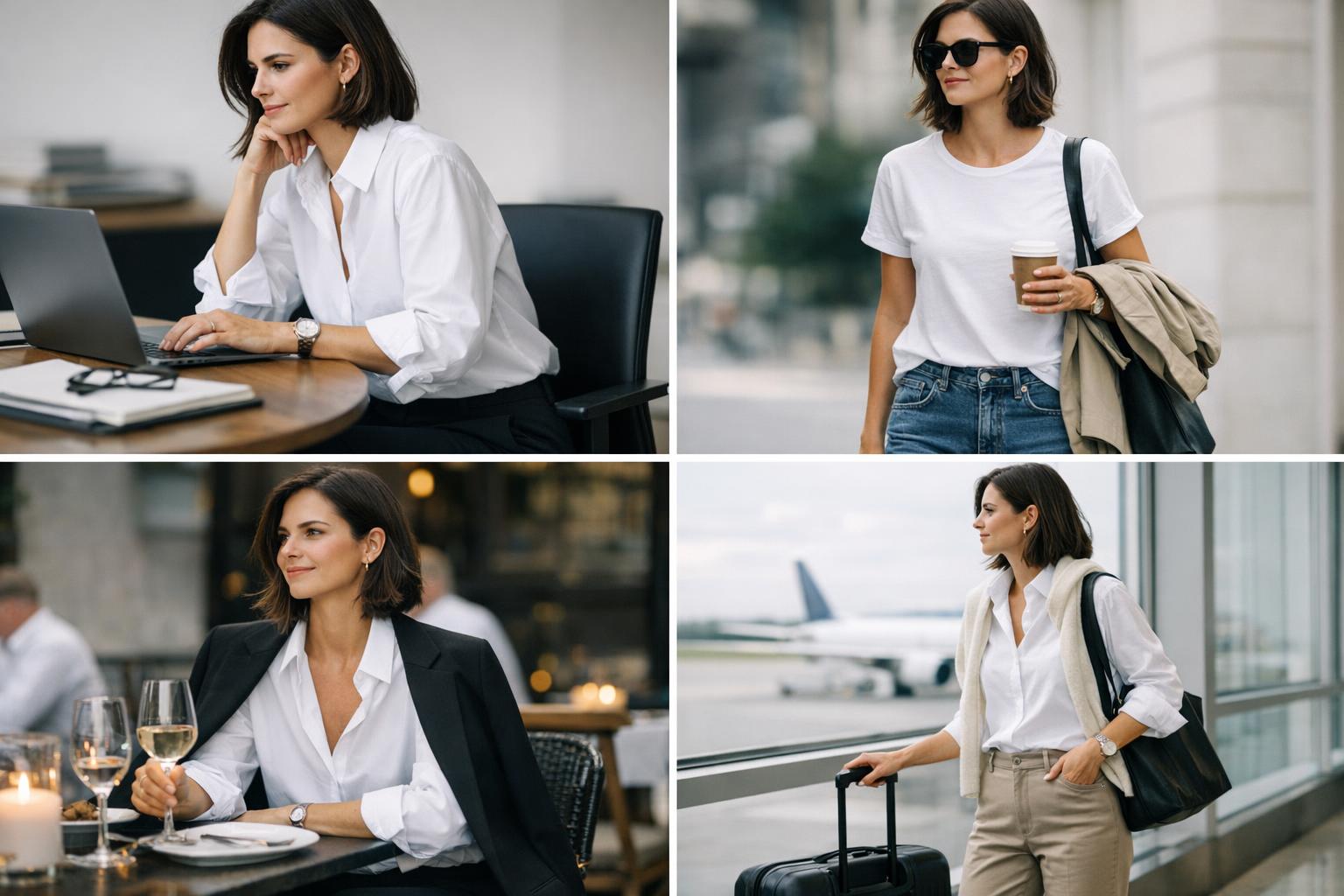
The white shirt outfit, seen through a real wardrobe
There’s a particular moment—usually five minutes before you need to leave—when even a carefully edited closet can feel oddly silent. You want to look composed, modern, and intentional, but you don’t want to look “done.” In that narrow space between effort and ease, the white shirt outfit quietly does what very few styling ideas can: it creates clarity. A white shirt brings a clean line to the body, a calm note to color, and a sense of finish to even the simplest base. It’s the kind of piece that doesn’t demand attention, yet somehow makes everything around it look more considered.
This is why white shirt outfits endure across aesthetics—from a crisp, buttoned-up look di moda sensibility to a softer, lived-in approach that still reads looks chic. And because “white shirt” can mean many things (a classic shirting piece, a relaxed poplin, a sleek knit, or a white T shirt outfit), the styling possibilities are less about rules and more about composition: proportion, fabric behavior, and the subtle architecture of layering.
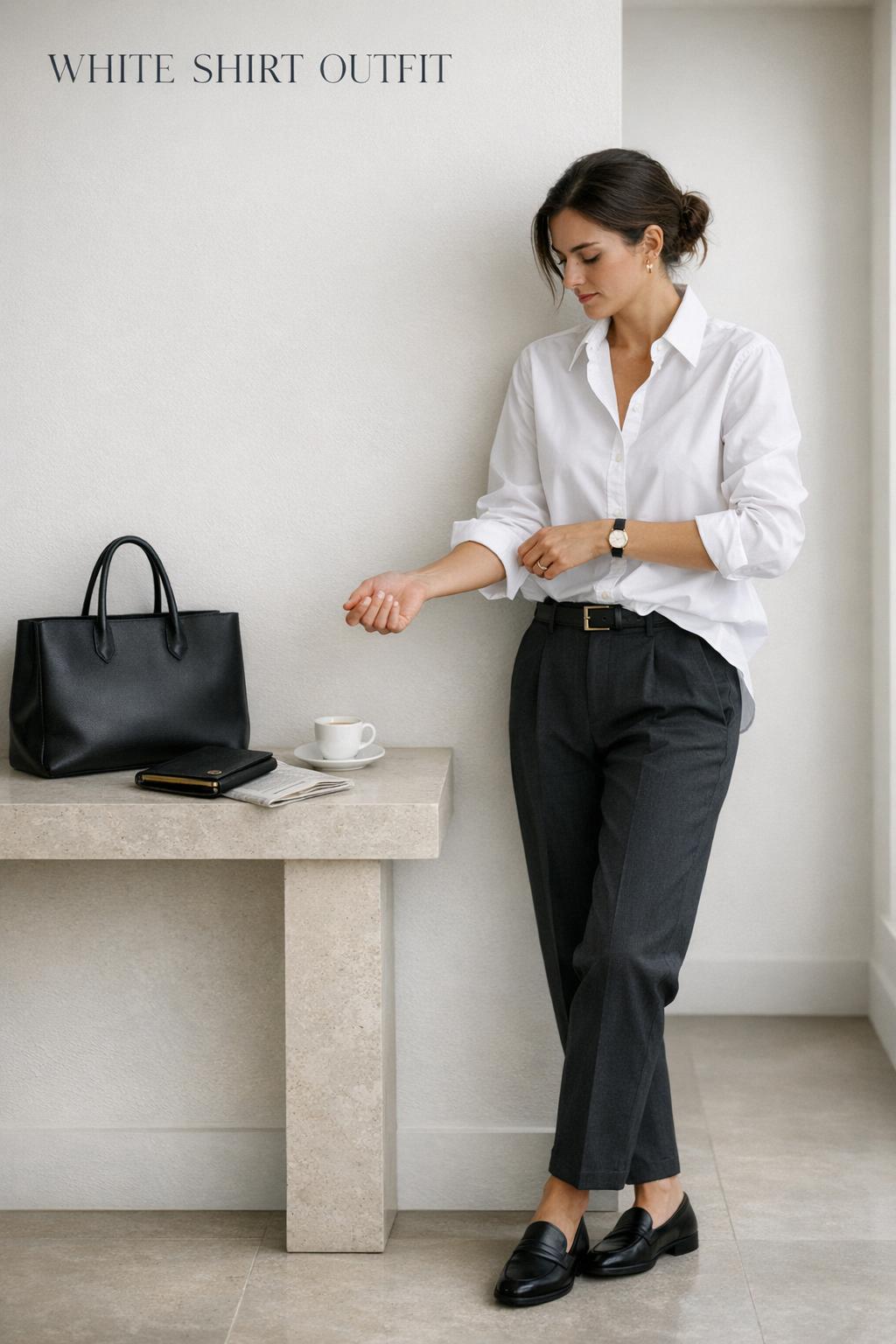
What follows is an editorial way to think about the white shirt—not as a single “idea,” but as a framework you can adapt to real days, real weather, and real movement.
Defining “white shirt”: one color, multiple personalities
“White shirt” sounds definitive, but in practice it’s a category. The difference between a crisp shirt and a soft T-shirt changes the entire mood of an outfit, even if the color stays constant. Before styling, it helps to name what you’re working with, because the silhouette will tell you what it wants.
Your wedding has a lot of moving pieces. Your plan can still feel composed.
Zarellea organizes guests, vendors, budget, and timelines in one shared space — so you can make decisions with clarity, not stress.
The structured white shirt
This is the classic: a shirt with enough body to hold a collar line and a cuff. It creates a precise frame around the face and shoulders, which is why it reads instantly polished. In white shirt outfits, structure becomes the anchor—especially when the rest of the look is relaxed.
The relaxed white shirt
A softer version (often looser through the torso) shifts the energy from boardroom to weekend, without losing the clean brightness white brings. This is where “effortless” can still look intentional, provided you control proportion—what’s tucked, what’s left loose, and where the volume sits.
The white T shirt outfit
A white T-shirt is the minimalist’s shorthand: less structure, more ease. But because it offers fewer built-in lines (no collar, no placket), it benefits from thoughtful pairing—tailoring, strong denim, or a sharper layer—to achieve that “looks chic” finish rather than “just basic.”
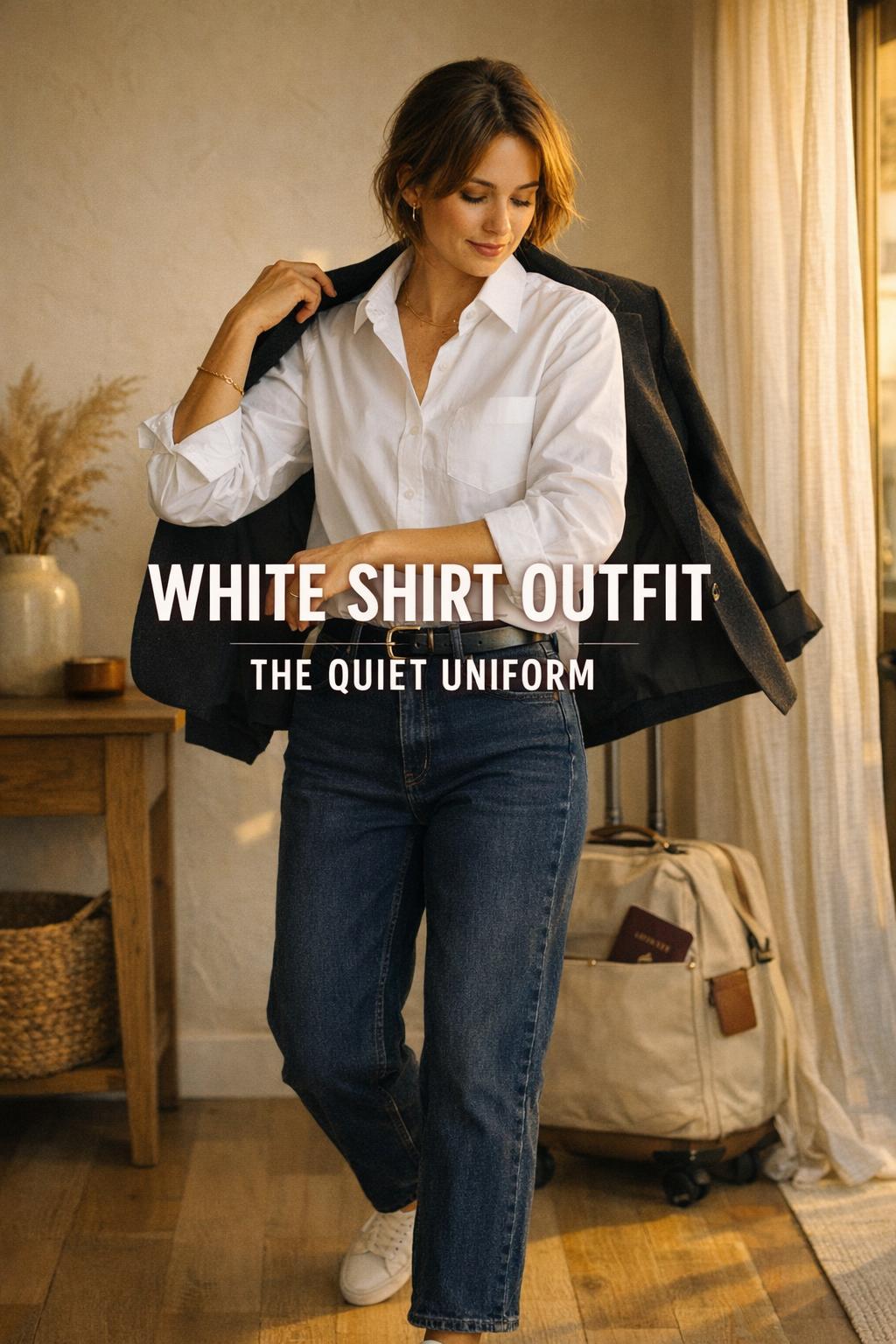
Why white shirt outfits look chic: the quiet math of silhouette and contrast
White is visually assertive precisely because it’s simple. It reflects light, lifts surrounding colors, and highlights shape. In a white shirt outfit, that means the shirt becomes a spotlight: it emphasizes collarbones, shoulder width, and the line of the torso. This can be incredibly flattering—but it also means the rest of the outfit needs to be chosen with intention.
Three quiet principles tend to separate a look di moda white shirt moment from a look that feels unfinished: contrast, proportion, and finish. Contrast can be tonal (white against cream) or graphic (white against black). Proportion is about balance—volume on top versus volume on bottom, and where the waistline is visually placed. Finish is the small discipline of styling: a clean tuck, deliberate sleeves, and shoes that match the level of polish you’re implying.
The crisp-and-relaxed equation: tailoring that doesn’t feel stiff
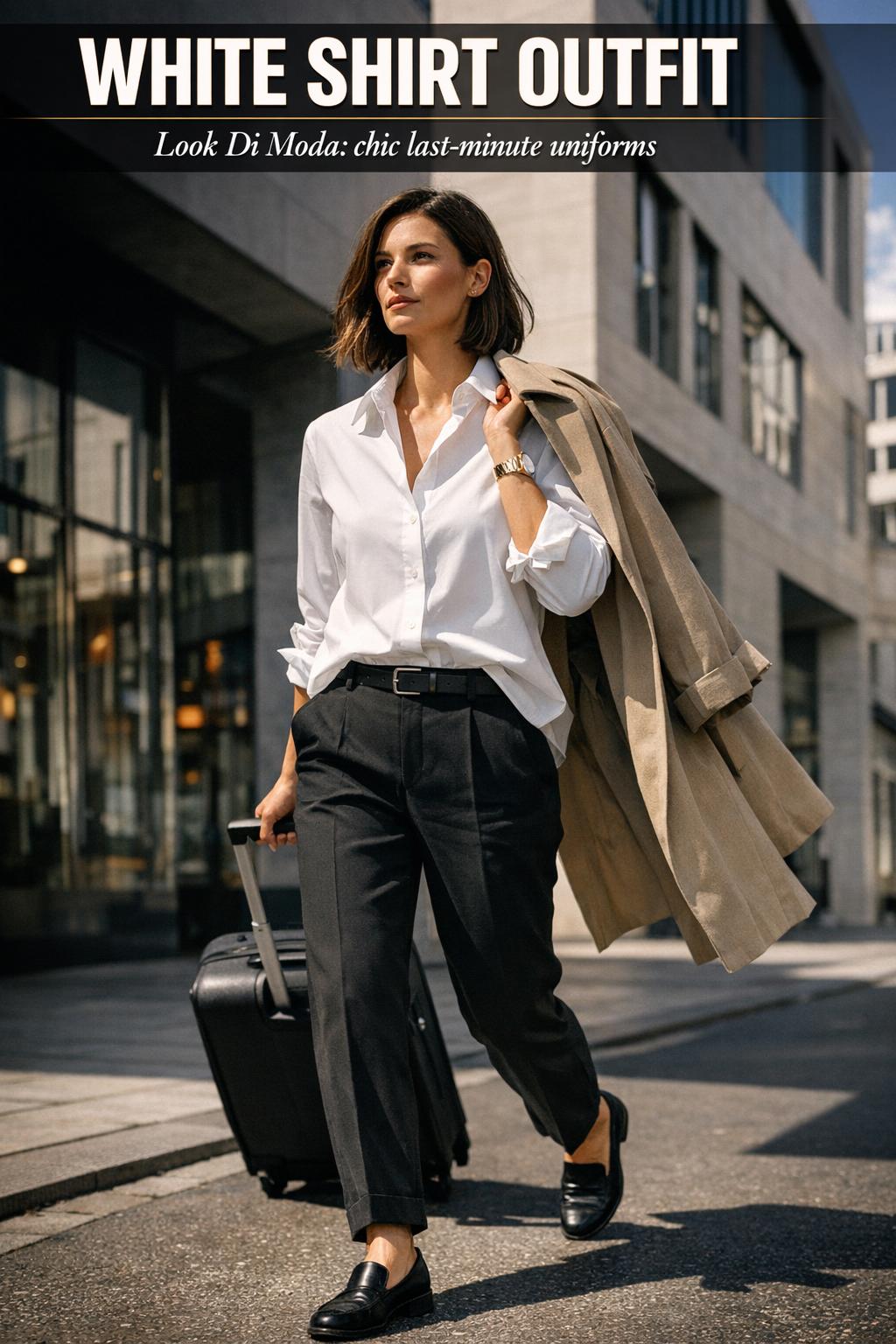
One of the most reliable white shirt outfits is built on a deliberate tension: a structured white shirt paired with a more relaxed element, or the reverse. Think of it as a styling conversation—one piece brings authority, the other brings ease.
A crisp white shirt with tailored trousers can read commanding, but it can also feel severe if everything is equally sharp. The solution is subtle: soften one element without losing the line. Slightly relaxed trousers, a more fluid drape, or a shoe choice that doesn’t shout can make the outfit feel modern rather than corporate.
Styling breakdown: building the “clean line”
Start with the shirt as the architecture. Button it high for a graphic, editorial neckline, or open the top slightly to let the collar fall naturally. Then decide where you want the waist to appear. A full tuck is the most polished; a half tuck can look intentional when the shirt has enough structure; leaving it untucked works best when the hemline and the pant rise cooperate rather than compete.
- For a sharper look: keep the shirt smooth through the torso, define the waist, and let the trouser line stay clean.
- For a softer look: add a touch of ease through sleeves and shoulders, and allow the fabric to move when you walk.
- For a balanced “looks chic” result: keep one area crisp (collar, cuff, waistband) and let another area relax (leg line, drape, layering).
The white T shirt outfit as modern minimalism (not an afterthought)
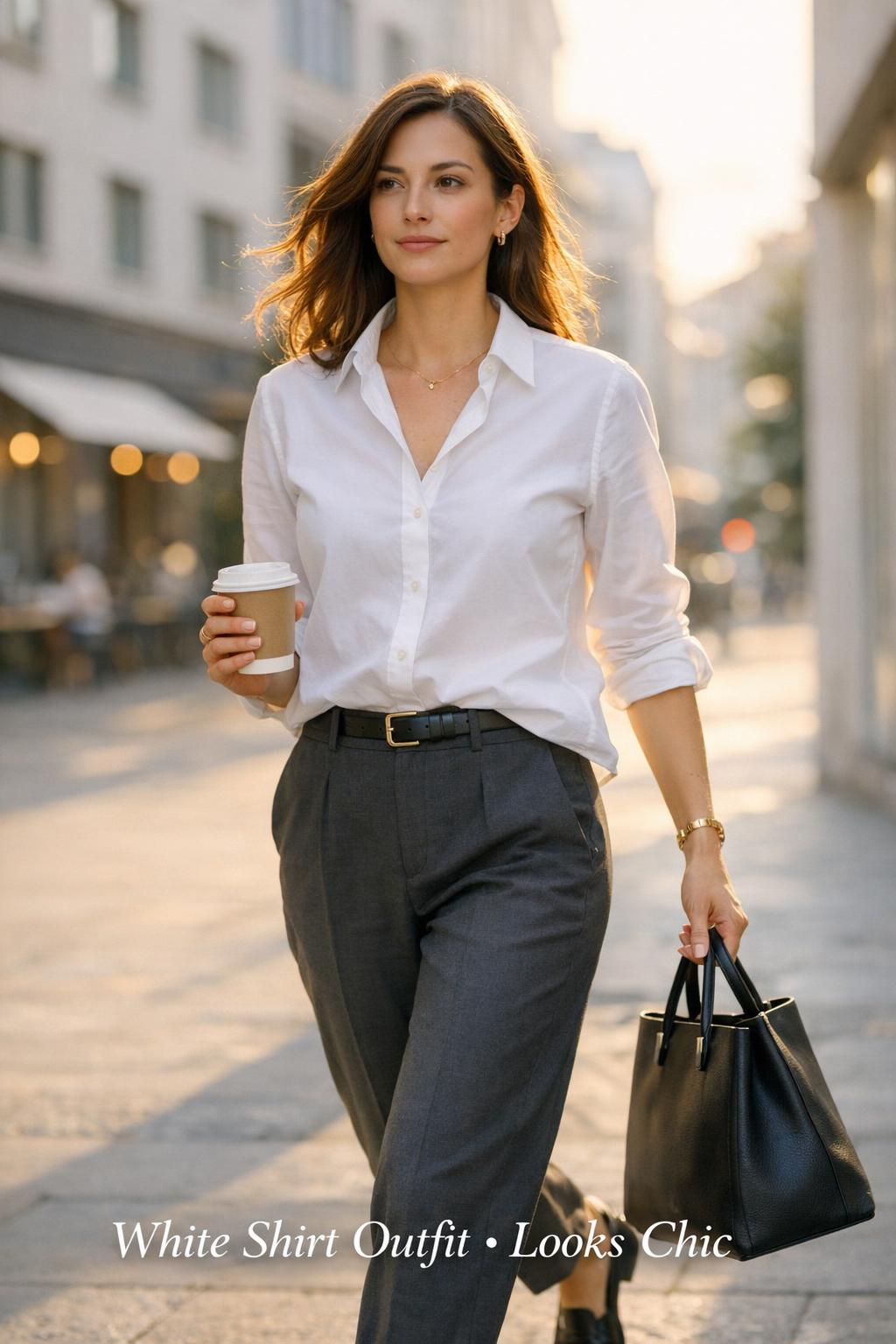
The white T shirt outfit is often treated as the baseline, but in practice it’s one of the most revealing style tests: without structure, the outfit relies on composition. A white T-shirt can look deliberately pared-back—almost Parisian in its restraint—if the rest of the look is edited and the silhouette is clear.
Because the T-shirt doesn’t provide built-in sharpness, give it a partner that does. This could be a clean trouser line, a more tailored skirt shape, or a structured layer worn over it. The goal isn’t to “dress up” the T-shirt; it’s to create a modern silhouette where the T-shirt reads as intentional negative space.
Tips: make a white T-shirt look editorial
Keep the neckline and shoulder fit under control; if it collapses or gapes, the whole look loses clarity. A small sleeve roll can give the upper arm a more sculpted line, and a precise tuck—either full or subtly bloused—creates a waist without forcing one. Finish matters here: when the top is simple, the overall outfit needs a clear “endpoint,” whether that’s a defined waistband, a crisp hemline, or a deliberate shoe.
Layering with a white shirt: depth without heaviness
Layering is where white shirt outfits become truly versatile. White behaves like visual light, which means it can brighten a layered look and keep it from feeling heavy. But layering also introduces a common challenge: bulk at the shoulders and waist. The most refined layered looks treat the shirt as a thin, bright layer that creates separation between heavier pieces.
Consider how the collar and cuffs appear—or don’t. A glimpse of cuff under a sleeve reads intentional and precise; an awkward bunch at the wrist reads accidental. The same goes for the collar: either let it frame the neck cleanly or hide it entirely. Indecision is what makes layering look messy.
Choosing the “visible points”
If you’re wearing a white shirt under a layer, decide in advance which parts will be seen: collar, cuffs, hem, or none. A look di moda approach often shows one or two of these points deliberately, using white as a highlight rather than a full statement.
- Collar visible, cuffs hidden: sharp at the neckline, clean at the wrists.
- Cuffs visible, collar hidden: understated polish, especially for relaxed layers.
- Hem visible, everything else quiet: a modern, layered line that elongates the torso when done carefully.
Color strategy: letting white do the work
White is rarely “neutral” in effect—it’s bright, crisp, and high-contrast. That’s why it can make even familiar pieces feel newly intentional. In white shirt outfits, color strategy is less about chasing novelty and more about building a palette that looks composed in daylight, indoors, and in photos.
A white shirt can sharpen dark tones, soften warm neutrals, and clarify muted palettes. The key is to avoid competing whites: if your outfit includes multiple “whites,” ensure they look like a choice rather than a mismatch. When in doubt, let the shirt be the brightest element and keep everything else slightly warmer or deeper.
Tips: when white feels “too bright”
If a white shirt feels stark, the fix is usually not to abandon it, but to cushion it with softer tones and texture. Pairing with warmer neutrals can reduce harsh contrast, and adding a textured layer can make the white feel integrated rather than spotlighted. You can also adjust how much white is visible: opening the neckline slightly or adding a layer changes the visual intensity immediately.
Texture and fabric behavior: what makes a white shirt outfit look expensive
In styling, “expensive” is often a shorthand for coherence: the fabrics behave well together, the outfit holds its shape, and nothing looks fussy. White amplifies fabric quality because it shows wrinkles, sheerness, and pulling more clearly than darker colors. That doesn’t mean you need perfection—it means you need awareness.
Pay attention to how the shirt moves when you sit, reach, and walk. A shirt that gaps at the buttons changes the entire impression of polish. A shirt that’s overly stiff can feel costume-like if the rest of the outfit is relaxed. The most successful white shirt outfits pair fabric weights thoughtfully: a crisp shirt against a fluid bottom, or a soft shirt against a structured layer. The relationship creates depth.
A practical note on sheerness
White fabric can be unforgiving under bright light. If you find yourself constantly adjusting, the outfit will never feel effortless. The most wearable approach is to treat comfort as part of polish: choose underlayers that disappear under the shirt and prioritize a fit that stays in place throughout a normal day.
Where white shirt outfits live: office, weekend, dinner, and travel days
A white shirt is often described as versatile, but versatility is only useful when you can see the outfit in a real setting. The same white shirt can read differently depending on proportion, shoe choice, and how “finished” the styling is. Rather than separate your closet into rigid categories, think in terms of context sliders: more structure or less, more contrast or less, more skin at the neckline or less.
The office, interpreted modernly
For an office-appropriate white shirt outfit, the goal is quiet authority. Keep lines clean through the shoulders and waist, and let the shirt look intentional rather than fussy. If you add a layer, ensure it doesn’t fight the collar. If you keep it simple, ensure the fit is precise enough to carry the look on its own.
The weekend that still looks chic
Weekend white shirt outfits work best when they feel airy and unforced. A relaxed white shirt worn with easy bottoms can look beautifully nonchalant, but it needs one point of structure—sleeves rolled with intention, a clean tuck, or a crisp collar line. Without that, it can slip into “just thrown on.”
Dinner and evening: shine without sparkle
White at night is striking because it catches light. An evening-leaning white shirt outfit doesn’t require embellishment; it requires clarity. A slightly open neckline can feel modern, and a sharper silhouette through the waist or hip adds presence. The goal is not to make the white shirt something it isn’t, but to let it look intentional in a more refined setting.
Travel days: composed, comfortable, and photograph-ready
For travel, a white shirt can be surprisingly practical—if you plan for movement. You’ll sit, lift bags, reach overhead, and likely encounter temperature shifts. A white T shirt outfit becomes especially useful here because it layers easily, but a white shirt can work too if it’s comfortable at the shoulders and doesn’t crease into chaos. Consider how the outfit looks after three hours, not three minutes.
Common missteps that make a white shirt feel less refined
White is honest. It doesn’t flatter a styling choice just because it’s classic. If a white shirt outfit feels “off,” it’s usually one of a few correctable issues—small decisions that disrupt the line or the finish.
- Unclear proportion: too much volume everywhere, or no structure anywhere, so the outfit loses shape.
- Accidental wrinkles in the wrong places: a slightly relaxed texture can feel charming; crushed fabric at the midsection often reads careless.
- Mismatch in formality: a very crisp white shirt paired with overly casual elements can look disjointed unless you intentionally bridge the gap with a third piece.
- Overstyling: too many focal points competing with a bright, clean shirt.
- Neglected finishing details: collar and cuffs that look limp, or a tuck that bunches unevenly.
The quiet fix is nearly always the same: simplify and decide. Decide on the silhouette, decide what’s crisp and what’s relaxed, and decide where the eye should go first.
Micro-styling that changes everything: collars, cuffs, and tucks
In a white shirt outfit, the “styling” is often a matter of centimeters. A collar that stands too rigidly can feel severe; a collar that collapses can feel tired. Cuffs that are precisely folded signal intention; cuffs that are pushed up without control can overwhelm the wrist and shorten the arm line. These details may sound minor, but white makes them visible—so they become part of the outfit’s message.
Tips: the three tucks, and what each one communicates
A full tuck is the most polished and elongates the leg line when paired with a higher rise. A half tuck can read look di moda when it’s clean and deliberate—especially with a structured shirt—yet it can look messy if the fabric is too soft or bulky. Wearing the shirt untucked can feel modern and relaxed, but it depends on hem length: if the shirt cuts the body at an awkward point, it shortens the silhouette rather than lengthening it.
Cuff discipline for “looks chic” ease
Rolled sleeves can be charming, but the roll needs intention. A neat fold that stops at the forearm creates a clean line and reveals the wrist—one of the simplest ways to make a white shirt feel lighter and more modern. If the roll is uneven, it can pull attention in the wrong direction, especially against the crispness of white.
Seasonal thinking: keeping white wearable year-round
White is often associated with warm weather, but a white shirt doesn’t belong to a single season. The styling shifts are mostly about fabric weight, layering logic, and how much skin is exposed at the neckline and wrist. If your white shirt outfits feel seasonal, it’s usually because the surrounding pieces are seasonal—not the shirt itself.
In warmer months, white can be the entire point: light on the body, bright in daylight, and clean against sun-warmed tones. In cooler months, white becomes a highlight, a way to break up deeper palettes and add dimension to layers. The result can feel quietly European in spirit—understated, composed, and never overly precious.
Tips: managing temperature without losing the line
If you’re layering for air-conditioning or a temperature swing, prioritize thin layers that slide rather than bunch. Keep the shirt closest to the skin when you want crispness at the collar and cuff; use a white T shirt outfit as the base when you need maximum comfort and easy layering. The goal is to stay comfortable without creating bulk at the shoulders or waist, which can make even beautiful white shirt outfits look heavy.
Making “look di moda” feel personal, not performative
The appeal of a look di moda white shirt moment is its confidence: it feels current without being loud. But there’s a difference between styling that looks editorial and styling that looks like you’re trying to look editorial. The difference is usually practicality. If you can’t move, sit, or live in the outfit, it stops being style and becomes costume.
Consider the day you actually have. If you’re commuting, you need an outfit that stays composed when you carry a bag and walk quickly. If you’re in and out of meetings, you need a collar that holds its line and a shirt that doesn’t require constant adjustment. If you’re traveling, you need a base that can handle temperature changes. A white shirt outfit can be all of these things—but only if it’s styled for the context, not for an imagined photograph.
A simple reality check
Before you leave, do three movements: sit, raise your arms, and walk briskly across the room. If the shirt pulls, gaps, or rides up in a way that will distract you, adjust the styling now—change the tuck, loosen the neckline, or swap to a white T shirt outfit that behaves more predictably. Refinement is not rigidity; it’s ease that has been thought through.
White shirt outfits as a personal uniform: repeating without looking repetitive
The most stylish people don’t avoid repetition; they refine it. A white shirt is ideal for this because it’s stable. You can repeat the white shirt and shift the outfit through silhouette and finish—changing the story without changing the core.
To keep repetition feeling intentional, vary one of the following: the volume (oversized vs. neat), the neckline (buttoned vs. slightly open), the base (tailored vs. relaxed), or the layer (none vs. structured). This is where “white shirt outfits” becomes a wardrobe language rather than a single idea—and where looks chic becomes a habit rather than an event.
- Change the shirt styling first: collar, cuffs, and tuck can create a new silhouette without buying anything.
- Change the base second: the same white shirt will read differently with a clean line versus a softer shape.
- Change the finish last: shoes and overall polish determine whether it feels daytime, office-ready, or evening-leaning.
FAQ
What makes a white shirt outfit look polished instead of plain?
A polished white shirt outfit usually comes down to clear proportion and finishing details: a deliberate tuck (or an intentional untucked hem), sleeves styled neatly, and an overall silhouette that balances structure with ease rather than feeling shapeless or overly stiff.
How do I make a white T shirt outfit look chic?
Because a white T-shirt has less built-in structure than a button-up, it looks most chic when paired with pieces that add clean lines—such as a more tailored shape elsewhere—and when the T-shirt fit at the shoulders and neckline is controlled so it reads intentional rather than sloppy.
Is a white shirt outfit appropriate for the office?
Yes, a white shirt outfit can be office-appropriate when the shirt holds a clean collar line, the overall silhouette looks composed, and the styling avoids extremes—neither too relaxed to feel unfinished nor so rigid that it reads severe.
What’s the easiest way to update white shirt outfits without buying anything new?
The simplest update is micro-styling: adjust how the collar sits, roll the sleeves with intention, and experiment with a full tuck versus a half tuck to change the apparent waistline and proportion while keeping the same core pieces.
Why does my white shirt outfit sometimes look messy even when the pieces are classic?
White highlights small issues—uneven tucks, bunching at the wrists, unclear volume distribution, or wrinkles concentrated at the midsection—so classic pieces can still look messy if the silhouette isn’t decided and the finishing details aren’t deliberate.
How can I layer with a white shirt without adding bulk?
Choose which shirt details will be visible (collar, cuffs, hem, or none) and keep layers thin enough to slide smoothly; bulk usually happens when too many elements compete at the shoulders or when fabric bunches around the waist and wrists.
What does “look di moda” mean in the context of a white shirt?
In practice, a look di moda white shirt outfit feels modern and editorial through intentional contrast—one element crisp, another relaxed—plus clean styling decisions that look purposeful in motion, not just in a still mirror moment.
How do I stop a white shirt from feeling too bright or stark?
Reduce the intensity by softening the surrounding palette and textures, and by adjusting how much white is visually dominant—opening the neckline slightly or adding a layer can integrate the shirt so it feels balanced rather than glaring.
Leave a Reply