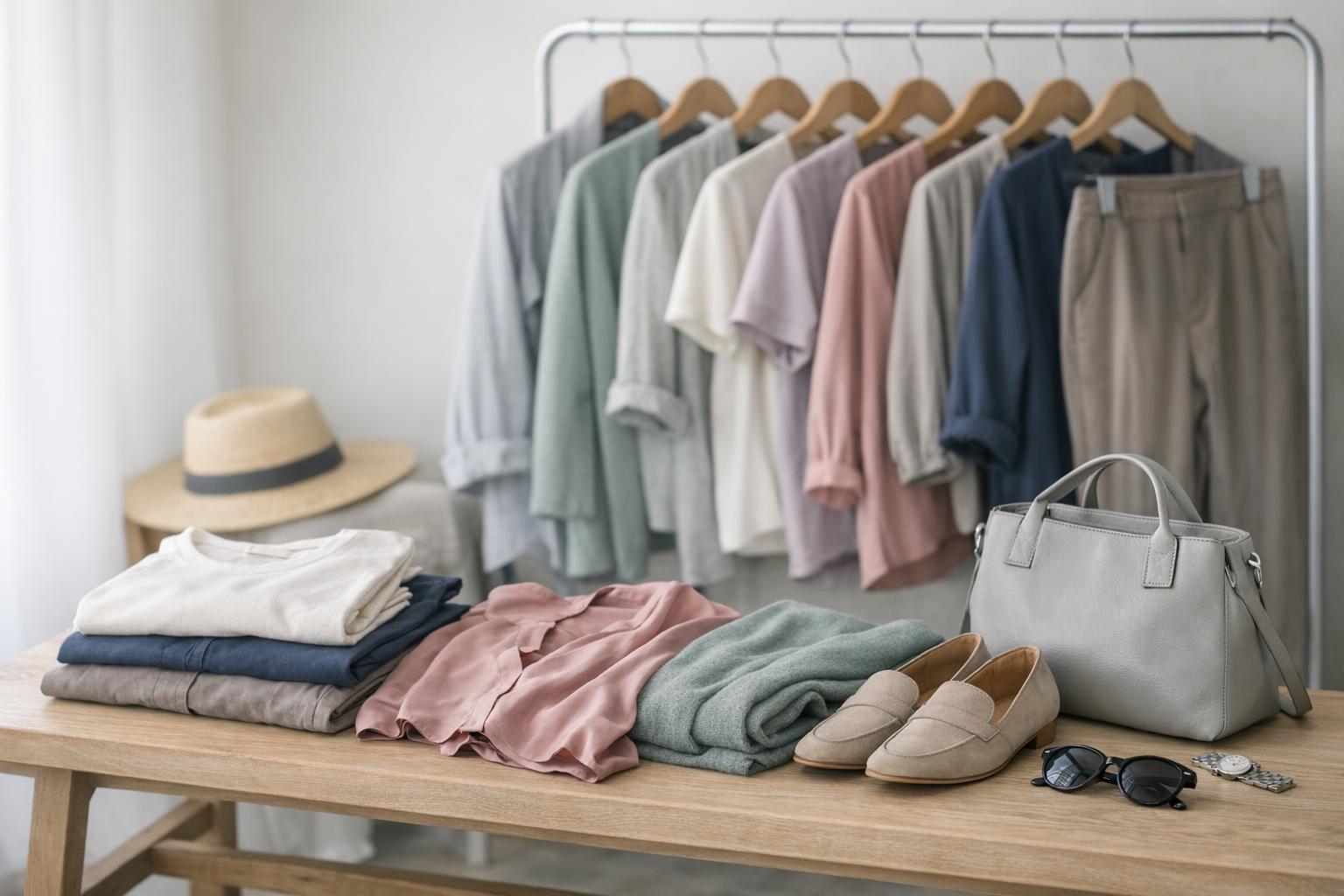
A soft summer capsule wardrobe, in real life: the morning you stop second-guessing
There’s a particular kind of wardrobe frustration that shows up when your closet is full, yet outfits feel “off” the moment you leave the mirror. Colors compete instead of harmonize, a top looks too bright in daylight, or a jacket feels too heavy against everything else you own. For many people drawn to the soft summer color season, that disconnect isn’t about having “nothing to wear”—it’s about having the wrong intensity. A soft summer capsule wardrobe solves that problem by anchoring your clothing choices to a cool, muted soft summer color palette, then narrowing your closet to a set of pieces that mix without constant negotiation.
This article takes a practical approach: what soft summer means in clothing, how a capsule wardrobe actually functions day to day, and how to choose foundational pieces (tops, bottoms, and outerwear) in colors like mushroom, rose brown, dusky pink, lilac, and soft gray—plus accents like dusty rose, sage, and smoky teal. You’ll also find fabric guidance (silk, cashmere, cotton tees, and wool blends), a realistic 25–33 piece framework, and the 70/30 rule for balancing neutrals with color. If you’re building a soft summer wardrobe from scratch or refining one that’s close-but-not-quite, the goal is simple: a closet that creates calm, cohesive outfits on repeat.
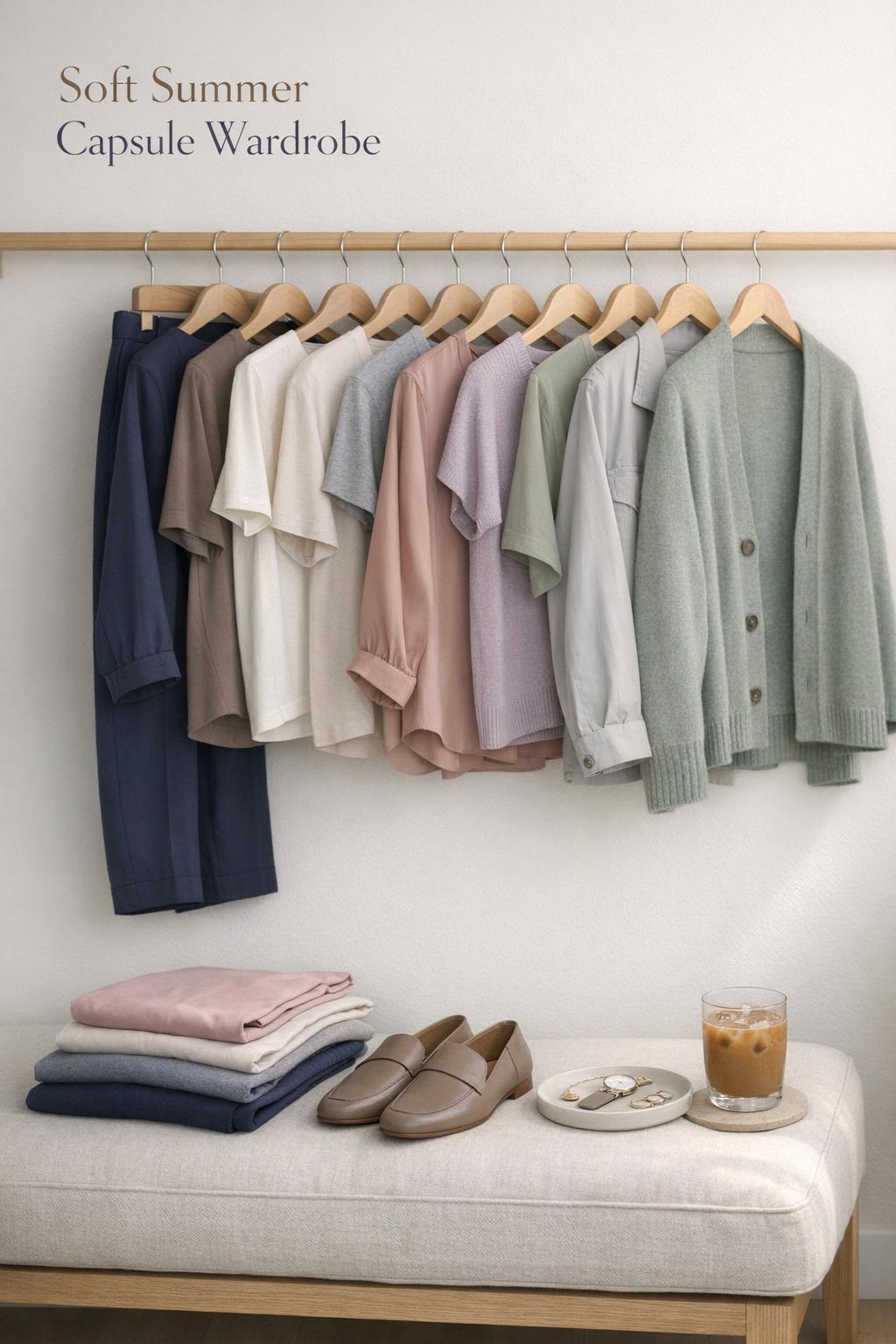
Understanding the soft summer color palette (and why it feels so wearable)
Soft summer sits in the world of seasonal color theory as a palette that reads cool and muted rather than bright or high-contrast. In outfit terms, that means your best colors tend to look a little softened—think “subdued palette” and “tonal harmony” rather than crisp, saturated statements. This is why a soft summer color palette often feels naturally aligned with minimalism: when tones are gentle, you can combine them without creating visual noise.
When you hear people describe soft summer colors, they’ll often reach for nature-like language—dusty, smoky, muted, soft. That’s not poetic fluff; it’s a functional guideline. If a color looks like it has been slightly gray-toned or “turned down,” it’s more likely to play well with other soft summer color palette clothes. If it looks neon, overly warm, or very stark, it can steal attention from the overall harmony a capsule wardrobe relies on.
Your wedding has a lot of moving pieces. Your plan can still feel composed.
Zarellea organizes guests, vendors, budget, and timelines in one shared space — so you can make decisions with clarity, not stress.
The soft summer “neutral set” you’ll lean on most
Capsules work when your neutrals do the heavy lifting. For soft summer, neutrals don’t have to be black-and-white; in fact, many people find those extremes create too much contrast. A more wearable neutral set often includes mushroom, soft gray, dusty navy, and rose brown. These shades behave like anchors: they repeat across bottoms and outerwear, quiet down accent colors, and make outfits look intentional even when you’re dressing quickly.
Tip: If you’re unsure whether a shade works as a soft summer neutral, place it next to something clearly muted (like soft gray) and ask one question: does it blend or shout? In a capsule, you want more “blend.”
Accent colors that still feel calm
Accents in a soft summer wardrobe are where you get to express personality without breaking cohesion. Colors like dusty rose, dusky pink, lilac, sage green, and smoky teal offer variety while staying inside the muted, cool-leaning mood. The trick is to treat accent colors as supporting actors: they’re meant to enrich your core neutrals, not fight them.
Because these accents share a similar softness, you can often create “tonal” outfits (different shades with similar muted intensity) that look sophisticated without feeling dressed up. That tonal cohesion is one of the reasons a minimalist wardrobe for soft summer can still feel interesting.

How a capsule wardrobe works for soft summer: structure before shopping
A capsule wardrobe is a curated set of clothing designed for maximum mix-and-match. Instead of chasing endless variety, you build a small ecosystem of pieces that connect through color, function, and fabric. With soft summer, that ecosystem becomes especially efficient because your palette naturally discourages loud outliers. If you keep your colors within a consistent “muted cool” range, most items will coordinate—meaning fewer outfit dead-ends.
Two frameworks show up repeatedly in soft summer capsule planning: the 25–33 piece baseline and the 70/30 rule. Together, they create a practical boundary that keeps your closet cohesive without feeling restrictive.
The 25–33 piece framework: a realistic baseline
Many people aim for a 25–33 piece capsule wardrobe as a functional core. This isn’t a moral rule or a minimalist badge—it’s a planning tool. Within that range, you can usually cover tops, bottoms, outerwear, and accessories with enough variety to dress for different days and moods while still repeating pieces often enough to justify quality.
Tip: If 25–33 pieces sounds intimidating, start with a “quick-start guide” mindset. Choose a small cluster of foundational pieces you can wear immediately, then fill in gaps only after you’ve worn the first set enough to identify what’s missing.
The 70/30 rule: neutrals first, then color
The 70/30 rule is a simple way to keep your soft summer capsule wardrobe from drifting into chaos. Roughly 70% of your capsule sits in your core neutrals (mushroom, soft gray, dusty navy, rose brown), while about 30% comes from accent shades (dusty rose, lilac, dusky pink, sage, smoky teal). This balance keeps outfits easy: neutrals allow repetition; accents prevent boredom.
In practice, the 70% often shows up as bottoms and outerwear, while the 30% shows up as tops, layering pieces, and accessories. That distribution is less about strict math and more about repeat-wear reality: people tend to rewear bottoms and jackets more frequently, so they benefit from being highly mixable.
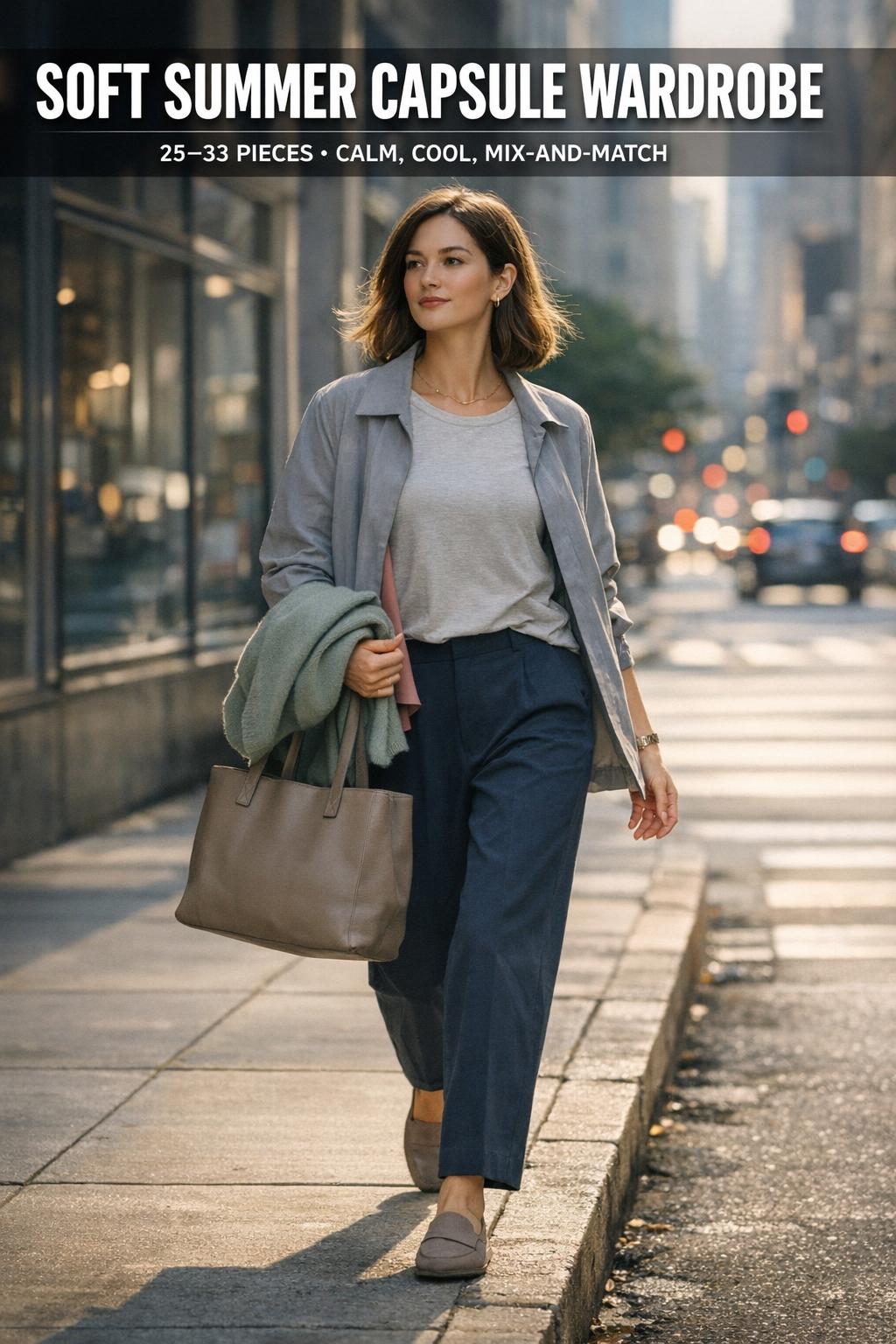
Foundational pieces that make soft summer outfits feel effortless
Foundational pieces are the backbone of your soft summer wardrobe. They’re the items you reach for when you need to look put-together without thinking too hard: cotton tees that layer under everything, trousers that work with both knits and blouses, and outerwear that doesn’t clash with your palette. Good foundations don’t have to be boring—but they do have to be reliable.
Tops: the “face-framing” category
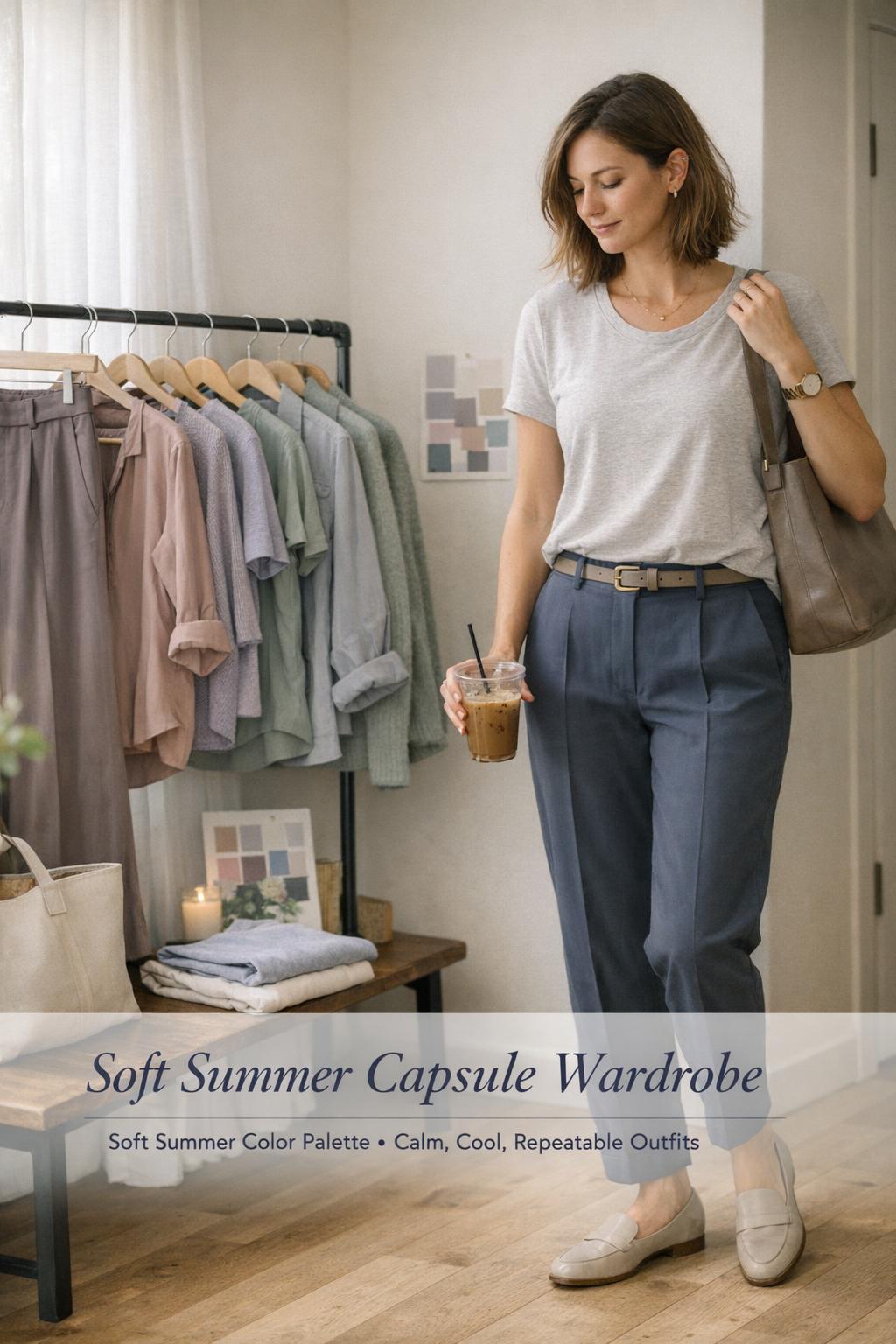
Tops do a lot of visual work because they sit close to your face. In a soft summer capsule wardrobe, tops are a smart place to use dusty rose, dusky pink, lilac, and sage, alongside softer neutrals like cream and soft gray. If you love the idea of “soft summer outfits inspiration,” start here: a muted top can make an otherwise simple outfit feel intentional.
- A cotton tee in cream or soft gray for layering and casual outfits
- A silk blouse in dusty rose for polished days without harsh contrast
- A knit top or lightweight sweater that stays within the subdued palette (soft gray, rose brown, or sage)
Tip: Keep at least one top in a “quiet neutral” (soft gray, mushroom, cream) specifically for days when your outerwear or trousers already carry color. This prevents the “too many competing tones” problem that can make muted palettes look muddy.
Bottoms: where capsule wardrobes either succeed or fall apart
Bottoms are the workhorses of a capsule wardrobe, which is why they’re often best in the most flexible neutrals. Dusty navy trousers are a prime example of a soft summer-friendly alternative to black: they create depth without the starkness. Mushroom and rose brown also function as sophisticated neutrals that pair easily with lilac, dusty rose, and smoky teal.
- Dusty navy trousers for a grounded, cool neutral base
- A skirt or trouser in mushroom for easy tonal outfits
- A bottom in rose brown to add warmth without leaving the soft summer mood
Real-life consideration: bottoms take the most friction—sitting, commuting, walking, and long days. If you’re choosing where to invest in your capsule, bottoms in dependable fabrics can dramatically improve how your wardrobe performs over time.
Outerwear and layering pieces: the capsule’s “glue”
Outerwear is where many wardrobes drift away from the palette—often because jackets and coats are expensive, so people keep older colors that no longer fit. In a soft summer capsule wardrobe, outerwear should be deliberately subdued. A cashmere cardigan in sage green, a soft gray layering piece, or a lightweight jacket that sits comfortably in your neutral range can tie together outfits that would otherwise feel mismatched.
- A cashmere cardigan in sage green for soft structure and warmth
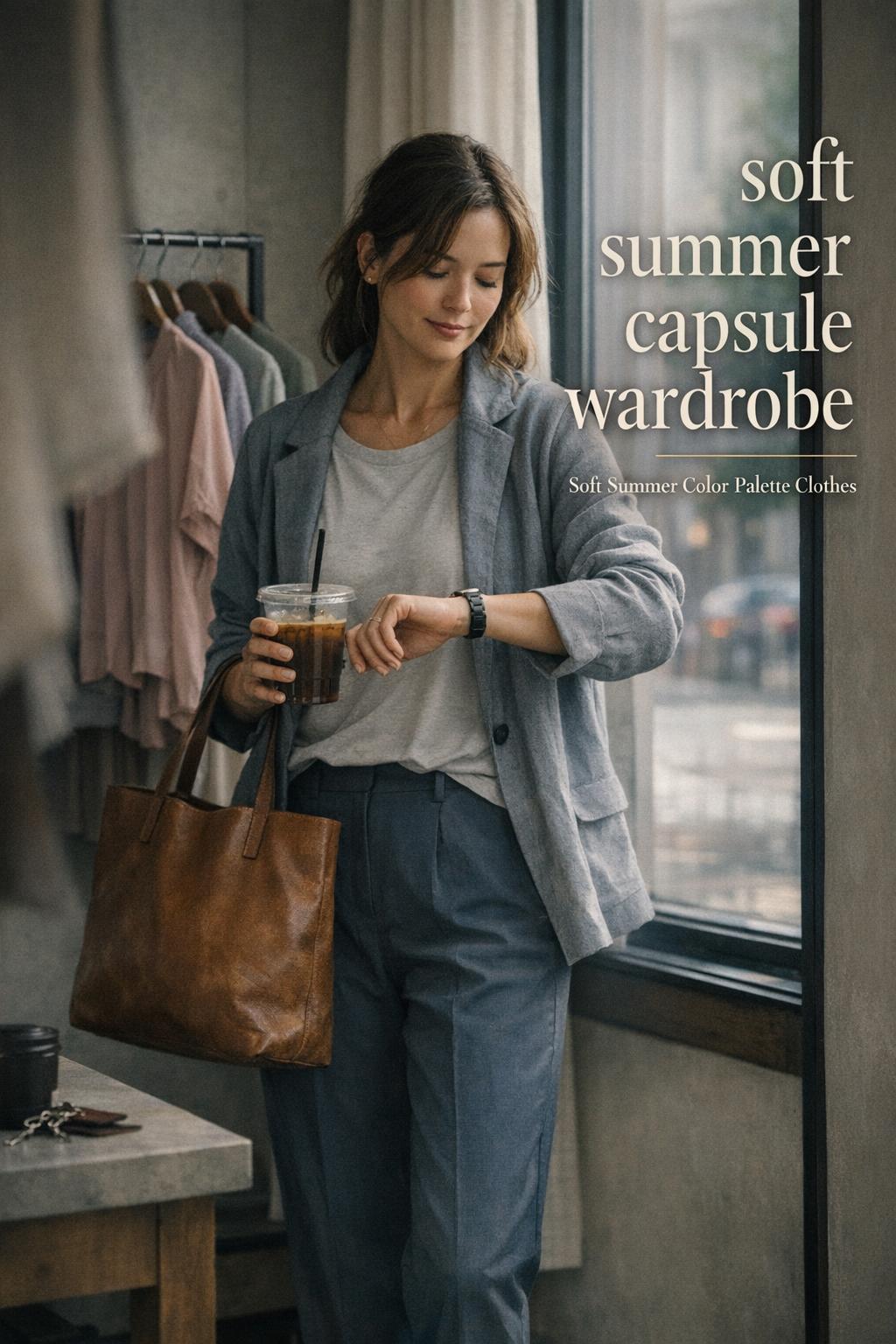
- A lightweight jacket in a subdued hue (soft gray or dusty navy)
- A coat that avoids harsh contrast and blends with your core palette
Tip: If you often move between air-conditioned interiors and outdoor heat (a common U.S. summer reality), prioritize layering pieces that pack easily and don’t wrinkle or lose shape. The goal is a wardrobe that works for long days, not just photos.
Color pairing strategies that keep a muted palette from looking dull
The fear with muted colors is that outfits will look washed out or too quiet. The solution isn’t to add a random bright; it’s to build intentional contrast inside the soft summer range. That’s where tonal harmony becomes a strategy, not just a vibe. By varying depth (light to medium to deeper muted tones) and texture (silk versus cotton tees versus knits), you create visual interest without breaking the palette.
Tonal outfits: the easiest path to “put-together”
A tonal outfit uses related shades that share the same softness. For example, mushroom with soft gray, or dusty navy with smoky teal. These combinations look cohesive because they sit at a similar saturation level, which is one of the defining mechanics of soft summer color palette clothes. The outfit reads intentional even when the silhouette is simple.
Soft summer outfits inspiration often looks elevated because the eye moves smoothly across the outfit; nothing is jarring. Tonal dressing achieves that. It’s also forgiving when you’re in a rush—if everything is in the same muted family, it’s hard to make a mistake.
Soft contrast: using depth instead of brightness
If you miss the punch of high-contrast outfits, recreate that impact with depth rather than intensity. Pair a lighter muted top (cream, soft gray, lilac) with a deeper neutral bottom (dusty navy, rose brown) and finish with an outer layer that sits between them (mushroom or sage). This creates structure without introducing stark black-and-white contrast that can overpower soft summer coloring.
Tip: When an outfit feels flat, check whether every piece is the same depth. Adding one deeper element—often trousers, a skirt, or outerwear—can solve the problem without changing the palette.
Prints and textures: gentle patterns that still read “soft”
Prints can absolutely live in a soft summer capsule wardrobe, but they work best when they respect the palette’s muted quality. Muted florals, subtle patterning, and low-contrast designs tend to integrate more easily than bold, high-saturation graphics. Texture is another powerful tool: silk blouses add sheen, cashmere adds softness, and wool blends add a quiet structure that makes even simple outfits look considered.
A useful guideline: if a print feels like it would dominate an outfit, it may be harder to rotate across a 25–33 piece capsule. If it feels like it could pair with multiple bottoms and outerwear options, it’s more likely to earn its place.
Fabric and quality: why soft summer colors look better in certain materials
Soft summer is as much about how color behaves as what the color is. Fabrics change how muted tones appear in natural light, how they drape, and how they hold up after repeated wear. This matters in a capsule wardrobe because you’ll rewear items often. When color and fabric work together, your wardrobe looks consistent; when they fight, muted tones can look faded, dull, or uneven.
Fabrics that complement a subdued palette
Natural fibers and quality knits show soft summer tones beautifully because they tend to have a refined surface and better drape. Silk blouses can make dusty rose and lilac look luminous rather than flat. Cashmere sweaters and cardigans create a soft, blended look that suits tonal dressing. Cotton tees form the backbone of casual outfits, especially in cream and soft gray, while wool blends add structure for outerwear and layering pieces.
- Silk for blouses when you want polish without harshness
- Cashmere for cardigans and sweaters that look soft, not bulky
- Cotton tees for breathable foundations in muted neutrals
- Wool blends for outerwear that holds shape and looks refined
Care habits that protect muted tones
In a soft summer wardrobe, maintaining the “muted but not tired” look is key. When colors fade unevenly, they can drift away from that intentional softness and start reading as worn out. Even without getting overly technical, it helps to treat your capsule pieces like repeat-wear essentials: handle knits gently, be mindful with delicate blouses, and keep an eye on how often you rotate bottoms and outerwear.
Tip: If you’re building your capsule around a small set of core items, plan for recovery time. Rotating between two cotton tees instead of wearing the same one nonstop can keep your basics looking crisp longer—especially important when your palette relies on subtlety.
Shopping and budgeting for a soft summer capsule wardrobe (without buying everything at once)
Capsules can accidentally trigger over-shopping: the idea of a “perfect” set of pieces can make it feel like you need to replace everything immediately. In reality, most successful soft summer capsule wardrobe edits happen in phases. You identify your palette, choose your foundations, and then gradually refine fabrics and fit as you learn what you actually wear.
Some wardrobes are built around brand-aligned guides, including ecommerce-adjacent content from Palmer Clothing, which links soft summer palette choices to specific garment types like silk blouses, cashmere sweaters, cotton tees, trousers, and coats. Whether you shop from one brand or many, the underlying strategy is the same: color cohesion first, then piece quality, then small accents that keep outfits interesting.
Invest vs. save: a practical capsule budget split
Not every category needs the same budget. In a 25–33 piece capsule, certain items carry disproportionate weight: bottoms and outerwear get worn often, and knitwear can define the whole “soft” feeling of your outfits. Meanwhile, some basics are easier to replace as they wear out. A balanced approach reduces regret and keeps your capsule adaptable.
- Consider investing in outerwear and knitwear (cashmere cardigans, well-made coats) because they shape the look of many outfits
- Prioritize fit and fabric for trousers, since they’re repeated frequently in a capsule
- Save strategically on basics like cotton tees, especially if you expect frequent laundering
Tip: If you’re deciding between two purchases, choose the one that connects to more outfits. In capsule terms, versatility is a measurable value: a soft gray layering piece that works with every top may outperform a single statement color that only pairs with one bottom.
A quick-start closet audit that respects the soft summer palette
A closet audit is less about throwing things out and more about clarifying what’s already working. Pull out your most-worn items and check whether they align with the soft summer color palette: do they feel muted, cool-leaning, and easy to combine? Then note where friction happens—often in outerwear (a too-harsh coat) or tops (colors that feel too bright in daylight).
If you’re keeping certain pieces for practical reasons—like a coat you need for weather—treat them as “temporary outliers” and avoid buying new pieces that only match that outlier. Over time, you can replace the mismatched item with something in soft gray, dusty navy, or mushroom and bring your wardrobe back into harmony.
Soft summer outfits inspiration: outfit formulas you’ll actually reuse
Outfit inspiration becomes useful when it translates into repeatable formulas. The best soft summer outfits inspiration relies on the same principles you’re building into your capsule: a neutral base, a muted accent near the face, and a layering piece that blends rather than dominates. Below are a few formulas you can adapt using your own tops, bottoms, and outerwear.
The polished-but-low-effort formula (for workwear or meetings)
Start with dusty navy trousers as your base, then add a silk blouse in dusty rose. Finish with a soft gray cardigan or a lightweight jacket in a subdued hue. This works because dusty navy creates depth, dusty rose adds soft color near the face, and soft gray bridges the two without creating sharp contrast. It’s a reliable formula when you need to look composed without looking overly formal.
The tonal weekend formula (for errands, travel days, and casual plans)
Pair a cotton tee in cream with a mushroom bottom and a sage green cashmere cardigan. The palette stays quiet, but the outfit looks intentional because the tones are related and the textures vary. This is where soft summer color palette clothes shine: you can dress simply and still look styled, especially when the knitwear adds softness and shape.
The “cool and calm” formula (for warm weather with strong A/C)
Choose a lilac or soft gray top with a rose brown bottom, then keep a lightweight jacket in dusty navy nearby. In many U.S. settings, summer means hot streets and cold interiors; this formula anticipates that by keeping the layering piece within the same muted range. The outfit remains cohesive whether the jacket is on or off.
The subtle-statement formula (when you want color without loudness)
Use soft gray or mushroom as the base (top or bottom), then introduce smoky teal as a controlled accent—either in a top, layering piece, or a small accessory. Because smoky teal stays muted, it reads as sophisticated rather than bold. The key is restraint: keep the rest of the outfit in core neutrals so the accent looks intentional, not accidental.
Accessories and finishing touches: the quiet power of cohesion
Accessories can either reinforce your soft summer capsule wardrobe or disrupt it. In a muted palette, finishing touches matter because the overall look is subtle; a single overly bright or high-contrast item can pull focus. While many capsule guides mention accessories as a category, the more useful approach is to treat them as connectors—pieces that help transition between mushroom and dusty navy, or between soft gray and dusty rose.
Tip: When you’re unsure about an accessory, ask whether it would work with at least three of your core outfits. If it only works with one top, it’s likely to sit unused in a capsule setup.
Climate, lifestyle, and the U.S. reality: making the capsule practical
A capsule wardrobe isn’t built in a vacuum; it has to handle your actual days. In the U.S., many people experience rapid shifts between heat and heavy air conditioning, and seasonal wardrobe planning often means building a summer capsule that still includes layering pieces. The practical takeaway is that your capsule should be organized by function as much as by color: breathable tops, dependable bottoms, and outerwear that supports rather than overwhelms your palette.
If your lifestyle leans casual, cotton tees and cardigans may dominate your 25–33 pieces. If you need more polish, silk blouses and structured trousers may take up more space. The soft summer color palette is flexible enough to support both; what changes is the proportion of categories. That’s why rigid “one-size” capsule lists can feel wrong—your capsule is a system that should mirror your routines.
Tips for organizing your capsule so you can see the palette
Many people struggle with soft summer because their closet isn’t visually organized by tone. When muted colors are scattered among brights and stark neutrals, it’s harder to see your workable combinations. A simple re-organization—grouping items by your core neutrals, then your accents—often reveals that you already own the start of a soft summer wardrobe.
- Group core neutrals together: mushroom, soft gray, dusty navy, rose brown
- Group accent colors together: dusty rose, dusky pink, lilac, sage, smoky teal
- Place layering pieces (cardigans, lightweight jackets) between tops and outerwear so you remember to use them
Tip: If you’re experimenting with minimalism, keep a small “trial rack” of your most cohesive soft summer pieces for two weeks. You’ll quickly learn which colors and fabrics you reach for—and which items create friction.
Common pitfalls: why soft summer capsules sometimes feel “meh”
Soft summer wardrobes can miss the mark in predictable ways. Usually, it’s not because the palette is wrong—it’s because the capsule lacks structure, depth variation, or quality fabrics that help muted colors look rich. Understanding these pitfalls makes it easier to course-correct without scrapping your entire closet.
Pitfall 1: treating “muted” as “faded”
Muted colors should look intentional, not tired. If your soft summer color palette clothes look washed out, it may be a fabric issue (a tee that doesn’t hold dye well) or a balance issue (too many light tones with no grounding depth like dusty navy or rose brown). The fix is often to add one deeper neutral and one higher-quality fabric piece that elevates the overall look.
Pitfall 2: too many accent colors, not enough anchors
Dusty rose, lilac, sage, and smoky teal are beautiful—but if they dominate your capsule, outfits become harder to build. The 70/30 rule exists for a reason: neutrals create repeatability. If you find yourself constantly searching for “the one bottom that matches,” that’s a signal to strengthen your neutral foundation with pieces like dusty navy trousers or mushroom bottoms.
Pitfall 3: harsh contrast sneaking in through “default” choices
Many wardrobes rely on default items—especially outerwear—that don’t match the soft summer palette. A very stark piece can make everything else feel less cohesive. If you’re not ready to replace a coat or jacket, work around it by keeping the rest of the outfit strongly tonal and muted, using soft gray or mushroom close to the face to preserve the soft summer effect.
Pitfall 4: forgetting that a capsule wardrobe is meant to be worn hard
A capsule wardrobe isn’t a museum collection. If you choose delicate items exclusively, you may avoid wearing them, and your capsule stops functioning. A smart soft summer wardrobe includes a mix of fabrics: durable cotton tees for everyday wear, knitwear like cashmere for comfort and polish, and selective silk pieces for elevated moments. The capsule works when it matches the rhythm of your week.
Putting it all together: a simple planning rhythm for seasonal wardrobe planning
Seasonal wardrobe planning is where a soft summer capsule wardrobe becomes a long-term system. Rather than rebuilding from scratch each season, you keep your core neutrals stable (mushroom, soft gray, dusty navy, rose brown) and rotate a small set of accents (dusty rose, lilac, dusky pink, sage, smoky teal) based on what you want to wear most right now. Over time, your closet becomes more consistent, and shopping becomes more targeted.
Tip: When you add something new, ask two questions: does it fit the soft summer color palette, and does it connect to at least two of your existing foundational pieces (tops, bottoms, outerwear)? If the answer is no to either, it may be a beautiful item—but not a capsule item.
If you prefer brand-led shopping, you can also use guided collections (including those from Palmer Clothing) as a way to stay aligned with capsule logic: select a silk blouse in dusty rose, a cashmere cardigan in sage green, and trousers in dusty navy, then build around them with cotton tees in cream and soft gray. Whether you shop one source or many, your success comes from repeating the same principles: muted palette cohesion, reliable foundations, and thoughtful accents.
FAQ
What is a soft summer capsule wardrobe?
A soft summer capsule wardrobe is a curated set of mix-and-match clothing built around the soft summer color season, focusing on cool, muted tones and a cohesive soft summer color palette so outfits look harmonized and easy to assemble.
How many pieces should a soft summer capsule wardrobe have?
A common baseline is a 25–33 piece framework that covers foundational pieces across tops, bottoms, outerwear, and accessories; it’s best treated as a flexible planning range rather than a strict rule.
What is the 70/30 rule for a soft summer wardrobe?
The 70/30 rule means building roughly 70% of your capsule in core neutrals (such as mushroom, soft gray, dusty navy, and rose brown) and about 30% in muted accent shades (such as dusty rose, lilac, sage, smoky teal, and dusky pink) to keep outfits both cohesive and interesting.
Which colors work best as soft summer neutrals?
Soft summer-friendly neutrals typically include mushroom, soft gray, dusty navy, and rose brown because they anchor outfits without creating harsh contrast, making it easier to mix tops, bottoms, and outerwear within a muted palette.
What fabrics are recommended for soft summer color palette clothes?
Fabrics commonly recommended include silk for blouses, cashmere for sweaters and cardigans, cotton for tees and everyday basics, and wool blends for outerwear, since these materials tend to drape well and support the refined look of muted tones.
How do I create soft summer outfits inspiration without buying a whole new closet?
Start by identifying the items you already own in muted, cool-leaning shades, then build outfits using tonal harmony (related muted colors together) and add one deeper neutral—like dusty navy trousers—to create structure before purchasing any new pieces.
Can I wear black in a soft summer capsule wardrobe?
Black can create a level of stark contrast that often fights the soft summer “muted” effect, so many people find softer alternatives like dusty navy or soft charcoal easier to integrate; if you do wear black, pairing it with soft gray or other subdued tones can help it feel less harsh.
How do I adapt a soft summer capsule to climate and lifestyle?
Adjust the proportion of categories rather than changing the palette: prioritize breathable tops and reliable bottoms for warm weather, keep layering pieces like cardigans and lightweight jackets for air-conditioned interiors, and choose foundational pieces that match whether your routine is more casual or more polished.
Leave a Reply