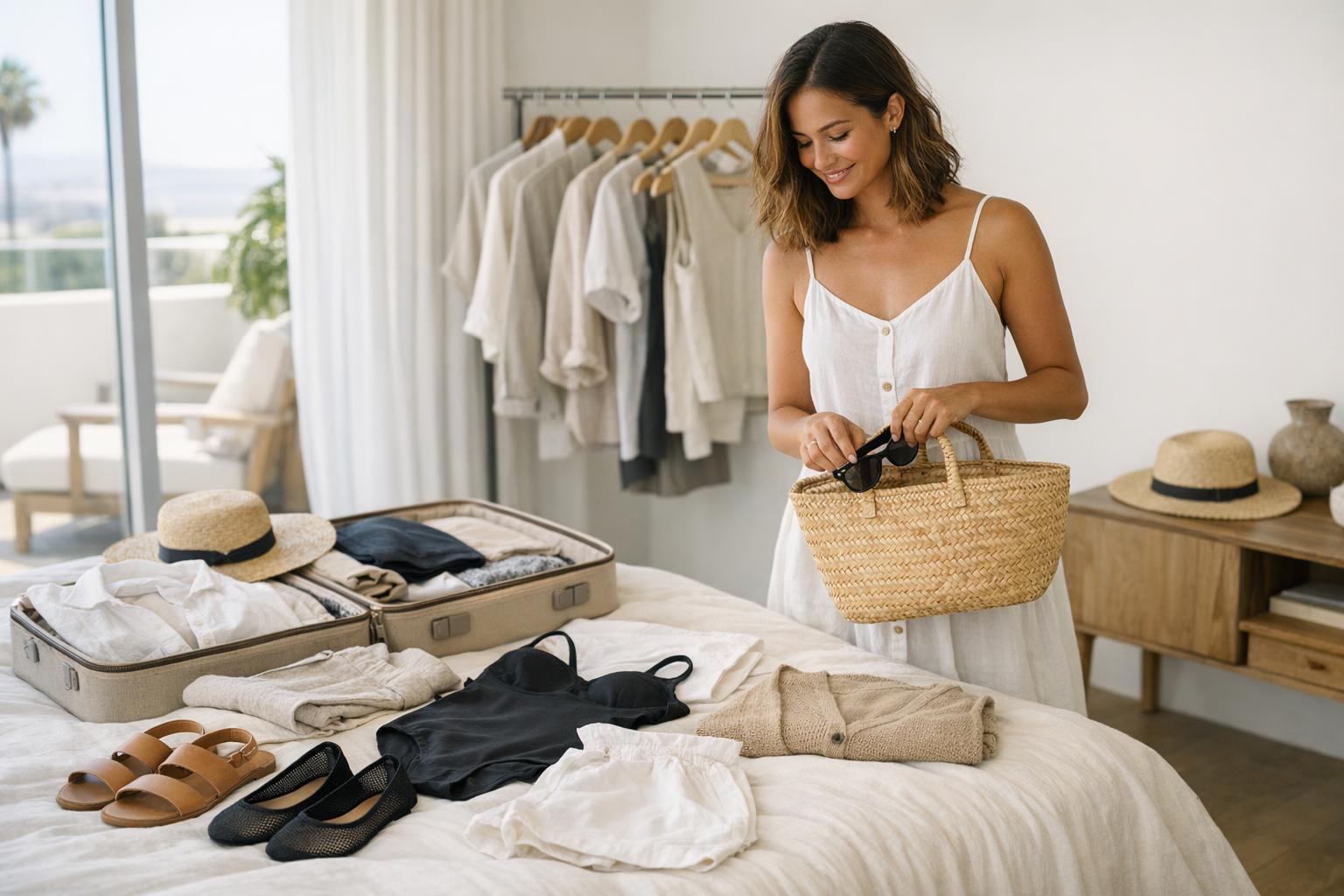
The Ultimate Summer Capsule Wardrobe: a 20–35 Piece, Mix-and-Match System for Hot Weather
A summer capsule wardrobe is a curated set of warm-weather essentials designed to mix and match effortlessly, so you can get dressed faster, pack lighter, and still feel like you have plenty of outfit options. Instead of chasing a closet full of “maybes,” you build a small, breathable, versatile lineup—think linen shirts, cotton tees, a versatile sundress, lightweight shorts or pants, and a reliable pair of summer sandals—then repeat outfit formulas with small styling shifts.
Most guides land in one of two directions: an aspirational edit of essentials (like the 12-item approach popularized by fashion magazines) or a practical, budget-conscious set (like a 9-piece framework built around pieces such as a raffia bag, button-down shirt, linen pants, and a white dress). The best approach for U.S. summer life usually sits between these: a core of roughly 20–35 pieces (plus shoes and a few accessories) that covers your real schedule—workdays, weekends, travel, and events—without forcing you to overbuy.
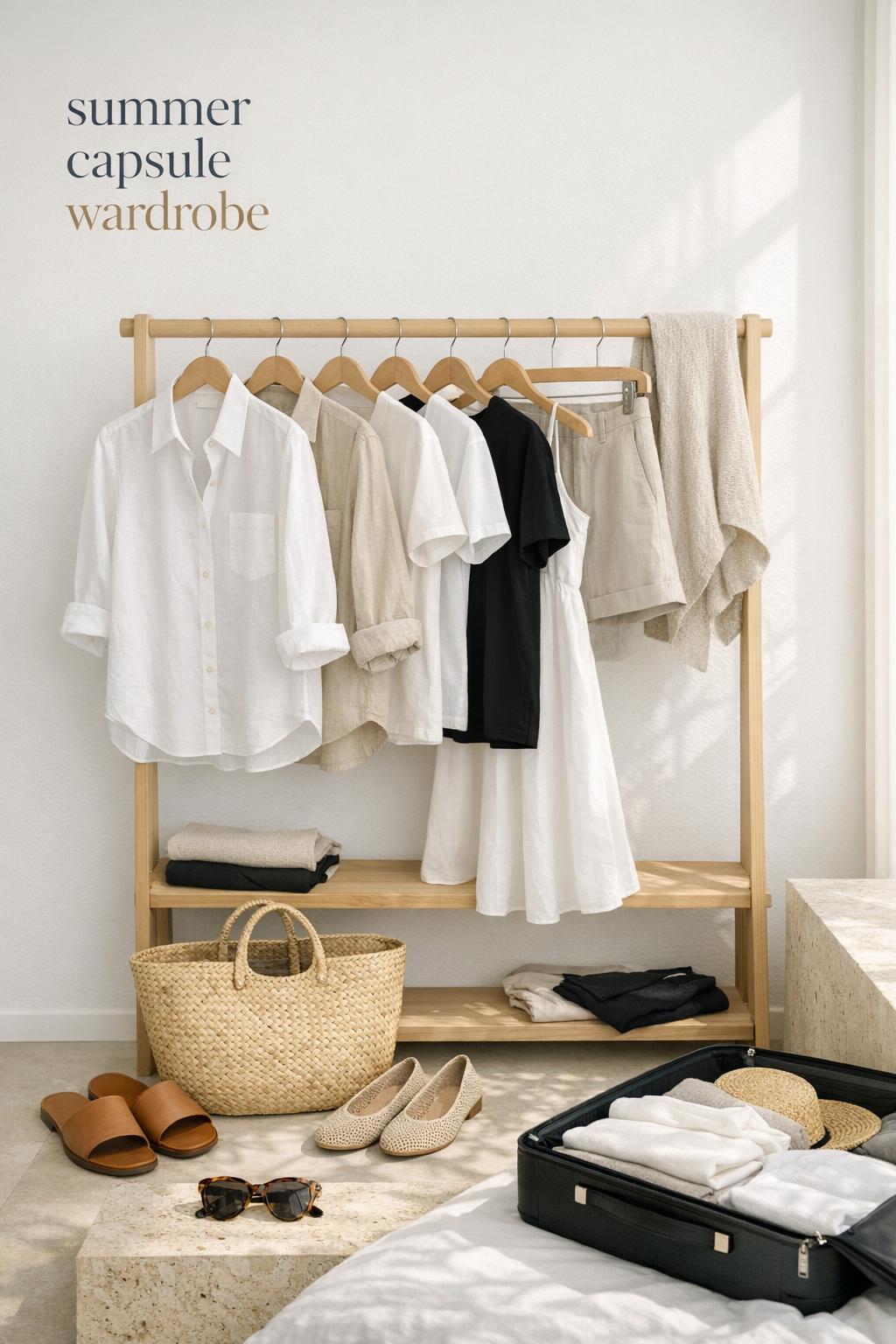
This guide walks you through a complete build: how to define your capsule wardrobe for hot weather, how many pieces to aim for, how to pick breathable fabrics like linen, cotton, and lyocell/TENCEL blends, how to set a cohesive palette, and how to use repeatable outfit formulas. Along the way, you’ll see how both luxury-leaning and budget-friendly strategies can work—whether your anchor items come from brands like Eres, Nili Lotan, Everlane, Prada, Loewe, Ray-Ban, Dragon Diffusion, Birkenstock, Totême, The Row, Frame, Mango, Zara, H&M, Madewell, or COS, or you simply shop your own closet first and fill gaps intentionally.
Why a Capsule Wardrobe Makes Summer Fashion Easier
Summer dressing has a specific set of problems: heat, humidity, travel, more social events, and (for many) less tolerance for “fussy” outfits. A capsule wardrobe reduces friction by making sure your pieces are interchangeable. When your button-up works with your shorts, your linen pants, and over your swimsuit, you stop wasting time trying to rescue “orphan” items that only match one look.
It also brings consistency to your style. Whether you lean classic-minimal or more playful, a capsule makes the through-line obvious: repeated silhouettes, compatible colors, and fabrics that actually perform in hot weather. This is why editors and stylists often focus on categories like seamless sundresses, breezy button-ups, staple swimsuits, practical shorts, and summer sandals—these become the backbone of outfits that can be dressed up or down with minimal effort.
Benefits you’ll notice immediately
- Less decision fatigue because your tops, bottoms, dresses, and shoes already “agree”
- More outfits from fewer items through repeatable mix-and-match combinations
- Better comfort by prioritizing breathable fabrics (linen, cotton, and lyocell/TENCEL blends)
- Smarter shopping: you buy based on gaps and versatility, not impulse
That said, a capsule isn’t automatically “better” for everyone. If you love a highly trend-driven closet or you need very different dress codes week to week, you may prefer a capsule core plus a small rotation of add-ons. The point is usefulness: a system that fits how you actually live in summer.
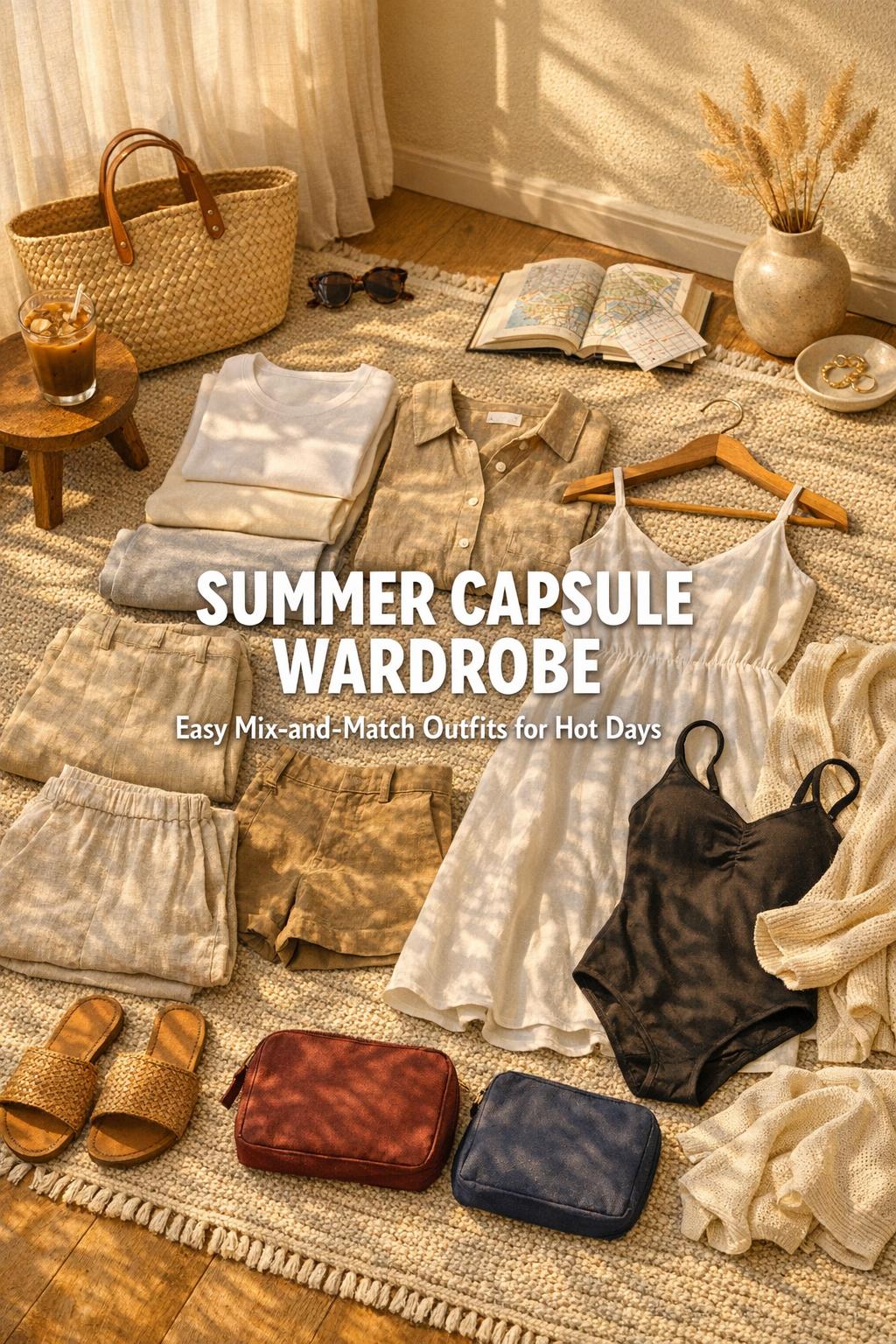
What a Summer Capsule Wardrobe Is (and What It Is Not)
At its simplest, a summer capsule wardrobe is a limited collection of warm-weather pieces chosen for breathability, comfort, and compatibility. It’s typically organized around a consistent color story and a small set of silhouettes—so you can repeat outfit formulas without repeating the exact same outfit.
It is not a rigid rulebook that forces you into an arbitrary number of items. Some capsules are built as a compact edit (like a 9-piece summer capsule wardrobe for every budget). Others are structured as “essentials lists” that highlight around 12 must-haves, often supported by specific examples—like a great sundress, a button-up, a swimsuit, shorts, sunglasses, a bag, and sandals. A practical guide often lands on a broader range (about 20–35 core pieces) because real summer life usually involves multiple contexts: weekends, errands, dinners, travel, and sometimes workwear.
It’s also not limited to one aesthetic. A capsule can be polished and luxury-leaning (think Totême or The Row for sandals, Prada or Loewe in the accessory orbit, Eres for swim, or Dragon Diffusion as a bag reference), or budget-driven and trend-aware (like Mango, Zara, H&M, Madewell, COS, or FRAME). The common denominator is the system: pieces chosen to function together.
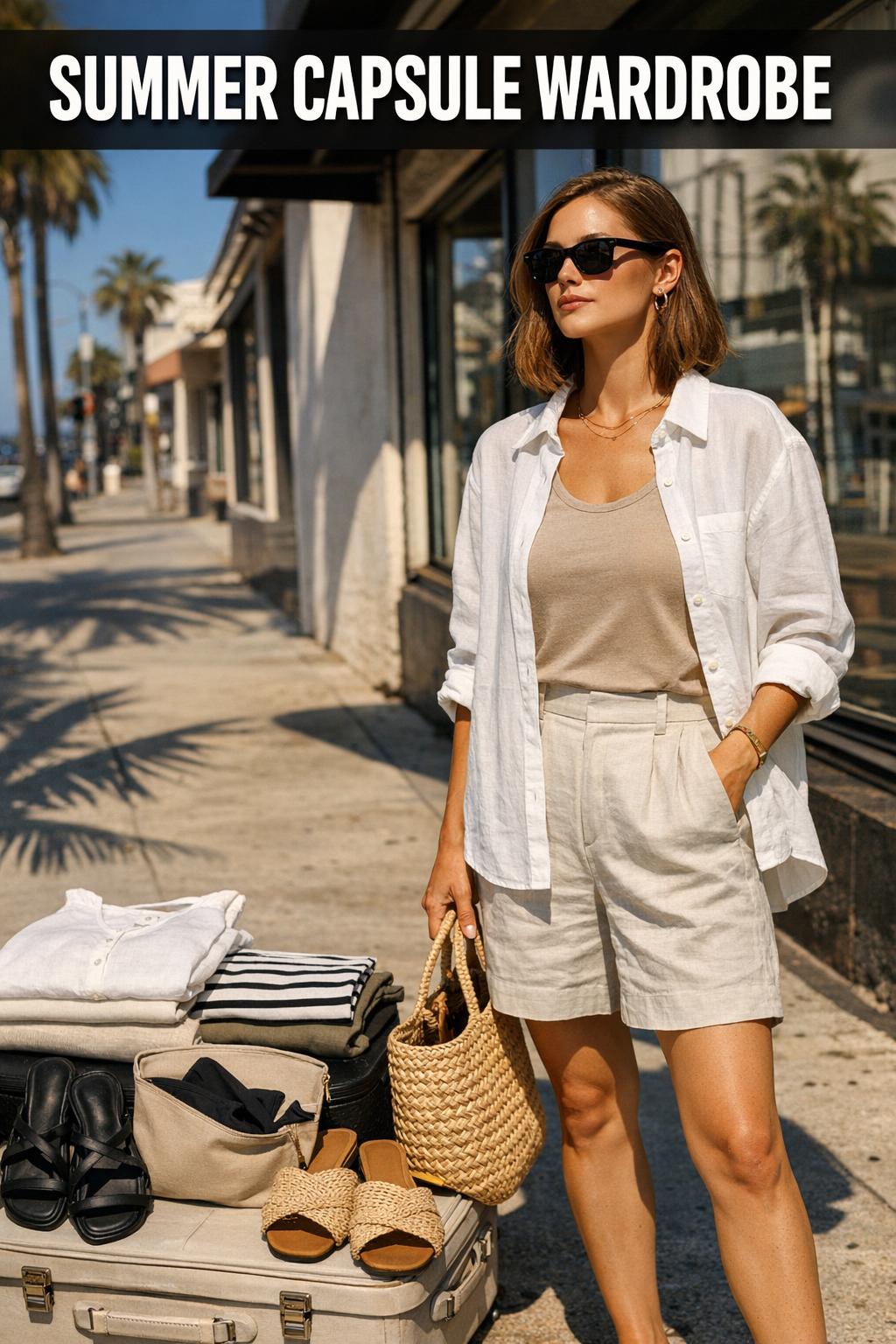
Plan Around Your Real Summer Life (The “Week in Summer” Exercise)
The fastest way to build a capsule that fails is to build it around an imaginary lifestyle. Before you count pieces or shop, map your real week. This is where capsule wardrobes become practical instead of aspirational: you’re matching the wardrobe to the demands of your life—work, social plans, travel, and climate—rather than forcing your life to match the wardrobe.
How to map your week
- List 7 days and write what you actually do: office days, remote work, commuting, errands, weekends, dinners, travel days
- Note your most common summer “event types”: casual, polished casual, swim/pool, and any dressier moments
- Decide your dominant footwear reality: lots of walking, driving, or indoor/outdoor changes
- Make a quick climate note: is your summer more coastal, urban heat, or dry desert?
Once you have that, you can assign outfit formulas to each scenario. For example, if you have three office days and you prefer a cleaner, tailored look, it makes sense to include a mix-and-match workwear mini-capsule approach—similar in spirit to a coordinated set like Spanx’s WellSuited collection (tailored blazer, wide-leg pant, pencil skirt, tailored vest, and a sleeveless crewneck mini dress). If you’re mostly in casual settings, your “workwear” might simply be a crisp button-down shirt plus lightweight pants and sandals.
Tip: If your week includes frequent swim time or travel, elevate swimwear from “extra” to “core.” Capsule lists that treat swimsuits as a foundational category reflect how often swimwear acts as a base layer in summer—paired with shorts, a breezy button-up, and sandals.
How Many Pieces Do You Really Need?
There’s no single correct number, but a practical range that shows up in capsule planning is about 20–35 core pieces, plus footwear and outer layers. Smaller edits (like 9-piece or 12-essential wardrobes) can work well if your lifestyle is consistent and casual or if you’re building a travel capsule. A larger core is often more realistic for U.S. summers, where a single season can include city heat, air-conditioned interiors, weekend trips, and varied social plans.
A decision guide for your piece count
- Choose closer to 20 if you work remotely, repeat outfits happily, and have a consistent dress code
- Choose closer to 35 if you need more variety across work, social events, and travel
- Use a smaller “essentials” list (9–12 items) as your core anchors, then add supporting pieces only when they increase combinations
A useful way to keep the count honest is to focus on interchangeability. If a piece doesn’t work with at least three other items in your capsule, it often becomes an “orphan,” which breaks the promise of a capsule wardrobe for hot weather: effortless mixing and matching.
Fabric First: Breathable Materials That Perform in Summer
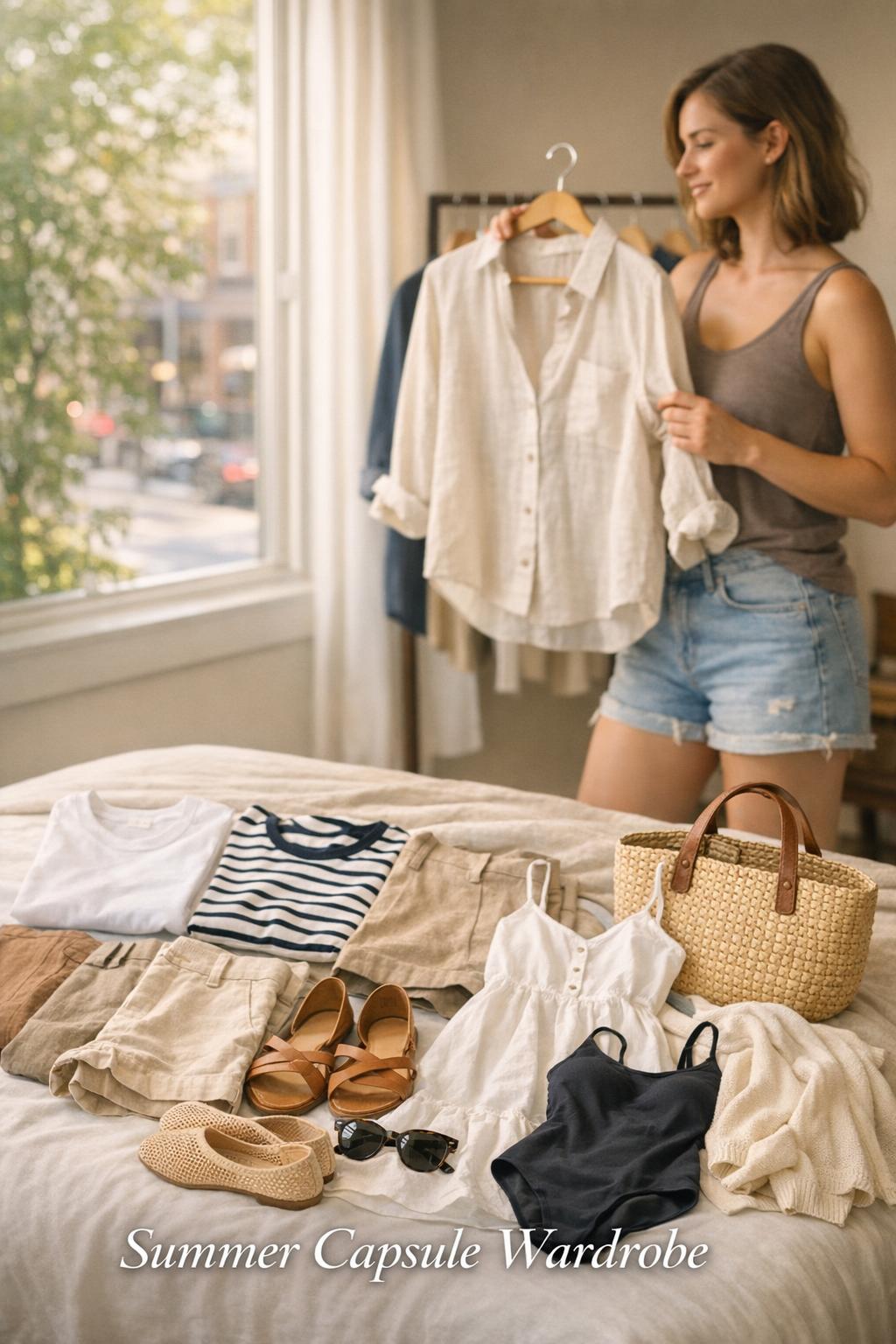
Summer capsules succeed or fail on fabric. Breathable fabrics show up repeatedly in strong capsule guidance because they affect comfort, polish, and how often you’ll actually reach for a piece. Linen and cotton are staples for a reason, and lyocell/TENCEL blends are often mentioned as a breathable option that drapes well for warm-weather silhouettes.
The core summer fabric trio
- Linen: ideal for breezy button-ups, light pants, and relaxed tops
- Cotton: dependable for breathable cotton tees, sundresses, and everyday layers
- Lyocell/TENCEL blends: useful for lightweight pieces that need a softer drape
Fabric also influences how “capsule-ready” an item is. A crisp button-down in a breathable weave functions as an overshirt at the beach, a top with shorts, and a light layer over a dress. Similarly, lightweight pants (linen or breathable blends) can flex between casual and more polished looks depending on your sandals and accessories.
Tip: When you’re deciding between two similar pieces, choose the one you can imagine wearing on the hottest day you still need to look presentable. In real life, that’s often the difference between a capsule you love and a capsule that looks good on paper but sits untouched.
Palette and Patterns: Build a Cohesive Color Story
A cohesive palette is what turns a pile of summer clothes into a capsule wardrobe. The simplest structure is a neutral base plus 1–2 accent colors, anchored by one print family. This approach supports the central capsule goal: mix-and-match summer clothes without constant second-guessing.
A practical capsule palette framework
- Two neutrals as your base (so tops and bottoms are easy to combine)
- Two accents for personality (so your wardrobe doesn’t feel repetitive)
- One print family that works across categories (so it coordinates naturally)
This is where luxury and budget capsules often look similar from a distance: both rely on repeatable colors and shapes. Whether your sunglasses are Ray-Ban or your sandals are Birkenstock, or you choose a raffia bag style like the ones frequently highlighted in budget-friendly capsules, the palette is what makes everything look intentional.
Tip: If you find yourself tempted by lots of single-purpose colors, set a “compatibility test”: if the color doesn’t work with your chosen neutrals and at least one accent, it’s likely to become an orphan piece.
The Core Set: Tops, Bottoms, Dresses, Layers, Shoes, and Accessories
A complete summer capsule wardrobe is easiest to build by category. Many editors present an “essentials list” (often around 12 items), while more practical wardrobe planners lean into broader totals that still stay streamlined. A helpful middle path is to choose a category breakdown that matches the 20–35 piece reality, but keep the “essential” categories at the center: seamless sundresses, breezy button-ups, staple swimsuits, practical shorts, summer sandals, and a reliable bag.
Tops (aim for 7–12)
Tops do the heavy lifting in summer capsules because they’re the easiest way to change the look of the same bottoms. Strong capsule guidance often emphasizes a top edit that includes breathable staples like linen shirts and tops, button-down shirts, and cotton tees. A breezy button-up is especially powerful: it works open as a light layer, tucked for polish, or thrown over a swimsuit.
- Breezy button-ups (a category often highlighted for maximum versatility)
- Breathable cotton tees for repeat wear
- A warm-weather “going out” top such as a halter top (common in smaller, budget-forward capsules)
- Optional: a lightweight knit or simple top that pairs with skirts or tailored bottoms
Brand examples show how this plays out across budgets: a button-up might come from Everlane or Nili Lotan in a more elevated edit, or from Mango, Zara, H&M, COS, or Madewell in a budget-conscious build. The key is not the label—it’s whether the top integrates with the rest of your capsule colors and silhouettes.
Bottoms (aim for 4–8)
Bottoms create your outfit structure. The capsule sweet spot is a small selection of lightweight shorts or pants, plus one to two more “statement” silhouettes that still function as neutrals. Capsule lists frequently include practical shorts (sometimes framed as “not-so-short shorts”) and light pants like linen pants for breathability.
- Lightweight shorts (easy with tees, button-downs, and swim)
- Linen pants (a common capsule staple for comfort and polish)
- An optional trend-leaning staple like capri pants (often featured in compact, budget-aware capsules)
- Optional: a midi/maxi skirt for an easy dress-up option (also common in 12-piece capsule frameworks)
If your summer includes office days, you can borrow from mix-and-match workwear capsule thinking: a pencil skirt and wide-leg pant can extend your outfit range without adding many pieces, especially when paired with a consistent top palette. This is the same logic behind coordinated workwear collections built around interchangeable items like a tailored blazer, tailored vest, and streamlined dress.
Dresses and one-pieces (aim for 3–6)
Dresses are often the quickest route to looking “done” in summer. Many capsule essentials lists prioritize seamless sundresses because they solve multiple scenarios: casual daytime, dinner, and even travel. A versatile sundress also reduces the need for additional separates when the weather is at its hottest.
- A versatile sundress you can dress up or down
- A white dress (frequently highlighted in minimal summer outfit edits)
- Optional: a simple mini dress silhouette for polished ease (like a sleeveless crewneck mini dress in a workwear capsule context)
- Optional: dresses in breathable fabrics that suit your climate and activity level
In more aspirational capsules, editors sometimes point to specific dress examples (with brands like Ulla Johnson, Matteau, Merlette, Asceno, Hill House, and Esse Studios) to illustrate the range of silhouettes that still function as capsule pieces. Even if you’re not shopping those labels, the takeaway is useful: choose dresses that coordinate with your sandals and bag, and that can be layered with a button-up or lightweight cardigan.
Swimwear (1–2 staple swimsuits)
A staple swimsuit belongs in many summer capsules, not only for vacations but because swimwear often doubles as the base of an outfit: swimsuit plus shorts, or swimsuit under a breezy button-up. Editorial capsule lists regularly call out swim as a core category, and brand examples like Jade Swim, Eres, and Matteau show how swim can be treated as a true “wardrobe” item rather than a one-off purchase.
Tip: Treat your swimsuit like a bodysuit in terms of coordination. If it works with your shorts, your linen pants, and your overshirt, it earns its place in the capsule.
Layers (2–4 lightweight layers)
Even in hot weather, layers matter—especially in air-conditioned indoor spaces, evenings, or travel days. Capsule guidance often includes lightweight cardigans or dusters, and button-ups also function as a key layer. The goal isn’t warmth; it’s flexibility and comfort without needing bulky outerwear.
- A lightweight cardigan or duster for indoor AC and evenings
- A breathable button-up to use as a shirt or layer
- Optional: a light layer that matches your palette and works over dresses
Shoes (3–5 pairs that cover your real walking life)
Footwear can quietly make or break a capsule. Many summer capsules center on summer sandals because they pair with shorts, dresses, and pants. Depending on your preferences, sandals can lean minimalist and elevated (as in some luxury edits featuring Totême or The Row) or practical and comfort-first (with Birkenstock as a common reference point). Some capsules also incorporate mesh flats to bridge casual and slightly dressier looks without adding heels.
- Everyday sandals (the cornerstone summer shoe)
- An alternate flat option (often a mesh flat style in compact capsules)
- Optional: a “dressier” sandal silhouette for dinners or events
Tip: When in doubt, choose shoes that match your most repeated outfit formula. If most of your looks are tee + shorts or button-up + linen pants, your everyday sandal choice matters more than a special-occasion pair you rarely wear.
Bags and accessories (2–4 essentials)
Accessories are where you can refresh looks without expanding your closet. Capsule content often spotlights a single versatile bag—like a woven leather style from Dragon Diffusion in an aspirational wardrobe, or a raffia bag in a budget-friendly capsule—because texture reads summery and pairs well with simple clothing. Sunglasses also show up as a repeat essential, with Ray-Ban as a recognizable reference point.
- One everyday bag (raffia or woven textures often fit summer capsules well)
- Sunglasses that work with your wardrobe (Ray-Ban is a common example entity)
- Optional: a sun accessory such as a hat (often implied in summer capsule accessory ecosystems)
The Capsule Outfit Formula: 6–8 Repeatable Templates
The fastest way to make your summer capsule wardrobe feel bigger is to rely on outfit formulas. Formulas are simply repeatable templates that you can run on autopilot—switching fabrics, colors, or accessories to create new combinations without reinventing the wheel. Practical capsule guides frequently include outfit formulas because they connect the abstract “capsule concept” to real mornings and real plans.
Everyday formulas you can reuse all season
- Breathable cotton tee + lightweight shorts + summer sandals
- Breezy button-up (tucked) + linen pants + sandals
- Breezy button-up (open) + swimsuit + shorts
- Versatile sundress + sandals + sunglasses
- White dress + mesh flats (or sandals) + a textured bag
- Halter top + capri pants + minimal sandals
- Midi/maxi skirt + cotton tee + sandals
- Lightweight cardigan/duster over a dress for evenings or indoor AC
These templates work because they’re built from categories that appear again and again in strong capsule guidance: tees, button-down shirts, linen pants, shorts, sundresses, and practical shoes. Once you identify your top three formulas, you can use them as your shopping filter: only buy new items if they improve these formulas or add a new scenario you truly need.
Tip: If you want the capsule to feel more polished without adding more pieces, adjust the “finishing items,” not the outfit core. A consistent pair of sunglasses and a reliable bag can do more to unify your look than adding another top in a random color.
How to Build It on a Budget (Without Sacrificing Versatility)
Budget-friendly capsules work best when they copy the structure of elevated ones: fewer categories, more compatibility, and strategic emphasis on staples. Many accessible capsule edits use recognizable retailers (Mango, Zara, H&M, Madewell, COS, and FRAME) to show that you can build a cohesive set without leaning on luxury price points. The trick is to buy intentionally: you’re building a system, not collecting individual items.
Practical shopping rules for a budget capsule
- Shop your closet first and identify gaps (especially in breathable tops and versatile bottoms)
- Buy for the outfit formulas you’ll repeat, not for one-off occasions
- Avoid “orphan” pieces that don’t match your palette or don’t pair with at least three other items
- Prioritize fabric comfort in key items you’ll wear weekly: tees, button-downs, linen pants, and your main sandals
Budget also benefits from a smaller “mini-capsule” approach: start with a 9-piece core (button-down shirt, linen pants, a white dress, a halter top, capri pants, a raffia bag, mesh flats, and other staples in that spirit), then add only what your week-in-summer map proves you need. This keeps the capsule lean and reduces regret purchases.
Tip: If you’re deciding where to spend a bit more, focus on the pieces that touch the most outfits: an everyday sandal, a breathable button-up, and a pair of pants or shorts that fit perfectly. These are the items you’ll wear on repeat—and the ones that make the entire capsule feel better.
Keeping It Fresh Without Expanding Your Closet
A capsule wardrobe isn’t about wearing the exact same outfit all summer; it’s about controlling the variables so you can create variety without chaos. The most reliable refresh strategies don’t require buying more clothes—they rely on rotation, layering, and small styling shifts.
Low-effort refresh strategies
- Rotate your top silhouettes: tee one day, button-up the next, halter for an evening plan
- Use your button-up as both a top and a layer over swim or dresses
- Swap footwear to change the mood: sandals vs mesh flats
- Change your bag texture: woven/raffia style for day, a more structured option for polished looks
Care and maintenance also matter. Breathable fabrics like linen and cotton are capsule favorites partly because they’re wearable and repeatable; when you take care of them, you can rely on them week after week. A capsule wardrobe is only as good as its readiness—pieces you avoid because they feel fussy or uncomfortable aren’t doing their job.
Tip: If your capsule starts feeling stale, change only one variable at a time. For instance, keep your favorite linen pants and sandals, but swap a cotton tee for a breezy button-up. Small changes keep the wardrobe cohesive while still feeling new.
Common Capsule Mistakes (and How to Fix Them)
Most capsule problems aren’t caused by having “the wrong style.” They’re caused by mismatched planning: buying pieces that don’t fit your climate, your schedule, or your outfit formulas. When you troubleshoot a capsule, look for where the system breaks—usually in fabrics, palette, or footwear comfort.
Mistake: Buying “fantasy life” pieces
If your capsule is full of dressy items but your week is mostly errands and casual plans, the wardrobe will feel unusable. Fix it by returning to the week-in-summer map and prioritizing the categories you repeat: breathable tees, lightweight shorts or pants, and your everyday sandals.
Mistake: Ignoring breathable fabrics
Even a beautiful capsule fails if it’s uncomfortable in heat. Fix it by making linen, cotton, and lyocell/TENCEL blends the starting point for the items you wear most often, especially tops and pants. Comfort drives repeat wear, and repeat wear is the whole point of a capsule.
Mistake: Too many colors, not enough coordination
If you’re constantly searching for something that “goes,” your palette may be too scattered. Fix it by narrowing to two neutrals, two accents, and a single print family. This keeps combinations high even when your piece count is modest.
Mistake: Underestimating shoes and accessories
When your shoes don’t match the capsule’s vibe—or they’re not realistic for walking—your outfits feel off. Fix it by choosing 3–5 footwear options that align with your most common activities, and add a reliable bag and sunglasses to unify outfits. This is why items like summer sandals, a raffia bag, and Ray-Ban-style sunglasses appear repeatedly across capsule edits.
Regional Variations: Coastal vs Urban vs Desert Summer Capsules
Even within the U.S., “summer” can mean different things. Capsule guidance often mentions the importance of aligning with real conditions, and adapting your capsule to your dominant environment is one of the most practical upgrades you can make. The goal is to keep the core logic the same—breathable fabrics, mix-and-match categories, and outfit formulas—while adjusting what you emphasize.
Coastal-focused capsule priorities
If you’re coastal, swim often functions as a core layer. A staple swimsuit (or two) becomes as important as shorts, and breezy button-ups become the workhorse layer you throw over swim or wear to lunch. Textured bags like raffia or woven leather styles fit naturally into this ecosystem, and sandals that can handle sand-to-street transitions often matter more than dress shoes.
Urban summer capsule priorities
In urban heat, polish and comfort have to coexist—especially if you’re moving between outdoor heat and indoor air-conditioning. This is where lightweight pants (linen pants, wide-leg silhouettes) and breathable tops shine. A simple layer like a lightweight cardigan or duster earns its keep for indoor spaces, and a coordinated mini workwear capsule approach can be helpful if you have office days (the mix-and-match logic seen in tailored items like blazers, vests, and pencil skirts translates well).
Desert summer capsule priorities
In dry, intense heat, breathable fabrics still lead, but coverage choices may shift. You may lean harder on breezy button-ups and lightweight long pants instead of very short shorts, simply because they can feel more comfortable in constant sun while staying airy. The capsule still centers on the same essentials—tops that breathe, bottoms that work with multiple shoes, and a small accessory set that finishes outfits.
Case Study: A Polished Mix-and-Match Capsule in Action
One of the clearest real-world demonstrations of capsule thinking is a coordinated workwear mini-wardrobe: a small set of tailored pieces designed to be combined repeatedly. A collection like Spanx WellSuited is a straightforward example of this concept in action, with interchangeable items such as a tailored blazer, tailored vest, pencil skirt, wide-leg pant, and a sleeveless crewneck mini dress. The capsule logic is simple: each top works with each bottom, and the dress functions as a one-step outfit.
Now translate that to summer beyond the office. Imagine a week that includes two office days, one dinner, a weekend trip, and one swim day. A capsule built around breathable button-ups, cotton tees, linen pants, practical shorts, a versatile sundress, staple swim, summer sandals, and a single cohesive bag/sunglasses set can cover all of it. The “workwear” pieces don’t have to be formal; they just have to coordinate. That’s the real lesson: capsule wardrobes work when they’re engineered like a set, not collected like souvenirs.
For those who prefer a more editorial, timeless aesthetic, capsule narratives sometimes reference iconic minimal styling cues associated with figures like Carolyn Bessette Kennedy. The value of that kind of inspiration isn’t about copying a person; it’s about using a clear style North Star—clean lines, consistent palette, and repeatable essentials—so your summer wardrobe staples feel cohesive.
Quick-Start Checklist and a 7-Day Summer Plan
If you want to start today, you don’t need to perfect your entire closet. Build a minimum viable summer capsule wardrobe first, then refine. The goal is immediate usability: enough pieces to cover a full week with multiple outfit formulas, using breathable fabrics and a consistent palette.
Quick-start checklist (shop your closet first)
- 1–2 breathable cotton tees
- 1 breezy button-up
- 1 lightweight short
- 1 pair of linen pants (or another lightweight pant)
- 1 versatile sundress or white dress
- 1 staple swimsuit (if swim is part of your real summer life)
- 1 lightweight layer (cardigan/duster or an extra button-up)
- 1 everyday sandal
- 1 bag (raffia/woven or a simple neutral)
- 1 pair of sunglasses
A realistic 7-day plan using outfit formulas
Run your week on repeatable templates: Day 1 tee + shorts + sandals; Day 2 button-up + linen pants + sandals; Day 3 sundress + sandals + sunglasses; Day 4 button-up (open) over swimsuit + shorts; Day 5 tee + midi/maxi skirt + sandals; Day 6 white dress + mesh flats (or sandals) + textured bag; Day 7 lightweight layer over a simple outfit for evening or indoor AC. As you wear these looks, you’ll quickly see what’s missing: maybe you need an alternate shoe, a second breathable top, or a better layer. That real-world feedback is how capsules become personal and reliable.
Tip: Keep your first upgrade small: add one piece at a time, only after you’ve worn the capsule for a week. This prevents you from recreating the same closet clutter you’re trying to escape.
FAQ
What is a summer capsule wardrobe?
A summer capsule wardrobe is a curated collection of warm-weather essentials chosen to mix and match easily, typically emphasizing breathable fabrics (like linen, cotton, and lyocell/TENCEL blends) and versatile categories such as button-down shirts, tees, lightweight shorts or pants, sundresses, and summer sandals.
How many pieces should a summer capsule wardrobe have?
There isn’t a single correct number, but many practical approaches work well with roughly 20–35 core pieces plus shoes and a few accessories; smaller edits like 9-piece or 12-essential lists can work if your lifestyle is consistent or you’re building a tight travel-focused capsule.
What are the best fabrics for a capsule wardrobe for hot weather?
Breathable fabrics are central to summer capsules, with linen and cotton repeatedly prioritized for comfort and repeat wear, and lyocell/TENCEL blends often included as a breathable option that can offer a softer drape for warm-weather silhouettes.
What are the most important summer wardrobe staples to include?
Common core staples include a breezy button-up, breathable cotton tees, lightweight shorts or pants (often including linen pants), a versatile sundress or white dress, a staple swimsuit if you swim, summer sandals, and a small set of accessories like a reliable bag (raffia or woven styles are common) and sunglasses such as Ray-Ban-style frames.
How do I build an affordable summer capsule wardrobe?
Start by shopping your closet, then fill only true gaps with versatile pieces that support repeatable outfit formulas; budget-friendly capsules often use accessible retailers like Mango, Zara, H&M, Madewell, and COS while keeping the same capsule structure of coordinated colors, breathable fabrics, and items that pair with multiple outfits.
What are “outfit formulas,” and why do they matter?
Outfit formulas are repeatable templates (like tee + shorts + sandals or button-up + linen pants + sandals) that help you get more combinations from fewer items; they’re useful because they turn a capsule wardrobe from a list of pieces into a practical system you can rely on daily.
How can I keep my capsule fresh without buying more clothes?
Use small, intentional changes—rotate tops, wear a button-up as both a shirt and a light layer, switch between sandals and flats, and vary accessories like your bag and sunglasses—so outfits feel different while the underlying capsule stays cohesive and manageable.
How do I avoid “orphan” pieces in a summer capsule?
Choose a clear palette (neutrals plus a couple of accents and a print family) and test each potential item against your existing capsule; if it doesn’t match your colors and doesn’t work with at least three other pieces, it’s likely to become an orphan that reduces mix-and-match flexibility.
Can a summer capsule include workwear?
Yes—many people benefit from a small mix-and-match workwear mini-capsule within their summer wardrobe, using interchangeable pieces (such as a tailored blazer, wide-leg pant, pencil skirt, tailored vest, or a simple dress) alongside breathable summer staples so the wardrobe covers both office and off-duty days.
Leave a Reply